Every successful interview starts with knowing what to expect. In this blog, we’ll take you through the top Scheming and Play Calling interview questions, breaking them down with expert tips to help you deliver impactful answers. Step into your next interview fully prepared and ready to succeed.
Questions Asked in Scheming and Play Calling Interview
Q 1. Describe your approach to developing a game plan.
Developing a game plan is a multi-faceted process that begins with a thorough understanding of our team’s strengths and weaknesses, as well as a deep dive into the opponent’s tendencies and personnel. It’s not just about picking plays; it’s about constructing a narrative that unfolds throughout the game.
- Film Study: We meticulously analyze the opponent’s recent games, focusing on their defensive formations, tendencies on specific downs and distances, and individual player strengths and weaknesses. This helps us identify exploitable matchups.
- Self-Scouting: We also critically evaluate our own performance, identifying successful plays and plays that need improvement or adjustment. This keeps us honest and helps fine-tune our approach.
- Game-Plan Construction: Based on this analysis, we construct a plan that emphasizes our strengths while minimizing our weaknesses against the opponent’s defensive schemes. This includes setting up specific situations later in the game, such as third down, through carefully selected early-down calls.
- Contingency Planning: The game plan also includes contingencies for different scenarios. What if they stack the box? What if they bring extra blitzers? We have answers prepared.
Think of it like chess – we’re not just planning our next move, we’re anticipating their responses and planning several moves ahead.
Q 2. Explain your philosophy on offensive scheming.
My offensive philosophy centers around creating balance and exploiting mismatches. We aim for a diverse attack that keeps the defense guessing, preventing them from settling into a rhythm. We’re not locked into a specific style; rather, we adapt based on what the defense gives us.
- Balance: A balanced attack, incorporating both the run and the pass, is crucial. This keeps the defense honest and prevents them from stacking the box or playing pass-heavy coverage.
- Tempo Control: Managing the tempo of the game is important. Sometimes a fast-paced attack can overwhelm a defense; other times, a slower, more deliberate approach can be more effective. We choose the tempo that best suits the situation and the opponent.
- Exploiting Mismatches: We continuously look for opportunities to exploit matchups. If we have a superior receiver against a weaker cornerback, we’ll look to target that matchup repeatedly.
For example, if our running game is highly successful early, we might leverage that success to set up play-action passes that exploit the defense’s over-commitment to the run.
Q 3. How do you adapt your play calling based on opponent tendencies?
Adapting to opponent tendencies is paramount. We use our film study to identify patterns in the opponent’s defense. This allows us to adjust our play calling accordingly.
- Identifying Tendencies: Does the defense consistently play zone coverage? Do they blitz on specific downs? Do they favor certain fronts?
- Countermeasures: Once we identify these tendencies, we tailor our play calls to counter them. For example, if they consistently play zone, we might use plays designed to stretch the field and attack the seams. If they blitz frequently, we might use quick passes or run plays to get the ball out quickly.
- In-Game Adjustments: We don’t just rely on pre-game analysis. We make in-game adjustments based on what we see. If a specific play isn’t working, we’ll take it out of the playbook. If something is consistently successful, we’ll keep doing it.
Imagine a defense that plays man coverage frequently. We can exploit this by using quick slants to get the ball to our receivers before the defensive backs can jam them at the line of scrimmage.
Q 4. What are your preferred offensive formations and why?
Our preferred offensive formations are highly dependent on personnel and game situation. However, we favor formations that offer versatility and allow us to easily switch between run and pass plays.
- 11 Personnel (1 RB, 1 TE, 3 WR): This is a very common and versatile formation. It allows us to run or pass effectively, depending on the situation. It’s a good balance of both.
- 21 Personnel (2 RB, 1 TE, 2 WR): This formation is more run-heavy, favoring power running plays. We use this when we want to establish the run or control the clock.
- 12 Personnel (1 RB, 2 TE, 2 WR): This formation often features tight ends that are capable blockers and receivers, giving us flexibility in both run and pass concepts.
The choice of formation isn’t arbitrary; it’s a strategic decision based on the down and distance, the opponent’s defensive alignment, and the personnel on the field.
Q 5. How do you utilize pre-snap reads in your play calling?
Pre-snap reads are vital. They allow us to adjust our play calls based on the opponent’s defensive alignment before the snap, maximizing our chances of success.
- Defensive Alignment: We look for tells in the defensive alignment. Is the defense showing a blitz? Are they in a zone or man coverage? Are they showing extra defenders in the box?
- Personnel Grouping: The number of defensive backs, linebackers and defensive lineman on the field can reveal their defensive intention.
- Adjustments: Based on our pre-snap reads, we can make adjustments to our play call. We might choose a different play entirely, or we might simply audible to a variation of the original play.
For example, if we see an extra linebacker creep up close to the line of scrimmage, indicating a likely blitz, we could adjust to a quicker pass play to avoid the pressure.
Q 6. Describe your process for evaluating the effectiveness of your plays.
Evaluating the effectiveness of our plays is an ongoing process that relies on both quantitative and qualitative data.
- Statistical Analysis: We look at standard statistics like yards gained, first downs achieved, and points scored. We also analyze advanced metrics like expected points added (EPA) to gain a deeper understanding of play efficiency.
- Film Review: We meticulously review game film to identify the reasons behind successes and failures. This might involve looking at player execution, defensive responses, or even the effectiveness of our blocking schemes.
- Situational Analysis: We consider the context of each play. A successful play in a critical situation holds more value than the same play in a less crucial moment.
- Opponent-Specific Analysis: We analyze how our plays fared against different defensive schemes and personnel groupings to assess their effectiveness against specific opponents.
This comprehensive approach helps us identify patterns and make data-driven decisions in future game planning, helping us refine our offensive strategies for optimum success.
Q 7. How do you incorporate deception and misdirection into your offensive schemes?
Incorporating deception and misdirection is key to keeping defenses off balance. It forces them to react instead of dictating their defensive plays, leading to vulnerabilities we can exploit.
- Motion: Using motion can create confusion and force defenders to react, creating opportunities for running plays or mismatches in coverage.
- Play-Action: Play-action passes use the threat of the run to deceive the defense and open up passing lanes. A well-executed play-action pass can be devastating.
- Shifting Personnel: Shifting receivers before the snap can create mismatches and disguise the intended play.
- Fake Handoffs/Pitches: These create the illusion of a run play before transitioning to a pass.
For example, a play-action pass that looks like a run play initially can leave linebackers and safeties out of position, creating a large window of opportunity for a deep pass. These types of deceptive plays are often called “gimmick” plays and their use is based upon the situation.
Q 8. Explain your defensive scheming philosophy.
My defensive scheming philosophy centers around creating a multiple, adaptable system that leverages our personnel’s strengths while exploiting the opponent’s weaknesses. We strive for balance, seamlessly transitioning between man and zone coverages to keep the offense guessing. This unpredictability is key. We don’t just react; we anticipate. Pre-snap reads are crucial, allowing us to adjust our defensive calls based on the offensive formation and tendencies. This proactive approach minimizes the opponent’s advantage and creates more opportunities for turnovers and negative plays.
For example, against a team known for its run-heavy approach, we might employ a heavier front, using more defensive linemen and linebackers to clog the running lanes and force longer developments. Conversely, against a pass-happy team, we might use more nickel and dime packages, increasing our defensive backs to enhance coverage and blitz opportunities.
Q 9. How do you adjust your defensive game plan based on offensive formations?
Offensive formations are a roadmap to their intended play. We use pre-snap reads to decipher the offense’s likely strategy. For instance, a heavy set, with multiple tight ends, often signals a run play. Conversely, a spread formation, with multiple wide receivers, suggests a pass play. Our response is immediate. A heavy set might trigger a more run-stuffing defensive front, while a spread formation might lead to a more zone-heavy approach to defend against quick passes or a designed blitz to exploit the spread out offensive line.
We also analyze historical data. If an offense consistently runs a specific play from a particular formation, we anticipate it and prepare a counter. This might involve specific player assignments or a strategic shift in our defensive alignment, such as shifting our linebackers or safety to better cover the most likely receiving options.
Q 10. What defensive schemes are most effective against specific offensive styles?
The effectiveness of a defensive scheme hinges heavily on the offensive style. Against a power-running team, a strong 4-3 defense with strong run-stuffing linebackers is usually effective. Against a spread offense that relies heavily on the pass, a nickel or dime package, with additional defensive backs to cover receivers, is usually favored. A team that uses a lot of misdirection and option plays might require a disciplined defense with strong tackling fundamentals and the ability to react quickly to the quarterback’s decision-making.
However, adaptability is key. We might use different schemes within a game. For instance, we may start with a 4-3 base defense and transition to a 3-4 against certain formations or when an offense shows a tendency to attack the edges.
Q 11. How do you manage timeouts effectively during a game?
Timeout management is strategic, requiring anticipation and awareness of game situation and momentum. We use timeouts to stop the clock when we’ve achieved a significant defensive stop, or to preserve time when we have a lead in the closing stages of a game, to help us take advantage of any potential momentum swings.
We also use timeouts to disrupt the offensive rhythm, especially if they’ve found a hot play. A timeout in this situation can provide a moment for our defense to adjust their assignment and re-focus. Conversely, we avoid calling timeouts excessively as this could tire the team and reveal our strategies. It’s a delicate balance between strategic use and conservation.
Q 12. Explain your approach to special teams strategy.
Special teams are often overlooked, but they are a crucial part of the game. We invest significant time and effort in developing specific schemes tailored to our players’ strengths. On punts and kickoffs, our strategy focuses on creating both field position advantage and opportunities for turnovers. Our punt return team emphasizes securing the ball first and then advancing it for additional yardage. Our kickoff coverage unit concentrates on stopping return attempts, while our kickoff return unit aims for strategic returns, avoiding risky situations while making the most out of the opportunity.
Field goal and extra point units undergo rigorous practice to ensure accuracy and timing. We also pay close attention to our opponent’s special teams tendencies, looking for weaknesses we can exploit. For example, we might employ different strategies based on whether the opposition typically favors certain kicks or returns.
Q 13. How do you handle unexpected situations during a game?
Unexpected situations require quick thinking and adaptability. A key injury, a sudden change in weather, or a controversial call—these demand calm and decisive action. Our approach is to first assess the situation calmly, then utilize our existing game plan as much as possible. If adjustments are necessary, we make them swiftly and clearly communicate them to the team.
For example, if a key defensive player gets injured, we’d quickly rotate in a substitute and adjust our defensive scheme to minimize the impact of the loss. We also regularly review and practice for emergency situations, ensuring that players understand their roles and responsibilities in different scenarios.
Q 14. Describe your experience with play calling software.
I have extensive experience using several play-calling software packages. These tools help us to efficiently organize and execute game plans, allowing for seamless adjustments mid-game. The software allows for quick substitutions and helps organize different personnel packages, defensive coverages and formations. It also enables the efficient input and retrieval of previous games’ data, which allows us to analyze opponent tendencies and develop strategic counters for future matches.
However, software is only as effective as the user’s understanding of the game. While the technology streamlines the process, it’s still the coach’s judgment and strategic thinking that remains the heart of game planning and execution. The software is a tool, not a replacement for a solid understanding of strategy and game theory.
Q 15. How do you communicate your play calls effectively to your team?
Effective communication of play calls is paramount. My approach is multifaceted, focusing on clarity, simplicity, and redundancy. I utilize a combination of verbal cues, hand signals, and visual aids (like a whiteboard on the sideline for complex plays).
- Clear Terminology: We establish a concise playbook terminology known and understood by every player. For example, instead of saying “Run left, three yards, tackle eligible,” we might use a code like “Green 33.” This reduces confusion under pressure.
- Visual Confirmation: I always visually confirm that my call has been understood. This involves making eye contact with key players and ensuring they are nodding or otherwise signaling comprehension.
- Redundancy: Critical information is relayed multiple ways. A play might be verbally called, signaled, and even shown on a tablet if needed.
- Practice and Repetition: Consistent practice of play calls during drills ensures quick recognition and execution on the field.
For instance, a quick audible requires a concise signal like a hand gesture combined with a short, easily understood word, such as a number corresponding to a specific backup play.
Career Expert Tips:
- Ace those interviews! Prepare effectively by reviewing the Top 50 Most Common Interview Questions on ResumeGemini.
- Navigate your job search with confidence! Explore a wide range of Career Tips on ResumeGemini. Learn about common challenges and recommendations to overcome them.
- Craft the perfect resume! Master the Art of Resume Writing with ResumeGemini’s guide. Showcase your unique qualifications and achievements effectively.
- Don’t miss out on holiday savings! Build your dream resume with ResumeGemini’s ATS optimized templates.
Q 16. Explain your process for identifying and exploiting opponent weaknesses.
Identifying and exploiting opponent weaknesses is a systematic process. It starts with meticulous film study to analyze tendencies, formations, and individual player performance. We look for patterns, such as predictable blitzes, weak pass coverage on a specific side, or consistent gaps in the run defense. This data-driven approach is crucial.
- Film Study: We dissect game film, breaking down opponents’ tendencies across various situations, noting their performance on first down, third down, and in specific formations.
- Personnel Evaluation: Identifying which players are strong and which are weak helps dictate where we focus our attacks. Are their defensive linemen consistently slow off the snap? Do their cornerbacks struggle with deep routes?
- Pre-game Meetings: We synthesize our findings into a targeted game plan, emphasizing plays designed to exploit those specific weaknesses. This involves tailoring our formations and play selection to attack their vulnerabilities.
- In-game Adjustments: During the game, we continuously monitor the opponent’s reactions to our plays and adapt our strategy accordingly. If a particular play is consistently successful, we continue to utilize it; if it’s unsuccessful, we swiftly adjust.
For example, if film review shows the opposing linebacker consistently over-pursuing the run, we might design a play that involves a quick screen pass to that side, capitalizing on their tendency.
Q 17. How do you evaluate the performance of individual players during a game?
Evaluating individual players during a game is an ongoing process that combines quantitative and qualitative analysis. I focus on both objective metrics and subjective observations.
- Objective Metrics: Statistics like yards gained, tackles made, completion percentages, and sacks are vital. However, context matters; a low completion percentage might be due to great opponent coverage.
- Subjective Observations: I carefully observe effort, technique, decision-making, and execution. Does a player consistently miss tackles despite being in the right position? Does a receiver struggle to run precise routes?
- Game-Specific Context: Account for the specific game situation when evaluating. A player might perform poorly in a high-pressure situation but excel in others.
- Post-Game Reviews: Formal post-game reviews with individual players allow for constructive feedback and identification of areas for improvement.
For example, while a running back might have decent rushing yards, if I observe consistent hesitation and poor decision-making in reading the defensive line, I know that individual areas need addressing.
Q 18. How do you maintain discipline and focus within your team during high-pressure situations?
Maintaining discipline and focus under pressure is crucial. My strategy hinges on preparation, clear communication, and a strong team culture.
- Pre-game Preparation: Extensive practice simulating high-pressure situations helps build confidence and mental resilience. This involves practicing under simulated game conditions with crowd noise and time constraints.
- Positive Reinforcement: Focusing on positive reinforcement, acknowledging good plays and effort, helps maintain morale and reduce stress.
- Timeouts for Adjustments: Utilizing timeouts strategically allows for quick corrections and refocusing the team’s attention.
- Clear Communication: Constant, calm communication during stressful moments minimizes confusion and anxiety. Simple, direct instructions are key.
- Trust and Accountability: Cultivating a strong team culture based on trust and mutual accountability increases resilience under pressure. Each player understands their role and responsibilities.
In critical moments, a simple, reassuring reminder of the game plan and a focus on executing one play at a time can be tremendously effective. Remind them “we’ve practiced this,” or “do your job.”
Q 19. What is your approach to risk management in play calling?
Risk management in play calling is a balancing act between maximizing potential gains and minimizing potential losses. It involves assessing probabilities and potential consequences of each play.
- Situational Awareness: The game situation dictates acceptable risk levels. Going for it on fourth down in our own territory is riskier than in the opponent’s territory. The score, time remaining, and field position all influence the decision.
- Player Personnel: The strengths and weaknesses of our players impact risk assessment. A risky play might be appropriate if we have a highly skilled quarterback, but unwise if he’s prone to interceptions.
- Opponent’s Defensive Alignment: The opposing team’s defensive alignment provides clues about their strategy and potential vulnerabilities. We can then select plays to exploit their vulnerabilities while mitigating potential risks.
- Statistical Analysis: Using historical data to analyze the success rates of various plays in specific situations helps inform risk assessment.
For example, going for a fourth down conversion late in the fourth quarter with a significant lead may be a low-risk, high-reward decision, whereas the same play earlier in the game with a close score would be riskier.
Q 20. Describe a time you had to make a critical play call under pressure.
In a crucial playoff game, down by three with less than a minute left, we faced a fourth and goal from the 5-yard line. Our opponent had a strong pass rush, and their secondary was extremely tight. The initial play call was a designed quarterback sneak. But after observing their defensive alignment, I saw an opportunity.
Under immense pressure, I audibled to a quick slant route to our best receiver, who was matched up against a smaller cornerback. The decision was high-risk – an incomplete pass would have likely ended the game. However, my analysis indicated a significant chance of success. Our receiver ran a perfect route, created separation, and caught the pass for the game-winning touchdown.
This experience highlighted the importance of situational awareness, quick thinking, trust in your players, and the willingness to make bold decisions under pressure. It also reinforced the idea that successful play calling requires a flexible approach that adapts to the dynamics of the game.
Q 21. How do you use analytics to inform your scheming and play calling decisions?
Analytics play a critical role in shaping my scheming and play calling decisions. It provides a data-driven approach that complements instinct and experience.
- Statistical Analysis: We collect and analyze extensive game statistics, tracking everything from passing efficiency against different coverages to run success rates against different defensive fronts.
- Opponent Scouting Reports: We combine our own statistical analysis with data from opponent scouting reports, giving us a comprehensive view of their strengths, weaknesses, and tendencies.
- Predictive Modeling: We use statistical models to predict the probability of success for different plays based on various factors, such as down, distance, field position, and opponent defensive alignment.
- Data Visualization: We use data visualization tools to create visual representations of our data, making it easier to identify trends and patterns.
For example, if our analytics show a high success rate running inside zone against a specific defensive front, we will increase the frequency of that play in the game plan. This data-driven approach ensures we are making informed decisions rather than relying solely on intuition.
Q 22. Describe your experience working with different coaching staffs.
Throughout my career, I’ve had the privilege of working with diverse coaching staffs, each with unique strengths and philosophies. Early in my career, I worked under a very offensive-minded head coach who emphasized a high-powered passing attack. This experience taught me the importance of creative play design and the need for precise execution. Later, I joined a staff that prioritized a strong running game and a robust defensive scheme. This shift allowed me to develop a deeper understanding of defensive strategies and the value of balance in a successful football program. Most recently, I collaborated with a staff that championed a more data-driven approach, using analytics to inform our play-calling and game preparation. This experience has sharpened my analytical skills and reinforced the value of using objective data to complement intuition and experience. Each of these experiences has contributed significantly to my understanding of various coaching styles and allowed me to adapt my own approach to different team needs and personnel.
Q 23. How do you handle disagreements with other coaches regarding game strategy?
Disagreements are inevitable in a collaborative environment like coaching. My approach focuses on respectful dialogue and a shared pursuit of the team’s best interests. I believe in fostering an environment where open discussion is encouraged. When disagreements arise, I prioritize active listening to fully understand the other coach’s perspective. We then collaboratively analyze the situation, examining factors such as player strengths and weaknesses, the opponent’s tendencies, and the overall game context. If we can’t reach a consensus, I advocate for a data-driven approach, reviewing past performances in similar scenarios to inform our decision. Ultimately, the final decision rests with the head coach, but I always ensure my input is well-reasoned and supported by objective analysis. In some cases, a compromise might be reached, where we implement elements from both strategies. Remember, the goal is not to win an argument, but to win the game.
Q 24. How do you balance offensive and defensive strategies?
Balancing offensive and defensive strategies is crucial for overall team success. It’s not simply about allocating equal time; it’s about creating synergy. A strong defense can provide the offense with better field position, while a productive offense can keep the opposing team’s offense off the field. I approach this balance strategically, tailoring it to the specific strengths and weaknesses of our team and the opponent. For instance, if we have a dominant running game and a suspect pass defense, we might lean more heavily on the run to control the clock and limit the opponent’s offensive possessions. Conversely, if our defense is extremely strong, we might employ a more aggressive offensive strategy, knowing our defense will be able to handle any resulting counter-attacks. This involves close collaboration between the offensive and defensive coordinators to ensure both sides are working towards a unified game plan.
Q 25. How do you prepare your team mentally and physically for a game?
Preparing a team mentally and physically requires a multi-faceted approach. Physically, this means implementing a rigorous training program that emphasizes strength and conditioning, injury prevention, and strategic rest. We tailor training schedules based on players’ positions and individual needs. Equally important is the mental preparation. This involves building team unity and individual confidence. We utilize team-building exercises to foster camaraderie and trust among players. We also work with sports psychologists to develop mental strategies for handling pressure, focusing on execution, and maintaining composure under stress. I believe in using positive reinforcement and emphasizing the process over solely focusing on outcomes. Visualizing success and practicing mental routines under pressure are also key components of our preparation.
Q 26. What is your preferred method for reviewing game film?
My preferred method for reviewing game film is a layered approach. It begins with a general overview, identifying overall team performance and key takeaways. This is followed by a more focused review of specific units (offense, defense, special teams), examining execution of plays, assignments, and player performance. I utilize advanced software that allows for slow-motion playback, multiple angle views, and the ability to chart plays and player movement. Finally, I conduct individual player reviews, focusing on specific aspects of their performance and providing constructive feedback. I strongly believe in collaborative film sessions, where players are actively involved in analyzing their performance and identifying areas for improvement. This fosters ownership and encourages player development.
Q 27. How do you adapt your strategies to different playing conditions (weather, field conditions)?
Adapting to different playing conditions is critical. Poor weather, for example, might necessitate a more conservative offensive approach, relying on shorter passes and a strong running game to limit turnovers and maintain possession. Conversely, a muddy field might necessitate adjustments to blocking schemes and player positioning. I use weather forecasts to prepare contingency plans, adjusting the practice schedule and game strategy as needed. For example, we might practice short passing drills in wet conditions leading up to the game, ensuring players are comfortable executing in adverse weather. The field conditions are also carefully assessed before the game, allowing for informed decisions on player personnel and play selection. Adaptability is a hallmark of a successful coaching staff.
Q 28. Explain your understanding of situational football.
Situational football refers to making strategic decisions based on the specific game context – time remaining, score, field position, down and distance, and game situation (e.g., tied game, late in the fourth quarter). Understanding situational football is paramount for effective play-calling. For instance, facing a fourth-and-short in the opponent’s territory late in the game, the decision to go for it on fourth down or attempt a field goal is heavily dependent on a variety of factors including the opponent’s defensive tendencies, time left on the clock, and the team’s risk tolerance. Similarly, a team trailing late in the fourth quarter might need to abandon the run and adopt a more aggressive passing game to attempt a comeback. It involves analyzing probabilities, understanding potential risks and rewards, and making data-driven decisions to maximize the chances of victory. This requires not only a strong understanding of football fundamentals but also the ability to make quick and decisive judgment calls under pressure.
Key Topics to Learn for Scheming and Play Calling Interview
- Game Theory Fundamentals: Understanding core concepts like decision trees, expected value, and game-theoretic equilibrium is crucial for analyzing play calls and developing effective schemes.
- Offensive and Defensive Strategies: Explore the intricacies of various offensive and defensive playbooks, including formations, routes, coverages, and blitz packages. Understand the strengths and weaknesses of each.
- Situational Awareness and Adaptability: Discuss how to adjust strategies based on game situations (score, time remaining, opponent tendencies), down and distance, and field position.
- Play Recognition and Adjustment: Develop your ability to quickly recognize defensive or offensive formations and adapt your own play calls accordingly. This includes understanding common defensive schemes and counter-strategies.
- Risk Assessment and Management: Analyze the risks and rewards associated with different play calls, weighing the potential gains against the likelihood of failure. This is crucial for making informed decisions under pressure.
- Data Analysis and Statistical Approaches: Learn how to use data analytics to inform your play-calling decisions. This could include analyzing opponent tendencies, player performance, and historical game data.
- Communication and Collaboration: Effective communication with players and coaching staff is paramount. Discuss techniques for clear, concise, and timely communication of play calls and adjustments.
Next Steps
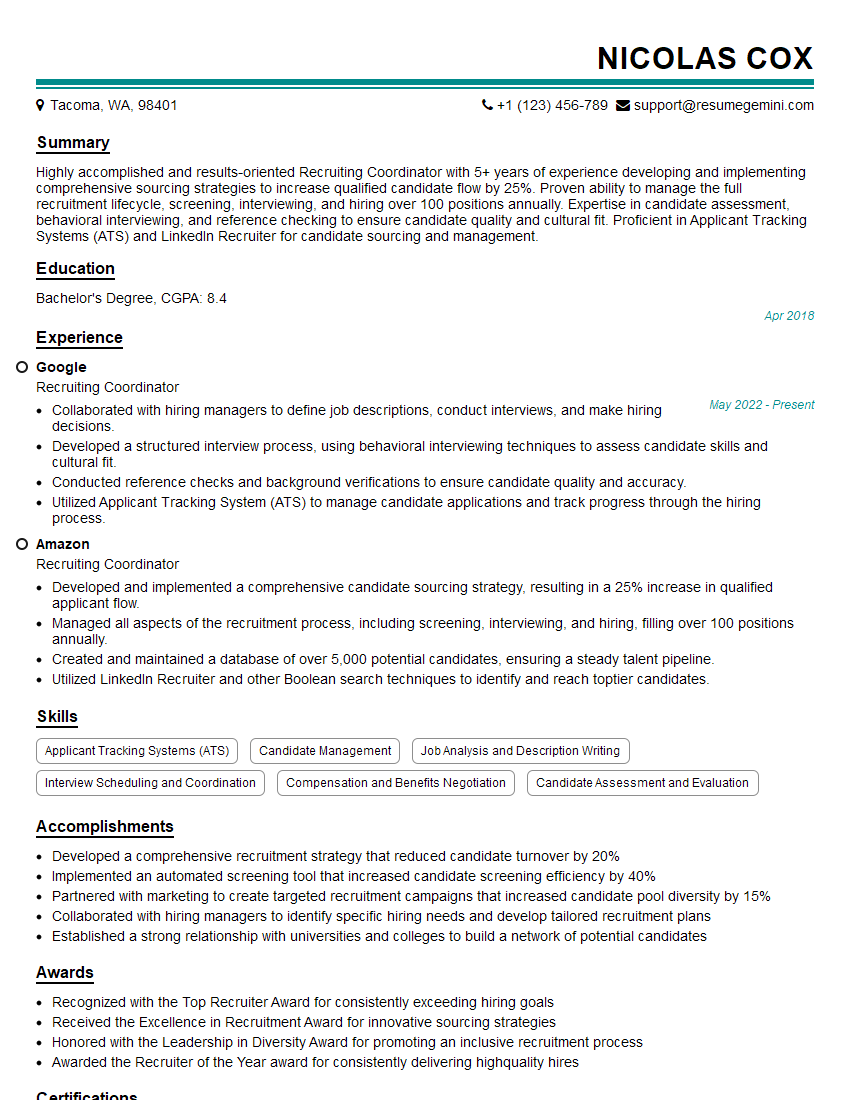
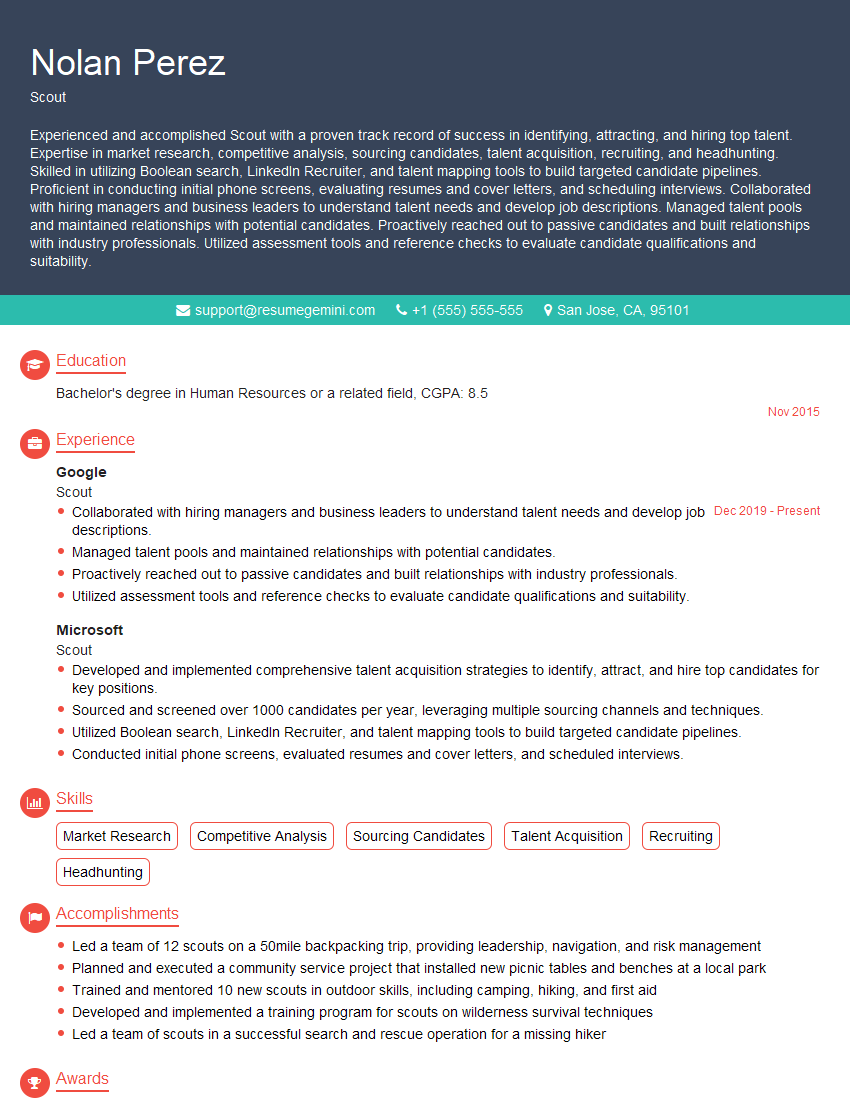
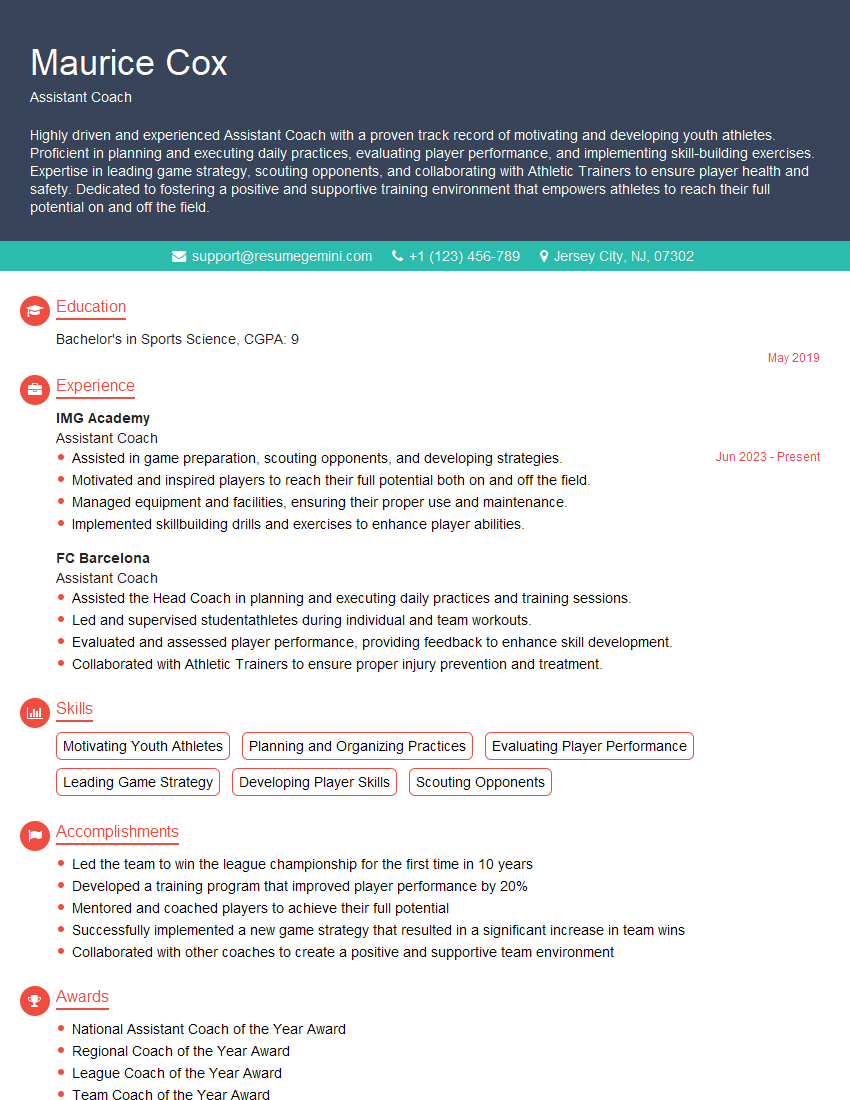
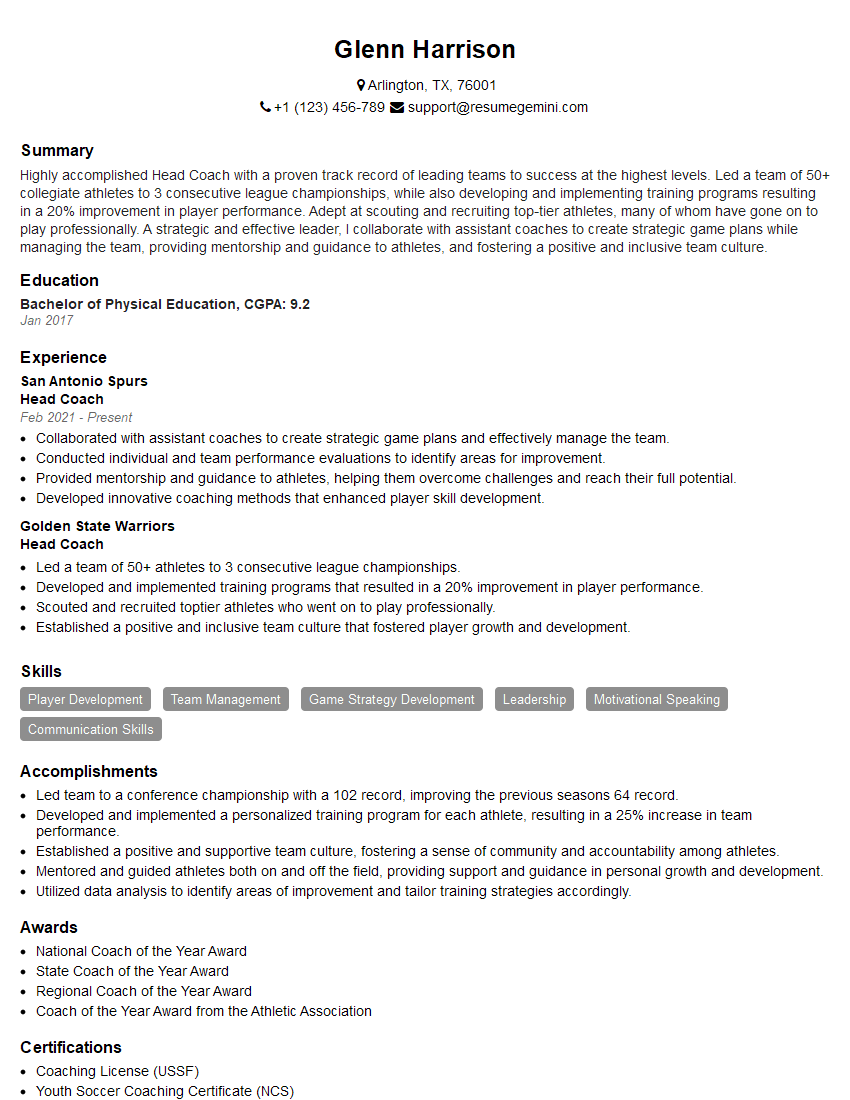
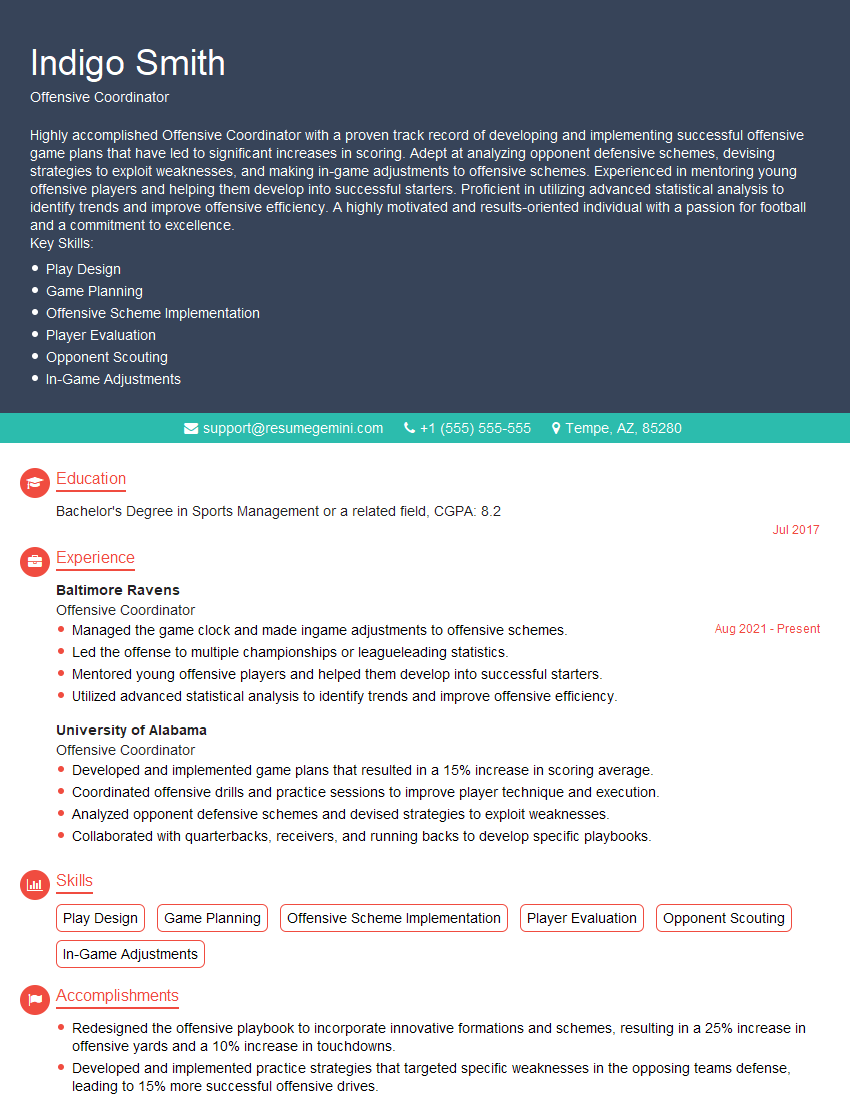
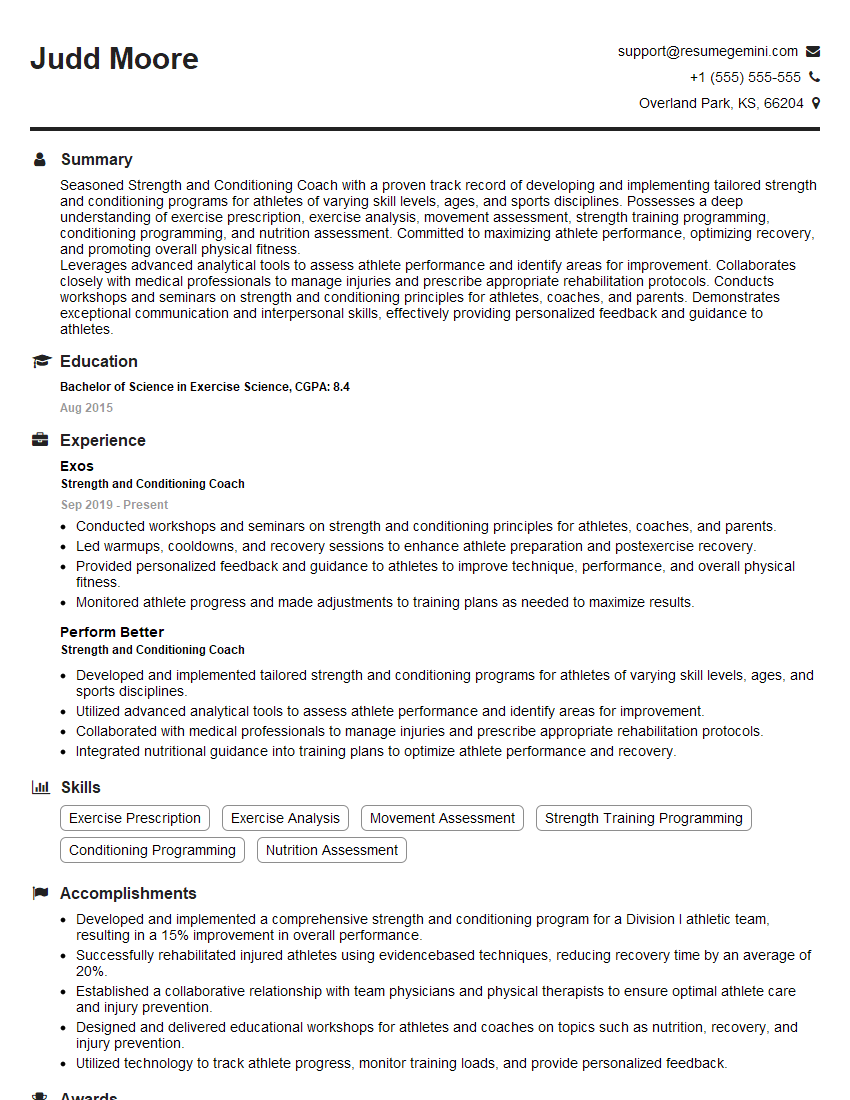
Mastering scheming and play calling is essential for career advancement in sports and related fields. A strong understanding of these concepts demonstrates strategic thinking, problem-solving skills, and the ability to adapt under pressure – highly valued attributes in many industries. To significantly improve your job prospects, create an ATS-friendly resume that showcases these skills effectively. ResumeGemini is a trusted resource that can help you build a compelling and professional resume tailored to your specific experience. Examples of resumes optimized for Scheming and Play Calling roles are available to guide you through the process.
Explore more articles
Users Rating of Our Blogs
Share Your Experience
We value your feedback! Please rate our content and share your thoughts (optional).
What Readers Say About Our Blog
Very informative content, great job.
good