Cracking a skill-specific interview, like one for Scripting and Automation for VFX Workflows, requires understanding the nuances of the role. In this blog, we present the questions you’re most likely to encounter, along with insights into how to answer them effectively. Let’s ensure you’re ready to make a strong impression.
Questions Asked in Scripting and Automation for VFX Workflows Interview
Q 1. Explain your experience with Python scripting in a VFX pipeline.
My experience with Python scripting in VFX pipelines spans several years and numerous projects. I’ve used it extensively for automating repetitive tasks, creating custom tools, and integrating different software packages. For instance, I developed a Python script to automate the process of rendering variations of a character model with different textures and lighting setups, significantly reducing manual effort and turnaround time. This involved using the pymel library to interact with Maya, managing file I/O, and leveraging Python’s multiprocessing capabilities for parallel rendering. Another significant project involved building a custom asset management system that used Python to interface with a database, allowing artists to easily track, version, and retrieve assets. This system improved overall pipeline efficiency and reduced the risk of asset collisions.
I am comfortable working with various Python libraries commonly used in VFX, such as pymel (for Maya), nuke (for Nuke), and subprocess for interacting with external commands. I also have experience with more general-purpose libraries like requests for web interactions and pandas for data manipulation when dealing with large datasets related to asset tracking or shot management.
Q 2. Describe your proficiency in at least one scripting language (e.g., Python, Mel, TCL).
My proficiency in Python is quite advanced. I’ve used it extensively in a professional VFX environment, building robust and efficient tools. My skills extend beyond basic scripting to encompass object-oriented programming, working with larger codebases, and implementing best practices such as proper error handling and modular design. Think of it like this: building a small script to rename files is one thing, but designing a complex system to manage thousands of assets across multiple projects requires a much higher level of skill, which I possess.
For example, I once had to integrate several disparate applications—a proprietary asset management system, Maya, Nuke, and a render farm manager—through a central Python script. This involved understanding the communication protocols of each application, handling potential errors during integration, and crafting elegant solutions to manage data transfer and control flow between these disparate systems. This project pushed my capabilities and required me to use Python’s advanced features to achieve seamless integration.
# Example: Simple Maya script to create a cube and color it red
import pymel.core as pm
pm.polyCube()
selected_cube = pm.selected()[0]
pm.polyColorPerVertex(selected_cube, color=(1, 0, 0))
Q 3. How would you automate a repetitive task in Maya using Python?
Let’s say you need to apply a specific shader to a large number of objects in a Maya scene every day. Doing this manually is tedious and error-prone. Automating this with Python is straightforward. Here’s how:
import pymel.core as pm

def apply_shader(shader_name, objects):
    shader = pm.PyNode(shader_name)
    for obj in objects:
        try:
            pm.sets(obj, edit=True, forceElement=shader)
        except Exception as e:
            print(f"Error applying shader to {obj}: {e}")

shader_to_apply = "lambert1"
objects_to_process = pm.ls(type="mesh") # Get all mesh objects in scene
apply_shader(shader_to_apply, objects_to_process)
This script uses pymel to access Maya’s API. It first defines a function that takes the shader name and a list of objects as input. It then iterates through the objects, applying the shader using pm.sets. Error handling is included using a try-except block to catch any potential issues. To run it, you would save the script (e.g., as applyShader.py), open your Maya scene, and execute it using the Maya script editor or a custom shelf button.
Q 4. What are some common challenges in automating VFX workflows?
Automating VFX workflows presents several challenges. One common issue is dealing with the inherent variability of creative work. Scripts that assume a rigid structure or data format often break when confronted with artist-driven deviations. Another significant challenge is the diversity of software and file formats. Integrating different tools and ensuring seamless data transfer can be complex. Proper error handling and robust input validation are crucial to avoid unexpected crashes or data corruption. Additionally, performance is a major concern, particularly when dealing with large datasets or complex operations. Scripts need to be optimized to avoid bottlenecks and ensure timely processing.
Another challenge is maintaining and updating automation scripts as the pipeline evolves. As software versions change or new features are introduced, scripts might require significant modifications. Finally, the need to integrate with existing tools and workflows and the need to ensure the scripts are easily understood and maintainable by other members of the team are often overlooked, leading to difficulties in collaboration.
Q 5. How do you handle version control in your scripting projects?
Version control is paramount for any scripting project. I consistently use Git for managing my script repositories. This allows me to track changes over time, collaborate effectively with others (if applicable), and revert to earlier versions if necessary. I typically create separate branches for different features or bug fixes, and I utilize pull requests for code reviews before merging changes into the main branch. A clear commit message summarizing each change is essential for maintaining a well-documented history. For larger projects, I might use a Gitflow workflow to manage releases more systematically. This approach adds layers of quality control which are important for large and complex scripting projects. I believe in the philosophy of continuous integration and frequently push my work to remote repositories, leveraging platforms like GitHub or Bitbucket for storage and collaboration.
Q 6. Explain your experience with different build systems (e.g., CMake, SCons).
My experience with build systems is limited primarily to using CMake for managing the compilation and linking of C++ extensions within larger Python projects. I’ve also utilized SCons for building tools that require cross-platform compatibility. CMake‘s ability to generate build files for various platforms makes it invaluable when you need to create plugins or extensions for different operating systems. With SCons, I appreciated the flexibility it offered in managing dependencies and creating customized build processes, especially when working with complex projects.
While I haven’t had extensive use of other build systems in VFX, I understand their value in managing the complexity of software projects, especially when dealing with multiple dependencies, different libraries, and platform-specific configurations.
Q 7. How would you debug a complex Python script within a VFX pipeline?
Debugging a complex Python script in a VFX pipeline requires a multi-faceted approach. I begin by using print() statements strategically to trace the flow of execution and inspect the values of variables at various points in the script. Python’s integrated debugger (pdb) is incredibly useful for stepping through code line by line, inspecting variables, and setting breakpoints. When dealing with errors that involve interactions with external applications (like Maya or Nuke), logging provides invaluable information. This enables capturing detailed information about the context where errors occur, allowing for easy identification of the root cause of the issue. The log files would be organized to ensure clarity and ease of comprehension, allowing for easy tracking of critical errors. For really complex scenarios, I might use a remote debugger or a logging system that writes data to a central log server to aid with debugging complex systems where tracking events across multiple machines may be necessary.
Finally, understanding the application’s API and limitations is crucial for effective debugging. For instance, knowing how Maya handles memory management or how Nuke processes node connections can dramatically aid in isolating the source of problems. Testing different parts of the code in isolation and using unit tests are vital for systematic error identification and prevention. Using a combination of these approaches ensures a thorough and effective debugging process.
Q 8. Describe your experience with integrating custom tools into existing VFX pipelines.
Integrating custom tools into existing VFX pipelines requires a deep understanding of the pipeline’s architecture and the specific software used. It’s like adding a new piece to a complex machine – you need to ensure it fits seamlessly and doesn’t break anything. My approach involves careful planning, thorough testing, and a focus on modularity.
Firstly, I analyze the existing pipeline to identify pain points and opportunities for improvement. This might involve examining current scripting solutions, identifying bottlenecks, or understanding data flow. Then, I design my custom tool in a modular way, breaking it down into smaller, reusable components. This makes it easier to integrate, debug, and maintain. For example, if I’m building a tool to automate the process of creating proxy geometry, I would create separate modules for geometry simplification, material assignment, and exporting to the appropriate format. This modularity allows for easy adaptation if the pipeline requirements change.
Finally, I integrate the tool using appropriate methods, such as Python’s import statements for scripts or creating plugins for applications like Maya or Nuke. Crucially, I meticulously document the tool’s functionality, parameters, and dependencies to make it easy for others to use and maintain. I’ve successfully implemented several such tools, including a custom shader generator for reducing render times and a batch processing system for efficiently handling large numbers of assets. The key is meticulous planning and a focus on seamless integration.
Q 9. What are your preferred methods for testing your scripts?
Testing is paramount in VFX scripting. A buggy script can cost hours of wasted time and potentially damage valuable assets. My testing methodology is multi-layered and employs a combination of unit tests, integration tests, and manual testing.
Unit testing focuses on verifying individual components of the script. I use Python’s unittest module to write automated tests that check the output of specific functions given various inputs. For example, if I have a function that renames files, I would write unit tests to check that it correctly renames files with different extensions and handles edge cases like existing files. This ensures each part works independently.
Integration testing involves checking how different components of the script interact. This is where I might manually test a sequence of actions within the larger script or use automated testing frameworks to simulate real-world scenarios. Finally, manual testing is crucial for catching unexpected errors or edge cases that might not be uncovered through automated tests. This step usually involves testing my scripts with a variety of representative assets to make sure it works across many situations.
Q 10. How do you optimize your scripts for performance?
Optimizing scripts for performance is crucial, especially in VFX, where we deal with large datasets and complex operations. Imagine trying to render a feature film with a slow script – that’s a recipe for disaster! My optimization strategy focuses on several key areas.
- Algorithmic Efficiency: Choosing the right algorithms is critical. For example, using efficient data structures like NumPy arrays significantly speeds up calculations compared to standard Python lists. Instead of looping through each element individually, vectorized operations can perform calculations on entire arrays at once.
- Memory Management: Avoid unnecessary memory consumption. This might involve closing files when they are no longer needed, deleting temporary variables, and employing generators to yield data on demand, rather than loading everything into memory at once.
- Profiling: Using Python’s
cProfilemodule is essential. It helps pinpoint performance bottlenecks by showing exactly where your script is spending its time. Once you identify the slow parts, you can focus your optimization efforts there. - Caching: Storing frequently accessed data in a cache can drastically reduce computation time. If you’re repeatedly accessing the same data, storing it locally can save significant time.
For instance, when working with point clouds, using optimized libraries like OpenVDB or custom C++ extensions significantly improves performance over naive Python solutions.
Q 11. Explain your understanding of object-oriented programming (OOP) and its application in VFX scripting.
Object-Oriented Programming (OOP) is a powerful paradigm that promotes code reusability, modularity, and maintainability. In VFX scripting, OOP allows us to create flexible and scalable solutions. Think of it like building with Lego bricks – you can create complex structures by combining smaller, self-contained units.
In VFX, we might create classes to represent assets (e.g., a Camera class, a Mesh class). Each class would have attributes (like focal length for a camera or vertex positions for a mesh) and methods (like rendering a camera image or transforming a mesh). OOP principles like inheritance allow us to create specialized classes from general ones; for instance, we could create a PerspectiveCamera class that inherits from the Camera class.
This approach is crucial in large VFX projects. Instead of writing repetitive code, we can reuse classes and methods, reducing development time and enhancing code consistency. For example, a Material class can manage different material properties, while a Shader class could handle rendering calculations for each material type. The use of inheritance, polymorphism, and encapsulation improves maintainability and reduces errors.
Using OOP in this manner makes it far easier to collaborate in large teams as it encourages consistency and allows for individual components to be replaced or updated without affecting others, provided that the interfaces remain consistent.
Q 12. Describe your experience with working with APIs (e.g., Maya API, Nuke API).
Working with APIs like the Maya API or the Nuke API is fundamental to automating VFX workflows. These APIs provide programmatic access to the core functionalities of the software, allowing you to automate tasks that would otherwise be performed manually. It’s like having a secret backstage pass to control the software’s inner workings.
My experience with these APIs includes automating tasks such as creating and manipulating geometry, setting up render settings, creating and connecting nodes, batch processing, and integrating custom tools within the software’s environment. I’m fluent in the use of Python with these APIs and am familiar with the common pitfalls, such as handling errors and managing memory efficiently. For instance, I have created tools that automate the rigging process in Maya by using the API to dynamically create joints and constraints according to defined parameters. I’ve also developed tools in Nuke to automatically process image sequences and apply color corrections based on user-defined settings.
Understanding the nuances of each API – the function calls, the data structures, and the event handling mechanisms – is vital for efficient scripting. This is where careful documentation and community resources become invaluable. I’ve regularly contributed to open-source projects and shared my scripts to help others benefit from my work and collectively learn from the challenges faced while engaging with these APIs.
Q 13. How familiar are you with different data formats used in VFX (e.g., Alembic, FBX)?
Familiarity with various data formats is essential for efficient VFX workflows. Different formats excel in different areas, and understanding their strengths and weaknesses is crucial for choosing the right format for the job. It’s like having a toolbox with different types of hammers – each is best suited for a different task.
Alembic, for instance, is excellent for caching and efficiently storing complex geometry and animation data. It supports a wide range of attributes and allows for efficient version control. FBX is a more general-purpose format, commonly used for exchanging models and animations between different software packages. It’s convenient but can sometimes be less efficient than Alembic for storing complex simulations. I’m also experienced with other formats like OBJ, USD, and OpenEXR, each with their own specific advantages and disadvantages. My experience extends to efficiently reading, writing, and manipulating data in these formats using both built-in libraries and specialized third-party libraries. This includes tasks like creating custom converters between formats and optimizing data transfer for faster loading times.
Choosing the right format is crucial for optimization. For example, using Alembic for caching complex simulations can dramatically reduce render times. Understanding the data structure of each format also facilitates the development of more efficient data-processing tools.
Q 14. How would you approach automating the rendering process in a VFX project?
Automating the rendering process is a key aspect of efficient VFX production. Manual rendering is time-consuming and prone to errors. A well-designed automated system significantly improves turnaround times and allows artists to focus on creative tasks. My approach involves a combination of scripting and leveraging render farm management systems.
The first step is to establish a clear rendering pipeline, identifying all necessary steps, dependencies, and output specifications. This pipeline would usually start with scene preparation and end with the final rendering and image composition. Then, I employ scripting (often using Python) to automate various aspects of this pipeline. This might include generating render layers, setting up render settings, launching renders, monitoring progress, and managing output files. For example, I might use Python to iterate over a list of shots, set their respective render settings, and submit them to the render farm.
Render farm management systems are critical for large-scale projects. These systems handle job distribution, resource allocation, and monitoring, allowing for efficient rendering across multiple machines. My experience includes integrating custom scripts with common render farm software, ensuring seamless integration and efficient job management. This often involves using APIs provided by the farm management system to monitor the progress of jobs and trigger alerts in case of failures. The whole process is meticulously documented so others can easily reproduce the process or resolve issues if needed.
Q 15. What are your strategies for managing dependencies in your scripts?
Managing dependencies effectively is crucial for robust and maintainable scripts. Think of it like building with LEGOs – you need the right bricks (libraries, modules) in the right place to construct your desired model (script). My strategy involves a multi-pronged approach:
Virtual Environments (venv): I always create isolated virtual environments for each project. This prevents conflicts between different project dependencies. For Python, this is as simple as
python3 -m venv myenvand then activating the environment. This ensures that each project uses its own specific version of libraries, preventing version clashes that can cause unexpected behavior.Requirements Files (requirements.txt): I meticulously document all project dependencies in a
requirements.txtfile. This file lists every library and its exact version, allowing for reproducible environments. It’s like having a detailed instruction manual for anyone wanting to replicate the project. It can be generated easily usingpip freeze > requirements.txtand installed withpip install -r requirements.txt.Dependency Management Tools (e.g., conda): For more complex projects or those involving multiple languages, I utilize tools like conda, which provide enhanced package and environment management capabilities. Conda simplifies the process of installing and managing complex dependencies across various platforms, especially helpful when dealing with compiled libraries.
Version Control (Git): This is non-negotiable. Using Git helps track changes in both code and dependencies, enabling easy rollback if problems arise. Committing
requirements.txtalong with code modifications allows me to effortlessly recreate the exact environment at any point in the project’s history.
By combining these methods, I ensure that my scripts are portable, reproducible, and free from dependency-related headaches.
Career Expert Tips:
- Ace those interviews! Prepare effectively by reviewing the Top 50 Most Common Interview Questions on ResumeGemini.
- Navigate your job search with confidence! Explore a wide range of Career Tips on ResumeGemini. Learn about common challenges and recommendations to overcome them.
- Craft the perfect resume! Master the Art of Resume Writing with ResumeGemini’s guide. Showcase your unique qualifications and achievements effectively.
- Don’t miss out on holiday savings! Build your dream resume with ResumeGemini’s ATS optimized templates.
Q 16. Describe your experience with creating and maintaining documentation for your scripts.
Documentation is paramount; it’s the bridge between my code and its users (often myself in the future!). My documentation strategy is based on three pillars:
Clear and Concise Comments: I embed comments directly in my code, explaining complex logic, algorithms, and the purpose of individual functions. This is like adding labels to the different sections of a complex machine.
README File: Every project has a comprehensive README file. This file acts as the project’s homepage, detailing installation instructions, usage examples, and a high-level description of its functionality. It’s akin to providing a user manual for the software.
External Documentation (e.g., Sphinx, JSDoc): For larger, more intricate projects, I leverage tools like Sphinx (Python) or JSDoc (JavaScript) to generate more structured, searchable documentation. This allows for creating a sophisticated user guide and reference material.
By diligently documenting my scripts, I ensure maintainability, ease of collaboration, and faster troubleshooting. It’s an investment that pays off tenfold down the line.
Q 17. How do you handle errors and exceptions in your scripts?
Error handling is crucial for creating robust and reliable scripts. A script crashing due to unexpected input is like a train derailing – it’s disruptive and frustrating. My approach involves:
try...exceptblocks (Python): I wrap potentially problematic code sections intry...exceptblocks. This allows me to catch specific exceptions (likeFileNotFoundErrororTypeError) and handle them gracefully, preventing script termination. For example:try: file = open('myfile.txt', 'r') except FileNotFoundError: print('Error: File not found!') except Exception as e: print(f'An unexpected error occurred: {e}')Logging: I use logging modules to record script events, including errors and warnings. This creates an audit trail that’s essential for debugging and identifying issues later. The log files provide a detailed record of what happened, allowing for efficient problem analysis.
Input Validation: Before processing any input, I always validate it to ensure it conforms to the expected format and type. This prevents many errors from occurring in the first place. It’s like quality control at the factory before the product goes on the shelves.
Assertions: I use assertions (
assertstatements) to check for conditions that should always be true during script execution. If an assertion fails, it indicates a bug in the code. Assertions act as safety nets, catching problems early in development.
These techniques ensure my scripts can handle unexpected situations, preventing crashes and providing valuable diagnostic information.
Q 18. Explain your experience with using command-line tools and shell scripting.
Command-line tools and shell scripting are fundamental to my VFX workflow. They’re like my Swiss Army knife – versatile and indispensable. I’m proficient in Bash (Linux/macOS) and PowerShell (Windows), using them for tasks such as:
Batch Processing: Automating repetitive tasks like rendering, compositing, and file conversions using scripts that orchestrate command-line tools like
ffmpeg,nuke, and render farm submission tools. This significantly increases efficiency.File Manipulation: Using commands like
find,grep,sed, andawkto locate, filter, and modify files and directories. This is invaluable for managing large datasets.System Administration: Managing user permissions, monitoring system resources, and troubleshooting problems. A strong understanding of the command-line is crucial for navigating and interacting with the operating system at a deeper level.
Pipeline Integration: Seamlessly integrating custom tools and scripts into existing VFX pipelines, using shell scripts to orchestrate the different stages of the process.
For example, I might use a Bash script to automatically render a sequence of shots, then use ffmpeg to compress the output videos and finally, upload them to a cloud storage location. This entire process is handled without manual intervention.
Q 19. How familiar are you with cloud computing platforms (e.g., AWS, Azure, GCP) and their application to VFX workflows?
I have experience with AWS, Azure, and GCP, understanding their application within VFX workflows. Cloud computing provides scalability, flexibility, and cost-effectiveness, particularly for render farms and storage. Here’s my experience:
Render Farms: Setting up and managing render farms on cloud platforms like AWS using services such as EC2 (virtual machines) and S3 (storage). This allows for scaling rendering capacity on demand, based on project needs.
Storage: Utilizing cloud storage (S3, Azure Blob Storage, Google Cloud Storage) for storing large datasets, backups, and project assets. This allows for centralized storage and easy access from anywhere.
Data Processing: Leveraging serverless functions (AWS Lambda, Azure Functions, Google Cloud Functions) for tasks that require quick bursts of processing power without needing to manage persistent servers. This allows for efficient processing of smaller tasks without the overhead of managing servers.
Collaboration Tools: Integrating cloud-based collaboration platforms for team communication and file sharing, enhancing productivity and efficiency.
My understanding extends to optimizing workflows for specific cloud environments, ensuring efficient resource utilization and cost control. Choosing the right cloud provider depends heavily on the specific needs of the project and team, and I’m adept at evaluating these factors to make informed decisions.
Q 20. How would you design a robust and scalable solution for automating a specific VFX task?
Designing a robust and scalable solution for automating a VFX task involves a structured approach. Let’s say the task is automating the process of creating camera projection maps for a 3D model from a set of plates. My design would involve:
Modular Design: Break down the task into smaller, independent modules (e.g., plate processing, camera solve, UV mapping, texture generation). This makes the system easier to maintain, debug, and extend.
API Integration: Utilize APIs from software like Nuke or Houdini to automate these modules. APIs act as communication channels, allowing the script to interact with these powerful tools programmatically.
Configuration Files: Employ configuration files (YAML or JSON) to parameterize the process, allowing flexibility without modifying code. This allows adjustments to be made without re-writing the script.
Error Handling and Logging: Implement robust error handling and logging mechanisms to ensure smooth operation and facilitate troubleshooting. This allows for identification of problems and efficient debugging.
Scalability: Design the system to handle increased input data volume. This might involve techniques like parallel processing or distributing tasks across multiple machines using a render farm.
Testing: Thoroughly test the system with various inputs to ensure accuracy and reliability. This is critical for detecting edge cases or unexpected issues that could arise.
This approach creates a solution that’s not only automated but also adaptable, robust, and capable of handling the demands of large-scale VFX projects.
Q 21. Describe a situation where you had to troubleshoot a complex scripting issue in a VFX pipeline.
During a recent project, we encountered a perplexing issue with a script responsible for batch-rendering sequences in Arnold. The script would intermittently fail, producing incomplete renders without any clear error messages. The problem wasn’t reproducible on demand, making debugging incredibly challenging.
My troubleshooting involved a multi-step approach:
Enhanced Logging: I first increased the verbosity of the logging, capturing detailed information about each stage of the render process. This provided clues about potential points of failure.
System Monitoring: I monitored the system resources (CPU, memory, disk I/O) during render runs, using tools like
topand system monitoring utilities. This revealed that the failures coincided with high disk I/O, indicating potential disk contention issues.Network Analysis: Since the render farm involved a network shared storage, I monitored network traffic and latency. This highlighted periods of high network congestion that correlated with the script failures.
Code Review and Optimization: After pinpointing disk I/O as the culprit, I reviewed the script and optimized the file I/O operations, reducing the number of simultaneous file accesses. I also implemented more efficient caching mechanisms to minimize disk reads.
By systematically investigating the issue and improving the logging, system monitoring, and the script’s efficiency, we were able to resolve the problem. The solution involved a combination of code optimization and understanding the limitations of the shared storage system. This experience highlighted the importance of thorough logging, comprehensive monitoring, and a systematic debugging approach.
Q 22. What are some best practices you follow to ensure the maintainability and readability of your scripts?
Maintainable and readable scripts are the backbone of any successful VFX pipeline. Think of it like building a house – if the foundation (your code) is messy and poorly planned, the entire structure will be difficult to work with and prone to collapse. My approach focuses on several key aspects:
Consistent Formatting: I religiously adhere to a specific style guide (like PEP 8 for Python) ensuring consistent indentation, naming conventions, and spacing. This makes the code instantly understandable to anyone familiar with that style, including my future self!
Meaningful Variable and Function Names: Instead of cryptic names like
xorfunc1, I use descriptive names such asparticleCountorcalculateNormalMap. This instantly conveys the purpose of each element.Modular Design: I break down complex tasks into smaller, self-contained functions. This improves readability, reusability, and makes debugging much easier. Imagine trying to fix a complex machine versus a collection of smaller, manageable modules – the latter is significantly simpler.
Comments and Documentation: I liberally use comments to explain complex logic or the purpose of specific code blocks. For larger projects, I also create comprehensive documentation, explaining the overall architecture and how different parts of the script interact.
Version Control: Using a version control system (like Git) is crucial for tracking changes, collaborating effectively and reverting to earlier versions if needed. This provides a safety net and a history of the development process.
For example, instead of:
x = y + z; a(x);I would write:
totalParticles = emittedParticles + existingParticles; updateParticlePositions(totalParticles);The difference is night and day in terms of readability and maintainability.
Q 23. How do you stay up-to-date with the latest advancements in VFX scripting and automation?
The VFX industry is constantly evolving, so staying current is essential. My approach is multifaceted:
Industry Blogs and Publications: I regularly follow blogs and publications focused on VFX and CG, such as fxguide and behance. These often feature articles on new techniques and technologies.
Conferences and Workshops: Attending industry conferences like SIGGRAPH provides invaluable opportunities to learn about the latest advancements directly from leading experts and network with other professionals.
Open-Source Projects: Exploring open-source VFX tools and libraries allows me to learn from the code of experienced developers. It’s like having a peek into the workings of the masters!
Online Courses and Tutorials: Platforms like Udemy, Coursera, and Pluralsight offer a wealth of courses on various scripting languages and VFX techniques, constantly updated to reflect the latest industry trends.
Community Engagement: Engaging with online communities and forums related to VFX scripting allows me to learn from others, share my knowledge, and stay abreast of the latest developments and challenges faced by other professionals.
This combination of formal and informal learning keeps me at the forefront of the field, ensuring I can leverage the most effective tools and techniques in my work.
Q 24. Describe your experience working with different version control systems (e.g., Git, Perforce).
I have extensive experience with both Git and Perforce, two of the most popular version control systems in the VFX industry. While they share the fundamental goal of tracking changes, they cater to different workflows and project sizes.
Git: I primarily use Git for smaller projects and personal scripts due to its flexibility, speed, and distributed nature. Its branching capabilities are excellent for experimenting with new features without affecting the main codebase. The ease of creating branches and merging them back is a significant advantage.
Perforce: For larger studio projects involving many artists and a significant amount of binary data (like textures and models), Perforce is often the preferred choice. Its robust features for handling large files and managing concurrent access by multiple users make it ideal for collaborative environments. I’m proficient in using Perforce’s command-line interface and its integration with various VFX software.
Regardless of the system, I always follow best practices like regular commits with clear messages, meaningful branch names, and utilizing pull requests for code review before merging changes into the main branch. This ensures a smooth collaborative workflow and helps prevent conflicts.
Q 25. What are some common performance bottlenecks in VFX pipelines, and how can scripting help address them?
VFX pipelines often encounter performance bottlenecks due to various factors. Scripting can play a vital role in addressing these issues:
I/O Operations: Reading and writing large files (textures, geometry) can be slow. Scripts can optimize this process by using efficient file formats, parallel processing techniques, and minimizing unnecessary disk access. For example, using memory-mapped files can drastically improve performance when dealing with huge image sequences.
Redundant Calculations: Repetitive calculations or unnecessary computations can slow down the pipeline. Scripting can identify these bottlenecks and implement caching mechanisms or optimize algorithms to avoid repeating work. For instance, pre-calculating transformations or storing results in a database can avoid redundant computations.
Inefficient Algorithms: Poorly designed algorithms can significantly impact rendering times. Scripts can help in implementing more efficient algorithms or leveraging parallel processing capabilities to speed up complex tasks. For example, switching from a brute-force approach to a more sophisticated algorithm for collision detection can improve performance exponentially.
Network Latency: Transferring large assets over a network can introduce delays. Scripts can facilitate asset management by pre-copying assets to local machines or optimizing the way assets are accessed remotely.
By strategically utilizing profiling tools and identifying the slowest parts of the pipeline, scripting enables us to create targeted solutions to alleviate performance bottlenecks, significantly boosting overall efficiency.
Q 26. Explain your understanding of different architectural patterns and their application in designing VFX pipelines.
Understanding architectural patterns is essential for designing robust and scalable VFX pipelines. Some common patterns include:
Model-View-Controller (MVC): This pattern separates concerns into three interconnected parts: the model (data), the view (presentation), and the controller (logic). In VFX, the model could be the scene data, the view could be the user interface, and the controller would handle user input and update the model and view accordingly. This promotes better organization and maintainability, especially in large projects.
Producer-Consumer: This pattern manages asynchronous tasks by having a producer generate tasks and a consumer process them. In VFX, a producer might be a script that generates render jobs, while consumers are render nodes processing these jobs independently. This improves efficiency by allowing concurrent processing.
Pipeline Pattern: This pattern defines a sequential flow of operations, ideal for tasks that must be performed in a specific order, like asset creation, animation, simulation, rendering, and compositing in a VFX pipeline. This creates a clear flow and eliminates conflicts.
Data-Oriented Design (DOD): This focuses on optimizing data access to improve performance. Instead of object-oriented programming, it organizes data in a way that minimizes cache misses and improves vectorization. This is particularly important for performance-critical tasks like rendering.
The choice of architectural pattern depends on the specific needs of the project. For example, a smaller project might benefit from a simpler pipeline pattern, while a large, complex production might require a combination of patterns to optimize for scalability, maintainability, and performance.
Q 27. How would you approach designing a system for tracking and managing assets in a VFX project using scripting?
Designing an asset tracking and management system requires a robust approach. I would utilize a combination of scripting, a database (like SQLite or PostgreSQL), and potentially a user interface for easy access and management.
Database Design: The database would store essential asset information such as the asset name, type, version, file path, creation date, author, and any relevant metadata. A well-structured relational database would allow for efficient querying and retrieval of information.
Scripting for Asset Ingestion: Scripts would handle the ingestion of new assets, automatically updating the database with the relevant information. This could involve parsing file names, extracting metadata from files, and generating unique identifiers. This could be triggered automatically upon file import or manually initiated.
Scripting for Asset Versioning: Scripts would manage asset versioning, ensuring that older versions are archived appropriately while allowing easy access to the latest versions. This could involve creating version folders and automatically updating database entries with version numbers.
Search and Retrieval: Scripts would provide methods for searching and retrieving assets based on various criteria (e.g., name, type, date). A simple command-line interface or a more sophisticated GUI could be used to interact with the database and retrieve asset information.
Reporting and Analytics: Scripts could generate reports on asset usage, storage space, and other relevant metrics. This allows for better resource planning and optimization.
For instance, a Python script could interact with an SQLite database, updating records upon new asset creation, using regular expressions to parse file names, and ensuring version control through folder organization and database entries. This would provide a centralized and easily searchable repository for all assets in the project.
Key Topics to Learn for Scripting and Automation for VFX Workflows Interview
- Python for VFX: Understanding fundamental Python concepts (data structures, loops, functions) and their application in VFX pipelines. Practical application: automating repetitive tasks like batch rendering or asset management.
- Pipeline Automation: Designing and implementing automated workflows using scripting languages. Practical application: creating custom tools to streamline the process from asset import to final render output.
- Working with APIs: Interacting with various software APIs (e.g., Maya, Nuke, Houdini) to control and extend their functionalities. Practical application: Building scripts to automate complex tasks within these applications.
- Version Control (Git): Understanding and utilizing Git for collaborative scripting and workflow management. Practical application: tracking changes, managing conflicts, and collaborating effectively on large projects.
- Troubleshooting and Debugging: Developing effective debugging strategies to identify and resolve issues in scripts. Practical application: utilizing print statements, debuggers, and error handling techniques.
- Data Wrangling and Manipulation: Working with different data formats (e.g., JSON, XML) and utilizing libraries for data manipulation and analysis. Practical application: processing large datasets for analysis and reporting.
- Software Architecture and Design Principles: Applying best practices to design maintainable, scalable and efficient scripts. Practical application: creating modular, reusable code components.
- Performance Optimization: Identifying and addressing performance bottlenecks in scripts. Practical application: improving render times and overall pipeline efficiency.
Next Steps
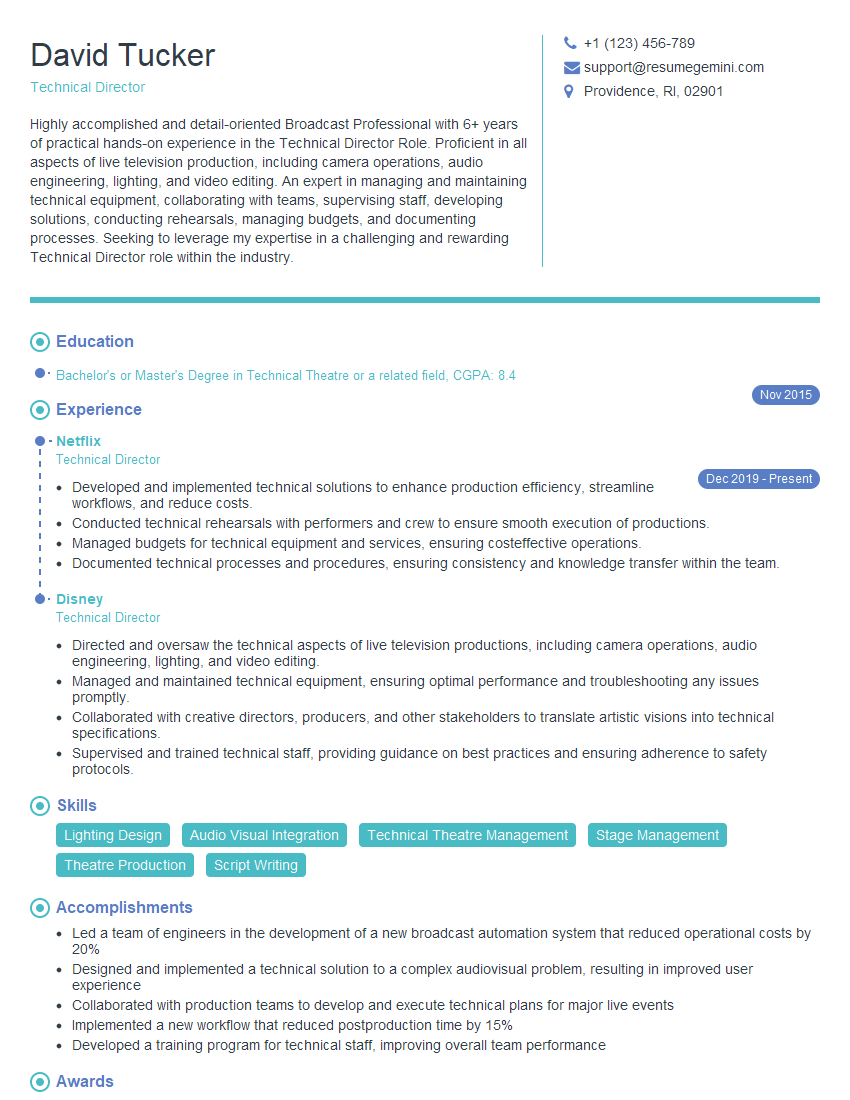
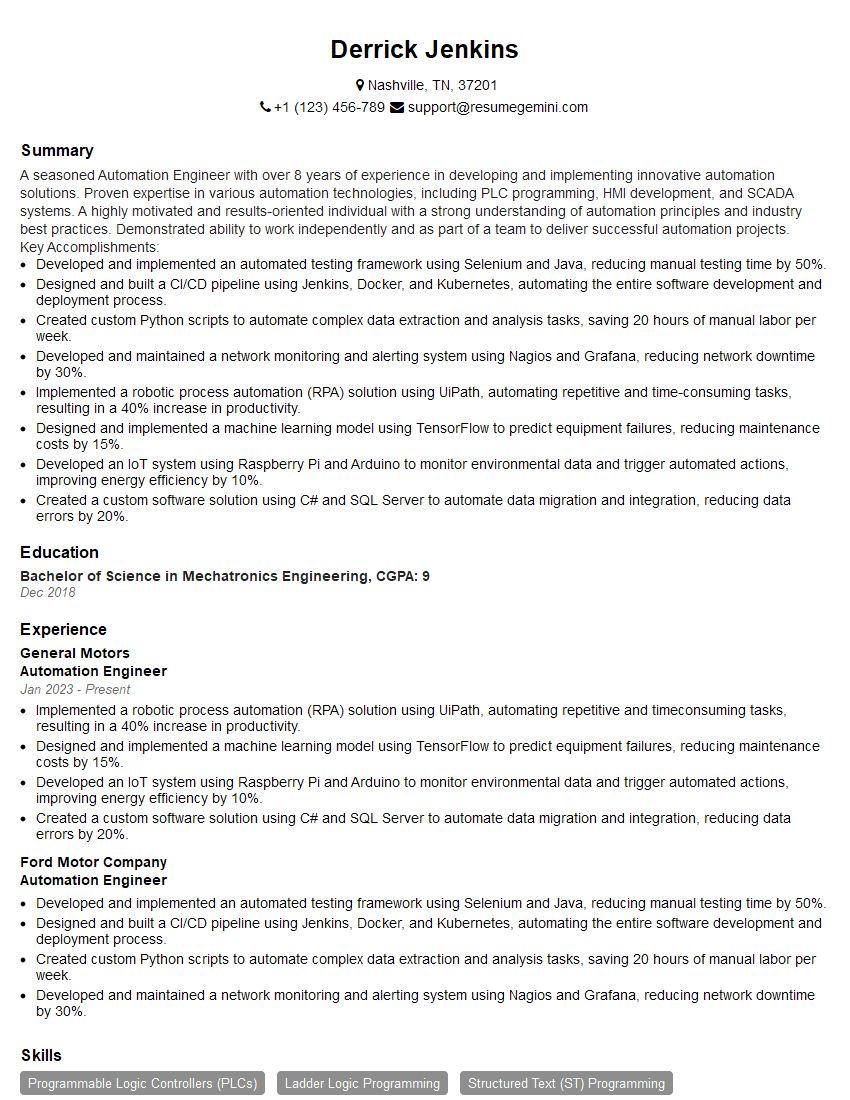
Mastering Scripting and Automation for VFX workflows is crucial for career advancement in this dynamic field. It allows you to become a more efficient and valuable member of any VFX team, opening doors to higher-level positions and more challenging projects. To significantly boost your job prospects, it’s essential to craft a compelling and ATS-friendly resume that showcases your skills effectively. We strongly recommend using ResumeGemini, a trusted resource for building professional resumes, to help you create a document that truly represents your abilities. Examples of resumes tailored to Scripting and Automation for VFX Workflows are available to help guide you. Take the next step towards your dream VFX career today!
Explore more articles
Users Rating of Our Blogs
Share Your Experience
We value your feedback! Please rate our content and share your thoughts (optional).
What Readers Say About Our Blog
Very informative content, great job.
good