Interviews are opportunities to demonstrate your expertise, and this guide is here to help you shine. Explore the essential Scriptwriting and Copywriting interview questions that employers frequently ask, paired with strategies for crafting responses that set you apart from the competition.
Questions Asked in Scriptwriting and Copywriting Interview
Q 1. Explain the difference between scriptwriting and copywriting.
Scriptwriting and copywriting, while both forms of writing, serve distinct purposes. Think of it this way: scriptwriting is about crafting dialogue and action for a visual medium, while copywriting focuses on persuading the reader to take a specific action. Scriptwriting creates narratives for film, television, or theatre, prioritizing storytelling and character development. Copywriting, on the other hand, is primarily focused on marketing and advertising, aiming to sell a product, service, or idea. A script for a movie might focus on building tension and emotional resonance, while copy for a website focuses on clear calls to action and benefit-driven language.
For example, a script for a movie might contain detailed descriptions of scenes and character interactions: [SCENE START] EXT. PARK - DAY A young woman sits on a bench, lost in thought. A dog runs up to her, wagging its tail. [SCENE END]. In contrast, copy for a website selling dog food might read: "Give your furry friend the energy they deserve with our premium dog food! Order now and get 10% off your first purchase." The script tells a story; the copy sells a product.
Q 2. Describe your process for developing a script for a short video advertisement.
My process for developing a short video advertisement script is iterative and involves several key steps. First, I thoroughly understand the client’s objectives – what are they trying to achieve with this ad? What is their target audience? Then, I conduct thorough research into the product or service being advertised. This might involve looking at competitor ads, reviewing market research, and speaking to potential customers. Next, I brainstorm ideas, focusing on creating a compelling narrative or message that resonates with the target audience. I often start with a strong hook to grab attention in the first few seconds. I then develop a detailed script outline, including scene descriptions, dialogue, and visual elements. This ensures a cohesive and engaging story. Once the outline is complete, I write the full script, focusing on clear, concise language and strong calls to action. Finally, I revise and refine the script, seeking feedback from others, until I achieve a polished and effective final product. Testing different versions through focus groups can be invaluable at this stage.
Q 3. How do you adapt your writing style to different target audiences?
Adapting my writing style to different audiences is crucial for effective communication. I consider factors such as age, demographics, socioeconomic status, interests, and level of knowledge. For example, writing for teenagers requires a different tone and vocabulary than writing for senior citizens. Teenagers might respond to slang and informal language, while seniors might prefer a more formal and respectful tone. I also adjust the level of complexity. A technical document requires precise and detailed language, while an advertisement needs to be simple and easily understood. I might use humor or emotive language with one audience, while a more factual and data-driven approach might be better for another. Understanding the audience’s needs and motivations is key to tailoring my writing for maximum impact. I often create detailed audience personas to guide this process.
Q 4. What are some key elements of compelling copywriting?
Compelling copywriting hinges on several key elements. Firstly, it needs a clear and concise value proposition: what problem does the product or service solve, and what are the benefits for the customer? Secondly, it requires a strong call to action, telling the reader exactly what you want them to do (e.g., “Buy Now,” “Learn More,” “Sign Up”). Thirdly, it should build credibility and trust, showcasing testimonials, expert opinions, or guarantees. Fourthly, it needs to be engaging and emotionally resonant, using storytelling, humor, or other techniques to connect with the reader. Finally, it must be tailored to the specific target audience, using language and tone that resonates with them. A great example of this would be Apple’s marketing copy – it focuses on emotional connection and aspirational lifestyle, rather than purely technical specifications.
Q 5. How do you ensure your writing is SEO-friendly?
Making my writing SEO-friendly involves incorporating relevant keywords throughout the text, naturally and organically. I research keywords using tools like Google Keyword Planner to identify terms that people actually search for when looking for products or information related to the topic. I don’t just stuff keywords into the copy; I strategically integrate them into headings, subheadings, body text, and meta descriptions. I also focus on creating high-quality, informative content that provides value to the reader. Search engines prioritize content that is both relevant and useful. Structured data markup (using schema.org vocabulary) can further enhance SEO performance by helping search engines understand the content better. I also consider things like page loading speed, readability, and mobile-friendliness, all of which can impact search engine rankings.
Q 6. How do you handle feedback and revisions on your writing?
I welcome feedback and revisions as integral parts of the writing process. I view them as opportunities to improve my work and ensure the final product meets the client’s needs and objectives. When I receive feedback, I carefully consider each point, prioritizing constructive criticism. I engage in open communication with the client or editor, asking clarifying questions if needed. I make revisions thoughtfully, ensuring changes are consistent with the overall message and tone of the writing. I aim to incorporate all valuable feedback while remaining true to the initial concept and avoiding unnecessary changes. I believe in iterative revisions to ensure a polished and effective final product. My goal isn’t just to meet the client’s expectations but to exceed them by providing thoughtful improvements based on the feedback I receive.
Q 7. Describe your experience with different writing styles (e.g., persuasive, informative, narrative).
My experience spans diverse writing styles, each requiring a unique approach. Persuasive writing, used extensively in advertising and marketing, focuses on convincing the reader to take a specific action. This involves employing strong calls to action, emotional appeals, and compelling arguments. Informative writing, prevalent in journalism and technical documentation, aims to educate the reader, using clear, concise language, factual data, and logical structure. Narrative writing, employed in storytelling across various media, creates engaging narratives with compelling characters and plotlines. I have used persuasive writing to craft compelling website copy, informative writing to create technical manuals, and narrative writing to develop engaging scripts for short films. The key is to adapt your vocabulary, sentence structure, and overall tone to the specific style and purpose. Each style requires a different level of detail and focus, reflecting the intended audience and communication goal.
Q 8. How do you research a topic before starting to write?
Thorough research is the bedrock of compelling writing. It’s not just about gathering information; it’s about understanding your audience, your purpose, and the context surrounding your topic. My research process is multi-faceted and often iterative.
- Audience Research: I begin by defining my target audience. Who am I writing for? What are their demographics, interests, pain points, and preferred communication style? This might involve analyzing existing market data, conducting surveys, or even engaging in social listening to understand their conversations.
- Competitive Analysis: I analyze what my competitors are doing. What kind of messaging are they using? What are their strengths and weaknesses? This helps me identify opportunities to differentiate my work and create a unique approach.
- Keyword Research (for Copywriting): For copywriting projects, I use keyword research tools like SEMrush or Ahrefs to identify relevant keywords and phrases that my target audience is searching for. This ensures my copy is optimized for search engines and attracts the right readers.
- Subject Matter Expertise: I delve deep into the subject matter itself. This might involve reading industry reports, interviewing experts, or conducting original research to ensure accuracy and authority.
- Information Synthesis: Finally, I synthesize all the gathered information, identifying key themes and crafting a clear narrative that resonates with my audience.
For example, when writing a script for a documentary about sustainable farming, I would research various farming practices, interview farmers, analyze government reports on agriculture, and study the environmental impact of different techniques. This ensures a well-rounded and informative narrative.
Q 9. What tools or software do you use for scriptwriting and copywriting?
My toolset is diverse and depends on the project. For scriptwriting, I rely heavily on:
- Final Draft: Industry-standard screenwriting software, offering features like scene numbering, character tracking, and formatting options for different script types.
- Celtx: A versatile option for scriptwriting, storyboarding, and even project management.
For copywriting, my toolkit includes:
- Google Docs/Microsoft Word: For initial drafts and collaboration.
- Grammarly: To ensure grammatical accuracy and clarity.
- Hemingway Editor: To improve readability and sentence structure, highlighting complex sentences and weak phrases.
- SEMrush/Ahrefs (SEO): For keyword research and competitor analysis.
- Canva/Adobe Creative Suite (for visuals): Sometimes copy requires visual elements, and these tools help create engaging visuals.
I also utilize project management software like Asana or Trello to organize my workflow and deadlines across multiple projects.
Q 10. Explain your understanding of brand voice and how you incorporate it into your writing.
Brand voice is the personality of a brand, expressed through its communication. It’s crucial to align your writing with the established brand voice to maintain consistency and build a strong brand identity. It’s more than just tone; it’s about the overall feeling and message conveyed.
I incorporate brand voice by thoroughly analyzing the brand’s existing materials, including their website, social media posts, and marketing collateral. I look for patterns in their language, tone, style, and messaging. Is it formal or informal? Playful or serious? Sophisticated or down-to-earth?
For instance, a luxury watch brand will have a sophisticated and refined brand voice, using elegant language and evocative imagery. Conversely, a sportswear brand might opt for a more energetic and casual voice, using concise language and active verbs. I tailor my writing to perfectly reflect these nuances, ensuring consistency across all platforms and communications.
Understanding the brand’s target audience is crucial in determining the appropriate brand voice. A brand targeting young adults might use slang or internet culture references, while a brand targeting professionals might prefer a more formal and professional tone. This understanding guides my word choices, sentence structure, and overall style.
Q 11. How do you measure the success of your copywriting campaigns?
Measuring the success of a copywriting campaign requires a multi-faceted approach, going beyond just vanity metrics. Key Performance Indicators (KPIs) vary depending on the campaign’s goals, but common metrics include:
- Conversion Rate: The percentage of visitors who complete a desired action (e.g., making a purchase, signing up for a newsletter).
- Click-Through Rate (CTR): The percentage of users who click on a link or call-to-action.
- Return on Investment (ROI): A measure of the profitability of the campaign, comparing the cost of the campaign to the revenue generated.
- Website Traffic: Monitoring website traffic from the campaign to assess its reach and effectiveness.
- Lead Generation: Tracking the number of qualified leads generated through the campaign.
- Brand Awareness (Qualitative): Measuring brand mentions, social media engagement, and media coverage to assess the campaign’s impact on brand awareness (often through surveys or social listening).
By analyzing these metrics, I can identify what aspects of the campaign worked well and what areas need improvement. A/B testing different versions of copy can also provide valuable insights into what resonates most effectively with the target audience.
Q 12. Describe a time you had to overcome a challenge in your writing.
I once faced a significant challenge while writing a script for a medical device company. The technical information was incredibly complex, and I had to translate it into a compelling and understandable narrative for a lay audience. The initial drafts were dense and difficult to follow.
To overcome this, I adopted a multi-pronged approach:
- Collaborate with Experts: I worked closely with the engineers and medical professionals involved in developing the device, asking clarifying questions and ensuring accuracy.
- Break Down Complex Information: I broke down the complex technical details into smaller, more manageable chunks. I used analogies and metaphors to make the information more relatable and accessible.
- Focus on Storytelling: I shifted from a purely technical explanation to a story that focused on the benefits of the device for patients. This made the information more engaging and memorable.
- Multiple Revisions and Feedback: I conducted multiple revisions, seeking feedback from both experts and target audience members to ensure clarity and impact. This iterative process led to a final script that was both informative and engaging.
This experience reinforced the importance of collaboration, clear communication, and a focus on the target audience when tackling challenging writing projects.
Q 13. How do you ensure your writing is concise and impactful?
Concise and impactful writing is a result of careful planning and editing. It’s about conveying your message clearly and efficiently, without unnecessary words or jargon.
- Strong Verbs and Precise Language: Use strong verbs that convey action and precise language that avoids ambiguity. Avoid weak verbs like “is” or “are” where possible.
- Active Voice: Prefer active voice over passive voice to make your sentences more direct and engaging.
- Eliminate Redundancy: Remove any unnecessary words or phrases that don’t add value to your message.
- Short Sentences and Paragraphs: Keep sentences and paragraphs short and focused, making your writing easier to read and digest.
- Ruthless Editing: Be willing to cut words and phrases, even if it feels painful. Every word should serve a purpose.
- Read Aloud: Reading your writing aloud helps identify awkward phrasing or sentences that don’t flow smoothly.
For example, instead of writing “The product is characterized by its ease of use,” I would write “The product is easy to use.” This simple change removes unnecessary words while maintaining the meaning.
Q 14. Give an example of a successful copywriting campaign you’ve worked on.
I worked on a copywriting campaign for a small, eco-friendly coffee roaster. Their goal was to increase online sales and build brand awareness among environmentally conscious consumers. The challenge was to differentiate them in a crowded market.
My approach focused on highlighting their unique selling points: sustainable sourcing practices, ethical labor, and delicious, high-quality coffee. I crafted website copy, social media posts, and email marketing materials that emphasized these aspects using evocative language and compelling imagery. For instance, we used phrases like “Sustainably sourced, ethically roasted, exquisitely brewed” to encapsulate their brand values.
The results were impressive. We saw a significant increase in website traffic, online sales, and social media engagement. Importantly, the campaign helped establish the brand as a leader in sustainable coffee, attracting a loyal customer base that shared their values. The success was measurable through increased sales, higher website traffic, and a positive shift in brand perception as reflected in customer reviews and social media sentiment.
Q 15. Explain your experience with different content formats (e.g., blog posts, social media updates, website copy).
My experience spans a wide range of content formats, each demanding a unique approach. Blog posts, for instance, require a more conversational and in-depth style, often incorporating SEO best practices to improve search engine ranking. I’ve crafted numerous blog posts on diverse subjects, from technology trends to sustainable living, always focusing on engaging the reader with a clear narrative and compelling call to action. Social media updates, on the other hand, demand brevity and impact. Think of Twitter – 280 characters to capture attention! Here, I prioritize concise, punchy language and visuals to maximize engagement. Finally, website copy necessitates a different tact. It’s about clarity, accuracy, and conversion. I’ve written website copy for businesses across various sectors, focusing on highlighting key features and benefits to drive sales or lead generation. For example, I recently created website copy for a software company, focusing on the ease of use and cost-effectiveness of their product, resulting in a significant increase in trial sign-ups.
Career Expert Tips:
- Ace those interviews! Prepare effectively by reviewing the Top 50 Most Common Interview Questions on ResumeGemini.
- Navigate your job search with confidence! Explore a wide range of Career Tips on ResumeGemini. Learn about common challenges and recommendations to overcome them.
- Craft the perfect resume! Master the Art of Resume Writing with ResumeGemini’s guide. Showcase your unique qualifications and achievements effectively.
- Don’t miss out on holiday savings! Build your dream resume with ResumeGemini’s ATS optimized templates.
Q 16. How do you stay up-to-date on industry trends and best practices in scriptwriting and copywriting?
Staying current in scriptwriting and copywriting is crucial. I actively engage in several strategies to maintain my edge. I subscribe to industry newsletters and publications like Copyblogger and MarketingProfs, which provide insights into the latest trends and techniques. I regularly attend webinars and online courses, often focused on emerging platforms like TikTok or innovative writing styles. Furthermore, I actively participate in professional communities on platforms like LinkedIn, engaging in discussions and learning from other writers. Analyzing successful campaigns from companies like Netflix or Apple, studying their narrative structures and messaging, offers another invaluable learning opportunity. Finally, I always seek feedback on my work, both formally and informally, to identify areas for improvement and refine my craft.
Q 17. How do you handle tight deadlines and prioritize tasks?
Managing tight deadlines effectively involves a structured approach. I begin by breaking down large projects into smaller, manageable tasks. I then prioritize these tasks based on their urgency and importance, often using a Kanban board or a simple to-do list. Time blocking is another essential tool in my arsenal. I allocate specific time slots for particular tasks, minimizing distractions during those periods. Proactive communication with clients is also paramount, ensuring that any potential roadblocks are identified and addressed early on. For example, if I foresee a delay, I immediately inform the client and explore potential solutions collaboratively. Finally, I’m adept at working under pressure and maintaining focus, even in high-stress environments.
Q 18. What is your preferred method for brainstorming ideas?
My preferred brainstorming method involves a multi-faceted approach. I often start with mind mapping, visually connecting related ideas and concepts. This allows me to explore various avenues and identify unexpected connections. Next, I’ll engage in freewriting, allowing my thoughts to flow freely onto paper without self-editing. This helps to unlock creative ideas that might otherwise be missed. Sometimes, I’ll even collaborate with colleagues during brainstorming sessions, leveraging the power of diverse perspectives and sparking creative synergy. For example, while working on a script for a new product launch, we used a ‘reverse brainstorming’ technique – identifying what *not* to do first, leading to a more impactful and focused final product.
Q 19. Describe your experience working collaboratively with designers and other creatives.
Collaborative work is essential in creative fields. My experience demonstrates a strong ability to work seamlessly with designers and other creatives. I believe in open and transparent communication, ensuring everyone is on the same page. I actively listen to their input and actively incorporate their feedback into my work. I view design and writing as complementary disciplines, understanding that their combined effort leads to a superior final product. For instance, while working on a marketing campaign, I collaborated closely with the graphic designer, ensuring that my copy’s tone and message aligned perfectly with the visuals. This synergistic approach resulted in a highly impactful and cohesive campaign.
Q 20. How do you incorporate keywords effectively into your copy without compromising readability?
Keyword integration is crucial for SEO, but it shouldn’t compromise readability. My approach is to use keywords naturally within the text, ensuring they fit the context smoothly. I avoid keyword stuffing, which can harm your SEO ranking and make your copy sound unnatural. Instead, I focus on creating compelling content that naturally incorporates relevant keywords. For example, instead of writing “We sell blue widgets,” I might write “Our high-quality blue widgets are perfect for enhancing your workflow.” The keyword “blue widgets” is there, but it’s integrated organically, maintaining the flow and clarity of the sentence. I also utilize long-tail keywords – more specific phrases that target niche audiences – to enhance SEO effectiveness without sacrificing readability.
Q 21. What are your strengths and weaknesses as a writer?
One of my greatest strengths is my ability to craft compelling narratives, whether for a short social media post or a lengthy script. I’m adept at adapting my writing style to suit different audiences and platforms. I also pride myself on my strong attention to detail, ensuring accuracy and consistency in my work. However, like any writer, I have areas for improvement. Sometimes, I can be overly critical of my own work, which can hinder my productivity. To combat this, I’ve incorporated regular breaks and mindfulness techniques into my workflow, striving for a more balanced approach to my craft. I’m always eager to learn and actively seek feedback to refine my skills further.
Q 22. How do you deal with writer’s block?
Writer’s block is a common challenge for creatives, but it’s rarely a total shutdown; it’s more like a temporary detour. My approach is multifaceted. First, I recognize that it’s often a symptom of underlying issues – perhaps insufficient research, a poorly defined brief, or simply burnout.
- Step back and reassess: I review my notes, the project’s objectives, and my initial brainstorming. If the problem is scope, I might break the task into smaller, more manageable chunks. If it’s research-related, I’ll dedicate time to gathering more information.
- Change my environment: A change of scenery can work wonders. I might move to a coffee shop, a library, or even just a different room in my house. Sometimes, a complete break is necessary – a walk, a short meditation, or engaging in a completely unrelated activity.
- Freewriting or mind mapping: I’ll engage in freewriting – just writing whatever comes to mind without editing – to unlock hidden ideas. Mind mapping helps visualize connections between concepts and generate fresh perspectives.
- Seek inspiration: I might reread my favorite pieces of writing, browse inspirational content online, or listen to music that sets the right mood for the project. Collaboration with colleagues can also provide a fresh perspective and spark new ideas.
For instance, I recently experienced a block while writing a script for a corporate video. By breaking down the script into individual scenes and focusing on one at a time, using freewriting to explore each character’s motivations, and finally, taking a walk in the park to clear my head, I was able to overcome the block and complete the script successfully.
Q 23. Explain your understanding of different copywriting frameworks (e.g., AIDA, PAS).
Copywriting frameworks provide structured approaches to crafting persuasive copy. They’re not rigid rules, but helpful guidelines to ensure your message is clear, concise, and effective.
- AIDA (Attention, Interest, Desire, Action): This classic framework guides you through grabbing the reader’s attention, piquing their interest, creating desire for your product or service, and ultimately driving them to take action (e.g., make a purchase). Example: A headline that grabs attention (‘Lose 10 pounds in 3 weeks!’), followed by details highlighting the benefits (interest), testimonials building desire, and a clear call to action (‘Buy Now!’).
- PAS (Problem, Agitation, Solution): This framework focuses on identifying a problem the reader faces, agitating that problem to highlight its urgency, and then presenting your product or service as the solution. Example: ‘Tired of endless paperwork? (Problem) It’s costing you time and money, preventing you from focusing on what really matters. (Agitation) Our software automates the process, saving you hours and boosting your productivity. (Solution)’
- Other Frameworks: There are many other frameworks, such as the 4Ps (Product, Price, Place, Promotion) in marketing, or the STAR method (Situation, Task, Action, Result) for storytelling in resumes and interviews. The best framework depends on the context and the desired outcome.
Choosing the right framework is crucial; for instance, AIDA is ideal for short, impactful advertisements, while PAS is better suited for longer-form content that requires more in-depth explanation and problem-solving.
Q 24. What is your experience with different content management systems (CMS)?
I have extensive experience working with various CMS platforms, including WordPress, Drupal, and Contentful. My proficiency extends beyond basic content entry; I understand how to leverage each platform’s features to optimize content organization, SEO, and workflow efficiency.
- WordPress: I’m comfortable using plugins for SEO, social media integration, and analytics. I understand themes and their customization options, and I can troubleshoot common issues.
- Drupal: My experience includes working with Drupal’s robust content modeling capabilities, user roles and permissions, and its highly customizable architecture.
- Contentful: I’ve utilized Contentful’s headless CMS approach for projects requiring flexible content delivery across various platforms and devices. I understand the importance of API integration and content modeling for scalability.
In a recent project, migrating a client’s website from an outdated platform to WordPress enhanced their SEO significantly, improving their search engine ranking and boosting their website traffic considerably. This demonstrates my ability to leverage CMS functionality to achieve tangible results.
Q 25. How do you ensure the accuracy and factual correctness of your writing?
Accuracy is paramount in my writing. My process involves multiple layers of verification to ensure factual correctness.
- Thorough Research: Before I begin writing, I conduct comprehensive research, using reputable sources such as peer-reviewed journals, government websites, and established news outlets. I always cite my sources, which is essential for transparency and credibility.
- Fact-Checking and Verification: I meticulously cross-reference information from multiple sources to ensure consistency and accuracy. I utilize fact-checking tools and databases to confirm details, especially numbers and statistics.
- Peer Review: When possible, I involve a second pair of eyes in the process. A fresh perspective can often catch errors that I might have missed.
- Proofreading and Editing: I employ multiple rounds of proofreading and editing to identify and correct grammatical errors, typos, and inconsistencies.
For example, when writing a blog post about a scientific topic, I carefully sourced data from reputable scientific journals and cross-referenced the information to ensure that my claims were backed by robust evidence. This rigorous process ensured accuracy and built trust with the audience.
Q 26. What are your salary expectations for this position?
My salary expectations for this position are in the range of [Insert Salary Range], depending on the specifics of the role, including responsibilities, benefits, and the company’s compensation structure. I’m open to discussing this further and am confident that my skills and experience align with the value I would bring to your team.
Q 27. Do you have any questions for me?
Yes, I have a few questions. First, could you elaborate on the specific projects I would be working on? Second, what are the company’s expectations regarding workflow and collaboration? Finally, what opportunities are there for professional development and growth within the company?
Key Topics to Learn for Scriptwriting and Copywriting Interview
- Story Structure & Narrative Arc: Understanding the fundamental elements of storytelling, including plot, character development, conflict, and resolution, and how to apply them to different scriptwriting formats (e.g., screenplay, short film, commercial). Practical application: Analyze successful scripts and identify these elements.
- Dialogue & Characterization: Crafting believable and engaging dialogue that reveals character and advances the plot. Practical application: Practice writing dialogue scenes for different character types and scenarios.
- Script Formatting & Style Guides: Mastering industry-standard formatting conventions for scripts and adhering to specific style guides for different mediums. Practical application: Familiarize yourself with common scriptwriting software and formatting guidelines.
- Copywriting Principles: Understanding the core principles of effective copywriting, including headline writing, call to action creation, and persuasive language. Practical application: Analyze successful advertising campaigns and identify the key copywriting techniques used.
- Brand Voice & Tone: Adapting writing style to match the brand’s personality and target audience. Practical application: Practice writing copy for different brands with varying target demographics.
- SEO & Keyword Optimization (for Copywriting): Understanding how to incorporate relevant keywords to improve search engine rankings for online content. Practical application: Research keyword strategies and apply them to sample copy.
- Problem-Solving & Creative Thinking: Demonstrating the ability to approach creative challenges strategically and generate innovative solutions. Practical application: Prepare examples showcasing your ability to overcome creative blocks and adapt to changing briefs.
Next Steps
Mastering scriptwriting and copywriting opens doors to exciting careers in film, television, advertising, marketing, and more! Your skills are highly sought after, and a strong resume is your key to unlocking these opportunities. Creating an ATS-friendly resume is crucial for getting your application noticed. To help you build a compelling resume that showcases your talent, we recommend using ResumeGemini. ResumeGemini provides a user-friendly platform and offers examples of resumes tailored specifically to Scriptwriting and Copywriting professionals, ensuring yours stands out from the competition.

Content Strategist Resume Sample
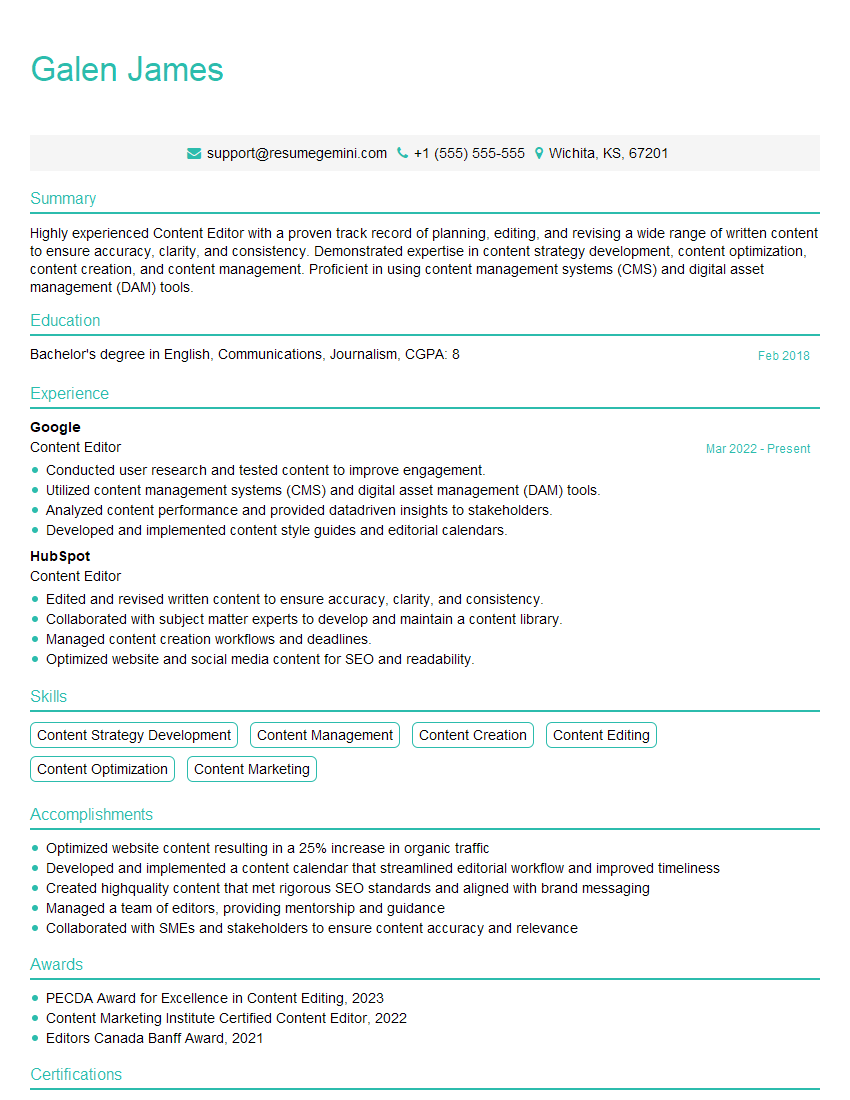
Content Editor Resume Sample
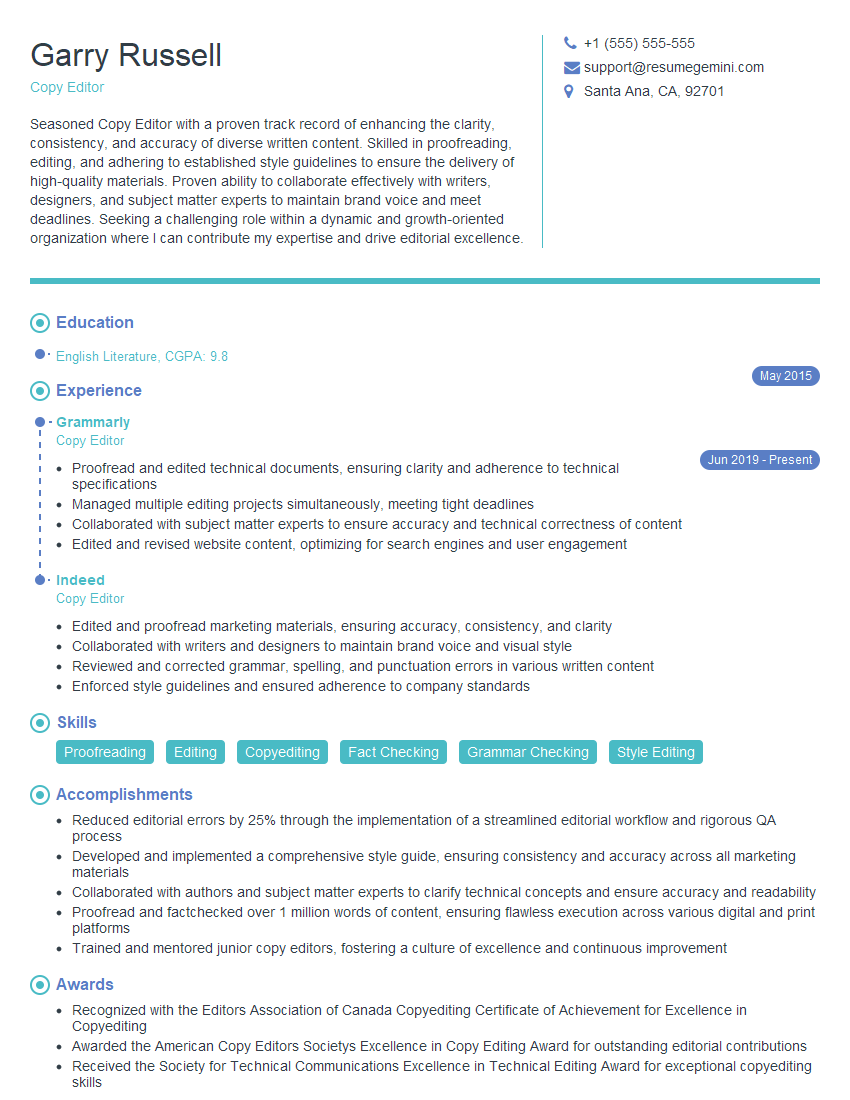
Copy Editor Resume Sample
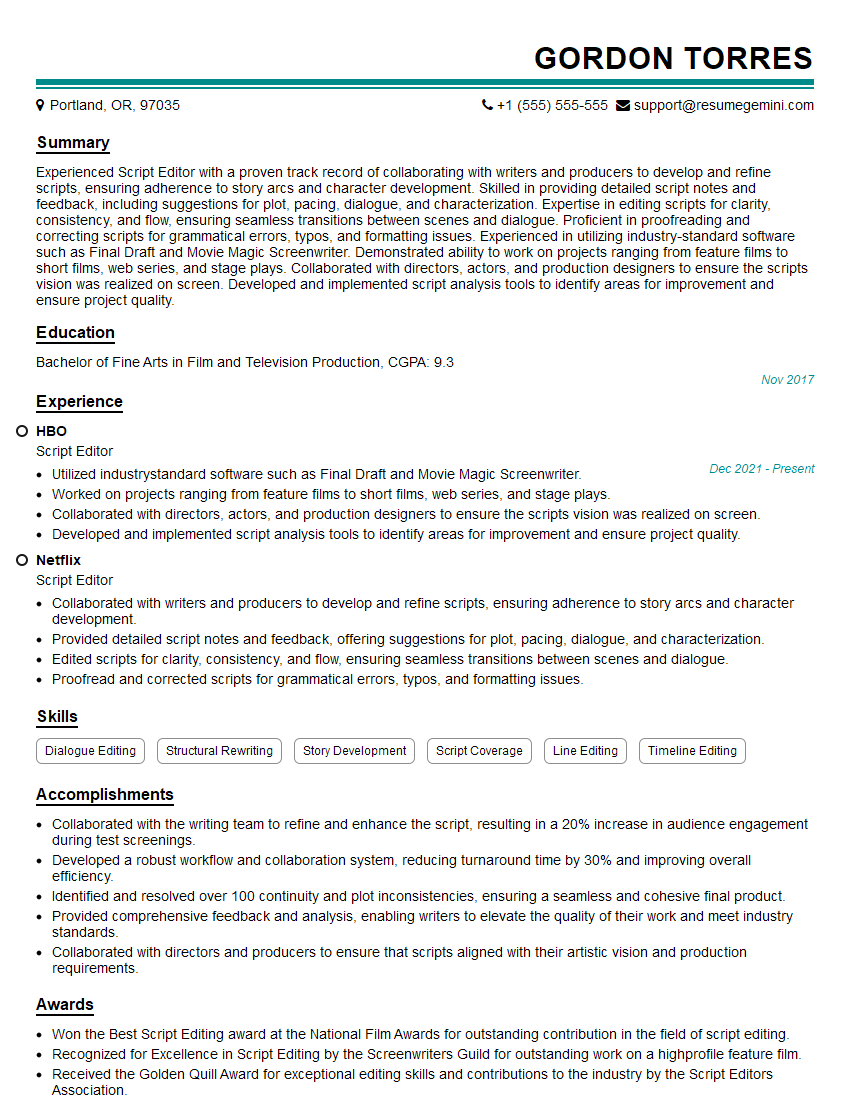
Script Editor Resume Sample
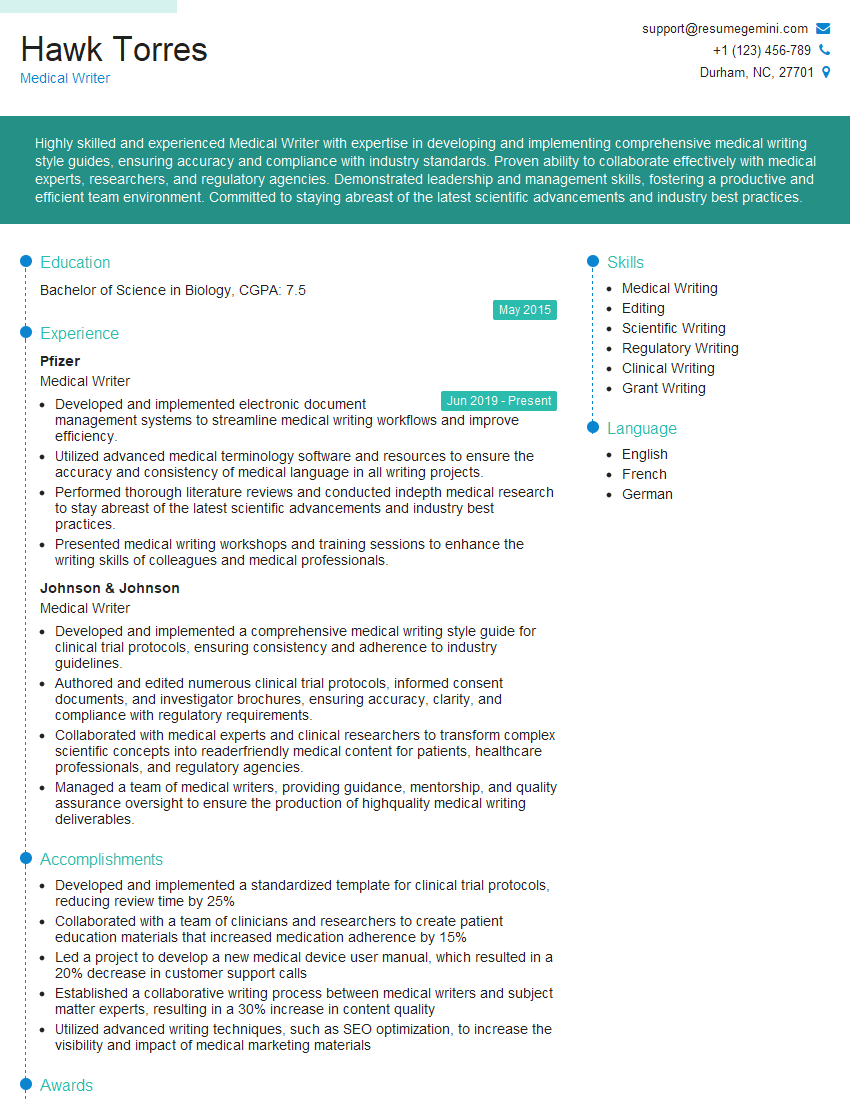
Medical Writer Resume Sample

Technical Writer Resume Sample
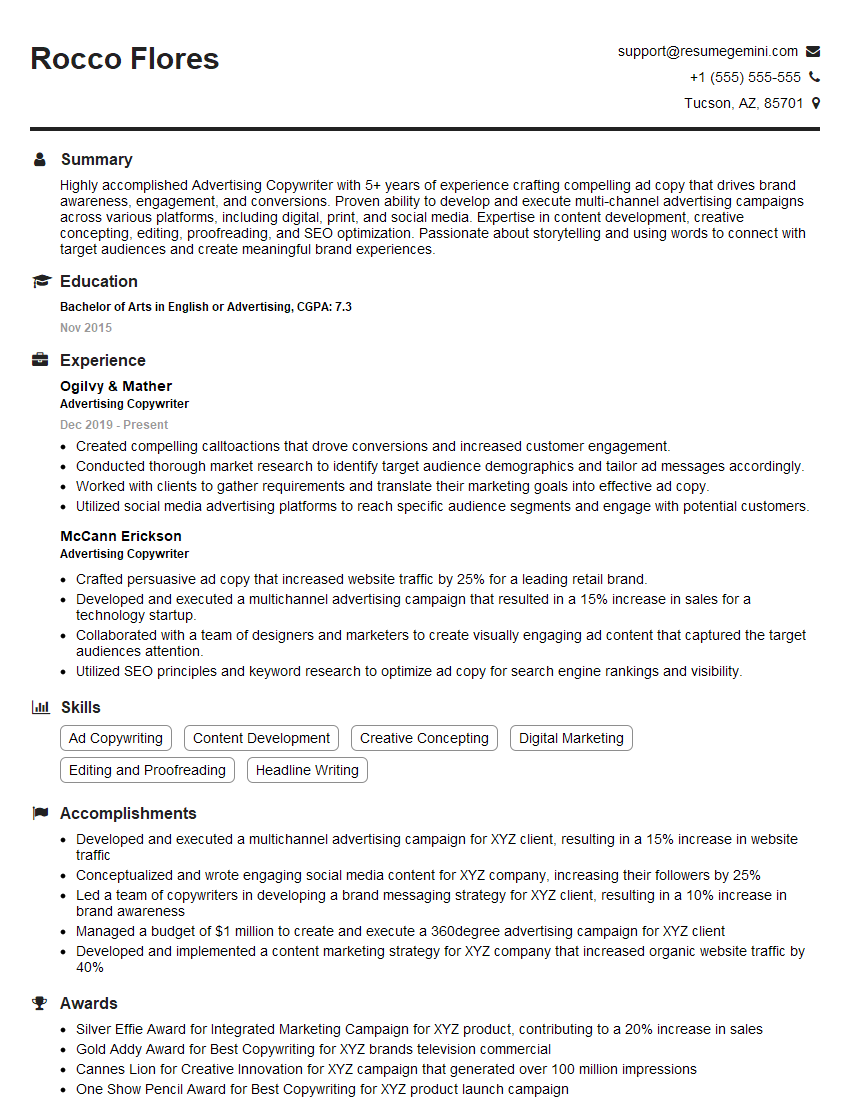
Advertising Copywriter Resume Sample

Copywriter Resume Sample
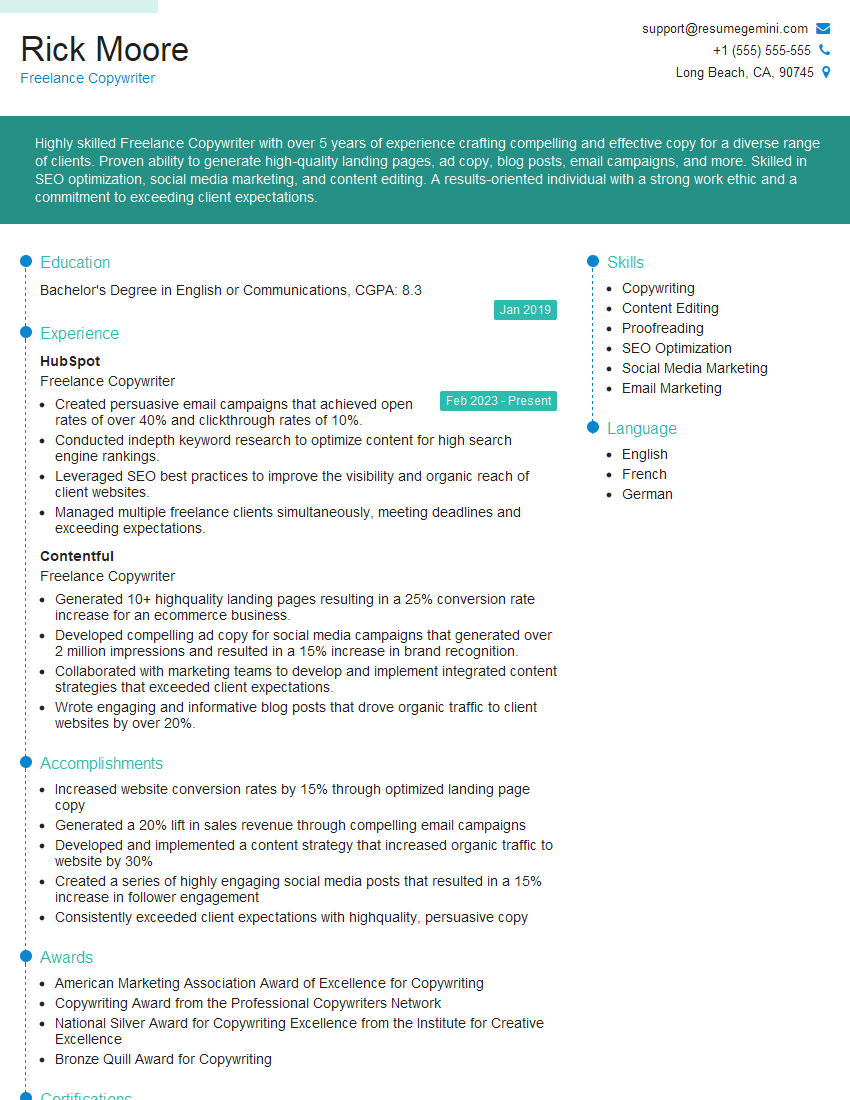
Freelance Copywriter Resume Sample
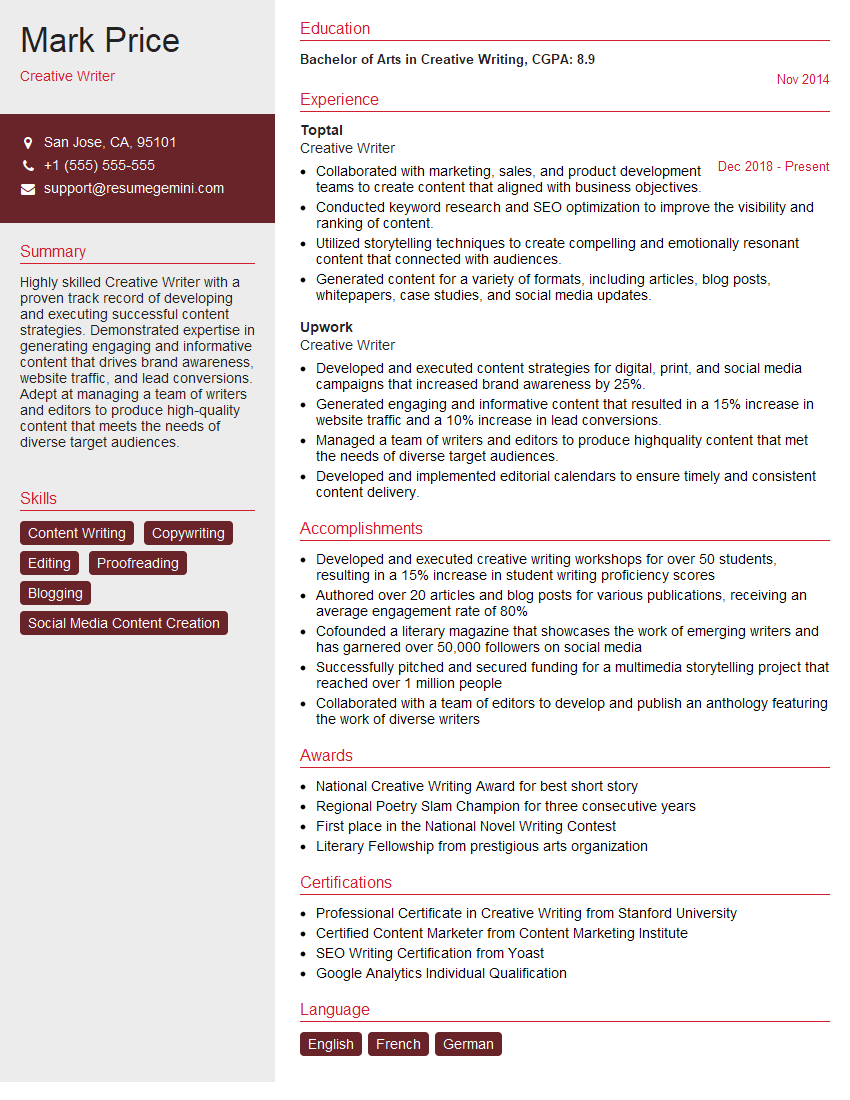
Creative Writer Resume Sample
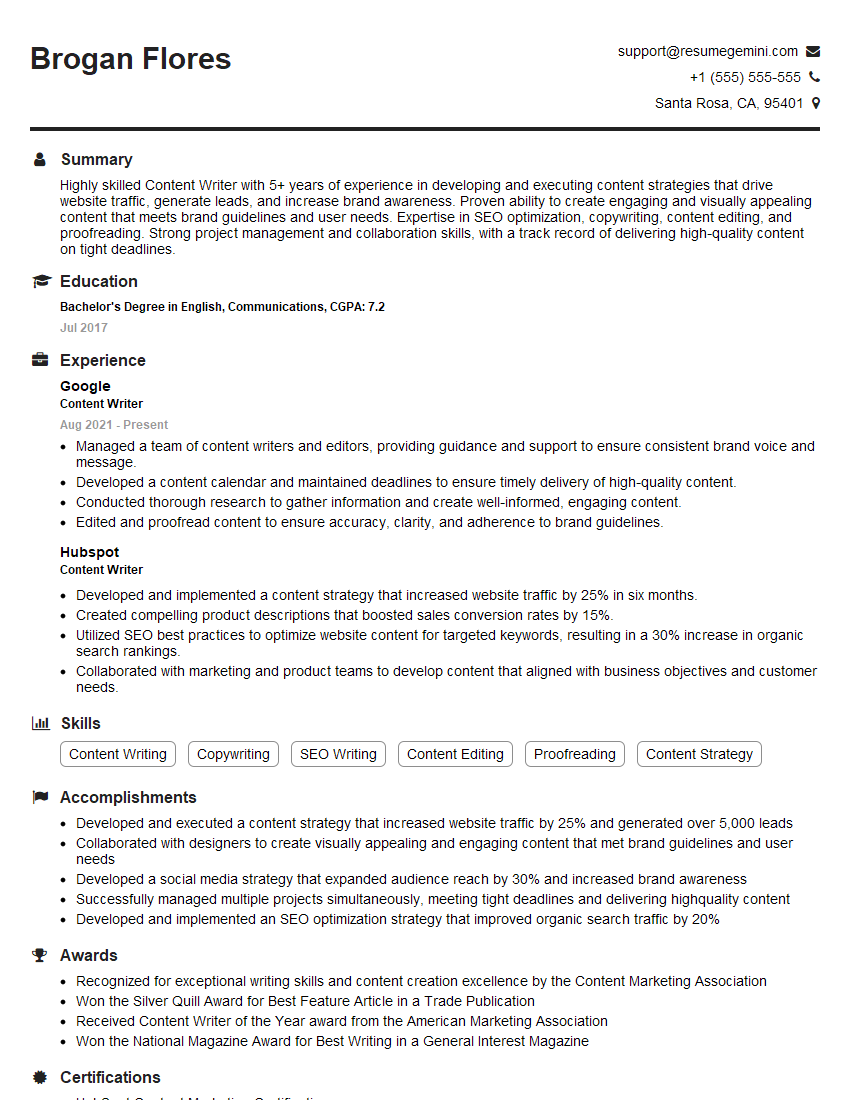
Content Writer Resume Sample
Explore more articles
Users Rating of Our Blogs
Share Your Experience
We value your feedback! Please rate our content and share your thoughts (optional).
What Readers Say About Our Blog
Very informative content, great job.
good