Preparation is the key to success in any interview. In this post, we’ll explore crucial Seaman’s Knots and Rigging interview questions and equip you with strategies to craft impactful answers. Whether you’re a beginner or a pro, these tips will elevate your preparation.
Questions Asked in Seaman’s Knots and Rigging Interview
Q 1. What are the three basic types of knots?
Knots are broadly categorized into three basic types based on their function: Stoppers, Bends, and Hitches.
- Stoppers: These knots prevent rope from running through a system. Examples include the figure-eight knot and overhand knot, primarily used to secure the end of a rope.
- Bends: These are used to join two ropes of similar or different diameters. A bowline is a classic example of a bend, forming a strong loop at the end of a rope without significantly shortening it.
- Hitches: These temporarily secure a rope to an object. Clove hitches and timber hitches are common examples, used to fasten a rope around a post or other fixed point.
Understanding these categories helps in choosing the appropriate knot for a given task, ensuring safety and efficiency.
Q 2. Describe the steps to tie a bowline.
Tying a bowline is straightforward once you understand the technique. Think of it as creating a ‘rabbit coming out of its hole’.
- Form a loop at the working end of the rope (this is the ‘hole’).
- Bring the working end up and across the standing part (the main length of the rope), passing it through the loop you just made.
- Then, pass the working end down through the hole formed between the standing part and the initial loop.
- Tighten the knot gently, ensuring the loop is secure and the knot is snug against the standing part.
Practice makes perfect! Once mastered, the bowline becomes an invaluable knot for creating a reliable loop that won’t slip under load. It’s often used to create a loop for attaching a lifeline or hoisting equipment.
Q 3. Explain the purpose and application of a clove hitch.
The clove hitch is a versatile and easily tied hitch used to secure a rope to a post, ring, or other object. Its simplicity and adaptability make it a favorite among sailors and climbers.
Purpose and Application: The primary purpose is to provide a quick and easily adjustable fastening. It’s not a particularly strong knot on its own, but it’s excellent for temporary situations. For example, it’s frequently used to:
- Secure a mooring line to a cleat.
- Attach a rope to a branch for climbing.
- Temporarily fasten a tarp to a pole.
Important note: Always use a second knot, like a half-hitch, as backup to enhance security when the load is significant.
Q 4. How do you tie a figure-eight knot and what is its purpose?
The figure-eight knot is a simple stopper knot primarily used to prevent a rope from running through a system. Imagine it as a safety net for your rope end.
- Make a loop in the working end of the rope.
- Pass the working end around the standing part, forming a figure-eight shape.
- Pass the working end back through the loop you initially made.
- Tighten the knot gently.
Purpose: This knot is excellent for securing the end of a rope to prevent it from unraveling or slipping. It’s often used as a stopper knot at the end of a climbing rope or as a safety measure before tying another knot.
Q 5. When is a bowline on a bight used?
The bowline on a bight creates two loops at the end of a single rope, essentially making a double-ended bowline. This is incredibly useful when you need two independent loops from a single rope.
Applications:
- Raising a person: Create a secure seat harness with one loop around the waist and the other under the legs.
- Creating a makeshift sling: Ideal for lifting light objects, providing two points of attachment.
- Multiple attachment points: Useful when you need to attach to different points simultaneously.
Remember to thoroughly test the strength of any knot before using it for heavy loads or in critical situations.
Q 6. Describe the differences between a rolling hitch and a timber hitch.
Both the rolling hitch and the timber hitch are hitches used to secure a rope around a spar or cylindrical object; however, they differ significantly in their application and how they grip the object.
- Rolling Hitch: This hitch is designed to slide along the spar, making it useful when you need to adjust the rope’s position easily. It’s frequently used in rigging to adjust tension on lines during sailing or other applications where shifting the attachment point is necessary. It’s not as strong as a timber hitch.
- Timber Hitch: This hitch is a stronger, more secure way of attaching a rope to a cylindrical object. It grips firmly and is more resistant to slipping, making it ideal for hauling or lifting heavy objects. It’s less adaptable than a rolling hitch and not suitable for applications requiring sliding.
The choice depends on the specific task: a rolling hitch for adjustments, a timber hitch for strong, secure attachment.
Q 7. What is a taut-line hitch and where would you use it?
The taut-line hitch is specifically designed to adjust tension on a rope under load and maintain its tightness even as the rope stretches or shrinks with changing temperatures or conditions. Think of it as a self-adjusting knot.
Application: It’s commonly used in:
- Tent lines: To maintain the tautness of guy lines or support ropes for tents, especially in changing weather.
- Guying masts or poles: Providing adjustable tension to support vertical structures.
- Temporary rigging: Where maintaining consistent tension is essential for stability.
Its ability to adjust to tension changes makes it an indispensable knot in outdoor applications where environmental factors impact rope tension.
Q 8. Explain the proper method for securing a load using a round turn and two half hitches.
The round turn and two half hitches is a fundamental knot for securing a load to a post, ring, or other fixed point. It’s simple, reliable, and easily adjustable. Think of it like wrapping a gift – you want the knot to be secure and not slip.
- The Round Turn: Pass the rope around the object you’re securing the load to, creating a loop. Imagine this loop as your first layer of security.
- The First Half Hitch: Take the working end of the rope (the end you’re manipulating) and pass it around the standing part (the main length of the rope) and back through the loop created by the round turn. This creates a small loop that adds to the security.
- The Second Half Hitch: Repeat the process of the first half hitch, passing the working end around the standing part and back through the loop created by the first half hitch. This second half hitch further tightens the knot, making it incredibly secure.
- Tightening: Pull on the standing part of the rope to tighten the entire knot. The round turn provides the main grip, while the two half hitches prevent it from slipping.
Example: Imagine securing a boat to a dock. The round turn would be around the cleat on the dock, and the two half hitches would prevent the boat from slipping.
Q 9. How do you assess the condition of a rope before using it?
Assessing rope condition before use is crucial for safety. Ignoring this could lead to catastrophic equipment failure. Think of it as a pre-flight check for an airplane – vital to ensure everything is in good working order.
- Visual Inspection: Carefully examine the entire length of the rope, looking for any signs of wear, damage, or fraying. Pay special attention to the ends and areas where the rope might have been subjected to significant stress.
- Feel the Rope: Run your hands along the rope, feeling for any stiff or unusually soft spots. A stiff section could indicate internal damage. Soft spots might indicate fiber breakage.
- Check for Abrasions: Look for any abrasions, cuts, or chafing, especially near the ends or where the rope may have rubbed against other objects. These are weaknesses that can easily cause rope failure under load.
- Test the Rope (if possible): If possible and appropriate for the situation, apply a gentle load to the rope to check for any signs of weakness. However, be cautious not to overstress the rope during this test.
Example: A rope used for rock climbing needs a thorough inspection before each climb, checking for any minute damage that could lead to a serious accident.
Q 10. What are the signs of a damaged or weakened rope?
Recognizing signs of damage in a rope is paramount to prevent accidents. A damaged rope is a dangerous rope.
- Fraying: Individual fibers separating from the main body of the rope, indicating weakening of the structure.
- Cuts and Abrasions: Visible breaks or surface damage, potentially reducing the rope’s strength significantly.
- Kinks and Sharp Bends: These create stress points that weaken the rope and can lead to failure under load.
- Discoloration: Unusual color changes could indicate chemical damage or degradation of the rope’s material.
- Stiffness or Softness: A noticeable change in texture or feel might point to internal damage or rot.
- Swelling or Mushiness: These are signs of water damage or rot, compromising the rope’s strength.
Example: A rope showing significant fraying at the end, even if it looks intact elsewhere, should be discarded immediately because it is prone to failure under load.
Q 11. What safety precautions should be taken when working with ropes under tension?
Working with ropes under tension requires strict adherence to safety protocols. It is crucial to never compromise on safety when handling this potentially dangerous situation.
- Proper PPE: Always wear appropriate personal protective equipment (PPE), including gloves, safety glasses, and sturdy footwear. Depending on the situation, a helmet may also be necessary.
- Controlled Movements: Approach the task methodically, making smooth, controlled movements to avoid sudden jerks or strains on the rope.
- Never Underestimate the Load: Always account for unexpected strain or movement; ensure the rope’s working load limit is significantly higher than the expected load.
- Multiple Points of Contact: Use multiple points of contact with the rope whenever possible, preventing it from slipping from your hands.
- Clear Communication: If working in a team, maintain clear communication to coordinate actions and ensure everyone’s safety.
- Never Stand Directly in Line: Never stand in direct line with a rope under tension; a sudden break could cause serious injury.
Example: When lifting heavy equipment, ensuring the rigging is correctly sized and secured to distribute the weight evenly across multiple points is crucial to prevent accidental rope failure.
Q 12. What is the proper way to splice a three-strand rope?
Splicing a three-strand rope is a skilled technique that creates a seamless join stronger than a knot. It’s like weaving intricate braids for added durability.
The process involves several intricate steps and varies depending on the type of splice required (e.g., short splice, long splice). A full description is beyond the scope of this brief answer, but it involves unlaying the strands of each rope end, carefully tucking and interweaving them, and then carefully securing the splice. Specialized tools and considerable practice are required to master the various types of three-strand rope splices.
Example: A long splice would be preferred for applications where minimal bulk is required at the splice, while a short splice might be preferred for its simplicity and speed of creation.
Q 13. Explain different types of wire rope and their applications.
Wire rope, unlike fiber rope, offers exceptional strength and durability, making it ideal for heavy lifting and industrial applications. Different types cater to specific needs.
- 6×7 (6 strands, 7 wires per strand): This construction offers high flexibility and is commonly used in applications requiring frequent bending, such as cranes and elevators.
- 6×19 (6 strands, 19 wires per strand): This offers a balance of strength and flexibility. It’s popular in general rigging and hoisting applications.
- 6×37 (6 strands, 37 wires per strand): This construction provides high strength and resistance to abrasion, suitable for applications with significant wear and tear.
- 8×19 (8 strands, 19 wires per strand): Offers greater flexibility than 6×19 while still retaining high strength. It’s often preferred in applications where tighter bending radii are required.
The choice depends on the application’s specific demands, including the level of strength, flexibility, and resistance to abrasion needed.
Example: A crane would utilize wire rope with high tensile strength and good fatigue resistance, while a winch on a boat might prioritize flexibility to handle frequent winding and unwinding.
Q 14. Describe different types of shackles and their uses.
Shackles are U-shaped metal fasteners with a pin for connecting ropes, chains, or other rigging components. Various types are designed for different applications.
- Bow Shackle: This common type features a curved bow, making it easy to attach to other components. The bow also provides a wider bearing surface, distributing stress effectively.
- Dee Shackle: A D-shaped shackle with a straight pin. It’s strong and durable but can be more difficult to attach than bow shackles.
- Screw Pin Shackle: Features a screw pin that provides better security and prevents accidental opening compared to a standard pin shackle.
- Anchor Shackle: A heavy-duty type typically used in high-stress applications, such as anchoring.
Selecting the right shackle involves considering its working load limit (WLL), material (often high-grade steel), and the application’s specific requirements.
Example: A bow shackle is ideal for quickly connecting a load to a crane hook. A screw pin shackle would be preferable for securing a heavy chain to a winch drum where added security is critical.
Q 15. What are the safety considerations when working at heights using ropes?
Working at heights with ropes demands meticulous attention to safety. It’s not just about the knots; it’s about the entire system – the ropes, the hardware, the anchor points, and most importantly, the human element.
- Proper Training and Certification: This is paramount. Understanding rope handling techniques, fall protection systems, and rescue procedures is non-negotiable. No shortcuts here.
- Anchor Point Inspection: Before even touching the rope, thoroughly inspect the anchor point. Ensure it can withstand the load many times over. Think about potential load shifts and unforeseen circumstances.
- Harness and Fall Arrest System: Always use a full-body harness properly fitted and connected to a reliable fall arrest system. Regular inspections of the harness are crucial. Inspect straps for fraying, stitching, and buckles.
- Redundancy: When safety is critical, using a redundant system, meaning two separate independent ropes or systems, significantly improves safety. This minimizes the risk of a single-point failure.
- Communication: Clear and constant communication between team members is essential. Miscommunication can lead to catastrophic accidents. Assign roles clearly.
- Environmental Factors: Account for weather conditions such as wind, rain, and temperature. These can significantly impact rope strength and your overall safety.
- Regular Inspections: All ropes and equipment must be inspected before each use for wear, tears, cuts, or any sign of damage. Regular maintenance is essential.
For example, imagine working on a tall ship’s rigging. A seemingly minor fray in the rope could cause a devastating fall. Consistent inspection and preventative maintenance avoid such tragedies.
Career Expert Tips:
- Ace those interviews! Prepare effectively by reviewing the Top 50 Most Common Interview Questions on ResumeGemini.
- Navigate your job search with confidence! Explore a wide range of Career Tips on ResumeGemini. Learn about common challenges and recommendations to overcome them.
- Craft the perfect resume! Master the Art of Resume Writing with ResumeGemini’s guide. Showcase your unique qualifications and achievements effectively.
- Don’t miss out on holiday savings! Build your dream resume with ResumeGemini’s ATS optimized templates.
Q 16. How do you inspect rigging hardware for damage?
Rigging hardware inspection is a critical safety procedure. A seemingly small defect can lead to catastrophic failure. We employ a thorough, systematic approach:
- Visual Inspection: Begin with a careful visual examination of each component. Look for signs of wear, such as cracks, dents, corrosion, deformation, or excessive wear on shackle pins. Check for any signs of stretching or twisting.
- Load Rating Check: Verify that each piece of hardware is rated for the load it will carry. Always use hardware with a significantly higher working load limit (SWL) than the expected load. This provides a safety margin.
- Testing: In some cases, non-destructive testing (NDT) may be necessary, especially if there’s any doubt about the integrity of the hardware. This might involve methods such as magnetic particle inspection or ultrasonic testing.
- Documentation: Maintain detailed records of each inspection, including the date, condition of the hardware, and any remedial actions taken. This creates an auditable trail.
Imagine inspecting a chain hoist. A small crack in a link might go unnoticed with a cursory glance, but a thorough inspection will reveal this potential failure point, preventing an accident.
Q 17. What are the different types of slings used in rigging?
Various sling types cater to specific lifting needs. The choice depends on factors like load characteristics, weight, and geometry.
- Polyester Web Slings: These are versatile, durable, and relatively lightweight. They’re ideal for many general lifting applications. They come in various widths and lengths.
- Nylon Web Slings: Similar to polyester slings, but offer slightly better shock absorption, making them suitable for applications involving dynamic loads.
- Chain Slings: Robust and resistant to abrasion, chain slings are excellent for heavier loads and harsh environments. Regular inspection for elongation or damage is crucial. Different grades of chain offer varying strength.
- Wire Rope Slings: Strong and durable, wire rope slings are commonly used for heavier loads and in challenging environments. However, they require careful inspection for broken wires, kinks, or corrosion.
- Round Slings: These are often used for lifting cylindrical objects, providing a more even load distribution.
For example, a delicate piece of machinery might require a soft, padded polyester sling to avoid damage. A heavy steel beam, however, will need the strength of a chain sling.
Q 18. Describe the correct procedure for lifting and securing a heavy load.
Lifting and securing heavy loads requires a methodical approach to ensure safety and prevent accidents.
- Pre-Lift Planning: Assess the load’s weight, dimensions, and center of gravity. Plan the lift path, ensuring ample clearance and identifying potential obstacles.
- Equipment Inspection: Inspect all equipment – cranes, slings, and rigging hardware – for any damage or defects. Ensure equipment load ratings exceed the weight of the load significantly.
- Secure Load: Attach the slings to the load properly, distributing the weight evenly. Avoid sharp edges and points that could damage the slings.
- Controlled Lift: Initiate the lift smoothly and slowly, monitoring the load for any unusual movement or instability. Use taglines if needed for extra control.
- Placement: Carefully lower and position the load at its intended location. Secure it according to regulations and best practices.
- Post-Lift Inspection: Inspect the equipment again after the lift, looking for damage or wear.
Imagine lifting a large engine block for installation. Careful planning, including the correct sling placement and crane positioning, prevents damage and minimizes risk.
Q 19. How do you calculate the safe working load of a rope or sling?
Calculating the safe working load (SWL) is critical for safety. It’s not a simple calculation; it depends on multiple factors.
- Manufacturer’s Data: The manufacturer provides SWL data for specific ropes and slings, usually expressed in kilograms or pounds. This is always the starting point.
- Material Degradation: Age, wear and tear, UV exposure, chemical exposure, and other environmental factors reduce a rope or sling’s strength. Regular inspection and retirement policies are crucial to account for this.
- Angle of Lift: Lifting at an angle reduces the effective SWL. The sharper the angle, the greater the reduction. Always consult tables or formulas that provide correction factors for angled lifts.
- Safety Factor: A significant safety factor is always applied. This means the actual breaking strength of the rope or sling is several times greater than the SWL. This accounts for unforeseen circumstances.
For instance, a rope may have a manufacturer’s breaking strength of 1000kg, but its SWL might be just 200kg due to the safety factor and to account for potential degradation.
Q 20. What is the difference between static and dynamic rope?
Static and dynamic ropes have fundamentally different properties and applications.
- Static Rope: A static rope is designed for minimal elongation under load. It’s used in applications where minimal stretch is critical, such as supporting loads, creating anchor points, or in rescue systems where a precise length is needed. Think of it as a stiff, strong wire.
- Dynamic Rope: A dynamic rope is designed to stretch significantly under load. This stretching characteristic absorbs energy during a fall, preventing sudden shock loads. It’s primarily used in climbing, rappelling, and other applications where falls are possible. Think of it as a more elastic, shock-absorbing cord.
Using a static rope in a climbing application would be dangerous, as the lack of stretch could result in a greater impact force in a fall. Conversely, using a dynamic rope for supporting heavy loads would be inappropriate because the stretch could cause instability.
Q 21. What are the common causes of rope failure?
Rope failure can stem from various causes, often interconnected.
- Overloading: Exceeding the SWL is a primary cause. This can lead to sudden and catastrophic failure.
- Abrasion: Friction against sharp objects or rough surfaces wears down the rope fibers, weakening the rope over time.
- Chemical Exposure: Contact with certain chemicals can degrade the rope fibers, compromising their strength and longevity.
- UV Degradation: Prolonged exposure to sunlight weakens the fibers of many rope materials.
- Improper Knots: Incorrectly tied or poorly maintained knots can create weak points in the rope, leading to failure.
- Manufacturing Defects: In rare instances, manufacturing defects can weaken the rope, rendering it unsafe.
For example, a rope used repeatedly to lift heavy loads without proper inspection will likely experience wear and tear leading to eventual failure. Regular maintenance and adhering to the SWL are critical for preventing this.
Q 22. Describe different types of blocks and tackles.
Blocks and tackles are fundamental components in rigging, used to redirect and amplify force. They consist of sheaves (pulleys) within blocks, arranged in systems to increase mechanical advantage. Different types are categorized by the number of sheaves and their arrangement.
- Single Block: A single sheave in a block, primarily used for changing direction of a rope. It doesn’t increase mechanical advantage.
- Double Block: Two sheaves in a block, commonly used in conjunction with another block to form a tackle.
- Gun Tackle: A simple tackle using one fixed and one movable block, providing a mechanical advantage of 2:1. Think of it as a basic pulley system.
- Luff Tackle: This combines a single and a double block, offering a mechanical advantage of 3:1. It’s more complex but provides greater lifting power.
- Three-Fold Purchase: Uses two double blocks, creating a system with a mechanical advantage of 5:1 or 6:1 depending on the arrangement. This is ideal for heavier loads.
The arrangement of blocks, and the number of rope parts supporting the load, determine the system’s effectiveness and mechanical advantage.
Q 23. How do you calculate the mechanical advantage of a block and tackle system?
Calculating the mechanical advantage (MA) of a block and tackle system is straightforward: count the number of rope parts supporting the load. This number is your MA. For example:
- Gun Tackle (1 fixed, 1 movable block): Two rope parts support the load, resulting in a 2:1 MA.
- Luff Tackle (1 single, 1 double block): Three rope parts support the load, yielding a 3:1 MA.
- Three-Fold Purchase: Typically five or six rope parts supporting the load depending on the setup, leading to a 5:1 or 6:1 MA.
This calculation assumes ideal conditions – no friction or rope stretch. In reality, friction in the sheaves reduces the actual mechanical advantage, particularly in complex systems.
Q 24. What are the safety regulations regarding working with rigging equipment?
Safety is paramount when working with rigging. Regulations vary by location and industry, but common themes include:
- Regular Inspections: Thorough inspections of all rigging components (ropes, blocks, shackles, etc.) before each use are mandatory. Check for wear, damage, or corrosion.
- Proper Load Limits: Never exceed the working load limit (WLL) of any component. This information is usually stamped on the equipment.
- Competent Personnel: Only trained and certified personnel should handle rigging operations. Improper handling leads to accidents.
- Personal Protective Equipment (PPE): Always use appropriate PPE, including gloves, safety harnesses, and hard hats.
- Safe Work Practices: Follow established procedures and guidelines for rigging, including proper knot tying, securing loads, and communication among the team.
- Emergency Procedures: Develop and practice emergency procedures for handling unexpected events such as equipment failure.
Adhering to these safety regulations minimizes risk and prevents accidents.
Q 25. How do you handle an emergency situation involving damaged rigging?
In a rigging emergency involving damaged equipment, immediate action is critical:
- Assess the Situation: Evaluate the extent of the damage and the potential hazards. Is the load secure? Are personnel in danger?
- Secure the Load: If the load is unstable, take immediate steps to secure it using available resources, ensuring personnel safety.
- Evacuate the Area: Clear the area of all personnel to prevent injuries from falling objects or other hazards.
- Notify Relevant Parties: Alert supervisors, emergency services, and other relevant personnel as needed.
- Do Not Attempt Repairs: Damaged rigging should never be repaired on-site. Replace the damaged components immediately.
- Investigate the Cause: After the immediate danger has passed, conduct a thorough investigation to determine the cause of the damage and prevent future occurrences.
Remember, safety is the top priority. Never compromise safety for speed or expediency.
Q 26. Explain the importance of proper rope maintenance.
Proper rope maintenance is crucial for safety and longevity. Neglecting maintenance increases the risk of rope failure. Key aspects include:
- Regular Inspections: Inspect ropes regularly for wear, cuts, abrasions, fraying, and signs of internal damage. Pay close attention to areas subjected to high stress or friction.
- Cleaning: Keep ropes clean and free of dirt, grime, and chemicals that can weaken the fibers.
- Storage: Store ropes in a dry, cool place, away from direct sunlight and sources of heat or chemicals. Avoid coiling ropes tightly, as this can cause damage.
- Proper Handling: Avoid dragging ropes across rough surfaces or sharp objects. Use rope protectors when necessary.
- Retirement: Ropes should be retired when they reach the end of their service life or show signs of significant wear and tear. Don’t risk using a compromised rope.
Regular maintenance ensures that ropes remain strong and reliable, contributing to a safer work environment.
Q 27. Describe your experience with various types of rigging equipment.
My experience encompasses a wide range of rigging equipment, from simple blocks and tackles to complex systems used in heavy lifting and marine applications. I’ve worked extensively with:
- Various types of ropes: Manila, synthetic (nylon, polyester, etc.), wire ropes, each with specific strengths and limitations depending on the application.
- Shackles, rings, and swivels: I am proficient in selecting appropriate hardware for different load capacities and working environments.
- Lifting Beams and Spreader Bars: I have experience in assembling and using these specialized components for safe and efficient lifting.
- Winches and Hoists: I understand the principles of operation and safety procedures for using these power-assisted rigging tools.
- Specialized rigging for marine applications: This includes experience with mooring lines, anchor systems, and various sailing rigging components.
My practical experience spans multiple projects, requiring expertise in selecting appropriate equipment, ensuring safe operation, and resolving challenges in the field.
Key Topics to Learn for Seaman’s Knots and Rigging Interview
- Basic Knots: Understanding the purpose and application of essential knots like the Bowline, Clove Hitch, Figure Eight, and Sheet Bend. Practice tying them quickly and securely under pressure.
- Advanced Knots: Familiarize yourself with more complex knots used in rigging, such as the Ashley Bend, Rolling Hitch, and various splices. Be prepared to discuss their strengths and weaknesses in different situations.
- Rigging Techniques: Mastering the principles of proper rigging, including safe working loads, load distribution, and the selection of appropriate materials for different applications. Consider studying different types of rigging hardware.
- Safety Procedures: Demonstrate a thorough understanding of safety regulations and best practices related to knot tying and rigging. Be prepared to discuss risk assessment and hazard mitigation.
- Troubleshooting: Develop your problem-solving skills by considering scenarios where knots fail or rigging needs adjustments. Discuss how you would identify the problem and implement a solution safely and efficiently.
- Rope Types and Properties: Understand the different types of rope used in maritime settings (e.g., synthetic vs. natural fibers), their strengths, weaknesses, and appropriate applications. Know how to assess rope condition for wear and tear.
- Wire Rope and Slinging: If applicable to the role, demonstrate knowledge of wire rope construction, safety factors, and proper slinging techniques for lifting heavy loads.
- Practical Application: Think of real-world scenarios where you’ve used or observed the use of these knots and rigging techniques. Be prepared to discuss your experience and the challenges you may have encountered.
Next Steps
Mastering Seaman’s Knots and Rigging is crucial for career advancement in maritime industries, showcasing your practical skills and commitment to safety. A strong resume is your first step towards landing your dream role. To maximize your job prospects, create an ATS-friendly resume that highlights your expertise and experience effectively. ResumeGemini is a trusted resource that can help you build a professional and impactful resume, optimized for applicant tracking systems. Examples of resumes tailored to Seaman’s Knots and Rigging roles are available to guide you.

Marine Engineer Resume Sample

Marine Surveyor Resume Sample

Captain Resume Sample

Crane Operator Resume Sample

Deckhand Resume Sample

First Mate Resume Sample

Second Mate Resume Sample

Third Mate Resume Sample

Rigger Resume Sample
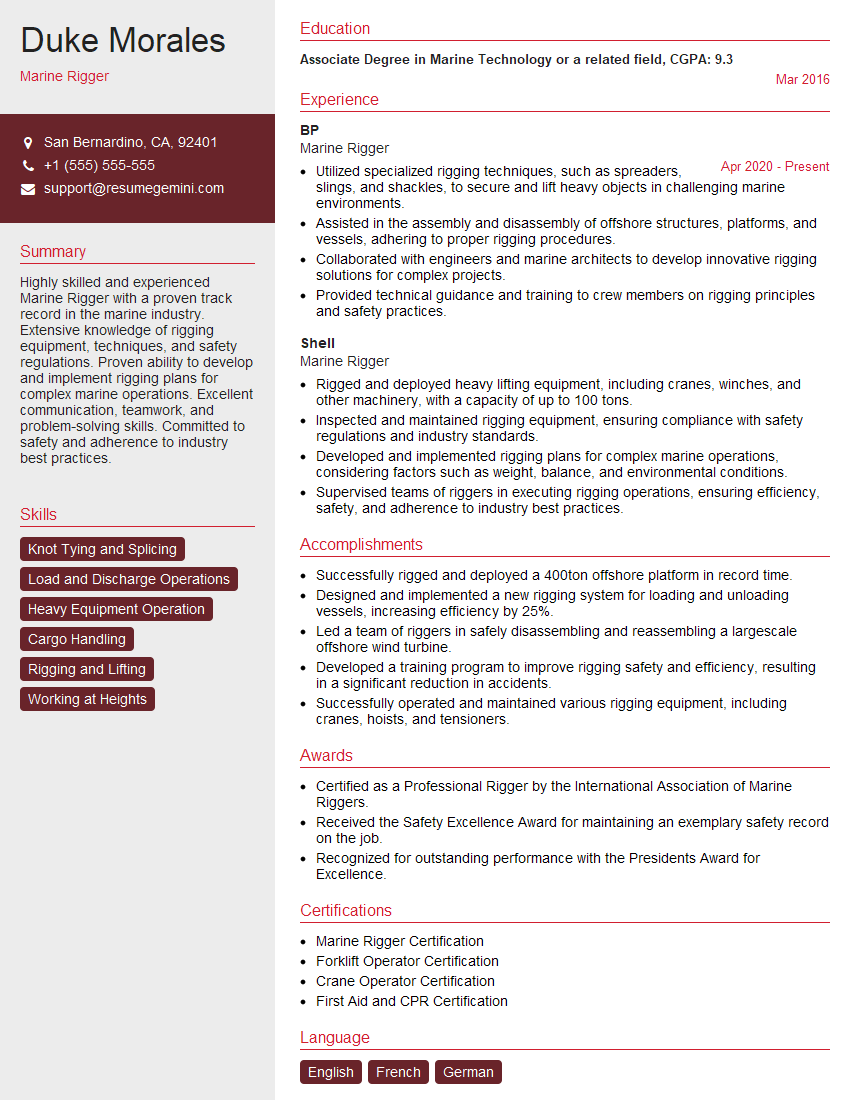
Marine Rigger Resume Sample

Able Seaman Resume Sample

Bosun Resume Sample

Deck Officer Resume Sample
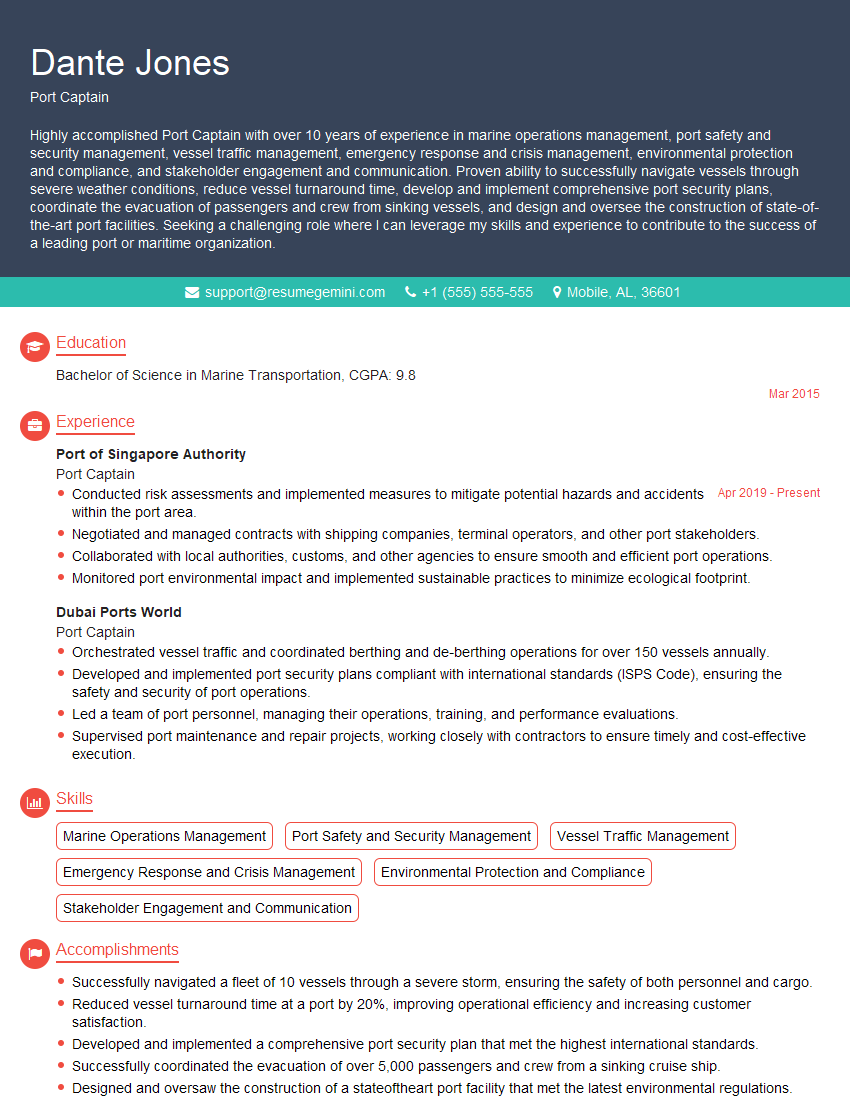
Port Captain Resume Sample

Tugboat Captain Resume Sample

Sailing Master Resume Sample
Explore more articles
Users Rating of Our Blogs
Share Your Experience
We value your feedback! Please rate our content and share your thoughts (optional).
What Readers Say About Our Blog
Very informative content, great job.
good