Every successful interview starts with knowing what to expect. In this blog, we’ll take you through the top Security Threat Intelligence and Analysis interview questions, breaking them down with expert tips to help you deliver impactful answers. Step into your next interview fully prepared and ready to succeed.
Questions Asked in Security Threat Intelligence and Analysis Interview
Q 1. Explain the difference between strategic, tactical, and operational threat intelligence.
The three levels of threat intelligence – strategic, tactical, and operational – differ primarily in their scope, timeframe, and application. Think of it like military planning: strategic is the big picture, tactical is the battle plan, and operational is the moment-to-moment execution.
- Strategic Threat Intelligence: This focuses on long-term trends and high-level threats affecting an entire organization or industry. It helps establish overall security posture and inform long-term resource allocation. For example, analyzing the rising trend of ransomware attacks targeting healthcare providers would fall under strategic intelligence. This informs the creation of overarching security strategies.
- Tactical Threat Intelligence: This addresses specific threats and vulnerabilities relevant to immediate operational goals. It focuses on the ‘how’ of mitigating identified threats, often concerning specific campaigns or actors. An example might be identifying a specific malware variant actively targeting a company’s systems. This guides incident response and patching strategies.
- Operational Threat Intelligence: This focuses on real-time information and actionable insights to directly support ongoing operations and incident response. It’s the most granular level, using data from various sources to rapidly address immediate security issues. For instance, detecting a live intrusion attempt using network monitoring tools and reacting immediately to contain the threat falls under operational intelligence.
The key difference lies in the time horizon and granularity. Strategic is long-term and broad, tactical is mid-term and specific, and operational is short-term and highly detailed.
Q 2. Describe the intelligence cycle and its relevance to threat intelligence.
The intelligence cycle is a structured process for collecting, analyzing, and disseminating intelligence. It’s a continuous loop, vital for effective threat intelligence. The cycle typically consists of these phases:
- Planning and Direction: Identifying intelligence needs and defining the scope of the intelligence effort. This might involve determining the key threats to the organization.
- Collection: Gathering raw data from various sources (more on this later). This is where information from different channels gets pulled together.
- Processing: Transforming raw data into usable intelligence. This involves cleaning, organizing, and enriching data from various sources.
- Analysis: Interpreting processed information to understand threats, vulnerabilities, and risks. This often involves identifying patterns, and linking different pieces of information.
- Production: Creating reports, briefings, and alerts based on the analysis. The resulting intelligence gets disseminated to the relevant teams and stakeholders.
- Dissemination: Sharing the intelligence with relevant stakeholders within the organization, enabling quick response and mitigation.
- Feedback: Evaluating the effectiveness of the intelligence and the intelligence cycle itself to improve future efforts. The cycle repeats, constantly refining its process based on effectiveness and new threats.
Relevance to Threat Intelligence: The intelligence cycle is crucial for threat intelligence because it provides a structured framework for turning raw data into actionable intelligence, enabling timely mitigation of threats. Without a structured approach, relevant threat information might be missed or handled inefficiently.
Q 3. What are the key sources of threat intelligence?
Threat intelligence comes from a multitude of sources, categorized as open-source, closed-source, and internal sources.
- Open-Source Intelligence (OSINT): This includes publicly available information from websites, forums, social media, news articles, and research papers. Think of it like detective work, using publicly available information to build a picture of threats.
- Closed-Source Intelligence: This involves information from private sources, such as commercial threat intelligence providers, government agencies, and industry partnerships. Think of it as paying for specialized insights from experts.
- Internal Sources: This includes log data from security tools, incident reports, vulnerability scans, and security audits within your own organization. Think of it as your organization’s internal records of threats and vulnerabilities.
Examples: OSINT might include a blog post detailing a new malware variant, closed-source information could be a threat report from a security vendor, and internal sources could include logs showing suspicious network activity from a specific IP address.
Q 4. How do you validate threat intelligence?
Validating threat intelligence is critical to ensure its accuracy and reliability. False positives can waste valuable time and resources, while inaccurate information can lead to ineffective security measures. Here’s a process for validation:
- Source Verification: Evaluate the credibility and trustworthiness of the source. Is it a reputable organization or individual? Has it been accurate in the past?
- Data Triangulation: Corroborate information from multiple independent sources. If several sources point to the same threat, it increases confidence in its validity.
- Technical Validation: For technical indicators like IP addresses or malware hashes, verify them through independent tools and techniques. This might involve running a hash against a malware database.
- Contextual Analysis: Analyze the intelligence within its context. Does it align with other threat information or observed trends? Does it seem plausible based on your organization’s risk profile?
- Impact Assessment: Assess the potential impact of the threat if it were to materialize. Does it pose a significant risk to your organization? This assessment helps in prioritizing the validated intelligence.
For example, if a threat report claims a specific vulnerability exists, validating it would involve confirming the vulnerability exists in your software using a vulnerability scanner, and possibly independently verifying with vulnerability databases.
Q 5. Explain the concept of threat modeling.
Threat modeling is a structured process for identifying potential security vulnerabilities in a system or application. It’s a proactive approach to security, helping organizations identify weaknesses before attackers can exploit them. Think of it like a security ‘stress test’ for a system.
The process typically involves:
- Defining the scope: Identifying the system or application to be modeled.
- Identifying assets: Listing the valuable data and components of the system.
- Identifying threats: Listing potential attackers and their motivations.
- Identifying vulnerabilities: Identifying weaknesses that could be exploited by attackers.
- Determining likelihood and impact: Assessing the probability and consequences of each threat.
- Developing mitigation strategies: Creating strategies to reduce risks.
Different threat modeling methodologies exist, like STRIDE (Spoofing, Tampering, Repudiation, Information Disclosure, Denial of Service, Elevation of Privilege) and PASTA (Process for Attack Simulation and Threat Analysis). The goal is to proactively identify vulnerabilities and create mitigation strategies before they can be exploited by attackers.
Q 6. What are common threat intelligence frameworks (e.g., Diamond Model, Lockheed Martin Cyber Kill Chain)?
Several frameworks help structure threat intelligence analysis. Two prominent ones are:
- The Diamond Model: This model describes the four key elements of a cyber attack: Adversary, Capability, Infrastructure, and Victim. It provides a framework for understanding the relationships between these elements. Visualizing these four elements helps to build a holistic picture of the threat.
- The Lockheed Martin Cyber Kill Chain: This is a seven-stage model that describes the typical phases of a cyber attack: Reconnaissance, Weaponization, Delivery, Exploitation, Installation, Command and Control, and Actions on Objectives. Understanding this timeline helps predict attacker behavior and create mitigation strategies at each stage. It is widely used for incident response and threat hunting.
Using these frameworks allows analysts to systematically analyze threats, identify patterns, and develop effective mitigation strategies. They provide a common language and structure for sharing intelligence effectively.
Q 7. How do you prioritize threats based on their likelihood and impact?
Prioritizing threats requires a systematic approach, balancing likelihood and impact. A simple way to visualize this is using a risk matrix.
Steps to Prioritize Threats:
- Assess Likelihood: Determine the probability of each threat occurring. This considers factors such as attacker capability, vulnerability existence, and attack vectors.
- Assess Impact: Determine the potential consequences if the threat materializes. This considers factors such as data loss, financial damage, reputational damage, and operational disruption.
- Create a Risk Matrix: Plot each threat based on its likelihood and impact. High likelihood and high impact threats should be prioritized first.
- Prioritize based on Risk Score: Calculate a risk score (e.g., likelihood x impact) for each threat, then prioritize them from highest risk score to lowest.
Example: A threat with high likelihood (e.g., readily available exploit for a known vulnerability) and high impact (e.g., total data loss) will naturally have a higher priority than a threat with low likelihood (e.g., a highly complex attack) and low impact (e.g., minor service interruption).
Q 8. Describe your experience with threat intelligence platforms and tools.
My experience with threat intelligence platforms and tools spans several years and encompasses a wide range of solutions. I’ve worked extensively with platforms like ThreatConnect, MISP (Malware Information Sharing Platform), and Splunk Enterprise Security, leveraging their capabilities for data ingestion, analysis, and visualization. I’m proficient in using these platforms to collect, correlate, and analyze diverse threat data, including IOCs (Indicators of Compromise), malware reports, vulnerability information, and open-source intelligence. For example, in a recent engagement, I utilized ThreatConnect to build a comprehensive threat model for a client, integrating data from various sources like their internal SIEM and external threat feeds. This allowed us to proactively identify and mitigate potential risks.
Beyond commercial platforms, I’m also comfortable working with open-source tools like TheHive and Cortex, which offer powerful capabilities for collaborative threat hunting and analysis. My expertise extends to integrating these tools into existing security infrastructures to enhance the overall threat intelligence capabilities of an organization. This includes configuring data flows, developing custom scripts for automation, and building custom dashboards for effective visualization and reporting.
Q 9. How do you communicate threat intelligence findings to technical and non-technical audiences?
Communicating threat intelligence effectively requires tailoring the message to the audience. For technical audiences, I use precise language, including specific IOCs, technical details about vulnerabilities, and malware analysis reports. I might present information in a format they readily understand, such as a technical report detailing the attack chain or a presentation showcasing specific malware analysis results. For instance, I’d describe a specific exploit using its CVE ID and explain the technical aspects of the vulnerability and the remediation steps.
With non-technical audiences, I focus on the big picture, using clear, concise language and avoiding jargon. I emphasize the business impact of the threats, using relatable analogies and visualizations to communicate the risks effectively. For example, I might explain a phishing campaign by comparing it to a burglar trying to trick someone into opening their front door. I prioritize providing actionable recommendations, focusing on steps they can take to protect themselves or the organization.
Q 10. Explain the concept of Indicators of Compromise (IOCs) and how they are used.
Indicators of Compromise (IOCs) are essentially pieces of evidence that suggest a compromise has occurred or is underway within a system or network. Think of them as fingerprints left behind by an attacker. They can be various types of data, such as:
- IP addresses: The source or destination IP address of malicious traffic.
- Domain names: Malicious websites used in attacks.
- Hashes (MD5, SHA1, SHA256): Unique identifiers for malware files.
- URLs: Links to malicious websites or phishing pages.
- File paths: Locations of malicious files on a compromised system.
IOCs are used to detect, investigate, and respond to security incidents. Security tools can be configured to monitor for these IOCs, triggering alerts when they are encountered. By analyzing IOCs, security analysts can understand the nature of an attack, identify affected systems, and take steps to contain and remediate the threat. For example, if a system is communicating with a known malicious IP address listed in a threat intelligence feed, it triggers an alert and allows investigation to determine if compromise has occurred.
Q 11. How do you identify and analyze malware samples?
Identifying and analyzing malware samples involves a multi-step process. First, I ensure the sample is safely contained within a sandboxed environment to prevent it from causing harm. Then, I use a combination of static and dynamic analysis techniques.
Static analysis involves examining the malware without executing it. This includes analyzing the file’s metadata, headers, and code using tools like PEiD (for Windows executables) or strings to uncover potential clues. I might also use disassemblers to reverse-engineer the code, looking for malicious functions or suspicious behavior.
Dynamic analysis involves executing the malware in a controlled environment and observing its behavior. This can be done using sandboxes like Cuckoo Sandbox or Hybrid Analysis, which provide detailed reports on the malware’s actions, network connections, and registry modifications. The sandbox reports help in characterizing its function – data exfiltration, ransomware encryption etc. and in identifying additional IOCs.
Throughout this process, I utilize various techniques to understand the malware’s functionality and its potential impact. This might involve using debuggers, packet sniffers, and other security tools to obtain a full picture of the malware’s behavior and capabilities.
Q 12. Describe your experience with open-source intelligence (OSINT) gathering.
My experience with open-source intelligence (OSINT) gathering is extensive. I regularly use various tools and techniques to collect information from publicly available sources, including:
- Search engines: Google, Bing, DuckDuckGo etc for finding relevant information related to threat actors, campaigns and vulnerabilities.
- Social media platforms: Twitter, Facebook, LinkedIn etc to identify potential threats or gather information about threat actors.
- Pastebins and forums: Websites like Pastebin and various underground forums to find leaked credentials, malware samples, and other sensitive information. This information needs to be analyzed cautiously and within legal and ethical boundaries.
- Threat intelligence platforms: Platforms that aggregate and analyze OSINT data, providing valuable insights into emerging threats.
I’m adept at using advanced search operators and techniques to refine my searches and identify relevant information quickly and efficiently. For example, during a recent investigation, OSINT research led to the identification of the infrastructure used by a threat actor group, allowing us to develop signatures to block their future activities.
Q 13. How do you handle false positives in threat intelligence?
False positives are a common challenge in threat intelligence. These are alerts or indicators that suggest a threat, but are actually benign. Handling them effectively requires a methodical approach:
- Contextual analysis: Carefully review the alert and its associated IOCs, considering the source and the context in which it was generated. Ask yourself: Does this fit with other information I know? Is this a known false positive from this particular source?
- Reputation analysis: Investigate the reputation of the flagged entity (IP, domain, etc.) using tools such as VirusTotal. If multiple reputable sources confirm the alert, the likelihood of it being a true positive increases.
- Manual verification: If the evidence remains inconclusive, I manually investigate the alert, potentially examining network traffic or logs to determine whether malicious activity occurred.
- Feedback loops: Maintaining feedback loops with threat intelligence platforms and other security tools helps improve their accuracy and reduce the number of false positives over time. Reporting false positives helps refine the system’s understanding and detection parameters.
By applying these steps, I strive to minimize the impact of false positives while ensuring that genuine threats are not overlooked.
Q 14. What are the ethical considerations in collecting and using threat intelligence?
Ethical considerations are paramount in threat intelligence. It’s crucial to ensure that all activities comply with relevant laws and regulations. This includes:
- Legal compliance: Adhering to laws related to data privacy (GDPR, CCPA, etc.), computer crime, and surveillance.
- Privacy protection: Respecting individuals’ privacy rights and avoiding the collection or use of personal data without consent. Anonymization and aggregation techniques are vital.
- Transparency and disclosure: Being transparent about data collection methods and sharing practices with relevant stakeholders. Being upfront about how OSINT data is gathered and the methods applied.
- Attribution and responsibility: Carefully considering the implications of attributing attacks to specific actors and avoiding making unsubstantiated claims. Understanding the implications of the analyses and conclusions presented.
- Avoiding misuse: Preventing the misuse of threat intelligence for malicious purposes, such as targeting individuals or organizations without justification. Ensuring that the collected data isn’t used to harm or violate the rights of individuals or organizations.
By adhering to these principles, I ensure that my work is conducted ethically and responsibly, upholding the integrity and trust within the security community.
Q 15. How do you measure the effectiveness of your threat intelligence program?
Measuring the effectiveness of a threat intelligence program isn’t a simple task; it requires a multi-faceted approach. We need to track key performance indicators (KPIs) that demonstrate the program’s impact on reducing risk and improving security posture.
- Reduction in Security Incidents: This is a primary metric. We compare the number and severity of security incidents before and after the program’s implementation. A significant decrease indicates effectiveness. For example, a decrease in successful phishing attacks or ransomware infections demonstrates the program’s value.
- Improved Mean Time To Detect (MTTD) and Mean Time To Respond (MTTR): Threat intelligence helps us identify threats earlier, leading to faster detection and response times. Tracking these metrics shows the program’s impact on incident handling.
- Enhanced Security Posture: Threat intelligence informs security architecture and controls. We can measure improvements in vulnerability management, patching processes, and overall security configurations. For example, a reduction in open critical vulnerabilities after implementing threat intelligence-driven remediation shows positive impact.
- Cost Savings: By preventing breaches and reducing the cost of incident response, the threat intelligence program delivers significant cost savings. These savings can be quantified and compared to the program’s costs to demonstrate its ROI.
- Improved Stakeholder Communication: Effective threat intelligence leads to better communication and collaboration with stakeholders. We track improvements in information sharing and decision-making processes.
Regularly reviewing these KPIs, using dashboards and reports, provides a clear picture of the program’s effectiveness and allows for continuous improvement.
Career Expert Tips:
- Ace those interviews! Prepare effectively by reviewing the Top 50 Most Common Interview Questions on ResumeGemini.
- Navigate your job search with confidence! Explore a wide range of Career Tips on ResumeGemini. Learn about common challenges and recommendations to overcome them.
- Craft the perfect resume! Master the Art of Resume Writing with ResumeGemini’s guide. Showcase your unique qualifications and achievements effectively.
- Don’t miss out on holiday savings! Build your dream resume with ResumeGemini’s ATS optimized templates.
Q 16. Explain the concept of attribution in threat intelligence.
Attribution in threat intelligence is the process of identifying the individuals, groups, or organizations responsible for a specific cyberattack or malicious activity. It’s like solving a crime – we gather evidence to pinpoint the perpetrators. It’s crucial for understanding the ‘why’ behind attacks and informing future defenses.
Attribution is challenging due to the sophisticated techniques used by adversaries to obscure their identities. They use tools like proxies, botnets, and stolen credentials to mask their origins. However, skilled analysts use various methods, including:
- Technical Analysis: Examining malware code, network traffic, and infrastructure to identify patterns and links to known actors.
- Open Source Intelligence (OSINT): Gathering information from publicly available sources such as news articles, social media, and forums.
- Collaboration and Information Sharing: Working with other organizations and intelligence communities to pool resources and share insights.
- Behavioral Analysis: Identifying distinctive attack patterns and tactics, techniques, and procedures (TTPs) associated with specific groups.
Even with strong evidence, definitive attribution can be difficult to achieve. A high degree of confidence is often the best that can be expected, and this level of confidence should always be stated clearly in any reports or briefings.
Q 17. Describe your experience with different threat intelligence sharing platforms.
I have extensive experience with various threat intelligence sharing platforms, both commercial and open-source. My experience includes working with platforms like:
- Information Sharing and Analysis Centers (ISACs): Industry-specific platforms designed to facilitate secure information sharing among members. For example, working within a financial ISAC allowed for rapid sharing of threat indicators related to financial fraud schemes.
- Government-sponsored platforms: These platforms, often requiring security clearances, provide access to classified threat information and facilitate collaboration with law enforcement and intelligence agencies. Access to such platforms is highly regulated and dependent on individual security clearance and need-to-know.
- Commercial threat intelligence platforms: These platforms, such as those from CrowdStrike, FireEye, or Recorded Future, aggregate threat data from multiple sources, providing valuable insights and actionable intelligence. I’ve utilized their capabilities for threat hunting and proactive security enhancements.
- Open-source intelligence (OSINT) platforms and communities: Platforms like Twitter, Github, and various security forums are invaluable sources of information. I have extensive experience mining these resources to identify emerging threats and validate intelligence from other sources.
My experience covers the various strengths and weaknesses of each platform, including data quality, accessibility, and ease of integration into existing security workflows. I’m proficient in adapting my techniques to leverage the best of each platform based on the specific needs of the analysis.
Q 18. How do you stay up-to-date with the latest threat landscape?
Staying current with the threat landscape requires a multi-pronged approach. It’s a continuous process, not a one-time activity.
- Subscription to threat intelligence feeds: I subscribe to reputable threat intelligence feeds from various sources, both commercial and open-source. This provides a continuous stream of up-to-date threat indicators and reports.
- Active monitoring of security news and blogs: I regularly read industry news from sources like KrebsOnSecurity, Threatpost, and BleepingComputer. This helps identify emerging threats and vulnerabilities.
- Participation in security communities: I engage in online forums and attend security conferences to learn from peers and experts. This fosters collaboration and provides valuable insights.
- Malware analysis: Hands-on analysis of malware samples enhances my understanding of attack techniques and improves my ability to detect similar threats.
- Vulnerability research: Keeping abreast of newly discovered vulnerabilities and their potential impact is crucial for proactive threat mitigation.
By combining these methods, I maintain a comprehensive understanding of the evolving threat landscape, enabling me to proactively adapt security measures and respond effectively to emerging threats.
Q 19. Explain your understanding of advanced persistent threats (APTs).
Advanced Persistent Threats (APTs) are sophisticated, long-term cyberattacks carried out by highly skilled and well-resourced actors, often state-sponsored or organized crime groups. Think of them as highly organized, patient burglars who spend months planning and executing a heist, leaving little trace behind.
Key characteristics of APTs include:
- Stealth and persistence: They are designed to remain undetected for extended periods, often years, while gradually exfiltrating sensitive data.
- Targeted attacks: APTs are highly targeted, focusing on specific organizations or individuals with valuable assets. This might be intellectual property, financial data, or national security information.
- Sophisticated techniques: They employ advanced techniques like zero-day exploits, custom malware, and social engineering to penetrate defenses.
- Long-term goals: Their objectives often extend beyond immediate financial gain, encompassing espionage, sabotage, or long-term access to systems.
Examples of APT groups include APT41 (known for both espionage and financially motivated attacks) and Lazarus Group (linked to North Korea and known for highly sophisticated attacks against financial institutions). Detecting and mitigating APTs requires advanced security technologies, thorough threat intelligence, and close collaboration between security teams and potentially law enforcement.
Q 20. How do you incorporate threat intelligence into incident response?
Threat intelligence plays a vital role in incident response by enabling faster detection, more effective containment, and improved remediation. It acts as a crucial guide, helping us to navigate the chaos of a security incident.
Here’s how I incorporate threat intelligence into incident response:
- Threat hunting: Proactive searching for indicators of compromise (IOCs) based on known APT campaigns or threat actor TTPs. This is extremely valuable in discovering threats before they cause significant damage.
- Prioritization: Threat intelligence helps us prioritize incidents based on severity and impact. We can focus on the most critical incidents first.
- Containment and eradication: Knowing the attacker’s TTPs helps contain the threat more effectively. For example, understanding how the malware spreads allows for more precise isolation of infected systems.
- Remediation: Threat intelligence informs remediation strategies. We may find that the vulnerability exploited is known and has existing patches. This helps in improving the security posture and preventing future incidents.
- Post-incident analysis: Threat intelligence helps in understanding the root cause and motivations behind the attack. This informs the development of more effective preventative measures.
Essentially, threat intelligence provides a framework for more efficient and effective incident response, reducing the impact of security breaches.
Q 21. How do you use threat intelligence to inform security architecture and design?
Threat intelligence is crucial for informing security architecture and design. It allows us to move from a reactive to a proactive security posture. Instead of just responding to attacks, we anticipate and prevent them.
Here’s how I use it:
- Vulnerability management: Threat intelligence informs vulnerability prioritization. We focus on patching vulnerabilities that are actively exploited by threat actors, rather than just addressing vulnerabilities based on CVSS scores alone.
- Network segmentation: Understanding threat actor TTPs helps us design more effective network segmentation strategies to limit the impact of breaches. If we know an attacker typically targets a specific system, we can isolate that system to reduce the blast radius.
- Security controls implementation: Threat intelligence guides the implementation of appropriate security controls. For example, if we see a rise in phishing attacks, we enhance our security awareness training and implement additional email filtering mechanisms.
- Incident response planning: Threat intelligence forms the basis for incident response plans. Knowing which threats are most likely to affect our organization allows us to create effective incident response playbooks.
- Architecture design: Threat intelligence informs security architecture decisions. For example, understanding that certain attacks use specific protocols can help us decide to block those protocols at the network perimeter.
By incorporating threat intelligence into the design phase, we build a more resilient and adaptable security architecture that is better equipped to withstand and mitigate current and future threats.
Q 22. Explain your experience with analyzing network traffic for malicious activity.
Analyzing network traffic for malicious activity involves meticulously examining network data to identify patterns and anomalies indicative of attacks. This process often leverages various tools and techniques, ranging from simple packet inspection to advanced machine learning algorithms. My experience includes using tools like Wireshark for deep packet inspection to identify suspicious protocols, port scans, or unusual data flows. I also utilize Security Information and Event Management (SIEM) systems to correlate alerts and identify broader attack patterns across the network. For example, I once uncovered a sophisticated command-and-control (C2) communication channel hidden within seemingly benign HTTPS traffic by analyzing unusual TLS certificate usage and payload sizes. This required a combination of manual analysis in Wireshark and automated analysis through our SIEM, which helped us identify compromised systems and remediate the breach.
Furthermore, I have extensive experience using Intrusion Detection Systems (IDS) and Intrusion Prevention Systems (IPS) to detect and prevent malicious activities in real-time. I’m proficient in analyzing logs generated by these systems to identify false positives and focus on true threats. My approach always combines automated analysis with human expertise, as malicious actors continually evolve their techniques, making a purely automated approach inadequate.
Q 23. How do you contribute to the development of security policies based on threat intelligence?
Threat intelligence plays a crucial role in shaping effective security policies. My contribution involves translating raw intelligence data into actionable security controls. This process begins with identifying key threats relevant to our organization, which involves analyzing threat reports, vulnerability databases (like the NVD), and participating in threat intelligence sharing communities. Once identified, I assess the likelihood and impact of these threats, considering factors like our organization’s infrastructure, assets, and business processes. This risk assessment informs the development of specific security policies and controls.
For instance, if threat intelligence indicates a rise in ransomware attacks targeting specific vulnerabilities in our widely used CRM system, I would work with the security team and IT to implement policies mandating patching those vulnerabilities, enabling multi-factor authentication, and potentially implementing data backups and recovery plans. The resulting policies would clearly outline acceptable use, access controls, incident response procedures, and acceptable levels of risk. Continuous monitoring and refinement of these policies are essential, as the threat landscape is constantly changing.
Q 24. Describe your experience with threat hunting methodologies.
Threat hunting is a proactive security practice that goes beyond simply reacting to alerts. It involves actively searching for malicious activity within a network, even in the absence of immediate alarms. My experience encompasses a range of threat hunting methodologies, including hypothesis-driven hunting, where we develop specific hypotheses based on known threats and actively search for evidence confirming or refuting them. I also employ data-driven hunting, which involves using advanced analytics techniques to identify anomalies and suspicious patterns within network traffic and system logs. This often involves correlating data from diverse sources to find hidden connections.
For example, in one instance, I used a combination of log analysis and network flow data to uncover a previously unknown lateral movement campaign within our internal network. We weren’t receiving any alerts, but through analyzing unusual connections between seemingly unrelated systems, we were able to identify and contain a malicious actor before significant damage was done. This required a deep understanding of our network infrastructure, coupled with powerful analytical tools and a creative approach to identifying subtle deviations from normal activity.
Q 25. Explain your understanding of various attack vectors and their associated threats.
Understanding attack vectors is fundamental to effective threat analysis. Attack vectors are the pathways attackers use to compromise systems. These can range from simple phishing emails (social engineering) to sophisticated exploits targeting vulnerabilities in software (e.g., buffer overflow attacks). The associated threats vary drastically depending on the vector.
- Phishing: Targets human error to gain access to credentials or sensitive data. The threat is data breaches, identity theft, and financial loss.
- Malware: Malicious software like viruses, Trojans, and ransomware infects systems and can lead to data theft, system damage, and financial losses.
- SQL Injection: Exploits vulnerabilities in database applications, leading to data breaches or system compromise.
- Zero-Day Exploits: Exploit newly discovered, unpatched vulnerabilities, posing a high risk due to the lack of immediate defense mechanisms.
- Supply Chain Attacks: Compromising software or hardware before it reaches the end-user, causing widespread impact.
Understanding the different attack vectors allows us to prioritize our defenses, focusing resources on the most likely avenues of attack. For example, implementing strong multi-factor authentication reduces the effectiveness of phishing attacks, while regular patching minimizes the risk posed by software vulnerabilities.
Q 26. How do you identify and assess vulnerabilities based on threat intelligence?
Threat intelligence is instrumental in identifying and assessing vulnerabilities. By correlating threat intelligence reports with our organization’s asset inventory and vulnerability scans, we can prioritize which vulnerabilities pose the greatest risk. For example, if threat intelligence reveals a growing number of exploits targeting a specific vulnerability in a widely used application, we know that vulnerability needs immediate attention, even if it’s not considered high-risk in a generic vulnerability assessment.
My process involves:
- Gathering Vulnerability Data: Utilizing vulnerability scanners (e.g., Nessus, OpenVAS) and regularly updating our asset inventory.
- Correlating with Threat Intelligence: Comparing vulnerability data with threat intelligence feeds to identify vulnerabilities actively being exploited in the wild.
- Risk Assessment: Assessing the likelihood and impact of a successful exploit based on factors like the vulnerability severity, the availability of exploits, and the value of the affected asset.
- Prioritization: Prioritizing remediation efforts based on the assessed risk level.
Q 27. How do you handle conflicting threat intelligence information?
Conflicting threat intelligence is a common challenge. Different sources may provide varying information on the same threat. My approach involves a structured process to resolve these conflicts. First, I evaluate the credibility of each source based on its track record, methodology, and the evidence provided. Sources with a history of accurate intelligence are given greater weight. Next, I analyze the specific points of conflict, looking for inconsistencies in timelines, technical details, or attribution. If the differences are significant, I may need to consult additional sources or conduct further investigation to validate the conflicting information.
Often, the apparent conflict is due to different perspectives or incomplete information. Sometimes, a seemingly contradictory report may be accurate from a specific angle or timeframe. Through careful analysis and cross-referencing, I aim to build a comprehensive understanding that incorporates the most reliable information while acknowledging the uncertainties.
Q 28. Describe your experience with using threat intelligence to improve security awareness training.
Threat intelligence plays a vital role in enhancing security awareness training. Instead of generic training, we can tailor programs using real-world examples derived from current threat intelligence. This makes the training more relevant and engaging. For instance, if threat intelligence indicates a rise in phishing attacks using specific themes or lures, we can incorporate these exact examples into our simulations and training materials. We can show participants realistic phishing emails, demonstrating the techniques attackers use and how to identify them. This practical approach significantly improves knowledge retention.
Furthermore, we use threat intelligence to develop scenarios that mimic actual attack chains. This allows us to simulate real-world events and educate employees on the potential consequences of security lapses. We don’t just teach users about the dangers of clicking suspicious links; we demonstrate the entire process, from a targeted phishing attempt to a simulated ransomware infection. This experiential learning fosters a greater understanding of the threats and helps employees recognize and react to them effectively. The training also includes a component of reporting suspicious activity, emphasizing the importance of employees being our first line of defense.
Key Topics to Learn for Security Threat Intelligence and Analysis Interview
- Threat Landscape Understanding: Develop a strong grasp of current and emerging threats, including malware analysis, advanced persistent threats (APTs), and nation-state actors. Consider the motivations and tactics behind these threats.
- Intelligence Gathering & Analysis: Explore various intelligence gathering methods (OSINT, HUMINT, SIGINT), data analysis techniques (statistical analysis, anomaly detection), and the process of turning raw data into actionable intelligence. Practice applying these techniques to hypothetical scenarios.
- Threat Modeling & Vulnerability Assessment: Understand how to identify potential vulnerabilities in systems and applications, and how to use threat intelligence to prioritize risk mitigation efforts. Be prepared to discuss different threat modeling methodologies.
- Incident Response & Remediation: Familiarize yourself with the incident response lifecycle and your role in identifying, containing, eradicating, and recovering from security incidents. Practice explaining your approach to incident handling.
- Security Information and Event Management (SIEM): Gain practical experience working with SIEM tools and understanding how to use them to collect, analyze, and correlate security logs to identify threats. Practice writing queries and creating dashboards.
- Data Visualization & Reporting: Develop skills in presenting complex security data in a clear and concise manner. Practice creating compelling reports and presentations for different audiences (technical and non-technical).
- Legal & Ethical Considerations: Understand the legal and ethical implications of security threat intelligence gathering and analysis, including data privacy and compliance regulations.
Next Steps
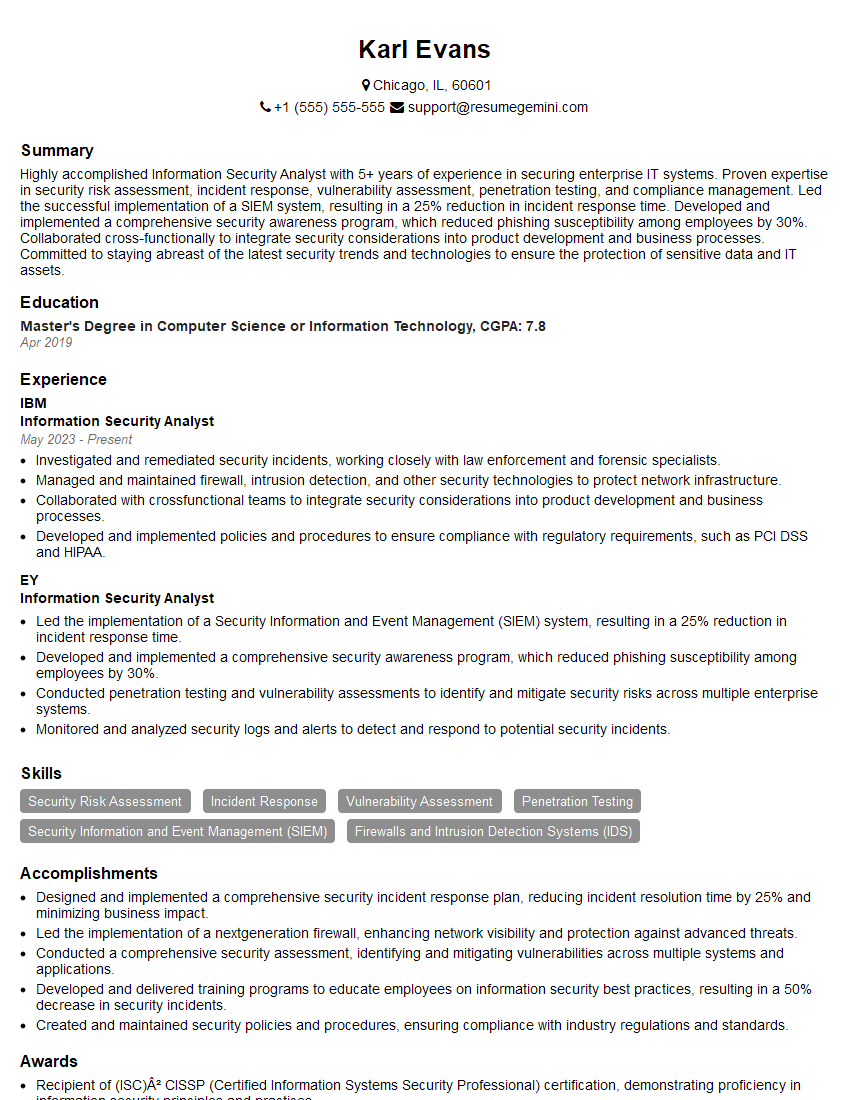
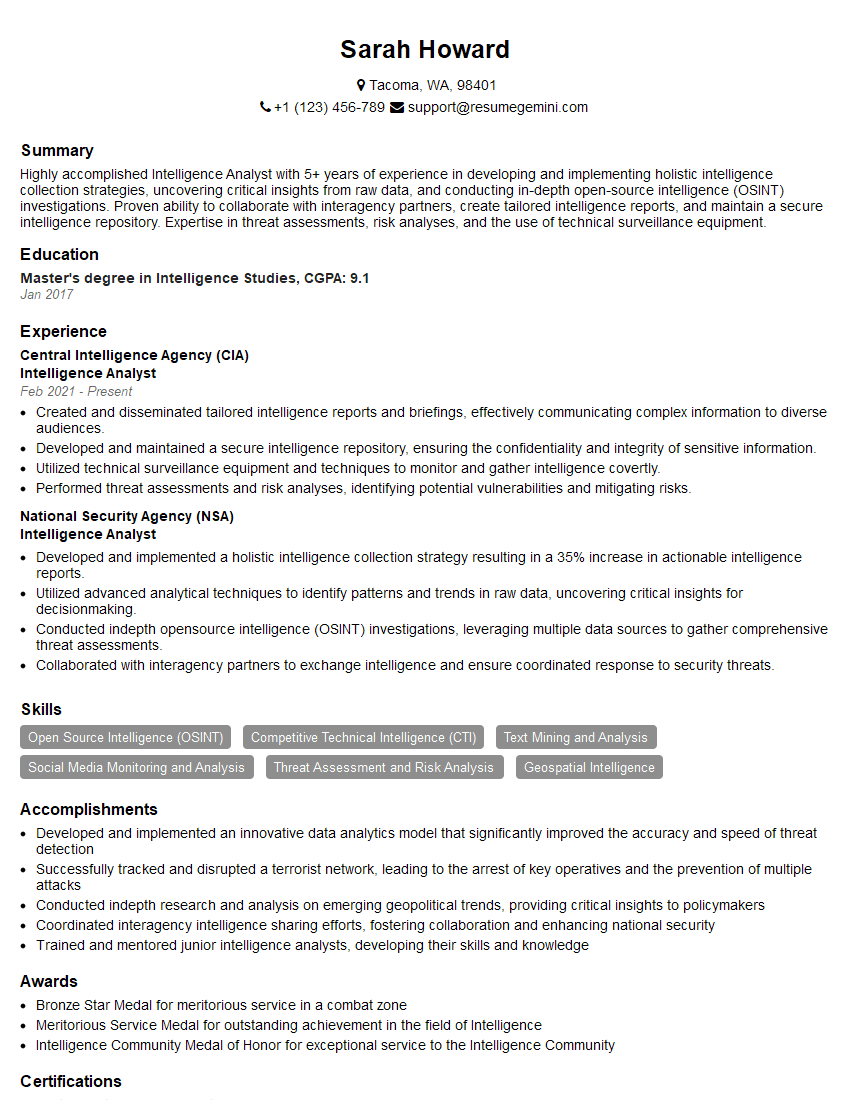
Mastering Security Threat Intelligence and Analysis is crucial for a successful and rewarding career in cybersecurity. It opens doors to high-impact roles with significant responsibility and growth potential. To maximize your job prospects, invest time in crafting a strong, ATS-friendly resume that effectively showcases your skills and experience. ResumeGemini is a trusted resource that can help you build a professional and impactful resume. They provide examples of resumes tailored to Security Threat Intelligence and Analysis roles to help you get started.
Explore more articles
Users Rating of Our Blogs
Share Your Experience
We value your feedback! Please rate our content and share your thoughts (optional).
What Readers Say About Our Blog
Very informative content, great job.
good