Feeling uncertain about what to expect in your upcoming interview? We’ve got you covered! This blog highlights the most important Self-Hypnosis Training interview questions and provides actionable advice to help you stand out as the ideal candidate. Let’s pave the way for your success.
Questions Asked in Self-Hypnosis Training Interview
Q 1. Explain the difference between self-hypnosis and traditional hypnosis.
The core difference between self-hypnosis and traditional hypnosis lies in the role of the hypnotist. In traditional hypnosis, a trained professional guides the client into a hypnotic state and suggests specific changes or behaviors. The hypnotist controls the process and the suggestions provided.
Self-hypnosis, on the other hand, empowers the individual to induce their own hypnotic state and guide themselves towards desired changes. The individual is both the hypnotist and the client, taking complete control and responsibility for the process.
Think of it like learning to drive: traditional hypnosis is like having a driving instructor guide you, while self-hypnosis is like learning to drive independently after mastering the techniques.
Q 2. Describe the induction techniques you commonly use in self-hypnosis training.
I commonly utilize a variety of induction techniques tailored to the individual’s preferences and learning style. These include:
- Progressive Relaxation: This technique involves systematically tensing and releasing different muscle groups, promoting deep relaxation and a hypnotic state. It’s a great starting point for beginners.
- Visualization: Guiding the client to create vivid mental images of calming scenes (e.g., a peaceful beach, a tranquil forest) can create a receptive state for suggestions.
- Counting Down: A simple yet effective method, counting down from 10 to 1, with suggestions for deeper relaxation embedded at each count. It provides a structured path to trance.
- Guided Imagery: Taking the client on a metaphorical journey, perhaps through a garden or a magical place, engaging their imagination and lowering their critical faculty.
The key is to find the method that resonates most effectively with the client. I often combine techniques for a more powerful and personalized experience.
Q 3. How do you address client resistance during self-hypnosis sessions?
Client resistance during self-hypnosis is often rooted in underlying beliefs, fears, or skepticism. Addressing this requires a compassionate and understanding approach. I find that:
- Empathy and validation are crucial. Acknowledging and validating their concerns helps to build trust and rapport.
- Education is key. Explaining the process, benefits, and dispelling myths surrounding self-hypnosis can ease concerns.
- Gradual Progression is important. Starting with short, simple sessions and gradually increasing duration and complexity allows for a comfortable pacing.
- Positive Reframing helps to transform negative beliefs into empowering ones. For example, replacing ‘I can’t do this’ with ‘I am learning and growing’.
It’s essential to remember that self-hypnosis is a journey, not a race. Allowing space for the client’s pace and adjusting techniques are vital for success.
Q 4. What are the ethical considerations in self-hypnosis practice?
Ethical considerations in self-hypnosis are paramount. It’s vital to:
- Respect client autonomy: Clients should always feel empowered to discontinue the process at any point.
- Maintain confidentiality: The information shared during sessions must remain strictly confidential.
- Avoid making unrealistic promises: Hypnosis is a tool for self-improvement, not a miracle cure.
- Refer appropriately: If a client’s issues are beyond the scope of self-hypnosis, referral to a qualified mental health professional is essential.
- Be mindful of suggestibility: Clients should not be manipulated or coerced into actions against their will.
Operating with integrity and transparency builds trust and safeguards the client’s wellbeing.
Q 5. Outline the steps involved in creating a personalized self-hypnosis script.
Creating a personalized self-hypnosis script involves a collaborative process:
- Identify the Goal: Clearly define the specific desired outcome. For instance, ‘reduce stress’ is too broad; ‘reduce anxiety before public speaking’ is more precise.
- Establish the Induction: Choose an appropriate induction technique (as discussed earlier).
- Develop Suggestions: Craft positive affirmations and visualizations aligned with the goal. Use present tense and positive language (e.g., ‘I am calm and confident’ instead of ‘I will be calm’).
- Incorporate Anchors: Use words, phrases, or actions to signal the beginning and end of the hypnotic state, reinforcing the experience.
- Create a Deepening Phase: Include suggestions for deeper relaxation and hypnotic absorption.
- Structure the Script: Organize the script logically with clear transitions and a calming voice.
- Test and Refine: Practice the script and seek feedback for improvement.
Remember to keep the script concise and focused, avoiding complicated language or jargon.
Q 6. How do you assess a client’s readiness for self-hypnosis?
Assessing a client’s readiness for self-hypnosis involves a multi-faceted approach. I typically:
- Discuss their motivations and expectations: Understanding their reasons for seeking self-hypnosis clarifies their commitment and realistic expectations.
- Assess their belief system: A positive attitude and openness to the process are crucial for success. Addressing any skepticism or misconceptions is important.
- Evaluate their mental health: Individuals with severe mental health conditions may not be suitable candidates for self-hypnosis without professional guidance.
- Check their cognitive abilities: The ability to focus and follow instructions is essential.
I always emphasize that self-hypnosis is not a replacement for professional mental health care and may not be suitable for all.
Q 7. What are some common misconceptions about self-hypnosis?
Several misconceptions surround self-hypnosis:
- Loss of control: Self-hypnosis is not about losing control; rather, it’s about gaining control over your thoughts, feelings, and behaviors.
- Mind control: You cannot be forced into doing something against your will through self-hypnosis.
- It’s magic or a quick fix: It’s a powerful tool that requires consistent practice and patience to achieve lasting results. It’s a journey, not a destination.
Addressing these misconceptions creates a clear and realistic understanding of the process and its potential benefits.
Q 8. Explain the role of suggestion in self-hypnosis.
Suggestion is the cornerstone of self-hypnosis. It’s the process of planting positive and constructive ideas into your subconscious mind while in a hypnotic state. This state, achieved through relaxation and focused attention, allows your subconscious to be more receptive to these suggestions. Think of it like watering a seed – the suggestion is the seed, and the hypnotic state is the fertile ground that allows it to grow.
The suggestions are not commands, but rather gentle guides. They’re formulated positively, focusing on what you want to achieve rather than what you want to avoid. For example, instead of suggesting ‘I will not be anxious,’ a more effective suggestion would be ‘I feel calm and confident.’ The subconscious mind doesn’t process negatives well, so positive phrasing is crucial.
These suggestions can target various aspects of life, from managing stress and improving sleep to enhancing confidence and breaking bad habits. The effectiveness lies in the repeated reinforcement of these positive suggestions, gradually reprogramming the subconscious mind to respond accordingly.
Q 9. How do you maintain client confidentiality?
Client confidentiality is paramount. I adhere to strict ethical guidelines and legal requirements regarding the protection of personal information. This includes:
- Secure record-keeping: All client records, including session notes and any personal details, are stored securely, both physically and digitally, with access restricted to myself.
- Informed consent: Before commencing any training, I obtain explicit informed consent from clients, outlining the process, potential risks and benefits, and my commitment to confidentiality. This consent clearly addresses how their information will be handled.
- HIPAA compliance (where applicable): In relevant contexts, I follow the Health Insurance Portability and Accountability Act (HIPAA) regulations to maintain the privacy and security of protected health information.
- Limited disclosure: I will only disclose client information with their explicit consent or when legally obligated to do so, such as in cases of suspected harm to self or others.
Maintaining trust is essential in a therapeutic relationship, and confidentiality is crucial to fostering that trust.
Q 10. Describe a time you had to adapt your self-hypnosis approach to a specific client need.
I once worked with a client struggling with severe test anxiety. My standard self-hypnosis approach focused on relaxation and positive self-talk. However, this client’s anxiety was so pronounced that simply relaxing wasn’t enough.
I adapted my approach by incorporating visualization techniques. We worked on visualizing successful scenarios: completing the test calmly, feeling confident in their knowledge, and even visualizing the positive outcomes of achieving a good grade. We also incorporated breathing exercises designed to calm the nervous system, and I tailored the positive suggestions to specifically address her fears about failure and the pressure of the test situation. This personalized approach, combined with regular practice outside of sessions, resulted in a significant reduction in her anxiety and an improvement in her test performance.
Q 11. What are the limitations of self-hypnosis?
While self-hypnosis is a powerful tool, it’s important to acknowledge its limitations. It’s not a magic bullet and won’t work for everyone or every problem. Some limitations include:
- Severity of the issue: Self-hypnosis is more effective for managing mild to moderate issues like stress, sleep problems, or minor phobias. Severe mental health conditions or serious trauma often require professional therapeutic intervention.
- Motivation and commitment: Success relies heavily on the client’s motivation and consistent practice. Without commitment to regular practice, the effects are likely to be less pronounced.
- Lack of personalized guidance: While self-guided programs exist, individual coaching or therapy often provides a more tailored and effective approach, particularly for complex challenges.
- Underlying medical conditions: Certain medical or psychological conditions could interfere with the effectiveness of self-hypnosis, and should be assessed by a health professional.
It’s crucial to approach self-hypnosis with realistic expectations and to seek professional help when necessary.
Q 12. How do you measure the effectiveness of your self-hypnosis training?
Measuring the effectiveness of self-hypnosis training involves a multi-faceted approach. I utilize a combination of methods to assess progress:
- Self-reported questionnaires: Clients complete questionnaires before and after the training to track changes in their symptoms, mood, or behaviors related to their goals (e.g., stress levels, sleep quality, confidence). These questionnaires use standardized scales for better quantification.
- Behavioral observations: During sessions, I observe changes in the client’s behavior, such as relaxation levels, verbal responses, and body language. These qualitative observations provide valuable insights into their progress.
- Goal attainment scaling: We collaboratively define specific, measurable, achievable, relevant, and time-bound (SMART) goals at the outset. We track progress towards these goals throughout the training, providing a clear indication of effectiveness.
- Follow-up sessions: Post-training follow-up sessions help gauge the long-term maintenance of the positive changes achieved through self-hypnosis.
This comprehensive approach provides a more accurate and holistic assessment of the effectiveness of the training.
Q 13. What are the potential risks or side effects associated with self-hypnosis?
Generally, self-hypnosis is considered safe, but potential risks and side effects are important to consider. Most side effects are mild and transient, but they could include:
- Temporary discomfort: Some individuals may experience mild discomfort or disorientation during or immediately after a session. This is usually temporary and resolves quickly.
- Emotional release: Self-hypnosis can sometimes trigger the release of suppressed emotions. While generally beneficial in the long run, this can be temporarily overwhelming, underscoring the importance of professional guidance if dealing with significant emotional trauma.
- Exacerbation of existing conditions: In rare cases, self-hypnosis might exacerbate existing psychological conditions, particularly if not conducted under the guidance of a trained professional. This makes professional assessment vital before commencing training for individuals with pre-existing mental health issues.
It is crucial that individuals approach self-hypnosis responsibly and seek professional guidance if they have any concerns or experience unexpected side effects.
Q 14. How do you handle a client experiencing discomfort or anxiety during a session?
If a client experiences discomfort or anxiety during a session, my priority is their safety and well-being. I have several strategies to address this:
- Interrupting the process: I immediately interrupt the hypnotic induction or guided visualization if the client expresses discomfort or anxiety. This ensures they remain in control and can communicate their feelings freely.
- Reassurance and grounding techniques: I use calming reassurance techniques, grounding exercises (such as focusing on physical sensations like their feet on the floor), and deep breathing to help the client regain a sense of calm and stability.
- Adjusting the pace and intensity: I adjust the pace and intensity of the session according to the client’s needs. This might involve slowing down the pace of the suggestions, shortening the session, or focusing on different aspects that feel more comfortable.
- Exploring the source of discomfort: We collaboratively explore the potential causes of their discomfort, addressing any underlying issues or anxieties that may be contributing to their experience.
The goal is to create a safe and supportive environment where the client feels empowered to express their feelings and regain control over their experience. In some cases, I might refer the client to a mental health professional for further assessment and support if the issue seems beyond the scope of self-hypnosis.
Q 15. What are your preferred methods for providing ongoing support to clients after training?
Ongoing support is crucial for self-hypnosis success. My preferred methods blend individual coaching with community engagement. Immediately after the training, I offer a private, one-on-one session to address any immediate questions and personalize their practice. Then, I provide access to a private online forum where clients can connect with each other, share experiences, and receive ongoing support from me and their peers. This fosters a sense of community and accountability. Additionally, I offer weekly email check-ins with personalized tips and techniques, tailored to their individual progress and goals. Finally, I offer discounted booster sessions for those who need extra support or want to revisit specific techniques. This multi-faceted approach ensures continued learning and support long after the initial training concludes.
Career Expert Tips:
- Ace those interviews! Prepare effectively by reviewing the Top 50 Most Common Interview Questions on ResumeGemini.
- Navigate your job search with confidence! Explore a wide range of Career Tips on ResumeGemini. Learn about common challenges and recommendations to overcome them.
- Craft the perfect resume! Master the Art of Resume Writing with ResumeGemini’s guide. Showcase your unique qualifications and achievements effectively.
- Don’t miss out on holiday savings! Build your dream resume with ResumeGemini’s ATS optimized templates.
Q 16. Discuss the different applications of self-hypnosis across various areas (e.g., stress management, pain relief).
Self-hypnosis is incredibly versatile. In stress management, it helps clients develop techniques to calm their nervous systems, reframe negative thoughts, and build resilience. For example, a client struggling with anxiety before public speaking might use self-hypnosis to induce a state of relaxation and confidence beforehand. In pain relief, it can be used to manage chronic pain conditions by altering pain perception and promoting relaxation. A client with chronic back pain might use guided imagery within a self-hypnosis session to visualize their back healing and reducing discomfort. Other applications include: improving sleep quality (by promoting relaxation and reducing racing thoughts), enhancing athletic performance (by improving focus and reducing pre-competition anxiety), and overcoming phobias (by gradually desensitizing clients to feared stimuli). The applications are truly vast and limited only by the client’s imagination and goals.
Q 17. What are the key components of a successful self-hypnosis program?
A successful self-hypnosis program hinges on several key components. Firstly, a strong foundation in the principles of hypnosis is essential. Clients need to understand the nature of the hypnotic state and how it differs from sleep. Secondly, effective induction techniques are vital to help clients enter a relaxed, focused state. Thirdly, clearly defined goals are paramount. Clients must articulate specific, measurable, achievable, relevant, and time-bound (SMART) goals. Fourthly, positive affirmations and visualizations are powerful tools for reprogramming subconscious beliefs and behaviors. Finally, consistent practice is crucial. Just like any skill, self-hypnosis requires regular practice to become effective. This is where the ongoing support system becomes vital.
Q 18. How do you incorporate different learning styles in your training approach?
I cater to different learning styles by employing a multi-sensory approach. Visual learners benefit from the use of guided imagery and visualizations within the self-hypnosis scripts. Auditory learners benefit from the audio recordings and clear instructions. Kinesthetic learners engage through relaxation exercises that involve physical sensations, such as deep breathing and progressive muscle relaxation. I also provide written materials summarizing key concepts, allowing for review and reinforcement. By combining these diverse methods, I ensure that everyone can learn effectively regardless of their preferred learning style. The training also includes interactive components such as Q&A sessions and group practices, further supporting diverse learning preferences.
Q 19. How do you ensure that your self-hypnosis training materials are evidence-based?
Evidence-based practice is fundamental to my approach. My training materials draw heavily from peer-reviewed research in clinical hypnotherapy and related fields like psychology and neuroscience. I incorporate findings from studies demonstrating the effectiveness of self-hypnosis for various conditions. I cite relevant research throughout the materials and actively stay updated on the latest scientific literature. For example, when discussing the effectiveness of self-hypnosis for pain management, I reference studies demonstrating its impact on brain activity related to pain perception. This rigorous approach ensures that my training is grounded in scientific evidence and not just anecdotal observations.
Q 20. Describe your experience with different self-hypnosis techniques.
My experience encompasses a range of self-hypnosis techniques, including progressive muscle relaxation, guided imagery, Ericksonian techniques (utilizing metaphors and stories), and the use of affirmations. Progressive muscle relaxation helps clients release physical tension, paving the way for deeper relaxation. Guided imagery uses vivid mental images to promote relaxation and positive change. Ericksonian techniques utilize the power of suggestion and metaphor to bypass conscious resistance. Affirmations are positive statements repeated regularly to reprogram limiting beliefs. I adapt my approach to suit each client’s needs and preferences, drawing from the most effective techniques for their specific goals. For instance, a client with performance anxiety might benefit from a combination of Ericksonian techniques and affirmations focused on boosting confidence.
Q 21. Explain the concept of ‘autosuggestion’ in self-hypnosis.
Autosuggestion is a cornerstone of self-hypnosis. It involves making positive suggestions to your subconscious mind while in a relaxed, receptive state. These suggestions are designed to influence your thoughts, feelings, and behaviors. The subconscious mind, being less critical than the conscious mind, readily accepts these suggestions. For example, a client aiming to improve their sleep might repeat the autosuggestion, “I sleep soundly and peacefully,” repeatedly during a self-hypnosis session. Over time, this repeated suggestion can reprogram the subconscious mind to promote better sleep patterns. The effectiveness of autosuggestion relies on consistent practice and a genuine belief in the positive suggestions.
Q 22. How do you address client skepticism or doubt about self-hypnosis?
Addressing skepticism about self-hypnosis is crucial for building trust and facilitating successful learning. I begin by normalizing doubt; many people are unfamiliar with the process and understandably hesitant. I explain that self-hypnosis isn’t about losing control or becoming someone else; it’s about accessing your own subconscious mind to achieve specific goals. I use analogies to make the concept relatable, for example, comparing it to daydreaming or being completely engrossed in a book – states where your conscious mind is less active and your subconscious is more receptive. I then demonstrate basic relaxation techniques and guided imagery to provide a tangible experience of the state of focused attention that is the basis of self-hypnosis. This allows clients to directly experience the power of their own minds, directly addressing their initial doubts through a hands-on approach. Finally, I emphasize the gradual nature of learning self-hypnosis, reassuring them that progress takes time and consistent practice.
Q 23. What is your approach to dealing with clients who may have underlying mental health conditions?
My approach with clients who have underlying mental health conditions is to prioritize safety and ethical practice. I always emphasize that I am not a therapist or medical professional and cannot provide treatment for mental health conditions. I explain that self-hypnosis can be a *complementary* tool, used to manage symptoms like anxiety or stress in conjunction with professional care. Before commencing any training, I require a release form signed by the client and often request they provide a note from their therapist or psychiatrist. This confirms that their doctor is aware of their participation in self-hypnosis training and considers it appropriate given their condition. My sessions focus on building resilience and coping mechanisms, avoiding techniques that could inadvertently trigger or worsen their conditions. I carefully tailor the scripts and suggestions to address the specific needs of each individual, prioritizing self-compassion and gentle guidance. If a client’s condition worsens during training, I immediately stop and recommend they seek professional help.
Q 24. Describe your personal experience with self-hypnosis and how it informs your practice.
My personal experience with self-hypnosis profoundly informs my practice. I first discovered self-hypnosis while coping with performance anxiety as a musician. Initially skeptical, I found that regular practice significantly reduced my stage fright and improved my focus during performances. This firsthand experience instilled in me a deep appreciation for the power of the subconscious mind and its potential to effect positive change. Through years of personal use, I’ve learned not only the technical aspects of self-hypnosis but also the importance of patience, self-compassion, and the unique needs of each individual. This allows me to provide empathetic and effective guidance, mirroring my own journey of self-discovery and understanding. My personal challenges and subsequent success with self-hypnosis give me a unique perspective that helps me better support my clients through their own transformations.
Q 25. How do you stay updated with the latest research and advancements in self-hypnosis?
Staying current with research is vital in this field. I regularly subscribe to relevant journals, such as the American Journal of Clinical Hypnosis, and attend conferences and workshops hosted by professional organizations such as the National Guild of Hypnotists. I actively participate in online forums and communities dedicated to hypnotherapy and self-hypnosis, engaging in discussions and exchanging knowledge with other practitioners and researchers. I also maintain a robust library of books and articles on the subject, constantly reviewing and updating my understanding of best practices, new techniques, and emerging research findings in related areas like neuroscience and psychology. This dedication to continuous learning ensures that my training is evidence-based and reflects the latest advancements in the field.
Q 26. What are your strengths and weaknesses as a self-hypnosis trainer?
My strengths as a self-hypnosis trainer include my empathetic communication style, my ability to create safe and supportive learning environments, and my extensive practical experience. I am adept at tailoring techniques to individual needs and preferences, effectively addressing diverse learning styles. My weakness, which I am actively working to improve, is sometimes being overly cautious with clients who have experienced significant trauma. I am currently pursuing additional training in trauma-informed care to ensure I can provide even more sensitive and appropriate support to these individuals. My self-awareness of this limitation allows me to proactively seek further education and refine my practice to better serve all my clients.
Q 27. What are your salary expectations?
My salary expectations are commensurate with my experience and qualifications, and are competitive within the industry. I am open to discussing a salary range that aligns with the position’s requirements and the organization’s compensation structure. I prioritize creating a collaborative and mutually beneficial professional relationship.
Q 28. Why are you interested in this specific self-hypnosis training role?
I am deeply interested in this specific self-hypnosis training role because of my passion for empowering individuals to achieve their goals and improve their well-being. The opportunity to work within [mention organization name or type of organization, e.g., a supportive and innovative company, a community-focused organization] aligns perfectly with my values. I am particularly drawn to [mention specific aspect of the role or organization, e.g., the organization’s commitment to evidence-based practices, the innovative approach to training, the opportunity to work with a diverse client base]. The chance to contribute to the growth and development of others while utilizing my skills and experience is incredibly motivating.
Key Topics to Learn for Self-Hypnosis Training Interview
- Theories of Hypnosis: Understand the different theoretical models explaining how self-hypnosis works, including the neodissociation theory and the sociocognitive theory. Be prepared to discuss their strengths and limitations.
- Induction Techniques: Master various self-hypnosis induction techniques, such as progressive relaxation, guided imagery, and counting methods. Practice explaining their effectiveness and suitability for different clients.
- Deepening Techniques: Know how to deepen a hypnotic state and maintain it effectively. Discuss different deepening techniques and their applications in therapeutic settings.
- Therapeutic Applications: Be ready to discuss the application of self-hypnosis in managing stress, anxiety, pain management, and other relevant areas. Provide examples of successful case studies or scenarios.
- Ethical Considerations: Demonstrate a strong understanding of ethical considerations in self-hypnosis practice, including informed consent, client confidentiality, and appropriate boundaries.
- Problem-Solving Approaches: Showcase your ability to identify and address challenges that might arise during self-hypnosis sessions, such as resistance or lack of progress. Explain different strategies for overcoming these challenges.
- Assessment and Evaluation: Discuss methods for assessing a client’s suitability for self-hypnosis and evaluating the effectiveness of the treatment.
- Post-Hypnotic Suggestions: Understand the principles and applications of post-hypnotic suggestions and their role in achieving lasting behavioral changes.
Next Steps
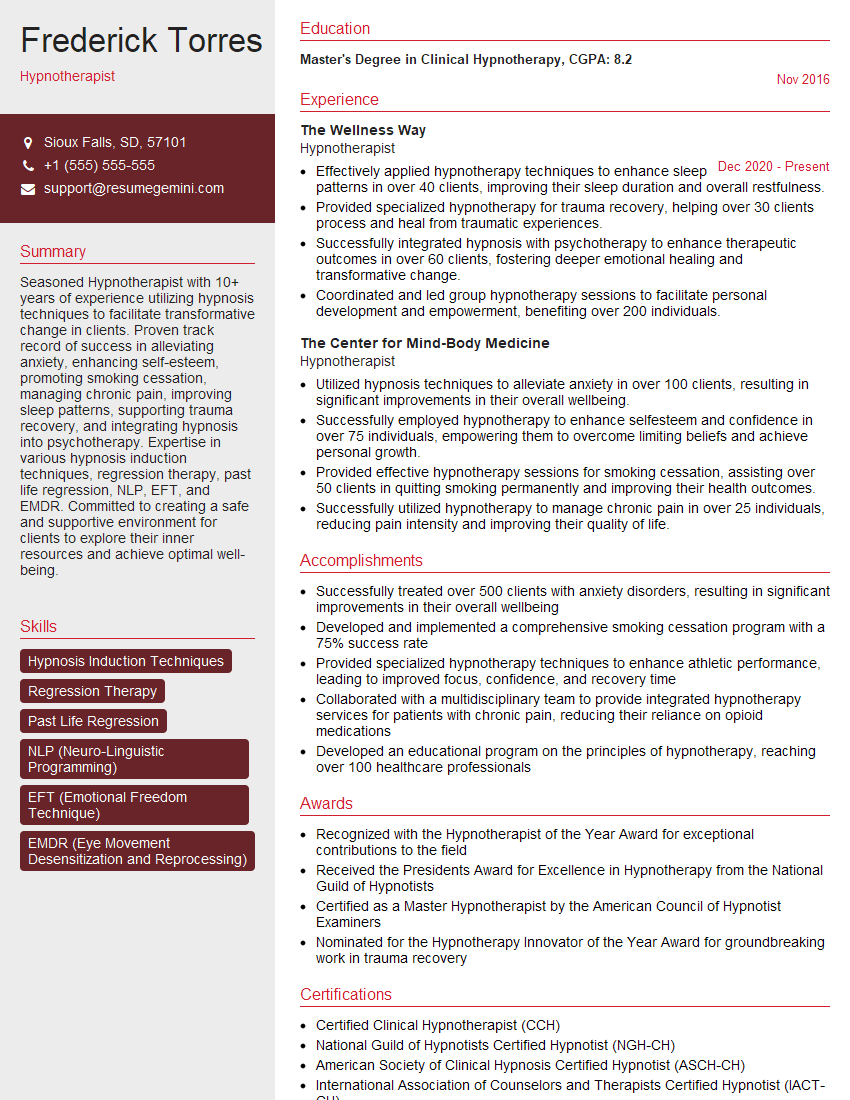
Mastering self-hypnosis training opens doors to a rewarding career empowering individuals to achieve personal growth and overcome challenges. To maximize your job prospects, a well-crafted, ATS-friendly resume is crucial. ResumeGemini is a trusted resource that can help you build a professional resume that highlights your skills and experience effectively. ResumeGemini provides examples of resumes tailored to Self-Hypnosis Training, ensuring your application stands out. Invest the time to create a compelling resume – it’s a key step towards securing your dream job.
Explore more articles
Users Rating of Our Blogs
Share Your Experience
We value your feedback! Please rate our content and share your thoughts (optional).
What Readers Say About Our Blog
Very informative content, great job.
good