Interviews are more than just a Q&A session—they’re a chance to prove your worth. This blog dives into essential Sensor Operation interview questions and expert tips to help you align your answers with what hiring managers are looking for. Start preparing to shine!
Questions Asked in Sensor Operation Interview
Q 1. Explain the different types of sensors and their applications.
Sensors are devices that detect and respond to some type of input from the physical environment. They convert a physical phenomenon into a measurable signal, typically electrical. There’s a vast range of sensor types, each designed for specific applications. Here are some key categories:
- Temperature Sensors: Thermocouples, thermistors, RTDs (Resistance Temperature Detectors) measure temperature changes. Applications range from industrial process control to weather monitoring and medical devices.
- Pressure Sensors: Piezoresistive, capacitive, and strain gauge sensors detect pressure variations. Used in automotive tire pressure monitoring systems, weather forecasting (barometric pressure), and industrial automation.
- Light Sensors: Photodiodes, phototransistors, and photoresistors measure light intensity. Applications include cameras, lighting control systems, and environmental monitoring.
- Motion Sensors: Accelerometers, gyroscopes, and magnetometers detect acceleration, rotation, and magnetic fields respectively. Found in smartphones, robotics, and navigation systems.
- Proximity Sensors: Ultrasonic, infrared, and capacitive sensors detect the presence of nearby objects without physical contact. Used in automatic doors, robotics, and parking assistance systems.
- Chemical Sensors: These detect the presence and concentration of specific chemicals. Examples include gas sensors (e.g., carbon monoxide detectors) and pH sensors (used in water quality monitoring).
This is not an exhaustive list, but it highlights the diversity of sensors and their widespread use across numerous industries.
Q 2. Describe the sensor selection process for a given application.
Choosing the right sensor is critical for a successful application. The selection process involves several steps:
- Define Requirements: Clearly specify the measurable parameter (temperature, pressure, etc.), the required measurement range, accuracy, resolution, and response time. Consider environmental factors like temperature, humidity, and vibration.
- Research Available Sensors: Explore different sensor technologies that can meet the specified requirements. Consider factors like cost, size, power consumption, and availability.
- Evaluate Sensor Specifications: Carefully review the datasheets of potential candidates. Pay close attention to accuracy, linearity, drift, hysteresis, and noise specifications.
- Prototype and Test: Build a prototype system using the selected sensor. Conduct rigorous testing under various conditions to validate performance and identify potential issues.
- Compare and Select: Compare the performance of different sensors based on the testing results and select the one that best meets the overall needs and constraints of the application.
For example, selecting a sensor for a high-precision industrial process will necessitate different criteria than selecting a sensor for a consumer application. A high-precision application might demand a sensor with lower noise and higher accuracy, even at a higher cost.
Q 3. What are the key performance indicators (KPIs) for sensors?
Key Performance Indicators (KPIs) for sensors are metrics that indicate how well a sensor is performing its intended function. Crucial KPIs include:
- Accuracy: How close the sensor’s measured value is to the true value.
- Precision: How consistent and repeatable the sensor’s measurements are.
- Sensitivity: The change in output signal for a given change in the measured quantity.
- Resolution: The smallest change in the measured quantity that the sensor can detect.
- Linearity: How well the sensor’s output is a linear function of the input.
- Response Time: The time it takes for the sensor to respond to a change in the measured quantity.
- Range: The span of values the sensor can accurately measure.
- Stability: How consistent the sensor’s performance is over time and under varying conditions.
- Noise: Unwanted signals that interfere with the desired measurement.
These KPIs are often specified in a sensor’s datasheet and should be carefully considered during the selection process.
Q 4. How do you calibrate a sensor?
Sensor calibration is the process of adjusting a sensor’s output to match a known standard. This ensures accurate measurements. Calibration methods vary depending on the sensor type, but generally involve these steps:
- Establish Reference Standards: Use traceable standards (e.g., calibrated weights for pressure sensors, NIST-traceable thermometers for temperature sensors).
- Apply Known Inputs: Expose the sensor to a range of known input values (within its operating range).
- Measure Outputs: Record the sensor’s output for each known input.
- Develop Calibration Curve: Create a mathematical relationship (e.g., a linear or polynomial equation) between the known inputs and the measured outputs. This curve compensates for non-idealities in the sensor’s response.
- Implement Calibration: Use the calibration curve to adjust the sensor’s output or to correct the measured values to obtain accurate readings.
For instance, a temperature sensor might be calibrated using a series of known temperatures from a calibrated bath and the corresponding sensor outputs. Software or a lookup table can then be used to adjust future readings based on the calibration curve.
Q 5. Explain sensor signal conditioning techniques.
Sensor signal conditioning is the process of modifying the raw sensor signal to make it suitable for further processing or display. Common techniques include:
- Amplification: Increasing the signal amplitude to improve signal-to-noise ratio.
- Filtering: Removing unwanted noise or frequencies from the signal (e.g., using low-pass, high-pass, or band-pass filters).
- Linearization: Correcting non-linear sensor response to obtain a linear output.
- Offset Adjustment: Correcting for a non-zero output when the input is zero.
- Analog-to-Digital Conversion (ADC): Converting the analog sensor signal into a digital representation for computer processing.
For example, an accelerometer might produce a weak signal that needs amplification before it can be reliably processed. A filter might be used to remove high-frequency noise caused by vibrations.
Q 6. What are common sensor noise sources and how do you mitigate them?
Sensor noise is unwanted signals that degrade measurement accuracy. Common sources include:
- Thermal Noise: Random fluctuations in the sensor’s output due to thermal energy.
- Shot Noise: Random fluctuations in the current due to the discrete nature of charge carriers.
- Environmental Noise: Interference from external sources like electromagnetic fields or vibrations.
- Power Supply Noise: Fluctuations in the power supply voltage.
Mitigation strategies include:
- Shielding: Protecting the sensor from electromagnetic interference.
- Filtering: Using filters to remove unwanted frequencies.
- Grounding: Properly grounding the sensor to reduce noise.
- Signal Averaging: Taking multiple measurements and averaging them to reduce random noise.
- Using Low-Noise Components: Choosing components with low inherent noise levels.
For instance, shielding a sensor from electromagnetic interference might involve using a metal enclosure. Averaging multiple readings can significantly reduce the impact of random noise on the final measurement.
Q 7. Discuss sensor data acquisition and processing methods.
Sensor data acquisition and processing involve capturing, converting, and analyzing sensor data. Methods include:
- Data Acquisition Systems (DAS): Hardware and software systems designed to acquire data from multiple sensors simultaneously. They typically handle signal conditioning, ADC, and data storage.
- Microcontrollers: Small, low-power computers often used for local data processing and control.
- Digital Signal Processing (DSP): Techniques for manipulating and analyzing digital signals, often used for noise reduction, signal enhancement, and feature extraction.
- Machine Learning (ML): Advanced algorithms used for pattern recognition, anomaly detection, and predictive modeling based on sensor data.
For example, a weather station might use a DAS to acquire data from temperature, pressure, and humidity sensors. A microcontroller could then process this data and transmit it wirelessly to a central server for further analysis. ML algorithms could be used to predict future weather patterns based on historical data.
Q 8. Describe your experience with different sensor communication protocols (e.g., I2C, SPI, CAN).
My experience spans a wide range of sensor communication protocols, including I2C, SPI, and CAN. Each has its strengths and weaknesses, making them suitable for different applications.
- I2C (Inter-Integrated Circuit): This is a simple, two-wire protocol ideal for low-speed, short-distance communication between a microcontroller and multiple sensors. Its ease of implementation and low cost make it popular in many embedded systems. I’ve used it extensively in projects involving temperature sensors and accelerometers. For instance, in a smart home project, I used I2C to read data from multiple temperature sensors distributed throughout a house and transmit it to a central hub for climate control.
- SPI (Serial Peripheral Interface): SPI offers higher speeds than I2C and typically utilizes four wires for communication – MOSI (Master Out Slave In), MISO (Master In Slave Out), clock, and select. It’s well-suited for applications needing faster data transfer rates, such as high-resolution image sensors or ADCs. I leveraged SPI in a robotics project to interface with a high-speed sensor array for navigation and obstacle avoidance.
- CAN (Controller Area Network): CAN is a robust, real-time protocol designed for reliable communication in noisy environments, often found in automotive and industrial applications. Its error detection and correction mechanisms make it highly reliable. In a past project involving a multi-sensor system for a manufacturing process, I implemented CAN to guarantee the accurate and timely transmission of crucial sensor readings, even amidst electromagnetic interference.
Choosing the right protocol depends on factors like data rate requirements, distance, power consumption, and the number of sensors involved.
Q 9. How do you troubleshoot sensor malfunction?
Troubleshooting sensor malfunctions requires a systematic approach. I typically follow these steps:
- Inspect the physical connection: Check for loose wires, damaged connectors, or incorrect wiring. A simple visual inspection can often solve the problem.
- Verify power supply: Ensure the sensor is receiving the correct voltage and current. Insufficient power is a common cause of sensor malfunction.
- Review sensor data: Analyze the sensor output. Unrealistic readings (e.g., consistently high or low values, or values outside the sensor’s specification) often indicate a problem. I often use data visualization tools to spot trends or anomalies.
- Check communication protocol: Ensure that the communication protocol between the sensor and the microcontroller is functioning correctly. Examine the data transmission for errors or interruptions. Using a logic analyzer or oscilloscope can help isolate communication issues.
- Calibrate the sensor: Sensor calibration can improve accuracy and address minor drifts. Manufacturers often provide calibration procedures. I usually recalibrate sensors periodically, especially those prone to drift.
- Compare against known good sensor: If possible, compare the faulty sensor’s output with a known good sensor under identical conditions. This helps quickly distinguish between sensor problems and issues in the larger system.
- Consult datasheets: Sensor datasheets contain valuable information, including troubleshooting tips and common error codes. I always refer to the documentation when facing problems.
For example, if a temperature sensor consistently reads 10 degrees lower than expected, I would first check the wiring, then power supply, then compare its reading to another sensor. If the problem persists, I’d consult the datasheet for possible error codes or calibration steps.
Q 10. Explain the concept of sensor drift and how to compensate for it.
Sensor drift refers to the gradual change in sensor output over time, even when the measured quantity remains constant. Imagine a clock that slowly loses time – that’s analogous to sensor drift. Several factors contribute to drift, including temperature changes, aging components, and mechanical wear.
Several methods exist to compensate for sensor drift:
- Calibration: Regular calibration involves comparing the sensor’s output to a known standard. This allows us to establish a correction curve to adjust the raw sensor readings. The frequency of calibration depends on the sensor’s drift rate and the required accuracy.
- Temperature compensation: Many sensors are sensitive to temperature variations. Using a separate temperature sensor and applying temperature compensation algorithms can mitigate temperature-related drift. This algorithm typically involves a mathematical model relating the sensor’s output to the temperature.
- Software filtering: Applying digital filters (e.g., moving average, Kalman filter) to the sensor data can smooth out short-term fluctuations and reduce the impact of drift.
- Zeroing or offset correction: Some sensors can be periodically zeroed or have their offset corrected using a known reference value. This corrects for any constant error in the sensor’s output.
For example, in a pressure sensor application, I might use a temperature sensor alongside the pressure sensor and employ a lookup table to correct pressure readings based on the measured temperature.
Q 11. What are the different types of sensor errors and how do you account for them?
Sensor errors can be broadly classified into several categories:
- Systematic errors: These errors are consistent and predictable, such as sensor bias (a constant offset) or scale factor errors (a multiplicative error). They can often be compensated for through calibration.
- Random errors: These errors are unpredictable and fluctuate randomly around the true value. They are often caused by noise in the sensor’s signal or environmental interference. Statistical techniques, such as averaging, can help mitigate these errors.
- Nonlinearity errors: Sensors may exhibit nonlinear behavior, meaning their output isn’t directly proportional to the measured quantity. Calibration curves or piecewise linear approximations are employed to correct nonlinearity.
- Hysteresis errors: These errors occur when the sensor’s output depends on its history, meaning the response is different depending on whether the measured quantity is increasing or decreasing.
To account for these errors, I often employ a combination of techniques. Calibration helps address systematic errors. Software filtering, such as moving averages or Kalman filters, can reduce the influence of random errors and noise. Nonlinearity can be corrected using curve fitting techniques. Understanding the sensor’s characteristics and limitations, as described in the datasheet, is crucial for effectively managing sensor errors. For instance, a detailed understanding of hysteresis effects may require specific measurement protocols to minimize their impact on the accuracy.
Q 12. Describe your experience with sensor integration into larger systems.
I possess extensive experience integrating sensors into larger systems, ranging from embedded systems to industrial control systems. This involves several key steps:
- Hardware integration: This includes selecting appropriate interfaces (I2C, SPI, CAN, etc.), designing PCB layouts, and managing power and signal integrity. I’ve worked with various microcontrollers and FPGAs for sensor data acquisition and processing. Careful consideration must be given to electromagnetic interference and other potential sources of noise.
- Software integration: This involves writing drivers for the sensors, implementing data acquisition routines, performing data validation and error handling, and integrating sensor data with other system components. I have experience using various programming languages like C, C++, and Python for this purpose.
- Data fusion: Many systems utilize multiple sensors. I have experience implementing algorithms for sensor data fusion to improve accuracy and reliability, combining data from different sensors to obtain a more complete picture. Kalman filters and other sensor fusion techniques are often employed.
- System testing and validation: Rigorous testing is crucial to verify the functionality and performance of the integrated system. I design test procedures to assess accuracy, reliability, and robustness under various operating conditions.
For example, in an industrial automation project, I integrated various sensors (pressure, temperature, flow) into a system monitoring a manufacturing process. The sensor data was used for real-time process control and quality assurance. Careful integration ensured that all sensor data was consistently logged, analyzed, and used to optimize the manufacturing process.
Q 13. How do you ensure sensor accuracy and reliability?
Ensuring sensor accuracy and reliability is paramount. I approach this through a multi-faceted strategy:
- Sensor selection: Choosing the right sensor for the application is crucial. Factors to consider include accuracy, precision, resolution, operating range, environmental tolerance, and cost. Thorough research and comparison of available sensors are vital.
- Calibration and compensation: Regular calibration, combined with temperature compensation and other correction techniques, significantly improves accuracy. The frequency of calibration will depend on the sensor’s drift characteristics.
- Data validation and error handling: Implementing robust error handling and data validation mechanisms in the software is crucial for detecting and mitigating sensor errors. This might involve range checks, plausibility checks, and the use of outlier detection algorithms.
- Redundancy: Employing redundant sensors can increase reliability. If one sensor fails, the other can continue providing data, ensuring system functionality. The use of sensor fusion techniques can also minimize the impact of individual sensor failures.
- Environmental protection: Shielding sensors from harsh environments (e.g., temperature fluctuations, vibration, electromagnetic interference) helps improve their longevity and reliability.
For instance, in a critical application like a medical device, I would employ redundant sensors and rigorous data validation to ensure accuracy and prevent false readings that could have serious consequences.
Q 14. What is the role of sensor diagnostics in system maintenance?
Sensor diagnostics play a vital role in system maintenance by providing real-time insights into the health and performance of sensors. They enable proactive maintenance, preventing unexpected failures and downtime.
Sensor diagnostics typically involve:
- Self-tests: Many sensors have built-in self-test capabilities that allow them to check their own internal functionality. These tests might involve checking internal circuitry or comparing readings against known values.
- Data plausibility checks: Algorithms check if sensor readings are within expected ranges or follow logical patterns. Unrealistic readings can trigger alerts, indicating potential problems.
- Signal quality monitoring: Monitoring the quality of the sensor signal (e.g., signal-to-noise ratio) can help identify issues like interference or sensor degradation.
- Error code analysis: Some sensors provide error codes indicating specific problems. Analyzing these codes provides valuable information for troubleshooting.
- Predictive maintenance: By analyzing sensor data trends over time, it’s possible to predict potential sensor failures and schedule maintenance proactively, preventing unexpected downtime. Machine learning techniques can enhance these predictive capabilities.
For example, in a wind turbine monitoring system, sensor diagnostics could detect anomalies in wind speed sensors, prompting maintenance before a sensor failure leads to operational issues. This proactive approach reduces downtime and increases the overall efficiency of the system.
Q 15. Explain your experience with various sensor interfaces (analog, digital).
My experience spans both analog and digital sensor interfaces. Analog interfaces, like those using potentiometers or thermocouples, produce a continuous signal directly proportional to the measured quantity. This often requires signal conditioning, such as amplification or filtering, to translate the raw signal into a usable format for data acquisition. For example, I’ve worked with strain gauges, whose millivolt output needed amplification before being digitized for analysis of structural loads.
Digital interfaces, on the other hand, provide a discrete signal, often in the form of a binary code (e.g., I2C, SPI, or UART). These are generally easier to interface with microcontrollers or computers because they don’t require as much signal processing. I have extensively used digital sensors like digital temperature sensors and MEMS accelerometers which directly output data in a standardized digital format. These often come with built-in features like calibration and temperature compensation. The choice between analog and digital depends heavily on the specific application, noise levels, precision required, and ease of implementation.
Career Expert Tips:
- Ace those interviews! Prepare effectively by reviewing the Top 50 Most Common Interview Questions on ResumeGemini.
- Navigate your job search with confidence! Explore a wide range of Career Tips on ResumeGemini. Learn about common challenges and recommendations to overcome them.
- Craft the perfect resume! Master the Art of Resume Writing with ResumeGemini’s guide. Showcase your unique qualifications and achievements effectively.
- Don’t miss out on holiday savings! Build your dream resume with ResumeGemini’s ATS optimized templates.
Q 16. How do you handle data from multiple sensors simultaneously?
Handling data from multiple sensors simultaneously requires a robust data acquisition system and careful synchronization. The approach depends on the sensors’ interfaces and data rates. A common method is to use a microcontroller or a data acquisition (DAQ) device with multiple analog-to-digital converters (ADCs) and digital input/output (DIO) ports. This allows simultaneous or near-simultaneous sampling from all sensors.
Synchronization is crucial to avoid timing discrepancies, especially for sensors measuring related quantities. For instance, in a robotics project I worked on, we needed to synchronize data from accelerometers, gyroscopes, and GPS for accurate pose estimation. We achieved this through a hardware-timed acquisition system with a precise clock source. Software solutions, like using a real-time operating system (RTOS), can also be used for scheduling the data acquisition from each sensor, optimizing the timing based on the need for precision of measurement for each sensor.
Data fusion techniques are often employed to combine the data from multiple sensors and improve the overall accuracy and robustness of the measurement. This may involve filtering, calibration, and statistical methods to reconcile potential discrepancies among the readings.
Q 17. What are your experiences with sensor data logging and analysis?
Sensor data logging and analysis are integral parts of any sensor-based system. I’ve used various methods and tools for this purpose. For logging, I’ve employed dedicated data loggers, custom-built software running on microcontrollers, and even cloud-based solutions. The choice depends on the data volume, required storage capacity, and accessibility needs. For example, for high-frequency, large-volume data collection from a vibration monitoring system, I used a high-speed data acquisition system with a dedicated hard drive.
Analysis usually involves using software tools such as MATLAB, Python (with libraries like NumPy, Pandas, and SciPy), or specialized software packages depending on the specific nature of the data and the application. This frequently includes signal processing techniques like filtering, Fourier transforms for frequency analysis, and statistical analysis to identify trends, anomalies, or patterns. In one project involving environmental monitoring, I analyzed sensor data using Python to detect pollution spikes and correlate these spikes to external factors like wind speed and direction.
Q 18. Describe your experience with different sensor technologies (e.g., ultrasonic, optical, capacitive).
My experience encompasses a wide range of sensor technologies. Ultrasonic sensors are useful for distance measurement, commonly found in parking sensors and robotics applications. I’ve worked with both time-of-flight and Doppler-based ultrasonic sensors, understanding the limitations of each in various environments (e.g., reflection interference). Optical sensors, such as photodiodes and phototransistors, are used for light detection and measurement. I’ve utilized them in applications like light intensity measurement and color sensing.
Capacitive sensors are another significant area of my expertise, especially in proximity sensing and liquid level detection. The sensitivity and range of these sensors can be carefully tailored through the choice of capacitor geometry and dielectric materials. I have also worked with other technologies, including temperature sensors (thermocouples, RTDs, thermistors), accelerometers, gyroscopes, and pressure sensors, tailoring sensor selection to the specific application’s requirements.
Q 19. How familiar are you with sensor safety and regulatory compliance?
Sensor safety and regulatory compliance are paramount. I’m familiar with various safety standards and regulations, such as those related to electromagnetic compatibility (EMC), environmental protection (e.g., RoHS), and functional safety (e.g., IEC 61508). This involves understanding potential hazards associated with sensors (e.g., electrical shock, explosion, data integrity issues) and implementing measures to mitigate them. This includes proper grounding, shielding, and signal isolation techniques.
For example, in a project involving sensors in a hazardous environment, we needed to ensure the sensors were intrinsically safe, meeting the required certification standards. This involved careful selection of components, design validation, and thorough testing to prevent ignition hazards.
Q 20. Explain your understanding of sensor life cycle management.
Sensor life cycle management encompasses all stages of a sensor’s life, from selection and procurement through calibration, maintenance, and eventual decommissioning. Careful selection is crucial, considering factors like accuracy, precision, operating conditions, and cost. Regular calibration is necessary to ensure accuracy over time. This usually involves comparing sensor readings to known standards or traceable references. The frequency of calibration depends on the sensor type, stability, and the application’s requirements.
Maintenance involves periodic inspections and cleaning to remove debris or corrosion that could affect sensor performance. Predictive maintenance techniques, which use data analysis to anticipate potential failures, can help minimize downtime and extend sensor lifespan. Finally, safe decommissioning involves proper disposal or recycling, considering any environmental or safety regulations that apply.
Q 21. Discuss your experience with sensor modeling and simulation.
Sensor modeling and simulation are invaluable tools for understanding sensor behavior, optimizing system design, and verifying performance before deploying the sensor in a real-world setting. Different modeling techniques are used depending on the sensor type and the level of detail required. Simple models might involve using transfer functions or empirical relationships to represent the sensor’s input-output characteristics. More complex models may involve finite element analysis (FEA) or computational fluid dynamics (CFD) for accurate simulation of sensor response to external factors.
Simulation tools, such as MATLAB/Simulink or specialized sensor simulation software, are used to create virtual representations of the sensor and its environment. This allows for testing different configurations, analyzing performance under various conditions, and identifying potential problems before real-world deployment. For example, I used simulation to optimize the placement of multiple sensors in a large structure, ensuring optimal coverage and minimizing blind spots.
Q 22. Describe your troubleshooting strategies for faulty sensor readings.
Troubleshooting faulty sensor readings requires a systematic approach. I begin by identifying the nature of the problem: is the data consistently wrong, intermittently wrong, or exhibiting unusual patterns? This helps narrow down the potential causes.
- Check the sensor itself: Is it physically damaged? Are the connections secure? This often involves visual inspection and checking for loose wires or corrosion. For example, in a temperature sensor application, a loose wire could lead to intermittent readings, while a broken thermistor would result in constant incorrect readings.
- Examine the sensor’s environment: Is the sensor operating within its specified range? Environmental factors like extreme temperatures, humidity, or vibrations can affect sensor performance. For instance, a pressure sensor exposed to excessive vibration might give erratic readings.
- Review the signal processing: Are there issues with signal conditioning, amplification, or filtering? Analog-to-digital conversion errors can also introduce inaccuracies. Checking the voltage levels and signal quality at various points in the signal chain can pinpoint the source of the problem. This might involve using an oscilloscope to visualize the signal.
- Analyze the data: Look for trends or patterns in the erroneous readings. Are they related to specific events or times of day? This can provide clues about the root cause. For example, if a light sensor consistently under-reports light levels at noon, this suggests a potential calibration issue or interference from another light source.
- Compare with other sensors: If possible, cross-reference the readings with data from other sensors measuring the same or a related parameter. Discrepancies can help identify the faulty sensor.
By systematically investigating these areas, I can often pinpoint the cause of faulty readings and implement the appropriate corrective action, whether it’s recalibrating the sensor, replacing a faulty component, or adjusting the signal processing parameters.
Q 23. How do you handle missing sensor data?
Handling missing sensor data is crucial for maintaining data integrity and preventing errors in analysis. The best approach depends on the context and the frequency of missing data. Simple strategies are suitable for occasional missing data, whereas more complex methods are required for more substantial gaps.
- Identify the cause: First, determine why the data is missing. Is it due to sensor malfunction, communication errors, or data transmission issues? Addressing the root cause is always the priority.
- Simple imputation methods (for infrequent missing data): For occasional missing data points, simple imputation techniques, such as using the last known value or the average of neighboring values, can be used. However, these methods should be used cautiously, as they can introduce bias.
- Advanced imputation methods (for frequent missing data): For larger gaps in the data, more sophisticated methods like linear interpolation, spline interpolation, or Kalman filtering might be employed. These methods leverage patterns in the available data to estimate the missing values. The choice depends on the nature of the data and its expected behavior. For instance, Kalman filtering is effective for noisy time-series data.
- Data flagging: Regardless of the imputation method, it’s crucial to flag the imputed data points to indicate that they are not directly measured values. This ensures transparency and prevents misinterpretations in downstream analysis.
- Prediction models: In some cases, a predictive model trained on the existing sensor data might be used to fill in the missing values. This approach requires sufficient data for training.
The selection of the appropriate method depends heavily on the nature of the missing data and the tolerance for potential inaccuracies. Documentation and transparency regarding the imputation method are crucial.
Q 24. How do you validate sensor data accuracy?
Validating sensor data accuracy is paramount for reliable decision-making. This involves a multi-faceted approach incorporating both direct and indirect methods.
- Calibration: Regular calibration against known standards is essential. This involves comparing the sensor’s readings to those of a highly accurate reference instrument. The calibration procedure varies depending on the sensor type, and often involves adjusting internal parameters or using a calibration curve to correct for systematic errors.
- Cross-validation: Comparing readings from multiple sensors measuring the same parameter can help identify discrepancies and potential errors. If several sensors show consistent readings, it increases confidence in the data’s accuracy. Inconsistencies could indicate sensor drift or malfunction.
- Internal consistency checks: Some sensors have built-in self-diagnostic capabilities that provide indicators of sensor health and accuracy. Monitoring these parameters can detect potential problems before they significantly affect the data quality.
- Data plausibility checks: Compare the sensor readings against known physical constraints or expected ranges. For example, if a temperature sensor suddenly reports a temperature far outside the realistic range, it suggests a potential problem. Such checks frequently involve setting up alert thresholds.
- Comparison with external data: If possible, compare the sensor readings to independent data sources or simulations to validate their accuracy. For instance, a weather sensor’s temperature readings can be compared against official weather station data.
Effective data validation requires a combination of these approaches and careful consideration of the specific sensor and its application. It’s a continuous process that ensures confidence in the quality of the data being utilized.
Q 25. What is your experience with sensor network architectures?
My experience with sensor network architectures spans various topologies and communication protocols. I have worked extensively with both wired and wireless sensor networks in diverse applications.
- Star topology: In this architecture, all sensors communicate directly with a central hub or gateway. This is simple to implement but suffers from a single point of failure. I’ve used this in applications where the central hub has significant processing power to perform initial data filtering and aggregation before transmitting to a server.
- Mesh topology: This robust architecture allows sensors to communicate with each other, creating redundant communication paths. This is highly resilient to node failures and offers improved coverage. I’ve implemented this in large-scale environmental monitoring projects.
- Tree topology: A hierarchical structure where sensors communicate through intermediate nodes before reaching the central hub. It balances scalability and efficiency. This approach is effective when a large number of sensors are deployed over a geographically dispersed area.
- Communication protocols: I am proficient in various protocols, including Zigbee, Z-Wave, Wi-Fi, Bluetooth, and LoRaWAN. The choice of protocol depends on factors like range, power consumption, data rate, and security requirements. For example, LoRaWAN is ideal for long-range, low-power applications, while Zigbee is well-suited for low-power, short-range networks.
- Data management: In sensor networks, efficient data management is key. This includes data acquisition, pre-processing, storage, and retrieval. I have experience with various data management techniques, including cloud-based solutions and edge computing architectures. In some projects, edge computing was utilized to reduce data transmission bandwidth.
I understand the importance of selecting the appropriate architecture and communication protocols based on the specific application requirements, considering factors like scalability, reliability, power consumption, and data throughput.
Q 26. Explain the importance of sensor calibration standards.
Sensor calibration standards are critical for ensuring data comparability and accuracy across different sensors and applications. Without standardized calibration procedures, sensor readings would be inconsistent and unreliable, hindering meaningful analysis and decision-making.
- Traceability: Calibration standards establish traceability to national or international metrology institutes, ensuring that measurements are consistent and comparable globally. This means the calibration process can be tracked back to known and accepted measurement standards.
- Accuracy and precision: Standards define acceptable levels of accuracy and precision for sensor measurements, preventing inaccurate or imprecise data from entering the system. This is particularly crucial in applications where precise measurements are essential, such as medical devices or industrial control systems.
- Uncertainty quantification: Calibration standards incorporate methods for quantifying the uncertainty associated with sensor measurements. Understanding the uncertainty is crucial for interpreting data correctly and making informed decisions. This allows researchers and engineers to understand the limitations of their measurements.
- Interoperability: Standardized calibration procedures enhance the interoperability of sensors from different manufacturers, allowing them to be used together seamlessly in a sensor network. This makes the integration of multiple sensors from different vendors easier.
- Regulatory compliance: In many industries, adherence to specific sensor calibration standards is a regulatory requirement to ensure safety and product quality. Following these standards is necessary for compliance and to avoid legal issues.
Adopting and adhering to recognized calibration standards are crucial for ensuring the reliability and validity of sensor measurements, enabling consistent and accurate data across various domains.
Q 27. Describe a time you had to resolve a challenging sensor-related problem.
In a previous project involving a network of soil moisture sensors in an agricultural setting, we encountered a persistent issue where a subset of sensors consistently reported abnormally low moisture levels, regardless of actual conditions. Initial troubleshooting steps, including checking wiring and sensor functionality, yielded no results.
After careful analysis of the data, I noticed a peculiar correlation between the faulty readings and specific times of day. The low readings occurred consistently during peak sunlight hours. This led us to suspect that the sensors’ casing, which was dark-colored, was overheating, leading to an inaccurate reading. We hypothesized that the heat was affecting the sensor’s internal components, causing it to misinterpret the moisture levels.
To resolve the problem, we designed and implemented a solution involving a simple modification to the sensor housing: adding a reflective white coating to the casing significantly reduced the temperature increase during peak sunlight hours. This simple change dramatically improved the accuracy of the sensors. Post-modification, we observed that the readings became consistent with other sensors and the actual soil moisture levels. The solution demonstrated the importance of considering environmental factors and using data analysis to identify unexpected correlations that could influence sensor readings.
Key Topics to Learn for Sensor Operation Interview
- Sensor Fundamentals: Understanding different sensor types (e.g., capacitive, resistive, optical), their operating principles, and limitations. Explore signal transduction mechanisms and the relationship between physical phenomena and measurable outputs.
- Calibration and Linearization: Mastering techniques for calibrating sensors to ensure accuracy and precision. Learn how to compensate for non-linear responses and improve data quality through linearization methods.
- Signal Conditioning: Familiarize yourself with various signal conditioning techniques such as amplification, filtering, and noise reduction. Understand the importance of signal-to-noise ratio (SNR) and methods to optimize it.
- Data Acquisition and Processing: Explore techniques for acquiring data from sensors using analog-to-digital converters (ADCs) and digital signal processing (DSP) algorithms. Learn how to handle large datasets and extract meaningful information.
- Sensor Integration and System Design: Understand the challenges and considerations involved in integrating sensors into larger systems. Learn about interface protocols (e.g., I2C, SPI) and system-level design aspects.
- Troubleshooting and Diagnostics: Develop your problem-solving skills related to sensor malfunction. Learn how to identify common issues, perform diagnostic tests, and implement effective troubleshooting strategies.
- Sensor Applications in your Industry: Deepen your understanding of how sensors are used in specific applications relevant to your target roles. This demonstrates practical knowledge and problem-solving skills.
Next Steps
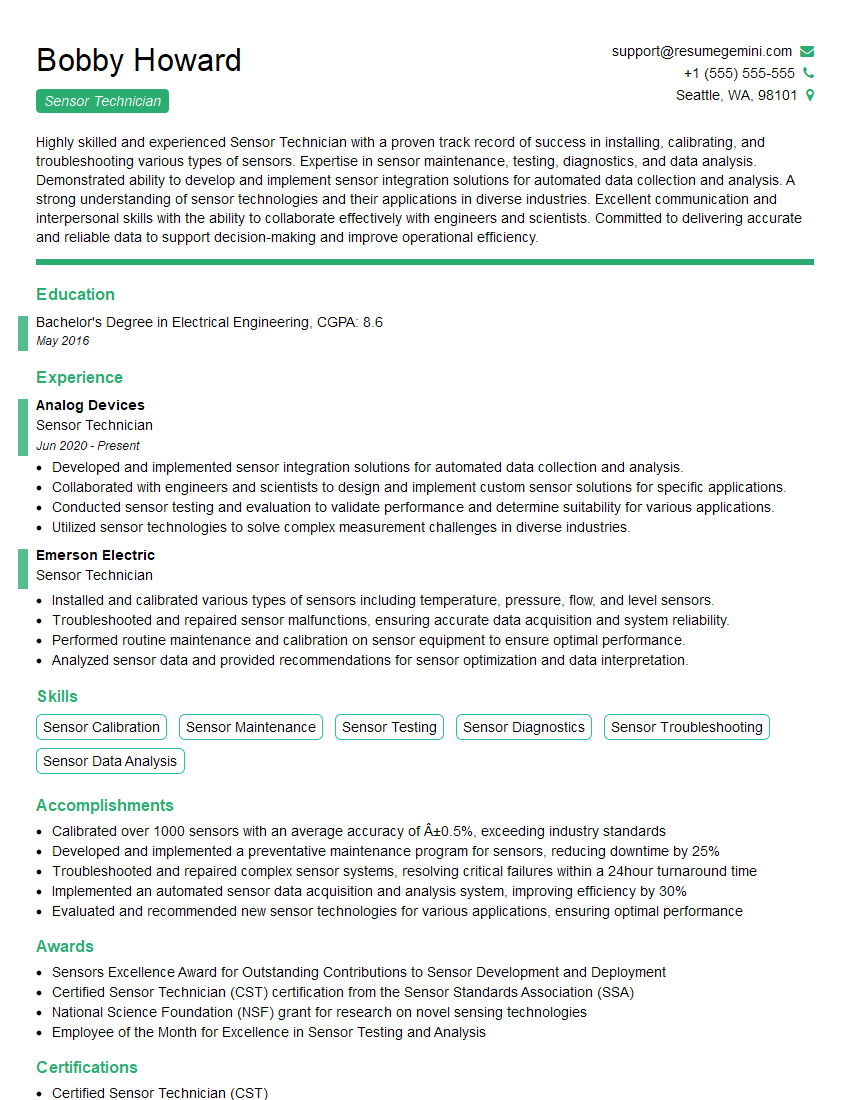
Mastering sensor operation opens doors to exciting career opportunities in diverse fields, offering high growth potential and the chance to work on cutting-edge technologies. To significantly improve your job prospects, crafting an ATS-friendly resume is crucial. This ensures your application gets noticed by recruiters and hiring managers. We highly recommend using ResumeGemini to build a professional and impactful resume. ResumeGemini offers a streamlined process and provides examples of resumes tailored specifically to Sensor Operation roles, giving you a head start in your job search.
Explore more articles
Users Rating of Our Blogs
Share Your Experience
We value your feedback! Please rate our content and share your thoughts (optional).
What Readers Say About Our Blog
Very informative content, great job.
good