Preparation is the key to success in any interview. In this post, we’ll explore crucial Sensory Lexicon interview questions and equip you with strategies to craft impactful answers. Whether you’re a beginner or a pro, these tips will elevate your preparation.
Questions Asked in Sensory Lexicon Interview
Q 1. Define ‘Sensory Lexicon’ and its importance in product development.
A sensory lexicon is a carefully selected and defined set of words that describe the sensory attributes of a product. Think of it as a specialized dictionary for describing how something looks, smells, tastes, feels, and sounds. Its importance in product development is paramount because it provides a standardized and objective way to communicate sensory perceptions across teams and consumers. For example, instead of vaguely saying a new chocolate bar is ‘good,’ a sensory lexicon allows for precise descriptions like ‘intensely dark chocolate flavor with notes of roasted nuts and a smooth, creamy texture.’ This precision is vital for consistent quality control, formulation improvements, and effective marketing communication.
Without a defined lexicon, subjective opinions can dominate product development decisions, leading to inconsistencies and missed opportunities. A well-defined lexicon ensures that everyone—from the sensory scientist to the marketing team—is on the same page, understanding and using the same language to describe sensory characteristics.
Q 2. Explain the difference between descriptive and affective sensory analysis.
Descriptive and affective sensory analysis differ fundamentally in their focus and the type of data they generate. Descriptive analysis aims to objectively characterize the sensory properties of a product. It focuses on identifying and quantifying the specific attributes present, such as the sweetness of a beverage or the crispness of a cracker. Think of it as a detailed sensory profile. For example, a descriptive analysis might reveal that a particular wine possesses high acidity, fruity aromas, and a medium-bodied texture. This analysis uses standardized scales and trained panelists.
Affective analysis, conversely, explores the consumer’s emotional response to the product. It measures hedonic aspects like liking, preference, and overall acceptability. While descriptive analysis provides factual details, affective analysis delves into the emotional impact of the sensory experience. For example, affective analysis might determine that consumers find a certain perfume ‘pleasant’ or ‘appealing,’ even if the specific odor notes remain undefined to them.
Q 3. What are the key characteristics of a well-designed sensory lexicon?
A well-designed sensory lexicon possesses several key characteristics. First, it needs to be comprehensive, covering all relevant sensory attributes for the product category. It also needs to be specific and unambiguous, avoiding vague terms. Each term should have a clear and consistent definition, ideally accompanied by reference standards or examples. For instance, instead of ‘sweet,’ the lexicon might include terms like ‘honey-like sweetness’ or ‘subtle sweetness.’
Relevance is crucial; the lexicon should only include terms applicable to the product being evaluated. The lexicon must also be practical, easily understood and used by panelists with varying levels of sensory experience. Finally, a well-designed lexicon should be validated to ensure reliability and consistency of use.
Q 4. Describe common methods used to develop and validate a sensory lexicon.
Developing and validating a sensory lexicon involves several steps. The process often begins with brainstorming sessions with experts and consumers to generate a preliminary list of terms. These terms are then refined through focus groups and interviews, ensuring that the terms are clearly understood and meaningfully differentiate between product samples. This refined list is used in sensory evaluation sessions where trained panelists assess products and rate the intensity of different sensory attributes using the proposed lexicon terms.
Statistical analysis of the panelists’ responses helps to identify terms that are reliable, discriminative, and consistently understood. The process often involves iteration; the lexicon is refined and tested repeatedly until it meets pre-defined criteria for reliability and validity. Common statistical techniques used include principal component analysis (PCA) and cluster analysis to group terms and identify redundant or ambiguous terms.
Q 5. How do you ensure the reliability and repeatability of sensory lexicon usage?
Ensuring the reliability and repeatability of sensory lexicon usage hinges on proper panelist training and standardized procedures. Panelists undergo rigorous training to learn to identify and consistently rate the intensity of sensory attributes using the defined terms. This training often includes sessions where panelists taste reference samples and discuss their sensory perception to develop a common understanding of the lexicon terms.
Using reference standards or visual aids can improve consistency. Regular calibration sessions help maintain panelists’ sensitivity and ensure that the interpretation of terms remains consistent over time. Proper sample presentation and environmental control minimize extraneous factors that might influence sensory perception. Finally, statistical analysis of the data collected from multiple testing sessions helps assess the reproducibility of the results and identify any outliers or inconsistencies.
Q 6. What are the limitations of using a pre-existing sensory lexicon?
Using a pre-existing sensory lexicon might seem convenient, but it has limitations. A pre-existing lexicon might not be perfectly aligned with the specific sensory attributes of your product. Terms might be too general or too specific, or the lexicon may not include terms relevant to your product. For example, a lexicon designed for wine might not be appropriate for evaluating yogurt.
Moreover, the definitions of terms might differ slightly from what’s needed for your specific application. A pre-existing lexicon also lacks the context and validation specific to your product and target audience. Therefore, while using a pre-existing lexicon can be a good starting point, it often requires significant adaptation or even complete replacement to ensure accuracy and suitability.
Q 7. How can sensory lexicon be utilized in consumer research?
Sensory lexicon plays a significant role in consumer research. It allows researchers to gain a detailed and nuanced understanding of how consumers perceive products. By using the lexicon during sensory evaluations, researchers can capture consumers’ detailed descriptions of sensory experiences, revealing preferences and identifying critical attributes that drive consumer choices.
For example, a sensory lexicon can reveal specific flavour notes that consumers associate with high quality or satisfaction in a food product. It allows researchers to collect data in a structured, standardized way, making data analysis more efficient and the results more interpretable. This information is invaluable for product development, reformulation, and marketing efforts, allowing companies to tailor products precisely to consumers’ needs and preferences.
Q 8. Explain the role of sensory lexicon in product reformulation.
A sensory lexicon is a carefully selected and defined set of descriptive terms used to characterize the sensory attributes of a product. In product reformulation, it acts as a crucial tool for objectively measuring and communicating changes in sensory properties. Imagine you’re tweaking a chocolate bar recipe. Instead of vague terms like “better taste,” the lexicon provides precise language to describe the changes: “increased cocoa notes,” “reduced bitterness,” “smoother texture.” This allows for targeted adjustments and ensures consistent quality throughout the reformulation process.
For example, if a company wants to reduce the sugar content in a yogurt without compromising its perceived sweetness, the sensory lexicon helps identify alternative descriptors that reflect desirable sweetness attributes like “fruity sweetness” or “creamy sweetness.” This allows the product developers to target specific sensory attributes during the reformulation process and objectively assess the impact of their changes.
Q 9. Discuss the challenges of using a sensory lexicon across different cultures.
Cultural differences significantly impact the perception and description of sensory attributes. What one culture considers a desirable aroma, another might find unpleasant. For instance, the aroma of durian fruit is highly valued in Southeast Asia but is often described as pungent or even offensive in Western cultures. Translating a sensory lexicon across cultures requires careful consideration of linguistic nuances and sensory experiences. Direct translation often fails to capture the intended meaning and cultural connotations.
To address this, we need to create culturally specific lexicons, or adapt a core lexicon with regionally appropriate terms. This requires extensive consumer research and sensory testing within the target cultural group. It involves working with native speakers and sensory experts within each culture to ensure the lexicon reflects the local sensory perception and language accurately. This careful cultural adaptation is critical to avoid misinterpretations and ensure the reliability of sensory evaluation across different markets.
Q 10. How do you address individual differences in sensory perception when using a lexicon?
Individual differences in sensory perception are inevitable. Some people are more sensitive to bitterness than others; some have higher olfactory acuity than others. To address this, we use techniques like trained panels. Panelists undergo rigorous training to achieve a high level of agreement in their descriptions, using the defined lexicon. Statistical analysis, such as ANOVA, allows us to identify and control for significant individual variations in sensory responses.
Furthermore, we can incorporate measures of individual sensory thresholds into our analysis. This allows us to understand the range of perception within the panel and to adjust our analyses accordingly. For example, if we find a particular panelist consistently scores higher on bitterness, we may need to adjust their scores or analyze their data separately to account for their higher sensitivity.
Q 11. How is sensory lexicon used in the creation of flavor profiles?
Sensory lexicons are indispensable in creating flavor profiles. Instead of relying on subjective descriptions, a lexicon provides the precise language to objectively define a flavor profile’s characteristics. For example, a lexicon might include terms like “sweet,” “sour,” “salty,” “bitter,” “umami,” but it goes much further, offering nuances within each category. For instance, sweetness could be described as “honey-like sweetness,” “fruity sweetness,” or “caramel sweetness.”
When creating a flavor profile for a new beverage, a team might use the lexicon to define the target profile as possessing ‘bright citrus notes,’ ‘subtle herbal undertones,’ and ‘lingering sweetness with hints of honey.’ This allows for the accurate comparison of different formulations and ensures that the final product meets the desired profile. The lexicon aids in clear communication between food scientists, marketers, and consumers, avoiding ambiguity and ensuring everyone is on the same page.
Q 12. Describe the process of training panelists to use a sensory lexicon effectively.
Training panelists is a crucial step. It involves several stages. First, we introduce the lexicon’s terms, providing detailed definitions and examples. Next, panelists participate in sensory sessions, evaluating samples using the lexicon. This practice helps them understand how to apply the terms consistently. We utilize reference standards – samples that embody the specific attributes defined in the lexicon – to enhance understanding and agreement among panelists.
Throughout the training, we emphasize the importance of using the defined terms objectively and consistently. We also employ exercises to refine their discriminatory ability and to ensure that they accurately identify and describe subtle differences in the sensory attributes of the samples. This rigorous training process ensures that the data collected is reliable, accurate and consistent, forming a strong basis for product development and quality control.
Q 13. How do you manage and analyze data collected using a sensory lexicon?
Data from sensory lexicon studies is typically structured in a spreadsheet or database, with each row representing a sample and each column representing a sensory attribute from the lexicon. The data might consist of numerical scores (e.g., intensity ratings on a scale of 1-9) or qualitative descriptions. For qualitative data, we often employ statistical techniques to quantify the frequency of different descriptors.
Data analysis might include descriptive statistics (means, standard deviations) to summarize the sensory profiles of different samples. We use statistical tests, such as ANOVA or t-tests, to compare the sensory profiles of different samples or groups. Data visualization techniques, like bar charts or heatmaps, help communicate the findings effectively. Sophisticated statistical methods like Principal Component Analysis (PCA) can reveal underlying patterns and relationships among the sensory attributes.
Q 14. What statistical methods are relevant for analyzing data from sensory lexicon studies?
Several statistical methods are relevant for analyzing sensory lexicon data.
- Analysis of Variance (ANOVA): Compares means of sensory attribute scores across different samples or treatments. For example, comparing the sweetness scores of three different formulations of yogurt.
- t-tests: Compares the means of two groups. For example, comparing the bitterness of a control product and a reformulated version.
- Principal Component Analysis (PCA): A dimensionality reduction technique used to identify patterns and relationships among multiple sensory attributes. This can help simplify complex datasets and identify key sensory drivers.
- Non-parametric tests (e.g., Mann-Whitney U test, Kruskal-Wallis test): Used when the data do not meet the assumptions of parametric tests (e.g., data not normally distributed).
- Regression analysis: Explores the relationships between sensory attributes and other variables, such as consumer preference or price.
The choice of statistical method depends on the research question and the nature of the data.
Q 15. What are some examples of common sensory attributes used in different product categories (e.g., food, beverage, cosmetics)?
A sensory lexicon is a structured vocabulary of terms used to describe sensory experiences. Different product categories naturally lend themselves to different sets of attributes. Think of it like a specialized dictionary for describing what we see, smell, taste, touch, and hear.
- Food: Think about describing a chocolate bar. We might use terms like sweet, bitter, creamy, smooth, intense, fruity, nutty, floral, etc. For a tomato, terms such as acidic, juicy, firm, earthy, sweet, and bright become relevant.
- Beverage: Consider coffee. A sensory lexicon might include descriptors such as fruity, floral, nutty, chocolatey, acidic, bitter, roasted, sweet, balanced, or complex. For wine, expect terms like oaky, tannic, herbaceous, fruity, mineral, full-bodied, etc.
- Cosmetics: In this domain, we look at attributes like creamy, smooth, silky, soft, light, heavy, refreshing, cooling, fragrant, floral, powdery, etc., which are often used to describe textures and scents of lotions, perfumes, and makeup.
The key is that these terms are carefully chosen for their precision and ability to evoke consistent sensory experiences across different assessors.
Career Expert Tips:
- Ace those interviews! Prepare effectively by reviewing the Top 50 Most Common Interview Questions on ResumeGemini.
- Navigate your job search with confidence! Explore a wide range of Career Tips on ResumeGemini. Learn about common challenges and recommendations to overcome them.
- Craft the perfect resume! Master the Art of Resume Writing with ResumeGemini’s guide. Showcase your unique qualifications and achievements effectively.
- Don’t miss out on holiday savings! Build your dream resume with ResumeGemini’s ATS optimized templates.
Q 16. How does sensory lexicon aid in competitive product analysis?
A well-defined sensory lexicon is invaluable in competitive product analysis. By using the same standardized language to describe competing products, we can objectively compare their sensory profiles. Imagine you’re analyzing three different brands of orange juice. Instead of vague statements like ‘this one tastes better,’ a sensory lexicon allows panelists to provide precise descriptions like ‘Brand A has a more intense citrus aroma and a higher perceived sweetness, while Brand B possesses a more tart and acidic profile with less intense aroma.’
This structured approach ensures that comparisons are reliable and repeatable, revealing significant differences and allowing for the identification of areas for product improvement or differentiation. It’s about moving beyond subjective opinions and towards data-driven insights.
Q 17. How can sensory lexicon improve communication between sensory scientists and other stakeholders?
A shared sensory lexicon acts as a bridge between sensory scientists and other stakeholders (marketing, product development, etc.). Without a common language, misunderstandings are almost inevitable. For example, a sensory scientist might describe a product as having ‘high astringency,’ while a marketing professional might interpret that as simply ‘dry.’ The lexicon ensures everyone is on the same page, using the same terminology to describe the same sensations. This clarity reduces confusion, streamlines communication, and promotes a shared understanding of product characteristics.
Q 18. Explain the connection between sensory lexicon and consumer preferences.
The link between sensory lexicon and consumer preferences is direct. By using a lexicon to systematically describe product attributes, we can correlate specific sensory characteristics with consumer liking. For instance, we might discover that consumers prefer a chocolate bar with a ‘high intensity of cocoa flavor’ and a ‘creamy texture’ over one described as ‘mildly cocoa flavored’ and ‘slightly grainy.’ This data helps guide product formulation and marketing strategies towards what consumers find most appealing. The lexicon helps us translate consumer feedback into actionable insights.
Q 19. Describe the impact of context on sensory perception and lexicon usage.
Context significantly influences both sensory perception and lexicon usage. The same product can evoke different sensory experiences depending on factors like temperature, surrounding environment, and even prior experiences. A cup of coffee might taste intensely bitter on a hot summer day but more comforting on a cold winter morning.
Similarly, the lexicon used might change depending on the context. In a formal sensory evaluation, panelists use highly specific and technical terms. However, in a casual setting, consumers might use more colloquial language. The understanding of these contextual influences is crucial for obtaining reliable and meaningful results.
Q 20. How would you handle discrepancies between panelists’ use of a sensory lexicon?
Discrepancies in lexicon usage among panelists are common and need careful handling. It often stems from differences in sensory acuity, prior experiences, and personal interpretations of terms. Here’s a step-by-step approach to address this:
- Training: Provide thorough training on the lexicon, ensuring panelists understand the definitions and application of each term. Include visual aids and examples.
- Calibration Sessions: Conduct calibration sessions where panelists evaluate reference samples and discuss their sensory perceptions. This helps to align their understanding of the descriptors.
- Anchor Samples: Provide anchor samples representing extremes of each attribute. For example, a sample with extremely high sweetness, and another with extremely low sweetness, to define the range.
- Statistical Analysis: Use appropriate statistical techniques to account for individual differences and assess the consistency of panelists’ assessments.
- Regular Feedback: Provide regular feedback to panelists, addressing any inconsistencies and clarifying any misunderstandings.
The aim is to minimize subjectivity and standardize interpretations, leading to more reliable and reproducible results.
Q 21. Discuss the role of sensory lexicon in the development of new products.
Sensory lexicon plays a pivotal role in new product development. It guides the creation of products that meet specific sensory targets, leading to enhanced consumer appeal. For instance, if market research suggests consumers prefer a yogurt with a ‘creamy texture’ and a ‘tangy flavor,’ the lexicon provides the framework for product developers to formulate a recipe that achieves these desired sensory attributes.
During product development, the lexicon provides a common language to track changes in sensory properties as different formulations are tested. This structured approach facilitates effective communication and collaboration between scientists, engineers, and marketers, accelerating the innovation process and significantly increasing the likelihood of creating a successful product.
Q 22. How do you incorporate sensory lexicon into quality control procedures?
Incorporating a sensory lexicon into quality control is crucial for ensuring product consistency and meeting consumer expectations. A well-defined lexicon provides a standardized language for panelists to describe product attributes, allowing for objective and repeatable sensory evaluations.
For example, imagine a chocolate manufacturer. Their lexicon might include descriptors like ‘intensely bitter,’ ‘creamy,’ ‘nutty,’ and ‘slightly sweet’ with defined intensity scales (e.g., 1-5). During quality control, trained panelists use this lexicon to evaluate samples, scoring each attribute on the defined scale. If scores deviate significantly from established benchmarks, it signals a potential quality issue, triggering investigation and corrective actions. This ensures that each batch of chocolate consistently matches the desired sensory profile.
This process goes beyond simple pass/fail judgments. The numerical data generated facilitates trend analysis. Over time, this allows for proactive adjustments to the manufacturing process to maintain consistent quality.
Q 23. What are the ethical considerations when designing and implementing a sensory lexicon?
Ethical considerations in designing and implementing a sensory lexicon are paramount. The primary concern is ensuring the fairness and unbiased nature of the evaluation process. This involves:
- Panelist selection and training: A diverse panel representing the target consumer population is essential. Proper training ensures all panelists understand the lexicon and evaluation procedures, minimizing subjective bias.
- Avoiding leading questions or biased instructions: The language used in questionnaires and during training must remain neutral, preventing panelists from being influenced toward specific responses.
- Data confidentiality and anonymity: Panelists’ identities should be protected, and their individual responses should be treated confidentially to ensure honest and impartial feedback.
- Transparency and reproducibility: The lexicon itself should be clearly defined and documented. The methodology should be reproducible, allowing for independent verification of results.
- Avoiding cultural bias: Descriptive terms should be chosen carefully, taking into account the cultural backgrounds of the panelists, to ensure that they are universally understood and interpreted consistently.
Ignoring these ethical considerations could lead to flawed results, biased conclusions, and potentially harmful misinterpretations of product quality or consumer preferences.
Q 24. Describe how emerging technologies could influence the future of sensory lexicon.
Emerging technologies are poised to revolutionize sensory lexicon and its application. Here are some key examples:
- Artificial intelligence (AI) and machine learning (ML): AI can analyze vast datasets from sensory evaluations, identifying patterns and relationships that humans might miss. This can lead to more sophisticated lexicons, better prediction of consumer preferences, and more efficient quality control procedures.
- Virtual and augmented reality (VR/AR): VR/AR can create immersive sensory experiences for panelists, enabling more precise and comprehensive evaluations. For example, a virtual tasting experience can control variables like lighting and ambient sounds, minimizing extraneous influences.
- Electronic noses and tongues: These instruments can objectively measure volatile compounds (electronic nose) and taste compounds (electronic tongue), providing quantitative data to complement sensory evaluations. This objective data can be incorporated into the lexicon development, offering a more holistic understanding of sensory attributes.
- Big data analytics: Combining sensory data with other market research data (e.g., sales figures, social media sentiment) can provide a comprehensive understanding of consumer preferences and product performance.
These technologies, when integrated thoughtfully and ethically, have the potential to enhance the accuracy, efficiency, and impact of sensory lexicons.
Q 25. Compare and contrast different types of sensory lexicons (e.g., free-choice profiling, quantitative descriptive analysis).
Several types of sensory lexicons exist, each suited for different research objectives.
Free-choice profiling (FCP) is an exploratory technique where panelists freely describe the sensory attributes of a product without any pre-defined vocabulary. It’s excellent for generating initial ideas and identifying key characteristics, but lacks the standardization of other methods. The resulting data is qualitative and often requires further analysis to establish consistent terminology.
Quantitative descriptive analysis (QDA) is a more structured approach. A trained panel uses a predefined lexicon to rate the intensity of various sensory attributes on a numerical scale. This yields quantitative data allowing for statistical analysis, comparison across products, and tracking changes over time. QDA is widely used for product development and quality control.
The key difference lies in the level of structure and pre-defined vocabulary. FCP is open-ended and exploratory, while QDA is structured and quantitative. The choice depends on the research goal: FCP is suitable for initial exploration, while QDA is preferred when precise, measurable data is needed.
Q 26. Explain how you would choose the appropriate sensory lexicon for a specific product and research objective.
Choosing the appropriate sensory lexicon requires careful consideration of the product and research objective. A step-by-step process might include:
- Define the research objective: What questions need to be answered? Are we aiming for product development, quality control, consumer preference mapping, or competitive analysis?
- Understand the product: What are the key sensory attributes of the product? Are there any unique or unusual characteristics that need to be captured?
- Identify the target consumer group: Whose perception is most important? This will influence the language and descriptors used in the lexicon.
- Select the appropriate method: FCP might be suitable for initial exploration, while QDA is preferred for quantitative comparisons. Consider hybrid approaches if needed.
- Develop or adapt the lexicon: The lexicon should be comprehensive yet concise, using clear, unambiguous terms. Existing lexicons can be adapted or a new one can be created using FCP as a foundation.
- Pilot test the lexicon: Before full-scale implementation, test the lexicon with a small group of panelists to identify any ambiguities or potential issues.
- Train the panel: Ensure all panelists understand the lexicon and the evaluation procedure.
This systematic approach ensures that the chosen lexicon is fit for purpose and generates meaningful, reliable data.
Q 27. How can sensory lexicon data be integrated with other types of market research data?
Sensory lexicon data can be powerfully integrated with other market research data to gain a more comprehensive understanding of consumer behavior and product performance.
For example, sensory data from QDA can be combined with sales data to correlate specific sensory attributes with purchase frequency. If consumers highly rate ‘fruity’ notes in a particular beverage, and this correlates with higher sales, this provides strong evidence that the ‘fruity’ characteristic is a key driver of consumer preference.
Similarly, sensory data can be combined with consumer feedback from surveys, focus groups, or social media to provide richer insights into consumer perceptions. This triangulation of data can help identify gaps between consumer expectations and product reality, leading to informed product improvements. Statistical techniques like regression analysis or cluster analysis can be used to uncover relationships between various data sources.
Q 28. Describe a time you had to overcome a challenge related to the use of a sensory lexicon.
During a project evaluating the sensory profile of a new type of bread, we encountered a challenge with the lexicon’s descriptors for ‘crust texture’. Initially, we used terms like ‘crispy,’ ‘crunchy,’ and ‘hard,’ but panelists found it difficult to differentiate between them consistently. Some panelists interpreted ‘crunchy’ as implying a louder sound than ‘crispy,’ introducing unwanted subjectivity.
To overcome this, we implemented a multi-stage approach. First, we conducted further FCP sessions to gather a more nuanced vocabulary from panelists directly. This yielded new terms like ‘brittle,’ ‘firm,’ and ‘snappy,’ more accurately reflecting the different textures. We then defined each term with accompanying visual aids (images and examples) to improve consistency in interpretation. Finally, we incorporated a standardized scoring scale (1-7) for each term to quantify the intensity of each textural attribute. This revised lexicon significantly improved the reliability and interpretability of our sensory data.
Key Topics to Learn for Sensory Lexicon Interview
- Defining Sensory Lexicon: Understand the core principles and applications of describing sensory experiences using precise language.
- Sensory Modalities: Master the detailed description of visual, auditory, olfactory, gustatory, and tactile experiences within the context of your field.
- Figurative Language & Sensory Imagery: Explore the use of metaphors, similes, and other literary devices to evoke vivid sensory impressions. Understand how to analyze and apply these effectively.
- Contextual Application: Practice applying sensory lexicon in different contexts, such as product descriptions, marketing materials, or user experience design (depending on the specific job). Consider how the nuances of language shift depending on the target audience.
- Analyzing Sensory Descriptions: Develop skills in critically evaluating existing sensory descriptions for clarity, accuracy, and impact. Be prepared to discuss strengths and weaknesses.
- Cross-Modal Correspondences: Explore the fascinating connections between different senses and how they influence each other in shaping perception. Be ready to discuss examples.
- Cultural Influences on Sensory Perception: Consider how cultural backgrounds affect the interpretation and expression of sensory experiences. This is crucial for global contexts.
- Problem-Solving with Sensory Lexicon: Prepare to demonstrate how you would use precise sensory language to address specific challenges, such as improving product descriptions or creating more engaging marketing copy.
Next Steps
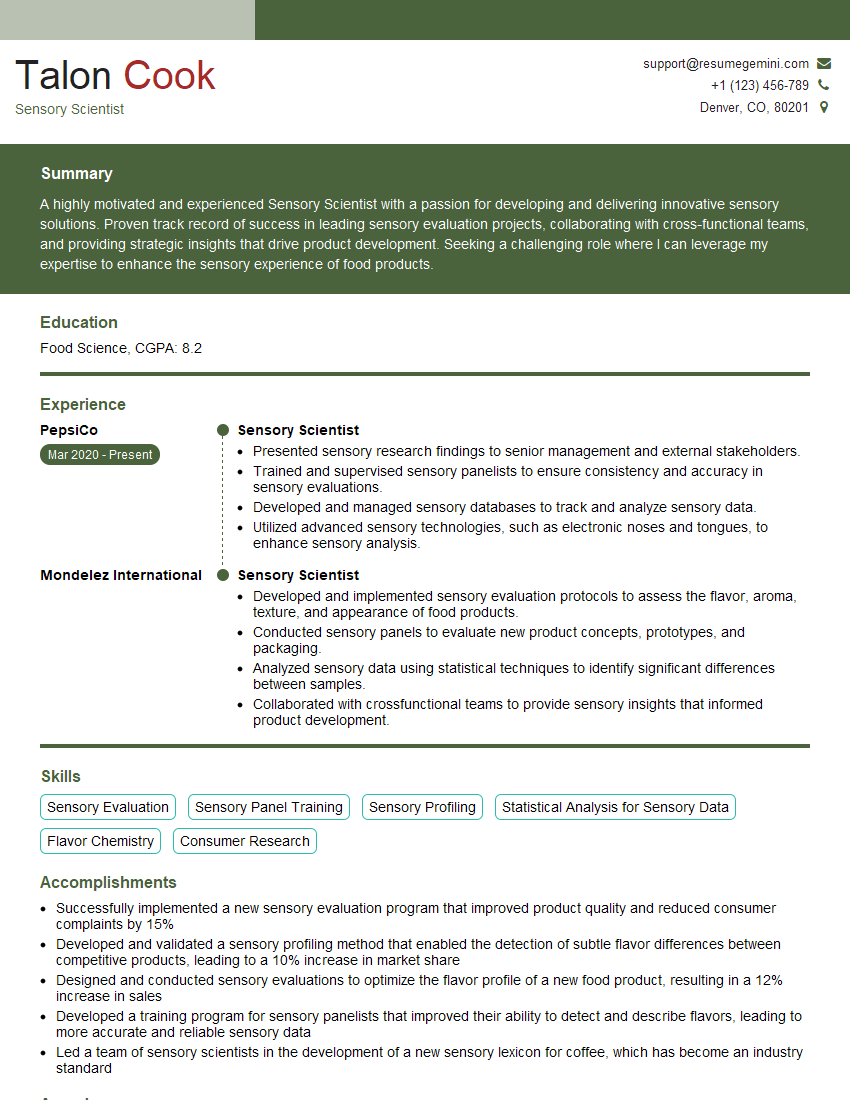
Mastering Sensory Lexicon is crucial for career advancement in fields that prioritize precise communication and impactful descriptions. A strong understanding opens doors to exciting opportunities and positions you as a skilled professional. To maximize your job prospects, focus on creating an ATS-friendly resume that highlights your relevant skills and experiences. ResumeGemini is a trusted resource to help you build a professional and impactful resume that stands out. Examples of resumes tailored to Sensory Lexicon roles are available to help guide you.
Explore more articles
Users Rating of Our Blogs
Share Your Experience
We value your feedback! Please rate our content and share your thoughts (optional).
What Readers Say About Our Blog
Very informative content, great job.
good