The right preparation can turn an interview into an opportunity to showcase your expertise. This guide to SEO and SEM Marketing interview questions is your ultimate resource, providing key insights and tips to help you ace your responses and stand out as a top candidate.
Questions Asked in SEO and SEM Marketing Interview
Q 1. Explain the difference between SEO and SEM.
SEO (Search Engine Optimization) and SEM (Search Engine Marketing) are both crucial for online visibility, but they differ significantly in their approach. Think of it like this: SEO is about earning organic (unpaid) traffic, while SEM focuses on paid advertising to achieve immediate results.
SEO focuses on improving your website’s ranking in organic search results by optimizing various aspects of your website and content. This involves techniques like keyword research, on-page optimization (improving content and HTML source code), and off-page optimization (building backlinks from other reputable sites). It’s a long-term strategy that builds brand authority and trust.
SEM, on the other hand, involves paid advertising on search engines like Google Ads. You create ads that target specific keywords and pay each time someone clicks on your ad. SEM delivers faster results than SEO, allowing you to reach a wider audience quickly. However, the traffic stops when you stop paying.
In essence, SEO is about building a strong foundation, while SEM provides a quick boost. Many successful online businesses use a combination of both strategies for optimal reach and impact.
Q 2. What are the key elements of a successful SEO strategy?
A successful SEO strategy requires a holistic approach encompassing several key elements. It’s not just about stuffing keywords; it’s about providing valuable content that users and search engines both appreciate.
- Keyword Research: Identifying relevant keywords with high search volume and low competition is paramount. We need to understand user search intent to target the right keywords.
- On-Page Optimization: This involves optimizing individual web pages to rank higher and earn more relevant traffic in search engines. This includes title tags, meta descriptions, header tags (H1-H6), image alt text, and internal linking.
- Off-Page Optimization: Building high-quality backlinks from reputable websites is crucial. These backlinks act as votes of confidence, signaling to search engines that your site is trustworthy and authoritative.
- Technical SEO: Ensuring your website is easily crawlable and indexable by search engines is essential. This includes site speed optimization, mobile-friendliness, XML sitemaps, and structured data markup.
- Content Marketing: Creating high-quality, engaging, and informative content that satisfies user search intent is key. This content should be optimized for relevant keywords naturally.
- User Experience (UX): A positive user experience is crucial for both users and search engines. A site with good UX has higher engagement, lower bounce rates, and ultimately, better rankings.
- Local SEO (if applicable): For businesses with a physical location, optimizing for local search results (Google My Business, local citations) is crucial.
By meticulously addressing each of these elements, we can build a robust and effective SEO strategy that drives sustainable organic growth.
Q 3. Describe your experience with keyword research and selection.
Keyword research and selection are foundational to any SEO strategy. My approach involves a multi-faceted strategy that combines data-driven insights with a deep understanding of user intent.
I start by using tools like SEMrush, Ahrefs, and Google Keyword Planner to identify relevant keywords. I look beyond just search volume; I analyze keyword difficulty, competition, and search intent. For instance, understanding if a user is looking for informational content versus transactional content is crucial in selecting the right keywords.
Then, I analyze competitor keywords to identify opportunities we might have missed. I also use tools to analyze long-tail keywords – longer, more specific phrases that often have less competition and higher conversion rates. For example, instead of targeting just “shoes,” I might target “best running shoes for women with flat feet.”
Finally, I prioritize keywords that align with our business goals and target audience. This ensures that our efforts are focused and effective, driving qualified traffic to our website.
I’ve successfully used this methodology across various client projects, resulting in improved organic rankings and increased website traffic.
Q 4. How do you perform a technical SEO audit?
Performing a thorough technical SEO audit is like giving your website a comprehensive health check. It involves systematically identifying and resolving technical issues that hinder search engine crawlability and indexability. My approach is structured and methodical.
- Crawlability and Indexability: I use tools like Screaming Frog to crawl the website, identifying broken links, crawl errors, and issues with robots.txt. I also check how many pages are indexed by Google.
- Website Speed and Performance: Using tools like Google PageSpeed Insights, I analyze website speed and identify areas for improvement, such as optimizing images and leveraging browser caching.
- Mobile-Friendliness: I use Google’s Mobile-Friendly Test to ensure the website is responsive and provides a seamless experience on all devices.
- XML Sitemap and robots.txt: I check if the website has a valid XML sitemap and properly configured robots.txt file to ensure search engines can easily access and index the website’s content.
- Structured Data Markup (Schema): I analyze the implementation of schema markup to ensure rich snippets are displayed in search results.
- HTTPS and Security: I verify that the website is using HTTPS, ensuring a secure browsing experience for users.
- Canonicalization: I identify and resolve issues with duplicate content using canonical tags.
After identifying issues, I prioritize them based on their impact and create a detailed report with actionable recommendations for improvement. This ensures a systematic approach to addressing technical SEO problems and improving website performance.
Q 5. Explain your understanding of on-page and off-page optimization.
On-page and off-page optimization are two crucial aspects of SEO that work in tandem to improve search engine rankings. Think of it like building a house: on-page is the foundation and structure, while off-page is the reputation and neighborhood.
On-page optimization refers to all the things you can control directly on your website. This includes optimizing content for specific keywords, improving website structure, and ensuring your site is easy to navigate. Examples include optimizing title tags, meta descriptions, header tags (H1-H6), internal linking, and image alt text. It’s about making your site content appealing and easily understood by search engines.
Off-page optimization focuses on building your website’s authority and credibility in the eyes of search engines. This is primarily achieved through building high-quality backlinks from other reputable websites. These backlinks act as votes of confidence, signaling to search engines that your site is trustworthy and authoritative. Other off-page activities include social media marketing, brand mentions, and online public relations.
Both on-page and off-page optimization are essential for achieving high search engine rankings. A strong foundation of on-page optimization is complemented by a strong off-page strategy to build authority and trust.
Q 6. What are some common SEO ranking factors?
Search engine ranking factors are the elements that search engines use to determine a website’s ranking in search results. They’re constantly evolving, but some key factors consistently remain important.
- Content Quality: High-quality, original, relevant, and comprehensive content is paramount. Search engines prioritize sites that provide valuable information to users.
- Backlinks: High-quality backlinks from reputable websites are a significant ranking factor, indicating trust and authority.
- Website Structure and Navigation: A well-structured and easily navigable website improves user experience and helps search engines crawl and index your content efficiently.
- Website Speed: Fast-loading websites are crucial for user experience and search engine ranking. Slow websites result in high bounce rates.
- Mobile-Friendliness: Websites should be responsive and provide a seamless experience on all devices.
- Domain Authority: Older domains with a history of positive SEO often have a higher domain authority, influencing rankings.
- Keyword Relevance: Using relevant keywords naturally within your content helps search engines understand your site’s topic.
- User Experience (UX): Positive UX signals, such as low bounce rates and high engagement, positively influence rankings.
- Technical SEO: Technical aspects like sitemaps, robots.txt, and structured data also affect search engine ranking.
- Security (HTTPS): Secure websites are prioritized by search engines.
It’s important to remember that no single factor guarantees high rankings; it’s the combination of these elements that determines a website’s overall ranking.
Q 7. How do you measure the success of an SEO campaign?
Measuring the success of an SEO campaign requires a multifaceted approach that goes beyond simply tracking rankings. While rankings are important, they don’t tell the whole story.
I use a combination of metrics to gauge success:
- Organic Traffic: Tracking the amount of organic traffic coming to the website from search engines is a key indicator of success. Tools like Google Analytics provide detailed insights into traffic sources and user behavior.
- Keyword Rankings: Monitoring keyword rankings over time helps assess the effectiveness of optimization efforts. We track changes in positions for target keywords.
- Conversion Rates: Tracking conversion rates (e.g., sales, sign-ups) is crucial to understand how much value SEO is generating.
- Bounce Rate: A high bounce rate suggests that users aren’t finding what they’re looking for and indicates a need for improvement.
- Time on Site: Longer time spent on site suggests engaging content that is satisfying user intent.
- Backlink Profile: Analyzing the quality and quantity of backlinks helps assess the effectiveness of off-page optimization efforts.
By regularly monitoring these metrics, I can identify areas for improvement and optimize the campaign to achieve better results. This data-driven approach is essential for demonstrating the ROI of SEO efforts to clients.
Q 8. What are the different types of SEO?
SEO, or Search Engine Optimization, isn’t a monolithic entity. It’s broadly categorized into two main types: On-Page SEO and Off-Page SEO. Think of it like this: On-Page is optimizing what’s *within* your website, while Off-Page focuses on what’s *outside* of it, building your website’s reputation and authority.
- On-Page SEO: This involves optimizing elements directly within your website’s control, such as keyword research and implementation in title tags, meta descriptions, headings (H1-H6), image alt text, and URL structure. It also includes improving website speed and user experience (UX). For example, ensuring your page loads quickly and is easily navigable improves both user satisfaction and search engine rankings.
- Off-Page SEO: This refers to activities performed *outside* your website to improve its search engine rankings. The primary focus here is link building (which I’ll discuss further in the next question), but also includes things like brand mentions, social media marketing, and online reputation management. Building a strong reputation organically leads to increased trust and authority in the eyes of search engines.
- Technical SEO: While often grouped with on-page, technical SEO deserves its own mention. This focuses on the underlying technical aspects of a website, including website architecture, sitemaps, robots.txt, and schema markup (which I’ll cover later). A well-structured site, easily crawlable by search engines, is crucial for good rankings.
Successfully implementing both on-page and off-page SEO strategies, along with a strong technical foundation, is key to achieving high search engine rankings.
Q 9. Explain the concept of link building and its importance.
Link building is the process of acquiring hyperlinks from other websites to your own. These links act as votes of confidence, telling search engines that your website is a valuable and trustworthy resource. Think of it like a recommendation system; the more reputable websites linking to you, the more authority your site gains.
Its importance lies in its direct impact on search engine rankings. Search engines use links as one of the primary signals to determine a website’s relevance and authority on a given topic. A website with many high-quality backlinks from relevant websites is more likely to rank higher in search results.
For example, if a highly respected industry blog links to your article, this tells Google that your content is credible and valuable, boosting your rankings for relevant keywords. However, it’s crucial to focus on acquiring high-quality links from reputable and relevant websites. Low-quality links from spammy sites can actually harm your rankings. A diverse backlink profile is also important, rather than relying on a small number of high-authority sites.
Q 10. How do you identify and address broken links?
Broken links, or dead links, are hyperlinks that lead to a page that no longer exists or is inaccessible (resulting in a 404 error). They negatively impact user experience and SEO. They create frustration for visitors and signal to search engines that your website is poorly maintained.
Identifying broken links can be done using several methods:
- Website Crawler Tools: Tools like Screaming Frog or other SEO crawlers can scan your entire website, identifying all broken links. They provide comprehensive reports, making it easy to pinpoint and fix issues.
- Google Search Console: This free tool from Google flags crawl errors, which often include broken links. It provides insights into website issues that affect search engine crawlability and indexing.
- Manual Checks: While less efficient for large websites, manually clicking through links on your site can uncover broken links.
Addressing broken links involves redirecting them to working pages using 301 redirects (permanent redirects) or updating the links to point to correct pages. For example, if a link points to `/old-page.html` and that page has been removed or changed, you’d create a 301 redirect from `/old-page.html` to the new correct page, `/new-page.html`.
Q 11. What is schema markup and why is it important for SEO?
Schema markup is a type of structured data that uses a standardized format (like JSON-LD) to provide search engines with additional information about your website’s content. It’s like adding extra context that helps search engines better understand what your website is about.
For example, using schema markup on a product page can specify the product’s name, price, description, reviews, and availability. This allows search engines to display rich snippets in the search results, including star ratings, prices, and other details, increasing click-through rates.
The importance for SEO lies in enhanced visibility and improved click-through rates. Rich snippets make your listings stand out, attracting more attention and driving more traffic to your website. Schema markup also helps search engines understand your content better, potentially improving rankings for relevant keywords.
Implementing schema markup involves adding code to your website’s HTML. While it doesn’t directly guarantee higher rankings, it improves the chances of getting featured snippets and richer search results, leading to better organic performance.
Q 12. Explain your experience with Google Analytics and Google Search Console.
Google Analytics and Google Search Console are integral parts of my SEO workflow. They provide invaluable data for monitoring website performance and identifying areas for improvement.
Google Analytics provides comprehensive website traffic data, including user demographics, behavior, and conversion rates. I use it to track key metrics such as bounce rate, average session duration, pages per session, and conversion rates to assess website effectiveness and identify areas needing optimization. For example, a high bounce rate might indicate a problem with page content or website navigation, prompting a redesign or content overhaul.
Google Search Console offers insights into how Google sees your website. It shows which keywords are driving traffic, identifies technical issues such as broken links and crawl errors, and allows you to submit sitemaps for faster indexing. I use this data to identify and fix technical SEO problems, optimize for target keywords, and improve website visibility in search results. I also use it to monitor for any manual actions or penalties that Google might apply.
In essence, Google Analytics helps me understand *what* is happening on my website (user behavior), and Google Search Console helps me understand *how* Google sees my website (indexability and ranking). Together, they provide a holistic view of website performance, enabling data-driven SEO decisions.
Q 13. How do you handle duplicate content issues?
Duplicate content is content that appears in substantially the same form across multiple URLs. This is problematic because it confuses search engines, potentially leading to lower rankings or penalties. It’s important to note that not all instances of similar content are problematic; slight variations or truly unique content across different sites are acceptable. The issue is when substantial amounts of identical or nearly identical content exist across multiple pages.
Handling duplicate content issues involves several strategies:
- Canonicalization: Using the
rel="canonical"tag on duplicated pages tells search engines which page should be considered the primary version. This is the best approach for dealing with similar content on different URLs. - 301 Redirects: If a page is truly redundant, redirecting it to the preferred version using a 301 redirect helps consolidate ranking signals.
- Consolidating Content: Combine similar content into one high-quality page. This offers a better user experience and avoids confusing search engines.
- Noindex Tag: Use the
noindexmeta tag on pages you don’t want indexed by search engines. This helps prevent duplicate content issues by explicitly excluding certain pages from search results.
Before implementing any of these solutions, it’s critical to thoroughly audit your website to identify all instances of duplicate content. You can use tools like Screaming Frog to help with this process. The strategy should be tailored to the specific situation, ensuring the best user experience and SEO performance.
Q 14. What is the role of content in SEO?
Content is king in SEO. It’s the foundation upon which all other SEO efforts are built. High-quality, relevant, and engaging content is crucial for attracting and retaining users, and it’s a key ranking factor for search engines.
The role of content in SEO goes beyond simply writing words. It encompasses:
- Keyword Optimization: Integrating relevant keywords naturally within the content helps search engines understand the topic and target audience.
- User Engagement: Content needs to provide value to users, keeping them engaged on your website. Metrics like time on page and bounce rate reflect content quality.
- Authority Building: High-quality, informative content establishes your website as a trusted resource in your niche. This improves credibility and influences rankings.
- Link Building: Excellent content is more likely to be linked to by other websites, thus improving the website’s backlink profile.
- Content Formats: Experimenting with diverse content formats (blog posts, videos, infographics, etc.) caters to different user preferences and improves overall reach.
In essence, content is the central element driving user engagement and search engine rankings. By creating high-quality, relevant, and engaging content optimized for search, you can significantly improve your website’s visibility and organic traffic.
Q 15. Explain your understanding of mobile-first indexing.
Mobile-first indexing means Google primarily uses the mobile version of your website’s content to understand what your page is about, index it, and rank it in search results. Think of it like this: Google is increasingly viewing your site through the lens of a smartphone user first. This is crucial because most searches now originate from mobile devices. If your mobile site is poorly optimized, slow, or has a poor user experience, Google will negatively impact your rankings, even if your desktop version is excellent. Googlebot, the crawler that indexes your website, now prioritizes the mobile version of your content. This means your mobile site needs to be fast, well-structured, and offer a great user experience. It’s no longer sufficient to just have a separate mobile site; the mobile version needs to be the primary focus of your SEO strategy. This impacts things like page speed optimization, mobile-friendly design (responsive design is key), and ensuring content is easily accessible on smaller screens. Failing to adapt to mobile-first indexing can severely limit your website’s visibility.
Career Expert Tips:
- Ace those interviews! Prepare effectively by reviewing the Top 50 Most Common Interview Questions on ResumeGemini.
- Navigate your job search with confidence! Explore a wide range of Career Tips on ResumeGemini. Learn about common challenges and recommendations to overcome them.
- Craft the perfect resume! Master the Art of Resume Writing with ResumeGemini’s guide. Showcase your unique qualifications and achievements effectively.
- Don’t miss out on holiday savings! Build your dream resume with ResumeGemini’s ATS optimized templates.
Q 16. Describe your experience with different PPC platforms (e.g., Google Ads, Bing Ads).
I have extensive experience managing PPC campaigns across Google Ads and Bing Ads. My work with Google Ads spans various industries, including e-commerce, SaaS, and finance. I’ve developed expertise in creating and managing campaigns across different networks, including Search, Display, Video, and Shopping. With Bing Ads, I’ve focused on leveraging its unique audience and targeting capabilities, particularly for clients seeking to reach a more mature and professional demographic. I understand the nuances of each platform – from keyword research and audience targeting to campaign structure and bidding strategies. For instance, I’ve found that Bing Ads often provides a lower cost-per-click (CPC) compared to Google Ads, which can be a strategic advantage for certain budgets. Furthermore, I’ve honed my skills in utilizing both platforms’ robust reporting and analytics dashboards to continuously optimize campaign performance and achieve ROI goals.
Q 17. How do you create and manage effective PPC campaigns?
Creating and managing effective PPC campaigns involves a strategic, data-driven approach. It begins with thorough keyword research to identify relevant terms with high search volume and low competition. I utilize tools like SEMrush, Ahrefs, and Google Keyword Planner to discover these keywords. Next, I carefully structure campaigns using well-defined ad groups, ensuring each group focuses on a specific set of closely related keywords. This improves ad relevance and Quality Score. Then, I develop compelling ad copy that aligns with user search intent and includes clear calls to action. Precise audience targeting is crucial, employing demographics, interests, location, and remarketing techniques to reach the most qualified prospects. Finally, continuous monitoring and analysis are key. I regularly review campaign performance metrics, adjusting bids, keywords, and ad copy based on real-time data. A/B testing is a critical component of this process, allowing me to optimize every aspect of the campaign for maximum efficiency and return.
Q 18. What are your strategies for optimizing PPC ad copy and landing pages?
Optimizing PPC ad copy and landing pages requires a holistic approach focused on relevance, clarity, and user experience. For ad copy, I ensure alignment with the keywords used in the search query and focus on addressing the user’s immediate needs. Compelling headlines, clear value propositions, and strong calls to action are essential. A/B testing different ad variations helps identify the most effective messaging. Landing pages must be optimized to mirror the promises made in the ads. They should be fast-loading, easy to navigate, and provide a seamless user experience. Relevant visuals, clear value propositions, and straightforward forms all contribute to conversions. In practice, this means using highly targeted keywords in both the ad copy and landing page content, ensuring consistency in messaging and branding, and minimizing friction in the user journey. For example, if an ad promotes a free trial, the landing page should offer the trial prominently and require minimal information from the user.
Q 19. How do you track and analyze PPC campaign performance?
Tracking and analyzing PPC campaign performance involves a multi-faceted approach leveraging the built-in analytics dashboards provided by Google Ads and Bing Ads. Key metrics I monitor include click-through rate (CTR), conversion rate, cost-per-click (CPC), cost-per-acquisition (CPA), return on ad spend (ROAS), and Quality Score. I use these metrics to identify areas for improvement, such as underperforming keywords, low-converting ad variations, or ineffective targeting. Google Analytics plays a critical role in providing a holistic view of user behavior on the website, helping me understand the path users take after clicking on the ads. Data visualization tools and reporting dashboards help me present findings clearly and inform strategic decision-making. Regular performance reviews, typically weekly or bi-weekly, provide opportunities for adjustments and optimizations based on the observed data trends.
Q 20. What are some common PPC bidding strategies?
Various PPC bidding strategies cater to different campaign objectives and budgets.
- Cost-Per-Click (CPC): You pay for each click on your ad.
- Cost-Per-Mille (CPM): You pay per 1000 impressions (views) of your ad.
- Cost-Per-Acquisition (CPA): You pay only when a specific action (conversion) occurs, like a sale or form submission.
- Enhanced CPC: Google Ads automatically adjusts bids based on conversion probabilities.
- Target CPA (tCPA): You set a target CPA, and Google tries to achieve it for you.
- Maximize Conversions: Google automatically sets bids to get the most conversions within your budget.
Q 21. Explain your understanding of A/B testing in PPC.
A/B testing in PPC is essential for continuous optimization. It allows you to compare different versions of your ads, landing pages, or other campaign elements to see which performs best. For example, you could test two different ad headlines, two different calls to action, or two different landing page designs. By making small, controlled changes and measuring the results, you can identify the variations that yield the highest CTR, conversion rates, and ROAS. Statistical significance is critical; running tests long enough to gather sufficient data to draw meaningful conclusions is paramount. Tools within the Google Ads and Bing Ads interfaces make A/B testing easy to set up and manage, allowing you to track performance and automatically allocate more budget to the winning variations. The iterative nature of A/B testing ensures ongoing improvement and maximization of campaign ROI.
Q 22. How do you identify and target the right keywords for PPC campaigns?
Identifying the right keywords for PPC campaigns is crucial for success. It’s like choosing the right shelf in a supermarket to place your product – you want to be where your target customers are looking. This involves a multi-step process:
- Keyword Research: I begin with comprehensive keyword research using tools like SEMrush, Ahrefs, or Google Keyword Planner. This involves brainstorming relevant terms, analyzing search volume, and identifying competitor keywords. I look for keywords with high search volume, low competition, and strong commercial intent (e.g., keywords containing words like ‘buy,’ ‘best,’ or ‘discount’).
- Keyword Mapping: Next, I map these keywords to specific ad groups. This ensures that each ad group targets a closely related set of keywords, leading to more relevant ads and improved Quality Score. For example, an ad group focused on ‘red running shoes’ would contain keywords like ‘buy red running shoes,’ ‘best red running shoes for women,’ etc., but not ‘blue running shoes.’
- Long-Tail Keywords: I prioritize long-tail keywords (longer, more specific phrases) as they often have lower competition and higher conversion rates. For example, instead of just ‘running shoes,’ I’d target ‘best lightweight running shoes for marathon training under $100.’
- Competitor Analysis: Analyzing competitors’ keywords reveals opportunities and helps refine our targeting. What keywords are they ranking for? Which ones are they bidding on? This provides valuable insights into the competitive landscape.
By combining these techniques, I ensure that our PPC campaigns target the most relevant and profitable keywords, maximizing return on investment (ROI).
Q 23. What is the role of negative keywords in PPC?
Negative keywords are essential for optimizing PPC campaigns by preventing ads from showing for irrelevant searches. Think of them as a filter, ensuring your ads are only shown to users who are genuinely interested in your products or services. Without negative keywords, you could waste your budget on clicks that won’t convert.
For example, if you sell organic dog food, you’d add negative keywords like ‘dog food recipes,’ ‘dog food brands comparison,’ and ‘how to make dog food’ to avoid showing your ads to users simply searching for information, not to buy.
I use a multi-pronged approach to identifying and implementing negative keywords:
- Search Term Reports: Regularly reviewing search term reports in the ad platform (Google Ads, Bing Ads) reveals actual search queries triggering your ads. This helps identify unexpected or irrelevant searches that should be added as negative keywords.
- Keyword Research Tools: Keyword research tools help uncover related terms that are not relevant to your products or services.
- Manual Brainstorming: Manually brainstorming irrelevant terms based on your product or service can reveal negative keyword opportunities.
Effective negative keyword management significantly improves campaign efficiency, reduces wasted spend, and boosts ROI.
Q 24. How do you handle ad extensions?
Ad extensions are valuable additions to your PPC ads that enhance visibility and provide users with more information. They’re like adding extra features to a product – making it more attractive and informative.
My approach to managing ad extensions involves:
- Utilizing All Relevant Extensions: I leverage a variety of extensions, including location extensions, sitelink extensions, call extensions, callout extensions, structured snippet extensions, and more. The selection depends on the business and campaign goals.
- Regularly Monitoring and Optimizing: I constantly monitor the performance of each extension type to see what’s working and what’s not. Extensions that aren’t performing well are either adjusted or removed.
- A/B Testing: I regularly A/B test different extension combinations to determine the most effective strategy. This helps refine the approach and maximize click-through rates.
- Ensuring Accuracy and Relevance: All information in extensions must be accurate and relevant to the ad and landing page. Incorrect information can damage your brand reputation and lead to poor user experience.
By strategically utilizing and optimizing ad extensions, I increase click-through rates, improve quality score, and enhance the overall user experience, ultimately leading to higher conversion rates.
Q 25. Describe your experience with conversion tracking in PPC.
Conversion tracking is essential for measuring the effectiveness of PPC campaigns. It’s like having a precise scale to weigh the impact of your advertising efforts. Without it, you’re essentially shooting in the dark.
My experience encompasses setting up and analyzing conversion tracking across various platforms and using different methods:
- Setting up Conversion Tracking Pixels: I proficiently set up conversion tracking pixels (e.g., Google’s conversion tracking tag) on websites and landing pages to accurately track valuable actions such as purchases, form submissions, and phone calls.
- Analyzing Conversion Data: I analyze conversion data to identify which keywords, ads, and ad groups are driving the most conversions. This allows for data-driven optimizations to improve campaign performance.
- Attribution Modeling: I understand different attribution models (last-click, linear, time decay, etc.) and choose the most appropriate one based on the business and campaign objectives.
- ROI Calculation: I calculate ROI (Return on Investment) to determine the profitability of each campaign and guide further optimization efforts.
Accurate conversion tracking provides invaluable insights into campaign performance, allowing for ongoing optimization and maximizing ROI.
Q 26. What is your experience with different types of PPC ad formats?
I have extensive experience with various PPC ad formats, understanding their strengths and weaknesses to select the most appropriate option for each campaign.
- Search Ads: These are the most common type, appearing at the top or bottom of search results pages. I utilize various match types (broad, phrase, exact) and experiment with ad copy variations to optimize performance.
- Display Ads: Display ads utilize images and text to grab attention and are displayed on various websites within the Google Display Network. I leverage targeting options like contextual, audience, and remarketing to reach the right users.
- Shopping Ads: These visually showcase products with images, price, and merchant information. They are particularly effective for e-commerce businesses. I focus on high-quality product feeds and competitive bidding strategies.
- Video Ads: Video ads are highly engaging and can be used across various platforms (YouTube, etc.). I leverage different video formats (skippable, non-skippable) and target appropriate audiences.
- App Ads: App install ads are used to drive downloads of mobile applications. I optimize campaigns based on app store optimization (ASO) and relevant targeting.
The choice of ad format depends on the campaign objectives, target audience, and budget. I always conduct thorough testing to determine which format performs best for each specific campaign.
Q 27. How do you stay up-to-date with the latest SEO and SEM trends?
Staying updated in the rapidly evolving world of SEO and SEM is critical for success. My approach involves a multi-faceted strategy:
- Following Industry Leaders and Publications: I follow influential blogs, podcasts, and publications such as Search Engine Journal, Moz, Neil Patel’s blog, and Google’s official webmaster blog. This keeps me informed about algorithm updates and emerging trends.
- Attending Conferences and Webinars: Participating in industry events such as SMX, Pubcon, and various webinars provides opportunities to learn from experts and network with peers.
- Utilizing Industry Tools: I actively use industry tools like SEMrush, Ahrefs, Google Search Console, and Google Analytics to monitor performance and stay abreast of algorithm changes.
- Continuous Learning: I dedicate time to continuous learning through online courses, certifications, and staying updated on Google’s best practices and documentation.
This proactive approach ensures I’m always prepared to adapt to changes and implement the latest strategies to benefit my clients.
Q 28. Describe a time you had to overcome a challenge in an SEO or SEM project.
In a recent project for an e-commerce client selling handmade jewelry, we faced a significant challenge with a sudden drop in organic search traffic. Initial investigation revealed no obvious website issues or algorithm penalties.
After thorough analysis using Google Search Console and other SEO tools, we identified a shift in user search intent. Our client had previously focused on broad keywords like ‘handmade jewelry.’ However, user search behavior had moved toward more specific terms, such as ‘handmade silver earrings for weddings’ or ‘bohemian style handcrafted necklaces.’
To overcome this, we implemented a comprehensive strategy:
- Keyword Research and Content Update: We conducted in-depth keyword research to identify high-volume long-tail keywords reflecting the shift in user search intent. We then updated existing content and created new blog posts and product descriptions targeting these specific keywords.
- On-Page Optimization: We optimized on-page elements, including title tags, meta descriptions, and header tags, to incorporate the new keywords.
- Schema Markup Implementation: We implemented schema markup to enhance the visibility of product information in search results.
- Content Promotion: We promoted the updated content through social media and outreach to relevant bloggers and influencers.
Within three months, we saw a significant rebound in organic search traffic, exceeding pre-decline levels. This experience highlighted the importance of constant monitoring, adapting to changing user behavior, and being flexible in our SEO strategies.
Key Topics to Learn for Your SEO and SEM Marketing Interview
- Keyword Research & Analysis: Understanding keyword intent, utilizing tools like Google Keyword Planner, and identifying long-tail keywords for targeted campaigns.
- On-Page Optimization: Implementing best practices for title tags, meta descriptions, header tags (H1-H6), image optimization (alt text), and internal linking to improve search engine crawlability and user experience.
- Off-Page Optimization: Building high-quality backlinks through strategic link building, content marketing, and social media engagement to enhance domain authority and search rankings.
- Technical SEO: Addressing website technical issues impacting SEO performance, including site speed optimization, mobile-friendliness, XML sitemaps, and robots.txt.
- SEM Campaign Management: Developing and managing effective Google Ads campaigns, including keyword bidding strategies, ad copywriting, A/B testing, and performance tracking using Google Analytics.
- Search Engine Algorithms & Updates: Staying updated on the latest algorithm changes and their potential impact on SEO and SEM strategies. Understanding core web vitals and their importance.
- Analytics & Reporting: Using tools like Google Analytics and Google Search Console to track campaign performance, identify areas for improvement, and report key metrics to stakeholders.
- Content Strategy & SEO: Creating high-quality, relevant content that aligns with target keywords and user search intent. Understanding content pillars and topic clusters.
- Local SEO (if applicable): Optimizing online presence for local businesses using Google My Business, local citations, and directory listings.
- Problem-Solving & Case Studies: Be prepared to discuss past projects and demonstrate your ability to analyze SEO/SEM challenges and develop effective solutions. Consider structuring your examples using the STAR method (Situation, Task, Action, Result).
Next Steps
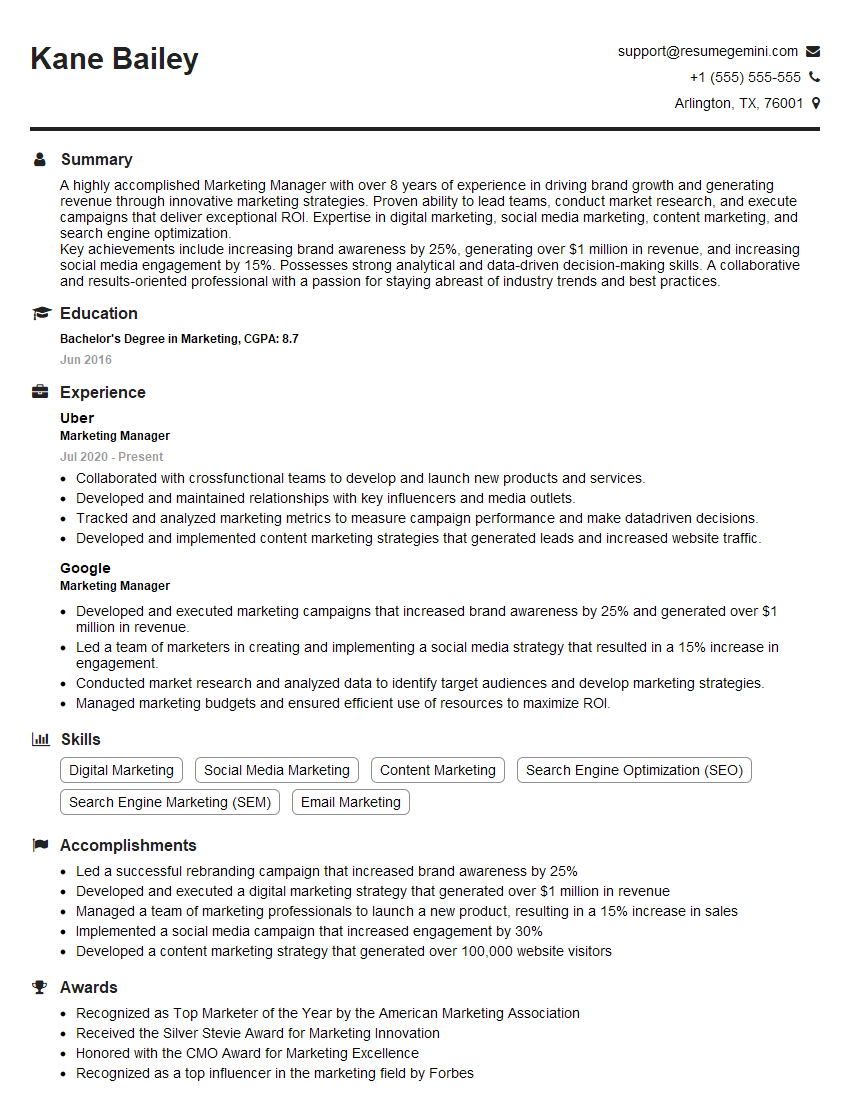
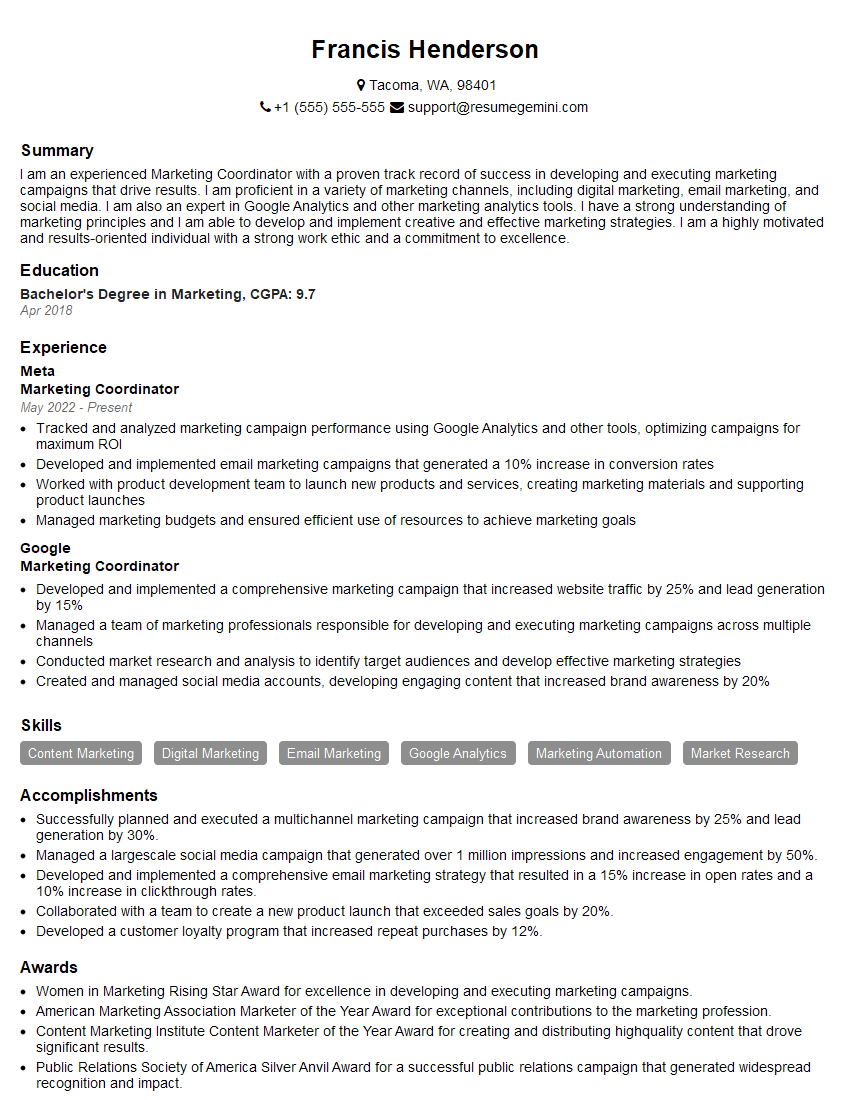
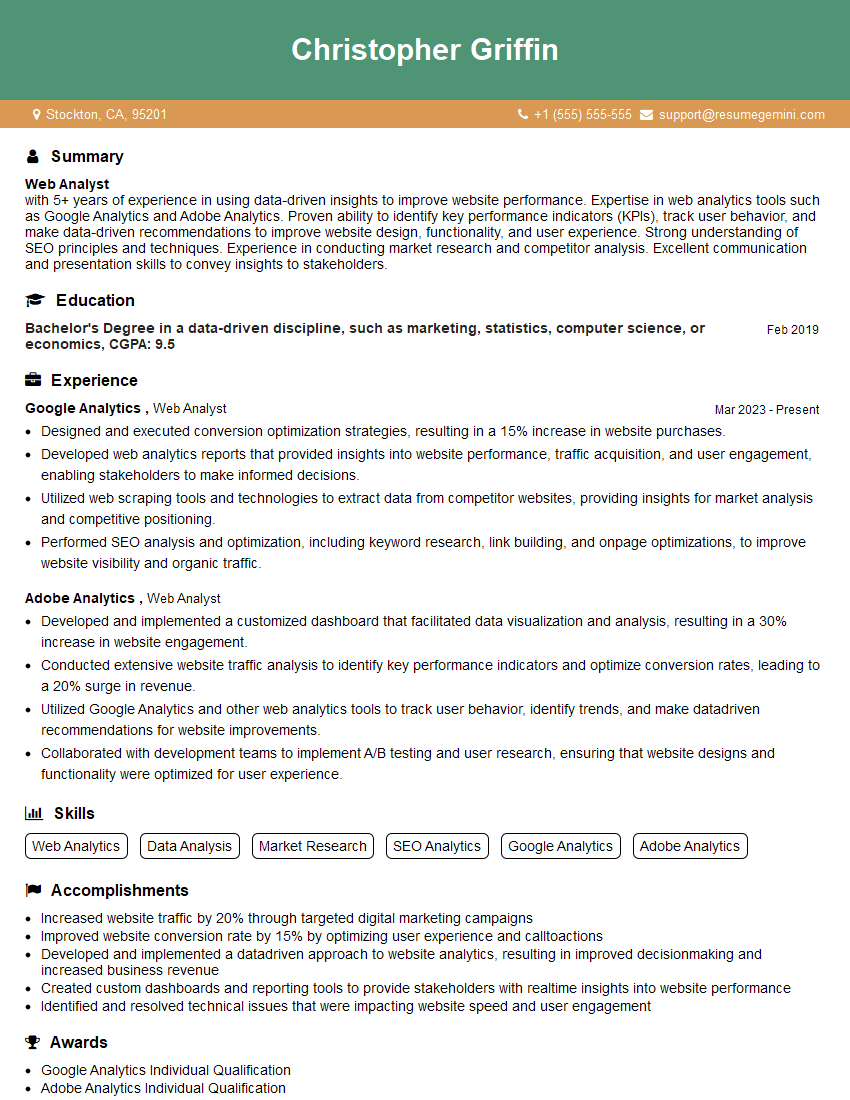
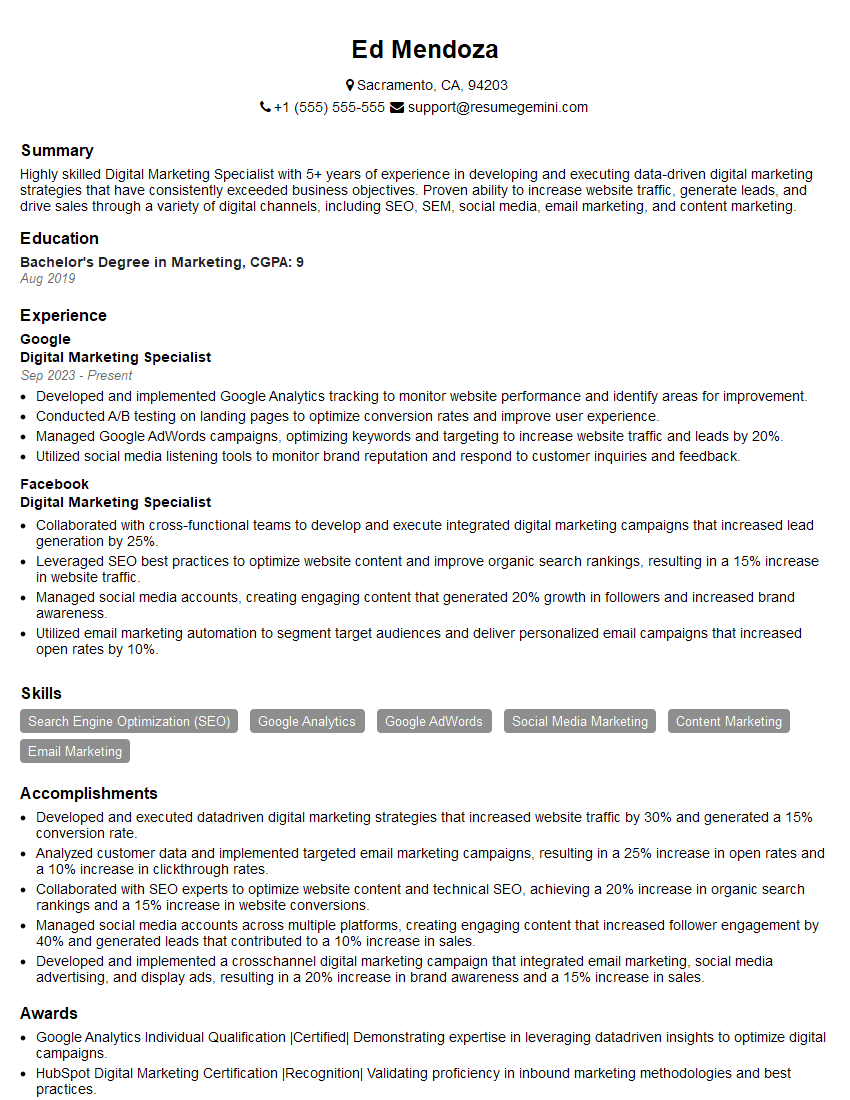
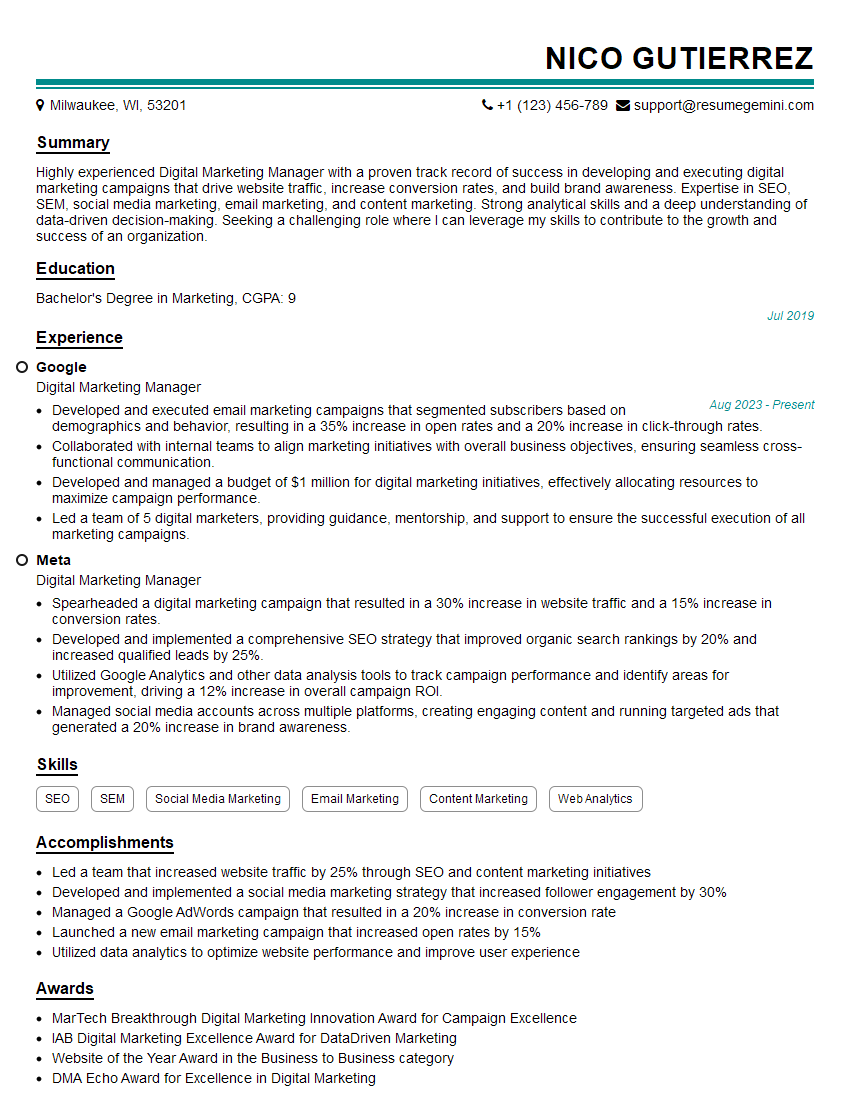
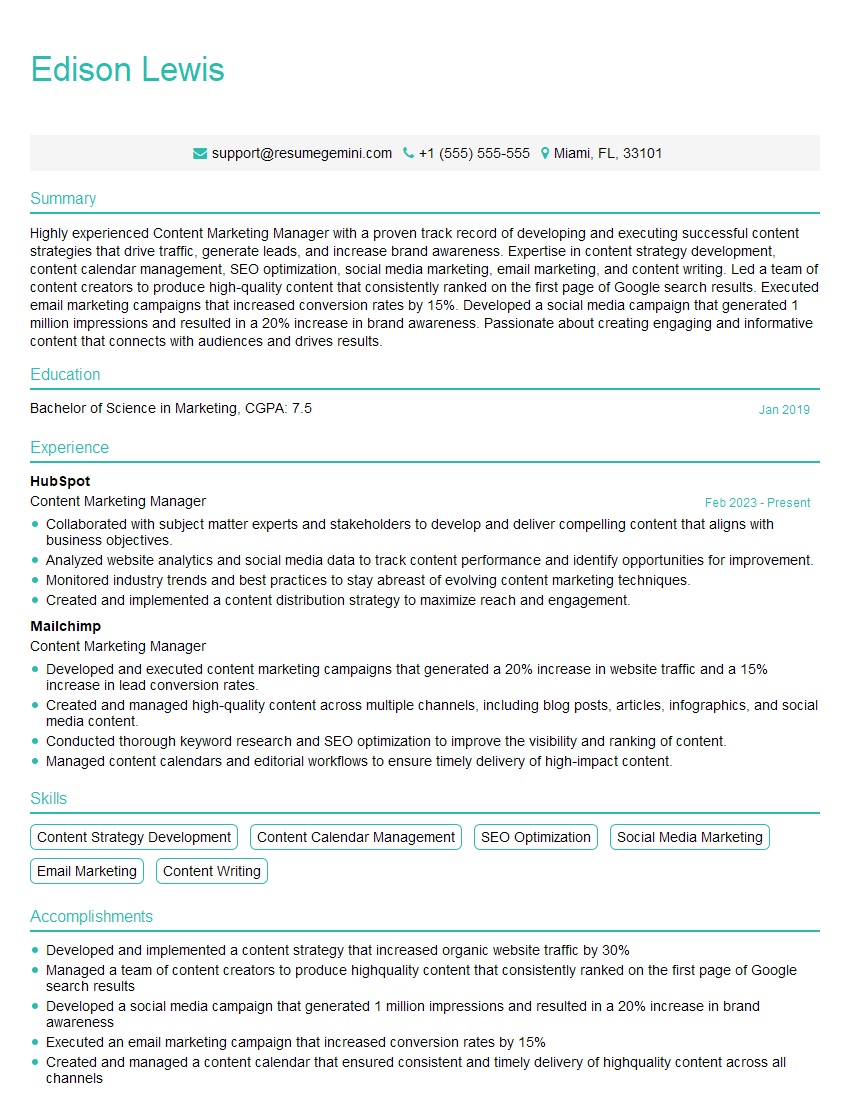
Mastering SEO and SEM marketing is crucial for a thriving career in digital marketing. These skills are highly sought after, opening doors to exciting opportunities and higher earning potential. To maximize your job prospects, crafting an ATS-friendly resume is essential. This ensures your application gets noticed by recruiters and hiring managers. ResumeGemini is a trusted resource that can significantly enhance your resume-building experience. They provide examples of resumes tailored to SEO and SEM marketing roles, helping you present your skills and experience effectively. Take advantage of these resources to showcase your capabilities and land your dream job!


Explore more articles
Users Rating of Our Blogs
Share Your Experience
We value your feedback! Please rate our content and share your thoughts (optional).
What Readers Say About Our Blog
Very informative content, great job.
good