Preparation is the key to success in any interview. In this post, we’ll explore crucial Sewer Drainage interview questions and equip you with strategies to craft impactful answers. Whether you’re a beginner or a pro, these tips will elevate your preparation.
Questions Asked in Sewer Drainage Interview
Q 1. Describe the different types of sewer pipes and their applications.
Sewer pipes come in various materials and designs, each suited for different applications. The choice depends on factors like soil conditions, depth, flow rate, and budget.
- Vitrified Clay Pipes (VCP): These are traditional, durable pipes made from fired clay. They’re resistant to corrosion but can be brittle and prone to breakage during installation. Commonly used in older systems and areas with stable soil.
- Concrete Pipes: These offer high strength and are relatively inexpensive. They’re available in various shapes and sizes, including reinforced concrete pipes for added strength in high-pressure situations. Often used for larger diameter mains.
- Plastic Pipes (PVC, HDPE): These are lightweight, corrosion-resistant, and easy to install. High-density polyethylene (HDPE) pipes are particularly suitable for challenging installations due to their flexibility. PVC is more common for smaller diameter laterals.
- Ductile Iron Pipes: These are strong, durable, and resistant to corrosion. They are a good choice for areas with aggressive soils or high water tables. They are frequently used for large diameter mains under heavy traffic.
For example, a new residential development might use PVC pipes for the smaller laterals connecting individual houses to the main sewer line, while the main line itself might be constructed from ductile iron or large diameter concrete pipes to handle the combined flow.
Q 2. Explain the process of sewer line cleaning and maintenance.
Sewer line cleaning and maintenance are crucial to prevent blockages and ensure efficient wastewater flow. The process involves several steps, often employing specialized equipment:
- Regular Inspection: Routine inspections, sometimes using CCTV cameras, help identify potential problems early on.
- Hydro-Jetting: High-pressure water jets are used to dislodge and flush out debris like grease, roots, and sediment.
- Mechanical Cleaning: Augers and other mechanical tools are employed to break up or remove solid obstructions.
- Root Cutting: Specialized equipment is used to cut through tree roots that penetrate and clog sewer lines. This is frequently a significant cause of blockages.
- Grease Removal: Removing grease buildup through chemical treatments or specialized cleaning methods is critical in areas with high grease content in wastewater.
For instance, a restaurant with a high grease output might require more frequent grease trap cleaning and sewer line jetting than a residential area. A proactive maintenance plan, including regular inspections and cleaning, is key to preventing major and costly sewer line repairs.
Q 3. What are the common causes of sewer blockages and how are they addressed?
Sewer blockages are a common problem, often caused by a combination of factors:
- Tree Roots: Roots searching for water can penetrate pipe joints and grow inside, significantly restricting flow.
- Grease Buildup: Grease from kitchens and bathrooms solidifies within the pipes, creating a sticky barrier that traps other debris.
- Improper Disposal of Waste: Flushing inappropriate items down the toilet (e.g., wipes, sanitary products, feminine hygiene products) can cause blockages.
- Sediment Accumulation: Over time, sand, silt, and other sediment can accumulate in pipes, reducing their capacity.
- Collapsed Pipes: Age, ground movement, or heavy loads can cause pipes to collapse, leading to complete blockages.
Addressing these issues requires targeted solutions. Tree roots are dealt with by root cutting or pipe relining. Grease buildup requires specialized cleaning methods. Improper disposal requires public education. Sediment accumulation may be addressed by flushing. Collapsed pipes often need repair or replacement.
Q 4. How do you assess the condition of a sewer line using CCTV inspection?
CCTV inspection is a non-destructive method used to assess the condition of sewer lines. A small, waterproof camera is inserted into the pipe and navigates its length. The images are recorded and analyzed to identify problems such as:
- Cracks and Fractures: The camera reveals any structural damage to the pipe walls.
- Root Intrusion: Images clearly show the extent of root growth within the pipe.
- Blockages: The camera can identify the location and type of blockage.
- Pipe Offsets and Sags: Deviations from the expected pipe alignment are easily detected.
- Corrosion and Deterioration: The extent of pipe deterioration can be assessed visually.
The recorded footage is then used to create a detailed report, including location-specific information on defects. This report helps determine the appropriate repair or replacement strategy. For instance, a small crack might be repaired with epoxy lining, while a large collapse would necessitate pipe replacement.
Q 5. What are the safety procedures for working in a sewer environment?
Working in a sewer environment presents significant safety risks, necessitating strict adherence to safety procedures:
- Confined Space Entry Procedures: Before entering a sewer, a thorough risk assessment must be conducted, and appropriate permits obtained. Atmospheric testing for toxic gases (e.g., methane, hydrogen sulfide) is essential.
- Personal Protective Equipment (PPE): Workers must wear appropriate PPE including respirators, protective clothing, gloves, and safety harnesses.
- Emergency Procedures: Clearly defined emergency procedures and communication systems must be in place. Trained personnel should be present during sewer entry.
- Ventilation: Adequate ventilation is crucial to prevent the buildup of harmful gases. Mechanical ventilation is often required.
- Rescue Plan: A detailed rescue plan should be developed and practiced regularly to ensure a swift response in case of emergencies.
Neglecting safety procedures can lead to serious injuries or fatalities. Prioritizing safety is paramount in sewer work, encompassing all aspects from initial planning to post-work debriefing.
Q 6. Explain the principles of hydraulics in sewer design.
Hydraulics plays a fundamental role in sewer design. The primary goal is to ensure efficient and gravity-driven flow of wastewater to the treatment plant. Key principles include:
- Gravity Flow: Sewer systems primarily rely on gravity to transport wastewater. Pipes are designed with a consistent slope to maintain a minimum velocity to prevent solids from settling.
- Manning’s Equation: This equation is used to calculate flow velocity and discharge in open channels and pipes. It considers factors such as pipe diameter, slope, and roughness coefficient.
V = (1/n) * R^(2/3) * S^(1/2)where V is velocity, n is the Manning’s roughness coefficient, R is the hydraulic radius, and S is the slope. - Minimum Velocity: A minimum flow velocity is required to prevent the deposition of solids and the generation of foul odors. This is crucial to ensure efficient transportation of sewage.
- Self-cleansing Velocity: This is a higher velocity that ensures that the pipe stays clean by carrying away all deposited materials.
- Hydraulic Design: The design considers factors such as pipe diameter, slope, and flow rate to optimize the hydraulic performance of the system and minimize energy consumption.
Proper hydraulic design ensures the smooth and efficient conveyance of wastewater, preventing blockages and maintaining the long-term integrity of the system. Inadequate design can lead to recurring blockages, costly maintenance, and even environmental pollution.
Q 7. How do you calculate the flow rate in a sewer pipe?
Calculating the flow rate in a sewer pipe involves several methods, often depending on the available data. The most common method is using Manning’s equation, as mentioned previously. Other methods include:
- Manning’s Equation: As discussed before, this is a widely used empirical formula. First, you calculate the hydraulic radius (R), which is the cross-sectional area divided by the wetted perimeter. Then, the flow velocity (V) is calculated using the formula provided earlier. Finally, the flow rate (Q) is calculated as Q = A * V, where A is the cross-sectional area of flow.
- Flow Measurement Devices: Devices like weirs, flumes, and flow meters can be used to directly measure the flow rate. These devices provide accurate and real-time measurements.
- Empirical Formulas: Several other empirical formulas are available for calculating flow rate based on pipe diameter and slope, often used as approximations for specific situations.
For example, in the design phase, Manning’s equation is crucial for determining appropriate pipe sizes for a given design flow. During operation, flow measurement devices provide real-time data to monitor the performance of the sewer system and detect any anomalies.
Q 8. Describe the design considerations for sewer gradients and slopes.
Sewer gradient and slope design is crucial for ensuring efficient wastewater flow. It’s all about achieving the right balance – a slope too steep can cause erosion and damage, while one too shallow leads to blockages and sedimentation. We aim for a self-cleansing velocity, meaning the flow is fast enough to carry solids along but not so fast as to be destructive.
Several factors influence the design: the diameter of the sewer pipe, the type of wastewater (domestic vs. industrial), and the anticipated flow rates. For instance, smaller diameter pipes require steeper slopes to maintain the self-cleansing velocity compared to larger pipes. We often use Manning’s equation, a fundamental formula in open channel flow, to calculate the required slope:
Q = (A * R^(2/3) * S^(1/2)) / n
Where:
Q= flow rateA= cross-sectional area of flowR= hydraulic radiusS= slopen= Manning’s roughness coefficient (depends on pipe material)
In practice, we use design charts and software that incorporate Manning’s equation and other factors, helping us to determine the optimal slope for each section of the sewer system. For example, in a hilly area, we might need to use multiple slopes to manage the varying terrain. A steeper slope in a steeper section of land may be more appropriate, while a flatter slope for flatter land will provide better flow management. The design process also considers future expansion needs, so we avoid designing systems that will quickly become inadequate.
Q 9. What are the different methods for sewer rehabilitation?
Sewer rehabilitation methods address aging or damaged sewer infrastructure. The choice of method depends on the severity and extent of the damage, the pipe material, and the surrounding environment. Some common techniques include:
- Cured-in-Place Pipe (CIPP): A resin-saturated liner is inserted into the existing pipe and cured in place, forming a new pipe within the old one. This is a trenchless method, minimizing disruption. It’s ideal for smaller-diameter pipes with localized damage.
- Pipe bursting: A new pipe is pulled through the existing pipe while the old pipe is simultaneously fractured and broken. This is more suitable for larger-diameter pipes and those with significant structural issues.
- Point Repair: This involves repairing individual sections of damaged pipe without replacing the entire line. Methods include patching, sealing, or inserting small liners into localized problem areas. This is a cost-effective solution for minor repairs.
- Open-cut repair/replacement: This traditional method involves excavating the damaged section of sewer line, repairing or replacing the pipe, and then backfilling the trench. While more disruptive, it provides access for complete inspection and repair. It is usually the choice for more substantial damage, or when access for other methods is not feasible.
The selection of a method always involves a cost-benefit analysis; a balance between the effectiveness of the repair and its cost and disruptive impact.
Q 10. Explain the process of sewer line repair using trenchless technology.
Trenchless sewer line repair, using techniques like Cured-in-Place Pipe (CIPP), offers a minimally invasive alternative to traditional open-cut methods. The process generally involves these steps:
- Inspection and Assessment: The damaged sewer line is inspected using CCTV cameras to identify the location and extent of the damage.
- Preparation: The sewer line is cleaned to remove debris and ensure a smooth surface for the liner. Access points are established.
- Liner Insertion: A felt or fabric liner, impregnated with resin, is pulled through the existing pipe using air or water pressure.
- Curing: The resin within the liner is cured using hot water or steam, forming a strong, durable new pipe within the old one.
- Testing: After curing, the new liner is tested for leaks and structural integrity.
- Completion: Once the test is successful, the access points are sealed, and the work site is restored.
This trenchless approach minimizes ground disturbance, reduces traffic disruption, and is often quicker and more cost-effective than traditional excavation methods, particularly in congested urban areas. An example would be repairing a cracked sewer line beneath a busy street where excavation would cause significant disruption. CIPP would allow the repair to be done with minimal surface impact.
Q 11. What are the environmental regulations concerning sewer discharge?
Environmental regulations governing sewer discharge are stringent and vary by location. The main objective is to protect water quality. Regulations often focus on:
- Effluent limitations: Limits are placed on the concentration of pollutants in discharged wastewater. These limits apply to various parameters, such as suspended solids, biochemical oxygen demand (BOD), chemical oxygen demand (COD), nutrients (nitrogen and phosphorus), and various toxic substances.
- Pretreatment requirements: Industrial dischargers are often required to pretreat their wastewater to remove pollutants before discharging it into the municipal sewer system. This prevents overloading the treatment plant.
- Spill prevention and control: Regulations mandate measures to prevent and control spills and accidental releases of wastewater.
- Monitoring and reporting: Regular monitoring and reporting of wastewater discharge are typically required to ensure compliance with regulations.
Non-compliance can lead to penalties, including fines and enforcement actions. Agencies like the Environmental Protection Agency (EPA) in the US or equivalent bodies in other countries set and enforce these regulations. These regulations are constantly evolving to address emerging pollutants and improve water quality standards.
Q 12. How do you manage stormwater runoff in a sewer system?
Managing stormwater runoff within a sewer system is critical to prevent sewer overflows and flooding. It often involves a combined sewer system or separate sewer systems. In combined systems, stormwater and wastewater flow through the same pipes, while in separate systems they flow through different pipes. However, even in separate systems, there can be issues if the stormwater system is overloaded.
Strategies for managing stormwater runoff include:
- Green infrastructure: Incorporating green infrastructure elements such as permeable pavements, rain gardens, and bioswales can absorb and filter stormwater before it enters the sewer system.
- Stormwater storage tanks: These tanks temporarily store stormwater during heavy rain events, reducing the load on the sewer system.
- Improved drainage infrastructure: Proper sizing and maintenance of stormwater pipes and channels are essential to ensure efficient drainage.
- Combined sewer overflow (CSO) control measures: For combined systems, CSO control measures aim to reduce the frequency and volume of overflows during heavy rain. These measures might include storage tanks, improved treatment processes, or sewer separation projects.
The choice of strategies depends on factors such as the size and type of sewer system, the amount of rainfall, and the characteristics of the land. Planning and integrating stormwater management into sewer system design are crucial for maintaining a healthy environment and preventing pollution.
Q 13. Explain the concept of sewer capacity and how it is determined.
Sewer capacity refers to the maximum amount of wastewater a sewer line or system can handle without exceeding its design limits. It’s a critical factor in ensuring the system functions effectively and prevents backups and overflows.
Sewer capacity is determined by various factors:
- Pipe diameter: Larger diameter pipes have higher capacities.
- Pipe slope: A steeper slope facilitates faster flow and higher capacity.
- Pipe material and roughness: The roughness of the pipe’s inner surface affects the flow resistance and capacity.
- Design flow rate: The anticipated flow rate, considering both current and future needs, is a fundamental input for capacity calculations.
- Hydraulic analysis: Sophisticated hydraulic models are used to simulate flow conditions in the sewer system under various scenarios, including peak flow events.
Capacity calculations usually involve using equations like Manning’s equation, mentioned earlier, or more complex software packages that consider a broader range of variables. The goal is to size the pipes and other components of the sewer system to meet the anticipated flow rates with adequate headroom to accommodate future growth or unexpected surges in flow.
Q 14. What are the different types of sewer manholes and their functions?
Sewer manholes are access points in the sewer system, allowing for inspection, maintenance, and cleaning. Different types exist, each suited to specific needs:
- Standard manholes: These are the most common type, typically cylindrical structures made of concrete or brick. They provide access for inspection and cleaning of the sewer line.
- Drop manholes: Used where there’s a significant change in elevation, they allow wastewater to drop from a higher elevation to a lower one. This can be vital to manage changes in elevation within the sewer system.
- Combination manholes: These combine features of standard and drop manholes, accommodating both changes in elevation and providing access for maintenance.
- Flow control manholes: These incorporate structures that regulate the flow of wastewater, preventing overloading of downstream sections. Weirs and other flow control devices might be incorporated into these manholes.
- Maintenance access manholes: Designed for smaller pipes, these provide easy access in areas where larger manholes are not practical or feasible.
The choice of manhole type depends on the specific conditions and requirements of the sewer system. Regular inspection and maintenance of manholes are essential to ensure the proper functioning of the sewer system.
Q 15. How do you perform a sewer system inspection and what are you looking for?
Sewer system inspections are crucial for maintaining the health and efficiency of the drainage network. We utilize a variety of methods, ranging from simple visual inspections to advanced technologies like CCTV (Closed-Circuit Television) surveys and robotic crawlers.
A typical inspection involves several key steps:
- Preliminary Assessment: This involves reviewing existing plans and records to understand the system’s layout and history. We identify potential problem areas based on past maintenance records or reported issues.
- Visual Inspection (Manholes & Access Points): We visually inspect manholes and access points, checking for blockages, debris, structural damage, and signs of infiltration/inflow (I/I).
- CCTV Inspection: This is a non-invasive method using a small camera on a wheeled platform to navigate the sewer lines. We look for blockages, root intrusions, pipe collapses, cracks, and offsets. The footage provides detailed documentation for analysis and reporting.
- Robotic Crawler Inspection: For more complex or inaccessible areas, robotic crawlers equipped with cameras and sensors can provide a detailed 3D view of the pipe’s interior condition.
- Flow Monitoring: Measuring flow rates at different points helps identify areas with unusual flow patterns, indicating potential blockages or leaks.
During the inspection, we’re looking for:
- Blockages: Grease buildup, debris, or structural collapse that restricts flow.
- Root Intrusions: Tree roots penetrating pipes and causing damage.
- Pipe Damage: Cracks, corrosion, joint failures, or offsets that compromise structural integrity.
- Infiltration/Inflow (I/I): Groundwater entering the system (infiltration) or surface water entering (inflow), increasing treatment costs and overloading the system.
- Settlements: Sagging or misalignment of pipes.
- Corrosion: Deterioration of pipe materials due to chemical reactions.
The inspection findings are documented with detailed reports, including photos, videos, and maps, highlighting areas requiring immediate attention and recommending repair or replacement strategies.
Career Expert Tips:
- Ace those interviews! Prepare effectively by reviewing the Top 50 Most Common Interview Questions on ResumeGemini.
- Navigate your job search with confidence! Explore a wide range of Career Tips on ResumeGemini. Learn about common challenges and recommendations to overcome them.
- Craft the perfect resume! Master the Art of Resume Writing with ResumeGemini’s guide. Showcase your unique qualifications and achievements effectively.
- Don’t miss out on holiday savings! Build your dream resume with ResumeGemini’s ATS optimized templates.
Q 16. Describe the process of sewer line installation.
Sewer line installation is a complex process requiring careful planning and execution. It involves several stages:
- Design & Planning: This phase involves designing the optimal route and grade for the sewer line, considering factors like soil conditions, existing infrastructure, and future expansion plans. Hydraulic calculations determine pipe size and slope needed to ensure adequate flow.
- Excavation: The trench is excavated using appropriate equipment, ensuring the proper depth and width to accommodate the pipe and backfill material. Care is taken to avoid damaging existing underground utilities.
- Pipe Laying: The sewer pipes are carefully placed in the trench, ensuring proper alignment and grade. This often requires specialized equipment to handle long pipe sections and maintain precise alignment.
- Jointing: Pipes are joined using appropriate techniques (e.g., solvent welding for PVC, rubber gaskets for concrete) to ensure a watertight seal. Joint integrity is critical to prevent leaks and infiltration.
- Backfilling: The trench is backfilled with suitable material, typically compacted in layers to prevent settlement and provide support for the pipe. Proper compaction is essential to prevent pipe damage and maintain the integrity of the surrounding soil.
- Testing: After backfilling, the sewer line is tested for leaks using air or water pressure testing. This ensures the system is watertight and meets design specifications.
- Restoration: The ground surface is restored to its original condition, including landscaping, paving, or other surface treatments.
Different pipe materials (PVC, ductile iron, concrete) are chosen based on factors like soil conditions, depth, and expected lifespan. The entire process is subject to strict quality control measures to ensure long-term performance and reliability of the sewer system.
Q 17. What are the common problems encountered during sewer construction?
Sewer construction projects often face several challenges:
- Unexpected Ground Conditions: Unforeseen obstacles like bedrock, unstable soil, or high water tables can significantly delay and increase the cost of the project. Thorough site investigations are critical before commencing construction.
- Utility Conflicts: Encountering underground utilities (gas, water, electric lines) during excavation can lead to delays, additional costs, and safety hazards. Accurate utility locating services are essential.
- Traffic Management: Construction in populated areas requires careful traffic management to minimize disruption and ensure public safety. This might involve detours, lane closures, or temporary traffic signals.
- Weather Conditions: Adverse weather (heavy rain, snow, extreme temperatures) can disrupt construction progress, leading to delays and increased costs.
- Environmental Concerns: Protecting the environment during construction is critical, including proper disposal of excavated materials, minimizing erosion and sedimentation, and managing stormwater runoff.
- Material Availability and Cost Fluctuations: Shortages of construction materials or unexpected price increases can impact the project schedule and budget.
- Inadequate Site Access: Difficult site access can complicate material delivery and equipment mobilization, impacting efficiency.
Effective project management, detailed planning, and risk mitigation strategies are crucial to overcome these challenges and ensure successful completion of the project within budget and schedule.
Q 18. How do you address infiltration and inflow in a sewer system?
Infiltration and inflow (I/I) are major problems in sewer systems, increasing treatment costs and potentially causing overflows. Addressing I/I requires a multi-pronged approach:
- Inspection and Assessment: Identifying the sources of I/I is the first step, often requiring CCTV inspections to pinpoint leaks or inflow points.
- Pipe Repairs and Replacements: Damaged pipes are repaired or replaced to prevent infiltration. This may involve trenchless technologies like pipe lining or cured-in-place pipe (CIPP) for minimizing disruption.
- Manhole Rehabilitation: Damaged or improperly sealed manhole covers and frames are repaired or replaced to prevent inflow.
- Improved Stormwater Management: Diverting surface runoff away from the sewer system using improved stormwater drainage systems can significantly reduce inflow.
- Grouting: Injecting grout into cracks in pipes or joints can seal leaks and prevent infiltration.
- Flow Monitoring and Data Analysis: Continuous monitoring of flow rates helps track I/I reduction efforts and identify remaining problem areas.
- Public Education: Educating the public about the importance of preventing illicit connections (e.g., sump pump discharges) can reduce inflow.
A comprehensive I/I reduction program usually involves a phased approach, prioritizing critical areas based on their impact on the system’s capacity and performance. This is often a long-term process requiring ongoing maintenance and monitoring.
Q 19. Explain the principles of sewer system modeling.
Sewer system modeling uses mathematical and computational techniques to simulate the flow of wastewater through the drainage network. This allows engineers to analyze the system’s performance under various conditions and predict its future needs.
The principles of sewer system modeling include:
- Hydraulic Modeling: This involves using software to simulate the flow of wastewater based on pipe geometry, slope, and roughness. It helps predict flow velocities, water depths, and pressure in the system.
- Kinematic Wave Modeling: A simplified approach suitable for large networks or where detailed hydraulic information is unavailable. It focuses on the propagation of the flow wave.
- Dynamic Wave Modeling: A more complex approach that accounts for changes in water levels and flow velocities over time. It’s particularly useful for analyzing unsteady flows such as those caused by rainfall events.
- Calibration and Verification: Model results are compared to actual field measurements (flow rates, water levels) to ensure accuracy and reliability.
- Scenario Analysis: The model can be used to simulate different scenarios, such as increased population, rainfall events, or infrastructure upgrades, to assess their impact on the system’s performance.
The goal of sewer system modeling is to optimize the design, operation, and maintenance of the sewer system, ensuring it can handle current and future demands efficiently and reliably. This might involve assessing the need for upgrades, identifying areas with potential flooding, or optimizing pumping station operations.
Q 20. What software do you use for sewer design and analysis?
Several software packages are commonly used for sewer design and analysis. The choice depends on the project’s complexity and specific requirements.
- SWMM (Storm Water Management Model): A widely used open-source model for simulating both stormwater and wastewater systems. It’s known for its flexibility and robust capabilities.
- InfoWorks ICM: A commercial software package offering comprehensive tools for water management, including sewer system modeling, analysis, and design.
- WaterCAD: Another commercial software focusing on hydraulic modeling and analysis of water and sewer networks.
- Civil 3D (with sewer design extensions): A common platform for civil engineering design, including sewer system design and drafting.
- Bentley OpenFlows: A suite of software for water and wastewater management including hydraulic and hydrodynamic modeling.
These software packages provide tools for hydraulic modeling, pipe sizing, pump station design, and network analysis. They often integrate with GIS (Geographic Information Systems) for visualization and data management.
Q 21. How do you interpret sewer system drawings and plans?
Interpreting sewer system drawings and plans requires a good understanding of civil engineering conventions and symbols. Typical drawings include:
- Plan View: Shows the layout of the sewer network, including pipe sizes, slopes, manhole locations, and connections to buildings.
- Profile View: Illustrates the elevation of the sewer lines, showing the grade and invert elevations (the lowest point inside the pipe).
- Cross-sections: Show the dimensions and materials of the pipes, as well as the surrounding soil profile.
- Details: Provide enlarged views of specific components, such as manholes, junctions, or pipe connections.
- Isometric Drawings: Three-dimensional representations that help visualize complex pipe configurations.
Understanding the symbols and abbreviations used is crucial. For instance, pipe sizes are often indicated by diameter and material (e.g., ’12” PVC’). Inverts are critical for calculating flow and determining the proper grade. Manhole locations are marked with symbols and their identification numbers. By carefully studying these drawings, engineers can understand the system’s layout, hydraulic characteristics, and material specifications. This knowledge is essential for planning maintenance, repairs, or expansions.
Q 22. Describe your experience with different types of sewer pumps.
My experience encompasses a wide range of sewer pumps, from the simplest submersible pumps used in smaller residential applications to the complex, high-capacity pumps needed for large municipal systems. I’m familiar with various pump types, including:
- Submersible pumps: These are versatile and commonly used for lifting wastewater from basements or low-lying areas. They are relatively inexpensive and easy to maintain.
- Non-submersible pumps: These pumps are positioned above the wastewater level and use suction to lift the sewage. They are often preferred for larger applications or where the risk of submersion is high.
- Grinder pumps: These are essential for handling sewage containing solids, effectively shredding waste to prevent clogging in pipes. I’ve worked extensively with various grinder pump models, focusing on their efficiency and longevity.
- Centrifugal pumps: Used in larger sewer systems, they efficiently move large volumes of wastewater over longer distances. My experience includes troubleshooting and optimizing these pumps for maximum performance.
In my previous role, I was responsible for selecting, installing, and maintaining a network of over 50 pumps across a large municipality. This involved regular inspections, preventative maintenance, and swift troubleshooting of malfunctions, minimizing service disruptions.
Q 23. What are the different methods for sewer odor control?
Sewer odor control is crucial for public health and environmental protection. Effective strategies involve a multi-pronged approach targeting the source and pathways of odor generation. Common methods include:
- Proper ventilation: Ensuring adequate airflow through sewer lines and manholes prevents odor accumulation. This often involves installing ventilation stacks or improving existing ventilation systems.
- Bioaugmentation: Introducing beneficial microorganisms to the wastewater breaks down organic matter, reducing the production of odorous gases like hydrogen sulfide. This is a more environmentally friendly approach than harsh chemical treatments.
- Chemical treatment: This involves using various chemicals, such as oxidizing agents, to neutralize or mask odors. However, this requires careful selection and application to avoid harming the environment.
- Odor masking agents: These agents don’t eliminate the source of the odor but rather mask it with a more pleasant scent. This is usually a temporary solution.
- Regular cleaning and maintenance: Removing accumulated debris and sludge from sewer lines reduces the breeding ground for odor-causing bacteria.
For instance, in one project, we implemented a bioaugmentation strategy coupled with improved ventilation in a heavily trafficked commercial area. This resulted in a significant reduction in odor complaints.
Q 24. Explain the importance of regular sewer system maintenance.
Regular sewer system maintenance is paramount for preventing costly repairs, ensuring public health, and protecting the environment. Neglecting maintenance can lead to:
- Clogs and blockages: Leading to sewage backups and overflows into homes and streets.
- Structural damage: Deterioration of pipes due to corrosion or root intrusion.
- Environmental contamination: Wastewater spills can pollute water bodies and soil.
- Public health risks: Sewage overflows can spread diseases.
A proactive maintenance program typically includes regular inspections using CCTV cameras to assess pipe condition, cleaning of lines to remove debris, and timely repairs of any identified issues. Think of it like regular check-ups for your body – prevention is far more cost-effective than cure.
Q 25. How do you prioritize sewer repair projects?
Prioritizing sewer repair projects requires a systematic approach considering several factors:
- Severity of the problem: Immediate attention is needed for issues posing a significant risk to public health or the environment, such as major leaks or overflows.
- Urgency: Projects that cause immediate disruptions to services need quicker attention than less critical repairs.
- Cost-benefit analysis: Balancing the cost of repair with the potential consequences of inaction is vital. A thorough cost-benefit analysis helps in making informed decisions.
- Long-term planning: Repair projects should align with the overall strategic plan for maintaining and upgrading the sewer system.
We use a scoring system that weighs each factor to objectively rank projects. For instance, a major pipe break causing a public health risk would score much higher than a minor crack in a less critical area.
Q 26. Describe your experience with trenchless technologies for sewer repair.
I have extensive experience with trenchless technologies for sewer repair, which offer significant advantages over traditional open-cut methods. These include:
- Pipe bursting: This involves breaking the old pipe and simultaneously pulling a new pipe into place. This minimizes disruption to the surface and surrounding infrastructure.
- Cured-in-place pipe (CIPP): A liner is inserted into the damaged pipe and cured to create a new, smooth pipe within the existing one. This is less disruptive than pipe bursting and suitable for various pipe materials.
- Pipe relining: Similar to CIPP, but using different liner materials and techniques.
In a recent project, we used CIPP to rehabilitate a section of aging sewer line under a busy highway. The trenchless approach allowed us to complete the repair quickly and efficiently, minimizing traffic disruptions and saving significant costs compared to traditional excavation.
Q 27. What are the challenges associated with managing aging sewer infrastructure?
Managing aging sewer infrastructure presents numerous challenges, including:
- Deterioration of pipes: Age, corrosion, and root intrusion weaken pipes, increasing the risk of leaks, blockages, and collapses.
- Increased maintenance costs: Regular repairs and replacements become more frequent and expensive as the infrastructure ages.
- Inadequate capacity: Aging systems may struggle to cope with increased wastewater flow due to population growth or changes in land use.
- Lack of accurate data: Older systems often lack detailed maps or condition assessments, making planning and maintenance challenging.
Addressing these challenges requires a comprehensive strategy that includes regular inspections, proactive maintenance, strategic investment in upgrades and replacements, and the implementation of innovative technologies like trenchless repairs.
Q 28. How do you ensure the safety and well-being of your crew during sewer maintenance?
Ensuring crew safety is my top priority. This is achieved through a multi-layered approach including:
- Comprehensive safety training: All crew members undergo extensive training on safe work practices, including confined space entry, hazard identification, and the use of personal protective equipment (PPE).
- Strict adherence to safety protocols: We meticulously follow all relevant safety regulations and industry best practices. This includes regular safety meetings and toolbox talks.
- Use of appropriate PPE: Our crews are always equipped with the necessary PPE, including respirators, protective clothing, and safety harnesses.
- Regular monitoring and supervision: Experienced supervisors closely monitor the work to ensure that safety procedures are followed and to address any potential hazards immediately.
- Emergency response plans: We have comprehensive emergency response plans in place to handle any accidents or emergencies.
We also conduct regular safety audits and incorporate lessons learned from any incidents to continuously improve our safety performance. Safety isn’t just a policy; it’s a culture we actively cultivate.
Key Topics to Learn for Sewer Drainage Interview
- Hydraulics of Sewer Systems: Understanding flow rates, pressure, and the impact of gravity on wastewater movement. Practical application: Calculating pipe sizing for optimal flow and minimizing blockages.
- Sewer System Design and Construction: Familiarize yourself with different pipe materials (e.g., PVC, concrete), jointing methods, and construction techniques. Practical application: Evaluating the suitability of different pipe materials for specific soil conditions and wastewater characteristics.
- Wastewater Treatment Principles: Understanding basic treatment processes, including screening, primary, secondary, and tertiary treatment. Practical application: Identifying potential issues in a treatment plant’s operation and suggesting solutions.
- Sewer Maintenance and Rehabilitation: Learn about common sewer problems (e.g., blockages, infiltration/inflow), inspection methods (e.g., CCTV), and repair techniques. Practical application: Developing a preventative maintenance plan for a sewer system.
- Regulatory Compliance and Safety: Understanding relevant health and safety regulations, permit requirements, and environmental considerations. Practical application: Ensuring a sewer project adheres to all applicable regulations.
- GIS and Sewer Mapping: Understanding the use of Geographic Information Systems (GIS) for managing and visualizing sewer infrastructure. Practical application: Locating and assessing the condition of sewer lines using GIS data.
- Sustainable Drainage Systems (SuDS): Familiarity with sustainable approaches to managing stormwater and reducing the load on traditional sewer systems. Practical application: Designing and implementing SuDS solutions in new developments.
Next Steps
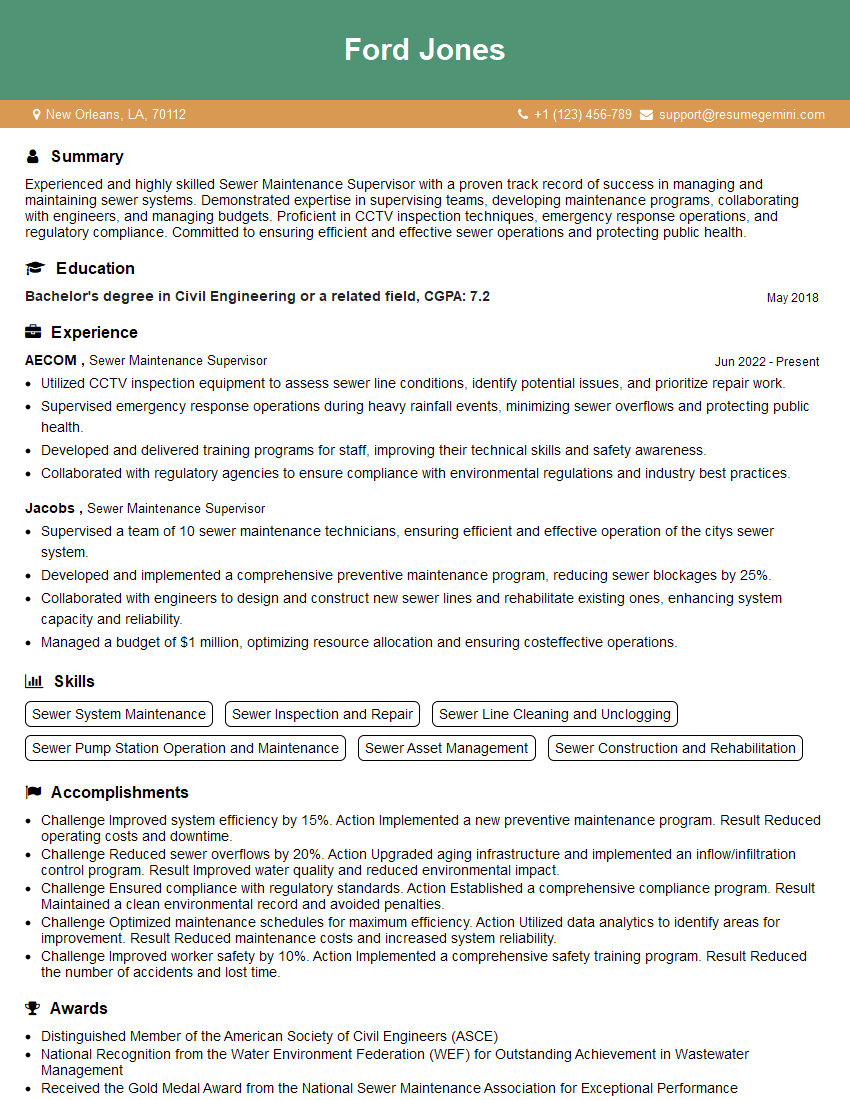
Mastering sewer drainage principles is crucial for a successful and rewarding career in this essential infrastructure field. Opportunities abound for skilled professionals who understand both the theoretical and practical aspects of sewer system design, construction, and maintenance. To maximize your job prospects, creating a strong, ATS-friendly resume is vital. ResumeGemini is a trusted resource to help you build a professional and impactful resume that highlights your skills and experience effectively. Examples of resumes tailored to the Sewer Drainage field are available within ResumeGemini to guide you. Invest the time to craft a compelling resume—it’s your key to unlocking exciting career opportunities.
Explore more articles
Users Rating of Our Blogs
Share Your Experience
We value your feedback! Please rate our content and share your thoughts (optional).
What Readers Say About Our Blog
Very informative content, great job.
good