The thought of an interview can be nerve-wracking, but the right preparation can make all the difference. Explore this comprehensive guide to Sewing Pattern Analysis interview questions and gain the confidence you need to showcase your abilities and secure the role.
Questions Asked in Sewing Pattern Analysis Interview
Q 1. Explain the difference between a sloper and a block pattern.
Both slopers and block patterns are foundational base patterns, but they serve different purposes. Think of a sloper as a truly personalized, customized base, like a tailor’s precise body measurements, while a block pattern is a more standardized, size-graded template, like a ready-to-wear size chart.
A sloper is a basic pattern created directly from individual body measurements or draping on a dress form. It’s incredibly accurate to the specific body it’s made for, providing a truly unique starting point. Because of its individualized nature, it’s not usually graded for different sizes.
A block pattern, on the other hand, is a standardized, basic pattern representing an average body shape for a particular size. It’s designed to be easily graded into a range of sizes and serves as the foundation for many different garment styles. While less precisely fitted to a single individual, it offers efficiency and scalability for mass production or creating consistent fits across a range of sizes.
Q 2. Describe your experience with various pattern drafting methods (e.g., draping, flat pattern making).
My experience encompasses both draping and flat pattern making. Draping, the process of manipulating fabric directly on a dress form, is invaluable for creating unique and complex designs, especially those that require a close fit or intricate shaping. I’ve used draping extensively to develop patterns for fitted bodices, asymmetrical designs, and garments featuring sculptural elements. It’s a very hands-on and intuitive method, allowing for immediate adjustments and a deep understanding of fabric drape and flow.
Flat pattern making, using measurements and calculations to create patterns on paper, is vital for consistency, accuracy, and scalability. It’s crucial for creating patterns intended for mass production. I’m proficient in various flat pattern techniques, including the use of standard block patterns as a base and adjusting them through various techniques like adding ease, shaping darts, and creating seam allowances. I often use this method to create designs requiring precision or those for which a precise measurement is imperative.
Q 3. How do you handle fit issues during the pattern making process?
Handling fit issues is a crucial aspect of pattern making. My approach is systematic and iterative. It starts with careful analysis of the fit of a muslin or toile (a test garment). I identify areas of tightness, looseness, or pulling, noting specific measurements and comparing them to the pattern measurements.
For example, if the muslin is too tight across the bust, I might need to add width to the pattern at the bust point, potentially by widening the seam allowance or adding a shaping dart. Similarly, if the garment is pulling at the shoulders, this could indicate an incorrect shoulder slope adjustment and requires modification of the shoulder line in the pattern. After making adjustments, I create a new toile and continue the process until the fit is satisfactory. Using a combination of measurement and visual analysis helps ensure that the final pattern reflects the desired look and fit.
Q 4. What software programs are you proficient in for pattern making (e.g., Gerber, Optitex, Lectra)?
I am proficient in several industry-standard pattern making software programs. My experience includes extensive work with Gerber Accumark, utilizing its features for design, grading, and marker making. I’m also well-versed in Optitex, using it particularly for its advanced 3D design and simulation capabilities allowing me to create and visualize the garment in 3D before production. While my experience with Lectra Modaris is somewhat less extensive, I am familiar with its interface and capabilities and can quickly adapt to its workflow. My software proficiency allows me to produce accurate, efficient, and well-documented patterns across a wide range of applications.
Q 5. Explain your understanding of grading rules and techniques.
Grading is the process of scaling a pattern to accommodate different sizes. Understanding grading rules and techniques is crucial for ensuring consistency and fit across the size range. Grading rules are essentially mathematical formulas applied consistently across different pattern pieces.
For example, a standard rule might specify that the waistline increases by a fixed amount (e.g., 1/2 inch) per size increase. However, these rules are not one-size-fits-all. Some areas need more adjustment than others – a sleeve circumference may require a different growth rate than the body width. I use specialized grading software, such as Gerber Accumark, to automate this process but also maintain manual oversight to ensure that critical style points and design details are maintained across sizes. I am very familiar with various grading methods and can apply appropriate adjustments based on garment style and target audience.
Q 6. How do you ensure consistent sizing across different pattern sizes?
Ensuring consistent sizing across pattern sizes involves a combination of precise grading and diligent quality control. Accurate grading, as discussed earlier, is paramount. But it’s not just about the numbers; it’s about preserving the design intent.
I meticulously review graded patterns, checking for proportion and balance across all sizes. This may involve creating and fitting toiles in multiple sizes, not only to check for the accuracy of the grading but to ensure that the design integrity is not compromised at the extremes of the size range. This quality control process is crucial for a successful outcome, allowing detection of any irregularities caused by automation, which can sometimes be subtle and easily missed without proper scrutiny. This guarantees a consistent customer experience across different sizes.
Q 7. Describe your experience with marker making and fabric layout optimization.
Marker making and fabric layout optimization are crucial for minimizing fabric waste and maximizing production efficiency. A marker is the layout of pattern pieces on a fabric bolt. The goal is to arrange the pieces to use as little fabric as possible. My experience includes using both manual and automated marker making techniques.
Manual marker making provides a deeper understanding of fabric layout. I can use this method to optimize the layout for particular fabric widths, taking into account factors such as pattern piece orientation and the need to account for fabric grain. Automated marker-making software, such as Gerber Accumark, is invaluable for efficiency, particularly when dealing with many sizes and pattern pieces. I choose the best technique depending on the project requirements and time constraints. The optimization goal is always to achieve the lowest possible fabric consumption while maintaining production speed.
Q 8. How do you manage and organize your pattern files?
Organizing pattern files is crucial for efficiency and avoiding chaos. I use a combination of digital and physical methods. Digitally, I employ a meticulously organized folder structure on my computer, using a naming convention that includes the garment type, size, and date. For example, Dress_Size12_20231027.pdf. This allows for quick retrieval. I also utilize pattern design software which offers robust file management features. Physically, I store my paper patterns in clearly labeled acid-free folders, categorized by garment type and size, ensuring they remain flat and protected from damage. Regular backups of digital files and physical pattern storage in climate-controlled environments are non-negotiable aspects of my workflow.
Q 9. Explain your process for creating a new pattern from a design sketch.
Creating a pattern from a design sketch involves a structured process. First, I carefully analyze the sketch, noting key design features, silhouette, and desired fit. Next, I create a basic block—a foundation pattern for the chosen garment type (e.g., a sloper for a dress). I then manipulate this block, using drafting techniques, to incorporate the design elements from the sketch. This might involve adding darts, adjusting seam lines, or creating unique design features. Throughout this process, I constantly refer back to the sketch and make adjustments as needed. I typically create a muslin (a test garment from inexpensive fabric) to check the fit and make further refinements before finalizing the pattern. The entire process is iterative, requiring close attention to detail and a deep understanding of garment construction.
Q 10. What are the key considerations for selecting appropriate fabrics for a given pattern?
Fabric selection is critical; the wrong fabric can ruin even the best pattern. Key considerations include drape (how the fabric falls), weight (heavy vs. light), texture (smooth vs. textured), stretch (elasticity), and fiber content (natural vs. synthetic). For example, a flowing silk charmeuse would be ideal for a bias-cut dress, emphasizing its drape, whereas a sturdy denim would be suitable for jeans, providing the necessary durability. Understanding how these properties interact with the pattern’s design—the number of seams, darts, and overall shape—is essential for a successful outcome. I always check the fabric’s suitability against the pattern’s design instructions before beginning construction.
Q 11. How do you incorporate ease and seam allowances into your patterns?
Ease and seam allowances are crucial for comfortable fit and proper construction. Ease refers to the extra fabric added to the pattern to allow for comfortable movement and body shape variation. Seam allowance is the extra fabric added beyond the seam line for stitching and finishing. I typically incorporate ease during the drafting stage of pattern creation, adjusting the basic block to accommodate the desired fit. The amount of ease depends on the garment type, fit (loose vs. fitted), and fabric stretch. Seam allowances are added to the pattern pieces after the ease has been incorporated; this is usually a standard measurement (e.g., 5/8 inch), but it might vary based on the garment and fabric.
Q 12. How do you identify and correct pattern distortions?
Pattern distortions can arise during cutting, tracing, or even due to fabric inconsistencies. I identify distortions by carefully checking the pattern pieces against each other for symmetry and accuracy. A common method is to lay the pattern pieces out on a flat surface and check for any mismatches. If distortions are detected, I use techniques like grading (adjusting pattern pieces for different sizes) or making small adjustments to the pattern pieces to correct the issues. Sometimes, re-drafting parts of the pattern is necessary for significant distortions. The muslin fitting process is invaluable in catching and correcting distortions before final garment construction.
Q 13. Explain the importance of accurate measurements in pattern making.
Accurate measurements are the cornerstone of good pattern making; they are the foundation on which the entire process is built. Inaccurate measurements will result in a garment that doesn’t fit properly. I always take body measurements using standard procedures—following established methods to ensure consistency— and I always record them meticulously. These measurements inform the selection of the appropriate pattern size and any necessary adjustments. For example, a slight difference in bust measurement might necessitate a full bust adjustment to the pattern. The focus on accurate measurements ensures the final garment fits the intended wearer comfortably and appropriately.
Q 14. How do you create a pattern for a complex garment (e.g., a tailored jacket)?
Creating a pattern for a complex garment like a tailored jacket is a multi-stage process requiring advanced skills. It typically begins with drafting individual pattern pieces for the jacket’s components—the front, back, sleeves, collar, and lining. Each piece requires careful consideration of the garment’s shape, fit, and design details. I might use slopers (basic blocks) as a foundation, adapting them to the specific jacket design. The process necessitates an understanding of advanced techniques, including manipulating darts, creating shaping curves, and incorporating design elements such as vents, lapels, and pockets. Multiple muslins are crucial for fitting adjustments, ensuring proper shoulder alignment, sleeve set-in, and overall balance. This iterative process can be time-consuming, requiring a deep understanding of construction and fit principles.
Q 15. Describe your experience with working with different types of fabrics (e.g., knit, woven, leather).
My experience encompasses a wide range of fabrics, each demanding a unique approach to pattern making. Woven fabrics, like cotton or linen, behave predictably and are generally easier to work with, allowing for precise cutting and clean seams. However, their lack of drape can be a challenge when designing flowing garments. Knits, on the other hand, offer incredible stretch and drape but require careful consideration of grainlines and ease, since they can easily distort during construction. I’ve developed expertise in adapting patterns to highlight the unique properties of various knit constructions, from lightweight jersey to heavier rib knits. Finally, working with leather demands specialized tools and techniques, such as careful pattern placement to minimize waste and using specialized needles and stitching methods to avoid tearing or damage.
For instance, when designing a dress in a lightweight silk crepe (woven), I focus on precise seam allowances and choose a pattern that allows for beautiful drape and movement. Conversely, designing a fitted top in a stretch rib knit necessitates added seam allowance and the use of interlock or other stable techniques to prevent the garment from stretching out of shape.
My experience also extends to more unusual fabrics like velvet, lace, and even faux fur, each presenting their own particular challenges and solutions. I thoroughly research the drape, stretch, and weight of each fabric to produce the most accurate and successful pattern.
Career Expert Tips:
- Ace those interviews! Prepare effectively by reviewing the Top 50 Most Common Interview Questions on ResumeGemini.
- Navigate your job search with confidence! Explore a wide range of Career Tips on ResumeGemini. Learn about common challenges and recommendations to overcome them.
- Craft the perfect resume! Master the Art of Resume Writing with ResumeGemini’s guide. Showcase your unique qualifications and achievements effectively.
- Don’t miss out on holiday savings! Build your dream resume with ResumeGemini’s ATS optimized templates.
Q 16. How do you handle amendments requested by the design team?
Handling amendment requests from the design team is a crucial part of the collaborative process. I approach each request with a systematic process to ensure the changes are feasible and maintain the garment’s integrity. First, I carefully review the request, noting the specifics. Next, I assess the impact of the proposed change on the existing pattern. This might involve adjustments to seam lines, dart placement, or even complete redrawing of pattern pieces.
For example, if the design team requests a wider sleeve, I would first examine the existing sleeve pattern. I might be able to simply increase the width while maintaining the armhole size. However, larger modifications may require adjustments to the shoulder and neckline, necessitating a complete grading of the pattern. I communicate clearly with the team on the feasibility and implications of each adjustment, providing them with realistic timelines and any potential constraints.
Once we agree on the revisions, I implement the changes, meticulously documenting each step. This allows for easy tracking and future reference, and ensures that any potential problems can be identified and corrected quickly.
Q 17. Explain your process for testing and fitting patterns on models or toiles.
Testing and fitting is a crucial phase where the pattern’s accuracy and fit are rigorously assessed. I usually start with a toile, a garment made from inexpensive fabric like muslin, to test the pattern’s construction and fit. This allows me to identify any issues before using expensive or delicate materials. The toile is constructed following the pattern instructions, paying close attention to seam allowances and details.
Fitting the toile on a model or dress form allows for adjustments to be made. Common adjustments include ease adjustments at the bust, waist, and hips; length alterations; and sleeve adjustments. I meticulously document these changes to be applied to the final pattern. This iterative process ensures that the final garment fits correctly and complements the body shape.
After the toile adjustments, I create a final sample using the corrected pattern and the intended fabric. This final fit offers a more refined assessment, considering the drape and weight of the actual fabric. This ensures that the final garment meets the design expectations and fits impeccably.
Q 18. How familiar are you with different types of sewing techniques?
My expertise encompasses a wide variety of sewing techniques, from basic seams and darts to advanced techniques like French seams, bound buttonholes, and intricate finishing details. I am proficient in hand-sewing techniques, including hand-stitching, embroidery, and appliqué. My machine sewing skills include diverse stitch types and techniques for different fabrics and applications.
For example, I understand how to choose appropriate stitch types for different fabrics. A zig-zag stitch is ideal for stretching fabrics to prevent seam fraying, whereas a straight stitch is better suited for woven fabrics. I understand the importance of proper seam finishes, such as serging or pinking, to prevent fabric fraying and maintain a professional finish.
I am also adept at using specialized sewing equipment, such as sergers, coverstitch machines, and industrial sewing machines, expanding my ability to handle a wide variety of fabrics and production demands.
Q 19. How do you collaborate effectively with other teams (design, production)?
Effective collaboration is fundamental to successful pattern making. I maintain open and regular communication with the design team to ensure the patterns accurately reflect their creative vision. This includes regular meetings, detailed pattern specifications, and prompt feedback on their requests. My collaboration with the production team focuses on ensuring the patterns are practical and efficient to manufacture. This involves discussions on fabric selection, construction methods, and potential manufacturing challenges.
For example, early communication with the production team regarding the complexity of a design, potential issues in bulk production, or specific finishing requirements allows us to resolve potential problems before they impede the manufacturing process. By engaging openly and consistently with all stakeholders, I can ensure that the final garment successfully meets the design goals, remains within production constraints, and delivers high quality.
Q 20. How do you troubleshoot and resolve technical issues related to pattern making?
Troubleshooting pattern-making issues requires a systematic approach. I begin by carefully examining the problem area. Does the pattern fit poorly? Are there construction issues? Is the fabric unsuitable for the pattern? I thoroughly review my work, checking for errors in measurements, calculations, or drafting techniques.
For example, if a garment fits poorly across the shoulders, I would check the shoulder slope measurements against the model’s measurements. I would also investigate if the pattern grading was accurately performed for the intended size range. If the issue persists after reviewing my work, I employ fitting tools, such as ease adjustments or dart manipulations, to fine-tune the fit.
Sometimes, the problem isn’t with the pattern itself but the fabric. If a fabric is too stretchy or too stiff, I might need to adjust the pattern to compensate. I may need to explore alternative construction techniques or choose a more appropriate fabric. Persistent issues may warrant consulting experienced colleagues or researching solutions in relevant resources.
Q 21. Describe a time you had to make a significant change to a pattern due to a problem.
One project involved designing a structured blazer in a heavy wool crepe. The initial pattern, while looking good on the toile, resulted in a significantly distorted garment once constructed in the final fabric. The heavy weight of the wool caused the garment to hang unnaturally, pulling at the shoulders and creating unsightly wrinkles across the back.
My solution involved a complete redesign of the back pattern piece. I added shaping darts and adjusted the seam lines to provide a better fit and drape for the heavier fabric. This involved re-drafting the pattern, creating a new toile, and undertaking several fitting sessions to achieve a more satisfactory result. The final blazer had a better drape and fit significantly better than the original version, showcasing the importance of considering fabric weight and drape throughout the entire design process.
Q 22. How do you stay updated with current trends and technologies in pattern making?
Staying current in the dynamic field of pattern making requires a multi-pronged approach. I actively engage in several strategies to ensure my skills and knowledge remain sharp.
- Industry Publications and Blogs: I regularly read publications like Threads Magazine and Burda Style, as well as relevant blogs and online articles focusing on new techniques, software updates, and emerging trends in garment construction and design. This allows me to understand the latest innovations in fabrics, construction methods and design aesthetics.
- Conferences and Workshops: Attending industry conferences and workshops provides invaluable opportunities for networking and learning from leading experts. I’ve recently participated in a workshop on advanced digital patternmaking techniques using [Software Name], greatly enhancing my skills in creating complex designs.
- Online Courses and Tutorials: Platforms like Skillshare, Udemy, and YouTube offer a wealth of educational resources. I frequently utilize these platforms to learn new software, refine existing techniques, and explore specialized areas like draping or pattern grading.
- Professional Networking: I maintain a professional network through online forums and industry groups. Discussing challenges and sharing knowledge with other pattern makers helps me stay abreast of the latest developments and troubleshoot problems effectively. For example, recently I solved a grading issue by participating in a discussion thread on a patternmaking forum.
This combination of active learning and professional engagement ensures I’m consistently adapting to the ever-evolving landscape of pattern making.
Q 23. Describe your experience with digital pattern making.
My experience with digital pattern making is extensive. I’m proficient in several industry-standard software packages, including [Software Name 1], [Software Name 2], and [Software Name 3]. I’ve used these tools to design and create patterns for a wide variety of garments, from simple t-shirts to complex couture pieces.
For example, I recently used [Software Name 1] to create a fully-graded pattern for a bespoke wedding dress. The software’s automated grading feature significantly reduced the time required for this task, while ensuring precision and consistency across all sizes. This allowed me to focus on the more creative aspects of the design process.
Beyond pattern creation, I’m also skilled in using digital tools for pattern manipulation, such as adjusting seam allowances, creating notches, and making modifications based on fit adjustments. My experience includes both 2D and 3D pattern making, enabling me to create highly accurate and efficient patterns for various needs.
I am adept at integrating digital patternmaking techniques with traditional methods, leveraging the strengths of both approaches for optimal results. This allows for a more fluid and efficient design workflow.
Q 24. What are your strengths and weaknesses related to pattern making?
My greatest strengths lie in my meticulous attention to detail, my proficiency in both traditional and digital pattern making techniques, and my problem-solving abilities. I’m known for my ability to create precise, well-fitting patterns, even for complex designs. I can readily adapt to different styles and sizing requirements, demonstrating flexibility and efficiency in my approach.
For example, I successfully resolved a pattern distortion issue on a recent project by carefully analyzing the grainlines and making strategic adjustments to the pattern pieces. This highlights my analytical skills and dedication to achieving perfection.
My main area for improvement is time management, particularly when dealing with multiple projects simultaneously. I’m actively working on this by implementing project management tools and prioritizing tasks more effectively. This includes adopting Agile methodologies to break down large projects into manageable steps and track progress efficiently.
Q 25. What are your salary expectations?
My salary expectations are in the range of $[Lower Bound] to $[Upper Bound] annually. This is based on my experience, skills, and the market rate for similar positions in this region.
I am open to discussing this further, taking into account the specifics of this role and the company’s compensation structure.
Q 26. Why are you interested in this position?
I am highly interested in this position because it aligns perfectly with my career aspirations and provides an exciting opportunity to contribute to a company known for its innovative designs and commitment to quality. The description of the role highlighted several key elements that resonate deeply with my professional goals, specifically [mention 1-2 specific aspects from the job description, e.g., working with advanced software, creating patterns for a specific type of garment, collaborative environment].
My experience and skills in both traditional and digital pattern making, coupled with my dedication to accuracy and problem-solving, make me confident in my ability to make significant contributions to your team.
Q 27. What are your long-term career goals?
My long-term career goals involve becoming a leading expert in the field of pattern making, specializing in [mention specific area of interest, e.g., sustainable garment production, advanced digital techniques, or a specific type of garment]. I aspire to lead projects, mentor junior designers, and contribute to the advancement of pattern making techniques through research and innovation. Ultimately, I hope to be recognized as a highly skilled and respected pattern maker, known for my creativity, precision, and expertise.
Q 28. Do you have any questions for me?
Yes, I do have a few questions. First, could you elaborate on the specific technologies and software used in this role? Secondly, what are the company’s expectations for pattern design innovation and experimentation?
Key Topics to Learn for Sewing Pattern Analysis Interview
- Understanding Garment Construction: Analyze the construction techniques depicted in a pattern, including seam allowances, darts, and ease.
- Fabric Selection & Properties: Discuss how fabric drape, weight, and stretch affect pattern choices and garment fit. Consider practical applications like choosing appropriate fabrics for different garment types.
- Pattern Alterations & Grading: Explain the principles of altering patterns for different body types and sizes, including techniques like grading and sloper adjustments.
- Pattern Draping & Mock-Ups: Describe the process of creating a muslin mock-up from a pattern and using it to assess fit and make adjustments before cutting into final fabric.
- Technical Drawing & Sketching: Demonstrate your ability to interpret technical drawings and sketches found in sewing patterns and translate them into garment construction.
- Software & Technology: Discuss your familiarity with relevant software used for pattern design, grading, and manipulation (e.g., CAD software).
- Problem-Solving in Pattern Making: Explain your approach to troubleshooting pattern issues, such as fit problems, inconsistencies, or unclear instructions. Provide examples of how you’ve successfully resolved such challenges.
- Industry Standards & Best Practices: Demonstrate awareness of industry-standard pattern-making techniques and terminology.
Next Steps
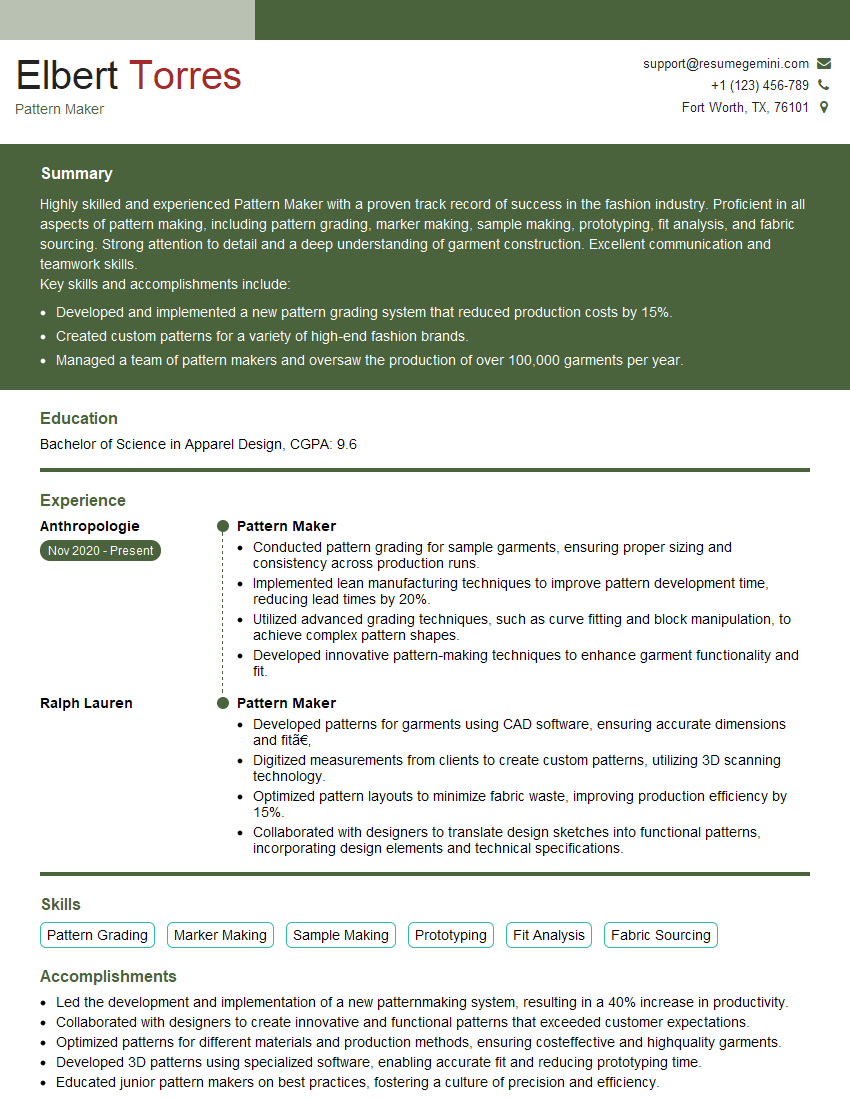
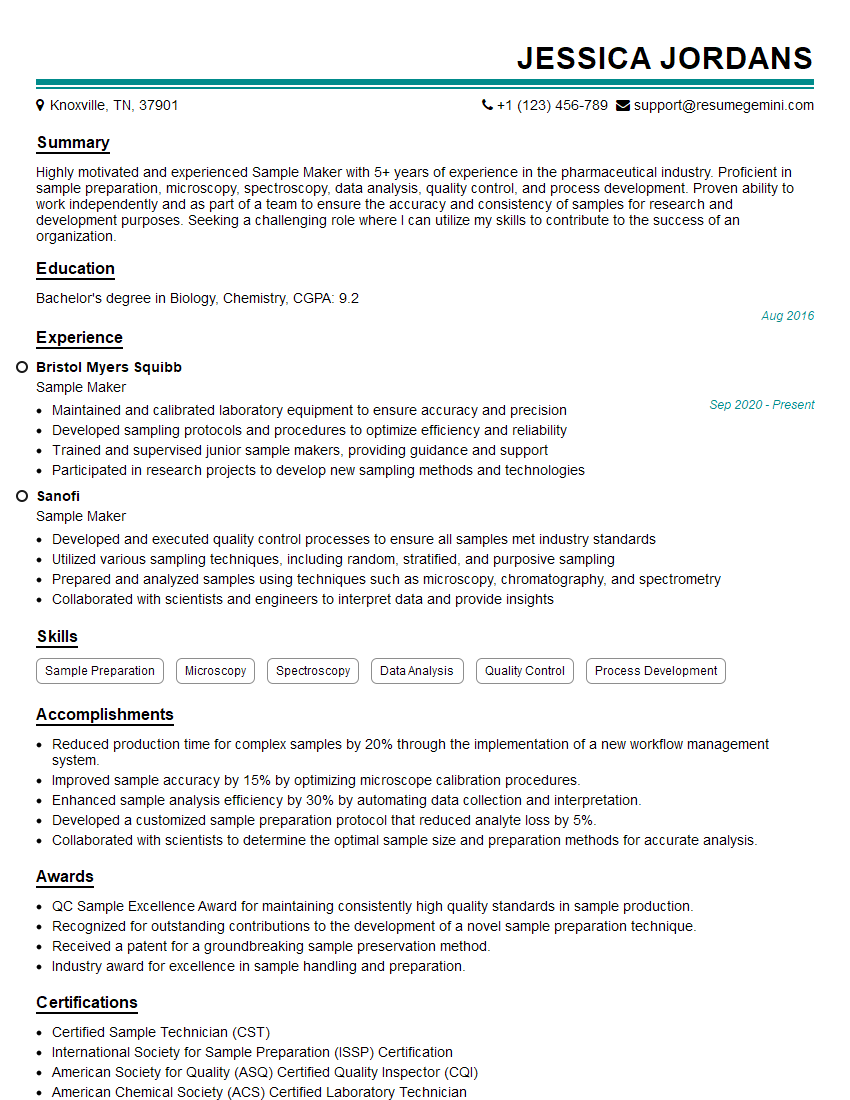
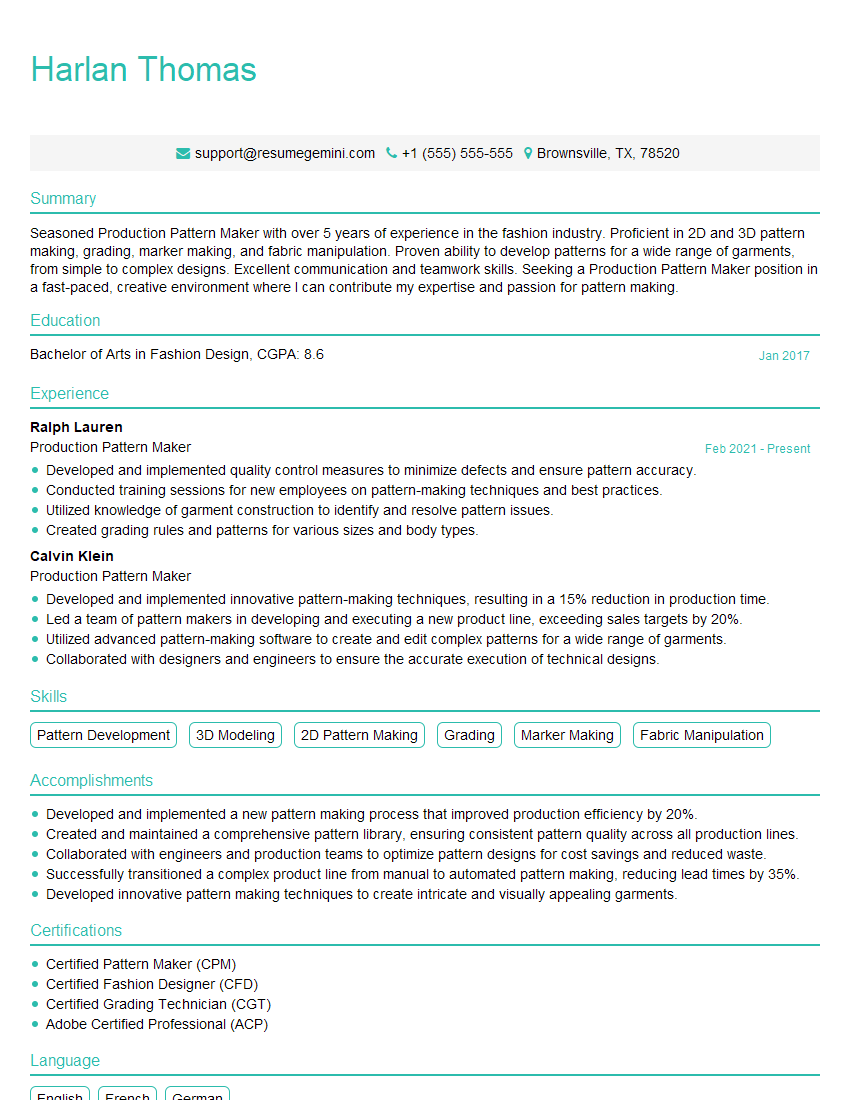
Mastering Sewing Pattern Analysis is crucial for advancement in the fashion and apparel industry, opening doors to specialized roles and higher earning potential. A strong understanding of pattern analysis showcases your technical skills and problem-solving abilities, making you a valuable asset to any team. To further enhance your job prospects, invest time in creating an ATS-friendly resume that highlights your key skills and accomplishments. ResumeGemini is a trusted resource for building professional resumes, and we provide examples of resumes tailored to Sewing Pattern Analysis to help you get started. Let ResumeGemini help you craft a resume that showcases your expertise and lands you your dream job.
Explore more articles
Users Rating of Our Blogs
Share Your Experience
We value your feedback! Please rate our content and share your thoughts (optional).
What Readers Say About Our Blog
Very informative content, great job.
good