Feeling uncertain about what to expect in your upcoming interview? We’ve got you covered! This blog highlights the most important Sheet-Fed Press Operation interview questions and provides actionable advice to help you stand out as the ideal candidate. Let’s pave the way for your success.
Questions Asked in Sheet-Fed Press Operation Interview
Q 1. Describe your experience with different types of sheet-fed presses (e.g., Heidelberg, Komori).
My experience with sheet-fed presses spans over a decade, encompassing various models from leading manufacturers like Heidelberg and Komori. I’ve worked extensively with Heidelberg Speedmaster XL series, known for their speed and automation, and Komori Lithrone presses, renowned for their precise color registration. I’m familiar with both perfecting and straight presses, understanding the nuances of each and how they suit different print jobs. For instance, a perfecting press is ideal for high-volume two-sided printing like brochures, while a straight press is better suited for specialized jobs needing precise control over each side individually. My hands-on experience includes setup, operation, maintenance, and troubleshooting across different press sizes and configurations, from smaller format presses used for business cards to large format presses used for posters and displays. This varied experience allows me to adapt quickly to different machine types and optimize printing processes for maximum efficiency and quality.
Q 2. Explain the makeready process for a sheet-fed press.
Makeready, the process of preparing a printing press for a specific job, is crucial for quality and efficiency. It’s a multi-step process that begins with reviewing the job specifications – including paper type, ink colors, and the number of copies. Next, we mount the printing plates onto the press cylinders, ensuring precise registration. This is critical for accurate color alignment across all pages and color separations. This step often involves careful adjustments using precision tools and involves a ‘test run’ to check the registration. Then, we set up the ink fountain, adjusting the ink viscosity and supply to achieve the desired color density and tone. The paper is then loaded into the press feeder, with careful attention paid to ensuring smooth and consistent feed. Finally, a test print is conducted to check for any errors, like misalignment or color discrepancies, before the full print run begins. Think of it like preparing a kitchen for a complex meal – each element needs meticulous preparation to ensure a smooth and delicious outcome. This meticulous process minimizes waste and maximizes print quality from the very first sheet.
Q 3. How do you troubleshoot common printing problems like slurring, ghosting, or hickeys?
Troubleshooting printing problems requires a systematic approach. Slurring, where the image appears blurry, often points to issues with ink viscosity, incorrect roller settings, or excessive pressure. We address this by adjusting ink viscosity, cleaning rollers, and checking the impression cylinder pressure. Ghosting, a faint repeat of an image, usually indicates problems with the dampening system or plate defects. We examine the dampening rollers, check for plate scratches, or re-etch the plates if necessary. Hickeys, small blemishes in the print, are usually caused by foreign objects like dust or fibers on the plates or blankets. The solution involves meticulously cleaning all components, and regularly inspecting the paper for contaminants. For example, I once solved a recurring ghosting issue by noticing a slightly worn dampening roller, demonstrating how careful observation is crucial in troubleshooting.
Q 4. What safety procedures do you follow when operating a sheet-fed press?
Safety is paramount in sheet-fed press operation. Before operating the press, we always conduct a thorough safety inspection, checking for any loose parts, damaged components, or potential hazards. We wear appropriate personal protective equipment (PPE), including safety glasses, hearing protection, and gloves. Lockout/Tagout procedures are strictly followed during maintenance or repairs to prevent accidental start-up. Proper lifting techniques are used when handling heavy paper stock or plates, and we maintain a clean and organized work area to prevent accidents. Furthermore, we regularly undergo safety training to refresh our knowledge of machine operation and emergency procedures. It’s more than following rules; it’s about cultivating a culture of safety awareness within the entire team.
Q 5. Describe your experience with color management and achieving consistent color reproduction.
Color management is key to consistent reproduction. My experience includes profiling the press, utilizing color management software like GMG ColorProof or X-Rite i1Profiler, and calibrating the press using color standards and control strips. We use spectrophotometers to measure color accurately and make adjustments to the ink and dampening system to achieve the desired color values. We work closely with clients to ensure that their color expectations are met by using reference materials, like Pantone color guides, and establishing accurate color proofs before the full press run begins. Maintaining consistency requires regular checks throughout the print run and potential adjustments to account for ink variations or environmental factors like humidity and temperature. The goal is to achieve consistent color reproduction across all pages and throughout the entire printing process.
Q 6. How do you maintain the quality and consistency of print throughout a long run?
Maintaining quality and consistency during a long run involves several strategies. Regular monitoring of ink levels, dampening, and pressure settings is crucial. Regular cleaning of the press components helps prevent ink buildup and other issues that could affect color and image quality. Consistent paper feeding is essential to ensure proper registration throughout the run. We meticulously monitor the printing process, using control strips to identify any changes in color or registration that may indicate the need for adjustment. We also carefully track waste and identify any unusual patterns that may indicate an impending problem. Proactive maintenance and a keen eye for detail are crucial for high-quality, long-run printing. It’s like a marathon runner carefully managing their pace and hydration; consistent vigilance ensures a strong and successful finish.
Q 7. Explain your understanding of different paper types and their impact on printing.
Understanding different paper types and their impact on printing is critical. The paper’s weight, coating, finish (glossy, matte, uncoated), and fiber content all affect ink absorption, drying time, and overall print quality. For example, coated paper provides a smooth surface, resulting in sharp, vibrant prints, but can be more challenging to print on with certain inks. Uncoated paper, with its porous nature, allows for better ink absorption, making it suitable for certain applications, but could lead to less vibrant colors. Different paper weights require adjustments in the press settings to prevent jams or damage. My experience covers a wide range of paper types, from lightweight papers for flyers to heavy stocks for brochures and packaging, and I can adapt press settings accordingly. Choosing the right paper is not just an aesthetic decision; it significantly impacts the final print quality and the efficiency of the printing process.
Q 8. How do you perform routine maintenance on a sheet-fed press?
Routine maintenance on a sheet-fed press is crucial for preventing breakdowns, ensuring consistent print quality, and maximizing the press’s lifespan. It’s a multi-faceted process involving daily, weekly, and monthly tasks.
- Daily: This includes inspecting the rollers for ink buildup and debris, cleaning the feeder and delivery systems, checking ink levels, and verifying the correct paper settings. Think of it like a car’s daily check – oil, tires, fluids. Ignoring this can lead to small issues escalating quickly.
- Weekly: A more thorough cleaning is needed, focusing on the inking system, dampening system (if applicable), and blanket cylinders. This often involves using specialized cleaning solutions and tools. We’d also perform a more detailed inspection of the grippers and feeder components for wear and tear.
- Monthly: This involves more in-depth maintenance, possibly including lubrication of moving parts, replacing worn parts, and a more comprehensive cleaning of the entire press. It’s similar to a car’s scheduled maintenance – ensuring everything is running smoothly and preventing larger problems down the road. We’d also check the overall condition of the press and make note of any parts that require attention.
Consistent adherence to this schedule ensures smooth operation and minimizes costly downtime.
Q 9. What are the key performance indicators (KPIs) you monitor while operating a sheet-fed press?
Key Performance Indicators (KPIs) for a sheet-fed press operation are vital for evaluating efficiency and productivity. I monitor several metrics, including:
- Production Speed (sph – sheets per hour): This tells us how many sheets are printed per hour, directly impacting overall output.
- Waste Rate: This measures the percentage of printed sheets that are unusable due to defects like misregistration or jams. Aiming for a low waste rate is key to profitability.
- Make-Ready Time: This is the time taken to prepare the press for a job, including changing plates, adjusting ink, and setting paper guides. Reducing this time is critical for efficiency.
- Press Uptime: This measures the percentage of time the press is actively printing, excluding downtime due to maintenance or malfunctions. High uptime is a sign of well-maintained equipment and efficient operation.
- Print Quality (e.g., color accuracy, dot gain): This ensures the printed output meets the required specifications. We use color control tools and visual inspection to maintain quality.
Regularly tracking these KPIs allows me to identify areas for improvement, troubleshoot problems, and optimize the printing process for maximum efficiency and quality.
Q 10. Describe your experience with different types of inks and coatings.
My experience encompasses a wide range of inks and coatings, each with its own characteristics and applications:
- Conventional Inks: These are oil-based inks that dry through oxidation and absorption into the substrate. They are cost-effective but have a longer drying time, making them unsuitable for high-speed printing or applications requiring immediate handling.
- UV Inks: These inks cure instantly upon exposure to ultraviolet light, allowing for immediate stacking and finishing. They produce vibrant colors and a high gloss finish, ideal for high-quality packaging or marketing materials. However, they require specialized equipment and can be more expensive.
- Water-Based Inks: These are environmentally friendly inks that dry quickly and have low odor. They are suitable for various applications, including food packaging, although they might not offer the same vibrancy as UV inks.
- Coatings: I have experience with various coatings, including aqueous, UV, and UV-curable varnishes. These coatings enhance the durability, shine, and feel of the printed product. Choosing the right coating depends on the substrate and desired final effect.
The selection of ink and coating depends heavily on the project requirements – factors like budget, drying time, desired finish, and substrate type play a significant role in the decision-making process.
Q 11. How do you handle paper jams and other press malfunctions?
Handling paper jams and malfunctions requires a systematic approach:
- Safety First: Always turn off the press before attempting to resolve any issue. Safety is paramount.
- Identify the Problem: Carefully examine the press to determine the cause of the jam or malfunction. Look for signs of damaged paper, misaligned components, or any obstructions.
- Consult Documentation: Refer to the press’s operational manual or troubleshooting guide for specific instructions on how to resolve the problem.
- Systematic Troubleshooting: Start with the simplest solutions first. For example, if it’s a simple paper jam, clear the obstruction carefully. If it’s more complex, I would start by checking the most likely causes based on the error messages and my experience.
- Seek Assistance: If the problem persists or is beyond my expertise, I would seek assistance from experienced technicians or the manufacturer.
Prevention is key. Regular maintenance, proper paper handling, and following operating procedures minimize the likelihood of these issues occurring.
Q 12. What is your experience with pre-press procedures and their impact on press operation?
Pre-press procedures are absolutely critical for a smooth and efficient press run. They directly impact the quality and speed of the printing process.
- File Preparation: Properly prepared files (correct color profiles, image resolution, and bleed) ensure accurate color reproduction and avoid costly reprints. A poorly prepared file can lead to significant delays and waste.
- Plate Making: The quality of the plates directly affects the print quality. Using high-quality plates and proper platemaking techniques ensures sharp images and consistent color.
- Proofing: Proofs (digital or physical) allow for color checks and adjustments before the actual printing begins. This prevents costly mistakes during the actual press run.
- Imposition: Correct imposition of the images on the plate ensures efficient use of paper and simplifies finishing processes. It’s like creating a puzzle to maximize output.
A well-prepared pre-press process minimizes errors, waste, and downtime during the printing process. It’s the foundation of a successful print job.
Q 13. Explain your understanding of different printing techniques (e.g., perfecting, UV coating).
I’m proficient in various printing techniques:
- Perfecting: This technique prints both sides of the sheet in one pass. It increases productivity and reduces handling, but requires specialized press equipment and careful registration setup. Think of it like a two-sided print in one go, rather than printing one side, turning the sheet, and printing the other.
- UV Coating: Applying a UV-curable coating provides a high-gloss finish, adds protection, and enhances the overall look and feel of the printed product. It requires a UV curing unit and special UV-curable inks or coatings.
- Other Techniques: My experience also includes various other techniques, such as aqueous coating, embossing, and die-cutting, depending on the project requirements. Each technique offers unique benefits and requires specific expertise.
The choice of printing technique depends on several factors, such as the type of product, the desired finish, and budget constraints.
Q 14. How do you identify and resolve registration issues on a sheet-fed press?
Registration issues, where the colors or images aren’t aligned properly, are a common problem in sheet-fed printing. Resolving them involves a systematic approach:
- Identify the Problem: Pinpoint the source of the misregistration – is it in the feeder, the printing units, or the delivery system? A misaligned image or color shift will help to identify which unit is causing the problem.
- Adjustments: Make small adjustments to the press components, such as sidelays, grippers, or plate cylinders, to realign the images. Start with small incremental adjustments to avoid further issues.
- Check Paper Path: Ensure the paper path is smooth and free of obstructions, as this can contribute to misregistration.
- Plate Alignment: Make sure the plates are properly aligned within the printing units. Improper plate installation is a frequent cause of misregistration.
- Systematic Approach: It’s often an iterative process; after each adjustment, print a test sheet to see if the problem is resolved. It’s a case of using small adjustments until you get it right.
Preventing registration issues begins with proper pre-press preparation, careful plate mounting, and regular press maintenance.
Q 15. Describe your experience with press automation and control systems.
My experience with press automation and control systems spans over a decade, encompassing various platforms from older Heidelberg models to the latest Komori and Koenig & Bauer presses. I’m proficient in operating and troubleshooting automated systems, including:
- Automated plate changing: I’m adept at using automated plate changers, minimizing downtime and maximizing productivity. For example, on a recent job with tight deadlines, the automated plate changer saved us over an hour compared to manual plate changes.
- Pre-set controls and job setup: I can efficiently program and manage pre-sets for different jobs, ensuring consistent color and registration across large print runs. This involves meticulous attention to detail to ensure accurate color profiles and precise sheet alignment.
- Automated quality control systems: I’m familiar with various integrated quality control systems, such as automatic density and register controls, allowing for real-time monitoring and adjustments to maintain consistent print quality. I’ve often used these systems to quickly identify and rectify minor inconsistencies before they become major issues.
- Press management software: I have experience using various press management systems, from basic operator interfaces to advanced production management software. This includes tracking job progress, optimizing press parameters, and generating reports on press performance.
My troubleshooting skills are equally strong. I can identify and resolve issues related to sensor malfunctions, software glitches, and mechanical problems, minimizing production disruptions. I approach troubleshooting systematically, utilizing diagnostic tools and my understanding of the press’s electrical and mechanical components.
Career Expert Tips:
- Ace those interviews! Prepare effectively by reviewing the Top 50 Most Common Interview Questions on ResumeGemini.
- Navigate your job search with confidence! Explore a wide range of Career Tips on ResumeGemini. Learn about common challenges and recommendations to overcome them.
- Craft the perfect resume! Master the Art of Resume Writing with ResumeGemini’s guide. Showcase your unique qualifications and achievements effectively.
- Don’t miss out on holiday savings! Build your dream resume with ResumeGemini’s ATS optimized templates.
Q 16. How familiar are you with different types of platemaking technologies?
My familiarity with platemaking technologies extends to various methods, each suited for different needs and budgets. I’ve worked with:
- Computer-to-plate (CTP) systems: This is the industry standard, and I’m proficient in using various CTP technologies, such as thermal, violet, and UV, understanding their respective strengths and weaknesses. For example, I prefer thermal CTP for its ease of use and relatively lower cost, while violet CTP offers higher resolution for fine detail work.
- Conventional platemaking: While less common now, I possess experience in traditional film-based platemaking for specialized projects or situations requiring compatibility with older equipment. This involved understanding the intricacies of film processing, exposure, and plate development.
- Plate processing and handling: This includes proper cleaning, storage, and handling of plates to minimize defects and ensure long plate life. For instance, understanding the impact of temperature and humidity on plate stability is crucial to minimize issues.
Choosing the right platemaking technology depends on factors like the print run length, desired quality, and available budget. My expertise allows me to select and utilize the optimal technology for each printing job.
Q 17. How do you manage waste and minimize material costs during press operation?
Managing waste and minimizing material costs is a crucial part of efficient press operation. My approach involves several strategies:
- Careful job planning and estimation: Accurate estimation of material needs minimizes waste. This involves meticulous review of the job specifications and previous print runs to get an accurate count.
- Optimized sheet size and imposition: I always try to use the most efficient sheet size and imposition to maximize the use of paper and minimize trim waste. I’m familiar with various imposition software and techniques to do this.
- Waste tracking and analysis: We regularly track waste quantities, identifying areas for improvement. This involves analyzing data from the press and related equipment, to spot trends and adjust accordingly.
- Paper selection and storage: Proper paper storage is crucial to prevent damage and waste. Understanding the characteristics of different paper types and managing its storage ensures that paper is used optimally.
- Regular maintenance of the press: This minimizes paper jams and other issues that lead to waste. Preventive maintenance reduces both downtime and material loss.
For example, in one instance, by analyzing waste data, we identified a consistent problem with paper misfeeds. By adjusting press settings, we managed to reduce waste by almost 15%.
Q 18. How do you prioritize tasks and manage your time effectively in a fast-paced pressroom environment?
Prioritizing tasks and managing time effectively in a fast-paced pressroom environment requires a structured approach. I utilize a combination of techniques including:
- Detailed job scheduling: I always start with a clear schedule, listing jobs according to their deadlines and complexities, allowing me to prioritize tasks effectively. This allows for a clear understanding of time allocations for each part of the job.
- Efficient workflow management: This involves optimizing the sequence of operations to minimize downtime and improve throughput. For example, making sure that plate changes are scheduled during the setup for the next job to minimize idle time.
- Effective communication and teamwork: Open communication with team members and other departments ensures smooth workflow and prevents delays. For instance, proactively communicating potential issues to prevent bottlenecks.
- Use of technology: We leverage various software tools for job tracking, monitoring production progress, and communicating with other departments. This enables quick responses to any changes or delays.
- Regular self-assessment and adaptation: Continuously evaluating performance and identifying areas for improvement is crucial. This involves tracking productivity metrics and adapting my workflow accordingly.
For instance, by streamlining our workflow for a large-volume order, we managed to finish the project several days ahead of schedule, impressing the client significantly.
Q 19. Explain your understanding of the relationship between pre-press, press, and post-press operations.
Pre-press, press, and post-press operations are interdependent stages in the printing process, each impacting the final product’s quality and efficiency. A breakdown of their relationship is as follows:
- Pre-press: This stage involves all activities before printing, including design, file preparation, color management, and platemaking. Any errors here can impact the entire process downstream. For example, incorrect color profiles will lead to inaccurate color reproduction in the final print.
- Press: This is the printing stage itself, where the plates are used to transfer ink onto the substrate (paper). The press operator’s skills and press’s condition directly influence print quality, speed, and efficiency. Any press malfunction, incorrect ink settings, or issues with the substrate can cause reprinting and increase costs.
- Post-press: This involves operations after printing, such as finishing, binding, folding, and delivery. This stage ensures the printed product meets the client’s requirements. A problem here such as misfolding or inconsistent cutting, might mean a whole batch needs to be reworked.
Smooth collaboration between these stages is essential for efficient and high-quality printing. Any issues in one stage will have a ripple effect on the others. For example, a pre-press error might lead to press downtime and increased post-press work.
Q 20. Describe your experience with quality control and inspection procedures.
Quality control and inspection are paramount in ensuring customer satisfaction. My experience covers a range of procedures:
- Pre-press checks: I perform rigorous checks on pre-press files for errors in resolution, color profiles, and imposition, ensuring they meet specifications before sending to the press. This prevents issues that would lead to waste during printing.
- Press checks: During printing, I conduct regular checks on color consistency, registration, and ink density to prevent any defects. Using color control instruments and test prints is essential to ensure adherence to industry standards.
- Post-press checks: Once printed, thorough inspection of the finished product for defects, misprints, or inconsistencies is critical before delivery. This involves checking for cuts, folds, and binding quality.
- Documentation and reporting: I maintain detailed records of all quality checks and inspection results, documenting any issues or corrections made. This ensures accountability and helps improve our quality control processes.
I strictly adhere to industry standards and client specifications, implementing corrective actions as necessary. For example, if a consistent color issue is detected, I immediately investigate and adjust the press settings, recording the changes and the outcomes.
Q 21. How do you work effectively with your team members in the pressroom?
Effective teamwork in the pressroom is crucial for efficiency and productivity. My approach emphasizes:
- Open communication: I ensure clear and open communication with all team members, sharing information relevant to the job, including potential challenges or delays. This includes daily briefings and sharing insights to improve the efficiency of the entire team.
- Collaboration and support: I actively collaborate with colleagues, offering support and assistance where needed, fostering a positive and productive environment. For example, if one person is facing a challenge, we work together as a team to troubleshoot and solve the issue.
- Respect for diverse skills: I recognize and value the diverse skills and experience of my team members, leveraging their strengths for maximum efficiency. Understanding individual skillsets allows for optimal task allocation for increased output.
- Problem-solving as a team: When facing challenges, I encourage collaborative problem-solving, brainstorming solutions together to find the best approach. This ensures that the problem is tackled from all perspectives.
By fostering a collaborative and supportive environment, we have consistently met deadlines and maintained high standards of quality.
Q 22. Explain your experience with different types of paper handling equipment.
My experience encompasses a wide range of paper handling equipment crucial for efficient sheet-fed press operation. This includes various types of feeders, such as continuous feeders, which are ideal for high-volume jobs and minimize downtime, and stack feeders, better suited for smaller runs and specialized paper types. I’m also proficient with paper joggers, which ensure precise alignment of sheets to prevent misfeeds, and delivery systems, ranging from simple pile delivery to more complex systems like stream feeders and cross-stackers.
For example, I once worked on a project where using a continuous feeder proved critical to meeting a tight deadline for a large magazine print run. The high-speed capabilities prevented significant delays and ensured timely delivery. Conversely, on a smaller project with unique textured paper, a stack feeder was more suitable due to its gentle handling capabilities, avoiding damage to the substrate.
Q 23. How do you troubleshoot problems related to moisture and humidity in the pressroom?
Troubleshooting moisture and humidity issues in the pressroom is crucial for preventing paper jams, static electricity, and print quality problems. It’s akin to baking a cake – too much moisture and it falls flat, too little and it’s dry and crumbly. My approach involves monitoring the pressroom environment using hygrometers to check both temperature and humidity. Ideal conditions generally fall within a specified range, and deviations trigger a response.
Step-by-step troubleshooting:
- Identify the Problem: Note the specific issues – curling, static, sticking, etc.
- Check Environmental Conditions: Verify temperature and humidity using hygrometers. Are they outside the optimal range?
- Adjust HVAC Systems: Make adjustments to the heating, ventilation, and air conditioning system to bring the environment back into the optimal range.
- Inspect Paper Storage: Ensure proper storage of paper in a climate-controlled area, away from direct sunlight and moisture sources.
- Paper Acclimatization: Allow newly delivered paper to acclimatize to the pressroom environment for a period of time before use to prevent shock.
For example, experiencing excessive static cling during a job, I adjusted the pressroom humidity by slightly increasing it, effectively resolving the problem. Consistent monitoring and proactive adjustments are key to preventing these disruptions.
Q 24. Describe your experience with press cleaning and maintenance schedules.
Press cleaning and maintenance are non-negotiable for consistent print quality and extending the lifespan of the equipment. It’s like regularly servicing a car – preventative maintenance is far less costly than major repairs.
My experience involves following a comprehensive schedule incorporating daily, weekly, and monthly tasks.
- Daily Cleaning: This includes cleaning ink rollers, dampening systems, and removing debris from the press.
- Weekly Maintenance: This involves more thorough cleaning of the press, including the inking unit and impression cylinders, and lubrication of moving parts.
- Monthly Maintenance: More in-depth cleaning and checks of the entire press, including the feeder and delivery systems, as well as preventative maintenance tasks such as checking and tightening bolts.
I use appropriate cleaning solutions and follow manufacturer guidelines diligently. Documentation is key, tracking maintenance tasks to anticipate potential problems and schedule necessary repairs. A well-maintained press is a productive press.
Q 25. How do you handle emergency situations and safety concerns in the pressroom?
Safety is paramount in a pressroom environment. My training emphasizes proactive safety measures and immediate, effective responses to emergencies. I am familiar with all safety protocols, including lockout/tagout procedures for maintenance and emergency shut-off procedures.
Emergency Response:
- Assess the Situation: Quickly assess the nature of the emergency (e.g., paper jam, machine malfunction, injury).
- Prioritize Safety: If an injury is involved, immediately administer first aid and contact emergency medical services. Ensure the safety of all personnel.
- Take Corrective Action: If it’s a machine malfunction, follow lockout/tagout procedures and initiate troubleshooting. For a paper jam, address the jam carefully, following safe procedures.
- Report the Incident: Thoroughly document the incident, including the cause, actions taken, and any injuries.
For instance, during a sudden power outage, I immediately ensured the press was shut down safely, evacuated personnel, and then, once it was safe to do so, began the process of restarting the machine according to established procedures.
Q 26. Explain your understanding of different types of press configurations (e.g., straight, perfector).
Press configurations vary widely, affecting the printing process and overall production. Understanding these differences is critical for job selection and efficient operation.
- Straight Press: Prints one side of the sheet at a time. Simple, cost-effective, but requires additional steps for double-sided printing.
- Perfector Press: Prints both sides of the sheet in one pass. More efficient for double-sided jobs, but usually more expensive to purchase and maintain.
The choice between a straight press and a perfector depends on the job requirements. High-volume double-sided jobs are better suited to a perfector, whereas smaller runs or single-sided jobs might be more cost-effective on a straight press. I have experience operating both types and can select the best configuration for a given job.
Q 27. How do you ensure the press is running efficiently and productively?
Ensuring efficient and productive press operation involves a multi-faceted approach that prioritizes optimized workflows, minimal downtime, and consistent quality.
- Workflow Optimization: Efficient job scheduling, proper makeready procedures, and streamlined workflow processes.
- Preventative Maintenance: Regular cleaning, lubrication, and inspections significantly reduce downtime caused by unexpected breakdowns.
- Operator Skill: Proficient operators minimize waste through accurate setup and efficient operation.
- Quality Control: Regular monitoring of print quality prevents costly reprints and ensures customer satisfaction.
- Data Analysis: Tracking key performance indicators (KPIs) such as press speed, waste, and downtime allows for identification of areas for improvement.
For example, by analyzing press data, I identified a recurring issue with misfeeds that was traced to a specific feeder component. Implementing preventative maintenance on this component resulted in a significant reduction in downtime and waste.
Q 28. What are your salary expectations?
My salary expectations are commensurate with my experience and skills in sheet-fed press operation, and reflect the market value for a professional with my expertise. I am open to discussing a competitive compensation package that aligns with the company’s compensation structure.
Key Topics to Learn for Sheet-Fed Press Operation Interview
- Press Setup and Operation: Understanding the entire process from job ticket review to final print output, including makeready, color registration, and troubleshooting common issues.
- Color Management: Practical application of color theory and managing color consistency across various print runs. This includes understanding color profiles, calibrating the press, and troubleshooting color discrepancies.
- Paper Handling and Feeding: Deep understanding of different paper types, their properties, and how to optimize the press for efficient and jam-free operation. Includes troubleshooting paper jams and misfeeds.
- Quality Control and Inspection: Proficiency in identifying and correcting print defects, understanding quality metrics, and implementing preventative maintenance to ensure consistent high-quality output. This also involves understanding customer specifications and quality standards.
- Safety Procedures and Maintenance: Detailed knowledge of safety protocols, preventative maintenance schedules, and the ability to perform basic press maintenance tasks. This includes understanding lockout/tagout procedures and recognizing potential safety hazards.
- Imposition and Plate Mounting: Understanding the principles of imposition, plate mounting techniques, and the impact on print quality and efficiency. Includes troubleshooting issues with plate mounting and registration.
- Troubleshooting and Problem-Solving: Developing effective strategies for diagnosing and resolving common press problems, including identifying the root cause and implementing corrective actions. This involves using both technical skills and problem-solving methodologies.
Next Steps
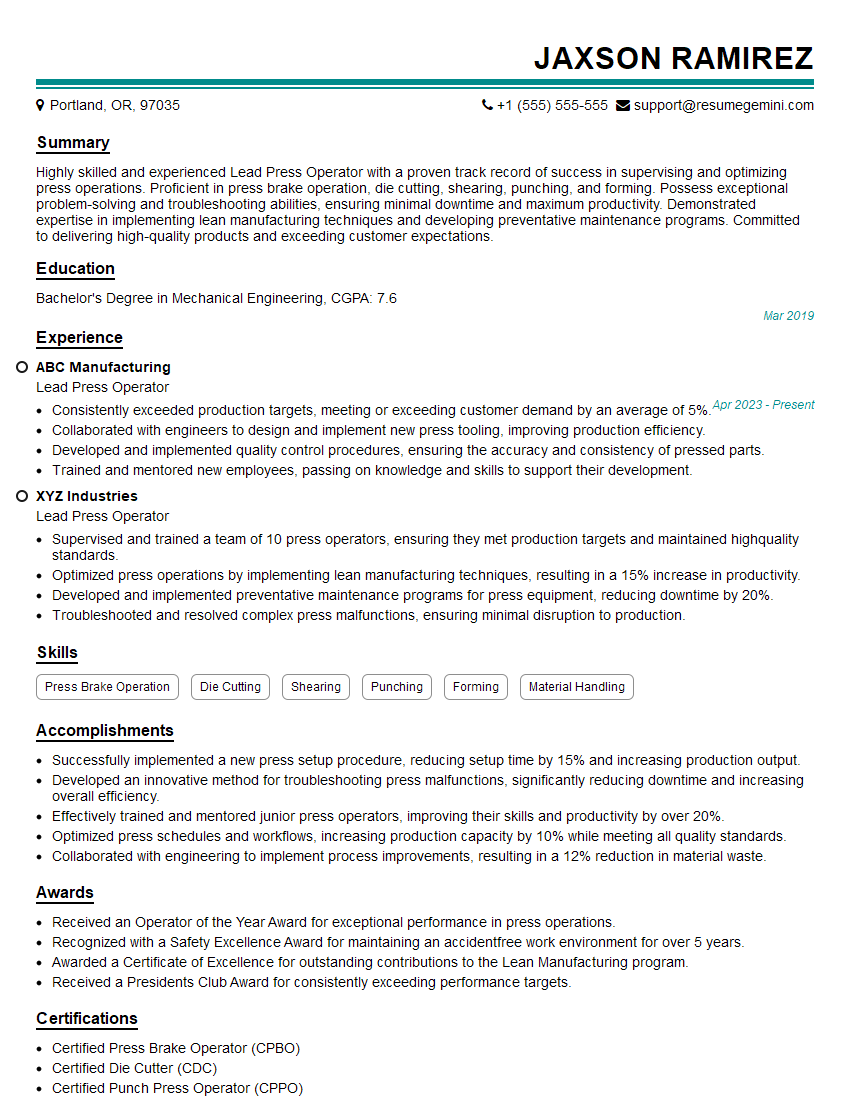
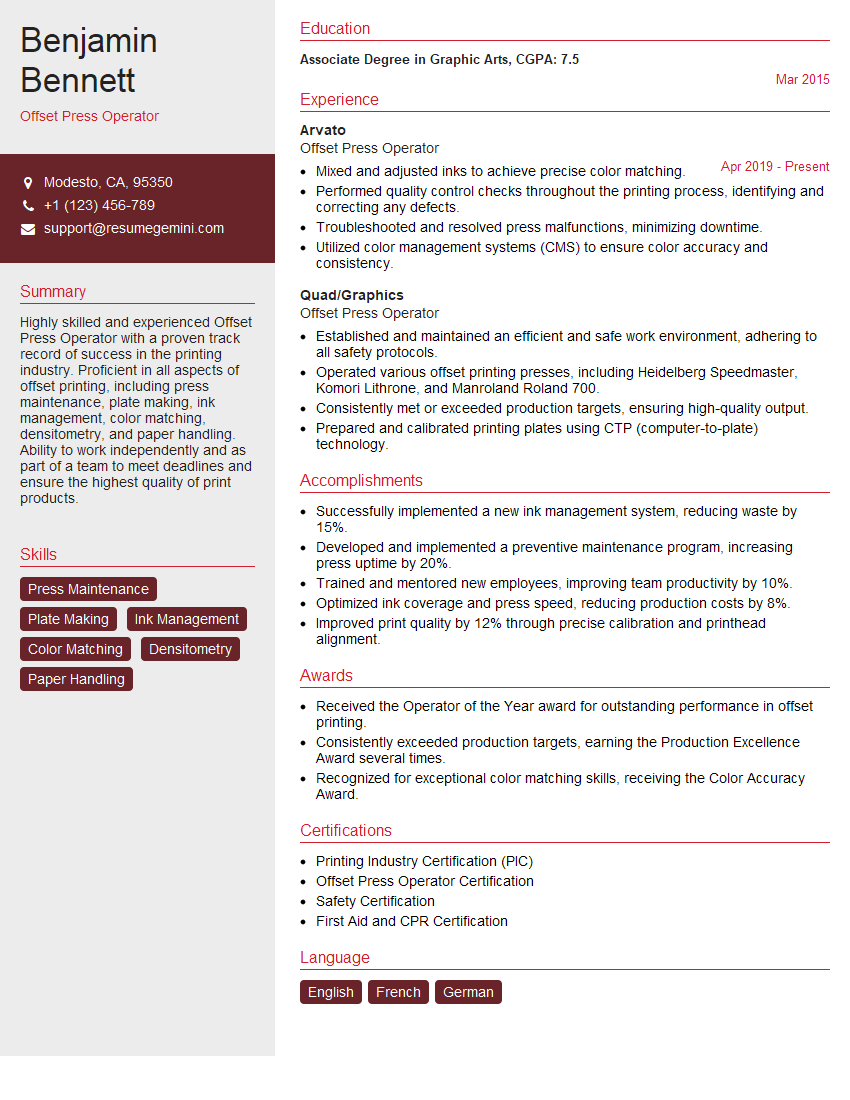
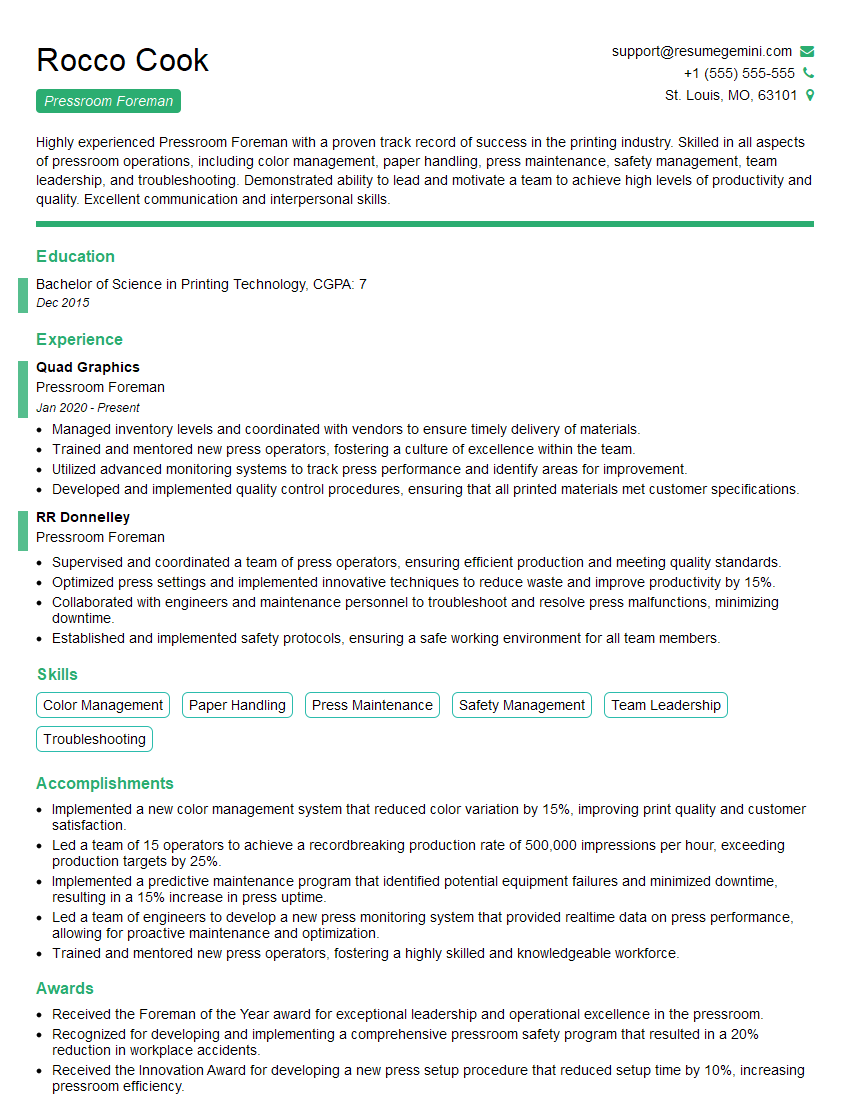
Mastering Sheet-Fed Press Operation opens doors to a rewarding career with excellent growth potential, offering opportunities for specialization and advancement within the printing industry. To significantly increase your chances of landing your dream job, crafting an ATS-friendly resume is crucial. This ensures your qualifications are effectively highlighted for recruiters and applicant tracking systems. We highly recommend using ResumeGemini to build a professional and impactful resume. ResumeGemini provides valuable resources and examples of resumes tailored to Sheet-Fed Press Operation, enabling you to showcase your skills and experience effectively.



Explore more articles
Users Rating of Our Blogs
Share Your Experience
We value your feedback! Please rate our content and share your thoughts (optional).
What Readers Say About Our Blog
Very informative content, great job.
good