Are you ready to stand out in your next interview? Understanding and preparing for Shucking and Grading interview questions is a game-changer. In this blog, we’ve compiled key questions and expert advice to help you showcase your skills with confidence and precision. Let’s get started on your journey to acing the interview.
Questions Asked in Shucking and Grading Interview
Q 1. What are the different grades of oysters?
Oyster grading is crucial for ensuring consistent quality and pricing. Grading systems vary slightly by region and market demands, but generally focus on size, shape, and shell condition. Common grades include:
- Select/Extra Select: These are the largest and most uniform oysters, with deep cups and pristine shells. They command the highest prices.
- Number 1: These are a good size and shape, with minimal shell imperfections. They represent a balance of quality and price.
- Number 2/Standard: These are smaller or have more shell irregularities but are still perfectly edible and suitable for many applications.
- Culls: These oysters have significant shell damage, are misshapen, or show signs of disease and are usually unsuitable for sale.
Imagine trying to create an elegant oyster platter – you’d select the ‘Select’ grade for its visual appeal and consistent size. Conversely, for a casual oyster roast, ‘Number 2’ oysters are perfectly acceptable and more cost-effective.
Q 2. Describe the proper technique for shucking oysters.
Shucking oysters requires a sharp oyster knife, a sturdy surface, and a keen eye for safety. Here’s a step-by-step process:
- Position the Oyster: Place the oyster on a flat, stable surface with the cupped side down and the hinge facing away from you.
- Insert the Knife: Find the hinge and carefully insert the knife’s tip into the hinge opening. This is where the muscles are least tense.
- Twist and Separate: Gently twist the knife to separate the top shell from the bottom. Avoid excessive force.
- Sever the Muscle: Once separated, run the knife along the inside of the top shell to loosen and cut the adductor muscle attaching the oyster to the shell.
- Remove the Oyster: Carefully dislodge the oyster from its shell, leaving the oyster intact. Inspect for any shell fragments.
Practice makes perfect! Start with a few oysters to get comfortable with the technique. Remember, a sharp knife minimizes the risk of slips and broken shells.
Q 3. How do you identify and handle damaged or contaminated shellfish?
Identifying and handling damaged or contaminated shellfish is crucial for food safety. Look for:
- Broken or damaged shells: These can indicate bacterial contamination or internal damage.
- Unusual odor: A foul or ammonia-like smell is a clear sign of spoilage.
- Open shells that don’t close when tapped: This suggests the oyster is dead and should be discarded.
- Discolored flesh: Oysters should have a pearly, opaque look. Any discoloration (e.g., dark spots or greenish hue) can indicate contamination or disease.
Handling: Immediately discard any shellfish showing these signs. Do not attempt to clean or salvage them. Maintain strict sanitation procedures to prevent cross-contamination of other shellfish.
Imagine finding a broken oyster among a batch – immediately removing it prevents the risk of contamination spreading to perfectly good oysters.
Q 4. What are the common safety hazards associated with shucking and grading?
Shucking and grading oysters present several safety hazards:
- Cuts from oyster knives: Sharp knives are essential, but require careful handling and attention to prevent accidents.
- Shell fragments: Broken shells can cause cuts or injuries. Proper technique and thorough inspection are vital.
- Slip hazards: Wet surfaces can create slippery conditions around the shucking area. Maintaining a clean and dry workspace is important.
- Repetitive strain injuries: Shucking involves repetitive hand movements. Regular breaks and proper posture are recommended to prevent strain.
Personal Protective Equipment (PPE) like cut-resistant gloves can significantly mitigate these risks.
Q 5. How do you maintain sanitation standards during shucking and grading?
Maintaining sanitation is paramount in shucking and grading. Key practices include:
- Clean workspace: Regularly clean and sanitize the shucking table and all tools. Use a food-grade sanitizer.
- Hand hygiene: Wash hands thoroughly and frequently with soap and water.
- Proper storage: Store shucked oysters at the correct temperature (below 40°F) to prevent bacterial growth.
- Waste disposal: Dispose of oyster shells and other waste promptly and appropriately. Do not mix with other waste streams.
- Protective clothing: Use clean aprons and gloves to prevent contamination.
Think of it like operating a surgical suite – maintaining a sterile environment is essential to avoid compromising food safety and prevent bacterial contamination.
Q 6. Explain the importance of proper knife handling in shucking.
Proper knife handling is essential for safety and efficiency. Use a specifically designed oyster knife with a short, strong blade and a rounded tip to minimize the risk of accidental punctures. Always:
- Keep the knife sharp: A sharp knife requires less force, reducing the chance of slips and mishaps.
- Maintain a firm grip: Hold the knife securely to prevent it from slipping.
- Cut away from yourself: Direct the blade away from your body while shucking.
- Use caution with the blade: Be aware of the knife’s location at all times and avoid careless movements.
I’ve seen firsthand the consequences of poor knife handling – a momentary lapse of concentration can lead to a painful cut. Treat the oyster knife with respect!
Q 7. What are the visual indicators of high-quality shellfish?
High-quality shellfish exhibit several visual indicators:
- Tightly closed shell: Live oysters usually tightly close their shells when disturbed.
- Clear, slightly opaque liquor: The liquid inside the shell should be clear or slightly milky.
- Plump, firm flesh: The oyster meat should be full and firm, not shriveled or slimy.
- Bright, shiny shell: The exterior shell should be clean and free of significant damage.
- Natural coloration: Oyster color varies by species, but should appear healthy and consistent with the variety.
Think of it like choosing a fresh peach – you look for plumpness, vibrant color, and a smooth skin. The same principles apply to judging oyster quality.
Q 8. How do you determine the weight and size grade of shellfish?
Determining the weight and size grade of shellfish is crucial for market value and consumer expectations. It typically involves weighing individual shellfish or a representative sample, then categorizing them based on pre-defined weight ranges. Size grading often complements weight grading, using calipers or rulers to measure shell length or width. These measurements are then matched to established grading scales, which can vary by region and species. For instance, oysters might be graded as ‘small,’ ‘medium,’ ‘large,’ or ‘jumbo,’ each with corresponding weight and size parameters. The specific grading standards are usually set by industry regulations or market demand.
For example, if I’m grading Pacific oysters, I might use a scale to weigh 100 oysters and then categorize them based on weight into grades like ‘Select’ (weighing between 60-80 grams), ‘Medium’ (80-100 grams), and ‘Large’ (over 100 grams). Simultaneously, I’d measure the shell length to ensure consistency within each grade. This dual approach—weight and size—ensures a more accurate and uniform product.
Q 9. What are the different types of shellfish you are experienced in shucking and grading?
My experience encompasses a wide range of shellfish, including oysters (Pacific, Kumamoto, Atlantic), clams (littleneck, Manila, razor), mussels, and scallops. Each species presents unique challenges in shucking and grading due to variations in shell shape, strength, and meat yield. For example, shucking Pacific oysters requires a different technique than shucking delicate Kumamoto oysters to prevent damage to the meat. Similarly, grading clams focuses on size consistency and shell quality, unlike scallops, where meat weight and condition are primary grading factors. This broad experience allows me to adapt my techniques and standards to each shellfish type.
Q 10. Describe your experience with using different shucking tools.
I’m proficient with various shucking tools, from traditional oyster knives with different blade shapes and sizes to more specialized tools like clam knives and mussel openers. The choice of tool depends on the shellfish type and personal preference. For example, a heavy-duty oyster knife with a sturdy blade is ideal for Pacific oysters, while a thinner, more flexible knife works better for delicate Kumamoto oysters. I’ve also used pneumatic shucking machines for high-volume processing, though these require careful operation to avoid damaging the product. Each tool demands a specific technique, learned through practice and experience to maximize efficiency and minimize waste.
My experience with different tools has taught me that efficiency and safety are paramount. A dull knife, for instance, increases the risk of injury and produces less clean shucking, resulting in more meat loss. Regular sharpening and proper tool maintenance are crucial.
Q 11. How do you ensure consistent grading throughout a large batch of shellfish?
Maintaining consistent grading across a large batch necessitates establishing clear grading criteria and employing rigorous quality control measures. This begins with clearly defined weight and size ranges for each grade, ideally documented and easily accessible to all team members. Using calibrated scales and measuring tools is paramount. Regular calibration checks ensure accuracy. In addition, a visual reference set—samples representing each grade—helps maintain consistency. Regular spot-checks and team training refresh everyone’s understanding of the standards.
Imagine processing thousands of oysters. To ensure uniformity, I’d set up multiple workstations with calibrated scales and size guides. Supervisors would periodically check each station’s output to verify grading adherence. This multi-faceted approach significantly improves the consistency of the final product.
Q 12. What are your methods for dealing with a particularly difficult-to-shuck oyster?
Dealing with a stubborn oyster requires patience and a systematic approach. First, I carefully assess the shell’s structure, identifying any weaknesses or points of entry. I might use a different knife or tool based on the shell’s characteristics. If the shell is particularly tough, I may carefully use a hammer and chisel to create an opening. In some cases, I might need to apply more force, but the goal is always to minimize damage to the meat. If damage is unavoidable, the oyster is downgraded or discarded based on company procedures.
I remember one instance with a particularly tough oyster. After trying different angles and tools, I used a small chisel to gently create a fissure. This allowed me to insert my knife, and, with careful leverage, I successfully opened the oyster without harming the meat. This experience highlighted that patience and careful assessment are essential when dealing with difficult-to-shuck shellfish.
Q 13. How do you handle shellfish that do not meet quality standards?
Shellfish that fail to meet quality standards are handled according to strict protocols, usually involving segregation and appropriate disposal methods. Factors like broken shells, dead animals, or meat contamination lead to rejection. The specific handling procedures depend on local regulations and company policies. In many cases, rejected shellfish are separated for disposal to prevent contamination of the good product. Sometimes, they may be repurposed for other uses, such as fertilizer, if permitted. Accurate record-keeping is critical to track the amount and reason for rejection.
Maintaining high quality standards is critical for food safety and brand reputation. Clear documentation of rejected shellfish allows for continuous improvement in our processing techniques.
Q 14. Explain your understanding of traceability in shellfish processing.
Traceability in shellfish processing is crucial for food safety and consumer protection. It’s the ability to track a product’s journey from harvest to the consumer’s plate. This involves meticulously documenting each stage, including harvest location, date, quantity, processing steps, and any handling or storage conditions. Often, unique identifiers are used—lot numbers, barcodes, or RFID tags—to track batches of shellfish throughout the entire supply chain. This information is vital for identifying the source of contamination or quality issues, ensuring rapid response and preventing widespread problems. Strict record-keeping is essential to maintain traceability, allowing for swift action should issues arise.
For example, if a batch of oysters is found to be contaminated, traceability allows us to swiftly identify the source of the contamination and isolate the affected lot, preventing broader contamination and potential health risks.
Q 15. What is your experience with different types of oyster shells?
My experience with oyster shells encompasses a wide range, from the familiar Pacific oyster (Crassostrea gigas) with its relatively deep, cupped shell, to the more delicate Kumamoto oyster (Crassostrea sikamea) known for its smaller, rounder shape. I’ve also worked extensively with Eastern oysters (Crassostrea virginica), which exhibit considerable variation in shell shape and thickness depending on their growing environment. Understanding these variations is crucial, as shell morphology directly impacts shucking technique and yield. For example, the thicker shells of some Eastern oysters require a more forceful, careful approach to avoid breakage, while the delicate Kumamotos necessitate a gentler touch. I’m also familiar with the challenges posed by unusually shaped or misshapen shells, which can increase shucking time and reduce yield.
Beyond the common varieties, I’ve encountered less frequent types, each requiring a unique approach. This experience has given me a nuanced understanding of how shell characteristics impact the efficiency and safety of the shucking process.
Career Expert Tips:
- Ace those interviews! Prepare effectively by reviewing the Top 50 Most Common Interview Questions on ResumeGemini.
- Navigate your job search with confidence! Explore a wide range of Career Tips on ResumeGemini. Learn about common challenges and recommendations to overcome them.
- Craft the perfect resume! Master the Art of Resume Writing with ResumeGemini’s guide. Showcase your unique qualifications and achievements effectively.
- Don’t miss out on holiday savings! Build your dream resume with ResumeGemini’s ATS optimized templates.
Q 16. How do you maintain the freshness of shellfish during processing?
Maintaining shellfish freshness during processing is paramount to ensuring quality and safety. Our facility employs a rigorous, chilled-chain system from the moment the oysters arrive. This begins with ensuring proper refrigeration during transport, ideally maintaining a temperature between 33°F and 40°F (0.5°C and 4.4°C). Upon arrival, the oysters are immediately moved to temperature-controlled storage, further minimizing time at ambient temperature. During shucking, the oysters are kept on ice slush to maintain their low temperature, preventing bacterial growth. After shucking, the meat is quickly chilled again, often using rapid-cooling techniques to ensure it remains at optimal temperature.
Furthermore, we strictly adhere to sanitary practices to prevent cross-contamination. All work surfaces, tools, and equipment are thoroughly cleaned and sanitized between batches, utilizing food-grade sanitizers. Regular monitoring of temperatures at critical control points is implemented to ensure consistent quality and prevent spoilage. Any shellfish showing signs of spoilage are immediately discarded.
Q 17. What are the regulatory requirements for handling and selling shellfish?
Regulatory compliance for handling and selling shellfish is stringent and crucial to public health. We are fully licensed and operate in accordance with all relevant local, state, and federal regulations, including those established by the FDA and the National Shellfish Sanitation Program (NSSP). This includes strict adherence to harvest area classifications, ensuring that oysters are sourced from approved areas that meet water quality standards. Comprehensive record-keeping is essential, meticulously documenting the origin, handling, and temperature of all shellfish throughout the entire process. We conduct regular testing for bacterial contamination, ensuring that our products meet the regulatory standards for safe consumption. Non-compliance can result in severe penalties, including fines and facility closures, so adherence is a top priority.
Our facility regularly undergoes inspections by regulatory bodies to verify our compliance, and we actively participate in industry training to remain updated on current regulations and best practices.
Q 18. What is your experience with automated shucking and grading equipment?
My experience with automated shucking and grading equipment is extensive. I’ve worked with various automated shucking machines, from older, less efficient models to the latest high-speed systems. These machines offer significant advantages in terms of speed and consistency, particularly for high-volume processing. However, they also present challenges. Machines can sometimes damage the oyster meat, particularly with irregularly shaped shells, leading to lower yields or damaged product. Therefore, skillful human intervention is often needed, especially for quality control and handling of rejects.
Automated grading systems are equally important, utilizing technologies such as image analysis and weight sensors to categorize oysters according to size and quality. This process enhances efficiency and ensures consistent sizing for different market segments. The integration of automated systems necessitates a solid understanding of both the machine’s capabilities and its limitations, along with regular maintenance and operator training to optimize performance and minimize product loss.
Q 19. Describe your experience with inventory management in a shellfish processing facility.
Inventory management in a shellfish processing facility is crucial for minimizing waste and maximizing profitability. We employ a sophisticated inventory tracking system, using both manual and computerized methods. This involves real-time tracking of incoming shellfish, ensuring accurate records of quantity, source, and date of arrival. As oysters move through the processing stages (shucking, grading, packaging), their status is updated within the system. This allows us to track the flow of inventory accurately and anticipate potential bottlenecks. We use the first-in, first-out (FIFO) method to ensure the oldest oysters are processed and sold first, minimizing the risk of spoilage.
Regular inventory audits are conducted to reconcile physical inventory with system records, ensuring accuracy and detecting any discrepancies. Forecasting future demand based on historical sales data and seasonal trends allows for efficient purchasing and scheduling to avoid overstocking or shortages.
Q 20. How do you handle customer complaints related to shellfish quality?
Handling customer complaints related to shellfish quality is crucial for maintaining reputation and customer satisfaction. Our process starts with empathetic listening to the customer’s concerns and gathering detailed information, including the batch number, date of purchase, and nature of the complaint. If the complaint involves a quality issue, such as spoilage or contamination, we initiate a thorough investigation. This might include reviewing our internal records, conducting additional testing on the affected batch, and tracing the oyster’s journey back to the source.
Depending on the findings, we take appropriate corrective actions, which could range from offering a replacement product or refund to investigating potential issues in our handling processes. Maintaining open communication with the customer is vital, keeping them informed throughout the investigation and resolution process. We document all complaints and investigations to identify trends and prevent recurring issues.
Q 21. What are your strengths and weaknesses related to shucking and grading?
My strengths lie in my extensive practical experience in all aspects of shucking and grading, including a deep understanding of oyster varieties and their unique handling requirements. I possess a keen eye for quality and can quickly identify and address potential issues in the processing chain. My ability to efficiently manage inventory and ensure regulatory compliance are also key strengths. I am adept at working both independently and collaboratively within a team environment and can readily adapt to changing demands.
One area for development is enhancing my proficiency in advanced data analysis techniques to further optimize inventory management and predictive modeling. While I possess a good understanding of automated systems, deepening my knowledge of the latest technologies and maintenance procedures would be beneficial for maximizing efficiency and minimizing waste.
Q 22. How do you adapt to changes in production demands?
Adapting to changing production demands in shucking and grading is crucial for efficiency and meeting market needs. My approach involves a combination of flexibility, communication, and proactive planning.
- Flexibility: I’m comfortable adjusting my shucking speed and grading criteria to match order volume. If there’s a sudden surge in demand for a specific size or type of oyster, I can prioritize those, ensuring faster processing times.
- Communication: Open and clear communication with supervisors and team members is vital. If a change in demand is anticipated, we can discuss strategies for optimizing workflow. For example, we might adjust staffing levels or re-allocate tasks based on the new priorities.
- Proactive Planning: I anticipate potential changes by monitoring market trends and order patterns. This allows me to suggest adjustments in advance, such as pre-sorting oysters based on expected demand. For instance, if we anticipate an increase in orders for large oysters, I might begin separating those in advance, optimizing the overall process.
For instance, during a busy holiday season, we experienced a massive increase in orders for smaller oysters. By quickly communicating this to the team and adjusting our sorting system to prioritize smaller oysters, we were able to meet the high demand without compromising quality.
Q 23. How do you ensure the safety of yourself and your coworkers while shucking?
Safety is paramount in shucking. We implement rigorous safety protocols to minimize risks. This includes:
- Proper Equipment: Using sharp, well-maintained shucking knives and gloves is essential. Regular knife sharpening ensures clean cuts, reducing the risk of slips and injuries. Gloves protect our hands from sharp shells and oyster liquor.
- Safe Work Practices: We maintain a clean and organized workspace, free from clutter. This prevents accidental cuts and falls. We also adhere to proper posture and lifting techniques to avoid strain and injuries. We always cut away from ourselves and use appropriate cutting boards.
- Teamwork and Communication: We work as a team, keeping each other informed about potential hazards. For instance, if someone drops a knife, we communicate it immediately, ensuring everyone is aware and can move to a safe distance.
- Training and Supervision: Regular training reinforces safe work practices. Supervisors ensure that all team members are following procedures, providing guidance and correcting any unsafe behavior.
A critical incident prevention strategy is to take breaks when needed to prevent fatigue. Fatigue greatly increases risk of injury.
Q 24. Describe a time you had to solve a problem related to shucking or grading.
During a busy summer, our oyster supply experienced a significant decrease in size due to a sudden change in water temperature. This impacted our ability to fulfill orders for specific size ranges.
The problem was that we couldn’t meet the demand for larger oysters because the harvest was primarily smaller. I proposed a solution that involved:
- Communication with Suppliers: I contacted our suppliers to understand the cause of the size reduction and the projected recovery timeline.
- Adjusting Grading Standards: I worked with the supervisor to slightly adjust our grading standards to accommodate the smaller sizes, ensuring that customers still received high-quality oysters, even if not precisely the size specified in their orders.
- Prioritizing Orders: We prioritized orders that could be filled with the available sizes while clearly communicating with customers about any potential size variations.
- Exploring Alternative Sources: I also started exploring alternative oyster suppliers to ensure we had diverse sources in the event of future shortages.
This multi-faceted approach allowed us to minimize disruptions to our production and maintain customer satisfaction during a challenging period.
Q 25. What is your experience with food safety certifications?
I possess extensive experience with food safety certifications. I am certified in ServSafe Food Handler, and I have participated in numerous training programs on safe shellfish handling practices, including those compliant with HACCP (Hazard Analysis and Critical Control Points) guidelines. These programs cover proper sanitation procedures, temperature control, and the prevention of cross-contamination. I’m proficient in maintaining detailed records, understanding labeling requirements, and following all regulations related to food safety and hygiene within a food processing environment.
Q 26. How do you stay updated on best practices in shellfish handling?
Staying updated on best practices in shellfish handling is vital. I utilize several methods to maintain my knowledge:
- Professional Associations: I am actively involved with professional seafood industry associations, attending conferences and workshops to learn about the latest advancements in shellfish safety and handling techniques.
- Industry Publications: I regularly read trade publications and journals focused on seafood processing and food safety. This keeps me informed about emerging trends, new regulations, and improved practices.
- Online Resources: I actively utilize online resources from reputable organizations such as the FDA and NOAA to stay current on guidelines and best practices.
- Training Programs: I actively seek out training opportunities and workshops offered by regulatory bodies and industry experts.
By combining these methods, I guarantee I’m always informed about the latest and most effective methods in shellfish safety and handling.
Q 27. What are your salary expectations for this role?
My salary expectations for this role are commensurate with my experience and skillset, and competitive within the industry. Based on my qualifications and the requirements of this position, I am seeking a salary range of [Insert Salary Range Here]. I’m open to discussing this further.
Q 28. What are your long-term career goals in the seafood industry?
My long-term career goals involve continued growth and leadership within the seafood industry. I aspire to become a supervisor or manager, overseeing a team and contributing to the overall efficiency and success of a seafood processing operation. I am committed to improving food safety protocols, optimizing production processes, and mentoring future generations of seafood professionals. Ultimately, I envision a career where I combine my technical expertise with leadership skills to make a significant contribution to a sustainable and successful seafood business.
Key Topics to Learn for Shucking and Grading Interview
- Oyster Handling and Safety: Understanding proper hygiene practices, safe shucking techniques to minimize injury, and the importance of food safety regulations.
- Shucking Techniques & Efficiency: Mastering various shucking methods for different oyster types, optimizing speed and precision while maintaining quality, and understanding the impact of technique on yield.
- Grading Standards & Criteria: Familiarizing yourself with industry-standard grading scales (size, shape, shell condition, meat quality), the ability to consistently apply these standards, and understanding the economic implications of accurate grading.
- Quality Control & Identification: Recognizing signs of spoilage, identifying defects, and implementing effective quality control measures throughout the process. Understanding how to assess oyster freshness and viability.
- Equipment Maintenance & Usage: Proper use and maintenance of shucking knives, gloves, and other equipment. Understanding safety protocols related to equipment use.
- Waste Management & Sustainability: Implementing efficient waste management practices, minimizing waste, and understanding the environmental impact of oyster shucking and grading operations.
- Problem-solving & Troubleshooting: Developing the ability to identify and resolve common issues during shucking and grading, such as dealing with difficult-to-open oysters or inconsistent quality.
Next Steps
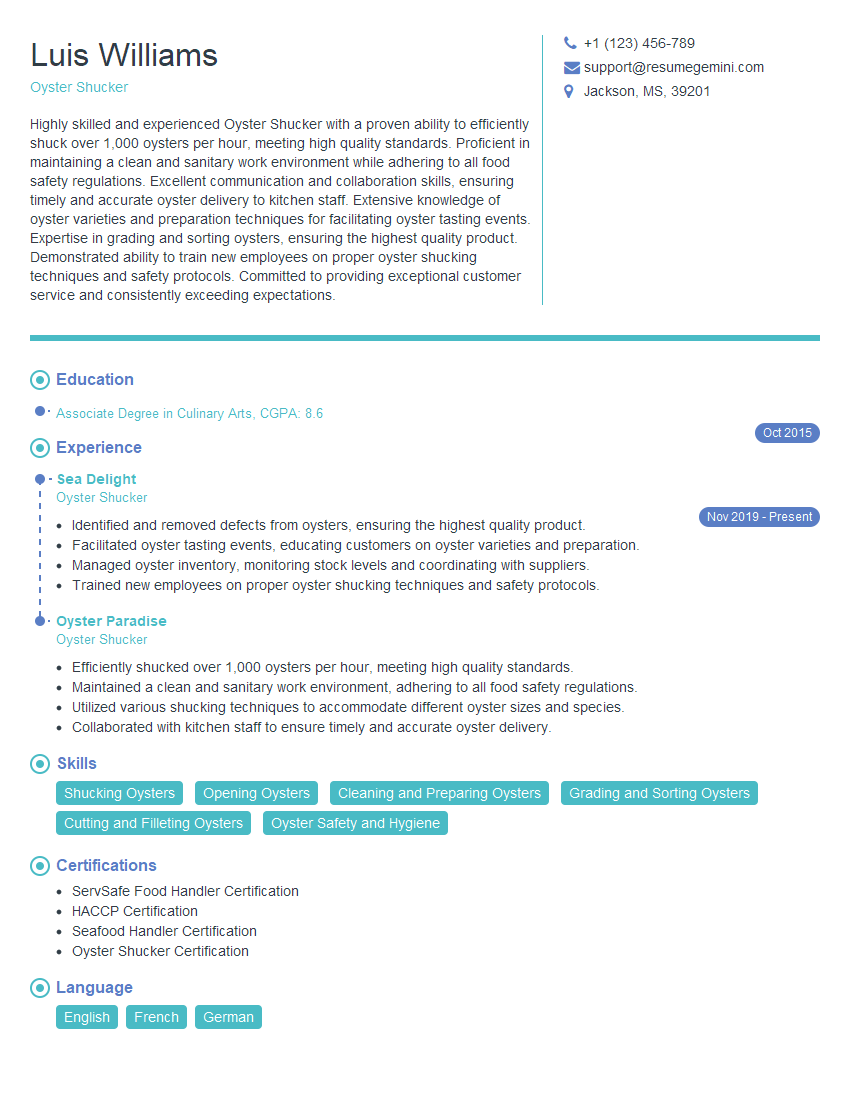
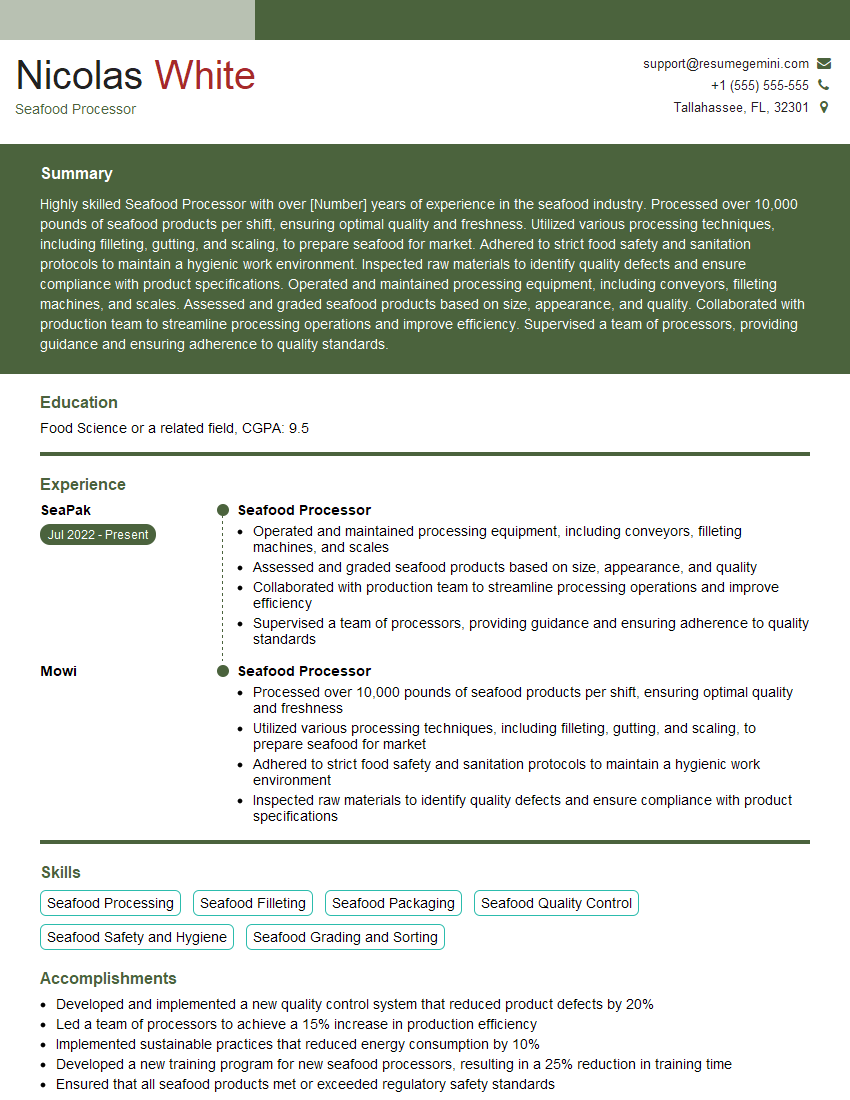
Mastering shucking and grading opens doors to rewarding careers in the seafood industry, offering opportunities for advancement and specialization. A strong resume is crucial for showcasing your skills and experience to potential employers. An ATS-friendly resume, optimized for Applicant Tracking Systems, significantly increases your chances of getting noticed. To help you craft a compelling and effective resume, we recommend using ResumeGemini, a trusted resource for building professional resumes. Examples of resumes tailored specifically to the shucking and grading industry are available to help guide you. Take the next step towards your dream job – build a standout resume today!
Explore more articles
Users Rating of Our Blogs
Share Your Experience
We value your feedback! Please rate our content and share your thoughts (optional).
What Readers Say About Our Blog
Very informative content, great job.
good