Cracking a skill-specific interview, like one for Signal Intelligence Collection and Analysis, requires understanding the nuances of the role. In this blog, we present the questions you’re most likely to encounter, along with insights into how to answer them effectively. Let’s ensure you’re ready to make a strong impression.
Questions Asked in Signal Intelligence Collection and Analysis Interview
Q 1. Explain the difference between COMINT, ELINT, and FISINT.
SIGINT, or Signals Intelligence, is a broad term encompassing the interception and analysis of electromagnetic emissions. It’s categorized into several sub-disciplines, three of the most prominent being COMINT, ELINT, and FISINT. They differ primarily in their target signals and the information extracted:
- COMINT (Communications Intelligence): Focuses on the interception and analysis of communications signals. This includes voice, data, and other forms of electronically transmitted information. Think intercepted phone calls, encrypted emails, or radio transmissions. The goal is to understand the content of the communication itself.
- ELINT (Electronic Intelligence): Concentrates on non-communications signals emitted by electronic systems. This could include radar emissions, electronic warfare systems, or even the unique electronic signature of a particular piece of equipment. The primary interest isn’t the content of a message, but rather the technical characteristics of the signals – revealing operational capabilities, system locations, and intentions.
- FISINT (Foreign Instrumentation Signals Intelligence): Deals with signals emitted by foreign instrumentation. This might be data telemetry from a missile test, scientific research data, or other types of technical information transmitted electronically. The goal is to understand the technical capabilities of the foreign system or the results of a specific activity.
Think of it like this: COMINT is eavesdropping on a conversation, ELINT is analyzing the type of phone being used and the signals it emits, and FISINT is examining the data sent from a scientific instrument within that phone. Each provides a different, but often complementary, piece of the intelligence puzzle.
Q 2. Describe your experience with signal processing techniques.
My experience with signal processing techniques is extensive, spanning both theoretical understanding and practical application. I’m proficient in techniques like:
- Filtering: Designing and implementing digital filters (FIR, IIR) to isolate signals of interest and remove noise. For example, using a bandpass filter to extract a specific frequency range from a noisy radio signal.
- Fourier Transforms: Utilizing Fast Fourier Transforms (FFTs) to analyze the frequency content of signals, identifying key features like modulation types and carrier frequencies. This is essential for signal classification and demodulation.
- Wavelet Transforms: Applying wavelet analysis to analyze non-stationary signals, extracting time-frequency information. This is particularly useful in analyzing signals with changing characteristics over time.
- Matched Filtering: Implementing matched filters to detect known signals buried in noise, improving the signal-to-noise ratio (SNR) and aiding in signal detection.
- Time-Frequency Analysis:Employing techniques like short-time Fourier transform (STFT) and Wigner-Ville distribution for analyzing signals with varying frequency characteristics over time, critical for identifying signal characteristics and patterns.
I’ve utilized these techniques extensively in real-world scenarios, from developing algorithms to automate signal classification to improving the detection of weak signals obscured by interference.
Q 3. How familiar are you with various signal modulation techniques?
My familiarity with signal modulation techniques is comprehensive. I’m well-versed in both analog and digital modulation schemes, including:
- Amplitude Modulation (AM): Including variations like Double Sideband (DSB), Single Sideband (SSB), and Amplitude Shift Keying (ASK).
- Frequency Modulation (FM): Including Frequency Shift Keying (FSK).
- Phase Modulation (PM): Including Phase Shift Keying (PSK), such as BPSK, QPSK, and higher-order PSK, as well as Differential PSK (DPSK).
- Digital Modulation Techniques: Including OFDM (Orthogonal Frequency-Division Multiplexing), widely used in modern wireless communication systems, and various spread-spectrum techniques like Direct Sequence Spread Spectrum (DSSS) and Frequency Hopping Spread Spectrum (FHSS).
Understanding these techniques is crucial for demodulating intercepted signals and extracting meaningful information. For instance, recognizing the unique characteristics of a specific type of modulation (like the chirped signal of a specific radar) allows for rapid signal identification and source determination.
Q 4. What are the common challenges in SIGINT data collection?
SIGINT data collection presents numerous challenges:
- Signal-to-Noise Ratio (SNR): Weak signals often get drowned out by background noise, requiring advanced signal processing techniques to extract the desired information. This is especially true in crowded radio environments.
- Interference and Jamming: Intentional or unintentional interference can mask target signals, making detection and analysis difficult. Jamming is a deliberate attempt to block or corrupt the signals.
- Dynamic Environments: Signals can change rapidly in frequency, power, and other characteristics, making real-time detection and tracking challenging. Consider the complexities of identifying a target signal in a busy urban environment.
- Encryption and Security: Many communications are encrypted, making it challenging to access the underlying information without appropriate cryptographic techniques.
- Geographic Limitations: The distance to the target and geographical obstructions can significantly impact signal strength and reception quality. Signals weaken with distance, and physical obstacles can block or distort them.
- Ethical and Legal Considerations: SIGINT operations must adhere to strict ethical and legal guidelines to ensure privacy and national security. Unauthorised collection of data is strictly prohibited.
Overcoming these challenges requires advanced signal processing, sophisticated antenna systems, secure data handling practices, and a deep understanding of the operational environment.
Q 5. How do you ensure the integrity and security of collected SIGINT data?
Ensuring the integrity and security of collected SIGINT data is paramount. We employ a multi-layered approach:
- Data Authentication and Integrity Checks: Using cryptographic hash functions (like SHA-256) to verify the authenticity and integrity of the data ensuring that it hasn’t been tampered with since it was collected.
- Encryption: Employing strong encryption algorithms (AES, for example) to protect the data both during transmission and storage. This prevents unauthorized access to sensitive information.
- Access Control: Implementing strict access control measures to limit access to sensitive data only to authorized personnel. The principle of least privilege is strictly followed.
- Data Logging and Auditing: Maintaining detailed logs of all data access and modifications to ensure accountability and track any potential security breaches. A complete audit trail allows investigators to identify any issues.
- Secure Storage: Utilizing secure storage facilities and robust data backup systems to protect against data loss and unauthorized access. This often includes redundancy and offsite storage.
- Regular Security Audits and Penetration Testing: Conducting regular security assessments and penetration tests to identify and address potential vulnerabilities in our systems and processes.
This comprehensive strategy ensures that our SIGINT data remains confidential, accurate, and reliable.
Q 6. Describe your experience with SIGINT data analysis tools and software.
My experience with SIGINT data analysis tools and software is extensive. I’m proficient in using a range of specialized software packages for signal processing, analysis, and visualization. These include:
- Commercial off-the-shelf (COTS) signal processing software: Such as MATLAB, with its signal processing toolbox, and specialized commercial platforms offering advanced signal analysis capabilities.
- Custom-built applications: Developed for specific SIGINT tasks, often incorporating machine learning algorithms for automated signal classification and anomaly detection.
- Specialized databases: Designed to store and manage large volumes of SIGINT data, enabling efficient retrieval and analysis. These databases often include powerful search and filtering capabilities.
I’m also familiar with programming languages like Python and C++, which are used extensively in developing custom signal processing and analysis tools. My experience extends to working with diverse data formats, including those from various sensor platforms and communication systems.
Q 7. Explain your understanding of different types of antennas and their applications in SIGINT.
My understanding of antennas and their applications in SIGINT is crucial for effective signal interception. Different antennas are optimized for different tasks. Some key types and their applications include:
- Dipole Antennas: Simple and versatile, used as a fundamental building block for many other antenna types. Often used in wideband applications.
- Yagi-Uda Antennas: Provide high gain and directivity in a specific direction. Useful for targeting specific signals of interest and improving the signal-to-noise ratio.
- Horn Antennas: Provide good gain and relatively wide bandwidth. Often used in applications where both gain and bandwidth are needed.
- Parabolic Dish Antennas: Provide very high gain and narrow beamwidth, excellent for long-range signal interception and focusing on weak signals.
- Phased Array Antennas: Allow for electronic beam steering, enabling rapid targeting of signals without physically moving the antenna. Extremely useful in dynamic environments.
- Adaptive Antennas: Employ signal processing techniques to dynamically adjust their characteristics to optimize signal reception and suppress interference. Essential for operating in cluttered radio environments.
The choice of antenna is crucial for successful SIGINT operations. For example, a Yagi-Uda antenna might be best suited for intercepting a specific radio transmission from a known location, while a phased array would be more appropriate for tracking a moving emitter.
Q 8. How do you handle large volumes of SIGINT data for efficient analysis?
Efficiently analyzing massive SIGINT datasets requires a multi-pronged approach. Think of it like sifting for gold – you have tons of sand, but only a small amount is valuable. We leverage several key strategies:
Data Reduction Techniques: This involves pre-processing the raw data to eliminate redundant or irrelevant information. For example, we might filter out signals outside a specific frequency range or those with known characteristics of benign traffic (like standard internet protocols).
Automated Feature Extraction: Algorithms automatically identify key features within signals, such as modulation types, signal strength, and timing patterns. This significantly speeds up analysis and allows us to focus on anomalies.
Machine Learning: We utilize machine learning models, trained on large datasets of known signals, to classify and prioritize signals of interest. This allows for the automated flagging of suspicious activity, dramatically improving efficiency.
Distributed Computing: Breaking down the analysis task across multiple processors or cloud-based systems allows for parallel processing of the data, significantly reducing processing time. This is crucial for handling terabytes or petabytes of data.
Data Warehousing and Databases: Employing optimized databases specifically designed for high-volume, high-velocity data allows for fast retrieval and querying of information. This is essential for efficient search and correlation of data points across multiple sources.
For instance, in one project, we used a combination of automated feature extraction and machine learning to identify and classify over 90% of the relevant signals within a dataset of several terabytes, reducing manual analysis time by more than 80%.
Q 9. What are some common methods for identifying and classifying signals of interest?
Identifying and classifying signals of interest is a crucial step. We use a combination of techniques, much like a detective investigating a crime scene:
Signal Signature Analysis: Each communication system has a unique ‘fingerprint.’ This includes modulation type (e.g., AM, FM, digital), frequency hopping patterns, and specific data encoding schemes. We compare these signatures to known databases to identify the source and type of communication.
Protocol Decoding: Once we identify a signal, we attempt to decode the underlying protocol to understand the message content. This might involve deciphering military communications protocols or standard internet protocols.
Traffic Analysis: Even without decoding the actual message, analyzing the frequency of communication, call duration, and communication partners can provide valuable intelligence. For example, frequent communication between two specific numbers might suggest a coordinated activity.
Geolocation: By analyzing the signal’s strength and propagation characteristics, we can often pinpoint the approximate location of the transmitter. This can be particularly useful in identifying illicit activities or tracking the movement of individuals.
For example, identifying a specific type of spread-spectrum signal could indicate the use of a particular military communication system. Analyzing the geolocation data could then reveal the precise location of the transmitting unit.
Q 10. Describe your experience with signal demodulation and decoding techniques.
Signal demodulation and decoding are at the heart of SIGINT. Demodulation extracts the information-bearing signal from the carrier wave, while decoding translates the extracted signal into a human-readable format. Think of it like removing the wrapping from a gift to reveal the contents:
Demodulation Techniques: I’m proficient with various demodulation techniques, including amplitude modulation (AM), frequency modulation (FM), phase-shift keying (PSK), frequency-shift keying (FSK), and spread-spectrum techniques. The specific technique used depends on the type of signal being received.
Decoding Algorithms: Decoding involves understanding the underlying encoding scheme. This could be simple text encoding or more complex encryption algorithms. We use a combination of software tools and custom-developed algorithms to tackle different encoding methods. For instance, we might employ specialized software for deciphering military encryption protocols or use algorithms to crack less sophisticated codes.
Error Correction: Often, received signals are corrupted by noise or interference. We use various error correction techniques to reconstruct the original signal, maximizing the accuracy of intelligence gained.
In one instance, we successfully demodulated and decoded a complex spread-spectrum signal, recovering encrypted messages that provided critical intelligence about an ongoing operation. This involved combining advanced demodulation techniques with custom-written decryption algorithms.
Q 11. How do you prioritize and manage competing demands in a SIGINT operation?
Prioritizing competing demands in SIGINT requires a structured approach. It’s like a battlefield commander allocating resources – you have limited personnel and equipment, and many urgent requests. We use the following:
Threat Assessment: We assess the potential threat posed by each target. The most critical threats are prioritized first.
Time Sensitivity: Some intelligence is time-critical. Information relevant to an imminent attack, for instance, will take precedence over less urgent targets.
Resource Allocation: We allocate resources (personnel, equipment, computing power) based on the priority levels assigned to various targets.
Task Management Software: We use specialized software to track tasks, monitor progress, and manage competing deadlines.
Regular Re-Prioritization: The threat landscape changes constantly. Regular reviews and re-prioritization are vital to ensure we’re focusing on the most critical targets at all times.
In a real-world scenario, we might prioritize the interception and analysis of communications from a suspected terrorist group preparing an attack over routine monitoring of less immediate threats. This would involve redirecting resources and personnel to ensure the timely completion of high-priority tasks.
Q 12. How familiar are you with various encryption and decryption methods?
My familiarity with encryption and decryption methods is extensive. It’s akin to understanding different locks and keys – the better you understand the locks, the easier it is to pick them (or develop better locks!).
Symmetric-key Cryptography: I have experience with algorithms like AES and DES, understanding their strengths, weaknesses, and practical applications.
Asymmetric-key Cryptography: I am familiar with RSA and ECC, including their use in digital signatures and key exchange protocols.
Hashing Algorithms: I understand the use of MD5, SHA-1, SHA-256, etc., for data integrity checks and digital signatures.
Cryptanalysis Techniques: I have experience with various cryptanalytic techniques, including frequency analysis, known-plaintext attacks, and chosen-plaintext attacks.
I’ve worked extensively with both commercially available cryptography tools and custom-developed algorithms used for intelligence purposes. This experience has been crucial in both understanding how to break less secure encryption and assessing the security of various systems.
Q 13. Explain your understanding of the legal and ethical considerations of SIGINT collection.
The legal and ethical considerations governing SIGINT are paramount. It’s a matter of national security, but we always need to operate within a strict legal and ethical framework. Think of it like a surgeon – precise skill is essential, but it must always be applied ethically and within legal boundaries.
Legal Frameworks: I am well-versed in relevant laws and regulations, such as the Foreign Intelligence Surveillance Act (FISA) in the United States and similar legislation in other countries. These laws dictate what types of SIGINT are permissible and the procedures that must be followed.
Privacy Concerns: We must always be mindful of the privacy rights of individuals. SIGINT activities must be targeted and proportionate, and unauthorized access to private communications is strictly prohibited.
International Law: When dealing with foreign intelligence, we must also consider international law and treaties to ensure that our activities are lawful and do not violate the sovereignty of other nations.
Ethical Guidelines: Beyond legal requirements, we adhere to strict ethical guidelines to ensure that SIGINT activities are conducted responsibly and with respect for human rights.
In every operation, we ensure strict adherence to all relevant legal and ethical guidelines, carefully balancing national security interests with the rights and privacy of individuals. This often involves working closely with legal counsel and ethics officers to ensure compliance.
Q 14. Describe your experience with data visualization and presentation techniques for SIGINT findings.
Effective data visualization is crucial for conveying complex SIGINT findings to decision-makers. It’s about translating raw data into actionable intelligence, much like turning a complex map into a clear route.
Network Graphs: These are excellent for visualizing communication patterns between individuals or organizations.
Timeline Charts: These show the evolution of events over time, highlighting significant activity and trends.
Geographical Information Systems (GIS): GIS maps can visually represent the location of targets, facilitating geographic analysis.
Interactive Dashboards: Dashboards allow for exploration of datasets, providing various views of data based on user-defined criteria. They can show trends, anomalies, and key findings in real time.
Statistical Visualizations: Charts and graphs, such as histograms, scatter plots and boxplots, are effective at showing trends and relationships in data.
In previous projects, we’ve developed interactive dashboards that allowed analysts to explore datasets, filter data based on specific criteria and create custom visualizations tailored to their needs. These tools made it easier to communicate complex findings and to highlight key intelligence findings to decision-makers in a clear and concise manner.
Q 15. How do you assess the reliability and credibility of SIGINT sources?
Assessing the reliability and credibility of SIGINT sources is crucial for accurate intelligence analysis. It’s like evaluating a witness in a court case – you need to consider their track record and the potential for bias.
- Source History: We meticulously examine the source’s past performance. Has it provided accurate information in the past? Has it been deliberately misleading or compromised? A consistent history of accurate reporting builds trust.
- Signal Characteristics: The technical characteristics of the signal itself provide valuable clues. A strong, clear signal from a known transmitter is inherently more reliable than a weak, intermittent, or encrypted signal from an unknown source. We analyze signal strength, modulation type, and other technical parameters.
- Correlation and Triangulation: We never rely on a single source. We corroborate information by comparing it with data from other independent sources. This triangulation helps confirm the accuracy and eliminate biases.
- Contextual Analysis: We consider the broader context in which the information was obtained. What are the geopolitical factors? What are the motivations of the source? Understanding the context helps us assess the likelihood of deception or manipulation.
- Human Intelligence (HUMINT) Cross-Referencing: Whenever possible, we cross-reference SIGINT findings with HUMINT to provide further validation. This collaborative approach helps to paint a clearer and more accurate picture.
For example, if a source consistently provides accurate weather data but suddenly reports on sensitive military movements, we would treat the latter with increased scrutiny and seek corroboration from other reliable sources. This layered approach minimizes the risk of basing critical decisions on unreliable information.
Career Expert Tips:
- Ace those interviews! Prepare effectively by reviewing the Top 50 Most Common Interview Questions on ResumeGemini.
- Navigate your job search with confidence! Explore a wide range of Career Tips on ResumeGemini. Learn about common challenges and recommendations to overcome them.
- Craft the perfect resume! Master the Art of Resume Writing with ResumeGemini’s guide. Showcase your unique qualifications and achievements effectively.
- Don’t miss out on holiday savings! Build your dream resume with ResumeGemini’s ATS optimized templates.
Q 16. How familiar are you with different types of signal jamming and countermeasures?
Familiarity with various signal jamming techniques and countermeasures is paramount in SIGINT. It’s a constant arms race – adversaries develop new jamming strategies, and we develop countermeasures to overcome them.
- Types of Jamming: I’m well-versed in various jamming techniques, including noise jamming (overpowering the signal with noise), barrage jamming (transmitting a wide range of frequencies simultaneously), and deceptive jamming (transmitting false signals to confuse or mislead).
- Countermeasures: Our countermeasures are equally diverse. These can include frequency hopping spread spectrum (FHSS) which rapidly changes transmission frequencies to avoid jamming, direct sequence spread spectrum (DSSS) that spreads the signal across a wider bandwidth, and advanced signal processing techniques to separate the desired signal from interference.
- Adaptive Signal Processing: We utilize adaptive signal processing algorithms to dynamically adjust to changing jamming conditions. These algorithms constantly analyze the received signal and adapt our processing techniques to optimize signal extraction. Imagine it like a constantly adapting filter cleaning noise from water.
- Directional Antennas and Beamforming: To improve signal quality and reduce jamming effects, we use directional antennas to focus on the target signal and beamforming to enhance signal strength and filter out interference.
For instance, in a scenario where an adversary utilizes barrage jamming to disrupt communications, we can implement FHSS and sophisticated signal processing to extract the signal from the chaotic background noise. This process requires a deep understanding of both jamming techniques and countermeasures.
Q 17. Describe your experience with developing and implementing SIGINT collection plans.
Developing and implementing SIGINT collection plans requires meticulous planning and execution. It’s akin to planning a complex military operation – every detail matters.
- Target Identification: We start by clearly identifying the target and their communication methods. What type of signals are we interested in? What frequency ranges do they use? What communication protocols are employed?
- Sensor Selection: We choose appropriate sensors based on the target characteristics. This could range from simple radio receivers to sophisticated satellite-based systems. Sensor selection is critical for optimal signal interception.
- Deployment Strategy: We develop a comprehensive deployment strategy, considering factors such as sensor placement, communication links, and data transfer protocols. This also includes operational security and risk mitigation.
- Data Acquisition and Processing: We design efficient data acquisition methods to ensure the collection of high-quality signal data. Robust data processing procedures are crucial for the analysis and interpretation of the captured signals.
- Legal and Ethical Considerations: Throughout the process, we adhere strictly to relevant legal and ethical guidelines. Data acquisition and processing must follow all appropriate laws and regulations.
For example, in a scenario where we need to monitor specific radio transmissions within a geographically defined area, we might deploy a network of strategically positioned sensors, utilizing appropriate antennas and signal processing techniques to ensure effective signal interception and analysis.
Q 18. How do you work effectively within a team in a SIGINT environment?
Effective teamwork is the cornerstone of successful SIGINT operations. It’s like a well-oiled machine – every part plays a crucial role.
- Communication and Collaboration: Open and transparent communication is critical. We regularly share information, insights, and challenges within the team to ensure a unified understanding of the operational goals.
- Specialized Skill Sets: Our team includes individuals with diverse skills in signal processing, data analysis, cryptography, and intelligence reporting. Each member brings their unique expertise to the table.
- Role Clarification: Clear roles and responsibilities are essential. Each team member understands their role in the process, avoiding overlap and maximizing efficiency.
- Regular Briefings and Debriefings: Frequent briefings and debriefings ensure everyone is up-to-date on the latest developments, progress, and challenges.
- Constructive Feedback: A culture of constructive feedback and continuous improvement enhances the efficiency and effectiveness of the team.
For instance, a signal processing expert might identify a specific modulation technique, which a cryptographer can then analyze for weaknesses, and finally an intelligence analyst interprets the extracted information within its broader context. This collaborative approach enhances the quality of analysis and speed of delivery.
Q 19. Explain your experience with using SIGINT to support intelligence assessments.
SIGINT plays a pivotal role in supporting intelligence assessments. It’s like having a secret window into the adversary’s activities.
- Providing Actionable Intelligence: SIGINT provides timely and actionable intelligence to support decision-making at all levels. We extract actionable intelligence that supports the assessment of adversary capabilities and intentions.
- Corroborating other intelligence: SIGINT data helps corroborate information from other intelligence sources, improving the overall reliability of the assessment.
- Identifying Patterns and Trends: We analyze patterns and trends in the intercepted signals to identify emerging threats or opportunities.
- Assessing Threat Capabilities: By analyzing communication systems, we can assess the adversary’s technological capabilities and communication infrastructure.
- Predictive Analysis: The analysis of intercepted signals can provide predictive intelligence, helping anticipate future adversary actions.
For instance, by monitoring the communication patterns of a terrorist group, we might identify plans for an upcoming attack. This intelligence allows timely intervention and mitigation of the threat. This contributes significantly to the overall intelligence assessment and subsequent strategy development.
Q 20. Describe a situation where you had to overcome a technical challenge in SIGINT analysis.
One particularly challenging situation involved analyzing heavily encrypted communications. It’s like trying to solve a complex puzzle with many missing pieces.
The challenge was decrypting highly sophisticated encryption methods used by a foreign government. Initial attempts using standard decryption techniques proved unsuccessful. We had intercepted encrypted voice communications that seemed strategically important.
Our solution involved a multi-pronged approach:
- Algorithm Analysis: We began by meticulously analyzing the characteristics of the encryption algorithm used by the target, searching for weaknesses or known vulnerabilities.
- Side-Channel Analysis: We explored potential side-channel attacks by examining subtle variations in the timing and power consumption of the communication devices. These can sometimes expose information about the encryption process.
- Collaboration and Expertise: We collaborated with cryptology experts from different agencies and universities to pool our knowledge and leverage diverse perspectives.
- Artificial Intelligence (AI): We employed AI algorithms, specifically deep learning models trained on large datasets of previously decrypted communications, to assist in pattern recognition and algorithm breakdown.
Through this persistent effort and diverse approach, we successfully identified some vulnerabilities and partially decrypted the communications, ultimately obtaining valuable intelligence that supported intelligence assessments.
Q 21. How do you stay up-to-date with advancements in signal processing and SIGINT technologies?
Staying up-to-date with advancements in signal processing and SIGINT technologies is crucial in this rapidly evolving field. It’s like constantly learning new tools and techniques.
- Professional Development: I regularly attend conferences, workshops, and training courses focusing on the latest signal processing algorithms, encryption techniques, and data analysis methodologies.
- Academic Journals and Publications: I actively read academic journals and publications in relevant fields, such as IEEE Transactions on Signal Processing and Information Forensics and Security.
- Industry Conferences and Networking: Networking with colleagues and experts at industry conferences and meetings allows for knowledge exchange and exposure to cutting-edge research.
- Online Courses and Webinars: I utilize various online platforms to access updated courses and webinars focused on signal processing, machine learning and cryptography.
- Open-Source Intelligence (OSINT): OSINT provides insight into emerging technologies and trends in the signal processing domain and provides an early glimpse of potential adversary capabilities.
This continuous learning ensures I remain at the forefront of the field, adapting to new challenges and employing the most effective methods in my work.
Q 22. What are your strengths and weaknesses as a SIGINT analyst?
My greatest strengths as a SIGINT analyst lie in my meticulous attention to detail, my ability to synthesize complex data from diverse sources, and my proficiency in various analytical tools and techniques. I excel at identifying patterns and anomalies within large datasets, even subtle ones that might be missed by others. I’m also a strong communicator, capable of explaining intricate technical findings to both technical and non-technical audiences. A weakness I’m actively working on is managing my time effectively when faced with competing priorities and tight deadlines. I’m implementing techniques like time-blocking and prioritization matrices to improve in this area. For example, during a recent project involving multiple data streams, I learned to prioritize the most time-sensitive analysis first, ensuring critical findings reached decision-makers promptly.
Q 23. Describe your experience with reporting SIGINT findings to senior management.
I have extensive experience reporting SIGINT findings to senior management. My approach focuses on clarity, conciseness, and actionable intelligence. I begin by summarizing the key findings in plain language, avoiding technical jargon unless absolutely necessary. Then, I present the supporting evidence and analysis, using visual aids like charts and graphs to highlight critical trends and patterns. Finally, I conclude with clear, concise recommendations for action based on my analysis. For instance, in a recent briefing on a suspected foreign intelligence operation, I presented my findings using a timeline, clearly illustrating the sequence of events and the supporting SIGINT evidence. This allowed senior management to quickly grasp the situation and make informed decisions.
Q 24. How do you handle conflicting or ambiguous SIGINT data?
Conflicting or ambiguous SIGINT data is a common challenge. My approach involves a systematic process. First, I meticulously review the data, cross-referencing it against other sources to identify potential errors or biases. Second, I employ triangulation techniques, comparing the data against multiple independent sources to corroborate or refute findings. Third, I develop multiple hypotheses to explain the discrepancies, prioritizing the most plausible ones based on available evidence. Finally, I document my analysis thoroughly, clearly outlining the uncertainties and limitations of the data. Think of it like a detective investigating a crime; conflicting witness accounts require careful analysis and consideration of multiple perspectives before reaching a conclusion.
Q 25. How do you ensure the accuracy and completeness of your SIGINT analysis?
Ensuring accuracy and completeness in SIGINT analysis is paramount. I adhere to a rigorous methodology that includes thorough data validation, rigorous source verification, and peer review. Data validation involves checking the integrity and authenticity of the collected data, ensuring it is free from errors or manipulation. Source verification involves confirming the reliability and credibility of the sources used in the analysis. Peer review involves having other analysts review my work to identify potential biases or errors. I also meticulously document my entire analytical process, including my methodology, assumptions, and limitations, to ensure transparency and reproducibility of my findings. This systematic approach minimizes errors and builds confidence in the accuracy and completeness of my analysis.
Q 26. Describe your experience with using SIGINT to support operational objectives.
I have extensive experience using SIGINT to support operational objectives. In one instance, I used communication intercepts to identify the location and activities of a high-value target. This information was crucial in planning a successful operation to apprehend the target. In another instance, I used SIGINT data to predict the movement of a hostile force, allowing friendly forces to preemptively position themselves for a defensive operation. My ability to translate raw SIGINT data into actionable intelligence has consistently contributed to the success of operational missions. The key is to bridge the gap between the technical details of the data and the strategic needs of the operational commander.
Q 27. How do you contribute to a positive and collaborative team environment in SIGINT work?
Contributing to a positive and collaborative team environment is vital in SIGINT analysis. I actively participate in team discussions, sharing my expertise and insights freely. I also actively listen to others’ perspectives, valuing different viewpoints and experiences. I believe in open communication and actively seek feedback from my colleagues. I am willing to assist team members, sharing my knowledge and expertise to improve their skills and capabilities. This collaborative approach not only strengthens team cohesion but also improves the quality of our collective analysis. For example, I recently mentored a junior analyst who was struggling with a particularly challenging dataset. By collaborating closely, we successfully solved the problem.
Q 28. Explain your understanding of the role of SIGINT in national security.
SIGINT plays a critical role in national security by providing insights into the intentions and capabilities of foreign actors. It helps us understand the threats we face, enabling proactive measures to protect national interests. SIGINT allows us to detect and thwart terrorist plots, monitor the activities of hostile states, and protect our critical infrastructure. It’s an essential tool for maintaining situational awareness, providing early warning of potential threats, and supporting effective decision-making in matters of national security. The information gathered helps shape foreign policy, informs military strategies, and supports counterintelligence efforts, ensuring the safety and security of our nation.
Key Topics to Learn for Signal Intelligence Collection and Analysis Interview
- Signal Acquisition and Processing: Understanding various signal interception techniques, modulation schemes, and digital signal processing fundamentals. Consider exploring different antenna types and their applications.
- Data Analysis and Interpretation: Practical application of statistical methods and machine learning algorithms for identifying patterns and anomalies within large datasets. Focus on techniques for noise reduction and signal enhancement.
- SIGINT Systems and Technologies: Familiarize yourself with the architecture and functionality of various SIGINT systems, including software-defined radios and specialized analytical tools. Explore the strengths and limitations of each technology.
- Cybersecurity and Data Protection: Understanding the security implications of SIGINT operations and the importance of data handling protocols and encryption techniques. This includes both protecting collected data and securing the systems used for collection and analysis.
- Communication Protocols and Network Analysis: Deep understanding of various communication protocols (e.g., TCP/IP, VoIP) and techniques for analyzing network traffic to extract meaningful intelligence. Consider exploring network mapping and intrusion detection.
- Intelligence Reporting and Presentation: Mastering the art of concise and impactful reporting, translating complex technical information into clear, actionable intelligence for decision-makers. Practice visualizing data effectively.
- Ethical Considerations and Legal Frameworks: Understanding the legal and ethical implications of SIGINT activities and adhering to strict regulations and guidelines. Explore relevant national and international laws.
Next Steps
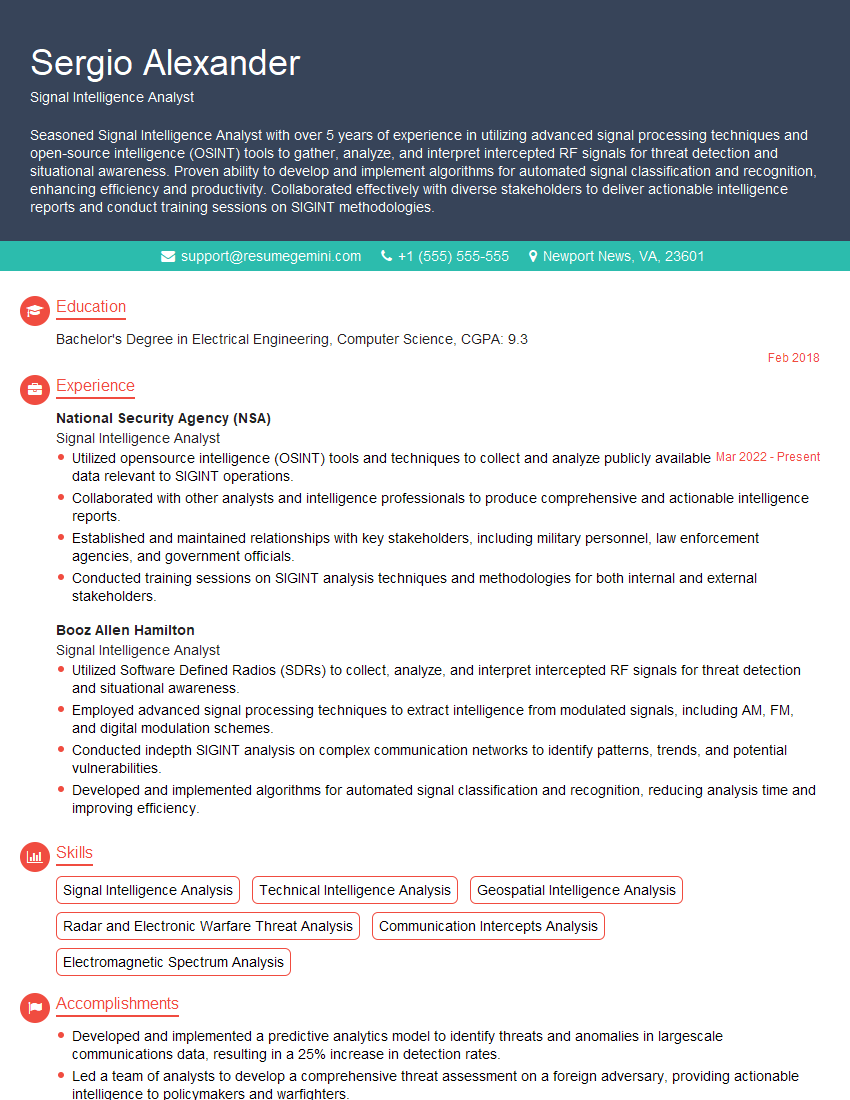
Mastering Signal Intelligence Collection and Analysis opens doors to a rewarding career with significant growth potential in a highly specialized and in-demand field. To maximize your job prospects, it’s crucial to present your skills and experience effectively. Crafting an ATS-friendly resume is key to getting your application noticed by recruiters. ResumeGemini is a trusted resource that can help you build a professional and impactful resume tailored to the specific requirements of SIGINT roles. Examples of resumes tailored to Signal Intelligence Collection and Analysis are available through ResumeGemini to guide you in this process. Take advantage of these resources to showcase your expertise and land your dream job.
Explore more articles
Users Rating of Our Blogs
Share Your Experience
We value your feedback! Please rate our content and share your thoughts (optional).
What Readers Say About Our Blog
Very informative content, great job.
good