The right preparation can turn an interview into an opportunity to showcase your expertise. This guide to Silver Smithing interview questions is your ultimate resource, providing key insights and tips to help you ace your responses and stand out as a top candidate.
Questions Asked in Silver Smithing Interview
Q 1. Describe your experience with various silver soldering techniques.
Silver soldering is a crucial skill in silversmithing, allowing us to join pieces of silver without melting the base metal. I’m proficient in several techniques, each suited to different situations.
- Hard soldering: This uses a higher-temperature solder, resulting in a stronger joint, ideal for structural components. I often use it for creating bezels or securing intricate elements.
- Medium soldering: This provides a balance between strength and ease of use, frequently employed for general joining tasks where a strong, yet less brittle, connection is needed. Think of joining decorative elements to a larger piece.
- Easy soldering: This low-temperature option is perfect for delicate work or repairs where heat sensitivity is a concern. I might use this to attach smaller findings, or repair a damaged section of a delicate piece.
- Flame soldering: This involves using a torch to precisely apply heat to the joint. It requires practice to control the flame but offers superior accuracy and speed, especially for detailed work.
- Induction soldering: A more modern approach, where an electromagnetic field heats the solder, minimizing heat damage to the surrounding metal. This is particularly useful for larger pieces or those with complex designs.
My experience encompasses all these methods, allowing me to select the most appropriate technique based on the project’s requirements and the silver’s characteristics.
Q 2. Explain the process of annealing silver.
Annealing is a heat-treating process that softens silver, making it more malleable and easier to work with. It relieves internal stresses built up during hammering, forming, or other shaping processes. Imagine trying to bend a stiff wire – annealing is like giving that wire a relaxing spa day!
The process involves heating the silver to a specific temperature (around 650-700°C for sterling silver), allowing it to cool slowly, ideally in a kiln or by burying it in vermiculite. Quick cooling can lead to cracking. The goal is to achieve a uniform, stress-free structure.
I assess when annealing is necessary by looking for signs of work hardening – increased resistance to deformation, or a tendency to crack. After annealing, I can reshape the silver easily. It is always advisable to clean the piece before annealing to avoid contaminating the silver.
Q 3. What are the different types of silver alloys and their properties?
Silver alloys are mixtures of silver with other metals, primarily copper, but also zinc, nickel, and others. The properties change with the alloy’s composition.
- Sterling Silver (925): This is the most common alloy, containing 92.5% silver and 7.5% copper. The copper adds strength and hardness, improving durability while maintaining a desirable shine.
- Fine Silver (999): Composed of nearly pure silver (99.9%), it’s exceptionally soft and malleable, perfect for intricate designs but also less durable for everyday use.
- Argentium Silver: A newer alloy containing germanium, it’s tarnish-resistant and easier to solder than sterling silver. This greatly enhances the lifespan of the jewelry.
- Coin Silver: Historically used in coins, this alloy varied but generally had a higher silver content than sterling silver. It’s often sought after for its antique appeal.
I choose the alloy based on the piece’s intended purpose – sterling for jewelry that needs to hold up to wear, fine silver for delicate artwork, and argentium for longevity and ease of working.
Q 4. How do you determine the karat of silver?
The karat (or carat) of silver indicates its purity. It represents the parts of pure silver in 24 parts of the alloy.
For example, sterling silver (92.5% silver) is 925/1000 or approximately 23.2 karat silver. Fine silver (99.9% pure) would be very close to 24 karat silver. Assaying is a process of testing the metal, often through chemical analysis, to determine its exact silver content and verify the karat.
Accurate karat determination is vital for legal and quality assurance. Misrepresentation of karat is a serious ethical and legal issue within the industry.
Q 5. Describe your experience with different finishing techniques for silver (e.g., polishing, brushing, texturing).
Finishing techniques are critical for achieving the desired aesthetic and enhancing the piece’s durability. I’m experienced in a range of methods:
- Polishing: Using various grades of polishing compounds and tools, from cloths to motorized buffers, I create a high-gloss, reflective finish. This is very common for jewelry.
- Brushing: With wire brushes of various textures, I can create linear patterns, satin finishes, or highlight details. This gives a more matte, less reflective look.
- Texturing: Techniques like hammering, chasing, and repoussé create three-dimensional patterns and textures, adding depth and character. I’ve employed techniques like stamping and using texturing hammers to achieve diverse patterns.
- Sandblasting: This gives a matte finish and can even create intricate designs depending on the masking involved.
My choice of finish depends on the design, intended style, and the piece’s overall effect. I often combine multiple techniques to achieve a unique look.
Q 6. How do you create a seamless solder joint?
Creating a seamless solder joint requires precision and attention to detail. Here’s my approach:
- Cleanliness: Thoroughly clean the surfaces to be joined, using a pickling solution to remove any oxides or contaminants. This ensures proper adhesion of the solder.
- Flux Application: Apply a flux to the joint, this helps the solder flow evenly and prevents oxidation. Choosing the right flux based on the solder is very important for success.
- Precise Heating: Use a controlled heat source, carefully heating the pieces until the solder flows cleanly into the joint. Overheating can damage the silver.
- Even Heat Distribution: Ensure even heating to avoid uneven melting of the solder. This is crucial to achieve a strong bond across the entire join.
- Proper Solder Amount: Use only enough solder to fill the joint, avoiding excess that can create a weak or unsightly joint.
- Cooling: Allow the joint to cool slowly to avoid stress cracks.
Practice is key to achieving seamless solder joints, but attention to each step consistently leads to optimal results. I regularly review and refine my techniques based on project feedback.
Q 7. What safety precautions do you take when working with silver and its alloys?
Safety is paramount when working with silver and its alloys. I consistently follow these precautions:
- Ventilation: Working in a well-ventilated area is crucial, especially when using fluxes or soldering, to minimize inhalation of fumes.
- Eye Protection: Safety glasses are always worn to protect against flying debris or solder splatter.
- Proper Handling: I always use appropriate tools for tasks, like tongs for handling hot metal, to avoid burns. Always handle sharp tools with extra care.
- Heat-Resistant Gloves: Gloves are worn during soldering to protect my hands from burns.
- Proper Disposal: I dispose of waste materials like flux and used chemicals according to local regulations and environmental best practices.
- First Aid Preparedness: A well-stocked first-aid kit is always readily available.
By maintaining a safe working environment and following these practices, I minimize potential hazards and work comfortably.
Q 8. Explain your experience with different silver forming techniques (e.g., forging, hammering, casting).
My experience encompasses a wide range of silver forming techniques, each offering unique advantages in achieving different aesthetic and structural goals. Forging, for instance, involves shaping the metal using compressive forces – think of a blacksmith shaping a horseshoe. This allows for creating strong, intricate forms, particularly useful in crafting larger pieces or those requiring significant structural integrity. I’ve used forging to create substantial silver bowls and decorative elements, relying on techniques like hammering, drawing, and upsetting to manipulate the metal’s form.
Hammering is a more delicate process, allowing for precise shaping and textural control. I often employ various hammers – from ball peen hammers for broad shaping to cross-peen hammers for more intricate work – to achieve subtle variations in surface texture and form. I’ve used hammering extensively in creating textured silver sheets for jewelry components, achieving diverse finishes from smooth to highly textured.
Casting, on the other hand, involves creating a mold and pouring molten silver into it. This method is invaluable for producing intricate designs or replicating existing pieces with high fidelity. My experience with casting includes both lost-wax casting, a time-honored method perfect for detailed pieces, and investment casting, which offers greater precision and scalability. I’ve used casting to create delicate pendants and highly detailed silver sculptures. Each technique offers a unique set of advantages, and my proficiency lies in selecting the most appropriate method based on the design complexity and desired final result.
Q 9. Describe your experience with designing and creating silver jewelry.
Designing and creating silver jewelry is a deeply creative process for me, combining artistic vision with technical skill. I begin by sketching numerous ideas, exploring different forms, textures, and gemstone combinations. The design process often involves experimenting with different materials – sometimes even incorporating unusual found objects into my designs – to gauge their potential and compatibility with silver.
Once a design is finalized, the technical challenge begins. I meticulously plan each step, considering the metal’s properties and the specific techniques required. This includes selecting the appropriate silver forming technique (forging, hammering, casting, or a combination), as well as determining the appropriate gauge of silver sheet or wire to achieve the desired strength and visual impact.
For example, I recently designed a line of rings incorporating ethically sourced gemstones. I opted for lost-wax casting to create the intricate settings that would showcase the stones’ brilliance, while the band itself was hand-hammered to create a uniquely textured surface. The final product showcases both delicate detail and a rugged, tactile quality, achieved through combining contrasting silverworking techniques.
Q 10. How do you troubleshoot common problems encountered during silver smithing?
Troubleshooting in silversmithing often requires a keen eye for detail and a systematic approach. For example, if a piece is warped during annealing (the process of heating and cooling metal to relieve stress), it might be due to uneven heating or improper quenching. To solve this, I would carefully re-anneal the piece, ensuring even heat distribution and a controlled cooling process.
Another common problem is cracks developing during soldering. This is often due to insufficient cleaning of the metal surfaces before soldering or using too high a temperature. I address this by meticulously cleaning the joints with a pickling solution and using a lower temperature for soldering, applying the solder precisely and evenly.
Identifying the root cause is crucial. I approach troubleshooting by systematically evaluating each step of the process, checking for inconsistencies in material preparation, tool usage, or heat application. Experience has taught me that careful attention to detail and methodical problem-solving are essential to overcoming challenges in silversmithing.
Q 11. What are your preferred tools and equipment for silver smithing?
My preferred tools and equipment reflect years of experience and a preference for quality and versatility. My essential tools include a range of hammers (ball peen, cross peen, chasing hammer), various punches for creating textures and patterns, different sizes of pliers (chain nose, flat nose, round nose), files and rasps for smoothing and shaping, and a soldering torch with appropriate fluxes and solders.
I also rely on specialized equipment like a jeweler’s saw for cutting intricate shapes, a rolling mill for shaping sheet metal, and a kiln for annealing. For casting, I have a vacuum casting machine and the necessary equipment for creating molds. The quality of these tools directly impacts the quality of the finished piece, making investment in reliable equipment a priority.
Q 12. How do you maintain and care for your silver smithing tools?
Maintaining my tools is critical for both their longevity and the quality of my work. After each use, I meticulously clean my tools. This includes removing any excess solder or metal particles using brushes and abrasive pads. Hammers and punches should be stored carefully to prevent damage to their heads and handles. Files are cleaned with a file card to prevent clogging.
Regular sharpening is essential, particularly for files and saws. I use appropriate sharpening stones or files for this purpose. For delicate tools like pliers, I ensure proper lubrication to prevent wear and tear. Proper storage in a designated toolbox or cabinet, away from moisture and extreme temperatures, is crucial to prolonging the life of my tools.
Q 13. Describe your knowledge of different silver patinas and their application.
Patinas are chemical treatments that alter the surface of silver, creating a range of colors and textures. My knowledge encompasses various patinas, each producing unique effects. Liver of sulfur, for example, creates a dark, antique finish ranging from brown to black, depending on the application time and concentration.
Other patinas include those created using ferric chloride, which produces warm brown or reddish tones, or ammonia solutions, that yield darker finishes. The application process typically involves immersing the silver piece in the patina solution for a specific duration or applying it with a brush or cloth for more localized effects.
Controlling the patina’s intensity is critical. This is accomplished by varying the concentration of the solution and the application time. After the patina is applied, the piece is typically cleaned and sealed to prevent further oxidation and preserve the achieved color. The choice of patina depends entirely on the desired aesthetic outcome, and I am skilled at applying a wide variety of patinas to achieve both subtle and dramatic effects.
Q 14. How do you measure and accurately cut silver sheet or wire?
Accurate measurement and cutting of silver sheet or wire are fundamental to successful silversmithing. For measuring, I use a combination of tools, primarily a steel ruler calibrated in millimeters and inches, and calipers for precise measurements of thickness or diameter.
Cutting sheet silver requires a sharp jeweler’s saw for intricate cuts or heavy-duty shears for straight cuts. For thin gauge sheet, I may also use a rotary cutting tool for added precision. Wire is cut using wire cutters or a jeweler’s saw, depending on its gauge and the desired cut. I always double-check measurements before cutting to avoid costly mistakes.
Precision is paramount; inaccurate cutting can significantly impact the finished piece. I therefore employ a methodical approach, double-checking measurements and using the appropriate cutting tools for each task. This ensures the final product meets the design specifications with accuracy and maintains a high standard of craftsmanship.
Q 15. Explain your experience with stone setting in silver.
Stone setting in silver requires precision and a steady hand. I’m proficient in various techniques, including bezel setting, prong setting, channel setting, and pave setting. Bezel setting, for instance, involves creating a metal frame around the stone, ensuring a secure and aesthetically pleasing finish. I’ve worked with a wide range of gemstones, from delicate opals requiring gentle handling to harder stones like sapphires and rubies which necessitate more forceful setting techniques. My experience includes setting both individually and in clusters, adapting my approach to the specific characteristics of each stone and the overall design of the piece. For example, I recently set a cluster of tiny diamonds in a delicate silver filigree pendant, requiring meticulous attention to detail and the use of specialized tools for precise placement and secure grip.
The choice of setting method depends greatly on the stone’s shape, size, and the desired aesthetic. Pave setting, for instance, offers a brilliant, densely-set look, but requires exceptional skill to create a flush, even surface. I take pride in my ability to select the most appropriate setting for every project, maximizing the stone’s brilliance while ensuring its long-term security.
Career Expert Tips:
- Ace those interviews! Prepare effectively by reviewing the Top 50 Most Common Interview Questions on ResumeGemini.
- Navigate your job search with confidence! Explore a wide range of Career Tips on ResumeGemini. Learn about common challenges and recommendations to overcome them.
- Craft the perfect resume! Master the Art of Resume Writing with ResumeGemini’s guide. Showcase your unique qualifications and achievements effectively.
- Don’t miss out on holiday savings! Build your dream resume with ResumeGemini’s ATS optimized templates.
Q 16. Describe your experience with using different types of files and saws for silver.
Selecting the right file or saw for silver is crucial for achieving clean cuts and precise shapes. My experience encompasses the use of various types of files, including flat files, half-round files, round files, and needle files, each designed for specific purposes. Flat files are ideal for smoothing larger surfaces, while needle files are perfect for intricate details. I also regularly use different types of saws, such as jeweler’s saws with various blade thicknesses and a piercing saw for intricate cutouts. The choice of saw blade depends on the thickness of the silver and the complexity of the cut. For example, a thicker blade might be necessary for cutting thicker sheets of silver, while a finer blade is better suited for creating delicate designs.
Proper maintenance of these tools is critical. Regular cleaning and sharpening ensure optimal performance and prevent damage to the silver. I’ve learned through experience to select the right file or saw not just for the task but also considering the finished look I want to achieve. A slightly coarser file may be used initially for shaping, followed by progressively finer files for polishing and refining the piece to a high shine.
Q 17. How do you create intricate designs in silver?
Creating intricate designs in silver involves a combination of skill, patience, and the right tools. I employ various techniques such as filigree, repoussé, chasing, and etching to achieve complex patterns and textures. Filigree, for instance, involves using thin wires to create delicate, lacy designs. Repoussé and chasing are metalworking techniques used to shape and refine metal from the front and back, allowing for three-dimensional effects. Etching, on the other hand, allows for creating intricate patterns using acid or other chemical processes.
For example, I once created a silver cuff bracelet featuring a detailed floral pattern using a combination of repoussé and chasing, carefully hammering the silver from the back to create the raised floral motif and then refining it from the front. These techniques, combined with precise sawing and filing, allow me to translate even the most elaborate design concepts into tangible pieces.
Q 18. What are your skills in creating custom designs from client sketches or descriptions?
I’m highly proficient in translating client sketches and descriptions into custom silver designs. I begin by carefully reviewing the client’s vision, asking clarifying questions to ensure I fully understand their expectations regarding design, size, material, and budget. I then create detailed sketches, incorporating my own expertise and knowledge of silversmithing techniques to optimize the design for both aesthetics and structural integrity. I will often present several design options to the client, incorporating feedback to refine the design until we achieve a perfect match.
For instance, I recently worked with a client who provided a simple sketch of a bird. Through careful discussion, we refined the design, incorporating details about feathers, posture, and the desired level of detail. The final design was significantly more intricate and detailed than the initial sketch, reflecting both the client’s preferences and my understanding of what’s feasible to achieve in silver.
Q 19. How familiar are you with CAD software for jewelry design in silver?
I’m familiar with several CAD software packages for jewelry design, including Rhino and Matrix. While I primarily work hands-on, I find CAD software invaluable for creating precise designs, experimenting with different layouts, and providing clients with detailed 3D renderings before fabrication. CAD allows me to visualize the final product accurately and to refine details digitally before committing to the physical creation process. This minimizes errors and revisions, saving both time and resources.
For example, I recently used Rhino to design a complex ring featuring intertwined silver bands and a gemstone. The CAD model allowed me to precisely determine the dimensions and angles of each band, ensuring a perfect fit and a harmonious blend of metal and stone.
Q 20. How do you manage deadlines and project timelines?
Managing deadlines and project timelines is essential in my work. I always begin by establishing a realistic timeline in collaboration with the client, factoring in each stage of the design and fabrication process. I use project management tools to track progress, identify potential bottlenecks, and ensure timely completion. I break down complex projects into smaller, manageable tasks, which makes progress monitoring and readjustments easier.
Unexpected delays can occur, and I’m prepared to address them proactively. For instance, if a particular supply is delayed, I have alternative sources or will adjust the timeline with the client to ensure the project remains on track without compromising the quality of the finished product. Open communication with clients is paramount in managing expectations and ensuring everyone is on the same page throughout the process.
Q 21. How do you handle unexpected problems during a project?
Problem-solving is an integral part of silversmithing. Unexpected problems can range from material flaws to design modifications. My approach involves a systematic process: First, I thoroughly assess the problem. What went wrong? What’s the impact on the project timeline and outcome? Once I have a clear understanding, I explore potential solutions, considering the feasibility and impact of each option. I always prioritize finding a solution that maintains the quality and integrity of the finished piece while meeting the client’s expectations and the project’s timeline.
For example, if a piece gets damaged during the fabrication process, I’ll assess the extent of the damage. Sometimes a minor repair is sufficient; other times, a complete refabrication may be necessary. Transparency with the client is crucial during such situations; I will explain the issue, present potential solutions, and discuss the necessary adjustments to the timeline and potentially budget.
Q 22. Explain your understanding of the different stages of the silver smithing process.
Silversmithing is a multi-stage process, much like baking a complex cake – each step is crucial for the final product’s quality. It typically begins with design, where I conceptualize the piece, sketching and refining the design until it’s perfect. Next is metal preparation; this involves selecting the appropriate sterling silver (or other silver alloy), and then using techniques like sawing, filing, and hammering to shape the metal according to the design. Then comes forming, where I might use techniques like forging, casting (lost-wax casting is a favorite), or chasing and repoussé to create the three-dimensional form. Soldering is a critical step, joining different parts of the silver piece with precision and care, using appropriate fluxes and carefully controlling the heat. After soldering, the piece requires finishing, which includes filing, sanding, polishing, and potentially texturing to achieve the desired surface finish. Finally, hallmarking (where applicable) and the application of any finishes, such as plating or patination, complete the process.
- Design: For example, I recently designed a custom cuff bracelet, sketching various designs until I arrived at the perfect balance of elegance and functionality.
- Finishing: Achieving a mirror-like polish on a silver pendant requires multiple stages of polishing with progressively finer abrasives.
Q 23. Describe your experience with repairing damaged silver items.
Repairing damaged silver items requires a delicate touch and a keen eye for detail. My approach depends on the nature of the damage. For instance, minor dents can often be repaired using techniques like planishing (hammering) or annealing (heating and cooling) to restore the original shape. More significant repairs, such as broken components, require careful soldering and refitting, often with the use of microscopic brazing techniques for seamless joints. I always start by assessing the damage thoroughly, determining the best repair strategy, and discussing the options with the client to ensure they are satisfied with the approach. I have successfully repaired everything from antique brooches with fractured clasps to modern silver cutlery with bent handles. Each repair is approached with respect to the item’s history and integrity.
One challenging repair involved a severely tarnished and dented antique silver locket. I carefully cleaned it using specialized solutions, and then applied planishing techniques to restore its original shape. The repair wasn’t only about fixing the dents; it was about restoring the piece’s original beauty and preserving its historical value.
Q 24. What are your methods for quality control in your work?
Quality control is paramount in silversmithing. My methods begin with the selection of high-quality materials – ensuring the sterling silver meets the required standards of purity. Throughout the creation process, I meticulously inspect each stage, checking for flaws, inconsistencies, and ensuring proper joins in soldered areas. I employ various measuring tools and gauges to maintain accuracy and precision, particularly when working on intricate pieces. Finally, a rigorous polishing and cleaning process ensures a flawless finish. Before delivery, I subject each piece to a final inspection under a strong light to catch even the slightest imperfections. This multi-layered approach guarantees a high standard of quality, which is reflected in my clients’ satisfaction.
Q 25. How do you handle customer feedback and requests?
I value customer feedback immensely; it’s essential for continuous improvement. I actively solicit feedback, both during and after the completion of a project. This helps me understand their expectations and ensure they are satisfied with the final product. Should any issues or concerns arise, I address them promptly and professionally, striving for a resolution that meets their needs. Custom requests are welcomed, and I work collaboratively with clients to realize their vision, ensuring their input is incorporated throughout the design and creation process. For example, a client recently requested a specific type of patina for a silver bowl, a request I happily accommodated, adapting my techniques to achieve the desired result.
Q 26. Describe your experience working independently and as part of a team.
I am comfortable working both independently and as part of a team. My independent work allows for focused attention to detail and the creation of meticulously crafted pieces. In team settings, I am a collaborative contributor, sharing expertise and assisting colleagues. I have worked in both solo artisan settings and larger workshops, successfully adapting my approach to different team dynamics and project scopes. In a recent team project, I collaborated with a designer and a stone setter to create a bespoke silver and gemstone necklace, showcasing my adaptability and teamwork skills.
Q 27. How do you stay updated on the latest trends and techniques in silversmithing?
Staying abreast of the latest trends and techniques is crucial in silversmithing. I accomplish this through a combination of methods. I regularly attend workshops and conferences, both national and international. I actively follow leading silversmiths and designers online and through publications. I also participate in online forums and communities, sharing knowledge and learning from other professionals. Continuous learning is essential; it allows me to refine my skills and incorporate innovative techniques into my work. For instance, recently I learned about new soldering techniques using laser technology and incorporated this into my practice.
Q 28. What are your salary expectations for this role?
My salary expectations for this role are commensurate with my experience and expertise, and competitive within the industry. I am open to discussing a specific salary range after learning more about the scope of responsibilities and benefits associated with the position. I am confident that my skills and dedication will be a valuable asset to your organization.
Key Topics to Learn for Your Silver Smithing Interview
- Metal Properties & Alloying: Understanding the characteristics of silver, common alloys (sterling silver, etc.), and their impact on workability and finish.
- Soldering & Joining Techniques: Practical experience with various soldering methods (hard, soft, etc.), flux application, and troubleshooting common soldering issues.
- Forming & Shaping Techniques: Proficiency in techniques like forging, hammering, rolling, annealing, and their applications in creating different forms.
- Fabrication Processes: Detailed knowledge of sawing, filing, filing, piercing, chasing, repoussé, and their precision applications.
- Finishing & Polishing Techniques: Mastering various polishing methods to achieve desired finishes (brushed, high-polish, satin), including the use of different compounds and tools.
- Stone Setting: Experience in various stone-setting techniques (prong, bezel, channel, etc.) and understanding of appropriate techniques for different stone types.
- Design & Sketching: Ability to translate design concepts into tangible pieces; understanding of proportion, balance, and artistic principles.
- Safety Procedures & Workshop Practices: Demonstrated understanding and adherence to safety protocols in a silversmithing workshop.
- Tools & Equipment: Familiarity with a wide range of silversmithing tools and equipment, and their proper use and maintenance.
- Problem-Solving & Troubleshooting: Ability to diagnose and resolve common issues encountered during the design and fabrication processes.
Next Steps
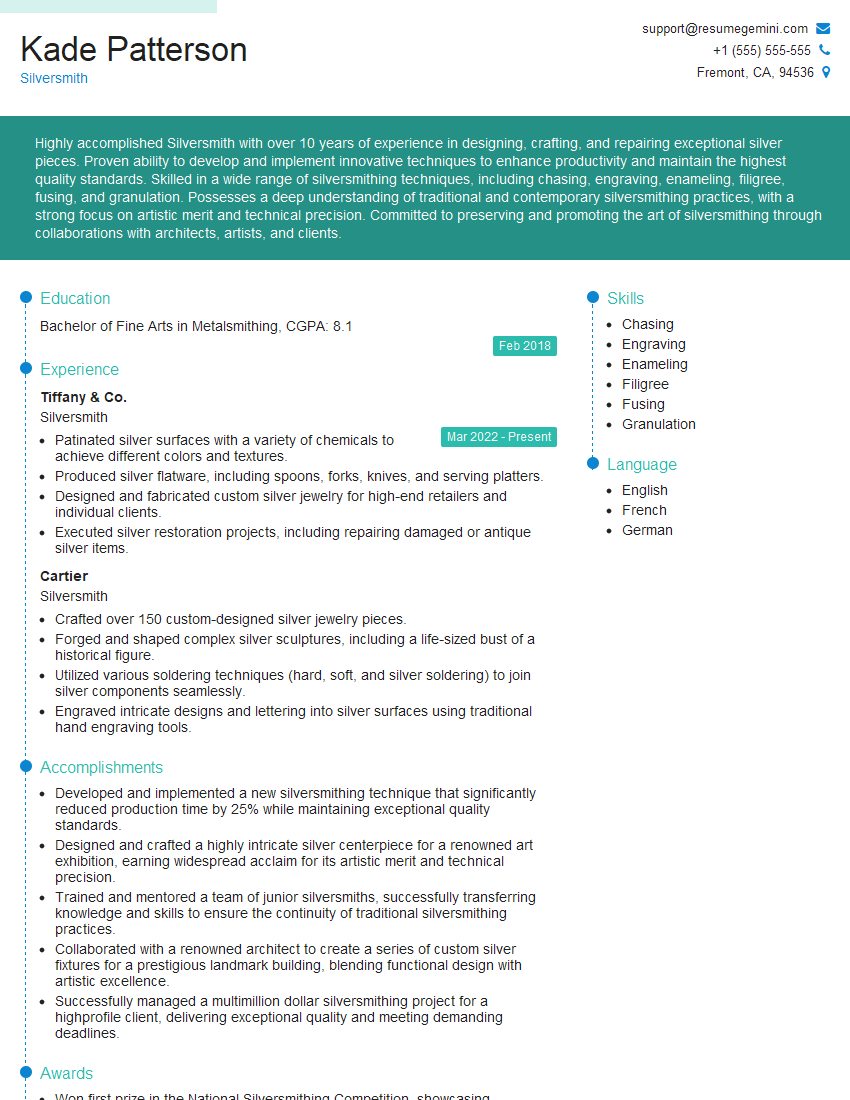
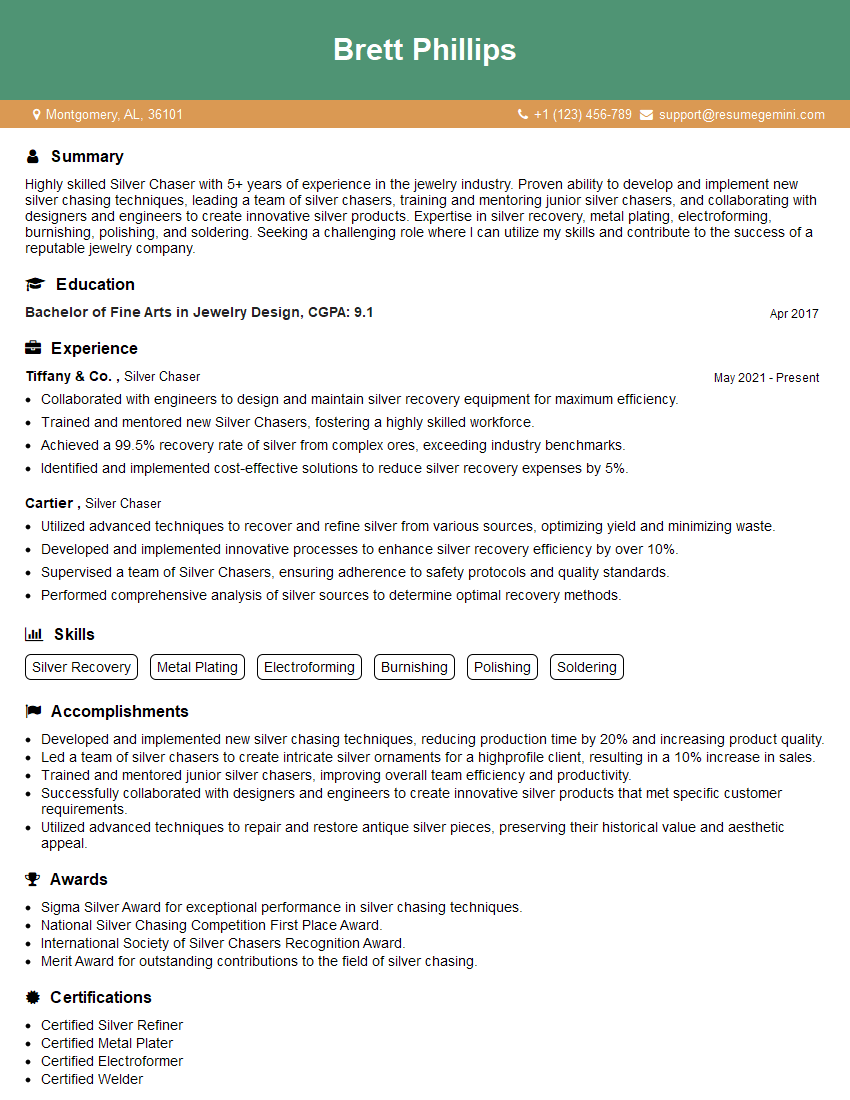
Mastering silversmithing opens doors to a rewarding career filled with creative expression and technical skill. To maximize your job prospects, crafting a strong, ATS-friendly resume is crucial. ResumeGemini is a trusted resource that can help you build a professional resume that highlights your unique skills and experience. They offer examples of resumes tailored specifically to the silversmithing field, giving you a head start in presenting your qualifications effectively. Invest time in creating a compelling resume – it’s your first impression and a key to unlocking your career potential.
Explore more articles
Users Rating of Our Blogs
Share Your Experience
We value your feedback! Please rate our content and share your thoughts (optional).
What Readers Say About Our Blog
Very informative content, great job.
good