Interviews are opportunities to demonstrate your expertise, and this guide is here to help you shine. Explore the essential Site Preparation and Land Reclamation interview questions that employers frequently ask, paired with strategies for crafting responses that set you apart from the competition.
Questions Asked in Site Preparation and Land Reclamation Interview
Q 1. Describe your experience with different site preparation methods.
Site preparation methods vary greatly depending on the project’s scope and the site’s existing conditions. My experience encompasses a wide range, from simple land clearing for residential projects to complex earthworks for large-scale infrastructure developments.
Clearing and Grubbing: This involves removing all vegetation, trees, and debris from the site. I’ve overseen projects where we used everything from hand tools for sensitive areas to heavy machinery like excavators and bulldozers for larger sites. For example, on a recent highway expansion project, we employed controlled blasting for particularly rocky terrain, ensuring the safety of both workers and the surrounding environment.
Grading and Excavation: This is the process of shaping the land to the required specifications. This might involve cut-and-fill operations, where excess earth from one area is used to fill another. My expertise includes managing the precise levelling needed for building foundations and creating appropriate slopes for drainage. For instance, on a large-scale housing development, we carefully graded the land to prevent water runoff and erosion.
Soil Stabilization: Weak or unstable soils often require stabilization before construction. I’ve worked extensively with methods like compaction, using heavy rollers to increase soil density, and soil improvement techniques involving the addition of binding agents or geosynthetics. One notable project involved stabilizing expansive clay soils using lime stabilization to prevent foundation settlement.
Blasting and Demolition: In cases where rocky outcrops or existing structures need to be removed, controlled blasting is a common method. My experience includes overseeing all aspects of blasting, from planning and permitting to execution and post-blast site cleanup, strictly adhering to safety regulations and environmental guidelines. This is often necessary in challenging terrain like mountainous regions.
Q 2. How do you ensure compliance with environmental regulations during site preparation?
Environmental compliance is paramount in site preparation. I meticulously ensure adherence to all relevant local, state, and federal regulations throughout each project. This starts with a thorough environmental assessment, identifying potential hazards and developing a comprehensive environmental management plan.
Permitting and Approvals: Obtaining all necessary permits before starting any work is crucial. This involves submitting detailed plans to the relevant authorities, including erosion and sediment control plans, hazardous materials management plans, and stormwater management plans.
Erosion and Sediment Control: Implementing measures like silt fences, straw bales, and vegetative buffers are critical to prevent soil erosion and runoff pollution. I regularly inspect these measures during construction to ensure their effectiveness.
Hazardous Waste Management: If hazardous materials are discovered (asbestos, lead paint, etc.), strict procedures must be followed for their safe removal and disposal. This includes proper containment, handling, and transportation to licensed facilities.
Stormwater Management: Effective stormwater management prevents pollution of local waterways. This might involve constructing retention ponds, installing sediment basins, or implementing best management practices for construction activities.
Air Quality Monitoring: For projects involving significant dust generation (e.g., demolition), air quality monitoring is often required to minimize impacts on the surrounding environment. I have experience overseeing such monitoring programs and implementing mitigation measures.
Regular audits and environmental inspections help maintain compliance throughout the project lifecycle.
Q 3. Explain your understanding of soil erosion and control measures.
Soil erosion is the detachment and movement of soil particles by water or wind. This is a significant concern during site preparation as it can lead to environmental damage, increased construction costs, and project delays. Understanding the factors contributing to erosion is vital for effective control.
Factors Affecting Erosion: Soil type, slope, rainfall intensity, vegetation cover, and construction activities all influence the rate of erosion. For example, steep slopes with bare soil are significantly more susceptible to erosion than flat areas with vegetation.
Control Measures: Effective erosion control strategies depend on the specific site conditions. Common measures include:
- Contouring: Shaping the land to follow natural contours minimizes runoff.
- Vegetative Stabilization: Planting vegetation helps bind the soil and reduce erosion. This could involve seeding, sodding, or planting shrubs.
- Mulching: Applying mulch provides a protective layer over the soil, reducing its exposure to wind and water.
- Erosion Control Blankets: These are fabric mats that stabilize the soil and help establish vegetation.
- Sediment Basins and Traps: These structures capture sediment before it reaches waterways.
- Diversion Ditches and Swales: These channels direct runoff away from sensitive areas.
Implementing these measures requires careful planning and ongoing monitoring to ensure their effectiveness throughout the construction process.
Q 4. What are the key considerations for selecting excavation equipment?
Selecting appropriate excavation equipment is crucial for efficiency, safety, and cost-effectiveness. Several factors guide this decision.
Soil Conditions: The type of soil significantly impacts the choice of equipment. Hard rock might require a rock breaker or specialized excavator, while softer soils are better suited to standard excavators or backhoes.
Project Scope: Large-scale projects might require heavy-duty excavators and bulldozers, while smaller jobs can be handled with smaller machines.
Accessibility: Site accessibility influences equipment size and maneuverability. Limited access might necessitate smaller, more compact machines.
Environmental Concerns: Considerations for minimizing noise and dust pollution can influence equipment choices. For instance, we may opt for electric or hybrid machines in environmentally sensitive areas.
Cost and Availability: Equipment rental costs and availability in the region must be factored in. Sometimes it’s more cost-effective to rent specialized equipment than to purchase it.
Careful consideration of these factors ensures the right equipment is selected for the job, optimizing productivity and reducing risks.
Q 5. How do you manage risks associated with hazardous materials on a site?
Managing hazardous materials is a critical aspect of site preparation. My approach involves a multi-stage process that prioritizes safety and compliance.
Pre-Construction Assessment: A thorough site assessment identifies potential hazards through historical records review, site investigation (including soil sampling), and interviews with previous occupants.
Hazard Identification and Characterization: This involves identifying the type and quantity of hazardous materials, assessing their potential risks, and determining the best approach for handling and disposal.
Safety Protocols: Strict safety protocols must be implemented, including proper personal protective equipment (PPE), worker training, and emergency response plans. We ensure compliance with OSHA and other relevant safety regulations.
Containment and Removal: Hazardous materials are safely contained and removed by licensed contractors with specialized expertise. This often involves careful excavation and transportation to approved disposal sites.
Documentation: Meticulous documentation is maintained throughout the process, including chain of custody for hazardous waste, sampling results, and worker training records.
Proactive hazard management minimizes risks to workers and the environment and ensures compliance with all relevant regulations.
Q 6. Describe your experience with land surveying and its role in site preparation.
Land surveying plays a vital role in accurate site preparation. It provides the foundational data needed for planning, design, and construction. My experience includes working closely with surveying teams to obtain high-precision data.
Topographic Surveys: These surveys create detailed maps showing the land’s elevation, contours, and existing features. This information is essential for determining cut and fill quantities, designing drainage systems, and establishing building foundations.
Boundary Surveys: These surveys accurately define the property lines, ensuring that construction stays within legal boundaries. This prevents potential disputes and legal complications.
As-Built Surveys: These surveys document the completed construction, verifying that it conforms to the original plans. They provide a permanent record of the project’s footprint.
Accurate surveying data reduces errors, minimizes delays, and contributes to a successful project. I regularly collaborate with surveyors throughout the project lifecycle to ensure data accuracy and alignment with construction activities.
Q 7. How do you develop and implement a site preparation plan?
Developing and implementing a site preparation plan is a systematic process involving several steps.
Project Scoping and Needs Assessment: This begins with a clear understanding of the project’s objectives, the site’s characteristics, and relevant regulations.
Site Investigation and Assessment: A thorough investigation involves topographic surveys, geotechnical investigations, and environmental assessments to understand site conditions.
Design and Planning: Based on the assessment, a detailed plan is created, specifying the required earthworks, drainage systems, erosion control measures, and environmental mitigation strategies. This often includes detailed drawings and specifications.
Permitting and Approvals: Securing all necessary permits and approvals from relevant authorities is crucial.
Equipment Selection and Resource Allocation: Appropriate equipment is selected, and resources (personnel, materials, time) are allocated to meet the project’s timeline and budget.
Implementation and Monitoring: The plan is implemented, with regular monitoring to ensure adherence to the schedule, budget, and safety standards. Any deviations from the plan are addressed promptly.
Documentation and Reporting: Detailed records are maintained throughout the process, including daily reports, site logs, and inspection reports.
A well-developed site preparation plan minimizes risks, maximizes efficiency, and ensures a successful project outcome. My experience demonstrates a proven ability to manage these processes successfully.
Q 8. What are the common challenges in land reclamation projects?
Land reclamation projects, while crucial for development, present numerous challenges. These can be broadly categorized into environmental, logistical, and regulatory hurdles.
- Environmental Challenges: These include dealing with contaminated soil and groundwater, managing erosion and sedimentation, and protecting sensitive ecosystems. For example, reclaiming a former industrial site might require extensive remediation of heavy metal contamination before construction can begin.
- Logistical Challenges: These involve factors like site accessibility, the availability of suitable fill material, and efficient waste management. Difficult terrain or remote locations can significantly increase costs and timelines. Imagine trying to transport large quantities of fill to a site only accessible by a narrow, winding road.
- Regulatory Challenges: Obtaining necessary permits and approvals from various government agencies can be a lengthy and complex process. Compliance with environmental regulations is crucial and often requires extensive environmental impact assessments.
Successfully navigating these challenges requires meticulous planning, a strong understanding of local regulations, and a proactive approach to risk management. A thorough site investigation is the cornerstone of any successful reclamation project.
Q 9. Explain your understanding of different soil types and their impact on site preparation.
Understanding soil types is paramount in site preparation. Different soils exhibit varying properties affecting their suitability for construction.
- Clay Soils: These are fine-grained soils with low permeability, making them challenging to work with. They can expand when wet and shrink when dry, leading to foundation instability. Drainage is a major concern.
- Sandy Soils: These are well-drained and easily compacted, making them suitable for many applications. However, they can be loose and prone to erosion if not properly managed.
- Silty Soils: These have intermediate properties between clay and sand. They are generally less problematic than clay but still require careful consideration.
- Organic Soils: These soils contain significant amounts of decomposed organic matter, often leading to high compressibility and instability. They require extensive treatment before construction, such as removal and replacement with more suitable material.
The impact on site preparation is significant. For instance, a foundation designed for sandy soil would be unsuitable for clay soil. Thorough soil testing is essential to determine appropriate foundation designs, drainage solutions, and earthworks strategies. Ignoring soil properties can lead to costly structural failures and project delays.
Q 10. How do you handle unexpected site conditions during a project?
Unexpected site conditions are an inevitable part of land reclamation. Our approach involves a multi-pronged strategy to mitigate their impact.
- Thorough Site Investigation: We perform detailed geotechnical investigations, including drilling and laboratory testing, to minimize surprises.
- Contingency Planning: We develop detailed contingency plans that address potential issues, like encountering unexpected bedrock or encountering buried utilities.
- Flexible Design: We adopt flexible design approaches that can adapt to changes without causing major delays.
- Open Communication: We maintain open communication with clients, regulatory agencies, and the construction team to ensure that any changes are managed effectively.
For example, if we unexpectedly find contaminated soil at a depth not initially revealed, we would immediately halt work, engage specialists for remediation, and adjust the project schedule and budget accordingly, ensuring all regulations are followed.
Q 11. Describe your experience with groundwater management during site preparation.
Groundwater management is critical, especially in low-lying areas or sites with high water tables. Neglecting this can lead to foundation instability, delays, and environmental damage.
- Lowering the Water Table: Techniques like well points or deep sump pumps are used to temporarily lower the water table, allowing for safe excavation.
- Drainage Systems: We design and install effective drainage systems to divert surface water and groundwater away from the construction site, preventing waterlogging.
- De-watering Plans: Detailed dewatering plans are developed that consider the impact on surrounding areas and comply with environmental regulations.
- Groundwater Monitoring: We monitor groundwater levels continuously to ensure that the dewatering operation doesn’t negatively impact the surrounding environment.
During one project, we encountered a higher-than-expected water table. Our pre-planned dewatering system, coupled with regular monitoring, successfully mitigated the issue, preventing any significant delays.
Q 12. How do you ensure the safety of workers on a construction site?
Worker safety is our top priority. We implement a comprehensive safety program that encompasses all aspects of the project.
- Site-Specific Risk Assessments: We perform detailed risk assessments to identify potential hazards and implement control measures.
- Safety Training: All workers receive comprehensive safety training before commencing work. This includes training on the use of personal protective equipment (PPE).
- Regular Safety Inspections: Regular site inspections are conducted to ensure compliance with safety regulations and identify any potential hazards.
- Emergency Response Plan: We establish a robust emergency response plan to deal with any incidents or accidents.
- Incident Reporting and Investigation: We have a clear system for reporting and investigating incidents to learn from mistakes and prevent future occurrences.
We also emphasize a safety-first culture, where every employee is empowered to halt work if they perceive a safety risk. This proactive approach has helped us maintain a strong safety record on all our projects.
Q 13. What are the key steps involved in the remediation of contaminated land?
Remediation of contaminated land is a complex process requiring specialized expertise. The key steps involve:
- Site Characterization: This involves conducting a thorough investigation to determine the extent and nature of contamination.
- Remediation Strategy Selection: Based on the site characterization, an appropriate remediation strategy is selected. This could involve excavation and removal of contaminated soil, bioremediation (using microorganisms to break down contaminants), or other in-situ techniques.
- Remediation Implementation: The chosen remediation strategy is implemented, often involving specialized contractors.
- Monitoring and Verification: Regular monitoring is conducted to verify that the remediation is effective and that cleanup goals are being met.
- Post-Remediation Monitoring: This involves long-term monitoring to ensure that the remediation remains effective and that there are no further releases of contaminants.
For example, if a site is contaminated with petroleum hydrocarbons, we might employ bioremediation techniques, using naturally occurring microbes to break down the contaminants, followed by close monitoring to confirm the effectiveness of the remediation process.
Q 14. How do you monitor and control the quality of work during site preparation?
Quality control is maintained through a multi-faceted approach, involving rigorous documentation, regular inspections, and adherence to quality standards.
- Quality Management System: We operate under a documented quality management system that outlines procedures for all aspects of the project.
- Regular Inspections: We conduct regular inspections of all work to ensure it meets the required specifications.
- Material Testing: We perform regular testing of materials to ensure they meet the required quality standards.
- Documentation: Detailed records are kept of all activities, including materials used, tests performed, and any deviations from the plan.
- Third-Party Audits: In some cases, we engage third-party auditors to verify the quality of our work and ensure compliance with relevant standards.
Using digital tools for recording inspection data and material certifications helps improve data transparency and helps in tracking progress, further enhancing the quality control process. This rigorous approach helps to minimize errors and ensures that the final product meets the required specifications.
Q 15. Explain your experience with different types of landfilling and disposal methods.
My experience encompasses various landfilling and disposal methods, each tailored to specific waste types and environmental considerations. We’re talking about everything from traditional sanitary landfills, which involve carefully layering waste with soil and compacting it to minimize environmental impact, to more specialized techniques.
Sanitary Landfills: These are the most common, employing liners and leachate collection systems to prevent groundwater contamination. I’ve overseen projects involving the design and construction of these landfills, ensuring compliance with all relevant regulations.
Secure Landfills: These are designed for hazardous waste, demanding stricter containment measures, including multiple liners, monitoring wells, and robust gas management systems. I’ve managed projects involving the remediation of existing sites before converting them into secure landfills, ensuring a safe and compliant operation.
Incineration: While controversial, incineration offers waste volume reduction and energy recovery. My experience includes assessing the feasibility of incineration projects, considering factors like air emission control and ash disposal.
Composting and Anaerobic Digestion: These biological processes offer sustainable waste management solutions for organic materials. I’ve worked on projects integrating these methods into larger site preparation plans, reducing landfill reliance and promoting resource recovery.
Choosing the right method requires a thorough site assessment, waste characterization, and regulatory review. For example, on one project, a former industrial site with contaminated soil required a phased approach: initial remediation followed by the construction of a secure landfill to handle the hazardous waste generated during the cleanup process.
Career Expert Tips:
- Ace those interviews! Prepare effectively by reviewing the Top 50 Most Common Interview Questions on ResumeGemini.
- Navigate your job search with confidence! Explore a wide range of Career Tips on ResumeGemini. Learn about common challenges and recommendations to overcome them.
- Craft the perfect resume! Master the Art of Resume Writing with ResumeGemini’s guide. Showcase your unique qualifications and achievements effectively.
- Don’t miss out on holiday savings! Build your dream resume with ResumeGemini’s ATS optimized templates.
Q 16. How do you manage project timelines and budgets effectively?
Effective project management hinges on meticulous planning and proactive monitoring. I utilize project management software to track progress, manage tasks, and allocate resources. For timelines, I employ critical path method (CPM) analysis to identify critical tasks and potential delays. This allows for proactive mitigation strategies.
Budget management involves detailed cost estimations, regular cost tracking against the budget, and contingency planning for unforeseen expenses. I use Earned Value Management (EVM) to monitor the project’s performance, comparing planned vs. actual costs and schedule. For example, on a large-scale land reclamation project, we identified a potential delay due to unforeseen weather conditions. By utilizing the CPM analysis, we were able to adjust the schedule accordingly and prevent significant cost overruns. Regular stakeholder meetings ensured transparency and collaboration, preventing further complications.
Example: A simplified CPM schedule can be represented using a Gantt chart, visually illustrating task dependencies and durations.Q 17. Describe your experience with working with various stakeholders (clients, contractors, etc.)
Collaboration is key to successful project delivery. I’ve worked with a wide range of stakeholders, including clients, contractors, regulatory agencies, and community representatives. Effective communication is paramount. I employ regular meetings, clear documentation, and transparent reporting to ensure everyone is informed and aligned.
Building strong relationships with contractors is crucial for ensuring timely and high-quality work. I focus on selecting qualified contractors, clearly defining expectations, and fostering a collaborative spirit. For example, on a challenging site remediation project, open communication with the contractor allowed us to identify and solve unexpected geological challenges swiftly, preventing project delays. Regular communication with clients keeps them informed about project progress and addresses any concerns promptly.
Q 18. What is your experience with permitting and regulatory compliance?
Navigating the permitting and regulatory landscape is a critical aspect of site preparation and land reclamation. My experience includes working with various agencies, including environmental protection agencies, departments of transportation, and local planning authorities. I’m proficient in preparing and submitting permit applications, ensuring compliance with all relevant regulations, and managing the environmental review process.
Understanding and complying with regulations such as the Clean Water Act, the Resource Conservation and Recovery Act (RCRA), and state-specific environmental regulations is essential. I’ve been involved in several projects requiring detailed environmental impact assessments (EIAs), navigating the permitting process, and securing necessary approvals. One specific example involved working with a local community group to address concerns about a proposed landfill’s impact on their water supply, ensuring both environmental protection and public approval before obtaining permits.
Q 19. How do you use technology (e.g., GIS, CAD) to support site preparation?
Technology plays a significant role in optimizing site preparation. I’m proficient in using GIS (Geographic Information Systems) for site analysis, mapping, and data management. GIS allows for the visualization of site conditions, identification of potential environmental hazards, and efficient planning of construction activities. For example, GIS helps determine optimal routes for excavation and transportation, minimizing environmental impact.
CAD (Computer-Aided Design) software is essential for creating detailed site plans, drawings, and models. This ensures accuracy and facilitates effective communication among stakeholders. In one project, CAD helped to precisely model the terrain and design a drainage system that minimized erosion and water runoff. The integration of GIS and CAD allows for seamless data transfer and analysis, ensuring a highly efficient and accurate project workflow.
Q 20. How do you address conflicts between environmental protection and project objectives?
Balancing environmental protection and project objectives often requires innovative solutions and collaborative decision-making. Identifying and prioritizing potential environmental impacts early in the planning phase is crucial. I engage in thorough environmental assessments to identify sensitive areas and potential conflicts. Then we develop mitigation strategies that minimize negative impacts while still meeting project goals.
This might involve selecting alternative construction techniques that reduce habitat disturbance, implementing water quality control measures to protect streams and wetlands, or adopting sustainable materials to reduce waste. A good example involves a project where we had to navigate the construction of a highway through a sensitive bird habitat. Working with environmental specialists, we devised a plan that included constructing the highway outside the breeding season, implementing erosion control measures, and creating a wildlife corridor to mitigate habitat fragmentation.
Q 21. Describe your experience with the remediation of different types of contaminants.
My experience in contaminant remediation includes addressing various pollutants, such as heavy metals, petroleum hydrocarbons, and chlorinated solvents. Remediation strategies vary depending on the type and extent of contamination, as well as site-specific factors like soil type and groundwater flow.
Excavation and Disposal: For highly contaminated areas, excavation and disposal in a licensed hazardous waste facility may be necessary.
Bioremediation: Using microorganisms to break down contaminants, a cost-effective and environmentally friendly approach suitable for certain pollutants.
Pump and Treat: This method extracts contaminated groundwater and treats it above ground before returning it to the aquifer.
Soil Vapor Extraction (SVE): This removes volatile organic compounds from soil using vacuum extraction.
For example, one project involved the remediation of a site contaminated with petroleum hydrocarbons. We employed a combination of excavation and bioremediation, achieving a successful cleanup while minimizing environmental impact and costs. Each project demands a tailored remediation strategy, which requires a thorough site assessment, risk assessment, and regulatory compliance.
Q 22. What are your strategies for effective communication and reporting during projects?
Effective communication and reporting are paramount to successful site preparation and land reclamation projects. My strategy involves a multi-faceted approach focusing on clarity, transparency, and proactive engagement. I initiate the process with clearly defined roles and responsibilities for all stakeholders. Regular meetings, both formal and informal, are crucial for keeping everyone updated on progress, challenges, and potential solutions. I utilize various communication tools, including email, project management software, and even daily site briefings, depending on the project’s scale and complexity. Reporting follows a standardized format, incorporating key performance indicators (KPIs) such as progress against schedule, budget adherence, and safety records. Visual aids such as maps, charts, and photos are integrated into reports to enhance understanding. Furthermore, I always encourage open dialogue and feedback to ensure everyone feels heard and informed, thus preventing misunderstandings and fostering collaboration.
For instance, on a recent highway construction project, daily site reports were crucial in identifying a potential delay due to unexpected bedrock. This allowed us to proactively adjust the work schedule and minimize project disruption. The detailed visual reporting also helped stakeholders understand the issue and accept the proposed solution.
Q 23. How do you ensure sustainable practices during site preparation and land reclamation?
Sustainability is integral to my approach to site preparation and land reclamation. It’s not just about minimizing environmental impact; it’s about creating lasting positive change. My strategies include careful consideration of resource management—minimizing waste generation through efficient material usage and recycling, and employing responsible sourcing practices. We implement erosion and sediment control measures throughout the project lifecycle, utilizing techniques like vegetative buffers, silt fences, and check dams to prevent soil erosion and water contamination. Water management is also crucial. This involves minimizing water usage through efficient irrigation techniques, and using rainwater harvesting where feasible. Furthermore, we strive to protect and enhance biodiversity through habitat restoration and careful planning to avoid disrupting existing ecosystems. Post-reclamation, we monitor the site to ensure the long-term viability of our sustainable practices.
For example, on a brownfield remediation project, we reused excavated soil on-site, reducing transportation costs and minimizing the environmental footprint of the project. We also incorporated native plant species in the landscaping, promoting biodiversity and enhancing the aesthetic appeal of the reclaimed land.
Q 24. Describe a challenging site preparation project and how you overcame the challenges.
One challenging project involved reclaiming a former industrial site heavily contaminated with heavy metals. The initial assessment revealed significantly higher levels of contamination than initially projected, requiring a revised remediation plan. The original plan was based on a less extensive cleanup, but the high levels of contamination meant we needed a more aggressive approach, including soil excavation and off-site treatment. This led to budget overruns and schedule delays. To overcome these challenges, we collaborated closely with regulatory agencies to obtain the necessary permits for the modified plan. We also implemented a phased approach, prioritizing the areas with the highest levels of contamination first. This allowed us to demonstrate progress and secure additional funding. Finally, the project team worked diligently to optimize the remediation process, minimizing waste generation and improving efficiency. Regular communication with stakeholders was crucial in maintaining trust and transparency throughout the process. Ultimately, the project was completed successfully, exceeding the regulatory requirements and creating a safe and usable space.
Q 25. How do you evaluate the success of a land reclamation project?
Evaluating the success of a land reclamation project goes beyond simply completing the planned activities. It involves a holistic assessment measuring several key indicators. Firstly, we assess the environmental impact, comparing pre- and post-reclamation data on soil quality, water quality, and biodiversity. We examine whether the project has achieved its ecological goals, such as habitat restoration or improved water filtration. Secondly, we evaluate the project’s economic viability, assessing the cost-effectiveness of the remediation methods and considering long-term maintenance costs. Thirdly, we assess social acceptance, evaluating the project’s impact on the local community and ensuring the reclaimed land serves its intended purpose and benefits the community. Finally, we review the project’s adherence to regulatory requirements and any long-term monitoring data to assess the sustainability of the outcome. A successful project demonstrates ecological recovery, economic feasibility, and social acceptance over the long term.
Q 26. What are the key factors to consider when designing a land reclamation plan?
Designing a land reclamation plan requires careful consideration of several key factors. Firstly, a thorough site assessment is crucial to understand the existing conditions, including soil type, topography, hydrology, and contamination levels. This assessment informs the choice of reclamation techniques and helps determine the feasibility and cost of the project. Secondly, defining clear objectives and goals is essential. This might include restoring the land to its natural state, creating a new habitat, or developing it for specific uses such as housing or agriculture. Thirdly, the design should incorporate sustainable practices, minimizing environmental impacts and ensuring the long-term viability of the reclaimed land. This includes selecting appropriate erosion and sediment control methods, implementing water management strategies, and promoting biodiversity. Finally, regulatory compliance is paramount, and the plan must adhere to all relevant environmental and land-use regulations. A well-designed plan balances ecological restoration, economic viability, and regulatory compliance.
Q 27. Explain your understanding of different types of erosion control techniques.
Erosion control techniques are diverse, chosen based on the site conditions and the desired outcome. Vegetative methods are commonly used and involve planting vegetation to stabilize the soil. This can include seeding native grasses, planting shrubs, or establishing trees, depending on the site’s characteristics and climate. Structural methods involve the use of physical barriers to control erosion. These include silt fences, check dams, and retaining walls. They are often used in conjunction with vegetative methods. Biotechnical methods combine vegetative and structural approaches, for example, using live staking to stabilize slopes. Other techniques involve the use of geotextiles or other engineered materials to protect the soil and prevent erosion. The selection of appropriate methods depends on several factors, including slope stability, soil type, rainfall patterns, and the overall project objectives. A combination of methods is often employed to ensure effective erosion control. For example, in a steep slope reclamation project, a combination of retaining walls, check dams, and vegetative stabilization would be the most appropriate approach.
Q 28. How do you ensure long-term stability of reclaimed land?
Ensuring the long-term stability of reclaimed land requires a comprehensive approach that goes beyond the initial reclamation activities. Post-reclamation monitoring is crucial to assess the effectiveness of the implemented measures and identify any potential issues. This monitoring involves regular inspections of the site to check for signs of erosion, subsidence, or other instability. Appropriate maintenance is essential for the long-term success of the project. This may involve ongoing vegetation management, repairs to erosion control structures, and periodic inspections to address any issues that arise. Careful selection of plant species that are well-suited to the local climate and soil conditions is crucial for long-term vegetative stability. Long-term monitoring data can then be used to inform future maintenance strategies and ensure the sustained success of the land reclamation project. For example, a post-reclamation monitoring program might include regular soil testing to assess its stability and nutrient content, informing the ongoing vegetation management plan.
Key Topics to Learn for Site Preparation and Land Reclamation Interview
- Site Analysis and Assessment: Understanding soil composition, topography, drainage patterns, and environmental considerations. Practical application: Interpreting site survey data to develop a safe and efficient work plan.
- Clearing and Grubbing: Techniques for removing vegetation, debris, and unsuitable materials. Practical application: Selecting appropriate machinery and methods based on site conditions and environmental regulations.
- Grading and Excavation: Principles of earthmoving, cut and fill calculations, and slope stability. Practical application: Designing and implementing effective grading strategies to meet project specifications.
- Drainage Systems: Designing and installing effective drainage solutions (e.g., ditches, culverts, swales) to manage water runoff and prevent erosion. Practical application: Calculating drainage capacity and selecting appropriate materials.
- Erosion and Sediment Control: Implementing best management practices (BMPs) to minimize environmental impact. Practical application: Using silt fences, straw bales, and other erosion control measures effectively.
- Land Reclamation Techniques: Restoring disturbed land to its natural state or for beneficial reuse. Practical application: Choosing appropriate revegetation methods and monitoring soil health.
- Safety Regulations and Compliance: Understanding and adhering to OSHA and other relevant safety regulations. Practical application: Implementing safety protocols on site and managing potential hazards.
- Project Management and Cost Estimation: Developing project timelines, budgets, and resource allocation strategies. Practical application: Tracking project progress and managing potential cost overruns.
Next Steps
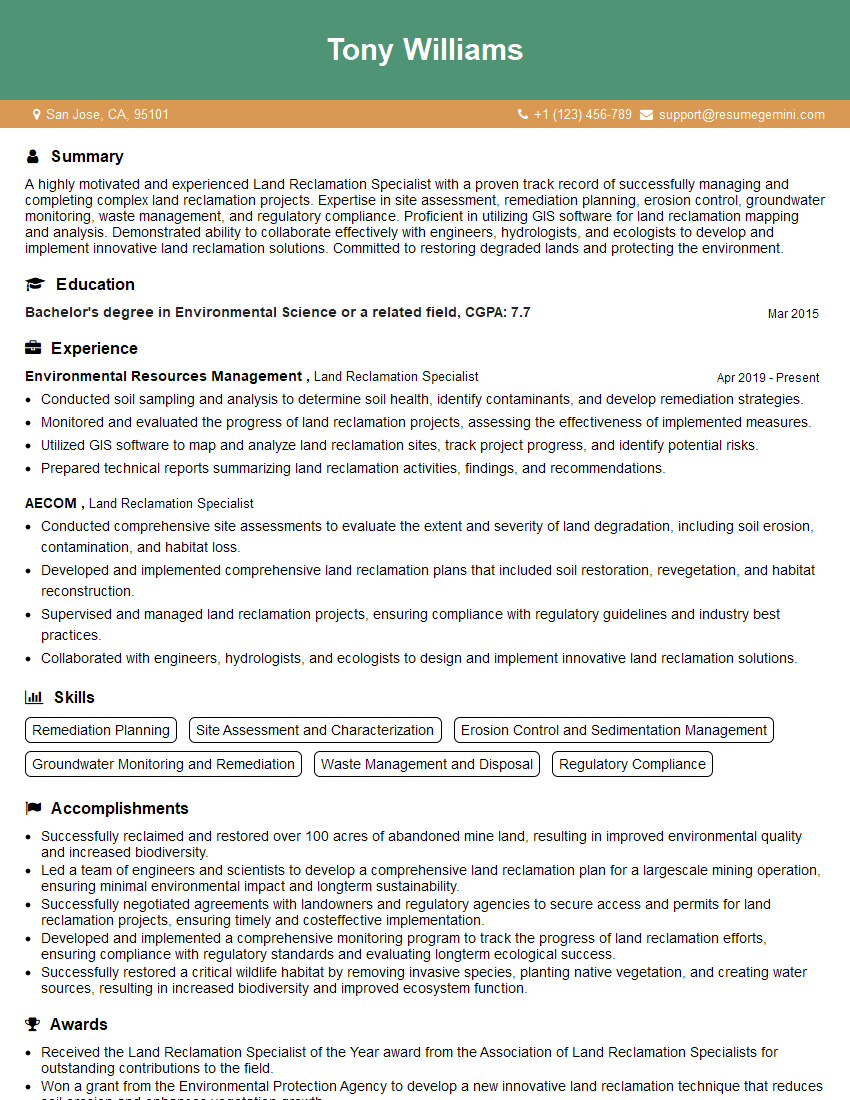
Mastering Site Preparation and Land Reclamation opens doors to exciting career opportunities and professional growth within the construction, environmental, and engineering sectors. A strong understanding of these principles is highly valued by employers. To maximize your job prospects, focus on building an ATS-friendly resume that highlights your skills and experience effectively. ResumeGemini is a trusted resource that can help you craft a professional and impactful resume. They provide examples of resumes tailored specifically to Site Preparation and Land Reclamation to help guide your process.
Explore more articles
Users Rating of Our Blogs
Share Your Experience
We value your feedback! Please rate our content and share your thoughts (optional).
What Readers Say About Our Blog
Very informative content, great job.
good