The thought of an interview can be nerve-wracking, but the right preparation can make all the difference. Explore this comprehensive guide to Solar Photovoltaics interview questions and gain the confidence you need to showcase your abilities and secure the role.
Questions Asked in Solar Photovoltaics Interview
Q 1. Explain the difference between monocrystalline, polycrystalline, and thin-film solar cells.
The main difference between monocrystalline, polycrystalline, and thin-film solar cells lies in their silicon structure and manufacturing process, which directly impacts their efficiency and cost.
- Monocrystalline silicon: These cells are made from a single, large silicon crystal, resulting in a uniform structure. Think of it like a perfectly clear, flawless diamond. This uniformity allows for high efficiency (typically 18-22%), but they are also the most expensive to produce due to the energy-intensive process of growing large, single crystals.
- Polycrystalline silicon: These cells are made from multiple silicon crystals melted and solidified together. Imagine a mosaic made of smaller, differently-oriented pieces of glass. This results in a slightly less efficient cell (typically 15-17%) than monocrystalline, but the production process is simpler and less energy-intensive, making them more cost-effective.
- Thin-film solar cells: Unlike the crystalline silicon types, thin-film cells are made by depositing a thin layer of photovoltaic material (such as cadmium telluride, copper indium gallium selenide (CIGS), or amorphous silicon) onto a substrate. They are very flexible and lightweight, allowing for diverse application scenarios like integration into building materials. Their efficiency is typically lower (8-13%), but they are also the most cost-effective and can be produced on large-scale, flexible substrates.
In summary, monocrystalline cells offer the highest efficiency but come at a premium price. Polycrystalline cells offer a good balance between cost and efficiency, while thin-film cells are best suited for applications where flexibility and low cost are paramount.
Q 2. Describe the process of photovoltaic energy conversion.
Photovoltaic energy conversion is the process of converting sunlight directly into electricity. It relies on the photovoltaic effect, where photons (light particles) from sunlight strike a semiconductor material (typically silicon), exciting electrons in the material. These excited electrons then flow through an external circuit, generating a direct current (DC) electricity.
Here’s a breakdown of the process:
- Sunlight Absorption: Photons in sunlight are absorbed by the semiconductor material in the solar cell.
- Electron Excitation: The absorbed photons transfer their energy to electrons in the semiconductor, causing them to break free from their atoms.
- Charge Separation: The solar cell is structured with a p-n junction (a boundary between a positively doped and a negatively doped semiconductor region). This junction creates an electric field that separates the excited electrons from the positively charged ‘holes’ they left behind.
- Current Generation: The separated electrons and holes move in opposite directions, creating an electric current within the solar cell.
- Energy Output: The electric current flows through an external circuit, powering electrical devices. The DC electricity produced by the solar cell is then typically converted to alternating current (AC) by an inverter for use in homes and businesses.
Think of it like a water pump: sunlight provides the energy to lift electrons (water) to a higher energy level, and they flow down through the circuit (pipeline) generating electricity (water power).
Q 3. What are the key components of a solar PV system?
A typical solar PV system comprises several key components working in synergy to generate and deliver electricity.
- Solar Panels (Photovoltaic Modules): These are the heart of the system, comprising numerous solar cells connected in series and parallel to produce a desired voltage and current output.
- Inverters: These devices convert the DC electricity generated by the solar panels into AC electricity compatible with household appliances and the power grid.
- Mounting System: A robust structure that securely attaches the solar panels to the roof or ground, ensuring optimal sun exposure and structural integrity.
- Wiring and Conduits: These components connect the solar panels, inverter, and other system components, safely and efficiently channeling the electricity.
- Disconnects: Safety switches that allow for quick isolation of sections of the system for maintenance or emergency situations.
- Meters and Monitoring Systems: These devices measure the energy generated, consumed, and fed back to the grid (if applicable).
- Batteries (optional): These store excess energy generated during peak sunlight hours, providing power during periods of low sunlight or at night. This is crucial for off-grid systems.
Each component plays a critical role in ensuring the system’s efficient and reliable performance. Improper selection or installation of any component can drastically impact the overall system’s effectiveness.
Q 4. How do you calculate the energy output of a solar PV system?
Calculating the energy output of a solar PV system involves considering various factors to arrive at a realistic estimate.
The basic formula is:
Energy Output (kWh/year) = System Size (kWp) x Peak Sun Hours (hours/day) x Days in Year x Derate FactorLet’s break down each component:
- System Size (kWp): This refers to the total power output of the solar panels under standard test conditions (STC), usually expressed in kilowatts peak (kWp).
- Peak Sun Hours (hours/day): This represents the average number of hours per day when the solar panels receive peak sunlight intensity. This value varies significantly based on geographical location and time of year. You can find this data from online solar irradiance maps or weather data.
- Days in Year: This is simply 365 days (or 366 in a leap year).
- Derate Factor: This factor accounts for various losses in the system, such as those due to temperature, shading, soiling, wiring losses, and inverter efficiency. A typical derate factor ranges from 0.75 to 0.85.
Example: A 5 kWp system in a location with 4 peak sun hours per day, using a derate factor of 0.8, would produce approximately:
5 kWp x 4 hours/day x 365 days/year x 0.8 = 5840 kWh/yearIt’s crucial to remember that this is just an estimation. Actual energy output can vary based on weather patterns, system maintenance, and other unforeseen factors.
Q 5. Explain the concept of maximum power point tracking (MPPT).
Maximum Power Point Tracking (MPPT) is a crucial technique used in solar PV systems to maximize the energy harvested from solar panels. Solar panels don’t produce constant power throughout the day; their output varies with changes in sunlight intensity and temperature. The MPPT algorithm continuously monitors the voltage and current produced by the panels and adjusts the operating point to extract the maximum possible power at any given moment.
Think of it like this: imagine you’re trying to fill a bucket with water from a stream. The stream’s flow (power) varies depending on rain and time of day. MPPT is like having a smart valve that constantly adjusts the flow rate to fill your bucket (get maximum power) as quickly as possible, regardless of the stream’s changing flow.
Without MPPT, the solar panel may not operate at its peak efficiency, leading to reduced energy output. MPPT algorithms are implemented in solar inverters or charge controllers. They use various techniques, such as Perturb and Observe or Incremental Conductance, to find and maintain the maximum power point.
Q 6. What are the different types of inverters used in solar PV systems?
Several types of inverters are used in solar PV systems, each with its own advantages and disadvantages:
- String Inverters: These are the most common and cost-effective type. They connect multiple solar panels in series (a string) and convert the DC electricity from that string to AC. Simple design, but a single fault can affect the whole string.
- Microinverters: Each panel has its own microinverter, converting DC to AC individually. This increases reliability (a single panel failure doesn’t impact the others) and optimizes energy production, especially in situations with partial shading. Higher initial cost.
- Power Optimizers: These devices are placed between the solar panel and the inverter. They maximize the energy output of each panel independently, similar to microinverters but without the DC-to-AC conversion at the panel level. They improve energy production in partially shaded conditions and can reduce the impact of shading on the overall system.
- Central Inverters: These are large inverters that handle the entire solar array. They are cost-effective for large-scale systems but require a complex wiring design. Any fault can take the whole system down.
The choice of inverter depends heavily on the system size, budget, and specific needs. Microinverters and power optimizers offer enhanced performance and reliability but at a higher cost, while string inverters are a more budget-friendly option for simpler systems.
Q 7. Describe the process of sizing a solar PV system for a residential application.
Sizing a residential solar PV system involves a careful assessment of energy consumption and sunlight availability. The goal is to design a system that meets the household’s energy needs while optimizing cost-effectiveness.
- Assess Energy Consumption: Analyze the household’s electricity bills over the past year to determine the average monthly and annual energy consumption in kilowatt-hours (kWh).
- Determine Energy Needs: Consider future energy needs, such as the addition of electric vehicles or appliances. Factor in any energy efficiency improvements planned for the home.
- Estimate Solar Production: Use online solar calculators or consult with a solar professional to estimate the potential solar energy generation based on the home’s location, roof orientation, shading, and available sunlight hours. These tools often require information about roof area and panel efficiency.
- Select System Size: Based on the energy consumption and solar production estimates, determine the appropriate system size in kWp. The system size should ideally cover the household’s energy needs with a small margin for future growth.
- Choose Components: Select appropriate solar panels, inverters, mounting system, and other components based on the system size, budget, and specific requirements. Consider the efficiency, reliability, and warranty of each component.
- Seek Professional Consultation: Consult with a qualified solar installer to perform a site assessment, verify calculations, ensure code compliance, and design a safe and efficient system. They will address factors not easily quantifiable, such as shading analysis and optimal placement.
Remember, accurate system sizing is critical to optimize energy production and return on investment. A system that’s too small might not meet energy needs, while one that’s too large may be unnecessarily expensive.
Q 8. Explain the importance of grounding in a solar PV system.
Grounding in a solar PV system is crucial for safety and performance. It provides a low-resistance path for fault currents to flow directly to earth, preventing dangerous voltage buildup on the system components and protecting against electrical shocks. Think of it as a safety valve for electricity. Without grounding, a fault could lead to equipment damage, electrical fires, and serious injury or even death.
The grounding system typically connects the metallic frames of solar panels, the racking system, the inverter, and other metal components to a ground rod driven deep into the earth. This creates a continuous path for any stray electrical current to safely dissipate into the ground. Proper grounding is mandated by electrical codes and is a critical part of any solar installation.
Q 9. What are some common safety hazards associated with working on solar PV systems?
Working on solar PV systems presents several safety hazards. The most significant is the risk of electric shock. Solar panels, even when not directly connected to the grid, can still hold a dangerous charge, especially during bright sunlight. Another hazard is working at heights, as solar panels are often installed on rooftops. Falls from roofs are a major safety concern. Furthermore, ultraviolet (UV) radiation from sunlight can cause skin damage, so appropriate protective gear is vital. Lastly, handling sharp-edged metal components during installation and maintenance poses a risk of cuts and abrasions.
To mitigate these risks, always de-energize the system before working on it, use proper personal protective equipment (PPE) including insulated gloves, safety glasses, and fall protection equipment, and follow all relevant safety protocols and local regulations.
Q 10. How do you troubleshoot a malfunctioning solar PV system?
Troubleshooting a malfunctioning solar PV system requires a systematic approach. First, you’ll want to visually inspect the entire system, checking for any obvious signs of damage to panels, wiring, or connectors. This is your first line of defense. Then, you’ll use specialized equipment such as multimeters to measure voltage, current, and resistance at various points in the system. This helps identify where the fault lies.
A common problem is shading on the panels. Even a small shadow can significantly reduce the output of an entire string of panels. Another common issue is faulty connectors, which can be identified using a multimeter to check continuity. Inverter problems are also relatively frequent. Monitoring the inverter’s display for error codes can often pinpoint the issue. Finally, using data logging tools and software can provide valuable insights into the system’s performance over time, helping to identify intermittent problems.
The troubleshooting process usually involves a combination of visual inspection, electrical measurements, and data analysis to pinpoint the source of the malfunction.
Q 11. What are the different types of solar panel mounting systems?
Solar panel mounting systems are broadly categorized into several types, each suited to different roof types and ground conditions:
- Roof-mounted systems: These are the most common and can be further classified into:
- Racking systems: These use metal frames and rails to securely attach panels to the roof.
- Tile-integrated systems: Panels are integrated into the roofing tiles themselves, providing a sleek aesthetic.
- Ballasted systems: Panels are mounted on a framework that is weighted down with ballast, eliminating the need for penetration.
- Ground-mounted systems: Panels are installed on the ground using various structures including:
- Fixed-tilt mounts: Panels are set at a fixed angle to optimize sunlight capture.
- Single-axis trackers: Systems that rotate the panels along a single axis (usually east-west) to follow the sun throughout the day.
- Dual-axis trackers: More sophisticated systems that rotate the panels on two axes for optimal sunlight capture throughout the day.
The choice of mounting system depends on factors such as roof type, structural integrity, available space, budget, and aesthetic considerations. Professional installers must consider all of these aspects before selecting the appropriate system.
Q 12. Explain the concept of net metering.
Net metering is a billing mechanism that allows solar PV system owners to sell excess electricity generated by their system back to the grid. Imagine you generate more power than you consume during the day; your meter runs backward, crediting you for the excess electricity. This credit is then applied to your bill during periods when you draw power from the grid. For instance, at night.
In essence, net metering incentivizes the adoption of renewable energy by enabling homeowners and businesses to offset their electricity costs and potentially even receive payments for excess power. The specifics of net metering policies vary by location, but it’s a crucial mechanism for promoting solar energy adoption.
Q 13. What are the environmental impacts of solar PV energy production?
Solar PV energy production has a relatively low environmental impact compared to fossil fuels. It significantly reduces greenhouse gas emissions by replacing electricity generated from coal, natural gas, and oil. However, it’s not entirely without environmental consequences.
The manufacturing of solar panels requires energy and resources, and some materials used in panel production can be toxic. Proper disposal and recycling of end-of-life panels are essential to minimizing this impact. Also, land use is a concern for large-scale solar farms, although this is often offset by the benefits of reduced carbon emissions. Some concerns have been raised around potential habitat disruption in areas where solar farms are constructed. Finally, the extraction of materials like silicon, essential for manufacturing panels, requires energy and can have associated environmental impacts.
Overall, the life-cycle assessment of solar PV systems highlights a net positive environmental impact, but responsible manufacturing practices and proper end-of-life management are critical for minimizing any negative consequences.
Q 14. Describe the lifecycle of a solar panel.
The lifecycle of a solar panel can be divided into several stages:
- Manufacturing: This involves the extraction of raw materials, manufacturing of components, and assembly of the panel. This stage has associated energy consumption and waste generation.
- Installation and Operation: The panel is installed on a roof or ground-mounted system and generates electricity for 25-30 years or longer.
- Decommissioning and Recycling: At the end of its operational life, the panel is removed and its components are recycled to recover valuable materials and minimize waste. Recycling rates are increasing as technology and recycling infrastructure improve.
While the operational phase is environmentally friendly, minimizing the environmental impact of the manufacturing and end-of-life stages is crucial for maximizing the overall sustainability of solar energy.
Q 15. What is the difference between DC and AC power?
Direct Current (DC) and Alternating Current (AC) are two fundamental types of electrical power. Think of it like water flowing in a pipe: DC is like a steady stream flowing in one direction, while AC is like a wave that oscillates back and forth.
In a solar PV system, the photovoltaic cells generate DC electricity. This DC power needs to be converted into AC power, which is what our homes and businesses typically use, using an inverter. AC power allows for easier and more efficient transmission over long distances compared to DC.
- DC: Direct Current; flows in one direction consistently. Batteries produce DC power.
- AC: Alternating Current; periodically reverses direction. This is the power from your wall outlet.
Understanding this difference is critical for designing and installing a solar PV system, as it dictates the necessary components and configurations.
Career Expert Tips:
- Ace those interviews! Prepare effectively by reviewing the Top 50 Most Common Interview Questions on ResumeGemini.
- Navigate your job search with confidence! Explore a wide range of Career Tips on ResumeGemini. Learn about common challenges and recommendations to overcome them.
- Craft the perfect resume! Master the Art of Resume Writing with ResumeGemini’s guide. Showcase your unique qualifications and achievements effectively.
- Don’t miss out on holiday savings! Build your dream resume with ResumeGemini’s ATS optimized templates.
Q 16. How do you calculate the array current and voltage?
Calculating array current and voltage is fundamental to sizing a PV system. The array voltage is the sum of the individual module voltages in series, while the array current is the same as the current of each module connected in series. The key is understanding the series and parallel connections of PV modules.
Example: Let’s say you have 10 modules, each with an open-circuit voltage of 36V and a short-circuit current of 9A. If you connect them in a series, the total array voltage is 10 * 36V = 360V, and the array current remains 9A. If you connect them in parallel, the voltage remains 36V, and the current increases to 10 * 9A = 90A. More complex setups involve series-parallel configurations to optimize voltage and current for the inverter.
For practical calculation, you need to consider:
- Module specifications: Obtain open-circuit voltage (Voc), short-circuit current (Isc), maximum power voltage (Vmp), and maximum power current (Imp) from the module’s datasheet.
- String configuration: Determine the number of modules in series (string voltage) and the number of strings in parallel (string current).
- Inverter compatibility: Ensure your inverter’s input voltage and current ranges match the array voltage and current.
Always refer to the specific module and inverter datasheets for precise calculations. Software tools significantly simplify these calculations.
Q 17. Explain the concept of solar irradiance and its impact on PV system performance.
Solar irradiance refers to the amount of solar radiation (sunlight) that strikes a surface area per unit time. Think of it as the intensity of the sun’s energy reaching your solar panels. It’s measured in watts per square meter (W/m²).
Solar irradiance significantly impacts PV system performance because it directly affects the power output of the solar panels. Higher irradiance leads to higher power generation, while lower irradiance reduces output. Other factors like temperature and shading also influence the overall system efficiency, but irradiance is the primary driver.
For example, on a bright sunny day with high irradiance, a solar panel will produce considerably more electricity than on a cloudy day with low irradiance. Understanding solar irradiance patterns for a specific location is crucial for accurate system sizing and performance prediction.
Q 18. What are the different types of energy storage systems used with solar PV?
Energy storage systems are increasingly important for solar PV installations, allowing us to use solar energy even when the sun isn’t shining. Several options exist:
- Battery-based storage: This is the most common type, using lithium-ion batteries which are widely available, relatively efficient, and have a reasonable lifespan. Other battery chemistries like lead-acid are also available, but generally less efficient and durable.
- Pumped hydro storage: This involves pumping water uphill when energy is plentiful and letting it flow down through turbines to generate electricity when demand is high. This is more suited for large-scale applications.
- Thermal storage: This approach stores excess solar energy as heat, often in molten salts, for later use in heating applications or electricity generation via thermal power cycles. This is mainly used in concentrated solar power (CSP) plants.
- Compressed air energy storage (CAES): Excess energy is used to compress air which is then expanded to generate electricity when needed. This technology is still developing.
The choice of storage system depends on factors like the scale of the system, application, cost, and available space. Battery storage is the most prevalent for residential and small commercial installations due to its ease of integration and relatively lower costs.
Q 19. Describe your experience with different solar PV software and design tools.
Throughout my career, I have extensively used various solar PV software and design tools, such as PVsyst, Helioscope, and AutoCAD. These tools provide different functionalities, catering to different aspects of design and analysis.
PVsyst excels in detailed simulations, considering factors like shading, temperature, and soiling. Helioscope is user-friendly and visually appealing, ideal for quick system design and performance estimations. AutoCAD is used for detailed drawing and design of the system layout.
My experience involves employing these tools to create accurate system designs, perform performance assessments, and generate detailed reports. Each tool possesses its strengths and weaknesses; selecting the right tool often depends on the project’s specifics and the level of detail required.
Q 20. How do you ensure the quality and reliability of a solar PV installation?
Ensuring quality and reliability in a solar PV installation is paramount. It involves meticulous attention to detail at every stage, from design to commissioning.
This includes:
- Careful site assessment: This includes analyzing shading, roof conditions, and grid connection capabilities.
- High-quality components: Using certified and tested solar panels, inverters, and mounting hardware from reputable manufacturers.
- Meticulous installation: Following best practices for wiring, grounding, and mounting, ensuring proper clearances and safety measures.
- Rigorous testing and commissioning: Thoroughly testing the system at each stage and performing a final commissioning test to ensure optimal performance and safety. This often involves specialized equipment for testing the efficiency and performance of the panels and the inverters.
- Proper documentation: Maintaining detailed records of all components, wiring diagrams, and test results. This is essential for troubleshooting and warranty claims.
- Regular maintenance: Implementing a preventative maintenance plan to address potential issues early, maximizing system lifespan and efficiency.
Adhering to relevant industry standards and building codes is fundamental to ensuring a safe, reliable, and high-performing installation.
Q 21. What are the key performance indicators (KPIs) for a solar PV system?
Key Performance Indicators (KPIs) for a solar PV system help evaluate its effectiveness and efficiency. These KPIs are essential for monitoring, optimization, and assessing the overall return on investment.
Some of the most important KPIs include:
- Energy production (kWh): The total amount of energy generated over a specific period.
- Capacity factor: The ratio of actual energy produced to the maximum possible energy production based on the system’s rated capacity (a higher capacity factor indicates better performance).
- Performance ratio (PR): Indicates the overall efficiency of the system, considering factors such as irradiance, temperature, and losses.
- Specific yield (kWh/kWp): Energy produced per kWp of installed capacity; provides a standardized measure of system performance across different sizes and locations.
- System availability: Percentage of time the system is operational and producing energy.
- Return on investment (ROI): Measures the profitability of the solar PV system over its lifespan.
Regular monitoring and analysis of these KPIs help identify potential issues and optimize system performance, ensuring the system meets expectations and delivers a worthwhile return on investment.
Q 22. What are some common challenges faced in the solar PV industry?
The solar PV industry, while experiencing tremendous growth, faces several significant challenges. These can be broadly categorized into technical, economic, and regulatory hurdles.
- Intermittency and Variability: Solar energy is inherently intermittent, depending on sunlight availability. This requires effective energy storage solutions (like batteries) or grid integration strategies to ensure a reliable power supply. For example, a cloudy day significantly reduces a solar farm’s output, demanding backup power sources.
- Land Use and Environmental Concerns: Large-scale solar farms require significant land areas, potentially impacting ecosystems and raising concerns about habitat loss. Careful site selection and mitigation strategies are crucial. For instance, selecting brownfield sites instead of greenfield sites minimizes environmental impact.
- Material Availability and Supply Chain Issues: The manufacturing of solar panels relies on specific materials, some of which have limited availability or are subject to geopolitical influences. This can lead to price fluctuations and project delays. For example, the reliance on silicon and rare earth elements makes the supply chain vulnerable to disruptions.
- Grid Infrastructure Limitations: Integrating large amounts of solar power into existing electricity grids can strain infrastructure and require upgrades to accommodate the influx of renewable energy. This necessitates investment in grid modernization projects.
- Financial Risks and Investment: Solar PV projects require significant upfront capital investment, and the return on investment can be affected by factors like policy changes, fluctuating energy prices, and technological advancements.
Q 23. Describe your experience with permitting and inspection processes for solar PV projects.
My experience with permitting and inspection processes for solar PV projects spans over eight years, encompassing various project scales and geographical locations. The process typically involves several key steps:
- Initial Site Assessment and Due Diligence: This includes verifying zoning regulations, setbacks, and other local ordinances impacting solar installation. We also conduct thorough site surveys to determine optimal panel placement and system design.
- Permit Application Submission: We prepare and submit comprehensive permit applications to relevant authorities, including detailed plans, specifications, and calculations demonstrating compliance with building codes and safety regulations. This often involves working with architects, engineers, and other stakeholders.
- Permit Review and Approval: We proactively engage with permitting agencies to address any questions or concerns, ensuring a smooth and timely review process. This often involves revisions and resubmissions based on agency feedback.
- Inspections: We schedule and coordinate all necessary inspections throughout the construction process, ensuring the installation meets all applicable codes and standards. This includes pre-wiring, racking, and final system inspections.
- Commissioning and Final Approvals: Once all inspections are successfully completed, we finalize the commissioning process, which involves testing and verifying the system’s performance. This culminates in receiving the final permits and approvals.
Effective communication and proactive engagement with permitting agencies are key to a successful and timely project completion. I’ve found that building strong relationships with inspectors through clear communication and demonstrating a thorough understanding of regulations greatly reduces delays and potential conflicts.
Q 24. How do you manage a solar PV project budget effectively?
Managing a solar PV project budget effectively requires a multi-faceted approach that starts from the very beginning of the project lifecycle. I employ a combination of strategies to ensure cost control and efficient resource allocation:
- Detailed Budgeting and Forecasting: We develop comprehensive budgets using detailed cost breakdowns, accounting for all aspects of the project, including materials, labor, permits, insurance, and contingency reserves. We also develop realistic project timelines to estimate labor costs accurately.
- Value Engineering and Optimization: We continuously analyze design and materials choices to find cost-effective alternatives without compromising performance or quality. For example, comparing different panel brands and selecting the best option for the specific site and budget requirements.
- Change Management and Tracking: Any changes to the scope of work are carefully documented, evaluated, and incorporated into the budget, ensuring transparent and controlled cost increases.
- Regular Monitoring and Reporting: We regularly track actual costs against the budget, identifying potential overruns early on. This facilitates timely corrective actions and informed decision-making. We use project management software to track progress and costs in real time.
- Risk Management and Contingency Planning: We identify potential risks and develop contingency plans to mitigate their impact on the project budget. This could include setting aside a percentage of the budget for unforeseen circumstances.
Through meticulous planning, proactive cost monitoring, and robust communication with clients, we ensure projects stay on budget and deliver maximum value.
Q 25. Explain your understanding of the various solar PV financing options.
Solar PV projects utilize a variety of financing options, each with its own advantages and disadvantages. These options include:
- Power Purchase Agreements (PPAs): In a PPA, a third-party company finances, installs, and maintains the solar PV system, while the customer purchases the electricity generated. This eliminates upfront costs for the customer but sacrifices ownership and potential long-term savings.
- Leasing: Similar to PPAs, leasing involves renting the solar system from a third-party provider, typically with monthly payments. It avoids upfront capital expenditure but also limits the financial benefits to the customer.
- Loans: Customers can obtain loans from banks or other financial institutions to finance the upfront cost of the system. This provides ownership and potential long-term cost savings but requires managing loan repayments.
- Cash Purchases: Customers can pay for the entire system upfront, giving them full ownership and control. This offers the greatest long-term financial benefits but requires a significant initial capital investment.
- Tax Credits and Incentives: Government incentives, such as tax credits and rebates, can significantly reduce the overall cost of the project. The availability of these incentives varies depending on location and government policies.
The best financing option depends on the specific needs and financial situation of the customer and the project. We help customers analyze their options and choose the most suitable financing method to optimize their investment.
Q 26. What are the future trends in the solar PV industry?
The future of the solar PV industry is bright, driven by several key trends:
- Increased Efficiency and Lower Costs: Technological advancements are leading to more efficient solar panels with lower manufacturing costs, making solar energy increasingly competitive with fossil fuels. Per-watt cost reductions are a major factor driving growth.
- Energy Storage Solutions: The development and deployment of advanced battery storage systems are addressing the intermittency challenge of solar power, enabling greater grid stability and reliability. Lithium-ion batteries and other storage technologies are becoming more cost-effective.
- Smart Grid Integration: The integration of solar PV systems with smart grid technologies enhances grid management, enabling better forecasting and control of energy distribution. This facilitates efficient utilization of renewable energy.
- Building-Integrated Photovoltaics (BIPV): BIPV integrates solar panels into building materials, such as roofing tiles and windows, offering aesthetic and functional advantages. This trend is enhancing the integration of solar energy into urban environments.
- Floating Solar Farms: Utilizing water bodies for solar farms (floatovoltaics) offers a solution for land scarcity and can have co-benefits such as reduced water evaporation.
- Perovskite Solar Cells: Research and development in perovskite solar cells show promise for achieving even higher efficiencies and lower production costs than current silicon-based panels.
These trends indicate a future where solar energy plays an increasingly dominant role in the global energy mix.
Q 27. Describe your experience with different types of solar trackers.
My experience encompasses various solar tracker types, each designed to maximize energy capture by optimizing panel orientation towards the sun throughout the day. Common types include:
- Single-Axis Trackers: These rotate around a single axis, typically east-west, following the sun’s movement across the sky. They are simpler and less expensive than dual-axis trackers but offer slightly lower energy gains.
- Dual-Axis Trackers: These rotate around both the azimuth (east-west) and elevation (north-south) axes, providing maximum energy capture but are more complex and costly. They offer the greatest yield increase over fixed-tilt systems.
- Fixed-Tilt Systems: These systems are the simplest and least expensive, with panels fixed at a specific angle based on site latitude and climate. They are less efficient than trackers but offer a good balance of cost and performance.
The choice of tracker type depends on several factors, including project budget, site conditions (terrain and shading), energy yield requirements, and maintenance considerations. For example, a large utility-scale project in a high-sunlight area might favor dual-axis trackers to maximize energy production, while a smaller residential installation might opt for a less costly single-axis or fixed-tilt system.
Q 28. How do you handle customer inquiries and complaints related to solar PV installations?
Handling customer inquiries and complaints is crucial for maintaining customer satisfaction and the reputation of a solar PV company. My approach involves:
- Prompt and Empathetic Response: I address all inquiries and complaints promptly and professionally, acknowledging the customer’s concerns and showing empathy. A timely response demonstrates respect for the customer’s time.
- Thorough Investigation: I thoroughly investigate the issue, gathering all relevant information to determine the root cause. This may involve site visits, system diagnostics, or reviewing documentation.
- Clear and Transparent Communication: I communicate the findings of the investigation to the customer in a clear, concise, and easily understandable manner, avoiding technical jargon. I also provide realistic timelines for resolving the issue.
- Effective Problem Solving: I collaborate with the appropriate teams (technical, engineering, or maintenance) to implement the necessary solutions to resolve the customer’s problem. This might involve repairs, replacements, or system adjustments.
- Follow-up and Customer Satisfaction: I follow up with the customer to ensure the issue is fully resolved and their satisfaction. Seeking feedback allows for continuous improvement in customer service.
Building trust and strong customer relationships is paramount. Addressing concerns effectively not only resolves immediate issues but also strengthens customer loyalty and ensures positive word-of-mouth referrals.
Key Topics to Learn for Your Solar Photovoltaics Interview
- Fundamentals of Photovoltaic Effect: Understand the underlying principles of how sunlight generates electricity in solar cells. Be prepared to discuss the role of photons, electrons, and semiconductors.
- Solar Cell Technologies: Familiarize yourself with different types of solar cells (e.g., monocrystalline, polycrystalline, thin-film) and their respective advantages and disadvantages. Be ready to compare their efficiency, cost, and lifespan.
- Solar Panel Design and Construction: Understand the components of a solar panel, including cells, encapsulants, and backsheets. Discuss the importance of efficient panel design for optimal energy production.
- Solar Power System Design: Learn about the components of a complete solar power system, including inverters, charge controllers, batteries (if applicable), and wiring. Be prepared to discuss system sizing and optimization.
- Energy Storage Solutions: Understand the role of battery storage in solar power systems and the different battery technologies available. Discuss the pros and cons of different storage options.
- Grid Integration and Net Metering: Be familiar with how solar power systems connect to the electrical grid and the concept of net metering. Understand the regulatory landscape surrounding grid-tied systems.
- Solar Energy Economics and Financing: Gain a basic understanding of the financial aspects of solar energy, including system costs, payback periods, and financing options.
- Troubleshooting and Maintenance: Be prepared to discuss common issues encountered in solar power systems and how to troubleshoot and maintain them. This demonstrates practical experience.
- Safety Regulations and Best Practices: Familiarize yourself with relevant safety standards and best practices for working with solar power systems. This highlights your commitment to safe work environments.
- Environmental Impact and Sustainability: Discuss the environmental benefits of solar energy and its role in achieving sustainability goals. Show your awareness of the broader implications of the field.
Next Steps
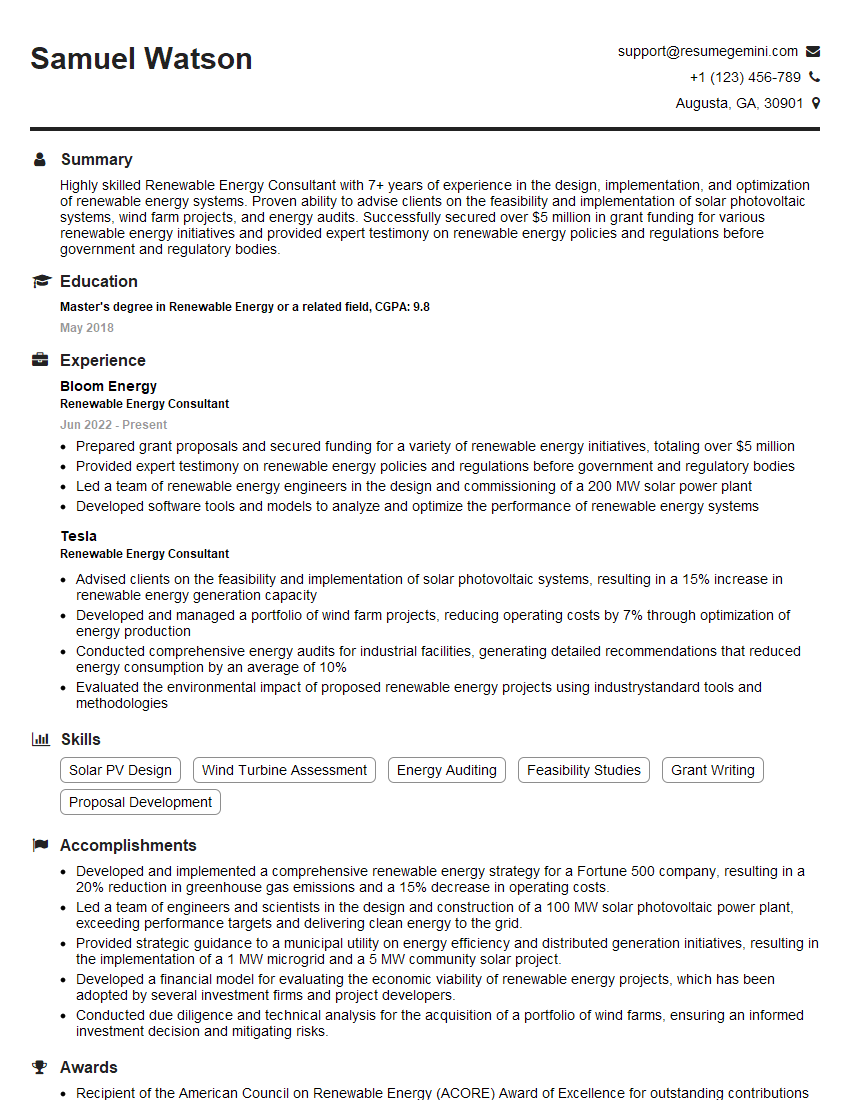
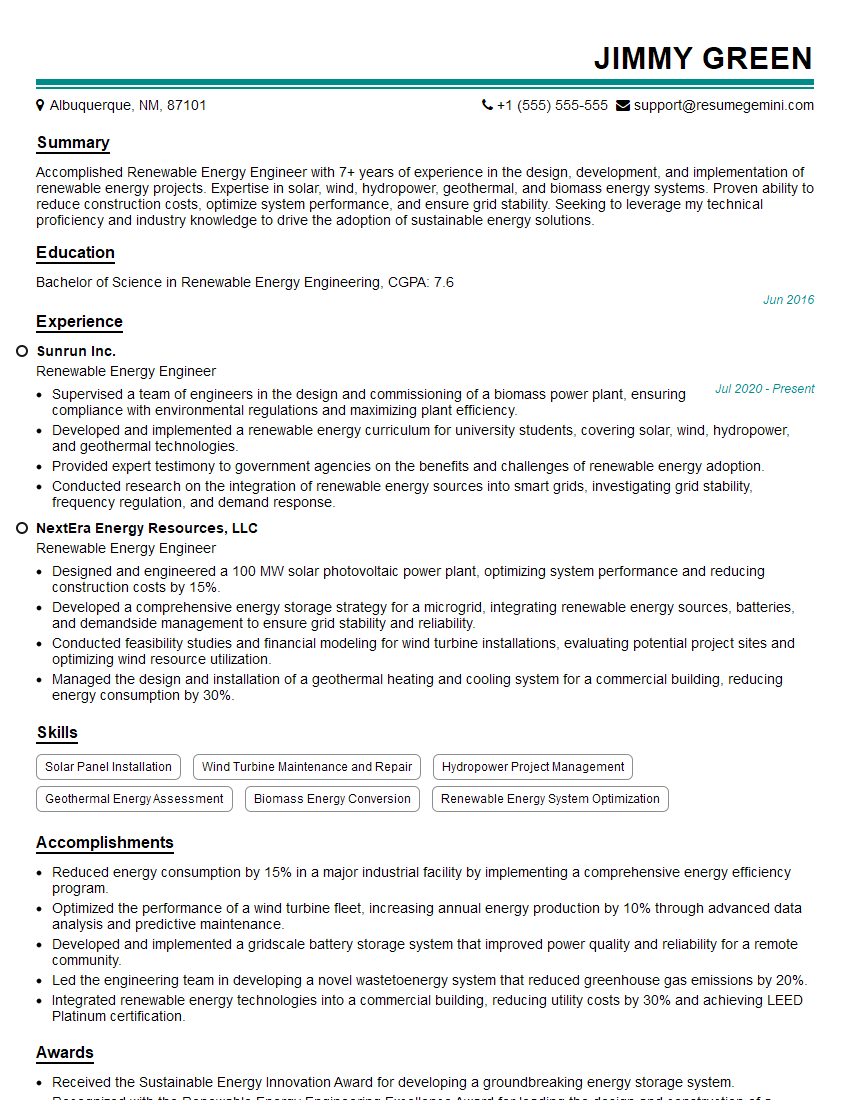
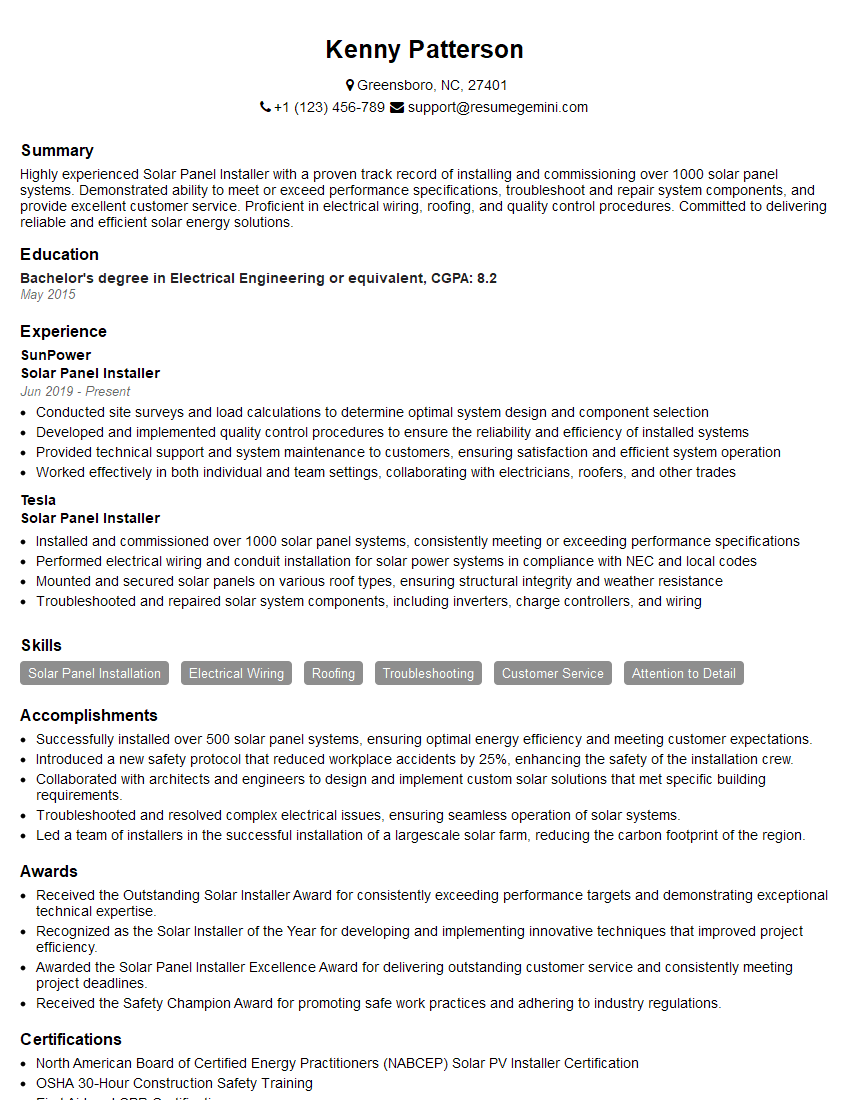
Mastering Solar Photovoltaics opens doors to a rewarding and impactful career in a rapidly growing industry. To maximize your job prospects, creating a strong, ATS-friendly resume is crucial. ResumeGemini can help you craft a professional resume that highlights your skills and experience effectively. ResumeGemini offers examples of resumes specifically tailored to the Solar Photovoltaics industry to help you get started. Take the next step in your career journey today!

Explore more articles
Users Rating of Our Blogs
Share Your Experience
We value your feedback! Please rate our content and share your thoughts (optional).
What Readers Say About Our Blog
Very informative content, great job.
good