Preparation is the key to success in any interview. In this post, we’ll explore crucial Solo Recital interview questions and equip you with strategies to craft impactful answers. Whether you’re a beginner or a pro, these tips will elevate your preparation.
Questions Asked in Solo Recital Interview
Q 1. Describe your experience preparing and performing a solo recital program.
Preparing for a solo recital is a marathon, not a sprint. It’s a multifaceted process involving meticulous planning, intense practice, and careful attention to detail. My preparation typically begins months in advance with repertoire selection. After that, I delve into a deep study of each piece, focusing on technical mastery, musical interpretation, and expressive delivery. This includes countless hours of practice, often broken down into smaller, manageable segments. I’ll work with my accompanist to ensure a seamless collaboration, and then I’ll incorporate performance practice, simulating recital conditions to build confidence and refine the performance.
The performance itself is a culmination of all this preparation. I aim to deliver a program that is not only technically flawless but also emotionally resonant, engaging the audience and conveying the composer’s intentions effectively. I find that mindful breathing and focusing on the music rather than the audience help me to stay present and connected during the performance.
Q 2. How do you select repertoire for a solo recital?
Selecting repertoire for a solo recital is a crucial step that significantly shapes the overall experience. My approach involves careful consideration of several factors. Firstly, I choose pieces that genuinely resonate with me emotionally and intellectually. I look for works that showcase a variety of my technical skills and stylistic preferences while creating a cohesive and varied program. I also consider the audience – their musical background, tastes and expectations. It’s important to create a balanced program that offers both familiar and challenging works, thereby maintaining audience interest throughout.
For example, I might choose a well-known sonata to provide a familiar anchor, and then pair it with a lesser-known but equally compelling piece to introduce the audience to something new. Finally, the practical aspects such as the availability of scores, the length of pieces and their suitability to my instrument also influence my choices. The goal is to curate a program that is both personally satisfying and artistically rewarding for both the performer and the listener.
Q 3. What is your approach to interpreting a particular piece for a solo recital?
Interpreting a piece for a solo recital goes beyond simply playing the notes correctly; it’s about bringing the composer’s vision to life. My approach involves a deep dive into the historical context of the piece, the composer’s life and intentions. I research critical analyses and listen to different interpretations by other performers to gain a broader perspective. I focus on understanding the emotional arc of the music, identifying key phrases and motifs, and understanding how dynamics, tempo, articulation and phrasing contribute to the overall narrative.
For example, if I’m playing a melancholic piece, I might focus on creating a sense of longing and introspection through subtle changes in tempo and dynamics. I also pay close attention to the text if it’s vocal music, seeking to understand the emotional meaning of the words. My interpretation is always informed by my own personal understanding and emotional connection with the music, but guided by scholarly research and respect for the composer’s intentions. It is a continuous process of refinement as I work through the piece during practice. The goal is a performance that is both authentic and captivating.
Q 4. How do you manage performance anxiety before a solo recital?
Performance anxiety is a common experience for musicians, and I’ve developed strategies to manage it effectively. Firstly, thorough preparation is key. The more I practice, the more confident I feel in my ability to perform. Secondly, I incorporate mindfulness techniques such as deep breathing exercises and meditation into my practice routine to help calm my nerves. Visualization exercises, where I mentally rehearse the performance, also help to build confidence and reduce anxiety.
On the day of the recital, I prioritize physical and mental relaxation. I avoid over-caffeinating and engage in activities that promote relaxation like light stretching or listening to calming music. Most importantly, I remind myself that I’ve prepared diligently and that it’s okay to be nervous – it means I care about the performance! I focus on the joy of sharing music rather than dwelling on the potential for mistakes. The feeling of sharing music with an audience generally outweighs any anxieties.
Q 5. Explain your process for practicing a challenging technical passage.
Practicing a challenging technical passage requires a systematic and patient approach. I break down the passage into smaller, manageable sections, focusing on mastering each section before moving on. I use slow practice, playing the passage at a tempo significantly slower than the intended performance tempo, to ensure accuracy and precision. I pay close attention to fingerings, ensuring they are efficient and comfortable. I might use metronome work to improve rhythmic accuracy and gradually increase the tempo as I gain proficiency.
If I encounter specific difficulties, I isolate those sections and employ targeted practice techniques, such as repetitive practice with short breaks, to improve accuracy and build muscle memory. I also ensure that I practice the passage in context within the whole piece to maintain the musical flow and avoid technical isolation. Recording myself helps to identify areas needing attention and provides a means of tracking progress. Persistence and patience are paramount – mastering difficult passages takes time and dedication.
Q 6. How do you ensure your performance is both technically proficient and emotionally engaging?
Balancing technical proficiency and emotional engagement is the cornerstone of a compelling performance. Technical skill provides the foundation, ensuring that the musical ideas are conveyed clearly and accurately. However, technical precision alone is not enough. To engage the audience emotionally, I need to communicate the musical narrative through expressive phrasing, dynamics, and articulation. This involves understanding the emotional nuances of the piece and translating those emotions into my performance.
For instance, I might use subtle changes in tempo to create a sense of urgency or longing. I might employ a wider dynamic range to highlight specific melodic lines or create contrast between different sections. My facial expressions and body language also play a role in conveying the emotional message of the piece. The ideal performance is a seamless blend of technical mastery and artistic expression, where the technical aspects enhance the emotional impact rather than overshadowing it.
Q 7. Describe your experience collaborating with accompanists for solo recitals.
Collaboration with an accompanist is essential for many solo recitals. A successful collaboration requires open communication, mutual respect, and a shared artistic vision. Before the recital, I meet with my accompanist to discuss the interpretation of the pieces, ensuring we are on the same page regarding tempo, dynamics, and phrasing. We’ll rehearse together regularly, paying close attention to the balance between the soloist and the accompaniment. It’s crucial to have a supportive relationship built on trust and understanding.
I value an accompanist who actively listens and adapts to my musical ideas, providing sensitive and responsive accompaniment that enhances, rather than diminishes, the solo performance. Good communication throughout the rehearsal process, including addressing any challenges or concerns, is vital to ensure a harmonious and successful collaboration that results in a well-balanced and engaging performance.
Q 8. What strategies do you use to connect with your audience during a solo recital?
Connecting with an audience during a solo recital is crucial for a successful performance. It’s about creating a shared experience, transcending the barrier between performer and listener. My strategy involves several key elements:
Eye contact: I make a conscious effort to connect with individuals throughout the audience, not just focusing on one section. This creates a sense of intimacy and involvement.
Storytelling: Before or between pieces, I might share a brief anecdote related to the composer, the piece itself, or even my own personal connection to the music. This adds context and depth, making the music more relatable.
Body language: My posture, gestures, and facial expressions reflect the emotions of the music. I aim for natural and expressive movements that enhance the musical narrative, without distracting from the performance.
Energy: The energy I project is vital. I aim for a balance – enough dynamism to captivate the audience without being overwhelming. This often depends on the specific piece and its emotional content.
Silence: Sometimes, the most powerful connection comes from moments of silence after a particularly moving passage. This allows the audience to reflect on the music and fully absorb its impact.
For example, during a performance of a Bach partita, I might pause briefly after a particularly intricate section and subtly acknowledge the audience with a small smile, allowing them a moment to appreciate the technical brilliance and emotional depth.
Q 9. How do you handle unexpected technical issues during a performance?
Unexpected technical issues are, unfortunately, a part of performing. My approach is rooted in preparedness and quick thinking. Firstly, I ensure all equipment is thoroughly checked beforehand. This includes the instrument (tuning, condition), microphones, sound system, and lighting (if applicable).
If a problem arises during a performance, my strategy is to remain calm and address it swiftly. For example, if a string breaks on my instrument, I might have a spare ready, or if there’s a microphone issue, I will adjust my projection accordingly.
Depending on the severity of the problem, I may need to improvise. This might involve skipping a short section, smoothly transitioning to a different piece, or even addressing the audience directly with a brief, apologetic explanation. The key is to maintain composure and minimize disruption to the overall flow of the recital.
I always have a backup plan. Having a selection of pieces readily available that suit different circumstances helps me react to unforeseen events.
Q 10. What is your approach to stage presence and projection?
Stage presence and projection are essential for a compelling solo recital. It’s not just about being seen but about conveying emotion and meaning. My approach is a blend of technique and artistry.
Posture and Movement: I maintain a confident yet relaxed posture, using natural movements that enhance the music’s expression. Avoid excessive or distracting movements. My movements are intentional and support the musical narrative.
Vocal Projection (when appropriate): If speaking between pieces, I project my voice clearly and engagingly, maintaining eye contact with the audience. This adds to the overall feeling of connection.
Facial Expression: My facial expressions are important. They reflect the emotional arc of each piece, from joyful exuberance to profound sorrow. This is a subtle but powerful aspect of conveying meaning.
Confidence and Calmness: These qualities help create an atmosphere of trust and connection with the audience. It allows them to fully immerse themselves in the music.
For example, during a dramatic piece, my posture might become more intense, reflecting the music’s emotional weight. Then, during a lighter piece, my movements might become more flowing and relaxed, reflecting the shift in emotional tone.
Q 11. Describe your experience promoting and marketing your solo recitals.
Promoting and marketing solo recitals requires a multifaceted approach. I utilize a combination of strategies to reach potential audience members:
Social Media: Platforms like Instagram, Facebook, and even TikTok can effectively reach a wide audience. I use high-quality photos and videos of my performances and behind-the-scenes glimpses into my practice to engage my followers. Regular postings are key.
Website/Online Presence: A professional website with details about upcoming recitals, biography, past performances, and high-resolution photos is crucial. This provides potential audience members with easy access to information.
Email Marketing: I maintain an email list to keep subscribers updated on upcoming events and news. Targeted email campaigns can announce new recitals or special offers.
Collaboration: Partnering with local businesses, music schools, and community organizations can broaden reach and attract new audiences.
Press Releases: Submitting press releases to local newspapers and magazines can generate media coverage.
For example, I recently collaborated with a local café to host a pre-recital reception, attracting patrons who might not otherwise attend a classical music event. The key is consistent and varied marketing efforts.
Q 12. What is your preferred method for recording and reviewing your performances?
Recording and reviewing my performances is an integral part of my growth as a musician. My preferred method utilizes a combination of professional recording equipment and software for detailed analysis.
For recording, I use high-quality audio recording equipment – often a multi-track recorder to capture individual instrument parts separately or a high-fidelity stereo setup. After the performance, I then use audio editing software to clean up the recording and refine its sound.
For reviewing, I focus on specific aspects of my performance, such as technical accuracy, phrasing, dynamics, and emotional expression. I pay close attention to areas needing improvement and make detailed notes. This helps me identify patterns and strengths in my performance and work to improve them during the subsequent practices.
While I find visual recordings helpful, audio recordings are often more effective for detailed analysis. Listening critically allows me to focus on nuances often missed when watching a video recording.
Q 13. How do you adapt your performance to different venues and audiences?
Adapting my performance to different venues and audiences is crucial. It’s about understanding the unique characteristics of each setting and tailoring the recital accordingly.
Venue Acoustics: Different venues have unique acoustic properties. A large concert hall requires a different approach than a smaller, intimate space. This may involve adjusting dynamics and phrasing to ensure the music sounds balanced and resonant.
Audience Demographics: Consider the audience’s background and familiarity with the music. If performing for a young audience, I might include more interactive elements or simpler pieces. For an experienced audience, more challenging and complex works may be more suitable.
Program Selection: Careful program selection is key. I consider the overall flow, balance, and overall tone of the program to match the setting and audience. A well-crafted program builds a compelling musical narrative.
Presentation Style: The style of presentation also adapts to the setting. A more formal venue might warrant a more traditional approach, while a less formal setting could allow for a more relaxed and conversational interaction with the audience.
For example, I recently performed in a small church where the acoustics were very reverberant. I adjusted my playing to be more precise and articulate, with fewer dynamics to avoid masking certain notes.
Q 14. What are your strengths and weaknesses as a solo recitalist?
As a solo recitalist, I constantly strive for improvement. Identifying my strengths and weaknesses is an ongoing process. One of my strengths is my technical proficiency. Years of dedicated practice have allowed me to master a wide range of repertoire with precision and control. I also receive feedback that I have a strong stage presence, which creates an engaging atmosphere for the audience.
However, a weakness is occasionally overthinking during performances. This sometimes affects my natural flow and spontaneity. To combat this, I focus on relaxation and mindfulness techniques during practice and before performances. I also strive to be more present in the moment, rather than worrying about potential mistakes.
Another area I am constantly developing is my ability to effectively promote myself and my recitals. While I’ve seen progress in this area, it remains a focus for growth.
Q 15. How do you incorporate improvisation into your solo recitals (if applicable)?
Improvisation in a solo recital, while not always a central feature, can add a captivating layer of spontaneity and personal expression. For me, improvisation is most effectively integrated in pieces that lend themselves to it – often those with a cadenza or a section specifically marked for ornamentation. For example, in a Baroque sonata, I might explore different embellishments on a repeated phrase, drawing from the stylistic conventions of the period. This isn’t about inventing a completely new melody, but rather about creating a nuanced and personalized interpretation within the established framework of the piece. I often spend time researching historical performance practices and listen to recordings of other musicians’ approaches to inform my improvisational choices. A key element is maintaining the integrity of the overall composition while showcasing my own musical voice.
In more contemporary pieces, improvisation could take the form of a short interlude between movements or a brief spontaneous flourish at the conclusion. The key is careful preparation. While the performance itself is spontaneous, the process leading up to it involves a great deal of technical and musical exploration. This helps ensure that even though elements are improvised, they remain coherent and stylistically appropriate within the context of the recital.
Career Expert Tips:
- Ace those interviews! Prepare effectively by reviewing the Top 50 Most Common Interview Questions on ResumeGemini.
- Navigate your job search with confidence! Explore a wide range of Career Tips on ResumeGemini. Learn about common challenges and recommendations to overcome them.
- Craft the perfect resume! Master the Art of Resume Writing with ResumeGemini’s guide. Showcase your unique qualifications and achievements effectively.
- Don’t miss out on holiday savings! Build your dream resume with ResumeGemini’s ATS optimized templates.
Q 16. Discuss your approach to program structuring for a solo recital.
Structuring a solo recital program is a delicate balancing act between showcasing my versatility and offering a cohesive and engaging listening experience. My approach is to think of it as creating a narrative, a journey through different musical styles and moods. I usually begin with a piece that is both captivating and accessible, grabbing the listener’s attention from the start. I then build upon this foundation, gradually introducing works of increasing complexity or emotional depth. Think of it like a carefully crafted story with rising action, a climax, and a satisfying resolution.
Variety is key. I try to avoid programming pieces that are stylistically too similar, opting instead for a diverse selection reflecting my strengths and the overall theme of the recital, if there is one. For example, I might pair a passionate Romantic sonata with a more introspective Classical work or a technically demanding piece with something gentler and more lyrical. The order of the pieces is crucial, considering their energy and emotional impact, aiming to create a flowing and engaging program.
I also consider the practical aspects, such as the length of each piece and the overall duration of the recital, aiming for a program that is both substantial and satisfying, but not overly taxing for the audience or myself.
Q 17. How do you handle constructive criticism after a performance?
Constructive criticism is invaluable to my artistic growth. I approach it with an open mind, focusing on understanding the feedback rather than simply defending my performance. I find it helpful to reflect on the specific points raised, considering the critic’s perspective and how it relates to my own artistic intentions. Sometimes, the criticism might highlight technical aspects that need improvement, such as intonation or phrasing. Other times, it might concern the overall interpretation or emotional connection with the piece.
I keep a journal where I record feedback from performances, noting down both positive comments and constructive criticism. This allows me to identify recurring patterns and to track my progress over time. I then use this information to refine my technical skills, deepen my musical understanding, and to improve my overall performance.
It’s important to differentiate between genuinely helpful criticism and subjective opinions. While I welcome diverse perspectives, I ultimately need to trust my own artistic judgment and ensure that any changes I make are aligned with my own vision of the music.
Q 18. Describe your experience with different performance styles (e.g., Baroque, Classical, Romantic).
My experience spans various historical periods and styles, each presenting unique challenges and rewards. The Baroque period, with its ornamentation and emphasis on counterpoint, requires meticulous attention to detail and a deep understanding of historical performance practices. I’ve performed works by Bach and Handel, learning to appreciate the elegance and intellectual rigor of their compositions. The Classical period, exemplified by the works of Mozart and Haydn, demands clarity, balance, and a refined sense of structure. I find the clarity and elegance of this style particularly rewarding.
The Romantic period, with its passionate intensity and expressive freedom, presents a different set of challenges. Works by Beethoven, Chopin, and Schumann demand a deeper emotional engagement and a greater degree of interpretive freedom. I’ve found that understanding the historical context and the composer’s biography can greatly enhance my interpretation of these works. These differing approaches have enriched my musicianship, allowing me to develop a diverse technical skill set and a wider emotional range.
Q 19. What are your goals for future solo recital performances?
My goals for future solo recitals extend beyond simply giving polished performances. I aim to continually challenge myself artistically, exploring new repertoire and pushing the boundaries of my technical and interpretive capabilities. This includes delving into lesser-known works by established composers and exploring the music of contemporary composers.
Furthermore, I strive to create more immersive and engaging experiences for my audiences. I’m exploring ways to enhance the recital through multimedia elements or by incorporating interactive components, making the concert experience more stimulating and memorable. The ultimate goal is to connect with my audience on an emotional level, creating a shared experience of musical discovery and joy.
Q 20. How do you maintain a balance between technical practice and musical expression?
The balance between technical practice and musical expression is crucial. It’s not a matter of choosing one over the other, but rather of integrating them seamlessly. Technical proficiency is the foundation upon which musical expression is built. Without a solid technical base, the expression will sound strained or unconvincing. For example, flawlessly executing a difficult passage allows me to convey the intended emotion with greater nuance and conviction.
My practice routine involves dedicated time for technical exercises, scales, arpeggios, and etudes. This ensures my fingers are agile and my technique is reliable. However, I never practice purely mechanically. Even technical exercises are infused with musicality, paying attention to tone quality, phrasing, and dynamics. The bulk of my practice time is dedicated to working on musical interpretation, exploring different phrasing, dynamics, and articulation to fully realize the composer’s intentions and communicate them effectively to the audience.
Essentially, technical proficiency frees me to focus on the emotional and intellectual aspects of the music. This allows for an authentic and impactful performance.
Q 21. Describe your experience working with a director or coach for a solo recital.
Collaborating with a director or coach for a solo recital is invaluable. A fresh perspective can help me identify areas that I might have overlooked in my own preparations. In one instance, I worked with a coach who helped me refine the phrasing and dynamics in a particularly challenging piece. He highlighted subtle nuances in the score that I hadn’t noticed before, leading to a much more nuanced and expressive performance. His insights helped me to connect more deeply with the emotional core of the piece.
The director can also help in aspects beyond purely musical ones. They might offer advice on stage presence, presentation, and even the program structure itself, ensuring that the recital flows logically and emotionally. It’s a collaborative process, and the best results come from a respectful exchange of ideas and a willingness to learn from another perspective.
This external perspective can be incredibly beneficial, providing valuable insights and enhancing my performance beyond what I could achieve on my own.
Q 22. What is your understanding of copyright and performance rights?
Copyright and performance rights are crucial aspects of the music profession. Copyright protects the composer’s musical work itself – the notes, melody, and harmony – preventing unauthorized copying or distribution. Performance rights, on the other hand, protect the composer’s right to be compensated when their work is publicly performed. This often involves licensing fees paid to performance rights organizations (PROs) like ASCAP, BMI, or SESAC, depending on the composer’s affiliation. For a solo recital, if you are performing copyrighted works, you must ensure that you have secured the necessary performance licenses either directly through the publisher or through your PRO. Failing to obtain these rights can lead to legal repercussions, including substantial fines.
For example, if I’m performing a piece by Beethoven in a public recital, I don’t need to obtain a copyright license for the work itself since it’s in the public domain. However, if I’m performing a contemporary work, I must obtain performance rights from the copyright holder or their designated PRO before the performance. This process usually involves submitting a program to the PRO well in advance of the recital.
Q 23. How familiar are you with different performance venues and their technical requirements?
My familiarity with various performance venues is extensive. I’ve performed in intimate recital halls with excellent acoustics, large concert halls requiring amplification, and even outdoor spaces with unique environmental challenges. Understanding the technical requirements of each venue is paramount. This includes familiarity with the stage size, lighting capabilities, sound systems, piano quality (especially its tuning and responsiveness), seating arrangements for the audience, and even the availability of a backstage area for preparation and warm-up.
For instance, in a smaller recital hall, I might focus on subtle nuances in my performance, relying on the natural acoustics to carry the sound. In a larger concert hall, I would work closely with the sound engineer to ensure the balance of my instrument is optimal for the entire space. I also consider factors like microphone placement, speaker placement, and stage lighting, collaborating with the venue’s technical staff to optimize the performance for the audience experience.
Q 24. How do you manage your time effectively when preparing for a solo recital?
Effective time management is crucial for a successful solo recital. My preparation usually begins months in advance, and I employ a structured approach. I start by meticulously planning my program, balancing contrasting styles and moods while considering the overall narrative arc. Then I create a detailed practice schedule that allows me to work on each piece systematically, addressing technical challenges and musical interpretations. This often involves breaking down each piece into smaller segments to focus on specific passages.
I use a combination of techniques, including time blocking, prioritizing tasks based on their importance and difficulty, and regular review sessions. Regular performance practice in front of a small audience – teachers, peers, or even friends – is crucial. I also incorporate regular breaks to avoid burnout. A well-structured schedule helps to ensure that the entire program is thoroughly prepared and polished before the recital. A last-minute rush leads to anxiety and mistakes.
Q 25. What is your understanding of audience etiquette and expectations?
Audience etiquette and expectations are essential considerations. I believe in fostering a respectful and appreciative atmosphere. This starts with arriving at the venue punctually and providing clear program notes with appropriate biographical information for the works. During the performance, I strive to engage the audience through my interpretation while also maintaining respect for the silence and concentration necessary for optimal listening.
Audiences generally expect a high level of musicianship, an engaging performance style, and an acknowledgement of their presence. Silence is key, except during well-placed and appropriate applause. While some audience members may fidget or cough, disruptive behavior is generally rare, and if it occurs, it’s important to remain professional and composed. Post-performance, I try to be available to interact and answer questions to the best of my ability, further demonstrating my appreciation for their attention and presence.
Q 26. Discuss your experience with pre-recital preparation rituals.
My pre-recital preparation rituals involve a combination of mental and physical preparation. I start by arriving at the venue early to familiarize myself with the stage and instrument. I have a quiet warm-up routine that allows me to focus my attention and prepare both mentally and physically. This could involve focused breathing exercises, light stretching, and running through scales or simple arpeggios. I try to minimize distractions and create a calm, centered environment.
I avoid heavy meals and excessive caffeine before the performance. I make sure my attire is comfortable and suitable. I also listen to calming music or engage in quiet meditation to center my thoughts. It’s a personalized ritual built over years of experience, refining and adjusting techniques to achieve an optimal state of readiness and performance.
Q 27. Describe a time you had to overcome a significant challenge during a solo recital.
During one particularly challenging recital, my piano’s sustain pedal malfunctioned mid-performance. The piece I was playing relied heavily on the use of the pedal, and its failure created a jarring interruption, leaving several notes hanging awkwardly in the air. Initially, I felt a surge of panic. However, I quickly composed myself and adapted. I finished the piece without the pedal, adjusting my dynamics and phrasing to compensate for its absence, and ensured the subsequent pieces were not affected.
After the recital, I spoke to the venue’s technicians and discovered that a wire had come loose. Though it affected the performance, I chose to maintain my composure and continue. The experience taught me the importance of adaptability and resourcefulness during live performances. It also reinforced my belief in the necessity of thoroughly checking the instrument’s condition before any performance.
Q 28. How do you handle questions from the audience after a solo recital?
Handling post-recital questions from the audience is an important part of the experience. I approach these interactions with respect and a desire to engage in meaningful dialogue. I appreciate that some individuals may have technical or interpretative questions about the performance, while others may be sharing their general impressions. I always strive to answer questions concisely and thoughtfully.
For technical questions, I might discuss specific choices regarding phrasing or dynamics. For more general questions, I’ll answer in an accessible manner, avoiding overly technical jargon. If I don’t know the answer, I’ll be honest and say so, rather than providing misinformation. The post-performance interaction provides valuable feedback, and it shows appreciation for the audience’s involvement and support.
Key Topics to Learn for Solo Recital Interview
- Musical Interpretation and Expression: Understanding how to convey the composer’s intent and your own artistic vision through nuanced performance.
- Technical Proficiency: Demonstrating mastery of the chosen instrument, including scales, arpeggios, and complex passages, with accuracy and fluidity.
- Program Selection and Sequencing: Articulating the rationale behind your recital program choices, showcasing a cohesive and engaging narrative.
- Stage Presence and Performance Practice: Exhibiting confidence, poise, and effective communication with the audience through body language and stagecraft.
- Historical Context and Analysis: Demonstrating knowledge of the historical period and stylistic elements of the chosen pieces.
- Problem-Solving and Adaptability: Discussing strategies for overcoming performance challenges, such as managing nerves or adapting to unexpected technical issues.
- Repertoire Knowledge: Showing breadth and depth of understanding across various compositional styles and eras.
- Musicality and phrasing: Demonstrating a refined understanding of musical phrasing, dynamics, and articulation.
Next Steps
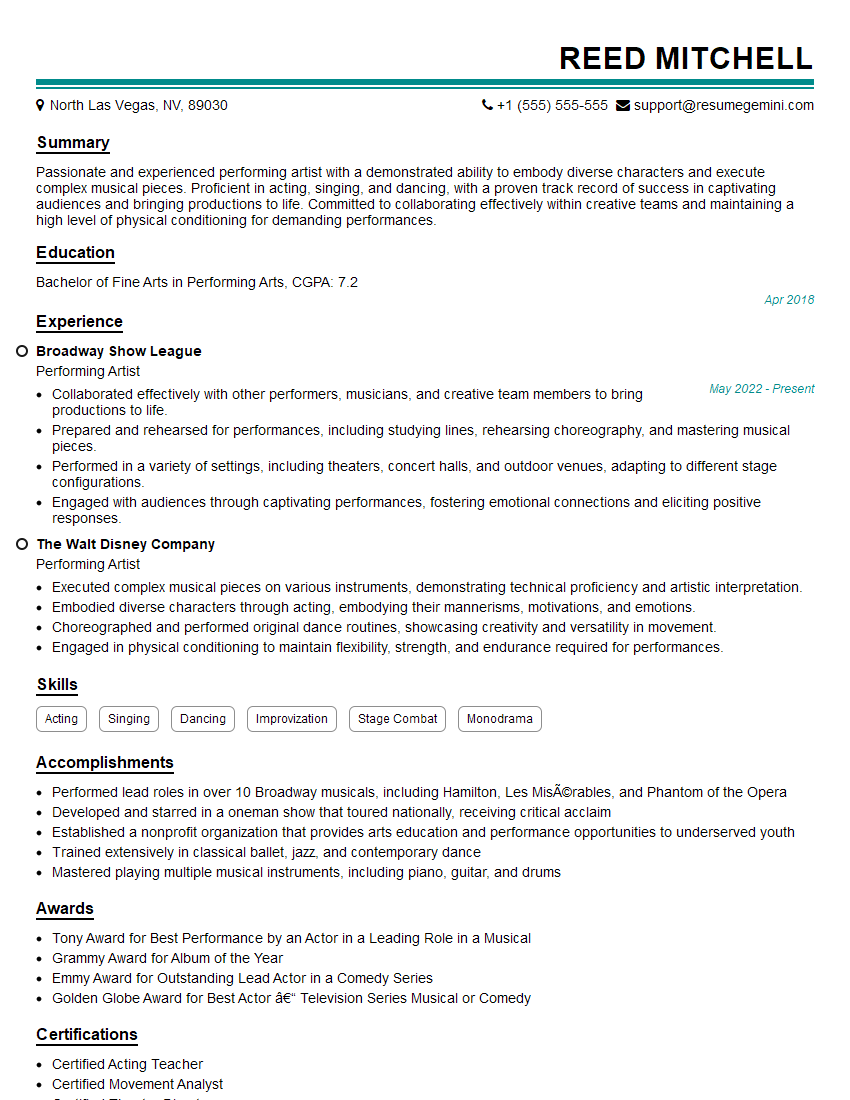
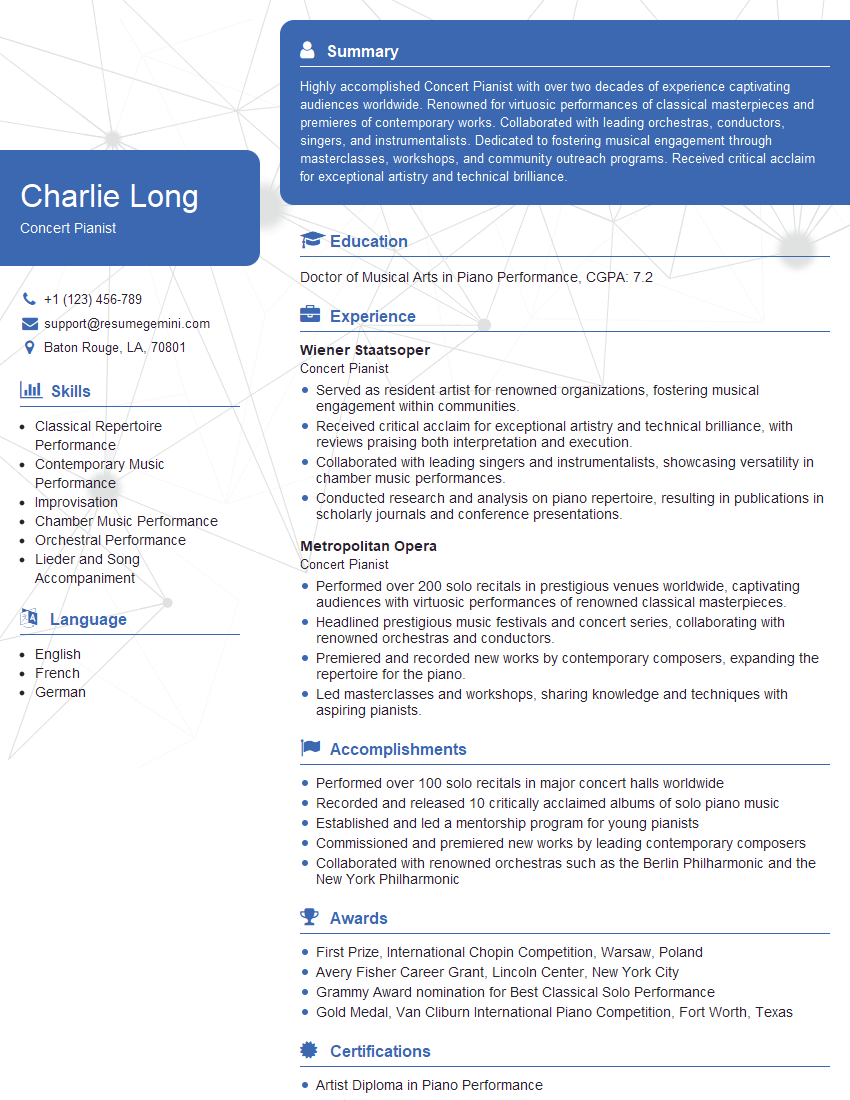
Mastering the art of the solo recital significantly enhances your career prospects as a musician, demonstrating both technical expertise and artistic maturity. A strong resume is crucial in showcasing your skills and experience to potential employers. To maximize your chances, crafting an ATS-friendly resume is essential. We highly recommend using ResumeGemini to build a professional and impactful resume. ResumeGemini provides the tools and resources to create a compelling document that highlights your unique abilities. Examples of resumes tailored to Solo Recital experience are available to help you get started.
Explore more articles
Users Rating of Our Blogs
Share Your Experience
We value your feedback! Please rate our content and share your thoughts (optional).
What Readers Say About Our Blog
Very informative content, great job.
good