Interviews are opportunities to demonstrate your expertise, and this guide is here to help you shine. Explore the essential Songwriting and Lyric Composition interview questions that employers frequently ask, paired with strategies for crafting responses that set you apart from the competition.
Questions Asked in Songwriting and Lyric Composition Interview
Q 1. Describe your songwriting process.
My songwriting process is iterative and often begins with an emotional spark – a feeling, a memory, a news headline, even a striking image. I don’t always start with music; sometimes, a compelling lyric phrase or a strong narrative idea takes precedence. I find it helpful to brainstorm and freewrite, capturing every thought and idea without judgment. Once I have a core concept, I might experiment with different melodies on my guitar or piano, seeking a musical framework that complements the lyrical content. The melody often influences the rhythm and structure of the lyrics themselves. I then refine the lyrics, paying close attention to rhyme scheme, meter, and the overall flow and emotional impact. I frequently record myself singing and playing through different versions, allowing me to objectively assess what works best. This process of refinement, revision, and experimentation continues until I’m satisfied with both the musicality and lyrical narrative.
Q 2. Explain your approach to crafting compelling lyrics.
Crafting compelling lyrics involves a blend of artistry and craft. It’s about telling a story, conveying emotions, and creating imagery that resonates with the listener. I focus on using vivid language that paints pictures in the listener’s mind; strong verbs and precise nouns are my allies. I strive for authenticity – writing about experiences, observations, and emotions that are genuine to me. However, this doesn’t mean the lyrics have to be literal; metaphors, similes, and symbolism are powerful tools for creating depth and adding layers of meaning. For example, instead of saying ‘I was sad,’ I might write ‘The rain mirrored the tears I couldn’t cry.’ I also pay close attention to the song’s structure – the arrangement of verses, choruses, and bridges – ensuring that the lyrics build towards a climax and leave a lasting impression on the listener. Finally, I constantly test my lyrics, reading them aloud to gauge their rhythm and impact.
Q 3. How do you overcome writer’s block?
Writer’s block is a common challenge for songwriters. My approach is multifaceted. Firstly, I step away from the project completely. A walk, a change of scenery, or even a different creative pursuit can help to clear my mind and generate fresh perspectives. Secondly, I embrace experimentation – I might try writing in a different genre, using a different instrument, or even collaborating with another songwriter. Sometimes, the mere act of writing something, even if it’s not perfect, can break the cycle of frustration. Thirdly, I revisit my inspirations – revisiting my favorite songs, poems, or books can reignite my creativity. Lastly, I utilize prompts – I’ll set a timer and write for a specific amount of time, focusing on a single image, emotion, or event. It’s about getting the creative juices flowing again, rather than forcing perfection from the outset.
Q 4. What are your preferred songwriting tools and technologies?
My primary songwriting tools are my acoustic guitar and piano. They allow me to experiment with melodies and chords intuitively. I also use a digital audio workstation (DAW) such as Logic Pro X or Ableton Live to record and arrange my songs. This allows for layering sounds, adding effects, and experimenting with different musical arrangements. Beyond these core tools, I rely heavily on a good notepad (both physical and digital) for capturing lyrics and ideas. I frequently use lyric-writing software that helps with rhyme schemes and meter, but I also value the spontaneity of handwritten notes. Finally, I find collaborative platforms like Google Docs invaluable when working with other musicians.
Q 5. Discuss your experience collaborating with other musicians.
Collaboration is a vital part of my songwriting process. Working with other musicians brings diverse perspectives, skills, and creative energies to the table. I’ve had incredible experiences co-writing with artists from various backgrounds, each collaboration enriching my songwriting and expanding my musical horizons. The key to successful collaboration is open communication, mutual respect, and a willingness to compromise. We establish clear goals for the project early on, ensuring that everyone understands the overall vision. We then brainstorm together, sharing ideas freely, and building on each other’s contributions. Sometimes, one person might lead on the melody, while another focuses on the lyrics; other times, it’s a more fluid, improvisational process. The collaborative process can be challenging at times, but the resulting product often surpasses what any single individual could achieve independently.
Q 6. How do you ensure your songs are commercially viable?
Ensuring commercial viability involves understanding the current musical landscape, identifying target audiences, and crafting songs that resonate with those audiences. This isn’t about writing ‘trendy’ music; it’s about crafting high-quality songs that are well-written, memorable, and well-produced. I research current chart trends to understand what types of songs are popular but I don’t let that dictate my creative vision. It’s more about understanding the overall market trends and potential for a song to reach a wider audience. Strong melodies, relatable lyrics, and a polished production are key elements. I also consider the potential for radio play, streaming success, and sync licensing opportunities. However, artistic integrity is paramount; commercial success shouldn’t come at the expense of sacrificing the creative vision.
Q 7. Explain your understanding of music theory and its application to songwriting.
Music theory is an invaluable tool for songwriters. Understanding concepts like chords, scales, rhythm, and melody allows for more conscious and effective songwriting. For example, knowing how different chords create specific emotional effects enables me to craft more nuanced and evocative musical landscapes. Understanding harmonic progressions (like the common I-IV-V-I) helps in creating pleasing and memorable melodies. I don’t rigidly adhere to theory, but I use it as a guide to enhance the musicality of my songs. A strong understanding of rhythm and meter ensures that the lyrics sit comfortably within the musical framework. It helps avoid awkward phrasing or rhythms that can disrupt the flow of a song. Furthermore, understanding musical form (verse-chorus, bridge, etc.) helps in structuring a song that is both engaging and satisfying for the listener. While theory provides a foundation, intuition and experimentation still remain crucial to crafting truly unique and moving music.
Q 8. How do you adapt your songwriting style to different genres?
Adapting my songwriting style to different genres involves understanding the core elements that define each genre and strategically employing them. It’s not about abandoning my personal voice, but rather about using it in a way that resonates with the specific audience and expectations of the genre.
- Genre-Specific Structures: Pop songs often follow a verse-chorus structure, while blues might lean towards a twelve-bar progression. I adapt my song structures accordingly. For instance, a country song might utilize a storytelling narrative with a strong emphasis on imagery and simple language, whereas an EDM track requires a strong beat and repetitive, catchy hook.
- Lyrical Content and Themes: The themes and vocabulary I use significantly vary depending on the genre. A love ballad will have different lyrical content and emotional depth compared to a punk rock anthem expressing rebellion. The language itself also adjusts; a folk song might be more poetic and metaphorical, while hip-hop relies on more direct, rhythmic delivery and often incorporates slang and internal rhyme.
- Musicality and instrumentation: The choice of instruments and musical arrangements directly affects the genre. A soft, acoustic guitar might suit a folk song, while a driving bassline and synthesizers would fit an electronic track. I collaborate closely with musicians to ensure my lyrics complement the overall musical direction.
- Example: When transitioning from writing a ballad to a rock song, I would shorten the verses, make the chorus more repetitive and anthemic, and incorporate more aggressive imagery and a faster tempo in my lyrics.
Q 9. Describe a time you had to revise your lyrics based on feedback.
During the development of a song about urban loneliness, my initial lyrics were quite abstract and relied heavily on metaphors. A friend, a fellow songwriter, provided feedback suggesting they were too cryptic and lacked emotional impact. They were missing a clear narrative that would resonate with listeners.
Revising the lyrics involved several steps. Firstly, I carefully analyzed the feedback, focusing on the specific areas requiring improvement. Then, I revisited the core message of the song, honing in on the universal experience of urban isolation. I replaced the abstract metaphors with more concrete imagery and emotionally charged descriptions, grounding the lyrics in relatable details. For instance, I replaced the line “Lost in the symphony of urban echoes” with a more concrete image of “A million windows gleaming, mirroring a million empty souls.”
The process involved several iterations of rewriting and refinement until I reached a version that was both artistically satisfying and emotionally impactful. The revised version connected better with the audience because it directly addressed feelings of loneliness and alienation in a comprehensible manner.
Q 10. How do you protect your intellectual property?
Protecting my intellectual property involves a multi-pronged approach combining legal safeguards with proactive measures.
- Copyright Registration: I register my copyrights with the appropriate copyright office (like the US Copyright Office or equivalent in other countries). This establishes a legal record of my ownership and provides evidence of creation date, crucial for any legal disputes.
- Version Control: I maintain detailed records of each version of my songs, including date stamps, and store them securely in multiple locations (both physical and cloud-based). This helps demonstrate the timeline of creation and ownership if needed.
- Collaboration Agreements: When working with other songwriters or producers, I always use formal written agreements clearly outlining ownership percentages, usage rights, and responsibilities. These agreements protect my share of the copyright.
- Sound Recordings Copyright: If I’m also involved in producing or recording, I also register the sound recording copyright separately from the underlying musical composition. This protects the specific artistic rendition.
- Watermark and Metadata: When sharing my work digitally (e.g., demos), I use watermarks and embed relevant copyright metadata to help deter unauthorized use.
It’s essential to remember that copyright protection is an ongoing process, not a one-time event. I regularly review and update my protection methods to adapt to changing legal and technological landscapes.
Q 11. How familiar are you with music publishing and copyright laws?
I am very familiar with music publishing and copyright laws. I understand that copyright protects the musical composition (the melody, harmony, and lyrics) and the sound recording (the actual recording of the song). Music publishing involves administering the copyrights to a song and collecting royalties on behalf of the songwriter. My understanding extends to:
- Copyright Ownership and Transfer: I know how to properly assign and transfer copyrights if necessary, using clear and legally sound agreements.
- Mechanical Licenses: I’m aware of the need to secure mechanical licenses to legally reproduce and distribute my songs.
- Synchronization Licenses: I understand the licensing process for using songs in film, television, and advertisements (synchronization licenses).
- Performance Rights Organizations (PROs): I am familiar with PROs like ASCAP, BMI, and SESAC and actively register my songs with them to collect performance royalties.
- International Copyright Treaties: I understand that international copyright treaties protect my work globally, and know how to navigate international copyright regulations.
I always seek legal counsel for complex situations or when dealing with significant licensing agreements. My familiarity with these legal aspects is critical in ensuring fair compensation and preventing infringement of my intellectual property rights.
Q 12. Explain your experience working within a budget.
Working within a budget is a crucial aspect of professional songwriting, especially for independent artists. Effective budget management requires meticulous planning and prioritizing expenses.
- Pre-Production Planning: I begin by establishing a clear budget before starting a project. I outline all potential expenses, including studio time, musicians’ fees, mixing, mastering, and any promotional materials. This allows for accurate cost estimations.
- Prioritizing Expenses: I prioritize essential expenses and make strategic choices about where to invest more or less. For instance, I might allocate a larger portion of the budget for professional mixing and mastering, as these are crucial for sound quality, while opting for more cost-effective solutions for other aspects.
- Resourceful Approaches: I explore cost-effective alternatives without compromising quality. For example, I might collaborate with musicians who offer barter arrangements or find affordable studio time during off-peak hours. I’m comfortable using free or low-cost software for certain tasks when appropriate.
- Seeking Funding: I proactively explore funding opportunities, such as grants, crowdfunding, or private investment, particularly for larger projects.
- Tracking Expenses: I meticulously track all expenses and revenue using spreadsheets or dedicated accounting software to maintain transparency and ensure adherence to the budget.
By strategically managing every element of the production, I can deliver high-quality results while respecting the financial constraints of the project.
Q 13. How do you manage deadlines effectively?
Effective deadline management is essential in the fast-paced world of songwriting. I employ several strategies to ensure projects are completed on time and to a high standard.
- Detailed Planning: Before starting a project, I create a detailed timeline, breaking down the tasks into smaller, manageable steps with specific deadlines. This allows for better progress tracking.
- Time Blocking: I dedicate specific time blocks in my schedule for songwriting, revisions, and collaborations. This dedicated time minimizes distractions and fosters productivity.
- Prioritization: I prioritize tasks based on their importance and urgency, focusing on the most critical aspects first. This prevents delays caused by working on less important elements.
- Regular Check-ins: I have regular check-ins with collaborators and clients to review progress, address any challenges promptly, and make adjustments to the schedule as needed.
- Flexibility: I incorporate a buffer into my schedule to account for unforeseen delays or setbacks. It’s important to be realistic about time constraints.
By combining meticulous planning, prioritization, and regular progress monitoring, I consistently meet project deadlines while maintaining a high level of quality in my work.
Q 14. How do you handle criticism of your work?
Handling criticism is an essential skill for any songwriter. It’s important to remember that constructive criticism is a valuable tool for growth. However, navigating criticism requires a balanced approach.
- Separate Emotion from Feedback: I strive to separate my emotional response from the feedback I receive. It’s easy to become defensive, but I try to focus on the merit of the suggestions themselves. I remind myself that the goal is improvement.
- Seek Constructive Criticism: I actively seek feedback from trusted sources who provide constructive critiques, offering specific suggestions rather than general opinions.
- Analyze the Feedback: I carefully consider the feedback, examining its validity and relevance to the song’s overall goals. Not all feedback is created equal, and some suggestions might not align with the creative vision.
- Reflective Practice: After receiving feedback, I take time to reflect on it, experimenting with different approaches based on the suggestions. This is an important part of the songwriting process.
- Don’t Take it Personally: It’s crucial to remember that criticism of a work doesn’t reflect on one’s personal value as an artist. It’s just a means to improvement.
Through thoughtful analysis and reflection, I use criticism to refine my craft and produce stronger, more impactful songs. It’s a necessary part of the creative evolution.
Q 15. How do you stay updated with current music trends?
Staying current in the ever-evolving music landscape requires a multi-pronged approach. I actively listen to a wide range of genres, not just what’s currently topping the charts. This includes exploring smaller independent artists and international music scenes. I use music streaming platforms with curated playlists and radio features to discover emerging trends and sounds. Furthermore, I regularly read music industry publications, blogs, and follow key influencers on social media to stay informed on the latest production techniques, lyrical themes, and overall creative directions within the industry. It’s about being a curious listener and consistently searching for fresh inspiration.
For example, recently I’ve noticed a resurgence of interest in lo-fi hip hop beats and the continued exploration of blending electronic elements with more organic instruments. Staying aware of these shifts helps me to incorporate contemporary sounds and techniques into my own work while still retaining my unique style.
Career Expert Tips:
- Ace those interviews! Prepare effectively by reviewing the Top 50 Most Common Interview Questions on ResumeGemini.
- Navigate your job search with confidence! Explore a wide range of Career Tips on ResumeGemini. Learn about common challenges and recommendations to overcome them.
- Craft the perfect resume! Master the Art of Resume Writing with ResumeGemini’s guide. Showcase your unique qualifications and achievements effectively.
- Don’t miss out on holiday savings! Build your dream resume with ResumeGemini’s ATS optimized templates.
Q 16. Describe your experience with music production software (e.g., Pro Tools, Logic Pro).
My experience with Digital Audio Workstations (DAWs) is extensive. I’m proficient in both Pro Tools and Logic Pro, having utilized them for countless projects over the years. While both offer similar core functionalities like recording, editing, mixing, and mastering, their workflows and interfaces differ slightly. Pro Tools, known for its industry-standard status, is particularly powerful for larger-scale productions and collaborative projects. Logic Pro, with its comprehensive built-in instrument library and intuitive interface, is ideal for solo projects and more experimental sound design. I find myself choosing between them based on the project’s specific needs and the available resources.
For instance, in a recent project requiring advanced audio editing and complex mixing for a full band recording, I opted for Pro Tools. For a solo acoustic project where I was extensively experimenting with synthesizers and virtual instruments, Logic Pro’s intuitive interface and extensive library proved more efficient.
Q 17. How do you determine the appropriate key and tempo for a song?
Choosing the right key and tempo is crucial for establishing a song’s overall mood and feel. The key significantly impacts the emotional resonance, while tempo dictates the energy and rhythm. I consider several factors when making this decision. First, the lyrical content often suggests a suitable key; for example, a melancholic lyric might suit a minor key, while an uplifting theme might work better in a major key. Secondly, the intended vocal range of the singer plays a major role. The key must be comfortable for the singer to perform effectively. Lastly, the instrumentation also influences the key choice; certain chords and progressions sound more natural in certain keys.
Regarding tempo, I consider the genre and desired feel. A ballad would naturally have a slower tempo than a pop song. Experimenting with different tempos is key. I might start with a few options, experimenting with each to see how the feel of the melody and the overall vibe changes.
Q 18. How do you create memorable melodies?
Creating memorable melodies is a blend of art and craft. I often start by experimenting with simple, memorable melodic fragments. These fragments should be easily singable and instantly recognizable. I then build upon these core ideas, adding variations and embellishments to create a richer and more interesting melody. I pay close attention to melodic contour, using a mixture of ascending and descending intervals to create a dynamic and engaging listen. Repetition and variation are also essential; repeating certain melodic phrases helps with memorability, while introducing variations keeps the listener engaged.
Think of the instantly recognizable opening melody of ‘Happy Birthday’ – its simplicity is part of its memorability. I often employ similar principles; simplicity, repetition, and just enough variation to prevent monotony.
Q 19. How do you structure a song effectively?
Effective song structure is vital for maintaining listener interest and delivering a cohesive musical experience. I generally follow a pattern of introducing the main theme, developing it, providing contrast, and then bringing it back to resolution. A well-structured song keeps the listener engaged without feeling repetitive. It’s like telling a story; you need an introduction, a rising action, a climax, and a resolution. Each section serves a specific purpose: the verse usually presents the main idea, the chorus is the memorable hook, the bridge offers contrast and development, and the outro provides closure.
For example, a common approach is Verse-Chorus-Verse-Chorus-Bridge-Chorus-Outro. However, I am not afraid to experiment with unconventional song structures, but always with a clear understanding of the overall arc and flow of the piece.
Q 20. What are some common song structures you use?
While the possibilities are endless, some common song structures I frequently employ include:
- Verse-Chorus: A simple and effective structure, ideal for pop and many other genres.
- Verse-Chorus-Bridge: Adds variation and contrast, increasing emotional depth.
- AABA: Features three verses (A) and a contrasting middle section (B), offering both repetition and change.
- Intro-Verse-Chorus-Verse-Chorus-Bridge-Chorus-Outro: A more elaborate structure often seen in longer songs.
The choice of structure heavily depends on the song’s story and desired effect. A complex story might benefit from a more layered structure, while a simpler message may lend itself to a more straightforward approach.
Q 21. Explain your understanding of harmony and chord progressions.
Harmony and chord progressions are fundamental to songwriting. Harmony refers to the simultaneous sounding of notes, creating a pleasing or dissonant effect. Chord progressions are sequences of chords that underpin a song’s melody and create its harmonic movement. Understanding harmony and chord progressions is essential for crafting compelling and emotionally resonant music. A strong understanding of basic music theory, including scales, intervals, and chord construction, is crucial. I use my knowledge of these concepts to create chord progressions that support the melody, create tension and release, and ultimately enhance the song’s overall impact.
For instance, a common progression in pop music is I-IV-V-I (e.g., C-F-G-C in the key of C major). This progression creates a sense of resolution and closure. However, I often deviate from typical progressions to create unique harmonic textures and emotional landscapes. Exploring unconventional chord voicings and using secondary dominants or passing chords can add complexity and depth to the harmonic language of the song.
Q 22. How do you incorporate storytelling in your lyrics?
Incorporating storytelling into lyrics is about crafting a narrative that resonates with the listener on an emotional level. It’s not just about telling a story; it’s about making the audience feel the story. I achieve this through several techniques. First, I focus on developing compelling characters, even if they’re just implied. Think about a song like Bob Dylan’s ‘Hurricane’ – it tells a detailed story of Rubin Carter, creating a sense of injustice and human drama. Second, I establish a clear setting and conflict. Where is the story taking place? What is the central struggle or challenge the protagonist faces? This creates a framework for the listener to understand and follow. Third, I use vivid imagery and figurative language to paint a picture with words, creating memorable moments and sensations. For instance, instead of saying ‘it was cold,’ I might write ‘the wind bit like a starving wolf.’ Finally, I carefully consider the song’s structure, often using verses to advance the plot and the chorus to highlight the emotional core of the narrative. A well-structured narrative allows the listener to engage with the unfolding events, mirroring the experience of reading a captivating short story.
Q 23. How do you create a strong emotional impact through your music?
Creating a strong emotional impact hinges on authenticity and vulnerability. My approach focuses on connecting with the raw, human experience. This begins with self-reflection; I draw inspiration from my own emotions and experiences, or those of others I’ve observed. The key is to express these feelings honestly and without pretense. Musically, dynamics play a huge role. A quiet, intimate verse can build intensity towards a powerful chorus, amplifying the emotional arc. Vocal delivery is crucial; subtle changes in tone and tempo can convey a wide range of emotions. For example, a slight crack in the voice during a vulnerable moment can be far more impactful than a perfectly controlled performance. Finally, I consider the overall mood and atmosphere of the song. The choice of instrumentation, tempo, and key all contribute to the emotional landscape. A minor key often suggests sadness or melancholy, while a major key might evoke joy or hope. Ultimately, it’s about creating a holistic emotional experience that leaves a lasting impression on the listener.
Q 24. What are your strengths and weaknesses as a songwriter?
My greatest strength lies in crafting compelling narratives and relatable characters within my lyrics. I’m good at finding the emotional core of a story and weaving it into a catchy and memorable melody. I also enjoy experimenting with different lyrical styles and structures. However, I sometimes struggle with self-editing. I can get overly attached to certain phrases or ideas, hindering the overall flow and impact of the song. To counteract this, I’ve begun working with other songwriters and producers for feedback, which helps me to approach my work with a more critical and objective eye.
Q 25. What are your career goals in songwriting?
My primary career goal is to write songs that connect with audiences on a deep emotional level and leave a lasting impact. I aspire to work with established artists and contribute to creating music that people will cherish for years to come. Beyond that, I want to continue honing my craft and developing my unique voice as a songwriter, constantly pushing my creative boundaries and exploring new musical territories. I am also exploring the possibility of writing for film and television, expanding the reach and impact of my songwriting.
Q 26. Why are you interested in this specific songwriting opportunity?
This specific songwriting opportunity excites me because [insert specific details about the opportunity, e.g., the project’s style, the artist’s work, the potential audience reach]. I believe my skills and experience align perfectly with the project’s needs, and I’m confident I can make a significant contribution. The creative vision resonates deeply with me, and I’m eager to collaborate with the team to bring this vision to life.
Q 27. What is your preferred method for recording your music?
My preferred method for recording involves a combination of digital and analog techniques. I usually start with a basic demo using a digital audio workstation (DAW) like Logic Pro X or Ableton Live, capturing initial ideas and arrangements. This allows for quick experimentation and flexibility. However, I also appreciate the warmth and character that analog equipment can provide, so I often incorporate elements like tape saturation or vintage microphones during later stages of the recording process. Ultimately, I prioritize capturing the essence of the song in a way that best complements the musical and emotional intent.
Q 28. How do you approach mixing and mastering your own tracks?
My approach to mixing and mastering is iterative and detail-oriented. Mixing involves balancing individual tracks to achieve a cohesive and impactful sound. I focus on clarity, ensuring each instrument and vocal part has its own space in the mix without muddiness. I use equalization (EQ) to shape the tonal balance, compression to control dynamics, and reverb and delay to create depth and atmosphere. Mastering, on the other hand, focuses on optimizing the overall loudness, frequency balance, and stereo imaging of the final mix, preparing it for distribution across various platforms. I employ specialized mastering plugins and techniques to ensure the song sounds its best across different playback systems. I also regularly reference mixes against professional standards and seek feedback to refine my process.
Key Topics to Learn for Songwriting and Lyric Composition Interview
- Melody and Harmony: Understanding melodic construction, chord progressions, and their emotional impact on the listener. Practical application: Analyze your own work and that of established songwriters, identifying effective melodic and harmonic choices.
- Lyric Writing Techniques: Mastering rhyme schemes, meter, imagery, and storytelling within the constraints of a song’s structure. Practical application: Practice writing lyrics in different styles and experimenting with various poetic devices.
- Song Structure and Form: Understanding common song structures (verse-chorus, bridge, etc.) and their variations. Practical application: Analyze the structure of your favorite songs and experiment with different arrangements.
- Musical Theory Fundamentals: A solid grasp of basic music theory, including scales, keys, and chords. Practical application: Demonstrate your understanding by analyzing song progressions and explaining your compositional choices.
- Collaboration and Communication: Discuss your experiences working with other musicians, producers, or artists. Practical application: Prepare examples of how you effectively communicate your artistic vision and collaborate to achieve a common goal.
- Genre-Specific Knowledge: Demonstrate familiarity with various musical genres and their typical songwriting conventions. Practical application: Be prepared to discuss your expertise in specific genres and how that informs your songwriting approach.
- Copyright and Intellectual Property: Understanding the legal aspects of songwriting and protecting your creative work. Practical application: Be aware of copyright laws and best practices for registering your compositions.
Next Steps
Mastering Songwriting and Lyric Composition is crucial for career advancement in the music industry. A strong portfolio is essential, but a well-crafted resume is your first impression. An ATS-friendly resume significantly increases your chances of getting noticed by potential employers. To build a compelling and effective resume that highlights your skills and experience, leverage the power of ResumeGemini. ResumeGemini provides a user-friendly platform and offers examples of resumes specifically tailored to Songwriting and Lyric Composition, helping you present yourself in the best possible light.
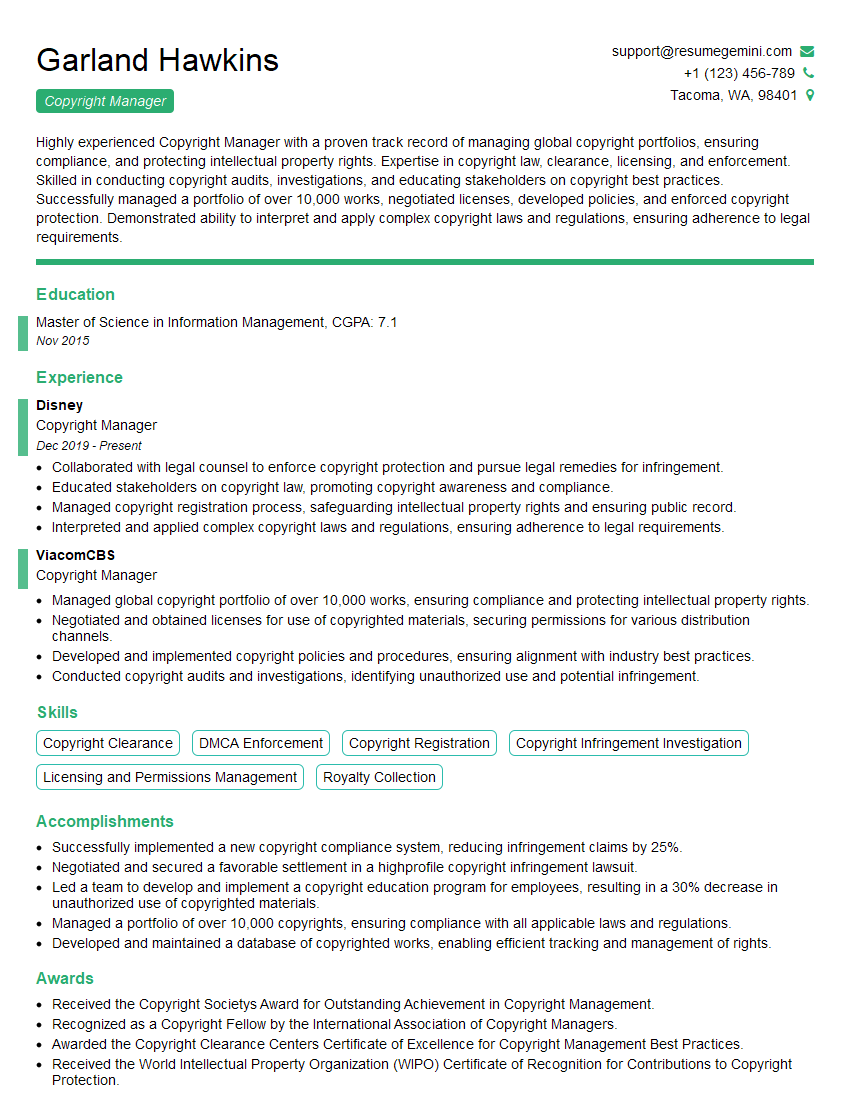
Copyright Manager Resume Sample
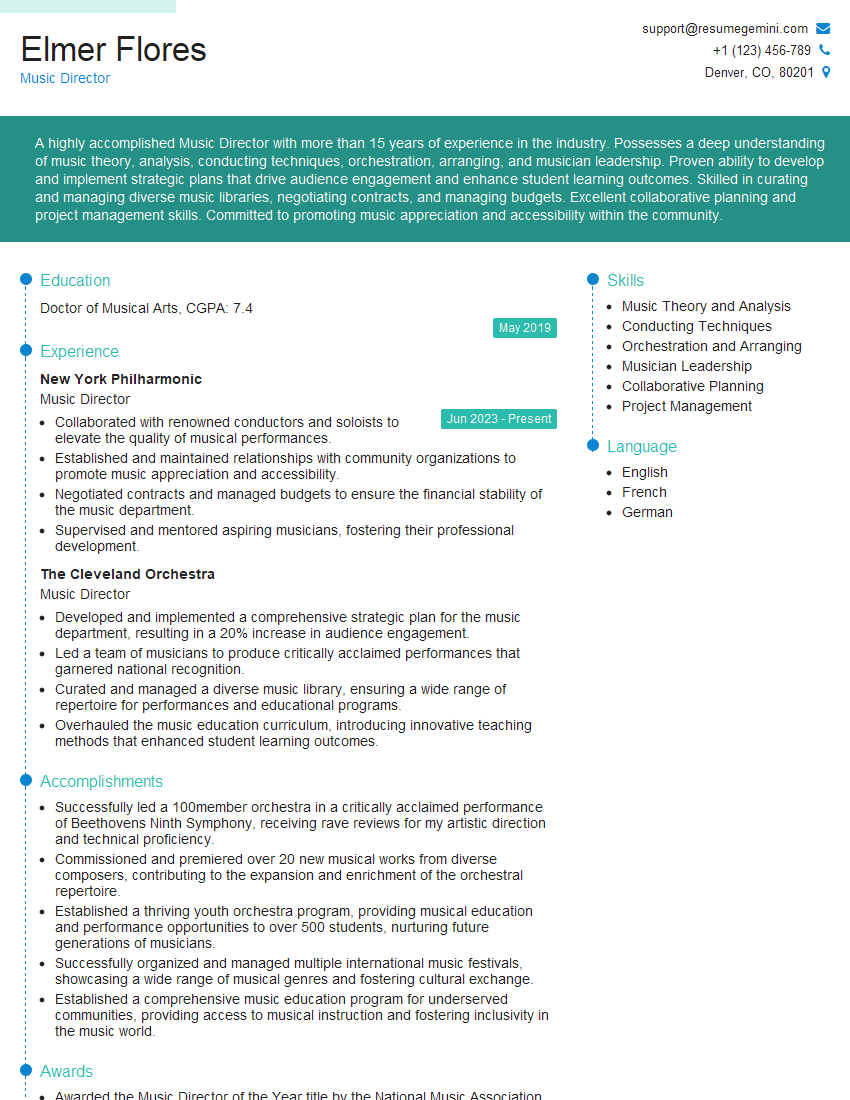
Music Director Resume Sample
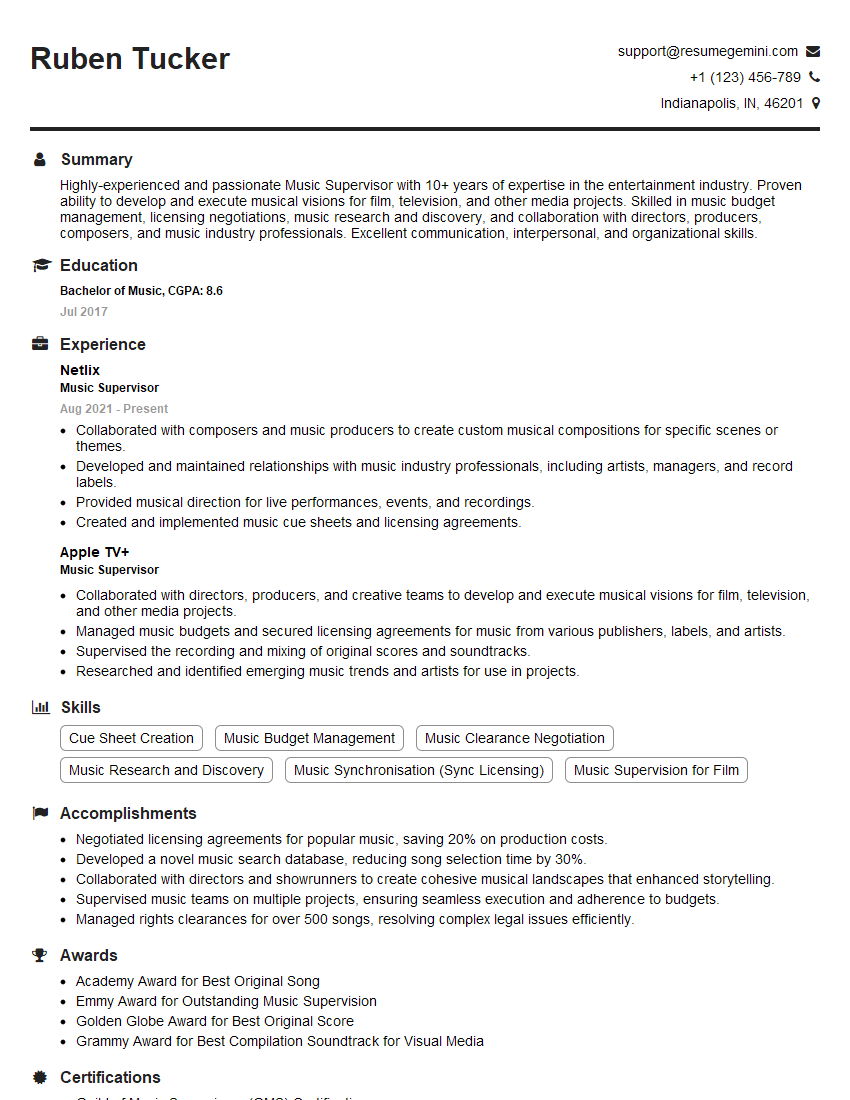
Music Supervisor Resume Sample
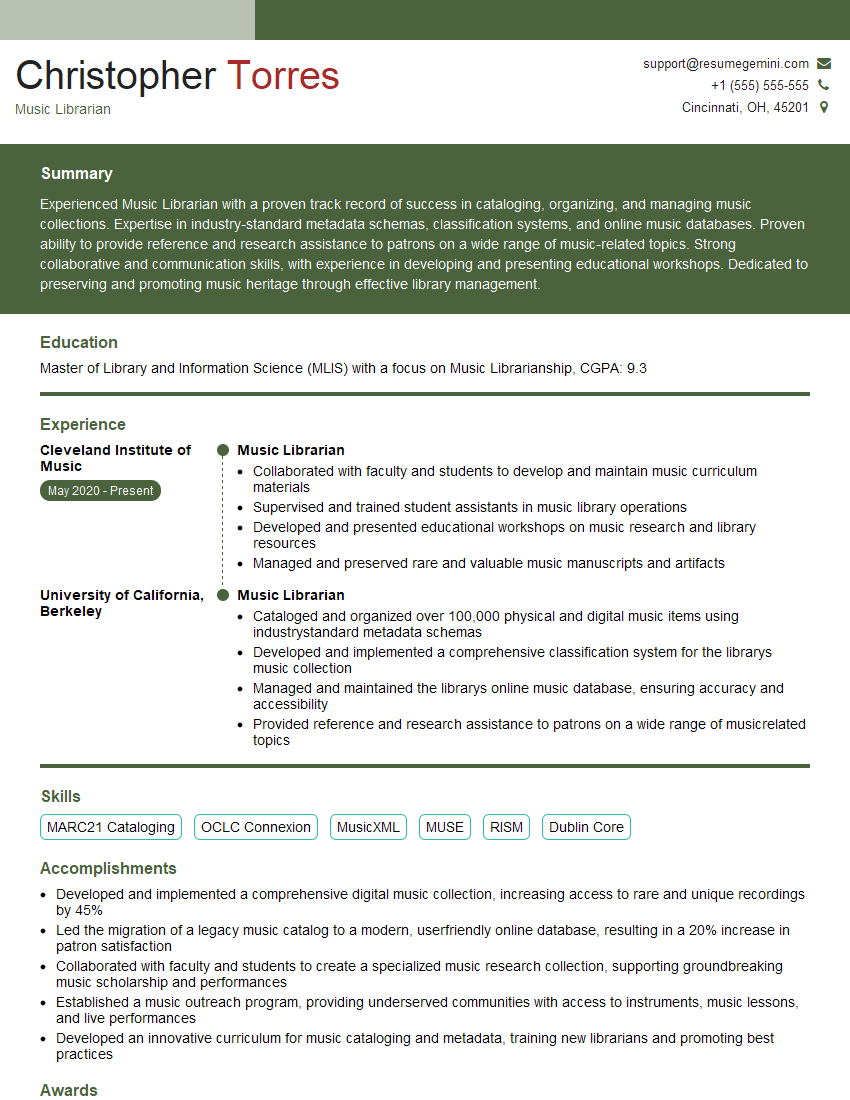
Music Librarian Resume Sample
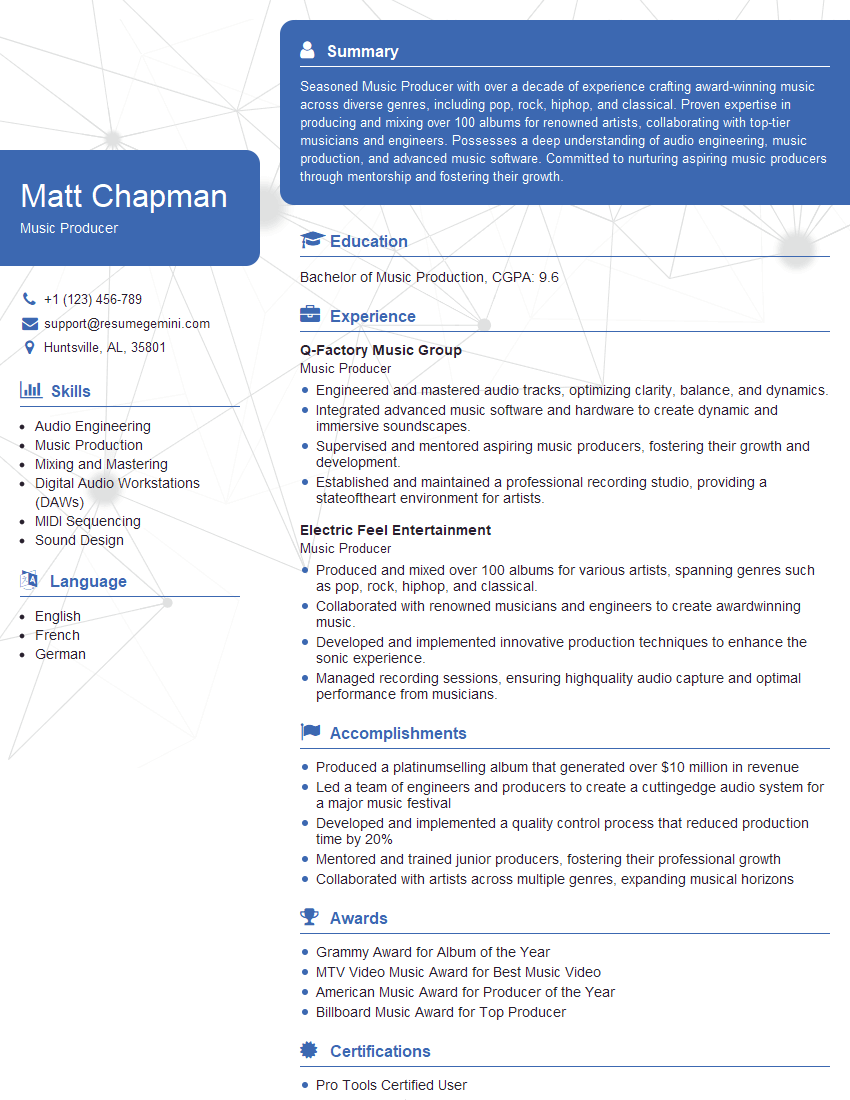
Music Producer Resume Sample
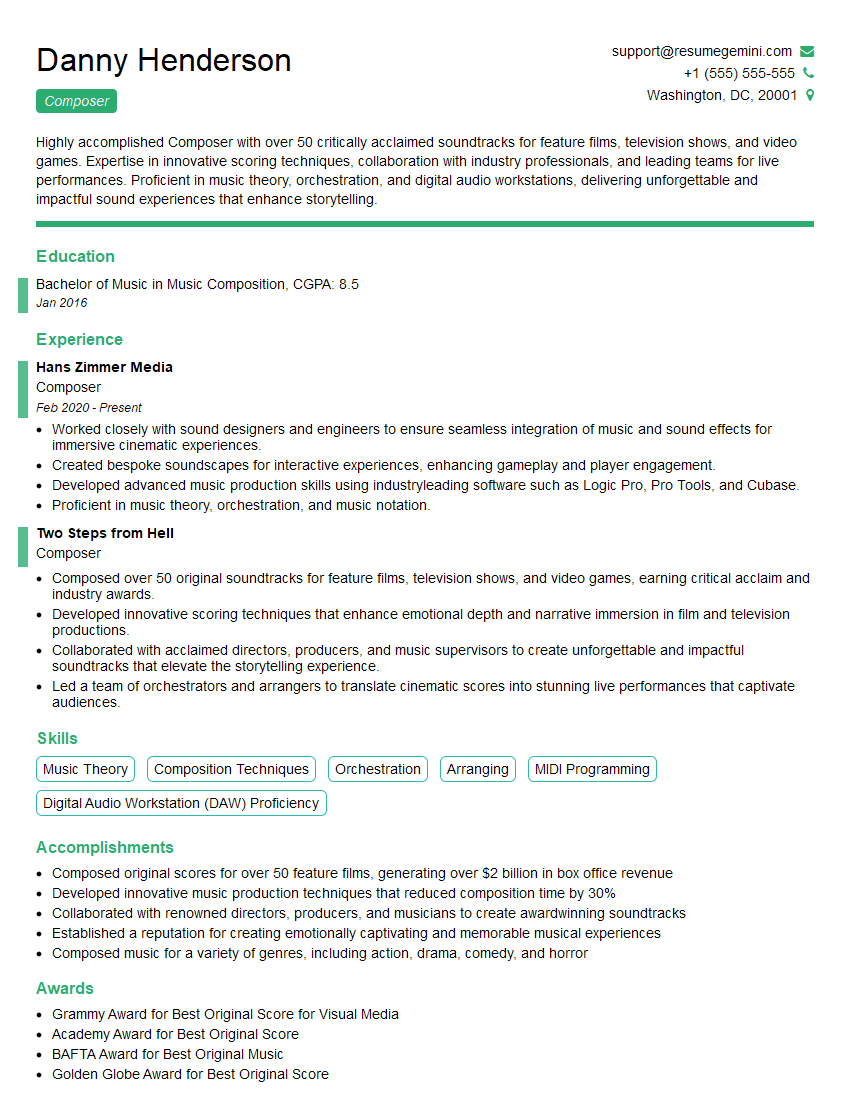
Composer Resume Sample
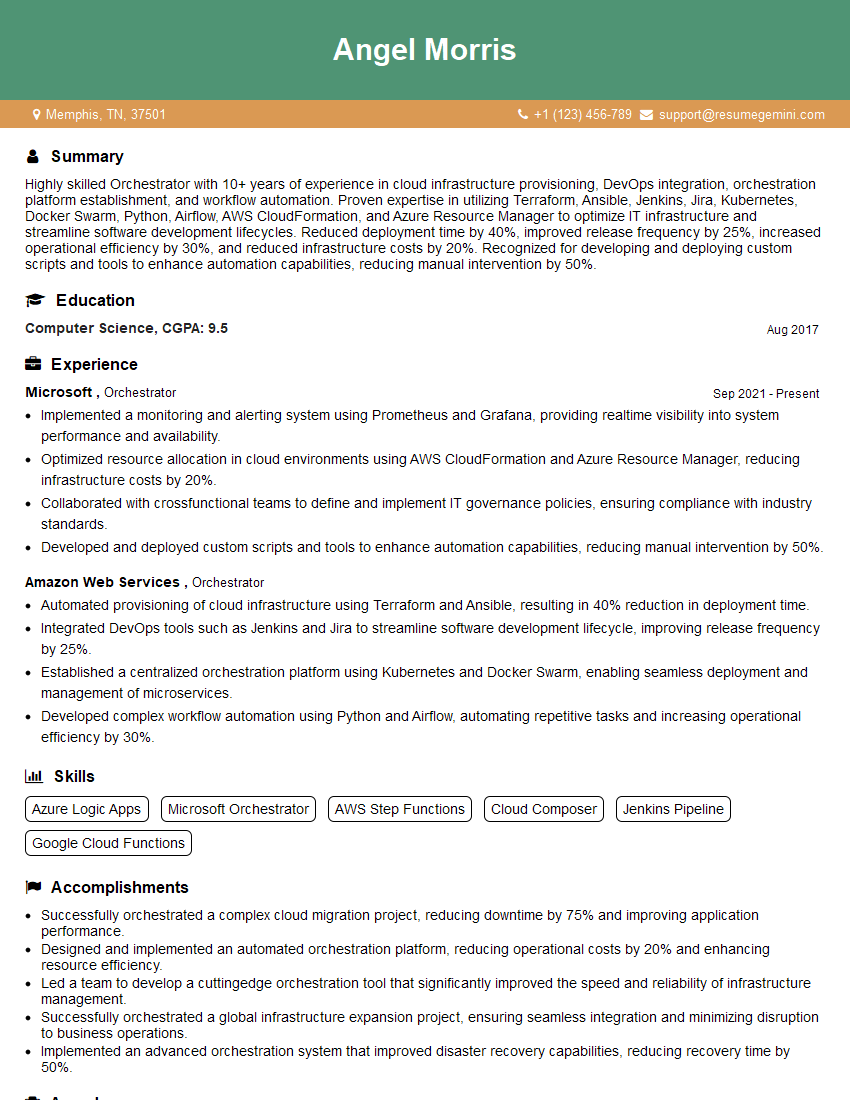
Orchestrator Resume Sample
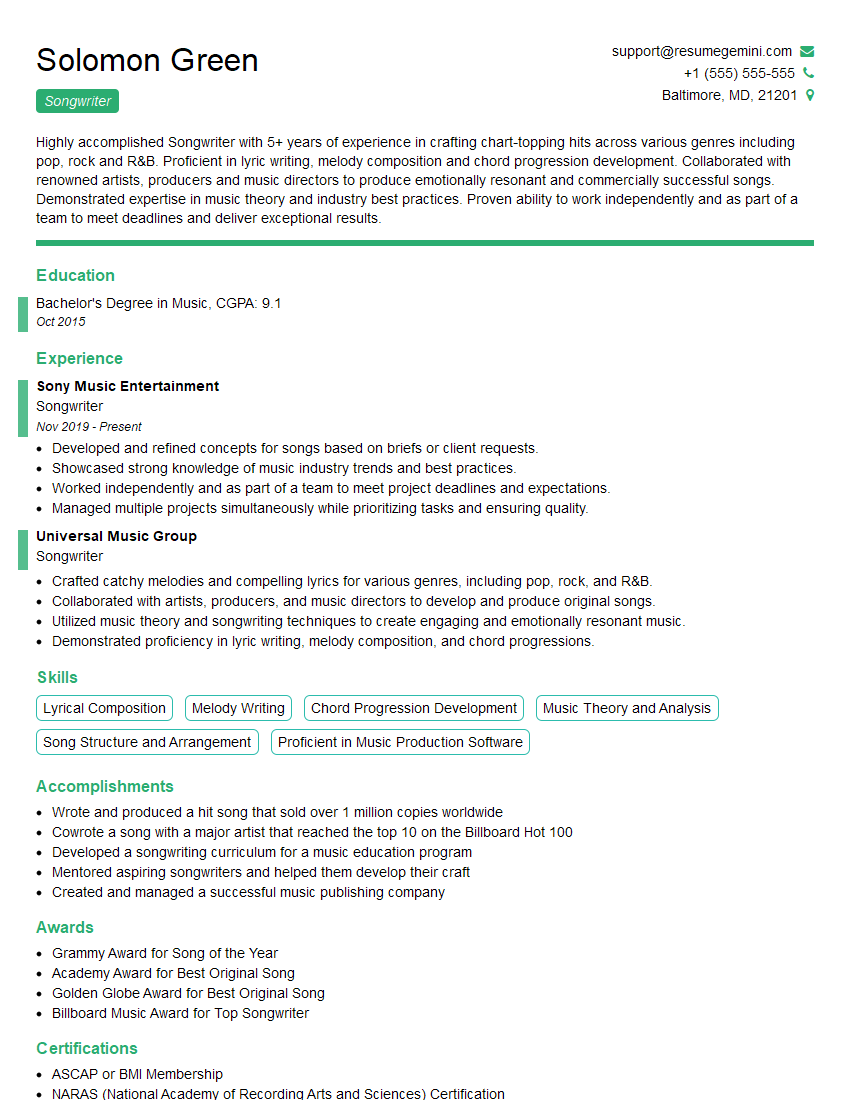
Songwriter Resume Sample
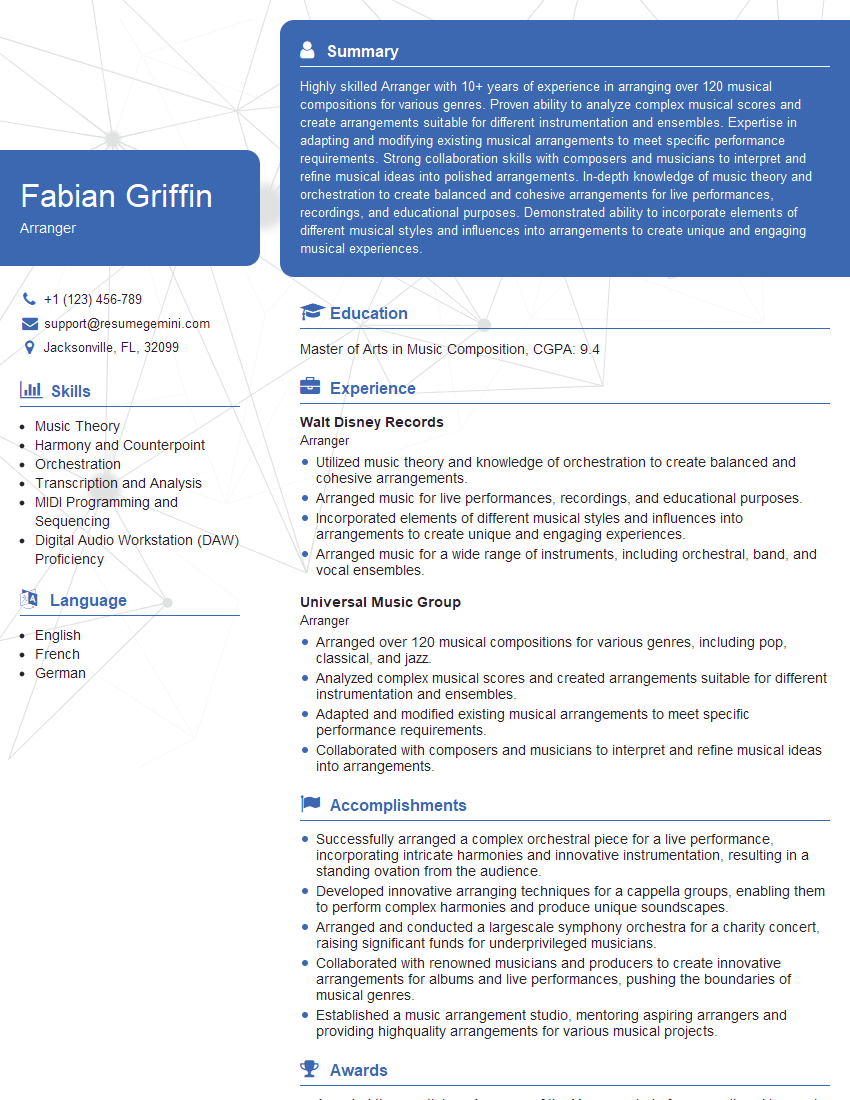
Arranger Resume Sample
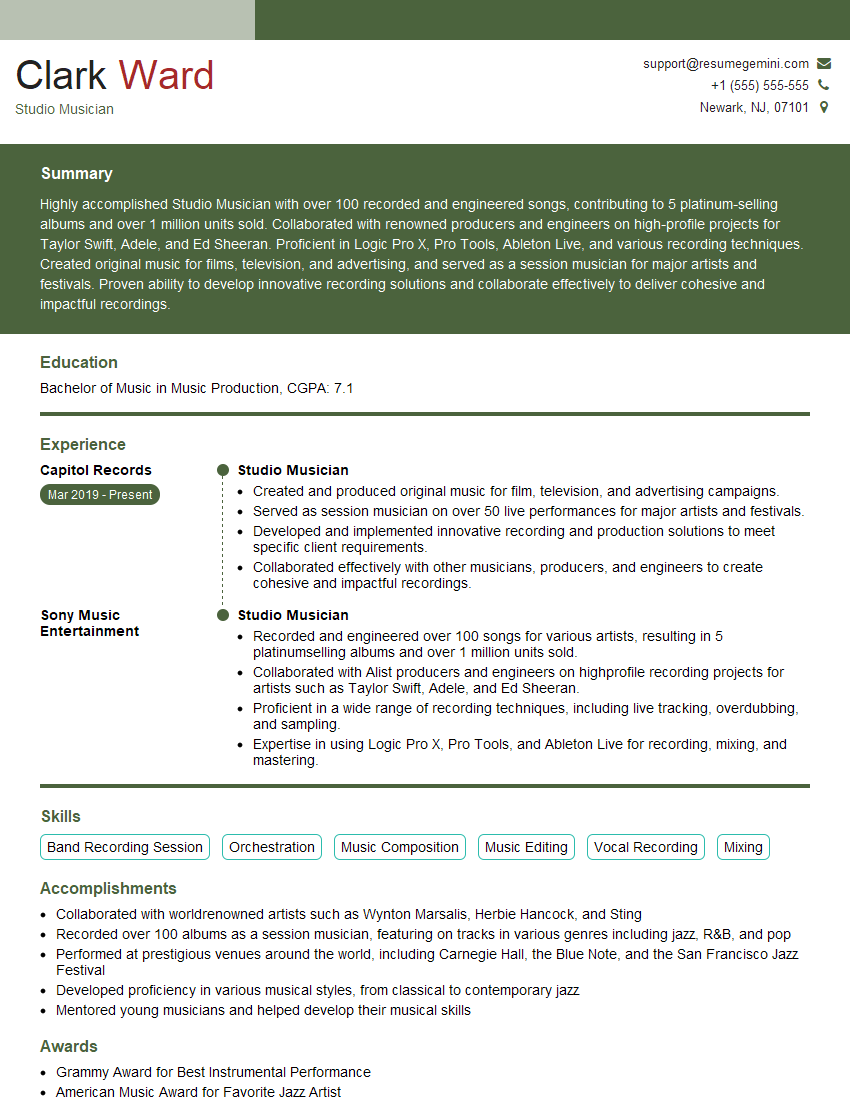
Studio Musician Resume Sample
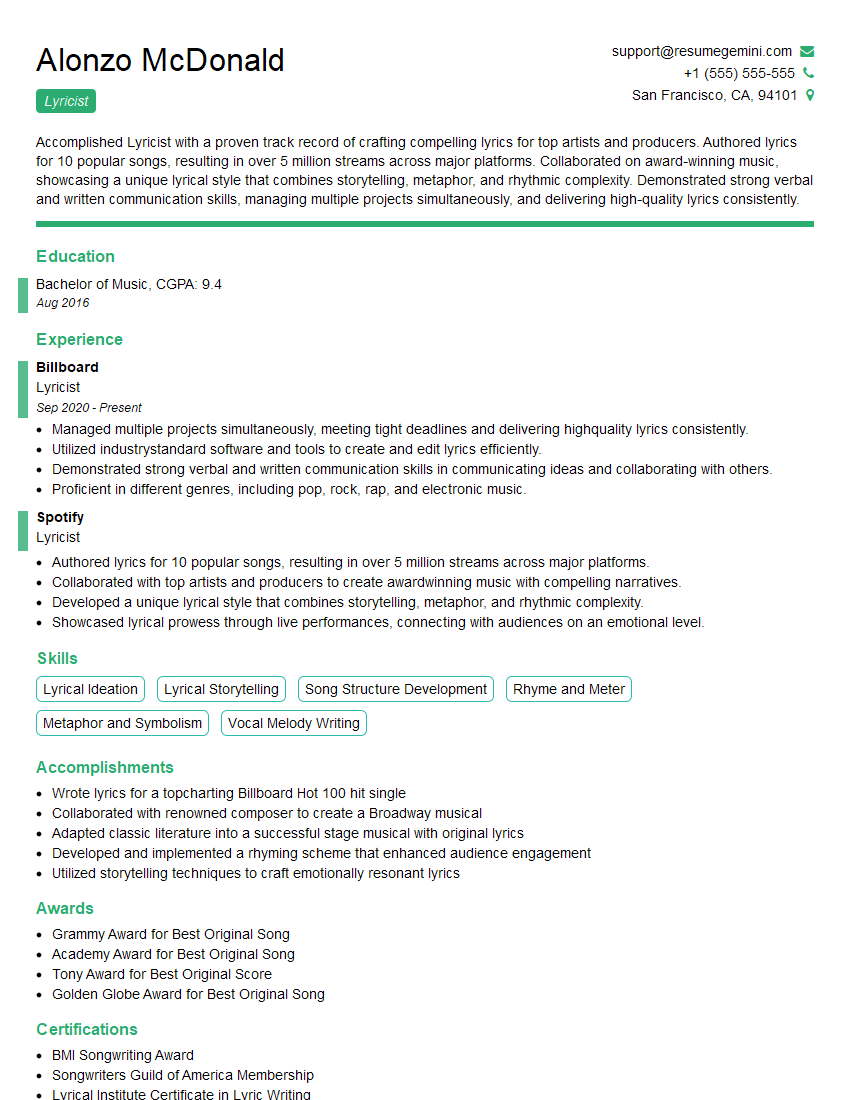
Lyricist Resume Sample
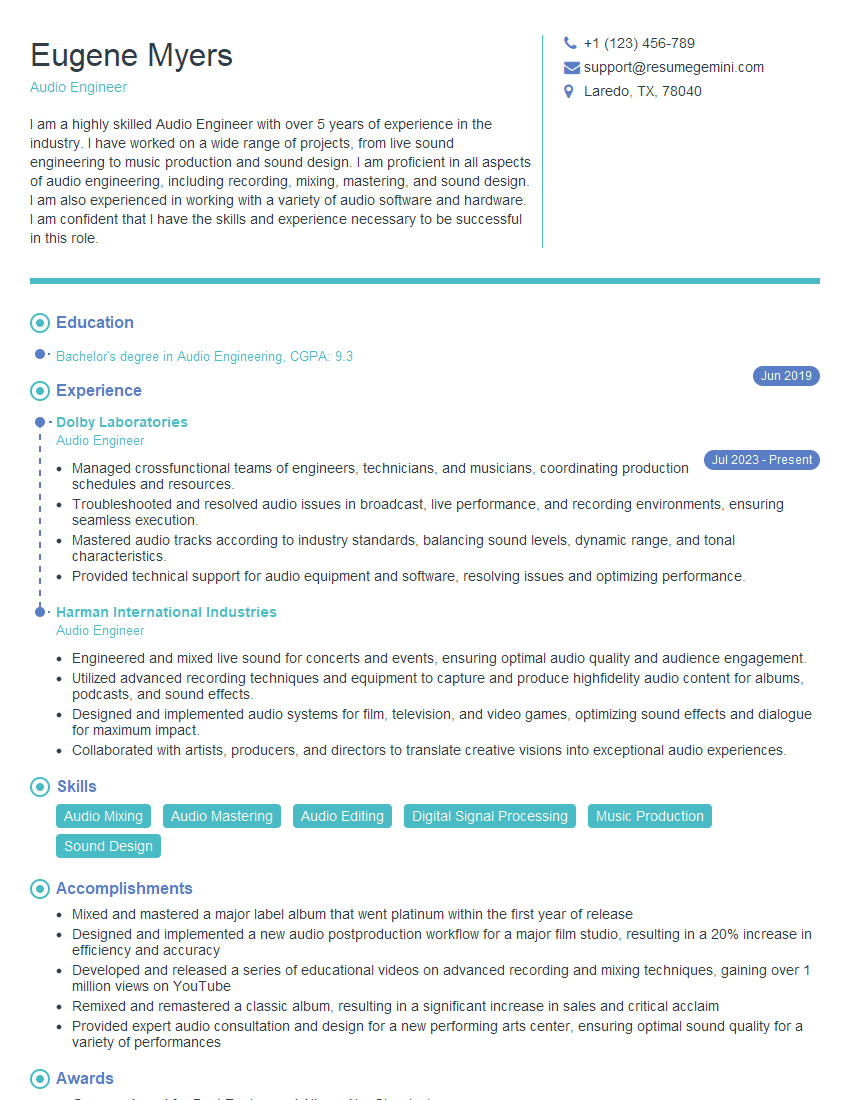
Audio Engineer Resume Sample
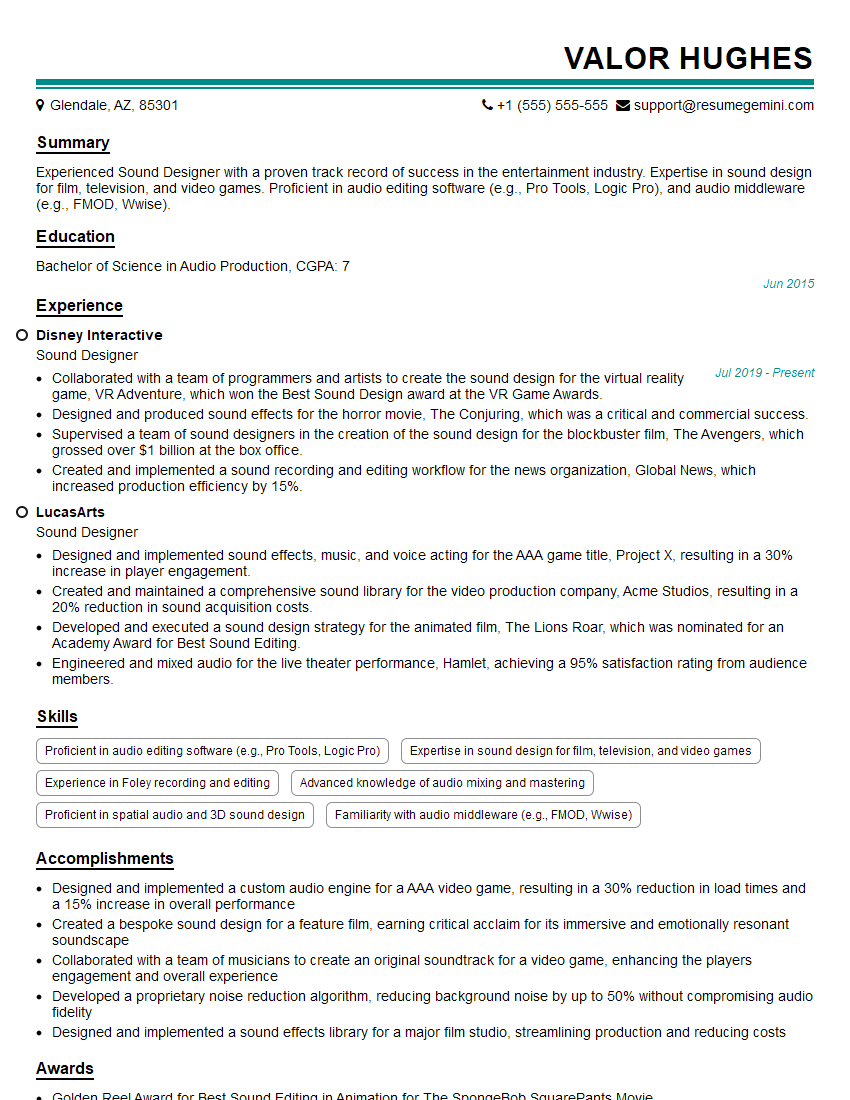
Sound Designer Resume Sample
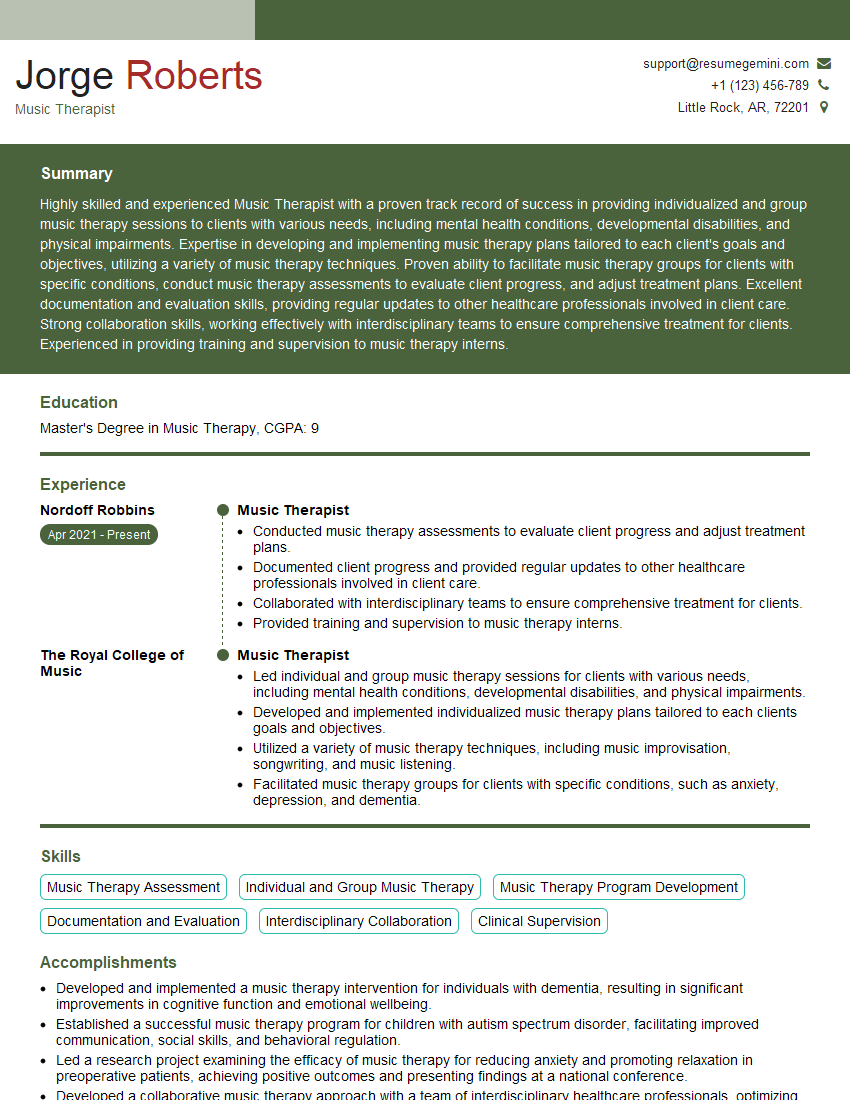
Music Therapist Resume Sample
Explore more articles
Users Rating of Our Blogs
Share Your Experience
We value your feedback! Please rate our content and share your thoughts (optional).
What Readers Say About Our Blog
Very informative content, great job.
good