Unlock your full potential by mastering the most common Sonobuoy Deployment and Analysis interview questions. This blog offers a deep dive into the critical topics, ensuring you’re not only prepared to answer but to excel. With these insights, you’ll approach your interview with clarity and confidence.
Questions Asked in Sonobuoy Deployment and Analysis Interview
Q 1. Describe the different types of sonobuoys and their respective applications.
Sonobuoys are categorized based on their primary function and the type of acoustic sensors they employ. There are several main types:
- DICASS (Directional Command Activated Sonobuoy System): These sonobuoys offer directional hydrophone arrays, allowing for bearing estimation of sound sources. They are particularly useful for pinpointing the location of submarines or other underwater targets.
- DIFAR (Directional Frequency Analysis and Recording): Similar to DICASS, DIFAR sonobuoys provide directional information, but they also offer improved frequency analysis capabilities, aiding in target classification.
- VLF (Very Low Frequency): These sonobuoys use very low-frequency transmissions to communicate with the deploying platform. They are crucial for long-range communication and are often used in conjunction with other sonobuoy types.
- Passive Sonobuoys: These only listen to sounds; they don’t actively emit any signals. They’re excellent for covert surveillance and detecting quiet targets.
- Active Sonobuoys: These sonobuoys emit their own sound signals and then listen for the echoes. This allows them to actively ping and locate targets, similar to sonar.
- Multi-sensor Sonobuoys: Combining multiple sensors, such as hydrophones and magnetometers, these offer enhanced data acquisition and classification capabilities.
The choice of sonobuoy type depends heavily on the mission objectives. For example, a search for a quiet diesel-electric submarine might favor passive DIFAR sonobuoys for directional and frequency information, whereas locating a noisy surface vessel might be easier using a simpler, less expensive passive sonobuoy.
Q 2. Explain the process of sonobuoy deployment, from launch to data reception.
Sonobuoy deployment is a multi-stage process. First, the sonobuoy is launched from an aircraft or ship. Once airborne or dropped from the vessel, the sonobuoy’s parachute deploys, slowing its descent to allow for proper deployment in the water. Upon hitting the water, the sonobuoy’s internal systems activate. It will then transmit a signal back to the deploying platform. This signal indicates that it is functional and providing data. The sonobuoy’s hydrophones begin listening to underwater sounds. This data is then transmitted back to the platform via radio frequency (RF) signals. The received data is processed and displayed in real-time on various consoles which allow analysts to interpret the acoustic information received from the sensor.
Imagine dropping a specialized floating microphone into the ocean. This microphone then sends signals to a nearby listening station detailing the sounds it is picking up. The process is more sophisticated in reality, of course, but this captures the essence of the operation.
Q 3. What are the limitations of sonobuoy technology?
Sonobuoy technology has limitations, including:
- Limited Range: The communication range is limited by the radio frequency signal’s strength and environmental conditions, restricting coverage area.
- Environmental Noise: Ocean noise (shipping, marine life, weather) can mask target sounds, making detection and classification challenging. This is especially true in busy shipping lanes or shallow, noisy waters.
- Limited Battery Life: Sonobuoys have a limited operational lifespan due to battery capacity, restricting mission duration.
- Drift: Sonobuoys drift with ocean currents, making precise target location challenging if not continuously monitored.
- Vulnerability: They are susceptible to damage or premature failure if deployed in harsh conditions or if impacted by debris.
Despite these limitations, advances in signal processing and hydrophone technology are constantly improving sonobuoy capabilities, enabling better performance under challenging conditions.
Q 4. How do environmental factors (e.g., water temperature, salinity) affect sonobuoy performance?
Environmental factors significantly impact sonobuoy performance. Water temperature affects the speed of sound underwater, altering the accuracy of range and bearing estimations. Changes in salinity also affect sound speed, leading to similar inaccuracies. Strong currents can cause the sonobuoy to drift significantly from its intended location, impacting data interpretation and potentially leading to false negatives. High levels of background noise due to factors like rain, waves and shipping traffic reduce the signal-to-noise ratio (SNR), decreasing the ability to detect faint underwater sounds.
Think of it like trying to hear a whisper in a noisy room – the louder the background noise, the harder it is to hear the whisper (the target). Similarly, a noisy environment significantly hampers the ability of sonobuoys to detect and analyze subtle sounds.
Q 5. Explain the concept of passive and active sonobuoys.
Sonobuoys are classified as either passive or active, based on their mode of operation:
- Passive Sonobuoys: These only listen to the sounds propagating in the water. They don’t emit any signals of their own. They rely entirely on the sounds generated by the target for detection. This makes them ideal for covert surveillance, as they do not reveal their presence.
- Active Sonobuoys: These emit their own sound signals (typically a ping) and then listen for the echoes that bounce off objects in the water. This echolocation technique allows active sonobuoys to actively ‘probe’ the environment and detect targets that might not emit sound on their own. However, the emitted sound makes their presence known to potential targets.
The selection of passive or active sonobuoys depends entirely on mission requirements. If covert operation is crucial, passive sonobuoys are preferred; when positive target identification or tracking is more important, active sonobuoys may be the better choice.
Q 6. How do you interpret sonobuoy data to identify and classify underwater targets?
Interpreting sonobuoy data to identify and classify underwater targets involves analyzing the received acoustic signals. Several techniques are employed:
- Signal Detection: The first step is to detect the presence of any signals above the background noise level. Sophisticated algorithms help to isolate potential targets.
- Frequency Analysis: Analyzing the frequency content of the detected signals helps classify the target. Different types of targets (submarines, ships, marine life) produce unique sound signatures based on their machinery, propeller type, and other physical characteristics.
- Bearing Estimation: For directional sonobuoys (DICASS, DIFAR), the bearing to the target can be estimated based on the differences in signal arrival times at different hydrophones. This is crucial for precisely locating the target.
- Time-of-Arrival (TOA) Measurements: By measuring the time it takes for the sound to travel from the target to multiple sonobuoys, the target’s range and location can be triangulated.
- Correlation and Pattern Recognition: Advanced signal processing techniques like matched filtering and pattern recognition algorithms are used to compare received signals against known acoustic signatures in a database to assist in classification.
Experienced analysts use a combination of these techniques, their knowledge of acoustic physics, and their understanding of the operational environment to accurately identify and classify the detected targets. The process is often iterative, with multiple pieces of evidence brought together to form a complete picture.
Q 7. Describe the process of data filtering and noise reduction in sonobuoy analysis.
Data filtering and noise reduction are crucial steps in sonobuoy analysis. The goal is to enhance the signal-to-noise ratio (SNR), making it easier to identify target signals amidst the background noise.
- Spectral Filtering: This technique removes unwanted frequencies from the received data, focusing on the frequency range where the target signal is expected. For instance, a low-pass filter could eliminate high-frequency noise associated with wind and waves.
- Adaptive Filtering: This approach adapts to changes in the noise characteristics, constantly refining the filtering process to optimize signal extraction. This is particularly useful in dynamic environments where the noise level fluctuates significantly.
- Beamforming: This technique combines signals from multiple hydrophones to enhance signals from a particular direction while suppressing noise from other directions.
- Time-Frequency Analysis: Methods like wavelet transforms help in decomposing the signal into different time-frequency components, enabling isolation of intermittent target signals from continuous background noise.
- Advanced Algorithms: Machine learning algorithms are becoming increasingly important in automating aspects of noise reduction and target recognition.
Proper data filtering and noise reduction are critical for accurate interpretation of sonobuoy data. Without these steps, the background noise could easily mask target signals, leading to false negatives or misinterpretations of the received data.
Q 8. What software and tools are commonly used for sonobuoy data analysis?
Sonobuoy data analysis relies on specialized software and tools capable of handling the unique characteristics of underwater acoustic data. These tools often incorporate signal processing techniques to extract meaningful information from the raw acoustic signals.
- Sonar processing software: Packages like MATLAB, with its Signal Processing Toolbox, are commonly used. They allow for filtering, spectral analysis (identifying frequencies), beamforming (combining signals from multiple sensors to improve resolution), and detection algorithms to pinpoint sound sources.
- Specialized Acoustic Analysis Software: Commercial software packages are available specifically designed for acoustic signal processing, often including advanced features for sonobuoy data such as automated target detection and classification. These typically have graphical user interfaces (GUIs) that simplify data visualization and interpretation.
- Data Visualization Tools: Programs like Ocean Data View or custom-built visualization tools are crucial for creating informative plots and graphs of the data. These help in identifying patterns, trends, and anomalies in the acoustic data and its context (e.g., location, time).
For example, we might use MATLAB to apply a fast Fourier transform (FFT) to the raw sonobuoy data to identify the frequency components of the underwater sound, helping us differentiate between different sound sources like submarines, marine life, or environmental noise.
Q 9. How do you handle multiple sonobuoy data streams simultaneously?
Handling multiple sonobuoy data streams simultaneously requires a robust and well-organized approach. Think of it like managing multiple phone calls at once – you need a system to ensure you don’t miss anything important.
- Synchronized Timestamping: Accurate, synchronized timestamps are essential. Each sonobuoy’s data must be precisely time-stamped to allow for proper correlation and analysis across all streams. GPS synchronization is crucial.
- Data Fusion Techniques: These algorithms combine information from different sonobuoys to provide a more complete picture. This might involve beamforming techniques that combine signals from multiple sonobuoys to enhance the accuracy and resolution of the detected sounds.
- Parallel Processing: Modern computers and software can handle parallel processing, allowing simultaneous analysis of data from multiple sources without significant delays.
- Database Management: A well-structured database is crucial for storing and managing the large volumes of data generated by multiple sonobuoys. This allows for efficient retrieval and analysis of specific data sets.
Imagine a scenario tracking a submarine. By synchronizing data from several sonobuoys in a larger area, we can triangulate the submarine’s position much more accurately than with a single buoy.
Q 10. Explain the challenges of sonobuoy deployment in various sea states.
Sea state significantly impacts sonobuoy deployment and data quality. Think of it like trying to throw a dart in a windstorm – the more turbulent the water, the harder it is to be accurate and get good results.
- Wave Action: High seas create challenging conditions for deployment. Strong waves can damage the buoy or cause it to drift from its intended location, leading to inaccurate sound localization.
- Currents: Strong ocean currents can affect the buoy’s position and the propagation of sound waves, introducing errors into range estimations and bearing calculations.
- Water Depth: The depth of the water influences the characteristics of sound propagation, affecting signal strength and clarity. Shallow water can cause multipath propagation (sound bouncing off the surface and bottom), which can complicate data analysis.
- Noise Levels: Rough seas produce more background noise, which can mask weaker sound signals from the target, reducing the effectiveness of the sonobuoy.
Deployment strategies, such as using heavier buoys or specialized deployment techniques, need to be adjusted based on sea conditions to improve data reliability.
Q 11. What safety procedures are essential during sonobuoy deployment?
Safety is paramount during sonobuoy deployment. The process involves operating in a marine environment, requiring adherence to strict safety protocols to prevent accidents and ensure the well-being of personnel and equipment.
- Vessel Safety Procedures: All crew members must follow standard maritime safety procedures, including the use of personal flotation devices (PFDs), appropriate clothing, and adherence to the vessel’s safety regulations.
- Communication Protocols: Clear communication channels must be established between the deployment team, the vessel’s bridge, and other relevant parties. This ensures coordinated actions and prevents mishaps during deployment.
- Environmental Awareness: Awareness of the surrounding environment, including weather conditions, currents, and the presence of other vessels, is critical to prevent collisions and other incidents.
- Proper Handling of Equipment: Sonobuoys and their deployment mechanisms must be handled carefully to avoid damage. Regular equipment inspections and maintenance are crucial.
- Emergency Procedures: Pre-planned emergency procedures must be in place to address potential accidents or malfunctions during deployment. These could involve rescuing personnel or recovering the malfunctioning equipment.
A thorough risk assessment should be carried out before each deployment to identify and mitigate potential hazards.
Q 12. How do you ensure the accuracy and reliability of sonobuoy data?
Ensuring the accuracy and reliability of sonobuoy data requires a multi-faceted approach, addressing both the physical aspects of deployment and the data processing techniques used for analysis.
- Calibration: Regular calibration of sonobuoys is essential. This verifies that their sensors are accurately measuring sound pressure levels and frequencies.
- Environmental Corrections: Data must be corrected for environmental factors that can affect sound propagation, such as water temperature, salinity, and depth. Sophisticated models are often used for these corrections.
- Quality Control: Rigorous quality control procedures are implemented to detect and filter out noisy or erroneous data. Automated detection algorithms and manual review by trained analysts are frequently used.
- Data Validation: Multiple data sources, when available, should be cross-referenced to validate the accuracy of sonobuoy data. Comparing the sonobuoy data with other sensor information (e.g., from a ship’s sonar) can significantly enhance confidence in the results.
- Data Uncertainty Analysis: A proper estimation of uncertainty is crucial. This helps determine the confidence level associated with the measurements and their interpretations.
For instance, a discrepancy between the sonobuoy’s detected bearing and the ship’s radar might indicate an error, prompting further investigation into the potential sources of inaccuracy.
Q 13. Describe the process of calibrating and maintaining sonobuoys.
Calibration and maintenance of sonobuoys are crucial for ensuring the accuracy and reliability of the data they collect. Think of it like regular checkups for a car – preventative maintenance keeps it running smoothly and accurately.
- Pre-Deployment Calibration: Before deployment, sonobuoys undergo rigorous calibration checks in a controlled environment to verify the accuracy of their sensors and ensure they are functioning as designed. This often involves comparing their readings against known standards.
- Post-Deployment Analysis: Analysis of the data itself can provide insight into the health of the sonobuoy. Anomalies in the data might indicate a problem requiring further investigation.
- Periodic Maintenance: Sonobuoys may require periodic maintenance, such as cleaning or replacing components, depending on the frequency and conditions of use. This prevents degradation over time and maintains data quality.
- Storage and Handling: Proper storage and handling techniques are crucial. Improper storage can damage the delicate sensors, affecting their accuracy and lifespan.
Calibration involves using specialized equipment to check sensor sensitivity, frequency response, and other critical parameters. The process is documented meticulously, providing a history of the buoy’s performance.
Q 14. Explain the concept of sonobuoy array deployment and its benefits.
A sonobuoy array deployment involves using multiple sonobuoys strategically placed to create a network of sensors that work together to provide improved detection, localization, and classification of underwater acoustic sources.
- Enhanced Accuracy: By using multiple sonobuoys, it’s possible to triangulate the position of a sound source much more accurately than using a single buoy. This improves the precision of localization.
- Improved Detection: The combined coverage of an array increases the probability of detecting a target, especially if it’s quiet or moving quickly.
- Beamforming: Advanced signal processing techniques like beamforming can combine signals from multiple sonobuoys to create higher-resolution images of underwater sound sources.
- Noise Cancellation: Some noise sources might be localized and cancelled out using techniques that take advantage of the relative positions of the sonobuoys.
Imagine searching for a needle in a haystack. One sonobuoy is like a single person searching. An array is like a team working together, significantly increasing the chance of finding the needle quickly and accurately.
Q 15. How do you troubleshoot malfunctions in sonobuoy systems?
Troubleshooting sonobuoy malfunctions requires a systematic approach. First, we need to identify the type of malfunction: is it a deployment issue, a data acquisition problem, or a communication failure?
Deployment Issues: These might involve the buoy failing to deploy correctly (e.g., getting stuck in the launcher, failing to activate), or a failure of the parachute to properly deploy. Troubleshooting involves checking the launcher mechanism, examining the buoy for physical damage, and reviewing deployment logs. Sometimes a simple visual inspection and a quick check of the deployment sequence will suffice.
Data Acquisition Problems: If the buoy deploys but doesn’t transmit data, we need to check the buoy’s internal sensors, battery, and the communication link. We can use diagnostic tools provided by the buoy manufacturer to check the internal status of the unit. Signal strength and interference issues are common culprits; we’d check for nearby vessels or environmental factors affecting signal propagation.
Communication Failures: This could be due to range limitations, interference from other signals, or problems with the receiving equipment. We would check antenna settings, ensure appropriate frequencies are being used, and investigate possible sources of electromagnetic interference. Working with the signal processing and communication engineers is essential to resolve complex transmission issues.
Example: During a recent exercise, a sonobuoy failed to transmit data. Initial checks indicated the buoy had deployed correctly. We then used diagnostic software to remotely query the buoy; this revealed a low battery voltage. Once we replaced the affected buoys, the problem resolved.
Career Expert Tips:
- Ace those interviews! Prepare effectively by reviewing the Top 50 Most Common Interview Questions on ResumeGemini.
- Navigate your job search with confidence! Explore a wide range of Career Tips on ResumeGemini. Learn about common challenges and recommendations to overcome them.
- Craft the perfect resume! Master the Art of Resume Writing with ResumeGemini’s guide. Showcase your unique qualifications and achievements effectively.
- Don’t miss out on holiday savings! Build your dream resume with ResumeGemini’s ATS optimized templates.
Q 16. Describe your experience with different types of sonobuoy deployment platforms.
My experience encompasses a wide range of sonobuoy deployment platforms, including fixed-wing aircraft (P-3 Orion, P-8 Poseidon), helicopters (MH-60R, SH-60B), and surface vessels. Each platform presents unique challenges and advantages.
Fixed-Wing Aircraft: These provide the widest coverage area and are ideal for large-scale searches. However, the deployment process requires precise coordination and careful consideration of altitude, airspeed, and the trajectory of the aircraft during the drop.
Helicopters: Helicopters allow for more agile and precise deployments, particularly in challenging environments, offering better maneuverability for targeting specific areas. The lower altitude allows for shorter ranges and better environmental monitoring in relation to the location of the acoustic event
Surface Vessels: Sonobuoy deployment from surface vessels is more straightforward. It’s generally suitable for near-shore operations and localized searches, but it’s limited in range compared to airborne platforms.
Example: In one operation, a helicopter was critical for rapidly deploying sonobuoys around a suspected submarine contact in a narrow strait, which was impossible to achieve with a fixed-wing aircraft due to the confined airspace.
Q 17. How do you interpret bearing and range data from sonobuoys?
Interpreting bearing and range data from sonobuoys involves understanding the limitations of the technology and considering various environmental factors. The data provides a relative position of the sound source (e.g., a submarine) with respect to the sonobuoy.
Bearing: This indicates the direction of the sound source relative to the sonobuoy’s location. Multiple sonobuoys are needed to triangulate the source’s position (similar to using rangefinders). Accuracy depends on several factors, including environmental noise, the speed of sound in water, and the accuracy of the buoy’s orientation.
Range: This represents the estimated distance between the sonobuoy and the sound source, determined by analyzing the sound’s time of arrival (toa) at the buoy and the speed of sound. The accuracy is limited by factors like the signal-to-noise ratio and sound speed variations in water.
Triangulation: We plot the bearing data from multiple sonobuoys on a chart to determine the likely location of the sound source. A higher number of buoys improves accuracy. Range data further refines the position. Advanced algorithms account for errors inherent in the system.
Example: If Sonobuoy 1 detects a bearing of 30 degrees and Sonobuoy 2 detects a bearing of 150 degrees, the sound source would likely be located at the intersection of these two bearings. Combining this with range data provides a much more precise estimate of the target’s position.
Q 18. What is your experience with using sonobuoy data to create tactical pictures?
Creating a tactical picture from sonobuoy data is a crucial aspect of my work. This involves integrating sonobuoy information with other intelligence sources, such as radar, satellite imagery, and electronic warfare data.
The process begins by analyzing the bearing and range data from individual sonobuoys. This raw data is then correlated to construct a time-space history of the acoustic contacts. We account for uncertainties and potential errors in the data. Sophisticated software assists in plotting the data and visualizing the likely locations of the contacts.
Integration with Other Data: Next, we integrate this acoustic information with other relevant data. For instance, if radar detects a surface vessel in the vicinity of a detected acoustic contact, this corroborates the acoustic data and enhances the tactical picture. The integration of such diverse data sources helps build a more comprehensive understanding of the operational environment.
Example: During an anti-submarine warfare exercise, we used sonobuoy data to track a simulated submarine’s movements. By integrating this information with radar data, which tracked surface ships’ activities, we developed a realistic tactical picture of the exercise.
Q 19. How do you communicate sonobuoy findings to other team members?
Communicating sonobuoy findings effectively is essential for coordinating actions among team members. Different methods are used based on the context and urgency.
Real-time Communication: During active operations, voice communication (using established protocols) is crucial. Clear and concise reporting of bearings, ranges, and contact types ensures rapid response. We use established terminology to avoid confusion.
Graphical Displays: Real-time graphical displays in the tactical operations center allow all team members to visualize the sonobuoy data and the developing tactical picture simultaneously. This fosters better understanding and allows for faster decision making.
Formal Reports: After the operation, we provide formal written reports which include a detailed summary of the sonobuoy data, its interpretation, and the resulting tactical picture. This documented information serves as a valuable record for future analysis and training.
Example: While tracking a submarine contact, I would use a combination of voice communication to report initial detections and then supplement this with graphical displays for providing ongoing updates, allowing commanders and other analysts to form an accurate and clear picture.
Q 20. Explain the importance of data logging and record-keeping in sonobuoy operations.
Data logging and record-keeping are paramount in sonobuoy operations. This ensures accountability, facilitates post-mission analysis, and allows for improvement of operational procedures and data processing techniques.
Accountability: Maintaining detailed logs of buoy deployments, data received, and any associated malfunctions aids in understanding the overall effectiveness of the mission. It allows for identifying potential problems and areas needing improvement.
Post-Mission Analysis: Detailed records enable thorough post-mission analysis. This often reveals previously undetected patterns, improves tactical algorithms, and validates or refines models of underwater sound propagation.
Training and Improvement: Analyzing data from past operations helps improve training programs and develop more effective operational procedures. It highlights areas where training may need improvement or new operational procedures can enhance effectiveness.
Example: By reviewing logs of past sonobuoy deployments, we noticed a recurring issue with buoy malfunctions under specific environmental conditions. This led to adjustments in deployment procedures and an improvement in overall mission success rates.
Q 21. Describe your understanding of the acoustic propagation characteristics of different water bodies.
Understanding acoustic propagation characteristics in different water bodies is critical for accurately interpreting sonobuoy data. Water temperature, salinity, and depth significantly affect the speed and direction of sound waves.
Temperature Gradients: Sound travels faster in warmer water. Temperature gradients (changes in temperature with depth) can cause sound waves to refract (bend), leading to unexpected propagation paths. This ‘sound channel’ effect can sometimes enable detection of targets beyond the expected range.
Salinity: Salinity affects sound speed similarly to temperature, and in coastal areas with river influences, the resulting salinity gradients have a large impact on sound propagation. Highly saline water typically transmits sound faster than less saline water.
Depth: Water depth directly influences the propagation of sound. Shallow water environments may exhibit significant bottom reflections, while deep water environments might exhibit complex sound propagation due to multiple reflections and refraction. The seabed’s composition also affects propagation.
Example: In a deep ocean environment, a sound channel can focus sound energy, extending the detection range of the sonobuoys. Conversely, in a shallow, highly turbid coastal region, the multiple reflections off the seabed could lead to noisy signal quality and inaccurate range measurements.
Q 22. How do you identify and mitigate false positives in sonobuoy data?
Identifying and mitigating false positives in sonobuoy data is crucial for accurate underwater surveillance. False positives, often caused by environmental noise (like marine mammals or seismic activity), can lead to wasted resources and inaccurate targeting. My approach involves a multi-layered strategy.
Sophisticated Filtering Techniques: I utilize advanced signal processing algorithms to filter out background noise based on frequency, amplitude, and temporal characteristics. This often involves techniques like matched filtering, beamforming, and adaptive noise cancellation. For example, I might use a frequency band-pass filter to isolate the expected frequency range of a target submarine’s propeller noise while eliminating higher-frequency noise from marine life.
Data Fusion and Cross-Correlation: Integrating data from multiple sonobuoys deployed in a coordinated pattern allows for cross-referencing and triangulation of signals. If a potential target is only detected by one sonobuoy, the probability of a false positive is higher. Cross-correlation helps verify the consistency and origin of the detected signal.
Contextual Analysis: I incorporate knowledge of the operational environment. Understanding the geographical area (e.g., known shipping lanes, presence of marine life) and historical data allows me to assess the likelihood of a detected signal representing a real submarine threat rather than a natural or man-made phenomenon. For instance, a strong signal consistent with a submarine’s profile detected in a known submarine operating area holds more weight than a weak, ambiguous signal detected in a busy shipping lane.
Operator Expertise: Human interpretation remains a critical component. My experience allows me to interpret data patterns and identify anomalies that automated systems might miss. Combining automated filtering with skilled human analysis is paramount for accuracy.
Q 23. What are some common errors in sonobuoy deployment and analysis?
Common errors in sonobuoy deployment and analysis stem from various sources, impacting the accuracy and reliability of the collected data. These can include:
Improper Buoy Deployment: Incorrect depth setting, faulty release mechanism, or inadequate spacing between buoys can compromise data quality. For instance, deploying a buoy too close to the surface may lead to significant surface noise contamination.
Environmental Factors: Strong currents, sea state, and unpredictable weather conditions can affect buoy performance and data acquisition. Heavy waves could damage the buoy or disrupt acoustic propagation.
Equipment Malfunctions: Sensor failures, battery depletion, or communication issues can lead to incomplete or corrupted data. Regular maintenance and pre-deployment checks are vital to mitigate this risk.
Analysis Errors: Incorrect interpretation of data, neglecting environmental corrections, or applying inappropriate signal processing algorithms can lead to inaccurate conclusions. Overlooking the influence of sea temperature and salinity on sound propagation, for example, can greatly impact target localization.
Lack of Coordination: Insufficient coordination between deployment teams, data analysts, and operational commanders can result in delays, misunderstandings, and missed opportunities.
Q 24. Explain your familiarity with relevant military and maritime regulations and standards.
My familiarity with military and maritime regulations and standards is extensive. I have a deep understanding of international maritime law, including regulations on safe navigation and environmental protection. I am well-versed in various military doctrines and procedures relevant to anti-submarine warfare (ASW) operations, including:
Operational Security (OPSEC): I understand the importance of maintaining confidentiality and protecting sensitive ASW information.
Communications Protocols: I am proficient in communicating data and analysis securely and efficiently within the military chain of command.
Safety Regulations: I am aware of all safety protocols concerning sonobuoy deployment and handling, including risk assessment and mitigation measures. I understand regulations concerning the potential impact on marine life.
Data Handling and Classification: I follow strict procedures for classifying, storing, and managing sensitive ASW data according to military standards and guidelines.
This background ensures that my analysis and recommendations always comply with applicable regulations and best practices, minimizing risks and maximizing operational effectiveness.
Q 25. How do you integrate sonobuoy data with other sensor systems?
Integrating sonobuoy data with other sensor systems is crucial for enhancing situational awareness and improving the accuracy of ASW operations. I have extensive experience in fusing data from various sources, including:
Sonar Systems (Active and Passive): Combining sonobuoy data with data from ship-based sonar systems provides a more comprehensive underwater picture. This allows for confirmation of contacts and improved target tracking.
Radar Systems: Integrating radar data can help identify surface vessels that may be associated with submarines. For example, a radar contact indicating a surface ship might be followed up by sonobuoy deployment to search for a nearby submarine.
Magnetic Anomaly Detectors (MAD): MADs detect subtle magnetic anomalies associated with submarines. Combining MAD data with sonobuoy information provides complementary information for confirming submarine presence.
Environmental Sensors: Sea temperature, salinity, and current data influence sound propagation and are integrated to improve the accuracy of sonobuoy data processing.
Data fusion techniques, such as Bayesian networks or Kalman filtering, are employed to combine information from different sensors, leading to more robust and reliable detection and tracking of underwater targets.
Q 26. Describe your experience with data visualization techniques for sonobuoy data.
Effective data visualization is essential for quickly understanding complex sonobuoy data. I utilize a variety of techniques to present information clearly and concisely to decision-makers. This includes:
Interactive 3D Plots: These allow for visualizing the location and characteristics of detected sound sources in a three-dimensional space. This is especially valuable for interpreting data from multiple sonobuoys and understanding the relative positions of targets and sensors.
Sonograms and Spectrograms: These visual representations of sound frequencies over time provide detailed information about the characteristics of detected signals. Changes in frequency or amplitude can help identify different types of underwater vessels or other sound sources.
Geographic Information Systems (GIS): Mapping sonobuoy locations and detected targets on a geographical map helps to understand the spatial context of underwater events.
Heatmaps: These graphical representations of data density can reveal areas of high acoustic activity, potentially indicating important targets or areas of interest.
Custom Dashboards: I create custom dashboards providing a consolidated view of all relevant data, including real-time updates from sonobuoys, other sensors, and situational information.
The choice of visualization technique depends on the specific information being conveyed and the target audience. My focus is always on clarity, accuracy, and effective communication of critical information.
Q 27. Explain how sonobuoy data is used to support decision-making in anti-submarine warfare.
Sonobuoy data is fundamental to effective anti-submarine warfare (ASW) decision-making. It provides critical information for:
Target Detection and Localization: Sonobuoys detect and locate submarines using passive acoustic sensing, identifying their approximate position and speed.
Classification: Analysis of the acoustic signatures detected by sonobuoys can help classify the detected target, distinguishing between different types of submarines or other underwater objects. The specific frequency and intensity patterns of the detected noise can be compared against databases of known acoustic signatures.
Tracking and Pursuit: Continuous monitoring of a target’s acoustic signature enables tracking its movement over time. This information is relayed to other ASW assets to support pursuit and engagement.
Weapon Targeting: Accurate sonobuoy data helps guide the deployment of anti-submarine weapons, maximizing the effectiveness of attacks.
Strategic Planning: Information gathered from sonobuoy deployments helps assess the effectiveness of ASW strategies and tactics. This allows for continuous improvement of ASW operations.
By providing real-time situational awareness, sonobuoy data enables timely and informed decisions within the ASW operations, greatly increasing the chances of successful mission outcomes.
Q 28. Describe your experience with the post-processing and analysis of sonobuoy data
Post-processing and analysis of sonobuoy data is a critical step in extracting valuable intelligence from raw acoustic signals. My experience includes:
Data Cleaning and Preprocessing: This involves removing noise and artifacts from the raw data, using various techniques such as filtering and calibration. I check for inconsistencies and potential errors that might have occurred during data transmission or acquisition.
Signal Processing: I apply advanced signal processing techniques like beamforming, spectral analysis, and matched filtering to enhance the detection and classification of targets. This involves interpreting frequency, amplitude, and time characteristics of the sounds detected.
Target Detection and Tracking: I use algorithms to identify potential targets within the processed data, determining their location, course, and speed. This often involves correlation with data from other sensors.
Classification and Identification: I analyze the acoustic characteristics of the detected signals to classify them and possibly identify the type of vessel or underwater object generating the sound. Libraries of reference acoustic signals are used for comparison.
Report Generation: Finally, I generate detailed reports summarizing the analysis, including visualizations, conclusions, and recommendations. These reports are tailored to the specific needs of the stakeholders, ranging from technical summaries for specialists to executive summaries for commanders.
Throughout the post-processing and analysis, quality control and rigorous verification methods are employed to ensure the accuracy and reliability of results.
Key Topics to Learn for Sonobuoy Deployment and Analysis Interview
- Sonobuoy Fundamentals: Understanding Sonobuoy types, their operational principles (active vs. passive), and limitations.
- Deployment Strategies: Mastering various deployment methods (e.g., aircraft, surface vessels), optimizing deployment patterns for different operational scenarios, and understanding the impact of environmental factors (sea state, wind).
- Data Acquisition and Processing: Familiarize yourself with the data acquisition process from sonobuoys, including signal processing techniques used to enhance detection and reduce noise.
- Acoustic Propagation Modeling: Understanding how sound travels underwater and its influence on sonobuoy performance. This includes factors like sound speed profiles and bottom reflections.
- Target Classification and Identification: Learn techniques for analyzing sonobuoy data to identify and classify different underwater targets (submarines, ships, marine life).
- Data Analysis and Interpretation: Developing skills in interpreting sonobuoy data to make informed tactical decisions, including the use of visualization tools and software.
- Troubleshooting and Problem Solving: Prepare to discuss common issues encountered during sonobuoy deployment and analysis, and how to effectively troubleshoot these problems.
- Safety Procedures: Understanding and adhering to safety protocols during sonobuoy handling, deployment, and data analysis.
- Integration with other systems: Understanding how sonobuoy data integrates with other sensors and systems within a broader maritime surveillance context.
Next Steps
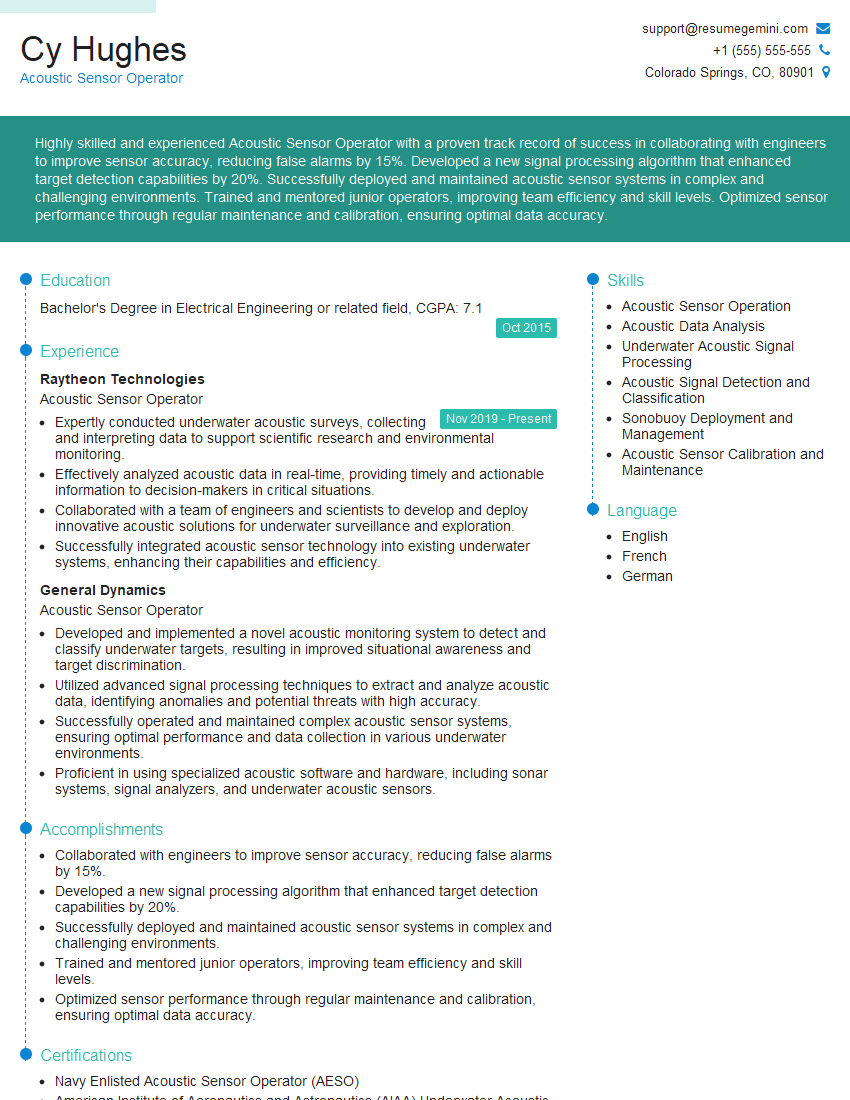
Mastering Sonobuoy Deployment and Analysis opens doors to exciting career opportunities in naval operations, oceanographic research, and related fields. A strong understanding of these concepts will significantly enhance your interview performance and increase your chances of securing your dream role. To further boost your job prospects, focus on creating a compelling and ATS-friendly resume that showcases your skills and experience effectively. ResumeGemini is a trusted resource that can help you build a professional and impactful resume, tailored to highlight your expertise in Sonobuoy Deployment and Analysis. Examples of resumes specifically designed for this field are available for your review to help inspire your own.

Explore more articles
Users Rating of Our Blogs
Share Your Experience
We value your feedback! Please rate our content and share your thoughts (optional).
What Readers Say About Our Blog
Very informative content, great job.
good