Feeling uncertain about what to expect in your upcoming interview? We’ve got you covered! This blog highlights the most important Sound and Vibration Level Measurements interview questions and provides actionable advice to help you stand out as the ideal candidate. Let’s pave the way for your success.
Questions Asked in Sound and Vibration Level Measurements Interview
Q 1. Explain the difference between sound pressure level (SPL) and sound intensity.
Sound pressure level (SPL) and sound intensity are both crucial measures in acoustics, but they represent different aspects of sound. SPL describes the pressure variations in the air caused by a sound wave at a specific point. Think of it as the ‘force’ of the sound wave on your eardrum. It’s measured in Pascals (Pa), but more commonly expressed in decibels (dB). Sound intensity, on the other hand, represents the power of the sound wave passing through a unit area. Imagine it as the ‘energy’ carried by the sound wave. It’s measured in Watts per square meter (W/m²), and also often expressed in decibels (dB).
The key difference lies in their dependence on distance. SPL decreases with the square root of the distance from the source, while sound intensity decreases with the square of the distance. This means that sound intensity drops off much faster than SPL as you move away from the source. For example, doubling your distance from a speaker will reduce the sound intensity to a quarter of its original value, but the SPL will only reduce to approximately 70%.
Q 2. Describe the decibel scale and its logarithmic nature.
The decibel (dB) scale is a logarithmic scale used to express the ratio of two values of a physical quantity, often power or intensity. It’s logarithmic because the human ear perceives sound intensity logarithmically; a small change in sound power results in a noticeable change in perceived loudness only over a specific range. A linear scale wouldn’t accurately reflect this perception.
The formula for calculating decibels is: dB = 10 log₁₀(P₁/P₀), where P₁ is the measured power and P₀ is a reference power. For sound pressure level, the reference pressure (P₀) is typically 20 micropascals (20 µPa), which is roughly the threshold of human hearing. This means a 10 dB increase represents a tenfold increase in sound pressure, while a 20 dB increase represents a hundredfold increase. The logarithmic nature compresses a vast range of sound intensities into a more manageable scale.
Q 3. What are the different weighting networks (A, C, Z) used in sound level measurements and why are they important?
Weighting networks in sound level meters adjust the measured sound level to better reflect the human ear’s frequency response. Different weighting networks emphasize different frequency ranges:
- A-weighting (dBA): This is the most commonly used weighting network. It de-emphasizes low frequencies which are less audible to the human ear, providing a better correlation with perceived loudness. It’s often used for assessing noise annoyance and potential hearing damage.
- C-weighting (dBC): This weighting network provides a flatter response across a wider frequency range, making it suitable for measuring peak sounds and impulsive noise, like explosions or gunshots.
- Z-weighting (dBZ): This is a linear weighting, meaning it doesn’t adjust the measured sound levels based on frequency. It provides an unweighted measurement, useful for acoustic calibrations and analyzing sound characteristics across the entire frequency spectrum.
These weightings are crucial for providing meaningful results and ensuring that measurements align with how humans perceive sound. For example, a loud low-frequency rumble might have a high overall SPL but a lower dBA level, reflecting its lesser impact on perceived loudness compared to a high-frequency screech.
Q 4. How do you measure sound levels using a sound level meter?
Measuring sound levels with a sound level meter is a straightforward process. First, ensure the meter is calibrated according to the manufacturer’s instructions. Then:
- Select the appropriate weighting network: Choose A-weighting for general noise assessment, C-weighting for peak sounds, or Z-weighting for linear measurements.
- Set the desired response time: Slow response is best for steady sounds, while fast response is better for fluctuating noises.
- Position the microphone: Place the microphone at the desired measurement location, ensuring it’s not obstructed by objects or affected by wind. Follow any specific guidelines provided for the measurement type (e.g., 1.5m from the source, at ear height for occupational noise assessments).
- Take the reading: Allow the sound level meter to stabilize before recording the reading. Repeat measurements at different locations if needed, noting environmental factors.
- Document the results: Record the measured sound levels (e.g., dBA), date, time, location, and any other relevant information.
Modern sound level meters often offer additional features like data logging and frequency analysis for more detailed sound characterization. Always use a properly calibrated and maintained instrument for accurate and reliable measurements.
Q 5. Explain the concept of sound absorption and its impact on noise levels.
Sound absorption is the process by which sound energy is converted into other forms of energy, typically heat, when a sound wave strikes a surface. Materials with high sound absorption coefficients effectively reduce the reflection of sound waves, lowering the overall sound pressure levels in a space. Think of it like a sponge absorbing water; the sound waves are ‘absorbed’ by the material, decreasing the sound’s intensity.
The impact on noise levels is significant. In a room with highly reflective surfaces (e.g., concrete walls), sound waves bounce around, leading to high reverberation and amplified noise levels. Introducing sound-absorbing materials reduces the reflections, creating a quieter environment. For example, acoustic panels in a recording studio minimize unwanted reflections to improve the quality of recordings. Similarly, sound absorbing materials in office spaces reduce noise interference and improve speech clarity. The amount of sound absorption depends on the material’s properties, frequency of the sound, and the angle of incidence.
Q 6. What are the common methods for noise control and reduction?
Noise control and reduction strategies focus on minimizing sound generation, blocking sound transmission, or absorbing sound energy. Common methods include:
- Source control: Addressing the noise at its source. Examples include using quieter machinery, modifying equipment to reduce noise emissions, or implementing better maintenance procedures.
- Path control: Blocking or diverting sound propagation paths. This involves using barriers (e.g., walls, berms), enclosures, or vibration isolation to reduce sound transmission.
- Receiver control: Protecting the receiver from noise exposure. This includes personal protective equipment (earplugs, earmuffs), sound masking systems to reduce the prominence of unwanted noise, or relocating the receiver to a quieter location.
- Absorption control: Employing sound-absorbing materials to reduce reverberation and overall noise levels in a room or space, as described in the previous answer.
Effective noise control often involves a combination of these methods tailored to the specific noise problem. For instance, reducing noise from a busy highway near residential area might require a combination of noise barriers, landscaping to absorb sound, and possibly double-glazed windows in homes.
Q 7. Describe different types of sound-absorbing materials and their applications.
Various sound-absorbing materials are available, each with specific properties and applications:
- Porous absorbers: These materials, like acoustic foams, fiberglass, and mineral wool, absorb sound energy by converting it into heat through friction as the sound wave passes through their porous structure. They’re effective across a broad range of frequencies and are widely used in recording studios, home theaters, and office spaces.
- Resonant absorbers: These materials are designed to absorb sound at specific frequencies. They typically involve a membrane or diaphragm that resonates at a particular frequency, effectively damping the sound energy. They are often used to target specific problematic frequencies in a room.
- Panel absorbers: These consist of a rigid panel backed by an air cavity. They absorb sound through the vibration of the panel, offering good absorption at mid-to-high frequencies. They are aesthetically pleasing and commonly used in offices and other public spaces.
- Helmholtz resonators: These are specialized absorbers that use a cavity with a small opening to absorb sound energy at a specific frequency. They’re often used for controlling low-frequency noise in specific applications.
The choice of material depends on the specific noise problem, frequency range, aesthetic requirements, and budget. For example, porous absorbers might be ideal for general noise reduction in an office, while resonant absorbers may be necessary to address specific low-frequency issues in a recording studio.
Q 8. What is the significance of frequency analysis in sound and vibration measurements?
Frequency analysis is crucial in sound and vibration measurements because it breaks down complex signals into their constituent frequencies, revealing the individual components contributing to the overall sound or vibration. Think of it like separating the colors in a rainbow – each color represents a different frequency, and analyzing them individually helps us understand the entire spectrum. This is typically done using techniques like Fast Fourier Transforms (FFT).
For instance, in machinery diagnostics, frequency analysis can pinpoint the specific frequencies associated with bearing faults, gear meshing problems, or imbalances. By identifying these characteristic frequencies, we can diagnose the root cause of the problem more effectively than by just looking at overall sound or vibration levels. This allows for preventative maintenance, preventing costly breakdowns.
In environmental noise monitoring, frequency analysis helps determine the contributions of different sources, such as traffic, industry, and construction. This allows for targeted noise reduction strategies. For example, identifying a peak frequency related to a specific factory machine might lead to improvements in its soundproofing.
Q 9. Explain the concept of resonance and its role in vibration.
Resonance is a phenomenon where a system vibrates with maximum amplitude at a specific frequency, called its natural frequency. Imagine pushing a child on a swing – you push at the right time (frequency) to maximize the swing’s amplitude. If you push at the wrong frequency, the swing’s motion will be much smaller. In vibration, when an external force excites a structure at its natural frequency, the structure will absorb a significant amount of energy, leading to large, potentially damaging vibrations.
This is incredibly important because resonant vibrations can cause structural failure, fatigue, and excessive noise. For example, a bridge might have a natural frequency that is excited by the wind, leading to catastrophic failure if not properly designed and dampened. In machine design, we need to ensure the operating frequencies of components are far from their natural frequencies to avoid resonance.
Q 10. How do you measure vibration levels and what are the common units used?
Vibration levels are measured using accelerometers, velocity pickups, or displacement sensors. These transducers convert mechanical vibration into an electrical signal that can be processed and analyzed. The choice of sensor depends on the frequency range of interest and the application.
Common units for vibration include:
- Acceleration: Measured in meters per second squared (m/s²), often expressed in g’s (where 1 g = 9.81 m/s², the acceleration due to gravity).
- Velocity: Measured in millimeters per second (mm/s).
- Displacement: Measured in micrometers (µm) or millimeters (mm).
The measurements are often taken at various locations on a structure or machine, and the data is then analyzed to determine the overall vibration level and identify areas of concern. For example, in a building, vibration measurements might be taken to assess the impact of nearby construction on the building’s structural integrity.
Q 11. What are the common sources of vibration in industrial settings?
Industrial settings are rife with vibration sources. These can broadly be categorized as:
- Rotating machinery: Motors, pumps, turbines, compressors, and fans are major culprits. Imbalances, misalignment, and bearing defects are frequent causes of excessive vibration.
- Reciprocating machinery: Internal combustion engines, piston pumps, and forging hammers generate significant vibration due to the cyclic nature of their operation.
- Impact processes: Forging, stamping, and other impact processes generate impulsive vibrations that can be very damaging.
- Fluid flow: Turbulent flow in pipes or around structures can induce vibration. This is particularly relevant in industries such as oil and gas.
- Transportation systems: Conveyer belts, rail traffic, and other moving equipment contribute to vibration within industrial facilities.
Understanding these sources is crucial for effective vibration control and prevention of damage.
Q 12. What are the different types of vibration isolators and dampers?
Vibration isolators and dampers are used to reduce the transmission of vibration from a source to its surroundings or vice versa. Several types exist, including:
- Passive Isolators: These rely on the inherent properties of materials to isolate vibration. Examples include:
- Springs: Provide isolation by allowing the isolated object to move independently from the vibrating source.
- Rubber mounts: Commonly used due to their flexibility and damping properties.
- Metal springs: Often used for heavier loads and higher frequencies.
- Active Isolators: These use sensors and actuators to actively counteract the vibrations. They are more complex but can achieve better isolation.
- Dampers: These dissipate energy from the vibration, reducing its amplitude. Examples include viscous dampers (using fluids) and frictional dampers (using friction).
The selection of the appropriate isolator or damper depends on the frequency range of the vibration, the weight of the isolated equipment, and the desired level of isolation.
Q 13. Explain the concept of modal analysis and its application in vibration control.
Modal analysis is a technique used to determine the natural frequencies and mode shapes of a structure. A mode shape is the pattern of deformation of a structure when vibrating at a natural frequency. Think of it as a snapshot of the structure’s shape at a particular resonant frequency. Imagine a guitar string vibrating – different frequencies will cause it to vibrate in different patterns, those are mode shapes.
By understanding the modal characteristics of a structure, we can predict how it will respond to vibrations and design effective vibration control strategies. If a structure’s natural frequency coincides with an excitation frequency, then we know we’ll experience resonance and need to modify the system, for example by adding damping, changing stiffness, or altering mass distribution. This information is critical in designing bridges, buildings, and machinery to avoid resonance and potential failures.
Q 14. Describe the principles of finite element analysis (FEA) for vibration analysis.
Finite Element Analysis (FEA) is a powerful computational technique used to model the behavior of complex structures under various loading conditions, including vibration. The structure is divided into numerous small elements, each with its own properties (mass, stiffness, damping). The behavior of each element is calculated using mathematical equations, and the results are assembled to predict the overall response of the structure.
FEA allows engineers to predict the natural frequencies, mode shapes, and stress levels within a structure under vibration loading without actually having to build and test a physical prototype, saving time and resources. This is immensely helpful in optimizing designs to minimize vibrations and prevent structural failures. It allows for ‘what-if’ scenarios testing modifications to the design before production, and thus prevents costly redesigns later.
For example, in the design of a car chassis, FEA can be used to simulate the vibrations experienced during driving and optimize the design to minimize noise and improve ride comfort.
Q 15. How do you perform sound power level measurements?
Sound power level measurements determine the total acoustic energy a source radiates. Unlike sound pressure, which is measured at a specific point, sound power is an inherent property of the source itself. We typically use an intensity method or a sound pressure method to determine sound power.
Intensity Method: This involves measuring sound intensity at multiple points around the source using a sound intensity probe. The probe measures both the sound pressure and particle velocity simultaneously. These measurements are then integrated over the surface enclosing the source to calculate the total sound power. This is often preferred for larger sources, as it’s less sensitive to the surroundings.
Sound Pressure Method: This method uses several sound pressure level (SPL) measurements taken at specified distances and angles around the source. These measurements, along with the source’s geometry and the room’s acoustic properties, are fed into a specialized software to calculate the sound power level. This method requires a more controlled environment (an anechoic chamber or hemi-anechoic chamber is often preferred to minimize reflections), but it can be simpler for smaller sources.
Imagine measuring the total light output of a bulb – sound power is analogous to this total light output. Sound pressure, on the other hand, is like measuring the light intensity at a particular point in the room.
Career Expert Tips:
- Ace those interviews! Prepare effectively by reviewing the Top 50 Most Common Interview Questions on ResumeGemini.
- Navigate your job search with confidence! Explore a wide range of Career Tips on ResumeGemini. Learn about common challenges and recommendations to overcome them.
- Craft the perfect resume! Master the Art of Resume Writing with ResumeGemini’s guide. Showcase your unique qualifications and achievements effectively.
- Don’t miss out on holiday savings! Build your dream resume with ResumeGemini’s ATS optimized templates.
Q 16. Explain the relationship between sound pressure, sound intensity, and sound power.
Sound power (Lw), sound intensity (I), and sound pressure (p) are fundamentally interconnected. Sound power is the total acoustic energy emitted by a source, measured in Watts (W). Sound intensity is the power flowing through a unit area, measured in Watts per square meter (W/m²). Sound pressure is the fluctuation in air pressure caused by the sound wave, measured in Pascals (Pa).
The relationship can be visualized as follows:
- Sound Power (Lw) is the source of the sound energy.
- Sound Intensity (I) represents the distribution of that sound power over a surface area.
- Sound Pressure (p) is the effect of that sound intensity at a specific point in space.
While there isn’t a single equation directly relating all three, sound intensity is proportional to the square of sound pressure. This relationship is influenced by the distance from the source and the environment’s impedance. The sound power level is determined by integrating the sound intensity across a surface encompassing the source.
For example, a loud speaker (sound power) radiates sound energy outward. The intensity diminishes with distance as the energy spreads across a larger area. At any point in space, you would measure a specific sound pressure.
Q 17. What is the significance of background noise in sound level measurements?
Background noise is crucial in sound level measurements because it can significantly affect the accuracy of your results. If the background noise is comparable to or even higher than the noise from the source you are measuring, it will mask the signal of interest and lead to inaccurate or unreliable data.
Imagine trying to hear a whisper in a busy marketplace – the background noise makes it nearly impossible to discern the whisper’s sound. Similarly, in sound measurement, high background noise makes it difficult to accurately determine the sound level of the target source. This is particularly problematic when measuring low-level sounds, such as those emitted by precision machinery or quiet home appliances.
Q 18. How do you correct for background noise in your measurements?
Correcting for background noise is vital for obtaining accurate results. Common methods include:
- Background Noise Subtraction: Measure the background noise level *before* the source is activated and subtract this level (in dB) from the overall sound level (measured with the source on). This is a simplistic approach only suitable if the background noise is relatively consistent and significantly lower than the source noise. In many cases this isn’t suitable, due to non-stationarity of the background noise and or the possibility that background noise is correlated to the signal of interest.
- Statistical Methods: Use statistical techniques to differentiate between the source’s sound and the background noise. For instance, analyzing the frequency spectrum and looking for peaks associated with the source can help differentiate these signals. For non-stationary signals, this may involve the use of wavelet analysis.
- Signal Processing: Apply digital signal processing techniques such as filtering or spectral subtraction to separate the source sound from the background noise. These are more sophisticated methods that require specialized software and expertise, but they are the most accurate when dealing with noisy environments.
The best method depends on the specific circumstances, but careful consideration of the background noise is absolutely essential in achieving reliable measurements.
Q 19. Describe different types of microphones used in sound level measurements.
Various microphone types are used in sound level measurements, each with its own advantages and limitations:
- Condenser Microphones: These are widely used due to their high sensitivity, wide frequency response, and low noise levels. They require a power supply (usually phantom power from the measuring instrument). They provide superior fidelity across the range of frequencies and are usually the standard for acoustic measurements.
- Dynamic Microphones: More robust than condenser microphones and less susceptible to environmental damage, but generally exhibit a lower sensitivity and a narrower frequency response. They are often used in harsh or high-intensity situations.
- Pre-polarized Microphones:These microphones are similar to condenser microphones and don’t require an external power source (such as 48V phantom power), but they are typically not as sensitive or accurate for measurements of low level acoustic signals.
- Measurement Microphones: These are designed specifically for acoustic measurements, ensuring high accuracy and calibration traceability. They usually come with a certificate of calibration tracing their accuracy to a national standards body.
The choice of microphone depends on factors like the sound level being measured, the frequency range of interest, environmental conditions, and the required accuracy.
Q 20. What are the limitations and uncertainties associated with sound and vibration measurements?
Sound and vibration measurements come with inherent limitations and uncertainties:
- Environmental Factors: Temperature, humidity, air pressure, and wind can all influence sound propagation and affect measurements. Reflections from surfaces can also distort results. The presence of other noise sources (background noise) can lead to significant errors.
- Microphone Calibration and Positioning: The microphone’s calibration accuracy and its placement relative to the sound source directly impact the results. Incorrect microphone placement can introduce significant errors.
- Frequency Response: Microphones have a limited frequency response; they may not accurately measure very high or very low frequencies. This can be especially relevant if the signal is not fully contained within the operational range of the microphone.
- Instrumentation Limitations: The measuring instrument itself introduces uncertainties due to its internal noise and resolution. The quality of the equipment and its calibration play a significant role in measurement uncertainty.
- Human Error: Incorrect instrument settings, improper measurement procedures, and subjective interpretations can lead to errors.
It’s crucial to understand and account for these uncertainties when interpreting measurement data. Proper calibration procedures, environmental controls, and sound measurement techniques can help to mitigate these limitations.
Q 21. How do you ensure the accuracy and reliability of your measurements?
Ensuring accuracy and reliability requires a multi-pronged approach:
- Calibration: Regular calibration of microphones and measuring instruments against traceable standards is paramount. This ensures that the equipment is measuring accurately and consistently. This would be carried out using a calibrated acoustic calibrator that is traceable to a National Metrology Institute (NMI).
- Environmental Control: Minimize environmental influences by conducting measurements in controlled environments (anechoic chambers or hemi-anechoic chambers) whenever possible. Document environmental conditions carefully during measurements.
- Measurement Techniques: Follow standardized measurement procedures, such as those outlined in ISO standards. This includes proper microphone positioning, signal processing, and data analysis techniques.
- Data Analysis: Carefully analyze data to identify outliers and potential errors. Employ appropriate statistical methods to determine the uncertainty associated with the measurements. In some cases, the use of multiple microphones may be implemented to reduce systematic error.
- Quality Control: Implement a rigorous quality control system throughout the measurement process. This will include routine checks and double checking of measurements to ensure reproducibility and consistency.
By adhering to these practices, we can greatly enhance the accuracy and reliability of our sound and vibration measurements, leading to more informed decisions and effective problem-solving.
Q 22. Explain the concept of sound propagation and factors affecting it.
Sound propagation is the way sound waves travel from their source to a receiver. Imagine throwing a pebble into a still pond – the ripples spreading outwards are analogous to sound waves radiating from a source. These waves are essentially pressure fluctuations in the medium (usually air) caused by vibrations.
Several factors influence this propagation:
- Distance: Sound intensity decreases with distance from the source, following an inverse square law (intensity is inversely proportional to the square of the distance).
- Medium: The speed and attenuation of sound differ significantly depending on the medium. Sound travels faster in denser materials like water or steel compared to air. Air temperature and humidity also affect the speed and attenuation.
- Obstacles: Objects in the path of sound waves can reflect, absorb, or diffract the sound. A large wall will reflect sound, while porous materials like acoustic foam will absorb it. Diffraction bends sound waves around obstacles, allowing you to hear sounds around corners.
- Frequency: Higher-frequency sounds are generally more attenuated (weakened) by the air than lower-frequency sounds. This is why high-pitched sounds are harder to hear from far away.
- Ambient Noise: Background noise can mask or interfere with the sound of interest, making it harder to perceive. This is a crucial consideration in noise measurement.
Understanding these factors is critical when designing noise barriers, predicting noise levels in urban environments, or troubleshooting noise problems in industrial settings.
Q 23. How do you assess the impact of noise on the environment?
Assessing the impact of noise on the environment involves a multi-faceted approach, encompassing several key steps:
- Noise Mapping: Using sound level meters and specialized software, we create noise maps of the area to pinpoint noise sources and their spatial extent. This visually represents noise levels across the affected area.
- Noise Level Measurements: We conduct precise sound level measurements, adhering to standardized procedures, including LAeq (equivalent continuous A-weighted sound level) which represents the average sound level over a specified time period and Lmax (maximum sound level) which captures the peak sound pressure level.
- Environmental Impact Assessment (EIA): This evaluates the potential effects of noise on various aspects of the environment, such as wildlife, human health, and property values. We consider factors like noise levels, duration of exposure, frequency content, and the sensitivity of the affected receptors.
- Predictive Modeling: Sophisticated software tools simulate future noise levels based on projected developments or changes in noise sources. This helps in planning mitigation strategies.
- Comparison with Standards and Regulations: Measured and modeled noise levels are compared against relevant environmental noise regulations to assess compliance and potential non-compliance.
For instance, in assessing the impact of a new highway on a nearby residential area, we’d create a noise map to visualize noise levels in the houses, then compare these levels with national or local noise limits to determine if mitigation is necessary. This could involve building noise barriers or implementing speed limits.
Q 24. What are the regulations and standards related to noise and vibration control?
Noise and vibration control regulations and standards vary globally, but they share common goals: protecting human health and the environment from excessive noise and vibration. Key examples include:
- OSHA (Occupational Safety and Health Administration): In the US, OSHA sets standards for permissible noise exposure levels in workplaces. Exceeding these limits requires employers to implement hearing protection programs.
- ISO Standards: The International Organization for Standardization publishes many relevant standards, including those related to sound level meters, measurement procedures, and environmental noise assessment. ISO 1996-1:2017, for example, details methods for measuring environmental sound.
- EPA (Environmental Protection Agency): In the US, the EPA provides guidelines and regulations concerning environmental noise pollution.
- Local Ordinances: Many municipalities have their own noise ordinances that specify allowable noise levels at different times of the day and in different zones. These can be stricter than national standards.
These regulations and standards are often expressed in terms of decibel levels (dB) and weighted frequency levels (like A-weighting) to reflect how humans perceive noise and its potential impact.
Q 25. Describe your experience with sound and vibration data acquisition and analysis software.
I have extensive experience with various sound and vibration data acquisition and analysis software packages. My expertise spans both proprietary and open-source options. I’m proficient in using:
- MATLAB with Signal Processing Toolbox: I utilize MATLAB for advanced signal processing techniques, such as Fast Fourier Transforms (FFTs) for frequency analysis, spectral analysis, and order tracking. For instance, I’ve used it to identify and quantify the frequencies present in the vibration signature of a rotating machine to diagnose bearing failures.
- LMS Test.Lab: This commercial software is a powerful suite for data acquisition, analysis, and reporting, ideal for complex modal analysis and order tracking of machinery.
- PULSE Reflex: Another industry-standard software widely used in various acoustic and vibration testing applications including modal analysis and operational deflection shapes.
- SoundPLAN: Specialized in environmental noise modelling, I use it for noise mapping and impact assessment projects.
My proficiency includes data import/export, signal processing, statistical analysis, and report generation. I’m comfortable working with diverse data formats and adapting my techniques to the specific requirements of each project.
Q 26. Explain your familiarity with different types of vibration transducers.
I’m familiar with a wide range of vibration transducers, each suited to different applications and frequency ranges:
- Accelerometers: These measure acceleration, a fundamental parameter for vibration analysis. Piezoelectric accelerometers are common for measuring high-frequency vibrations, while capacitive accelerometers are preferred for low-frequency measurements.
- Velocity Transducers: These measure velocity directly. They’re useful in specific applications where acceleration might be impractical, particularly in low-frequency ranges.
- Displacement Transducers: These measure the displacement or amplitude of vibration, crucial in understanding structural responses to vibration.
- Proximity Probes: Non-contact transducers that measure displacement by detecting the distance between the probe and a vibrating surface. They’re invaluable when direct contact is impossible or undesirable.
The choice of transducer depends on factors such as the frequency range of interest, the amplitude of vibration, the environment (e.g., temperature, humidity), and the type of measurement required (e.g., acceleration, velocity, or displacement). My experience allows me to select and utilize the appropriate sensor for each unique scenario and ensure accurate data acquisition.
Q 27. How do you interpret and present your sound and vibration measurement data?
Interpreting and presenting sound and vibration data involves a systematic process:
- Data Validation: First, we check the data for errors, inconsistencies, and outliers. This often involves visual inspection of waveforms and statistical analysis.
- Signal Processing: Techniques like FFTs, filtering, and averaging are employed to extract meaningful information from the raw data. For example, an FFT reveals the frequency components of a complex vibration signal, helping identify resonance frequencies.
- Statistical Analysis: Statistical methods are used to analyze data variability and quantify uncertainty. This includes calculating means, standard deviations, confidence intervals, and percentiles.
- Report Generation: Results are presented clearly and concisely through reports, graphs, and tables. This includes visualizations of frequency spectra, time-domain waveforms, and statistical summaries. The report needs to be tailored to the specific audience, highlighting key findings and recommendations.
For example, when analyzing the noise levels near an airport, we might present a graph showing the LAeq levels at various locations, overlaid with the regulatory limits. This allows stakeholders to readily understand the potential impact of the airport’s noise on the surrounding community.
Q 28. Describe a challenging sound or vibration problem you solved and your approach.
I once faced a challenging problem involving excessive vibration in a large industrial chiller unit. The vibration levels were high enough to cause concerns about structural damage and operational reliability. Our initial investigation using accelerometers revealed high vibration levels across a wide range of frequencies.
My approach involved a systematic troubleshooting process:
- Detailed Vibration Measurements: We conducted comprehensive vibration measurements at various locations on the chiller using accelerometers and conducted order tracking to correlate vibrations with rotational speeds.
- Frequency Analysis: We performed FFTs on the vibration data to identify the dominant frequencies. This pinpointed the source of the problem to imbalances in the rotating components of the chiller.
- Modal Analysis: Using experimental modal analysis techniques we identified the natural frequencies of the chiller structure and compared them to the excitation frequencies revealed from the FFT analysis. This helped explain why some frequencies were amplified more than others.
- Corrective Actions: Based on the analysis, we recommended balancing the rotating components of the chiller. This involved precise adjustments to ensure even weight distribution. We also recommended some structural modifications to decouple the chiller from the foundation, minimizing the transmission of vibrations.
Following these corrective actions, the vibration levels significantly decreased to acceptable levels, resolving the problem and avoiding potential costly repairs or downtime.
Key Topics to Learn for Sound and Vibration Level Measurements Interview
- Fundamentals of Acoustics: Understanding basic acoustic principles like sound waves, frequency, wavelength, intensity, and decibels (dB).
- Measurement Techniques: Familiarity with various measurement instruments (sound level meters, accelerometers, vibration analyzers), their calibration, and data acquisition methods.
- Sound and Vibration Standards: Knowledge of relevant international and industry-specific standards (e.g., OSHA, ISO) and their practical implications.
- Data Analysis and Interpretation: Proficiency in analyzing measured data, identifying trends, and drawing meaningful conclusions. This includes understanding frequency analysis (FFT) and other signal processing techniques.
- Noise Control and Vibration Mitigation: Understanding principles and methods for reducing noise and vibration levels in various applications (e.g., industrial machinery, building design).
- Practical Applications: Experience with real-world applications such as environmental noise assessment, machinery noise control, structural vibration analysis, or product development in the acoustics field.
- Problem-Solving Approaches: Ability to troubleshoot measurement issues, interpret conflicting data, and propose solutions to real-world sound and vibration problems.
- Signal Processing: Understanding concepts of filtering, averaging, and other signal processing techniques commonly used in sound and vibration analysis.
Next Steps
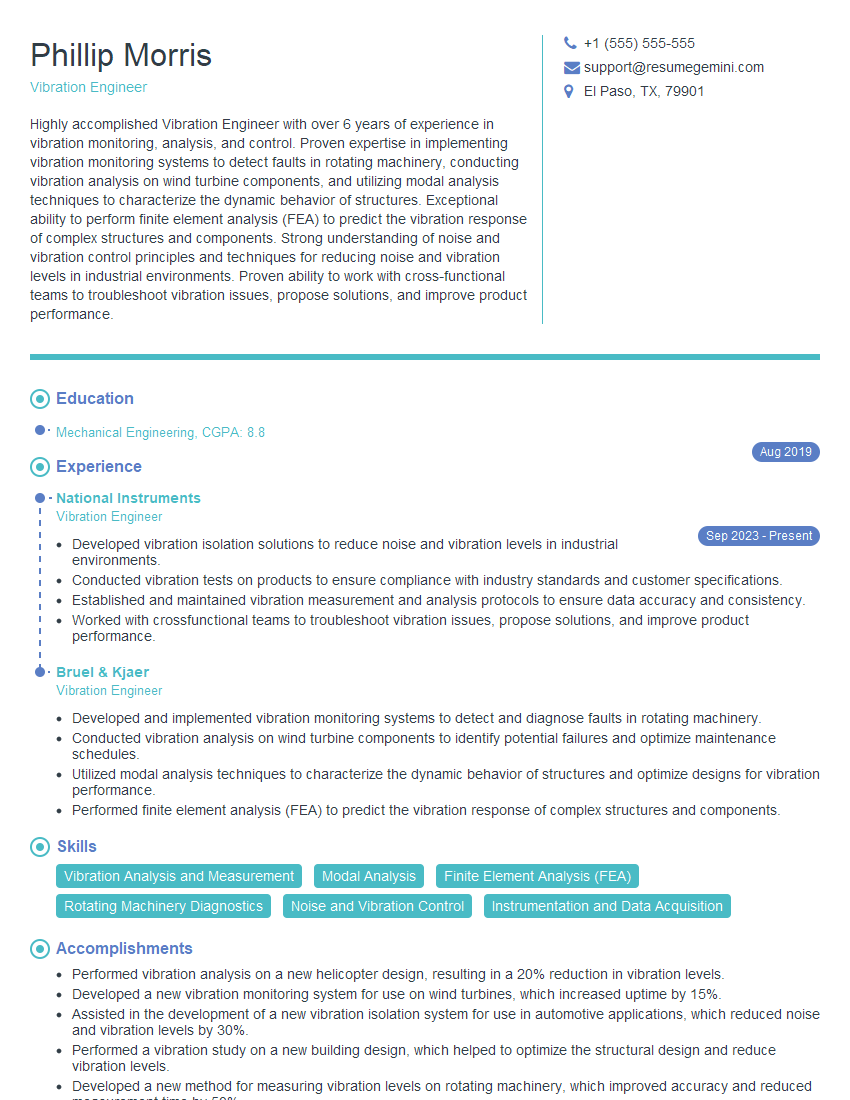
Mastering sound and vibration level measurements opens doors to exciting career opportunities in diverse fields like environmental consulting, manufacturing, automotive engineering, and research. A strong understanding of these principles is highly sought after by employers. To maximize your job prospects, it’s crucial to have a resume that effectively showcases your skills and experience to Applicant Tracking Systems (ATS). Building an ATS-friendly resume is essential for getting your application noticed. We highly recommend leveraging ResumeGemini, a trusted resource for crafting professional and impactful resumes. ResumeGemini provides examples of resumes tailored to Sound and Vibration Level Measurements to help you present your qualifications in the best possible light.
Explore more articles
Users Rating of Our Blogs
Share Your Experience
We value your feedback! Please rate our content and share your thoughts (optional).
What Readers Say About Our Blog
Very informative content, great job.
good