The right preparation can turn an interview into an opportunity to showcase your expertise. This guide to Special Operations Tactics interview questions is your ultimate resource, providing key insights and tips to help you ace your responses and stand out as a top candidate.
Questions Asked in Special Operations Tactics Interview
Q 1. Describe the principles of mission planning in Special Operations.
Mission planning in Special Operations is a meticulous process, fundamentally driven by the principles of planning, preparation, execution, and assessment. It’s not simply about choosing a target; it’s about meticulously crafting a solution that maximizes success and minimizes risk. This involves a thorough understanding of the operational environment, the enemy, and the available resources. Key principles include:
- Intelligence-driven planning: All planning begins with detailed and accurate intelligence. This informs every decision, from route selection to the choice of tactics.
- Simplicity: Complex plans often fail. Special Operations favors streamlined plans that are easy to understand and execute under pressure.
- Flexibility and Adaptability: Contingency plans are essential. The operational environment is inherently dynamic; therefore, plans must be adaptable to unforeseen circumstances.
- Rehearsal and Practice: Rehearsals allow the team to identify potential issues and refine their procedures. This is critical for success, particularly in high-risk operations.
- Risk Assessment and Mitigation: A detailed risk assessment is crucial. The team must identify potential threats and develop strategies to mitigate those risks.
Imagine planning a raid on a high-value target in a hostile environment. The plan would need to account for factors such as terrain, enemy defenses, potential civilian casualties, and exfiltration routes. Each element is meticulously examined and contingency plans are put in place. For example, an alternative exfiltration route may be pre-planned in case the primary route is compromised.
Q 2. Explain the process of conducting a reconnaissance mission.
Recon missions are the cornerstone of successful Special Operations. They provide the critical intelligence needed for mission planning and execution. The process usually involves these stages:
- Planning: This includes defining the objective, identifying the area of interest, selecting the reconnaissance method (e.g., visual, electronic, human intelligence), and developing contingency plans.
- Infiltration: The team infiltrates the target area undetected, using appropriate methods for the terrain and situation. This might involve helicopter insertion, maritime infiltration, or ground infiltration.
- Observation and Data Collection: The team systematically gathers information, paying close attention to details such as enemy positions, defenses, communications, and logistics. Photography, video, and sketching are common methods.
- Exfiltration: The team safely extracts from the area, ideally without detection.
- Debriefing and Reporting: The team provides a detailed report of their findings to the planning team, using maps, photos, and verbal descriptions.
Consider a team tasked with reconnoitering a suspected insurgent camp. They would need to approach undetected, ideally utilizing camouflage and concealment techniques. They’d then observe the camp, documenting troop numbers, weapon systems, defenses, and routines. Their findings would be crucial in determining the feasibility and tactics for a subsequent assault.
Q 3. Outline the key elements of a successful ambush operation.
A successful ambush hinges on several key elements:
- Intelligence: Knowing the enemy’s routes, timings, and vulnerabilities is crucial. The ambush location must be chosen to maximize the element of surprise.
- Surprise and Speed: The element of surprise is paramount. The ambush must be initiated rapidly and decisively, catching the enemy off guard.
- Fire Superiority: Concentrated fire from multiple positions is essential to quickly neutralize the target. This requires precise weapon placement and well-coordinated fire.
- Escape Route: A pre-planned escape route is critical for the team’s safe withdrawal after the ambush. This route must be well-rehearsed.
- Security: Measures to prevent detection before the ambush are crucial. This includes camouflage, concealment, and observation of approaches.
- Target Selection: The specific targets to be engaged must be clearly defined prior to the ambush.
Imagine an ambush against a convoy. The team would select a location that constricts the enemy’s movement, provides cover and concealment, and allows for coordinated fire. They would then employ surprise and overwhelming firepower to quickly disable the convoy before withdrawing along a pre-determined route.
Q 4. What are the different types of infiltration techniques used in Special Operations?
Special Operations employ various infiltration techniques depending on the mission, terrain, and threat level. These include:
- Airborne Infiltration: This involves parachuting or fast-roping from helicopters or fixed-wing aircraft. High-altitude, low-opening (HALO) and high-altitude, high-opening (HAHO) jumps offer greater range and stealth.
- Waterborne Infiltration: Infiltration via boats, submarines, or underwater vehicles allows access to coastal areas or waterways.
- Ground Infiltration: This can range from simple foot marches to more complex techniques involving vehicle infiltration, cross-border movements, or utilizing cover and concealment to bypass enemy defenses.
- Subterranean Infiltration: This method involves entering through tunnels, caves, or underground infrastructure.
For example, a raid on a coastal facility might utilize waterborne infiltration via small boats, whereas an operation in mountainous terrain might require airborne infiltration via HALO jump to avoid detection.
Q 5. How do you manage risk and uncertainty in a dynamic operational environment?
Managing risk and uncertainty in a dynamic operational environment requires a proactive and adaptable approach. This involves:
- Comprehensive Risk Assessment: Identifying all potential threats and vulnerabilities – political, environmental, tactical, and logistical.
- Contingency Planning: Developing alternative plans to address unforeseen events or setbacks. These plans should consider worst-case scenarios.
- Communication and Coordination: Maintaining clear and constant communication amongst the team and with higher headquarters.
- Decision-Making Under Pressure: The ability to make sound judgments based on incomplete information and under pressure is critical.
- Adaptive Planning: The willingness to adjust plans based on new information or changing circumstances. Rigidity is the enemy of success.
During a hostage rescue, for example, the team needs to constantly assess risks, adapt to the hostage-takers’ actions, and have contingency plans for everything from a sniper attack to a hostage being killed. Communication is critical to coordinate the team’s actions and keep everyone informed of changing circumstances.
Q 6. Describe your understanding of the rules of engagement (ROE).
Rules of Engagement (ROE) are the legally binding directives that govern the use of force by military personnel. They define the circumstances under which force may be used, the types of force permitted, and the limitations on the use of force. ROE are crucial for maintaining discipline, minimizing civilian casualties, and ensuring legal compliance. They are often context-specific and can change depending on the mission and political environment. Strict adherence to ROE is crucial for maintaining operational integrity and avoiding legal repercussions.
For instance, ROE might specify that lethal force can only be used in self-defense or defense of others, or when authorized by higher command in specific circumstances. Understanding and strictly adhering to ROE is paramount in any Special Operations mission.
Q 7. Explain the importance of communication in Special Operations.
Effective communication is absolutely vital in Special Operations. In high-stress, dynamic environments, clear, concise, and timely communication is the difference between success and failure. This involves:
- Clear Communication Protocols: Establishing standardized communication procedures and protocols to ensure messages are understood and acted upon correctly.
- Redundancy: Employing multiple communication systems to ensure continued communication even if one system fails.
- Secure Communication: Using encrypted channels to protect sensitive information from interception.
- Situational Awareness: Maintaining constant situational awareness and communicating any changes or threats to the team.
- Teamwork and Coordination: Communication facilitates seamless teamwork and coordination, allowing the team to function as a unified force.
Imagine a team navigating a complex urban environment. Real-time communication of enemy positions, friendly locations, and changing tactical situations is critical for maintaining situational awareness and coordinating actions. A breakdown in communication could lead to friendly fire incidents or mission failure.
Q 8. How do you handle information security in a sensitive operation?
Information security in sensitive operations is paramount. It’s not just about protecting data; it’s about protecting lives and mission success. Our approach is multi-layered and begins with strict need-to-know protocols. Only personnel directly involved in a specific task receive the necessary information, and that information is compartmentalized. We employ strong encryption methods for all communications and data storage, using robust algorithms and regularly updated keys. Physical security is equally critical. Secure facilities, controlled access, and constant surveillance are standard. Furthermore, we conduct thorough background checks on all personnel and implement strict communication security disciplines, minimizing the use of easily intercepted technologies like unencrypted cell phones. Finally, we regularly conduct security audits and training exercises to identify vulnerabilities and maintain operational security (OPSEC). Think of it like a castle with multiple layers of defense: a strong outer wall, inner defenses, and vigilant guards. Every measure is taken to prevent breaches, even those beyond our immediate control.
Q 9. What are the ethical considerations involved in Special Operations?
Ethical considerations in Special Operations are paramount. We operate under a strict code of conduct, adhering to the laws of war, international humanitarian law, and our national directives. This includes minimizing civilian casualties, respecting human rights, and acting with proportionality. Decisions are carefully weighed, considering the potential impact of actions, not only on the immediate target but on the wider community and geopolitical landscape. Difficult choices often arise, such as deciding whether to risk friendly forces to secure a high-value target. Ethical dilemmas are discussed extensively within the team and with appropriate higher command before any action is taken. The goal is to always act legally and ethically while achieving mission objectives, a delicate balance that requires constant vigilance and moral introspection. Transparency and accountability are essential; all actions are meticulously documented and reviewed to maintain the highest standards of conduct.
Q 10. Describe your experience with close-quarters combat (CQB).
My CQB experience spans numerous training exercises and real-world deployments. It’s not just about shooting; it’s about controlled movement, precise communication, and teamwork under extreme pressure. I’ve extensively trained in various CQB techniques, including room clearing, breaching, and close-quarters combat maneuvers. The emphasis is always on speed, precision, and minimizing risk. This includes thorough reconnaissance, understanding the layout of the building, and anticipating potential threats. During room clearing, we utilize the ‘stack’ formation and systematic techniques to ensure every part of the room is cleared before moving to the next. Effective communication is essential – using hand signals and concise commands to avoid miscommunication in loud and chaotic environments. One memorable exercise involved clearing a multi-story building; the complexity of the scenario underscored the importance of meticulous planning, effective communication, and the trust built within the team. It’s about controlled aggression, not reckless abandon; every action must be deliberate and informed.
Q 11. Explain your understanding of urban warfare tactics.
Urban warfare presents unique challenges due to the complex and unpredictable environment. My understanding involves employing adaptable tactics that leverage the urban landscape itself. This includes using cover and concealment effectively, understanding lines of sight and fire, and recognizing potential ambush points. We integrate intelligence gathering, such as reconnaissance and surveillance, to identify enemy positions and potential routes of movement. Communication becomes more complex; we rely heavily on secure communications channels and hand signals to maintain coordinated movement. The concept of ‘clear, secure, and hold’ becomes more critical due to the dense environment and potential for multiple threats. For example, in one operation, we utilized rooftops and alleyways to our advantage, flanking the enemy and achieving surprise. This approach helped us minimize our exposure and maximize our effectiveness. The unpredictability of urban warfare necessitates adaptability and a sound understanding of the environment; successful navigation requires a combination of planning and improvisation.
Q 12. How do you effectively lead and motivate a team under pressure?
Leading and motivating a team under pressure requires a combination of skills: trust, competence, and empathy. Firstly, building trust within the team is critical; this is achieved through open communication, shared experiences, and demonstrating competence. Secondly, I emphasize proactive communication, ensuring every team member understands the mission, their role, and the overall strategy. Under pressure, concise and clear communication is vital. Thirdly, I lead by example, demonstrating composure, decisiveness, and resilience. Empathy is crucial; understanding the stress levels of the team and offering support is important. In one particularly challenging mission, maintaining morale was crucial. By acknowledging the risks, emphasizing our training, and focusing on the shared goal, I helped keep the team focused and motivated. It’s about shared responsibility and mutual respect; every team member plays a vital role in the mission’s success. The ability to adapt to evolving circumstances and maintain a positive and resolute attitude is key to effective leadership in high-pressure environments.
Q 13. Describe your experience with weapons maintenance and handling.
Weapons maintenance and handling are non-negotiable aspects of Special Operations. We receive extensive training on the proper cleaning, lubrication, and maintenance of all assigned weapons systems. This includes regular inspections, ensuring functionality and readiness. We are proficient in a wide array of weapons, both small arms and specialized weaponry. Safe handling procedures are ingrained in us; the rules of safe weapons handling are meticulously followed, from storage to deployment. Negligence in this area is unacceptable. In addition to the practical skills, we understand the technical aspects of our weapons. I’ve personally conducted numerous weapon systems inspections and maintenance routines, addressing any issues immediately. The reliability of our equipment is directly linked to mission success; regular maintenance and meticulous handling are essential for ensuring operational readiness.
Q 14. What are the different types of explosives and their applications?
Explosives are classified into various types, each with unique applications. High explosives, such as C4 and Semtex, are used for breaching, demolitions, and disabling enemy equipment. Their high brisance allows for precise and powerful effects. Low explosives, such as black powder and ANFO (Ammonium Nitrate Fuel Oil), are used for creating controlled explosions, such as in demolitions or breaching structures. These produce a pushing effect rather than shattering. Other specialized explosives exist for specific tasks; thermite, for example, is used for cutting through metal. The application of explosives in Special Operations requires extensive training and precision. Understanding the characteristics of each explosive type – its detonation velocity, sensitivity, and brisance – is essential for safe and effective application. We conduct extensive training in both the theoretical and practical aspects of explosive handling and utilization, ensuring safety and maximizing efficiency in executing missions requiring demolitions or breaching capabilities. Improvised explosive devices (IEDs) represent a significant threat, requiring specialized training in detection, disabling, and disposal.
Q 15. Explain the importance of medical care in a Special Operations environment.
In Special Operations, medical care isn’t just a priority; it’s paramount to mission success and the survival of our personnel. Operating in austere environments, often far from conventional medical facilities, necessitates a highly specialized approach. The ‘golden hour’ – the first hour after injury – is critical, and our medics are trained to provide immediate, life-saving interventions in extremely challenging conditions. This includes advanced trauma life support, battlefield surgery, and the management of complex injuries, often under enemy fire. We train extensively in techniques such as blood management, wound care, and pain management, often utilizing limited resources and improvisational skills. The ability to stabilize a casualty quickly and efficiently directly impacts their long-term survival and the operational tempo of the entire team. A capable medic can be the difference between mission success and failure.
For example, during an operation in a remote mountainous region, a team member suffered a severe leg injury from a blast. Our medic, using only basic medical supplies, immediately implemented tourniquet application, controlled bleeding, and administered pain relief, keeping the casualty stable until CASEVAC could be initiated. Without this swift, professional medical intervention, the casualty would have likely succumbed to blood loss.
Career Expert Tips:
- Ace those interviews! Prepare effectively by reviewing the Top 50 Most Common Interview Questions on ResumeGemini.
- Navigate your job search with confidence! Explore a wide range of Career Tips on ResumeGemini. Learn about common challenges and recommendations to overcome them.
- Craft the perfect resume! Master the Art of Resume Writing with ResumeGemini’s guide. Showcase your unique qualifications and achievements effectively.
- Don’t miss out on holiday savings! Build your dream resume with ResumeGemini’s ATS optimized templates.
Q 16. How do you conduct a casualty evacuation (CASEVAC) operation?
Casualty Evacuation (CASEVAC) in Special Operations is far more complex than a simple ambulance ride. It demands meticulous planning, precise execution, and a high degree of adaptability to constantly changing situations. It involves a range of methods depending on the environment and threat level. These could include utilizing organic assets like helicopters or fast boats, requesting support from higher headquarters (e.g., fixed-wing aircraft), or even employing unconventional extraction methods like ropes, zip lines, or even utilizing local transport.
- Assessment: The initial step is a thorough assessment of the casualty’s condition and the environment to determine the best CASEVAC method.
- Planning: This includes identifying extraction points, assessing risks, coordinating with supporting elements, and selecting the appropriate extraction method. We must account for terrain, weather, and potential enemy threats.
- Execution: The actual extraction process, requiring careful coordination between the recovery team and supporting assets. Communication is critical throughout this phase, ensuring everyone is aware of the situation and their roles.
- Hand-off: Once the casualty reaches a secure location, a proper hand-off to more advanced medical care is essential. This might involve transferring the casualty to a forward operating base or a higher echelon medical facility.
For example, during a nighttime operation in dense jungle, we had to extract a casualty who sustained a gunshot wound. We couldn’t use a helicopter due to the risk of detection. Instead, we employed a quiet, low-profile boat extraction across a river to a nearby rendezvous point for further evacuation. The success of this operation hinged on careful planning and flawless execution considering environmental factors and threats.
Q 17. Describe your experience with navigation and land surveying.
My experience with navigation and land surveying is extensive, crucial in Special Operations where precise location awareness is paramount. This isn’t just about reading a map; it encompasses various skills – from traditional map and compass navigation to using advanced GPS technologies and even employing celestial navigation in case of electronic failure. I’m proficient in terrain association, understanding the nuances of contour lines, interpreting aerial imagery, and creating detailed land surveys. Land surveying knowledge is vital for establishing observation posts, ambush sites, and secure rally points.
During a training exercise in a mountainous region, our team was tasked with conducting a long-range patrol. Using a combination of map and compass, GPS, and ground referencing, we successfully navigated challenging terrain while maintaining precise location awareness. My understanding of land surveying enabled us to locate and establish a covert observation point utilizing natural features to enhance concealment and observation, a critical skill in Special Operations.
Q 18. How do you use technology and intelligence to support operations?
Technology and intelligence are inextricably linked to Special Operations success. We utilize a wide array of technologies, from advanced communication systems for secure and real-time communication, to sophisticated surveillance tools for reconnaissance and targeting, and geospatial intelligence systems for enhanced situational awareness. Intelligence analysis plays a critical role in understanding the operational environment, identifying threats, and developing effective plans. We leverage various intelligence sources (HUMINT, SIGINT, IMINT, etc.) to build a comprehensive picture of the operational landscape and the enemy.
For instance, during a counter-terrorism operation, we used satellite imagery and aerial reconnaissance to identify the target’s location and movement patterns. Real-time intelligence feeds provided critical updates during the operation, allowing for dynamic adjustment of tactics and procedures, ensuring mission success while minimizing risk.
Q 19. What is your understanding of different types of surveillance techniques?
Surveillance techniques are diverse and depend on the operational environment and specific objectives. They can be broadly categorized into:
- Visual Surveillance: Direct observation using binoculars, scopes, or even the naked eye, often requiring camouflage, concealment, and patience.
- Technical Surveillance: Employing technological tools such as cameras, audio recorders, and other sensors to gather intelligence discreetly. This can involve the use of drones or other unmanned aerial systems.
- Electronic Surveillance: Intercepting communications (SIGINT) or utilizing other electronic means to gather intelligence. This requires specialized training and equipment.
- Human Intelligence (HUMINT): Gathering information through human sources, requiring strong interpersonal skills, deception detection, and the ability to build trust.
The choice of technique is heavily contextual. In an urban environment, technical surveillance might be preferred for its discretion, whereas in a remote area, visual surveillance might be more effective. Successful surveillance often involves a multi-faceted approach, combining different techniques for a more comprehensive intelligence picture.
Q 20. Explain how you would adapt your tactics to different operational environments.
Adaptability is the cornerstone of Special Operations. Our tactics must be flexible and responsive to the unique challenges posed by different environments. Operating in dense jungles requires different approaches than operating in urban areas or arid deserts. This requires thorough pre-mission planning and consideration of environmental factors.
- Terrain Analysis: Understanding the terrain’s impact on mobility, communication, and concealment is vital. A mountainous region necessitates different movement techniques than a flat desert.
- Climate Considerations: Extreme weather conditions, such as intense heat or cold, impact endurance and operational tempo. This might dictate the choice of equipment and the timing of operations.
- Cultural Awareness: Understanding local customs, traditions, and the political landscape can be critical in minimizing civilian casualties and fostering cooperation with local populations.
For example, an operation in a dense jungle environment requires specialized training in jungle warfare tactics, including stealth movement, navigation in dense vegetation, and avoiding detection. We adapt our equipment and clothing to meet these unique demands. Conversely, an urban environment necessitates different skills, such as close-quarters combat, building clearing techniques, and the ability to navigate complex infrastructure.
Q 21. Describe your experience with counter-terrorism operations.
My experience in counter-terrorism operations involves a range of activities, from direct action raids to reconnaissance and surveillance operations. This experience highlights the importance of precision, planning, and flawless execution, all while prioritizing the safety of civilians and minimizing collateral damage. The operations usually involve meticulous intelligence gathering, careful targeting, and coordinated teamwork. It requires both operational expertise and a deep understanding of the psychological and ideological aspects of terrorist groups. We utilize a range of techniques to identify, track, and neutralize terrorist threats, always prioritizing the safety of civilians and adhering to the law of armed conflict.
In one operation, we used human intelligence (HUMINT) and technical surveillance to identify the location of a high-value target. Through careful planning and execution, we successfully neutralized the target without civilian casualties.
Q 22. How do you manage inter-agency coordination during operations?
Inter-agency coordination during special operations is paramount for success. It’s like orchestrating a complex symphony; each instrument (agency) needs to play its part precisely and in harmony. Effective coordination begins long before the operation itself, with detailed planning and the establishment of clear lines of communication and command. We utilize pre-mission briefings and joint training exercises to ensure everyone understands their roles, responsibilities, and the overall operational objectives.
During the mission, robust communication systems are critical, often relying on secure, encrypted channels to relay real-time information and adjust tactics as needed. A designated liaison officer from each agency facilitates information flow and conflict resolution. We rely heavily on standardized operating procedures (SOPs) and communication protocols to avoid confusion and ensure seamless integration across different agencies, each with their own unique strengths and capabilities. For example, in a counter-narcotics operation, seamless coordination between a DEA task force, local law enforcement, and a Special Forces unit might involve sharing real-time intelligence, coordinating air support, and establishing secure zones for apprehension and evidence collection. Post-mission, a thorough debriefing session involving all participating agencies ensures lessons learned are captured and incorporated into future operations.
Q 23. What are the challenges of operating in a foreign environment?
Operating in a foreign environment presents a unique set of challenges. The biggest hurdle is often the unfamiliar operational landscape. This includes understanding the local culture, laws, and political dynamics. Imagine trying to navigate a complex city without a map – challenging at best, disastrous at worst. That’s why meticulous intelligence gathering is crucial before any deployment. We invest heavily in understanding the local terrain, infrastructure, and potential threats – both human and environmental.
Language barriers can significantly hinder operations. This necessitates the use of skilled linguists or interpreters for clear communication. Moreover, the legal frameworks in foreign countries can differ dramatically from our own, requiring a thorough understanding of the legal ramifications of each action taken. Logistics are another critical factor: ensuring reliable supply lines, secure transportation, and adequate medical support in a potentially hostile environment requires extensive planning and coordination. Adaptability is key; operators must be prepared to improvise and overcome unexpected obstacles, adjusting their tactics as needed to suit the specific context. Consider the difference between conducting an operation in a dense urban jungle versus a sparsely populated desert. The tactics and equipment will need to be tailored to the environment.
Q 24. How do you assess and mitigate threats during a mission?
Threat assessment and mitigation is a continuous process, starting long before the mission begins and continuing until the safe return of the team. It involves a thorough analysis of all potential threats – human, environmental, and technical. This includes identifying potential adversaries, their capabilities, and their likely actions. We use a combination of intelligence gathering, reconnaissance, and risk analysis to build a comprehensive threat picture. Think of it as a chess match – we anticipate our opponent’s moves and plan accordingly.
Mitigation involves developing strategies and tactics to neutralize or minimize those threats. This may involve employing counter-surveillance techniques, establishing secure perimeters, utilizing technological advantages (such as surveillance drones), and having robust contingency plans for unexpected situations. For example, if we identify a potential sniper threat, we might utilize cover and concealment, deploy snipers of our own for counter-sniper operations, or employ electronic jamming techniques to disrupt their communication. The key is to be proactive, not reactive. We don’t wait for threats to materialize; we anticipate them and take steps to neutralize them before they can pose a serious risk. Continuous monitoring and reassessment throughout the mission are critical to adapt to evolving circumstances.
Q 25. Describe your experience with breaching and entry techniques.
Breaching and entry techniques are a core competency for special operations forces. It’s an art as much as a science, requiring precision, speed, and a thorough understanding of structural integrity. We are trained on a wide range of breaching methods, tailored to the specific target and its security measures. These range from simple techniques like using specialized tools to force open doors and windows to more complex methods, like using explosives to create entry points in reinforced structures.
Training involves extensive practice on various building materials, including brick, concrete, and steel. We also train on different types of doors and locks, ensuring proficiency with various tools and techniques for overcoming different security measures. Safety is paramount. Detailed risk assessments are conducted before any breaching operation, and safety protocols are strictly enforced to minimize the risk of injury to the team or collateral damage. For example, during a hostage rescue operation, we might employ a combination of techniques to breach a fortified building quickly and silently, prioritizing the safety of the hostages while neutralizing any threats. The specific technique used depends heavily on the surrounding environment and the intelligence gathered prior to the mission. This might include using explosives to create a controlled breach, followed by a rapid entry team to secure the area and extract the hostages.
Q 26. Explain your understanding of hostage rescue tactics.
Hostage rescue tactics are extremely complex and demand meticulous planning and precise execution. The overarching principle is to minimize harm to the hostages while neutralizing the threat. Every situation is unique and requires a tailored approach. We consider several key factors, including the number of hostages, the nature of the hostage-takers, the location of the incident, and the environment. Intelligence gathering is essential to understand the hostage-takers’ motivations, capabilities, and potential vulnerabilities.
Tactics range from negotiation and surveillance to swift, decisive assault. Negotiation attempts to de-escalate the situation and secure the release of hostages peacefully. If negotiation fails, a planned assault might involve a coordinated effort by multiple teams – breaching teams, entry teams, hostage rescue teams, and medical personnel, all working in concert to achieve a rapid and safe resolution. Training emphasizes speed, precision, and teamwork. Operators undergo rigorous physical and mental conditioning to handle the high-stress environment of a hostage rescue operation. We use sophisticated technologies, including night-vision equipment, advanced communication systems, and specialized breaching tools. Post-incident, thorough debriefing is critical to analyzing the success of the operation and identifying areas for improvement.
Q 27. How do you conduct a post-operational debriefing?
A post-operational debriefing is not just a formality; it’s a critical learning opportunity. It’s a structured process aimed at reviewing the entire operation, from planning to execution, to identify what went well, what went wrong, and how to improve future missions. This involves a facilitated discussion among all team members, including commanders, operators, support staff, and relevant agencies. The goal is to create a safe space for open and honest feedback, without blame or retribution.
We use a structured format, often employing a checklist or specific guidelines to ensure all aspects of the operation are covered. We examine the intelligence, planning, execution, communication, and logistical aspects. We also discuss individual performance, teamwork, and adherence to SOPs. This often involves reviewing recorded data, such as video and audio recordings, GPS tracking data, and communication logs, to reconstruct the events and gain insights into successes and failures. The outcomes of this debriefing often shape future training exercises and refined SOPs. The lessons learned are meticulously documented and shared with relevant stakeholders, ensuring continuous improvement and enhanced operational capabilities. It’s about learning from both successes and failures to refine our tactics, improve our equipment, and ultimately enhance our ability to execute successful missions in the future.
Key Topics to Learn for Special Operations Tactics Interview
- Mission Planning & Execution: Understanding the phases of mission planning, from initial intelligence gathering to post-mission analysis. Practical application includes analyzing risk assessments and contingency planning.
- Direct Action Tactics: Mastering close-quarters combat techniques, building breaching strategies, and understanding the principles of room clearing. Consider practical applications like scenario-based problem solving involving building entry and hostage rescue.
- Special Reconnaissance & Surveillance: Familiarize yourself with various reconnaissance techniques, surveillance methodologies, and intelligence gathering procedures. Think about how to effectively utilize limited resources and maintain operational security.
- Counter-Terrorism & Asymmetric Warfare: Understanding the principles of counter-terrorism operations, adapting to asymmetric warfare environments, and recognizing potential threats. Focus on practical applications such as threat identification and risk mitigation.
- Teamwork & Leadership: Demonstrate your understanding of effective leadership within a high-stakes environment, emphasizing communication, collaboration, and decision-making under pressure. Practical application includes analyzing case studies of successful and unsuccessful team operations.
- Communication & Coordination: Mastering various communication protocols, utilizing technology effectively, and understanding the importance of clear and concise communication in high-stress situations.
- Risk Assessment & Mitigation: Develop a strong understanding of risk assessment methodologies and the ability to effectively mitigate risks during mission planning and execution.
Next Steps
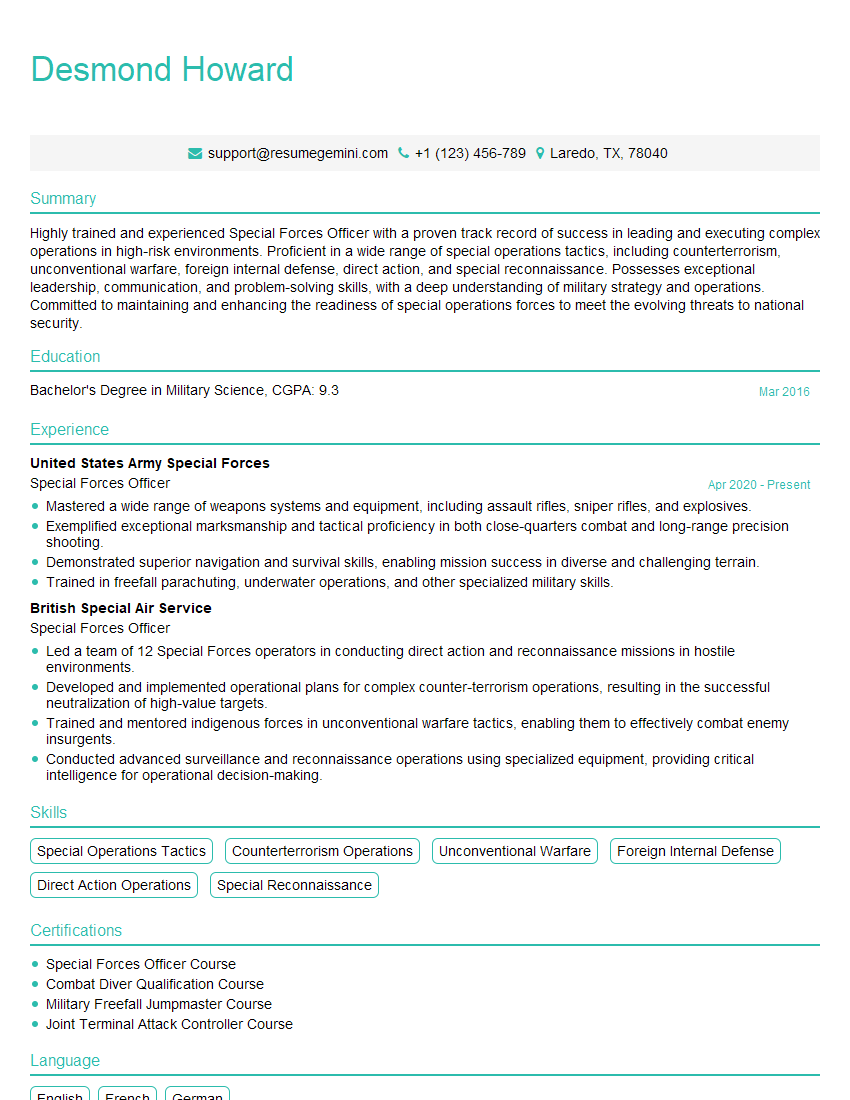
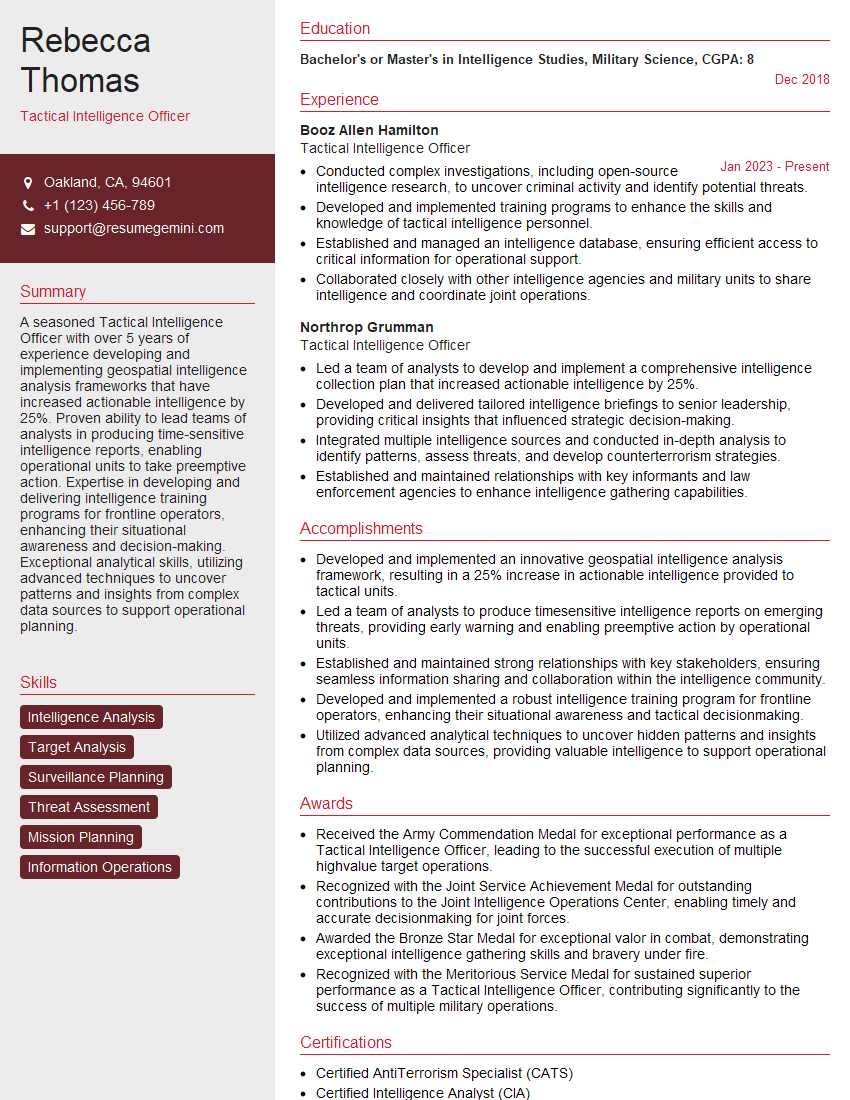
Mastering Special Operations Tactics is crucial for career advancement in this highly specialized field. A strong understanding of these concepts will significantly enhance your interview performance and overall career prospects. To further strengthen your application, focus on creating an ATS-friendly resume that highlights your relevant skills and experience. ResumeGemini is a trusted resource for building professional and impactful resumes. Leverage their expertise to craft a resume that truly showcases your capabilities. Examples of resumes tailored to Special Operations Tactics are available to help guide you.
Explore more articles
Users Rating of Our Blogs
Share Your Experience
We value your feedback! Please rate our content and share your thoughts (optional).
What Readers Say About Our Blog
Very informative content, great job.
good