Interviews are opportunities to demonstrate your expertise, and this guide is here to help you shine. Explore the essential Spray Finishing interview questions that employers frequently ask, paired with strategies for crafting responses that set you apart from the competition.
Questions Asked in Spray Finishing Interview
Q 1. What types of spray guns are you familiar with and their applications?
Spray guns are the heart of any spray finishing operation, and different types cater to specific needs. I’m familiar with several, including:
- Conventional Air Spray Guns: These use compressed air to atomize the paint. They offer good control and are versatile, suitable for a wide range of finishes, from automotive to furniture. Think of them as the ‘Swiss Army knife’ of spray guns, adaptable to different paint viscosities and application techniques. However, they can be less efficient than other methods due to higher air consumption.
- High-Volume, Low-Pressure (HVLP) Spray Guns: These guns atomize paint with a larger volume of air at lower pressure. This results in less overspray and improved transfer efficiency, reducing material waste and environmental impact. They are ideal for applications where minimizing overspray is critical, such as in environmentally sensitive areas or when working with expensive paints.
- Airless Spray Guns: These guns use extremely high pressure to atomize the paint without the need for much compressed air. They are very efficient and quick, perfect for large-scale projects like painting houses or industrial applications. Think of them as the ‘powerhouse’ for high-speed, large-area coverage. However, they require careful technique to avoid runs and sags.
- Electrostatic Spray Guns: These guns use an electrostatic charge to attract the paint particles to the surface being painted. This results in even better transfer efficiency and less overspray than HVLP, especially on complex shapes. They are commonly used in industrial settings for even, consistent coating on intricate parts.
The choice of spray gun depends entirely on the specific project, the type of paint, the surface area, and environmental considerations.
Q 2. Describe the different types of spray finishing techniques (e.g., HVLP, airless, electrostatic).
Spray finishing techniques are diverse, each with its own advantages and disadvantages. Let’s explore the most common:
- HVLP (High-Volume, Low-Pressure): As mentioned before, HVLP uses a large volume of air at low pressure for efficient transfer and reduced overspray. This is great for precise work and minimizing environmental impact.
- Airless: This technique atomizes paint using high pressure, leading to fast application and high transfer efficiency, ideal for large projects but demanding careful control to prevent runs.
- Electrostatic: This method uses an electrical charge to attract paint particles to the surface, resulting in superior transfer efficiency and minimal overspray. It’s particularly effective on complex shapes and reduces material waste.
- Air-Assisted Airless: This combines aspects of airless and conventional air spray. High pressure atomizes the paint, while a smaller amount of air assists in controlling the spray pattern. It offers a balance between speed and control.
- Two-Component (2K) Spraying: This involves mixing two components (e.g., resin and hardener) immediately before spraying. This provides superior durability and often faster curing times, but requires specialized equipment and precise mixing ratios.
The selection of the technique hinges on the project’s scale, the desired finish quality, the paint type, and environmental concerns.
Q 3. Explain the importance of surface preparation before spray finishing.
Surface preparation is the cornerstone of a successful spray finish. A poorly prepared surface will result in a poor finish, regardless of how skilled the painter is or how good the paint is. Think of it like building a house – you wouldn’t start constructing without a solid foundation.
Proper surface preparation involves several key steps:
- Cleaning: Removing dirt, grease, oil, and any previous coatings is crucial. This might involve washing with a suitable solvent, degreaser, or even abrasive blasting for heavily soiled surfaces.
- Sanding: Smoothing out imperfections and creating a uniform surface texture is vital for paint adhesion. The grit of sandpaper used depends on the surface material and the desired finish. Proper sanding prevents peeling and improves the overall look.
- Priming: Applying a primer provides a uniform base for the topcoat, improving adhesion and often providing additional protection against corrosion or rust. The primer should be compatible with both the substrate and the topcoat.
- Masking: Protecting areas that shouldn’t be painted is a must. Using painter’s tape and plastic sheeting prevents unwanted overspray and ensures clean lines.
Each step is critical. Skipping or rushing any stage compromises the final finish, leading to issues like peeling, bubbling, and poor adhesion.
Q 4. How do you ensure proper ventilation and safety in a spray booth?
Ventilation and safety are paramount in a spray booth. Overspray and paint fumes are hazardous, and proper precautions are mandatory.
Key aspects include:
- Proper Exhaust System: A well-designed exhaust system removes overspray and fumes from the booth, preventing them from accumulating and creating a dangerous environment. Regular maintenance and filter changes are vital for optimal performance.
- Airflow: Adequate airflow is essential to prevent paint particles from settling and ensures the removal of hazardous vapors. The airflow should be carefully managed to prevent recirculation of fumes.
- Fire Suppression System: Spray booths pose a fire risk, so a reliable fire suppression system (e.g., sprinklers, fire extinguishers) is critical. Regular inspections and maintenance are crucial.
- Personal Protective Equipment (PPE): Painters must wear respirators, safety glasses, gloves, and protective clothing to prevent inhalation of paint particles and contact with hazardous materials. Regular training on proper PPE use is essential.
- Emergency Procedures: Clearly defined emergency procedures for handling spills, fires, or medical emergencies should be readily available and regularly practiced.
Ignoring these measures can lead to severe health problems, fire hazards, and environmental damage.
Q 5. What are the common issues encountered during spray finishing and how do you troubleshoot them?
Spray finishing presents various challenges. Some common issues and their troubleshooting strategies include:
- Orange Peel: This uneven, textured finish is often caused by incorrect spray gun settings, too much paint, or insufficient air pressure. Adjust the gun settings, reduce the paint flow, and increase air pressure to remedy this.
- Runs and Sags: Excessive paint, low viscosity, or improper application techniques lead to this. Reduce paint flow, increase air pressure, and use thinner coats. Consider using a higher viscosity paint or a slower application technique.
- Dry Spray: This results in a rough, powdery finish due to insufficient paint or excessive air pressure. Increase paint flow and reduce air pressure to resolve this.
- Dust Nibs: Small imperfections caused by airborne dust settling on the wet paint. Improve booth cleanliness and use adequate filtration.
- Poor Adhesion: This may be due to inadequate surface preparation, incompatible paints, or improper curing conditions. Ensure thorough surface preparation, use compatible paints, and ensure proper curing conditions.
Systematic troubleshooting, starting with careful observation and analysis of the defect, leads to efficient problem-solving. Understanding the root cause is crucial for effective correction.
Q 6. Explain the concept of viscosity and its impact on spray finishing.
Viscosity refers to a fluid’s resistance to flow. In spray finishing, it’s crucial because it directly affects how the paint atomizes and applies to the surface. Think of it like pouring honey versus water – honey has a much higher viscosity and flows more slowly.
High viscosity paints are thicker and require more pressure to atomize, potentially leading to orange peel or runs. Low viscosity paints are thinner and can result in dry spray or excessive overspray. The ideal viscosity ensures proper atomization, good flow, and a smooth finish. Viscosity is often adjusted using thinners or retarders specifically formulated for the paint type, ensuring optimal flow for the selected spray equipment and application method. Using a viscosity cup or a Zahn cup is a common method to measure paint viscosity before applying it.
Q 7. What are the different types of paint used in spray finishing and their properties?
Many paint types are used in spray finishing, each with unique properties tailored to specific applications:
- Acrylic Lacquers: Fast-drying, versatile, and available in various sheen levels. Ideal for furniture, automotive, and general applications. However, they can be less durable than some other options.
- Acrylic Enamels: Durable, offer good flow and leveling, and provide a smooth finish. A common choice for automotive, industrial, and high-performance applications. They usually offer better resistance to chemicals and weathering than lacquers.
- Urethane Paints: Extremely durable and resistant to chemicals, weathering, and abrasion. Often used in industrial, automotive, and marine applications, where superior protection is needed. They often require a specialized spray gun and curing process.
- Powder Coatings: Applied as a dry powder and cured using heat. They are very durable, environmentally friendly (low or no VOCs), and offer a wide range of colors and textures. Commonly used in industrial and appliance applications.
- Water-Based Paints: Low-VOC, environmentally friendly, and easier to clean up. They are suitable for many applications but may require longer drying times compared to solvent-based paints.
The selection depends on the application’s requirements regarding durability, appearance, environmental impact, and cost. Understanding the properties of each type is critical for choosing the right paint for the job.
Q 8. How do you determine the correct paint pressure and spray distance?
Determining the correct paint pressure and spray distance is crucial for achieving a high-quality finish. It’s a balance between atomization and overspray. Too much pressure leads to excessive overspray, wasted paint, and a rough finish. Too little pressure results in a poor atomization, leading to runs, sags, and an uneven coating. The ideal settings depend on several factors including the type of paint, the nozzle size, the surface being sprayed, and the desired film thickness.
Determining the correct pressure: This is often found through experimentation and referring to the manufacturer’s recommendations for the specific paint and spray gun being used. Start with the manufacturer’s suggested pressure range, and adjust slightly based on the resulting spray pattern. You want a fine, even mist, not a heavy stream of paint.
Determining the correct spray distance: This usually falls within a 6-12 inch range. Too close, and you risk runs and uneven coverage. Too far, and you get a weak coating that may not offer sufficient protection. Again, the ideal distance is determined by observation. Maintain a consistent distance across the entire surface to ensure a uniform finish.
Example: When spraying automotive paint with a high-volume, low-pressure (HVLP) system, I might start with a pressure of 30 PSI and a spray distance of 8-10 inches, making adjustments based on the observed spray pattern and the finished surface.
Q 9. Describe your experience with different types of spray finishing equipment.
My experience encompasses a wide range of spray finishing equipment, from conventional air spray guns to more advanced technologies like HVLP (High-Volume, Low-Pressure) and electrostatic spray systems. I’ve worked with both gravity-fed and pressure-fed guns, and I’m familiar with various nozzle sizes and configurations for different applications.
- Conventional Air Spray Guns: These are widely used and relatively simple to operate, but they can lead to higher overspray.
- HVLP Spray Guns: These systems significantly reduce overspray compared to conventional guns, resulting in less waste and a cleaner work environment. They’re ideal for delicate work and environmentally conscious projects.
- Electrostatic Spray Systems: These systems utilize an electrostatic charge to attract paint particles to the surface, leading to even better transfer efficiency and reduced overspray. This is particularly beneficial for irregularly shaped objects.
- Airless Sprayers: These are best suited for large-scale applications requiring quick coverage. They use high pressure to atomize the paint, providing high transfer rates but potentially leading to more surface imperfections if not managed properly.
I’m also proficient in using various accessories, including different sized nozzles, fluid tips, and air caps to adapt to different paint viscosities and desired finish textures.
Q 10. Explain the importance of maintaining spray equipment.
Maintaining spray equipment is paramount for achieving consistent results and preventing costly repairs. Regular maintenance ensures the equipment operates efficiently, minimizing overspray and maximizing transfer efficiency. Neglecting maintenance can lead to poor atomization, inconsistent finishes, and even equipment failure.
My maintenance routine typically includes:
- Daily Cleaning: Thoroughly cleaning the gun after each use, removing all traces of paint and solvent to prevent clogging.
- Regular Fluid Tip and Nozzle Inspection: Checking for wear, damage, or clogging. Replacing worn or damaged parts as needed. A tiny speck of dried paint can significantly impact spray quality.
- Periodic Disassembly and Cleaning: Disassembling the spray gun for a more thorough cleaning, ensuring all internal passages are clear. This is particularly crucial after working with thicker materials that may be prone to clogging.
- Air Filter Maintenance: Regularly changing or cleaning the air filter to prevent contaminants from entering the system and damaging the gun or affecting the finish.
- Lubrication: Applying recommended lubricants to moving parts to ensure smooth operation and prolong the lifespan of the equipment.
A well-maintained spray gun is an investment that saves time, materials, and delivers superior results.
Q 11. How do you achieve a consistent finish across a large surface area?
Achieving a consistent finish across a large surface area requires meticulous planning and execution. It’s a combination of technique, equipment setup, and environmental control.
- Wet-on-Wet Technique: This involves applying multiple thin coats, allowing each coat to slightly flash before applying the next. This helps avoid runs and sags, and ensures even coverage.
- Overlapping Spray Passes: Each pass should overlap the previous one by about 50% to guarantee consistent coverage and avoid visible seams or banding.
- Consistent Spray Distance and Pressure: Maintaining a constant spray distance and pressure throughout the entire painting process is critical. Any variation will affect the thickness and quality of the finish.
- Proper Surface Preparation: A smoothly prepared surface is essential for an even finish. This includes sanding, cleaning, and priming as necessary.
- Environmental Control: Factors such as temperature, humidity, and airflow can significantly impact the drying time and finish quality. Controlling these environmental factors as much as possible ensures consistent results.
Imagine painting a large wall: I would divide the wall into sections, carefully maintaining my distance and overlap across each section to ensure a uniform finish across the whole surface.
Q 12. How do you manage different color changes during a spray painting job?
Managing color changes during a spray painting job requires meticulous cleaning to prevent contamination. Even a tiny amount of residual paint can significantly affect the next color.
My process involves:
- Thorough Cleaning: After completing each color, I completely disassemble and clean the spray gun, using appropriate solvents and brushes to remove all traces of the previous color. This is crucial to avoid contaminating the next color.
- Separate Containers and Equipment: Using separate containers for each color and even dedicated equipment if possible minimizes the risk of cross-contamination.
- Testing on a Sample Panel: Before spraying the actual workpiece, I always test the new color on a sample panel to ensure that the color is correct and the spray pattern is uniform. This allows adjustments to be made before affecting the final project.
- Color Charts and References: Relying on color charts or digital references provides consistency and accuracy in color matching throughout the job.
This approach ensures a clean transition between colors and prevents costly rework.
Q 13. Describe your experience with different paint mixing and matching techniques.
Paint mixing and matching techniques are essential for achieving precise color matches and specific paint properties. My experience encompasses both traditional methods and the use of modern color-matching systems.
- Traditional Methods: These involve using color charts and tint bases to create custom colors. It requires careful measuring, mixing, and testing to achieve the desired shade. This method demands a high level of precision and experience.
- Color-Matching Systems: Modern color-matching systems utilize spectrophotometers to analyze existing colors and provide precise formulations. These systems have significantly improved the accuracy and efficiency of color matching.
- Understanding Paint Properties: Besides color, I consider gloss level, viscosity, and other properties when mixing paints. This ensures the finished product meets the required specifications. For instance, matching the viscosity is essential for consistent application with the spray equipment.
I’m adept at using both traditional and modern methods, adapting my approach based on the specific job requirements and available resources. I always test any newly mixed color on a sample panel before applying it to the final project.
Q 14. What safety measures do you follow when handling spray paint and solvents?
Safety is paramount when handling spray paint and solvents. I strictly adhere to all relevant safety regulations and guidelines.
- Personal Protective Equipment (PPE): I always wear appropriate PPE, including respirators (specifically designed for paint fumes), safety glasses, gloves, and coveralls to protect myself from inhalation, skin contact, and eye irritation.
- Ventilation: I work in well-ventilated areas or use respirators with appropriate cartridges when adequate ventilation is not possible. This is crucial to minimize exposure to hazardous fumes.
- Proper Disposal of Waste: I properly dispose of paint waste and solvents according to local regulations, often using designated containers for hazardous materials.
- Fire Safety: I’m aware of the flammability of paints and solvents and take necessary precautions to prevent fires, such as using non-sparking tools and ensuring that there are no ignition sources nearby.
- Emergency Procedures: I’m familiar with emergency procedures in case of spills, accidental exposure, or fires and know how to use appropriate fire extinguishers and first-aid equipment.
Safety is not an option; it’s a priority, and I take it very seriously in every aspect of my work.
Q 15. How do you deal with imperfections or defects in a finished product?
Dealing with imperfections in spray finishing requires a systematic approach. First, we identify the defect – is it a run, a sag, an orange peel effect, dust nibs, or something else? This is crucial for determining the best course of action. For minor imperfections like light orange peel, a subsequent light sanding and recoating might suffice. More severe defects such as runs or sags often necessitate more aggressive remediation: removing the affected area completely, followed by proper surface preparation (cleaning, sanding, priming) and re-spraying. The key is to understand the root cause of the imperfection. Was it due to incorrect spray technique, inadequate preparation, environmental factors (humidity, temperature), or a problem with the finish itself? Addressing the root cause prevents recurrence. For example, orange peel can be caused by improper spray gun adjustment (too much air pressure, incorrect spray pattern) or an overly thick coat. Careful analysis ensures effective repair and consistent quality.
I once encountered a large run on a high-gloss automotive piece. Instead of simply trying to sand it out, I meticulously removed the affected area, re-primed, and applied thinner coats, ensuring proper flash-off time between coats. The result was a flawless finish.
Career Expert Tips:
- Ace those interviews! Prepare effectively by reviewing the Top 50 Most Common Interview Questions on ResumeGemini.
- Navigate your job search with confidence! Explore a wide range of Career Tips on ResumeGemini. Learn about common challenges and recommendations to overcome them.
- Craft the perfect resume! Master the Art of Resume Writing with ResumeGemini’s guide. Showcase your unique qualifications and achievements effectively.
- Don’t miss out on holiday savings! Build your dream resume with ResumeGemini’s ATS optimized templates.
Q 16. What are your experience with different types of substrates?
My experience encompasses a wide range of substrates, including wood (both hardwoods and softwoods), metals (steel, aluminum, etc.), plastics (ABS, polycarbonate), and composites. Each material requires a unique approach to surface preparation and finish selection. For instance, wood often needs sanding and potentially a wood filler to ensure a smooth surface before priming. Metals might require degreasing and possibly etching for better paint adhesion. Plastics can be sensitive to certain solvents and require a specific primer designed for plastic adhesion. Composites necessitate careful consideration of their specific composition and potential sensitivities.
Understanding the substrate’s characteristics – porosity, surface tension, chemical resistance – is vital for choosing the correct primers and topcoats and achieving optimal adhesion and durability. For example, working with high-gloss finishes on a porous substrate necessitates careful priming to ensure a perfectly smooth, even surface and prevent the porous material from ‘sucking’ the paint, leaving an uneven finish.
Q 17. How do you ensure the quality of your work meets the required standards?
Quality control is paramount in spray finishing. My process starts with thorough surface preparation – cleaning, sanding, and priming. Then, consistent application of the finish, maintaining proper gun distance, air pressure, and overlapping pattern, is crucial. Throughout the process, regular visual inspections and, when necessary, the use of measuring instruments (e.g., film thickness gauge) help to monitor quality. After the final coat, the finished product is inspected under controlled lighting for imperfections. Adherence to established standards, like those specified by industry bodies, is crucial. Documentation of each step, including material used and application parameters, provides traceability and helps with troubleshooting if problems arise.
For example, on projects where a specific gloss level is required, I use a gloss meter to ensure that the final finish matches the specifications. Careful record-keeping helps to demonstrate consistency and quality throughout the whole process.
Q 18. Describe your experience with different types of finishing materials (e.g., clear coats, primers).
I’m experienced with various finishing materials, including primers (epoxy, urethane, acrylic), clear coats (acrylic lacquer, polyurethane, catalyzed), and specialized finishes (e.g., metallics, pearlescents). Each type has its properties and applications. For instance, epoxy primers offer excellent adhesion and corrosion resistance, making them suitable for metal substrates. Urethane clear coats provide outstanding durability and UV resistance. Acrylic lacquers offer a fast-drying, easy-to-apply option, but may not be as durable as urethane. The choice depends on the substrate, desired finish (gloss level, durability), and budget.
I recently completed a project involving a custom-mixed pearl-white finish. The key to success with a specialty finish like this is careful preparation and meticulous application to achieve a uniform, even coating without streaks or imperfections. The understanding of the unique properties of the finish material allows me to select the most suitable material and methodology.
Q 19. Explain the process of cleaning and maintaining your spray equipment.
Cleaning and maintaining spray equipment is essential to prevent clogging, ensure consistent performance, and prolong the equipment’s lifespan. Immediately after each use, I thoroughly clean the spray gun by flushing it with the appropriate solvent recommended for the finish used. This involves disassembling the gun and cleaning each part individually, paying attention to the air cap and fluid nozzle. Airless spray systems require careful cleaning of the pump and filter. Regular maintenance includes checking for wear and tear on parts, such as the needle and nozzle, and replacing them as needed. The entire system is stored in a clean, dry environment to prevent corrosion.
Ignoring proper cleaning procedures can lead to clogs, inconsistent finishes, and costly repairs or replacements. I often use a combination of solvent flushing and specialized cleaning solutions to ensure the thorough removal of residue. This routine maintenance increases the efficiency and lifespan of the equipment.
Q 20. How do you handle waste materials generated during spray finishing?
Waste management is a critical aspect of responsible spray finishing. Overspray, contaminated solvents, and used rags are all potential hazards. I strictly adhere to all relevant environmental regulations and utilize appropriate waste disposal methods. Overspray is minimized through proper spray techniques and containment methods, such as using designated spray booths with appropriate filtration systems. Solvents are collected in designated containers and disposed of through licensed waste haulers. Used rags and other contaminated materials are disposed of in accordance with safety regulations, often through designated hazardous waste disposal systems.
In some cases, waste reduction techniques are employed – for instance, water-based paints are preferred over solvent-based paints whenever feasible, significantly reducing the amount of hazardous waste generated. This process is vital for responsible environmental management.
Q 21. What are your knowledge of various paint types (e.g., lacquer, enamel, urethane)?
My knowledge of paint types includes lacquer, enamel, and urethane, each with unique characteristics. Lacquers dry quickly through solvent evaporation, making them suitable for fast turnaround projects but generally less durable than other options. Enamels, typically oil-based, offer good durability and a smooth finish but require longer drying times. Urethanes provide the highest level of durability and resistance to chemicals and UV degradation, making them popular for exterior applications and high-performance finishes. Each paint type has various formulations affecting viscosity, drying time, and durability, adding another level of complexity to the selection process.
The choice of paint depends on the specific application requirements, considering aspects such as cost, drying time, desired appearance, and needed durability. For example, a quick-drying lacquer would suit a high-volume project where turnaround time is critical, while a durable urethane would be preferred for outdoor furniture that requires long-term protection.
Q 22. Describe your experience with different types of masking techniques.
Masking is crucial in spray finishing to protect areas that shouldn’t be painted. I’ve extensive experience with various techniques, choosing the best method depends heavily on the project’s complexity and the substrate’s geometry.
- Low-tack masking tape and paper: This is a standard for straight lines and larger areas. Think of painting stripes on a car – this is your go-to method. Proper application involves firmly pressing the tape down to ensure a clean edge and prevent bleed-through. I always use a suitable tape for the surface, considering factors like temperature and surface texture.
- Plastic sheeting and tape: Ideal for larger, irregular shapes or covering entire areas. Think of masking an interior of a car before painting the exterior. Securing it properly to prevent movement during spraying is key. I frequently use specialized adhesive sprays to help keep the plastic taut and secure.
- Specialized masking materials: This includes pre-cut stencils, liquid masking, and specialized tapes for curves and intricate designs. For example, when applying intricate patterns or logos, I’d use stencils to get the precise shapes. Liquid masking is excellent for curved surfaces where tape might not adhere well. I’ve used this extensively on automotive parts.
- Hand masking: This involves carefully applying tape and paper by hand for more detailed work. It requires patience and precision, as seen when masking around small components or delicate features. It’s all about technique to achieve clean edges and avoid overspray.
Selecting the right masking technique directly impacts the final finish quality. Careful planning and execution are crucial to avoid time-consuming corrections.
Q 23. How do you ensure proper airflow in a spray booth to prevent overspray?
Proper airflow in a spray booth is paramount to prevent overspray and ensure a safe working environment. The booth’s design and ventilation system play a critical role. It’s not just about volume, but about carefully controlled air movement to capture overspray particles.
I typically ensure the following:
- Sufficient Airflow: The system should have enough CFM (cubic feet per minute) to capture and exhaust airborne particles. This is calculated based on the booth’s size and the type of spray finishing being done. A poorly ventilated booth risks leaving overspray on the finished product or worse, creating a dangerous environment for the technician.
- Airflow Direction: Air should be drawn across the workpiece from front to back, and then exhausted to the outside. This creates a controlled pathway for the paint particles and prevents them from swirling around the booth. This is fundamental to avoiding the dreaded overspray and achieving an even coating.
- Air Filtration: Multiple stages of filtration are crucial. Pre-filters capture larger particles, while finer filters trap microscopic ones that would otherwise contaminate the air. Regular filter changes are critical and I meticulously maintain a schedule to prevent buildup which can affect air quality.
- Booth Maintenance: Regular cleaning of the booth walls, floor, and filters is crucial. Accumulated paint particles can re-circulate and compromise the finish. I always inspect the booth and filters regularly, as maintenance directly impacts the booth’s efficiency and air quality.
Addressing airflow issues is a critical part of my workflow. A properly functioning ventilation system is essential not only for quality but also for safety.
Q 24. What are your knowledge of different spray gun nozzle sizes and their applications?
Spray gun nozzle size significantly impacts the finish quality and efficiency. A smaller nozzle produces a finer atomized spray pattern, ideal for detailed work and delicate surfaces. Conversely, a larger nozzle provides a wider spray pattern, suitable for larger areas and faster coverage. The choice depends on the application.
- Small Nozzles (e.g., 1.0mm – 1.3mm): Used for fine detail work, such as automotive clear coats, where a smooth, even finish with minimal texture is paramount. These are my go-to nozzles for smaller items and detailed components.
- Medium Nozzles (e.g., 1.4mm – 1.8mm): Versatile and commonly used for general-purpose applications, offering a balance between detail and coverage. They are often ideal for medium-sized projects and surfaces requiring both precision and speed.
- Large Nozzles (e.g., 2.0mm+): Primarily used for high-volume applications or applications where thicker coatings are needed, such as primers or textured finishes. These are better suited for larger surfaces and projects demanding faster throughput.
Material viscosity also factors into nozzle selection. Thicker materials require larger nozzles to prevent clogging. I always consider this during my preparation and selection process.
In my experience, proper nozzle selection minimizes material waste and increases efficiency. Using the wrong nozzle size can lead to uneven coating, increased material use and longer completion times.
Q 25. How do you identify and address orange peel in a spray finish?
Orange peel is a common defect characterized by a bumpy, uneven texture resembling an orange peel. It’s typically caused by improper spray technique, incorrect air pressure, or incorrect material viscosity. Identification is visual – it’s quite noticeable.
Addressing orange peel depends on its severity:
- Minor Orange Peel: Often addressed by wet-sanding with progressively finer grit sandpaper (e.g., 1500-grit, 2000-grit) followed by a polishing process. This is a standard procedure I follow regularly. I might also experiment with slight adjustments to the air pressure and spray technique for the subsequent coats to attempt correction.
- Severe Orange Peel: May require recoating after proper surface preparation (cleaning and sanding) to smooth out the surface. Re-spraying with careful attention to technique and parameters is necessary in these cases.
Preventing orange peel is key. Maintaining a consistent distance from the workpiece, using proper air pressure, and ensuring the correct viscosity of the material are crucial. Proper technique is critical in preventing issues in the first place.
Q 26. Describe your experience with color matching and formula adjustments.
Color matching and formula adjustments are crucial for achieving the desired aesthetic outcome. I use a combination of spectrophotometers and color formulas to ensure consistency.
My approach:
- Spectrophotometer Analysis: I use a spectrophotometer to measure the color of the existing surface, providing numerical data for precise color matching. This gives a starting point for creating the formula.
- Formula Adjustment: Based on spectrophotometer readings and available colorants, I adjust the paint formula accordingly. This involves precise calculations and often requires iterative adjustments to attain the target color.
- Test Samples: Creating and evaluating test samples are essential before applying to the entire project. This allows fine-tuning the formula for accurate replication of the desired color.
Experience has taught me that factors such as lighting, substrate color, and even the human eye can influence color perception. I account for this during both the analysis and refinement steps, ensuring color accuracy.
Q 27. How do you ensure a smooth and even finish during spray application?
Achieving a smooth and even finish is the cornerstone of quality spray finishing. It requires a combination of proper preparation, technique, and equipment setup.
My process:
- Surface Preparation: Thorough cleaning and preparation are paramount. Any imperfections or contaminants on the surface will show through the final finish. I thoroughly clean and prepare every surface before application.
- Consistent Spray Technique: Maintaining a consistent distance, spray angle, and speed is crucial. Overlapping spray passes appropriately to create an even coat is also important. Practicing consistent movement eliminates issues like runs and sags.
- Proper Air Pressure and Material Viscosity: Incorrect air pressure or viscosity can result in an uneven finish, poor atomization, or orange peel. Using the correct combination of settings for each application is crucial.
- Multiple Thin Coats: Applying multiple thin coats instead of one heavy coat prevents runs and sags, allowing each layer to dry properly, resulting in a smoother overall finish. This is a fundamental aspect of my spraying process.
By meticulously following these steps, I consistently achieve high-quality, smooth, even finishes.
Q 28. What is your experience with powder coating application?
I have considerable experience with powder coating application, a durable and environmentally friendly alternative to liquid paint. The process involves applying a dry powder coating to a surface and then curing it using heat.
My experience encompasses:
- Pre-treatment: Proper surface preparation, including cleaning, degreasing, and possibly chemical etching, is crucial for adhesion. I meticulously prepare the substrate for optimal paint bonding.
- Powder Application: This involves using an electrostatic spray gun to apply the powder coating to the workpiece. The electrostatic charge ensures even distribution. I am proficient in handling various powder coating guns and managing their settings.
- Curing: The coated workpiece is cured in an oven at a specific temperature and time, depending on the type of powder coating. The curing process is critical for achieving optimal hardness and durability, and I maintain precise temperature and time parameters.
- Post-Curing Inspection: After curing, a visual inspection ensures the coating’s uniformity, thickness, and overall quality. Addressing any defects at this stage is important.
Powder coating offers excellent durability and a wide range of color and texture options. I find it an ideal choice for many applications where long-lasting finishes are needed.
Key Topics to Learn for Your Spray Finishing Interview
- Spray Gun Technology: Understand different types of spray guns (HVLP, airless, etc.), their applications, and maintenance procedures. Consider the advantages and disadvantages of each type.
- Material Properties and Application: Explore how different paint types (lacquer, enamel, acrylic) behave during spraying and how to achieve optimal finish based on substrate and desired outcome. This includes understanding viscosity, curing times, and VOC content.
- Surface Preparation Techniques: Master the importance of proper surface preparation (cleaning, sanding, priming) for achieving a high-quality, durable finish. Discuss different preparation methods and their suitability for various materials.
- Spray Techniques and Patterns: Learn about achieving different spray patterns (fan, circular, etc.), adjusting spray gun settings for even coating, and techniques for avoiding runs, sags, and orange peel.
- Health and Safety Regulations: Demonstrate your knowledge of relevant safety precautions, including proper ventilation, personal protective equipment (PPE), and handling of hazardous materials. This is crucial for any spray finishing role.
- Troubleshooting and Quality Control: Discuss common problems encountered in spray finishing (e.g., pinholes, fisheyes, dust nibs) and practical strategies for identifying and rectifying them. Explain your approach to quality control and inspection.
- Finishing Processes: Explore additional processes such as masking, sanding, and polishing to achieve a perfect final finish. Understand the role of each step in the overall process.
- Environmental Considerations: Understand environmentally friendly practices and regulations relating to solvent emissions and waste disposal.
Next Steps
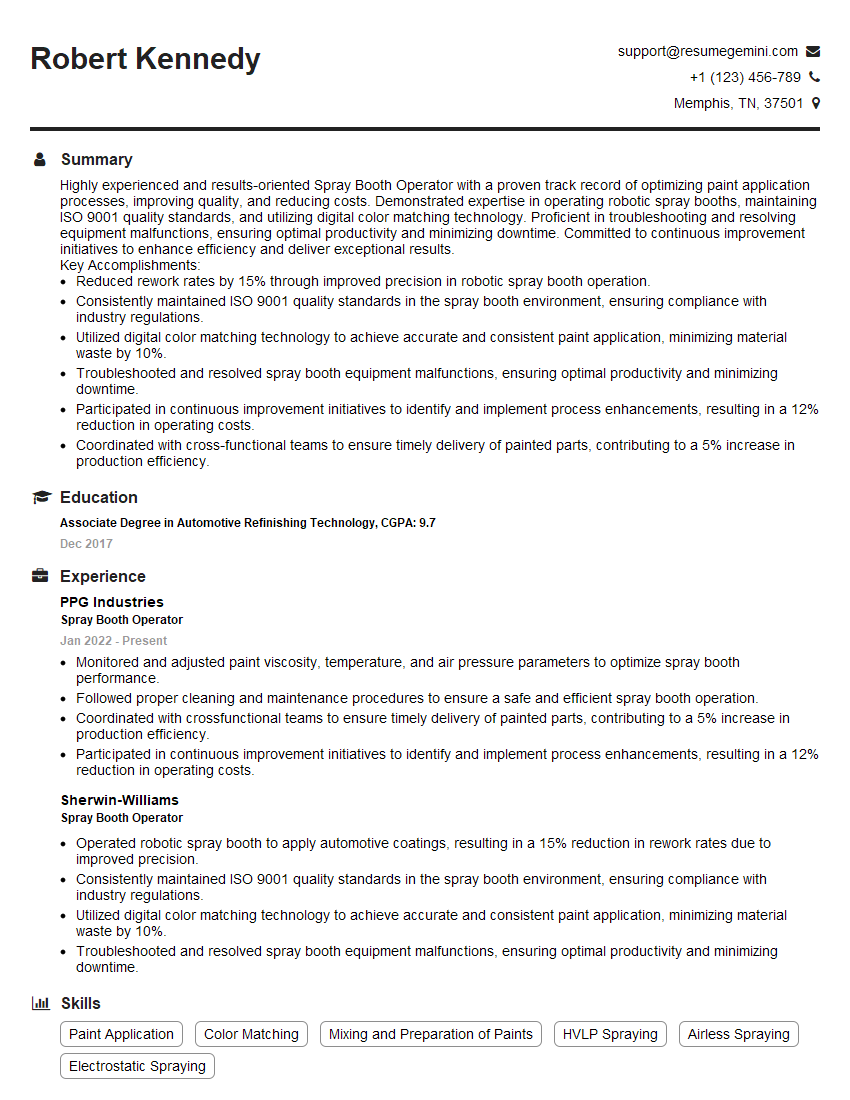
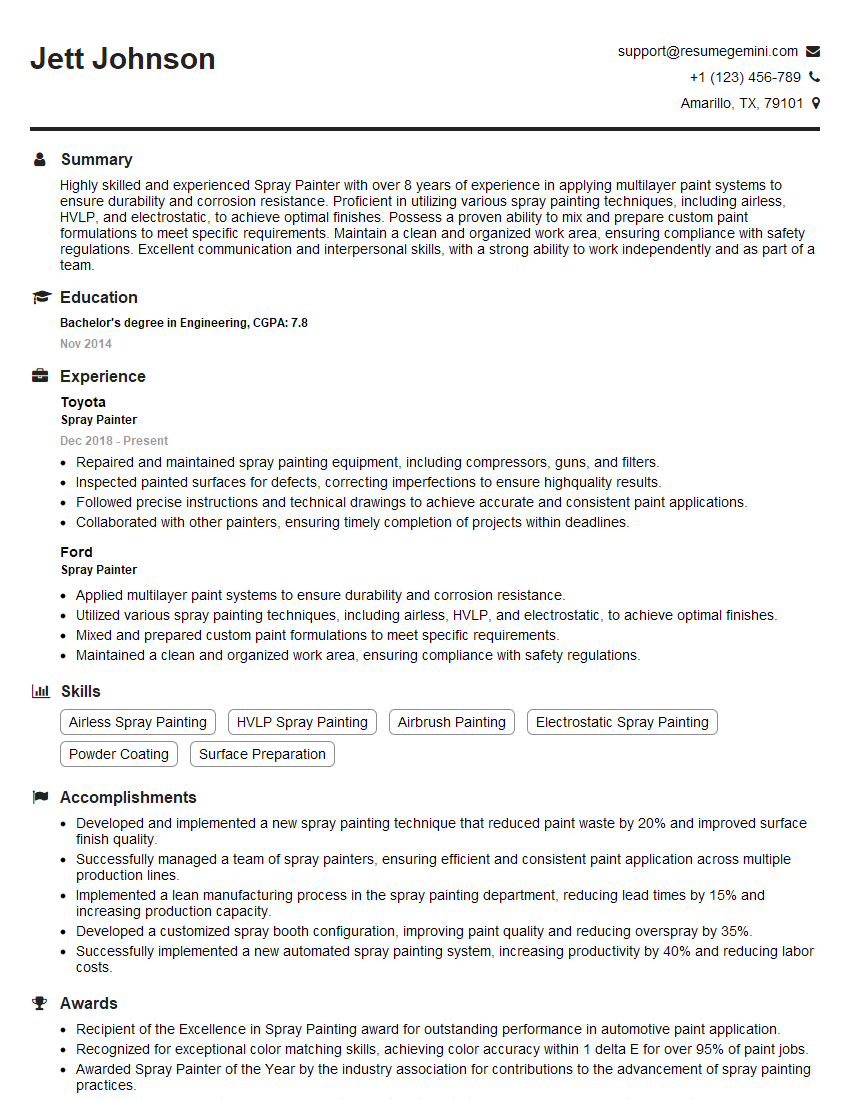
Mastering spray finishing opens doors to a rewarding career with excellent growth potential in various industries. To maximize your job prospects, crafting a strong, ATS-friendly resume is crucial. ResumeGemini is a trusted resource to help you build a professional and impactful resume that highlights your skills and experience effectively. Examples of resumes tailored specifically to Spray Finishing positions are available to guide you.


Explore more articles
Users Rating of Our Blogs
Share Your Experience
We value your feedback! Please rate our content and share your thoughts (optional).
What Readers Say About Our Blog
Very informative content, great job.
good