Interviews are opportunities to demonstrate your expertise, and this guide is here to help you shine. Explore the essential Sprinkler Pipe Fitting interview questions that employers frequently ask, paired with strategies for crafting responses that set you apart from the competition.
Questions Asked in Sprinkler Pipe Fitting Interview
Q 1. Explain the different types of sprinkler pipe materials and their applications.
Sprinkler pipe materials are chosen based on factors like pressure, temperature, and the environment. The most common materials include:
- Black Iron Pipe (BIP): Strong and durable, suitable for high-pressure systems. However, it’s susceptible to corrosion, requiring protective coatings in many applications. We rarely use this unless we are dealing with legacy systems or very high pressures.
- Galvanized Steel Pipe (GSP): Offers better corrosion resistance than BIP thanks to the zinc coating, making it a cost-effective choice for many applications. It’s still prone to corrosion over time, especially in aggressive soil conditions.
- Copper Pipe: Excellent corrosion resistance and longevity make it a premium option. Its flexibility and ease of joining make it suitable for complex layouts. It’s more expensive than steel options but the lifetime cost can be lower due to reduced maintenance.
- CPVC (Chlorinated Polyvinyl Chloride): A plastic pipe offering superior corrosion resistance and is lightweight and easy to install. It’s ideal for lower pressure systems and is becoming increasingly popular in residential and light commercial applications. Its thermal expansion needs to be considered.
- High-Density Polyethylene (HDPE): Another plastic option known for its flexibility, durability, and resistance to corrosion. Often used in underground systems and large-diameter main lines due to its ability to withstand ground movement and stress.
The selection depends on budget, system pressure, soil conditions, and local codes. For instance, in highly corrosive environments, copper or CPVC might be preferred over steel. In a low-pressure residential system, CPVC might be a cost-effective choice.
Q 2. Describe the process of sizing sprinkler pipes.
Sizing sprinkler pipes involves determining the appropriate diameter to ensure adequate water flow and pressure throughout the system. This is crucial to avoid insufficient water delivery to sprinkler heads, which can compromise fire suppression or irrigation effectiveness. We use specialized software and engineering principles to achieve optimal sizing.
The process involves calculating the required flow rate for each zone, considering the number and type of sprinkler heads. We then use friction loss calculations (discussed in the next question) and pressure drop charts to determine the pipe diameter. The goal is to select the smallest diameter pipe that will still maintain sufficient pressure at the most distant sprinkler head in the zone, while adhering to relevant standards and codes. For example, a high-density zone requiring many heads might need larger diameter pipes than a zone with fewer heads.
Insufficient pipe sizing leads to reduced water pressure and flow rates, while oversized pipes increase material costs and may cause system instability. It’s a balancing act between efficiency and cost.
Q 3. How do you calculate the friction loss in a sprinkler system?
Friction loss is the pressure reduction in a pipe due to water flowing against the pipe’s internal surface. It’s a crucial factor in sprinkler system design, as it directly affects the water pressure available at the sprinkler heads.
We use the Hazen-Williams equation or Darcy-Weisbach equation, depending on the pipe material and flow conditions, to calculate friction loss. These equations require parameters like pipe diameter, length, flow rate, and the pipe’s roughness coefficient.
Example using Hazen-Williams (simplified):
Head Loss (ft) = 4.52 * L * Q^1.85 / C^1.85 * D^4.87
Where:
L= pipe length (ft)Q= flow rate (gpm)C= Hazen-Williams coefficient (depends on pipe material)D= pipe diameter (in)
Software and online calculators are commonly used for these complex calculations, making the process far simpler than manual calculations. Accurate friction loss calculations are essential for designing efficient and reliable sprinkler systems. Ignoring friction loss can lead to significant performance issues.
Q 4. What are the common methods for joining sprinkler pipes?
Several methods exist for joining sprinkler pipes, each with its own advantages and disadvantages. The choice depends on pipe material, pressure requirements, and project scale.
- Threaded Joints: Used with BIP and GSP, requiring the use of pipe threads and fittings. Relatively strong but can be time-consuming and prone to leaks if not properly sealed with Teflon tape or sealant.
- Couplings: Quick-connect couplings facilitate easy assembly and disassembly, useful in temporary setups or maintenance. The use of appropriate couplings for the pipe material is critical to avoid leaks.
- Solvent Welding (CPVC): Used with CPVC pipes, this method involves using a special solvent cement to fuse pipe sections together. Creates a strong, leak-proof joint but requires precise application and proper ventilation.
- Fusion Welding (HDPE): Used with HDPE pipes, this method involves heating the pipe ends and fusing them together using specialized welding equipment. Creates very strong and leak-proof joints but needs specialized equipment and trained personnel.
- Compression Fittings: These fittings use a compression ring to create a watertight seal around the pipe. Suitable for many pipe materials and are relatively easy to install but can loosen over time.
Regardless of the method, proper joint preparation and adherence to manufacturer instructions are critical for achieving leak-free and durable connections. We always perform pressure testing after the piping is installed to verify the integrity of all connections.
Q 5. Explain the importance of proper pipe support and bracing.
Proper pipe support and bracing are critical for preventing pipe sagging, stress, and potential leaks or breaks. Sagging can lead to low points in the system, which can trap air and reduce efficiency, potentially creating areas for corrosion. Additionally, unsupported pipes are more vulnerable to damage from external forces.
Support methods vary depending on the pipe material, diameter, and installation environment. Common methods include:
- Pipe Hangers: These support pipes from above, preventing sagging. Proper spacing is crucial to distribute weight effectively. We calculate hanger spacing based on pipe material, diameter, and fluid weight.
- Pipe Straps: Secure pipes to walls or other structures, providing additional support and stability. We ensure that straps are properly fastened and do not overtighten, to avoid pipe damage.
- Sleeving: Protects pipes from external damage, particularly in harsh environments or areas prone to ground movement. This is a critical consideration for underground lines.
Insufficient support can lead to leaks, pipe failure, and system instability. Ignoring these aspects can be costly and potentially hazardous.
Q 6. How do you identify and address pipe leaks in a sprinkler system?
Identifying and addressing pipe leaks promptly is essential for maintaining system integrity and preventing water damage or wastage. Leaks can manifest in various ways, including:
- Visible Water: Obvious water leakage is the easiest to spot.
- Wet Spots: Dampness or staining on walls or ceilings can indicate a hidden leak.
- Water Meter Readings: Unusually high water consumption can suggest a leak.
- Pressure Drop: A significant decrease in system pressure can indicate a leak.
Once a leak is suspected, the following steps are followed:
- Isolate the Section: Shut off the affected section of the system to prevent further water loss.
- Locate the Leak: Use visual inspection, pressure testing, or leak detection tools as needed. We sometimes use acoustic leak detection equipment to pinpoint hard-to-find leaks.
- Repair or Replace: Repair smaller leaks with appropriate sealing materials. For significant damage, pipe replacement may be necessary. All repairs require pressure testing after completion.
- Restore System Operation: Once the repair is complete and verified, the system is brought back online.
Prompt leak detection and repair is crucial to prevent extensive water damage and to maintain the integrity of the sprinkler system.
Q 7. Describe your experience with different types of sprinkler heads and their applications.
My experience encompasses a wide range of sprinkler heads, each designed for specific applications and flow rates. Selection depends on the area to be protected, the type of hazard, and the available water pressure.
- Standard Spray Heads: These heads provide a wide spray pattern, suitable for open areas like lawns or fields. Different nozzle sizes determine the throw distance.
- Rotary Heads: These heads rotate, providing a more even distribution of water. They are more efficient than standard spray heads for larger areas.
- Upright Spray Heads: Commonly used in fire protection systems; these heads are designed to provide a wider spray pattern for efficient fire suppression.
- Concealed Heads: These heads are designed to be flush with the ground or ceiling, making them aesthetically pleasing but requiring more careful maintenance.
- Specialty Heads: There are specialized heads designed for various needs, including high-angle heads for reaching high areas, fog heads for sensitive plants, or heads with varying flow rates.
In a recent project, we utilized a combination of rotary heads and concealed heads in a high-end residential landscape, balancing coverage efficiency with aesthetics. For a warehouse fire suppression system, we used upright spray heads providing comprehensive coverage in a high-risk environment. Head selection is always driven by a thorough system design, incorporating local codes, and meeting the needs of the specific application.
Q 8. What are the safety precautions you take when working with sprinkler systems?
Safety is paramount when working with sprinkler systems. My approach begins with a thorough site survey to identify potential hazards like exposed wiring, underground utilities, and confined spaces. I always wear appropriate personal protective equipment (PPE), including safety glasses, gloves, steel-toed boots, and a hard hat. Before commencing any work, I ensure the system is isolated and depressurized to prevent accidental water discharge or injury. I follow lockout/tagout procedures meticulously to avoid accidental activation. Furthermore, I am always mindful of the environment, taking precautions to avoid damage to property and ensuring proper disposal of any waste materials.
For example, before cutting into a pipe, I always use a pipe locator to confirm the absence of other utilities in the area. Similarly, when working at heights, I use proper fall protection equipment. Regular safety briefings and adherence to company safety protocols are also integral parts of my routine.
Q 9. Explain the process of testing and commissioning a sprinkler system.
Testing and commissioning a sprinkler system involves a series of steps to ensure it functions as designed. First, a visual inspection is conducted to verify correct installation and component integrity. Then, the system is pressurized to the design pressure, typically using a calibrated pressure gauge. This is followed by a flow test, where individual sprinkler heads are activated to verify water flow and spray pattern. We meticulously document all test results, comparing them to the system’s design specifications. Any discrepancies or anomalies are immediately investigated and rectified. Finally, a system acceptance test is performed, involving the activation of a section or the entire system to assess the overall performance and ensure compliance with relevant codes and standards.
For instance, during a flow test, if a sprinkler head shows significantly lower flow than expected, it indicates a possible blockage or other problem in the piping network, prompting further investigation and repair. The entire process ensures the system is ready to protect the building in case of a fire.
Q 10. How do you interpret sprinkler system blueprints and schematics?
Interpreting sprinkler system blueprints and schematics is a fundamental skill. These documents provide a detailed representation of the entire system, including pipe sizes, valve locations, sprinkler head types, and water supply details. I start by understanding the legend, which defines symbols and abbreviations used on the drawings. Then, I trace the flow of water from the main supply to the individual sprinkler heads, noting the pipe sizes and the location of valves, such as control valves, check valves, and backflow preventers. I also carefully examine the details of sprinkler head spacing and placement to ensure they meet the required coverage area.
For example, identifying the location and type of a specific valve is crucial for maintenance or repair. Understanding the pipe sizes allows me to determine the correct fittings and materials for any modifications or repairs. Essentially, the blueprints serve as a roadmap for any work performed on the system.
Q 11. What are the common codes and standards related to sprinkler system installation?
Sprinkler system installation must adhere to several codes and standards, primarily NFPA 13 (Standard for the Installation of Sprinkler Systems) in the US and similar standards in other countries. These codes dictate everything from pipe sizing and materials to sprinkler head spacing, water supply requirements, and testing procedures. Familiarity with these standards is crucial for ensuring the system’s effectiveness and compliance with safety regulations. Additionally, local building codes and regulations might introduce further requirements specific to a particular jurisdiction. Staying updated with the latest revisions and interpretations of these codes is an ongoing professional responsibility.
For example, NFPA 13 specifies minimum pipe sizes based on the flow requirements of different sprinkler head types and the system’s design density. Ignoring these specifications could compromise the system’s ability to control a fire.
Q 12. Describe your experience with different types of sprinkler system valves.
I have extensive experience with various sprinkler system valves, including control valves (used to isolate sections of the system), check valves (preventing backflow), alarm valves (triggering an alarm when activated), and backflow preventers (protecting the potable water supply). Control valves can be manually operated or motorized, allowing for selective activation or isolation of sections of the system. Check valves are essential to ensure unidirectional water flow, while alarm valves provide an early warning of system activation. Backflow preventers are crucial for preventing contamination of the potable water supply. Understanding the function and operation of each type is critical for proper system maintenance and troubleshooting.
For example, I have worked with both hydraulically and electrically operated control valves. Knowing their specific operation helps to determine the source of malfunctions quickly and accurately. Understanding the workings of backflow preventers is crucial for ensuring the safety of the drinking water supply.
Q 13. How do you troubleshoot a malfunctioning sprinkler system?
Troubleshooting a malfunctioning sprinkler system begins with a systematic approach. First, I isolate the affected area to limit the scope of the problem. Then, I inspect the system visually, checking for obvious problems like leaks, damaged pipes or sprinkler heads, or improperly functioning valves. I’ll use pressure gauges to check for adequate water pressure throughout the system. If a specific sprinkler head isn’t functioning, I’ll investigate the pipe leading to it, looking for obstructions or damage. Testing the flow from individual heads and checking the system’s water supply are also vital steps.
For example, if a section of the system isn’t functioning, checking the control valve associated with that section might reveal it’s closed or malfunctioning. Similarly, a lack of water pressure throughout the system might indicate a problem with the main water supply.
Q 14. Explain the process of pressure testing a sprinkler system.
Pressure testing is a crucial part of commissioning a sprinkler system. It involves pressurizing the system to a predetermined level (usually above the design pressure) to check for leaks. Before beginning, all valves are closed, ensuring the entire system is isolated. Then, air or water is slowly introduced into the system, and the pressure is monitored using calibrated gauges. The pressure must remain stable for a specified duration (typically 30 minutes to an hour). Any pressure drop indicates a leak, which needs to be located and repaired. Once all leaks are fixed and the system holds pressure, the test is considered successful.
For instance, a slow pressure drop might indicate a small leak in a fitting or a pipe joint. A rapid pressure drop points to a significant leak needing immediate attention. Accurate pressure testing ensures the system’s integrity and reliability under pressure.
Q 15. What are the different types of fittings used in sprinkler pipefitting?
Sprinkler pipefitting utilizes a variety of fittings to connect pipes, change direction, and control water flow. The choice of fitting depends on factors like pipe material, pressure, and the specific application. Common types include:
- Couplings: Used to join two pipes of the same diameter. Think of them as simple connectors.
- Elbows: Change the direction of the pipe, available in various angles (e.g., 45°, 90°).
- Tees: Create a branch line, allowing water to flow in three directions.
- Crosses: Allow for flow in four directions, useful at major intersections in a system.
- Reducers/Enlargers: Connect pipes of different diameters.
- Unions: Allow for easy disconnection of pipes without cutting, ideal for maintenance.
- Caps: Seal the end of a pipe.
- Nipples: Short pipes used as connectors.
- Street Elbows: Have different end diameters, useful for connecting to valves or other components.
Choosing the right fitting is crucial for system integrity and efficiency. For instance, using a low-quality coupling in a high-pressure system could lead to leaks and damage.
Career Expert Tips:
- Ace those interviews! Prepare effectively by reviewing the Top 50 Most Common Interview Questions on ResumeGemini.
- Navigate your job search with confidence! Explore a wide range of Career Tips on ResumeGemini. Learn about common challenges and recommendations to overcome them.
- Craft the perfect resume! Master the Art of Resume Writing with ResumeGemini’s guide. Showcase your unique qualifications and achievements effectively.
- Don’t miss out on holiday savings! Build your dream resume with ResumeGemini’s ATS optimized templates.
Q 16. How do you ensure proper slope and drainage in a sprinkler system?
Proper slope and drainage are essential to prevent water from stagnating in the pipes, which can lead to corrosion, freezing (in colder climates), and bacterial growth. We achieve this by ensuring a consistent downward grade throughout the system. A general guideline is a minimum slope of 1/4 inch per 10 feet, though local codes may dictate stricter requirements.
This slope is achieved by careful surveying and precise pipe laying. We use laser levels or other surveying equipment to establish the correct grade. Low points in the system are identified and addressed using appropriate fittings and techniques to ensure proper drainage. In areas where a natural slope cannot be easily achieved, we might install strategically placed drain valves at low points to manually purge water from the system.
Think of it like creating a gentle incline on a slide – water will flow smoothly and efficiently without pooling.
Q 17. Describe your experience with different types of backflow preventers.
Backflow preventers are critical safety devices that stop contaminated water from flowing back into the potable water supply. I’ve worked extensively with several types:
- Double Check Valve Assemblies (DCVA): These are relatively simple and common, using two independent check valves to prevent backflow. They are suitable for low-pressure systems.
- Reduced Pressure Principle Backflow Preventers (RP): These offer greater protection by maintaining a reduced pressure zone between the water supply and the sprinkler system, preventing backflow even under significant pressure variations. They’re more expensive but provide a higher level of safety.
- Pressure Vacuum Breaker (PVB): This type is mainly used for low-pressure applications, like hose bibbs. They are simple and inexpensive but offer less protection than RPs or DCVAs.
The selection of a backflow preventer is based on the specific requirements of the system, local codes, and the potential risks of backflow contamination. Regular testing and maintenance of backflow preventers are crucial to ensure continued safety.
Q 18. How do you handle unexpected challenges or problems during installation?
Unexpected challenges are a reality in any field. I approach them systematically. For instance, encountering unexpected underground utilities (like buried gas lines) during excavation requires immediate action. We halt work, contact the appropriate utility company to locate and mark the lines, and then adjust the installation plan accordingly. This includes careful planning and communication to ensure safety and minimize delays.
Another example: if we discover soil conditions unsuitable for our planned trench depth, we may need to alter the design to accommodate the limitations. This might involve using different pipe materials or adjusting the sprinkler layout.
My approach always prioritizes safety and compliance with regulations. Thorough planning and pre-installation site assessments can minimize unexpected problems, but flexibility and problem-solving skills are essential when the unexpected happens.
Q 19. Explain the importance of maintaining accurate records during installation.
Maintaining accurate records during installation is crucial for several reasons:
- Future Maintenance: Detailed records, including locations of pipes, valves, and fittings, are vital for future repairs and maintenance. Imagine trying to find a leak without a map of the system.
- Warranty Claims: Accurate records support warranty claims by providing verifiable proof of proper installation and component usage.
- Compliance: Records demonstrate adherence to local codes and regulations, which is critical for inspections and legal purposes.
- System Upgrades: Comprehensive records are invaluable when modifying or expanding the system in the future.
We typically use a combination of digital and physical records. This includes detailed as-built drawings, photographs, material lists, and test results. These are meticulously maintained and organized to ensure easy retrieval when needed.
Q 20. What software or tools are you familiar with for sprinkler system design or analysis?
I’m proficient in several software applications commonly used in sprinkler system design and analysis:
- AutoCAD: For creating detailed design drawings, including pipe layouts, valve locations, and system schematics.
- Hydroblast or similar software: This type of software allows for hydraulic system modelling and analysis, ensuring that the design delivers the required water flow and pressure to all sprinkler heads.
- GIS software (e.g., ArcGIS): Useful for incorporating site data and integrating the sprinkler system design with the broader landscape.
Beyond software, I also use a variety of field tools, including laser levels, pipe cutters, and various measurement devices to ensure accurate installation.
Q 21. Describe your experience working with different types of pumps used in sprinkler systems.
My experience encompasses different pump types used in sprinkler systems, each with its own advantages and limitations:
- Centrifugal Pumps: These are the most common type, offering good efficiency and a relatively constant flow rate. They are suitable for most residential and commercial applications.
- Submersible Pumps: These are typically used for drawing water from deep wells or reservoirs. The entire pump assembly is submerged in the water source.
- Positive Displacement Pumps: These pumps deliver a precise volume of water regardless of pressure variations, which can be beneficial in some situations. However, they can be less efficient than centrifugal pumps.
The selection of the appropriate pump depends on factors such as the system’s water demand, the water source’s characteristics, and the required pressure. For instance, a large commercial system would require a significantly larger and more powerful centrifugal pump compared to a small residential system.
Q 22. How do you ensure the proper functioning of fire alarm and sprinkler system integration?
Ensuring proper integration between fire alarms and sprinkler systems is critical for effective fire safety. The systems must communicate seamlessly, with the fire alarm initiating the sprinkler system’s activation upon detecting a fire. This integration typically involves a control panel that receives signals from the fire alarm system and triggers the sprinkler system’s water flow.
The process involves several key steps:
- System Design: The fire alarm and sprinkler systems must be designed concurrently to ensure compatibility. This includes specifying the correct signaling protocols and activation thresholds.
- Wiring and Connections: Proper wiring is crucial. The fire alarm panel needs to be connected to the sprinkler system’s fire alarm interface, which may involve relay modules or direct wiring, depending on the specific systems involved. Thorough testing of these connections is essential.
- Testing and Commissioning: After installation, rigorous testing is mandatory. This includes simulating fire alarms to verify that the sprinkler system activates correctly. Documentation of these tests is vital for regulatory compliance.
- Maintenance: Regular maintenance of both systems is essential to ensure continued seamless integration. This includes inspecting wiring, checking control panel functionality, and ensuring the sprinkler system remains operational.
For example, in a recent project involving a large warehouse, we integrated a VESDA (Very Early Smoke Detection Apparatus) system with the sprinkler system. The VESDA system, providing early fire detection, triggered the sprinkler system’s pre-action valves, precisely targeting the fire zone before widespread activation. This minimized water damage and ensured efficient fire suppression.
Q 23. What are the common causes of sprinkler system malfunctions?
Sprinkler system malfunctions can stem from various issues. These can be broadly categorized as:
- Mechanical Problems: These include clogged sprinkler heads (due to debris or corrosion), leaking pipes (from corrosion or damage), and malfunctioning valves (due to age or wear). Regular inspections and maintenance can greatly mitigate these issues.
- Water Supply Issues: Insufficient water pressure, low water flow, or air pockets in the system can prevent proper sprinkler activation. This requires checking the water main pressure, examining the system’s piping for blockages, and ensuring proper air venting.
- Electrical Malfunctions: Problems with the control panel, wiring, or sensors can prevent the system from activating or functioning correctly. Routine electrical inspections and testing are necessary to identify and resolve these issues.
- Environmental Factors: Freezing temperatures can damage pipes and sprinkler heads. Corrosion due to water chemistry is also a major concern. Regular inspections and preventative measures such as winterization in cold climates are crucial.
For instance, a recent issue I dealt with involved a low-pressure situation caused by a partially closed valve in the water main feeding the building. A simple valve adjustment resolved the problem, preventing a costly system failure.
Q 24. Explain your experience working with various types of pipe threading techniques.
My experience encompasses a wide range of pipe threading techniques, essential for creating robust and leak-free sprinkler system connections. These techniques vary based on pipe material (e.g., black iron, galvanized steel, copper) and system pressure.
- Manual Threading: This method, requiring skill and precision, uses hand tools like dies and taps to create threads on pipes. It’s suitable for smaller diameter pipes and less demanding applications. The process involves aligning the die or tap perfectly to ensure clean, consistent threads. Improper alignment can result in cross-threading and damage the pipe.
- Power Threading: For larger diameter pipes and higher volume projects, power threading machines offer efficiency and accuracy. These machines ensure consistent thread quality and significantly reduce labor time compared to manual threading. Safety precautions such as using appropriate safety gear (eye protection, hearing protection) are crucial when using such machines.
- Mechanical Fittings: Many modern sprinkler systems use mechanical fittings, such as compression fittings and grooved couplings, which eliminate the need for threading altogether. These fittings are quick to install and require less specialized skill, though they can be slightly more expensive.
I’ve successfully employed all these methods across many projects. For example, a recent high-rise building project utilized power threading machines for the main supply lines and manual threading for smaller branch lines, optimizing both efficiency and precision.
Q 25. Describe your experience in working within confined spaces during sprinkler installation.
Working in confined spaces during sprinkler installation is a regular occurrence and requires meticulous planning and adherence to safety protocols. The challenges include limited movement, potential for poor ventilation, and the risk of accidental injury from tools or falling objects.
My approach involves:
- Confined Space Entry Procedures: Always adhering to established confined space entry procedures, which include atmospheric monitoring for oxygen levels, flammable gases, and hazardous materials. Proper ventilation and use of respirators where necessary.
- Appropriate Personal Protective Equipment (PPE): Using appropriate PPE like hard hats, safety glasses, gloves, and respiratory protection is non-negotiable. Proper lighting is equally vital.
- Tool Selection: Selecting compact and lightweight tools optimized for confined space work is essential. Avoid tools that could generate excessive sparks.
- Communication: Maintaining clear communication with a team member outside the confined space is critical for monitoring conditions and providing assistance if needed.
- Emergency Procedures: Having a well-defined emergency response plan that includes procedures for rescue and evacuation in case of an accident.
For example, during the renovation of an older building, we had to install sprinkler pipes within the tight spaces of a crawl space. Careful planning and the use of smaller tools, along with the presence of a spotter outside, ensured a safe and efficient completion of the task.
Q 26. How do you manage your time effectively on a sprinkler pipefitting project?
Effective time management on sprinkler pipefitting projects involves meticulous planning, efficient execution, and proactive problem-solving.
- Detailed Scheduling: Develop a detailed schedule that breaks down the project into smaller, manageable tasks. Consider the sequence of operations and dependencies between tasks.
- Resource Allocation: Efficiently allocate resources such as personnel, equipment, and materials. Ensure that sufficient quantities of materials are on hand to prevent delays.
- Proactive Problem Solving: Address potential problems before they occur. This includes anticipating material availability issues and scheduling inspections.
- Regular Progress Monitoring: Monitor progress regularly to identify potential schedule slips early on. This involves daily progress meetings and regular checks on material inventory.
- Clear Communication: Maintain clear and consistent communication with the project team, client, and other stakeholders.
In a recent project, I implemented a Kanban board to track the progress of each task, allowing for a clear visualization of project status and potential bottlenecks. This helped us to meet the tight deadlines effectively.
Q 27. Describe your approach to working safely at heights during sprinkler installation.
Safety at heights is paramount during sprinkler installation. My approach prioritizes prevention over reaction:
- Proper Scaffolding and Fall Protection: Using appropriate scaffolding and fall protection systems is crucial. This includes ensuring the scaffolding is correctly erected and maintained, and that fall arrest systems are regularly inspected and tested.
- Safety Harness and Lanyards: Using appropriate safety harnesses and lanyards which are correctly anchored, and maintaining the correct fall distance.
- Training and Competence: All personnel working at heights must receive proper training and have demonstrable competence in using fall protection equipment.
- Weather Conditions: Never work at heights in adverse weather conditions such as high winds or rain.
- Regular Inspections: Carry out regular inspections of all equipment and work areas to identify potential hazards and prevent accidents.
On a high-rise project, we used a comprehensive fall protection system, including scaffold netting and personal fall arrest systems, ensuring that every team member was protected while working at height. This resulted in zero incidents related to falls.
Q 28. How do you maintain a clean and organized workspace while working on sprinkler pipefitting projects?
Maintaining a clean and organized workspace is not just about aesthetics; it significantly impacts safety and efficiency. My approach emphasizes:
- Designated Material Storage Areas: Designate specific areas for storing materials and tools. This reduces clutter and prevents tripping hazards.
- Regular Cleanup: Conduct regular cleanups to remove debris and waste. This includes discarding scraps, cleaning up spills, and organizing tools.
- Tool Organization: Maintain organized tool storage, using toolboxes, racks, or shadow boards. This ensures tools are readily accessible and prevents loss or damage.
- Waste Disposal: Follow proper procedures for waste disposal. Proper segregation of different waste types (e.g., metal, plastic) is important.
- 5S Methodology: Implementing the 5S methodology (Sort, Set in Order, Shine, Standardize, Sustain) can greatly improve workplace organization and efficiency.
For instance, on a recent hospital project, we adopted a strict 5S system, resulting in a cleaner and safer work environment that ultimately improved productivity and reduced errors. Everyone felt more comfortable working in an organized setting, improving teamwork and efficiency.
Key Topics to Learn for Your Sprinkler Pipe Fitting Interview
- Blueprint Reading and Interpretation: Understanding sprinkler system schematics, including pipe sizing, valve locations, and fitting specifications. Practical application: Accurately interpreting blueprints to plan efficient pipe installation.
- Pipe Sizing and Calculations: Mastering the formulas and techniques for determining appropriate pipe diameter based on flow rate and pressure requirements. Practical application: Ensuring sufficient water flow throughout the system to meet fire suppression needs.
- Fitting Selection and Installation: Understanding the different types of sprinkler fittings (e.g., couplings, unions, elbows) and their appropriate applications. Practical application: Selecting and installing fittings correctly to ensure system integrity and prevent leaks.
- Welding and Brazing Techniques: Proficiency in joining pipes using various welding and brazing methods, adhering to safety regulations and achieving strong, leak-free joints. Practical application: Creating durable and reliable connections within the sprinkler system.
- System Testing and Inspection: Understanding pressure testing procedures and methods for identifying and resolving leaks or malfunctions. Practical application: Ensuring the sprinkler system functions correctly and meets safety standards.
- Safety Regulations and Codes: Familiarity with relevant building codes, fire codes, and safety regulations related to sprinkler system installation and maintenance. Practical application: Adhering to safety protocols to prevent accidents and ensure compliance.
- Troubleshooting and Problem-Solving: Developing skills to diagnose and resolve common sprinkler system issues. Practical application: Quickly identifying and repairing leaks, clogs, or other malfunctions.
Next Steps
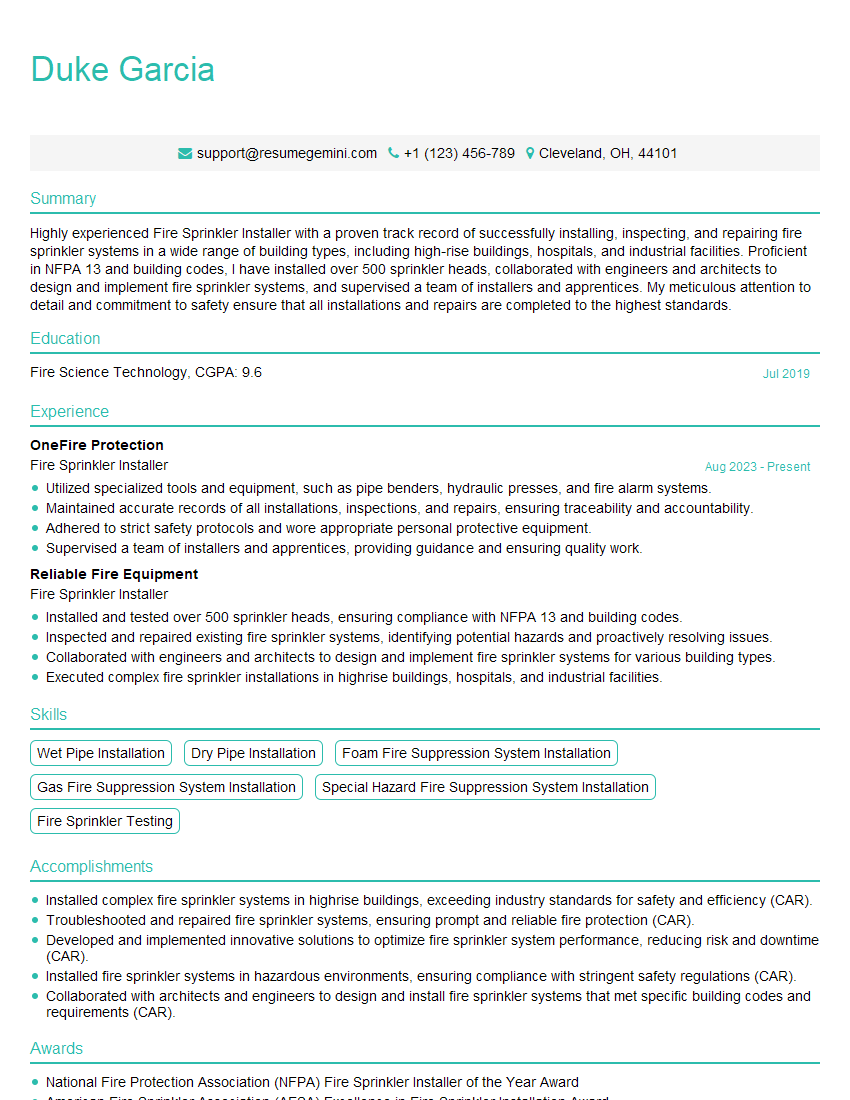
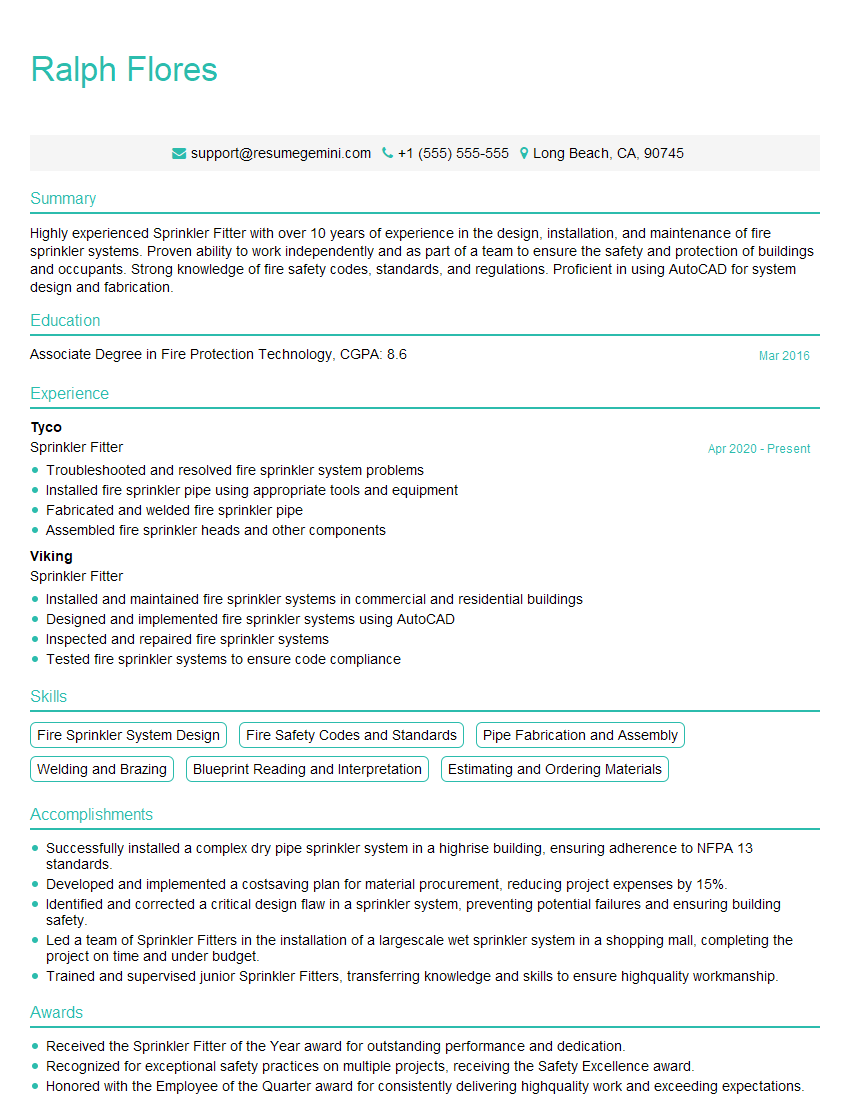
Mastering sprinkler pipe fitting opens doors to a rewarding career with excellent growth potential. As you build your expertise, a strong resume is crucial for showcasing your skills to potential employers. An ATS-friendly resume significantly increases your chances of getting noticed. We recommend using ResumeGemini to build a professional and impactful resume that highlights your qualifications effectively. ResumeGemini provides examples of resumes tailored to the Sprinkler Pipe Fitting field, ensuring your application stands out from the competition. Take the next step toward your dream career – craft a compelling resume today!
Explore more articles
Users Rating of Our Blogs
Share Your Experience
We value your feedback! Please rate our content and share your thoughts (optional).
What Readers Say About Our Blog
Very informative content, great job.
good