Preparation is the key to success in any interview. In this post, we’ll explore crucial Stamping Die Design interview questions and equip you with strategies to craft impactful answers. Whether you’re a beginner or a pro, these tips will elevate your preparation.
Questions Asked in Stamping Die Design Interview
Q 1. Explain the difference between progressive, compound, and transfer dies.
The main difference between progressive, compound, and transfer dies lies in how they perform multiple operations on a workpiece. Think of it like an assembly line: each type represents a different level of integration.
- Progressive Dies: These are the most efficient for high-volume production of parts requiring multiple operations. Each station on the die performs a single operation (blanking, piercing, forming, etc.) as the workpiece moves progressively through the die. Imagine a conveyor belt carrying the metal sheet through a series of specialized tools. This approach minimizes handling time and maximizes output, but it’s best suited for simple parts with straightforward operations.
- Compound Dies: In a compound die, multiple operations are performed simultaneously within a single station. It’s like having several tools working together in one location. This is useful when parts are complex but the operations can be performed concurrently within the confines of one press stroke. It’s less efficient than progressive dies for high volumes but offers flexibility for parts requiring simultaneous actions.
- Transfer Dies: These dies use a mechanical transfer mechanism to move the workpiece between individual stations. Each station performs one or more operations, but the workpieces are moved mechanically, offering more flexibility than progressive dies for larger, more complex parts or parts with more delicate operations. Imagine a robotic arm carefully moving the part from one station to the next. It’s slower and more complex than progressive, but suited to larger, more sensitive parts.
For example, a simple washer might be efficiently produced using a progressive die, while a complex automotive part with intricate bends and cutouts might require a transfer die.
Q 2. Describe your experience with various die materials (e.g., steel, carbide).
My experience encompasses a broad range of die materials, each with its own strengths and limitations. I’ve extensively worked with various grades of tool steels, including high-speed steels (HSS), cold work tool steels, and hot work tool steels. The selection depends heavily on the application, required life expectancy, and the material being stamped. I’ve also worked extensively with carbide tooling, which provides exceptional wear resistance and can handle very high production volumes.
For example, a simple blanking die for low carbon steel might be made from a standard cold work tool steel, providing a good balance of cost and performance. However, a die for stamping high-strength materials like hardened stainless steel would require a more durable material, such as a high-speed steel or possibly a carbide die for exceptional wear resistance. Carbide dies are typically more expensive but offer significantly longer tool life, especially in high-volume applications, making them cost-effective in the long run. I have experience specifying and selecting appropriate coatings to enhance the wear and corrosion resistance of the die components further.
Q 3. How do you select the appropriate die material for a specific application?
Selecting the right die material is critical for die longevity, part quality, and overall cost-effectiveness. The process involves careful consideration of several factors:
- Material Properties: The strength, hardness, and toughness of the material being stamped significantly influence the choice of die material. Harder materials require harder dies to prevent wear. Ductile materials may require a tougher die to prevent cracking.
- Production Volume: High-volume applications often justify the use of more expensive but longer-lasting materials like carbide, while lower-volume applications might use less expensive tool steels.
- Die Complexity: Intricate die designs might necessitate specific materials to ensure dimensional accuracy and prevent deformation during the stamping process.
- Budget: Cost is always a factor. A cost-benefit analysis, weighing die material cost against production volume and part cost, is critical.
For instance, if we’re stamping aluminum at high speed, a tool steel with a high wear resistance might be chosen. If the application involved stamping titanium alloys, which are extremely difficult to cut, the use of polycrystalline cubic boron nitride (PCBN) tooling or special carbide grades might be considered. The overall goal is to find the optimal balance between material cost, die life, and production efficiency.
Q 4. What are the common failure modes of stamping dies, and how do you prevent them?
Common stamping die failure modes include:
- Die Wear: This is the most frequent failure, particularly at the cutting edges and contact points. Regular sharpening and maintenance, along with appropriate die materials, can mitigate this.
- Fracture: Cracks can form due to excessive stress, usually at stress concentration points. Proper design, minimizing sharp corners, and optimizing die clearances reduce this risk.
- Deformation: Over time, dies can deform from repeated impacts, leading to dimensional inaccuracies. Using appropriate materials and robust designs helps to prevent this.
- Punch and Die Breakage: Improper die design, faulty material, or excessive forces can lead to breakage. Proper design and material selection are crucial.
- Erosion: This is common in abrasive materials. Using appropriate coatings or wear-resistant materials can help reduce erosion.
Prevention involves rigorous design review, proper material selection, regular maintenance (including inspection and sharpening), and implementing process control measures to ensure consistent operation within safe parameters. Using finite element analysis (FEA) during the design process can predict potential stress concentration points and identify areas requiring reinforcement or design changes.
Q 5. Explain the importance of die clearances and their impact on part quality.
Die clearances are the gaps between the punch and die. Getting them right is crucial for part quality. Too much clearance leads to a burr, poor dimensional accuracy, and potentially fractured parts. Too little clearance leads to increased friction, higher forces, premature wear, and potentially die breakage.
The ideal clearance depends on several factors such as the material thickness, the material’s ductility, and the type of operation (e.g., blanking, piercing, forming). The clearance is typically expressed as a percentage of the material thickness. The process of determining the optimal die clearance often involves experimentation and iteration, sometimes incorporating FEA to simulate the material flow and stress distribution. Improper clearances directly translate into scrap rate and impact part quality leading to increased costs and potentially production delays. Precision in this critical aspect is essential for a successful stamping operation.
Q 6. How do you design for optimal material flow in a stamping die?
Designing for optimal material flow is essential for preventing wrinkles, tears, and other defects. This involves understanding the material’s behavior under stress and designing the die to guide the material smoothly through each operation.
Key considerations include:
- Blank Design: The shape and size of the blank should facilitate smooth flow into the die. Sharp corners should be avoided, and radii should be incorporated to minimize stress concentrations.
- Die Geometry: The design of the punch and die, including the radii, angles, and the die cavity shape, plays a critical role in guiding the material flow. Careful consideration of blank holder design is crucial in minimizing wrinkling in drawing operations.
- Lubrication: Proper lubrication reduces friction and helps ensure smooth material flow. Different lubricants are chosen based on the material being stamped and the operations involved.
- Material Properties: A complete understanding of the material’s mechanical properties, including its tensile strength, yield strength, and ductility, is essential for predicting its behavior during forming.
I often use simulations (FEA) to visualize material flow and identify potential problem areas before the die is built. This iterative design process allows us to optimize the die geometry and minimize defects, leading to higher yields and improved part quality.
Q 7. Describe your experience with different types of stamping presses.
My experience with stamping presses encompasses various types, each suited to specific applications and production volumes:
- Mechanical Presses: These are the most common and utilize a crankshaft to drive the ram. They are robust, reliable, and offer a wide range of capacities. I’ve worked with single-crank, double-crank, and knuckle-joint presses, each offering different characteristics regarding speed and force profile.
- Hydraulic Presses: These use hydraulic cylinders to generate pressing force, providing precise control over force and speed. They’re particularly well-suited for deep drawing and forming operations requiring precise control.
- Servo Presses: These presses use servo motors for precise control of the ram’s speed and position, offering significant advantages in terms of energy efficiency and part quality. They’re ideal for complex forming operations requiring high precision.
- High-Speed Presses: These are designed for extremely high production rates, often used in mass production environments. They are capable of extremely high-speed stamping operations and are designed for robustness and reliability in high-cycle environments.
The choice of press depends on factors such as required tonnage, speed, and the complexity of the stamping operation. For example, a high-volume production line might employ a high-speed mechanical press, while a precision automotive part might be stamped using a servo press. My experience allows me to select and optimize the press type for any given application, ensuring both efficiency and part quality.
Q 8. How do you determine the appropriate press tonnage for a given part?
Determining the appropriate press tonnage for a stamping die is crucial for successful part production and press longevity. It’s not a simple calculation, but rather a multi-faceted process involving several factors. The primary factor is the blank size and material’s tensile strength. Larger blanks and stronger materials require significantly more force to form. Think of it like this: punching a hole in a piece of paper versus punching a hole in a thick steel plate; the latter needs a much more powerful punch.
We use a combination of methods, starting with empirical formulas which consider the material’s shear strength, the perimeter of the blank, and the thickness. These formulas provide an initial estimate. However, for complex parts with features such as deep draws or multiple bends, finite element analysis (FEA) software is invaluable. FEA allows us to simulate the forming process and predict the force distribution throughout the die, providing a highly accurate tonnage prediction. For example, a deep-drawn cup requires significantly more tonnage than a simple blanking operation on the same material. Always add a safety factor (typically 10-20%) to the calculated tonnage to account for variations in material properties and unforeseen circumstances.
Finally, we consult press capacity charts provided by the press manufacturer. These charts provide a maximum tonnage limit for the press which must never be exceeded, ensuring safe operation and preventing press damage.
Q 9. Explain your process for designing and validating a new stamping die.
Designing and validating a new stamping die is a systematic process requiring precision and attention to detail. It begins with a thorough review of the part drawing, paying close attention to GD&T (Geometric Dimensioning and Tolerancing) specifications. We also analyze the material properties of the blank and the desired production volume. This informs our die design choices; for example, a high-volume production might justify a more complex progressive die, while a low-volume part might be more efficiently produced using a simpler single-stage die.
Next, using CAD/CAM software, we create the die design, meticulously modelling the punch, die, stripper plates, and other components. This stage includes simulating the forming process to identify potential problems such as wrinkling, tearing, or insufficient material flow. We then use CAM software to generate the NC (Numerical Control) code for machining the die components. This code guides the CNC machines which precisely cut and shape the die.
Validation is equally critical. This typically starts with a trial run on a small scale, using scrap material, to verify the die’s function and identify any adjustments needed. We carefully inspect the produced parts to ensure they meet the required dimensions and tolerances. Any issues detected are addressed through design modifications or adjustments to the die’s parameters. This iterative process continues until the parts conform to specifications. Finally, a larger scale tryout with production-grade material confirms the process is capable of consistent, high-quality part production before full-scale implementation.
Q 10. How do you utilize CAD/CAM software in your design process?
CAD/CAM software is the cornerstone of modern stamping die design. I’m proficient in several industry-standard packages such as AutoCAD, SolidWorks, and NX. I use these tools throughout the design process from initial concept modeling to generating NC code for machining. The use of 3D modeling allows for a better visualization of the die components and their interaction during the stamping process. For instance, I can simulate the blank’s movement and deformation to predict potential issues before the physical die is even built, reducing costly rework.
In the design phase, I use parametric modeling techniques to easily modify the design and explore different iterations quickly. This is particularly useful when addressing customer design changes or optimizing the design for better manufacturability. After the design is finalized, I employ the CAM capabilities to generate the precise NC code required for machining each die component. This code ensures the accuracy and efficiency of the CNC machining process. Furthermore, these systems enable the creation of detailed simulations which can predict the stresses involved, ensuring the design can withstand the rigors of high-speed production.
Q 11. How familiar are you with different types of die coatings and their purpose?
Die coatings are essential for extending die life, improving surface finish, and reducing friction. My experience encompasses various types, each serving a specific purpose. For example, chromium plating provides excellent wear resistance, crucial for high-volume production runs. It is particularly useful for punches and dies that experience repeated contact with the material. However, chromium can be brittle and prone to cracking under extreme stress.
Another common coating is nickel plating, which offers a smoother surface finish than chromium, leading to improved part quality and reducing friction. This is particularly beneficial in drawing operations. Moreover, there are specialized coatings like DLC (Diamond-Like Carbon) which offer exceptional wear resistance and low friction, extending die life even further. Choosing the appropriate coating depends on factors such as the material being stamped, the complexity of the part, and the desired production volume. The selection process involves weighing the cost, performance, and environmental implications of each coating option. This requires a good understanding of both material science and manufacturing processes.
Q 12. Explain the process of die tryout and troubleshooting.
Die tryout is a critical stage involving careful observation and problem-solving. It begins with a series of trial runs using scrap material. We monitor several key aspects including part quality (dimensions, surface finish), die wear, and press performance. This often reveals minor issues that are easily corrected, like slight adjustments to punch or die positions. However, sometimes, more significant problems emerge such as material wrinkling, tearing, or cracks.
Troubleshooting requires a methodical approach. We start with thorough inspection of the produced parts to identify the nature and location of the defects. Then we analyze the die design and the stamping process parameters. For example, wrinkling often suggests insufficient blank holding force or improper material flow. Tearing indicates excessive stress or sharp edges on the punch or die. We often use specialized tools to measure forces and displacements within the die to pinpoint problem areas. The process is iterative. We implement changes to the die design or process parameters, then retest and repeat until the issues are resolved. Detailed documentation throughout this phase is crucial for ensuring repeatability and future problem-solving.
Q 13. How do you handle design changes during the manufacturing process?
Handling design changes during manufacturing is a common challenge that requires careful coordination and effective communication. We begin by thoroughly reviewing the design change request to understand its implications. This includes analyzing the impact on the existing die design, tooling, and the manufacturing process. For example, a seemingly small dimensional change could require significant modifications to the die or even necessitate a complete redesign.
Once the impact assessment is complete, we determine the feasibility of incorporating the changes. In some instances, minor changes might be easily accommodated with adjustments to existing tooling. However, major changes might require substantial rework or even the creation of new tooling. Throughout the process, rigorous communication with the client and the manufacturing team is vital to maintain transparency and manage expectations. This includes providing updated timelines and cost estimations for the necessary modifications. Effective change management tools, such as a structured change request system, is critical for controlling costs and timeframes, ensuring a smooth integration of design changes into the existing manufacturing process.
Q 14. Describe your experience with GD&T (Geometric Dimensioning and Tolerancing).
GD&T (Geometric Dimensioning and Tolerancing) is fundamental to my work. A thorough understanding of GD&T ensures the designed parts meet the required specifications and function correctly. I utilize GD&T principles throughout the die design process, from initial concept through to final validation. For example, understanding positional tolerances ensures that critical features are located accurately within the specified limits, even when accounting for variations in manufacturing processes.
I use GD&T symbols and annotations in the CAD models to communicate precisely the required tolerances and geometric controls. This ensures clear communication with manufacturing, and this eliminates ambiguity and avoids misinterpretations. My proficiency extends to using GD&T analysis tools within CAD software to simulate the effects of tolerances on the final part’s dimensions, ensuring the die design accommodates variations and produces parts within the specified tolerances. This is especially important to prevent fitment issues, particularly for parts that must assemble with other components. Proficiency in GD&T significantly improves the quality and reliability of the final product and minimizes manufacturing errors.
Q 15. How do you ensure the dimensional accuracy of stamped parts?
Ensuring dimensional accuracy in stamped parts is paramount. It relies on a multifaceted approach starting from the initial design stage and extending through the manufacturing process. We begin by employing sophisticated CAD (Computer-Aided Design) software to create highly precise models. These models incorporate tolerances – acceptable ranges of variation – defined according to industry standards and client specifications. For example, a tight tolerance might be required for a critical part in a medical device, while a less stringent tolerance might suffice for a less critical automotive component.
Beyond design, tooling plays a crucial role. Dies are meticulously manufactured, often using CNC (Computer Numerical Control) machining, ensuring that the die cavities precisely match the CAD model. Regular die maintenance and inspection are critical; wear and tear can compromise accuracy over time. We use CMM (Coordinate Measuring Machines) to regularly measure the die and the parts produced to detect and correct even minor deviations. Finally, the stamping process itself needs careful control; factors such as press tonnage, material properties, and lubrication all influence the final dimensions. Statistical Process Control (SPC) methods are utilized to monitor these parameters, identifying and rectifying any issues that could lead to dimensional inaccuracies.
Career Expert Tips:
- Ace those interviews! Prepare effectively by reviewing the Top 50 Most Common Interview Questions on ResumeGemini.
- Navigate your job search with confidence! Explore a wide range of Career Tips on ResumeGemini. Learn about common challenges and recommendations to overcome them.
- Craft the perfect resume! Master the Art of Resume Writing with ResumeGemini’s guide. Showcase your unique qualifications and achievements effectively.
- Don’t miss out on holiday savings! Build your dream resume with ResumeGemini’s ATS optimized templates.
Q 16. What are your preferred methods for managing and organizing design documents?
Managing and organizing design documents effectively is crucial for maintaining a streamlined workflow and preventing errors. I primarily rely on a Product Lifecycle Management (PLM) system, a centralized database that stores and manages all design data, including CAD models, drawings, specifications, and revision history. This ensures everyone involved has access to the latest version of the documents. Furthermore, a robust file naming convention is essential; a clearly structured system, such as using project codes, revision numbers, and component names, makes locating specific files quick and easy. We maintain a rigorous revision control process; any changes made to documents are tracked, documented, and approved before being incorporated into the main project. In addition to the PLM system, we utilize cloud storage for secure offsite backups, safeguarding our valuable design data.
Q 17. How do you calculate the cost of manufacturing a stamping die?
Calculating the cost of manufacturing a stamping die is complex, involving several key factors. The primary components are material costs (steel type and quantity), machining time (which depends on die complexity), labor costs (skilled machinists and engineers), and tooling costs (for specialized tooling like electrodes for EDM). Estimating accurately involves breaking down the process into smaller tasks. We start by determining the material required for the die components (punch, die, stripper plates, etc.), based on the part design and die type (progressive, compound, etc.). Then, the machining time is estimated, accounting for the time spent on different operations like milling, grinding, EDM, and polishing. Labor costs are calculated based on the number of hours required by skilled labor and their hourly rates. The cost of specialized tooling required to create the die adds to the total cost. Finally, overhead costs like depreciation, electricity and facility maintenance are included. To provide an accurate estimate, we often utilize cost estimation software that considers these elements and historical data from similar projects. Each project has a unique set of cost drivers, so a detailed breakdown is always necessary. A simplified example is: Material cost + Machining cost + Labor cost + Tooling cost + Overhead cost = Total Die Cost.
Q 18. Explain your experience with different types of punches and dies.
My experience encompasses a wide range of punches and dies, catering to diverse stamping applications. I’ve worked extensively with progressive dies, renowned for their high-speed production of complex parts. These dies perform multiple operations – blanking, piercing, forming – in a single stroke, enhancing efficiency. I’m also proficient with compound dies, which execute two or more operations simultaneously within a single die set, often used for simpler parts where speed isn’t paramount. Transfer dies, ideal for intricate parts needing multiple operations in a controlled manner, are another area of my expertise. Additionally, I’ve worked with fine blanking dies for producing high-precision parts with smooth edges and minimal burrs. The selection of the punch and die type is heavily influenced by the part design, desired production volume, and required part quality. For example, a simple washer might only need a simple blanking die, while a complex automotive body panel would require a sophisticated progressive die.
Q 19. How do you address issues related to springback in stamping?
Springback, the elastic deformation of a part after it’s been formed, presents a significant challenge in stamping. Addressing it requires a multi-pronged approach, starting with careful part design. We aim to minimize bending angles and complex geometries where springback is more pronounced. Finite Element Analysis (FEA) simulations play a critical role, allowing us to predict and compensate for springback before the die is even built. These simulations model the material behavior under stress and provide insights into the necessary adjustments to the die design, such as altering the die angle or adding corrective bends. Additionally, material selection significantly affects springback; stiffer materials exhibit less springback. Finally, process parameters, such as blank holder force (to restrain the material) and lubrication, are fine-tuned to minimize springback. Iterative adjustments based on trial runs and feedback from measurements are common. Through careful design, simulation and process optimization we can mitigate springback and ensure dimensional accuracy of the final product.
Q 20. Describe your experience with different types of lubricants used in stamping.
Lubrication is essential in stamping to reduce friction, improve part surface finish, and extend die life. The choice of lubricant depends heavily on the material being stamped, the type of die, and the specific stamping operation. I have experience with a variety of lubricants, including drawing compounds for deep drawing operations, where they prevent surface scratching and tearing, and stamping oils for blanking and forming operations, where they reduce friction and improve part flow. We’ve also worked with water-based lubricants in environmentally conscious projects, prioritizing safety and sustainability. The selection process involves considering factors such as the lubricant’s viscosity, film strength, and environmental impact. Each lubricant has strengths and weaknesses, and the selection process often involves testing different lubricants under controlled conditions to determine optimal performance.
Q 21. How do you design for minimizing scrap and optimizing material usage?
Minimizing scrap and optimizing material usage is a crucial aspect of cost-effective stamping die design and manufacturing. This starts with careful nesting of blanks, using software tools that optimize the arrangement of parts within the sheet material to minimize waste. Advanced nesting algorithms consider part shapes and orientations to maximize material utilization. Designing for progressive dies, which process multiple parts in a single stroke, greatly reduces material waste and labor costs compared to using single-operation dies. Additionally, using blanks of the most economical sizes reduces scrap. For example, selecting standard coil sizes to optimize the sheet metal provided by the supplier will significantly affect total material used. Beyond nesting, exploring alternative part geometries that reduce material requirements without sacrificing functionality is an important strategy. Finally, proper material handling and efficient waste collection further contribute to minimizing scrap. A holistic approach, combining design optimization, process improvements and material management, is essential for maximizing material efficiency.
Q 22. How do you address issues related to burrs and surface finish in stamped parts?
Burrs and poor surface finish are common challenges in stamping. Addressing them requires a multifaceted approach focusing on die design, material selection, and process parameters.
Die Design: Sharp corners and poorly designed radii are prime culprits. We mitigate this by incorporating generous radii in the die design, using specialized tools like burnishing dies, or employing techniques like coining for improved surface quality. For example, in a part with a sharp corner, I would specify a minimum radius of 0.1mm or more to prevent excessive material shearing.
Material Selection: Material properties influence burr formation. Selecting a material with better ductility reduces burr size. A material’s formability is analyzed using processes like Forming Limit Diagrams (FLD), ensuring it’s appropriate for the chosen stamping process.
Process Parameters: Die clearance, press speed, and lubrication are crucial. Reducing die clearance slightly can minimize burr formation, but excessive reduction may lead to increased friction and other issues. Optimizing press speed prevents excessive material deformation, and employing appropriate lubricants reduces friction and improves surface finish.
Post-Processing: Deburring operations, such as tumbling, vibratory finishing, or manual deburring, are often necessary even with optimal die design and processing. The choice depends on the part’s complexity and the required surface finish.
Q 23. Describe your experience with die maintenance and repair.
Die maintenance and repair are crucial for consistent part quality and press uptime. My experience encompasses preventative maintenance, troubleshooting, and repair of various die components.
Preventative Maintenance: This includes regular inspections for wear and tear, lubrication of moving parts, and sharpening of punches and dies. I’ve implemented scheduled maintenance programs, reducing downtime and prolonging die lifespan. For example, we developed a checklist to inspect critical wear points on progressive dies every 10,000 strokes.
Troubleshooting and Repair: This involves diagnosing problems like broken punches, cracked dies, or misalignment. I’ve utilized various techniques, including precision grinding, welding, and EDM (Electrical Discharge Machining) to repair damaged components. In one instance, I successfully repaired a cracked die using laser welding, saving considerable cost compared to die replacement.
Record Keeping: Detailed records are essential. I maintain meticulous records of all maintenance activities, including repairs, component replacements, and die performance metrics. This data helps in predictive maintenance, allowing us to anticipate potential failures and prevent costly downtime.
Q 24. How do you ensure the safety of operators during the stamping process?
Operator safety is paramount. My approach to ensuring safety involves a combination of engineering controls, administrative controls, and personal protective equipment (PPE).
Engineering Controls: This involves incorporating safety features into the stamping press itself, such as light curtains, two-hand controls, and die protection devices that prevent accidental entry into the press. I also ensure proper die locking mechanisms and ejection systems are used.
Administrative Controls: This includes implementing lockout/tagout procedures, providing thorough operator training on safe operating procedures, and establishing a system for reporting and investigating near misses and accidents. We use regular safety meetings to reinforce best practices.
Personal Protective Equipment (PPE): This includes providing and ensuring the correct use of safety glasses, hearing protection, gloves, and other appropriate PPE depending on the specific process. We emphasize the importance of proper PPE usage to reduce risks of injuries.
Regular Audits: Conducting regular safety audits and inspections to identify and address potential hazards proactively.
Q 25. Explain your experience with using finite element analysis (FEA) in die design.
FEA is indispensable for optimizing die design and predicting potential problems before manufacturing. My experience includes using FEA software to simulate various aspects of the stamping process.
Applications: I’ve used FEA to analyze blank holding force, springback, wrinkle formation, and fracture prediction. For example, using FEA I optimized the blank holder force to minimize wrinkling in a complex automotive part, significantly improving part quality.
Software Proficiency: I am proficient in using various FEA software packages, including Abaqus and ANSYS. I can create accurate models, define material properties, apply boundary conditions, and interpret the results effectively.
Iterative Design: FEA allows for an iterative design process. By analyzing the results of simulations, we can make design modifications to improve part quality and reduce the likelihood of defects. This reduces prototyping costs and accelerates the overall design cycle.
Q 26. How do you handle complex geometries in stamping die design?
Handling complex geometries necessitates a strategic approach involving advanced die design techniques and tooling considerations.
Progressive Dies: For high-volume production of parts with multiple features, progressive dies are often employed. These dies incorporate multiple operations in a single die set, reducing cycle time and increasing efficiency. The design must consider the sequence of operations carefully to ensure proper material flow and minimize defects.
Combination Dies: These dies utilize a combination of different stamping operations (e.g., blanking, piercing, forming) in a single die set, optimizing the manufacturing process for complex shapes.
Multi-stage Dies: For extremely complex parts that cannot be manufactured in a single stage, multiple dies may be required, where the part is incrementally formed in successive stages. This involves precise alignment and coordination between the different die stages.
Advanced Tooling: Specialized tooling, such as hydraulic or pneumatic forming tools, may be necessary to form intricate shapes. Simulation tools like FEA are crucial to ensure the tool design effectively achieves the desired geometry and prevents part defects.
Q 27. How familiar are you with different types of safety mechanisms used in stamping presses?
I’m very familiar with various safety mechanisms in stamping presses. These safeguards are crucial for preventing accidents and protecting operators.
Light Curtains: These are non-contact safety devices that create an invisible light beam across the press opening. If the beam is broken, the press stops immediately, preventing injuries from hands or other objects entering the danger zone.
Two-Hand Controls: The operator must simultaneously activate two separate controls to initiate the press stroke. This eliminates the risk of accidental activation.
Safety Blocks and Interlocks: These prevent the press from operating unless the die is properly secured and all safety components are in place. This ensures that the die is correctly set and will not cause damage or injury.
Emergency Stop Buttons: Large, readily accessible emergency stop buttons are strategically positioned around the press to quickly halt operation in the event of an emergency.
Presence Sensing Devices: These devices detect the presence of an operator or an object within the danger zone. If an object is detected, the press will stop to avoid any contact.
Q 28. Describe your experience with automation in stamping die design and manufacturing.
Automation plays a significant role in modern stamping die design and manufacturing, leading to increased efficiency, improved quality, and reduced costs. My experience includes various aspects of automation.
CAD/CAM Software: I’m proficient in using advanced CAD/CAM software for designing dies and generating CNC programs for machining die components. This significantly reduces lead times and improves accuracy.
Automated Die Manufacturing: I’ve worked with automated machining centers and EDM machines that significantly enhance the precision and speed of die manufacturing.
Robotic Automation in Stamping Presses: I’ve been involved in the integration of robots for material handling, part loading and unloading, and other tasks within the stamping process. This increases productivity, reduces operator fatigue, and improves safety.
Data Acquisition and Analysis: Automated data acquisition systems monitor the stamping process parameters (e.g., press force, stroke rate) and collect relevant data for quality control and process optimization.
Key Topics to Learn for Stamping Die Design Interview
- Die Design Fundamentals: Understanding basic die components (punch, die, stripper, etc.), material selection criteria, and fundamental design principles.
- Progressive Die Design: Analyzing the sequence of operations in a progressive die, optimizing for efficiency and minimizing material waste. Practical application: Designing a progressive die for a complex part, considering material flow and tolerances.
- Blanking and Piercing: Mastering the design considerations for accurate blanking and piercing operations, including shear, clearance, and burr formation. Problem-solving approach: Troubleshooting common issues like broken punches or uneven cuts.
- Bending and Forming: Understanding the principles of bending and forming, including bend allowances, springback, and die design considerations for various bending techniques. Practical application: Designing a die for forming a specific part with desired dimensions and tolerances.
- Drawing and Embossing: Knowledge of deep drawing processes, including blank holder design, and embossing techniques for creating raised or indented features. Problem-solving approach: Addressing issues like wrinkles or tearing in drawn parts.
- Die Manufacturing Processes: Familiarity with common manufacturing methods for die components (EDM, grinding, etc.) and their impact on design choices.
- Tolerance Analysis and GD&T: Applying Geometric Dimensioning and Tolerancing (GD&T) principles to ensure accurate part production and effective communication of design specifications.
- Material Flow Simulation and Analysis: Utilizing software for simulating material flow and predicting potential problems during the stamping process.
- Cost Estimation and Optimization: Analyzing die cost factors and developing cost-effective designs.
- Safety and Regulations: Understanding relevant safety regulations and incorporating safety features into die designs.
Next Steps
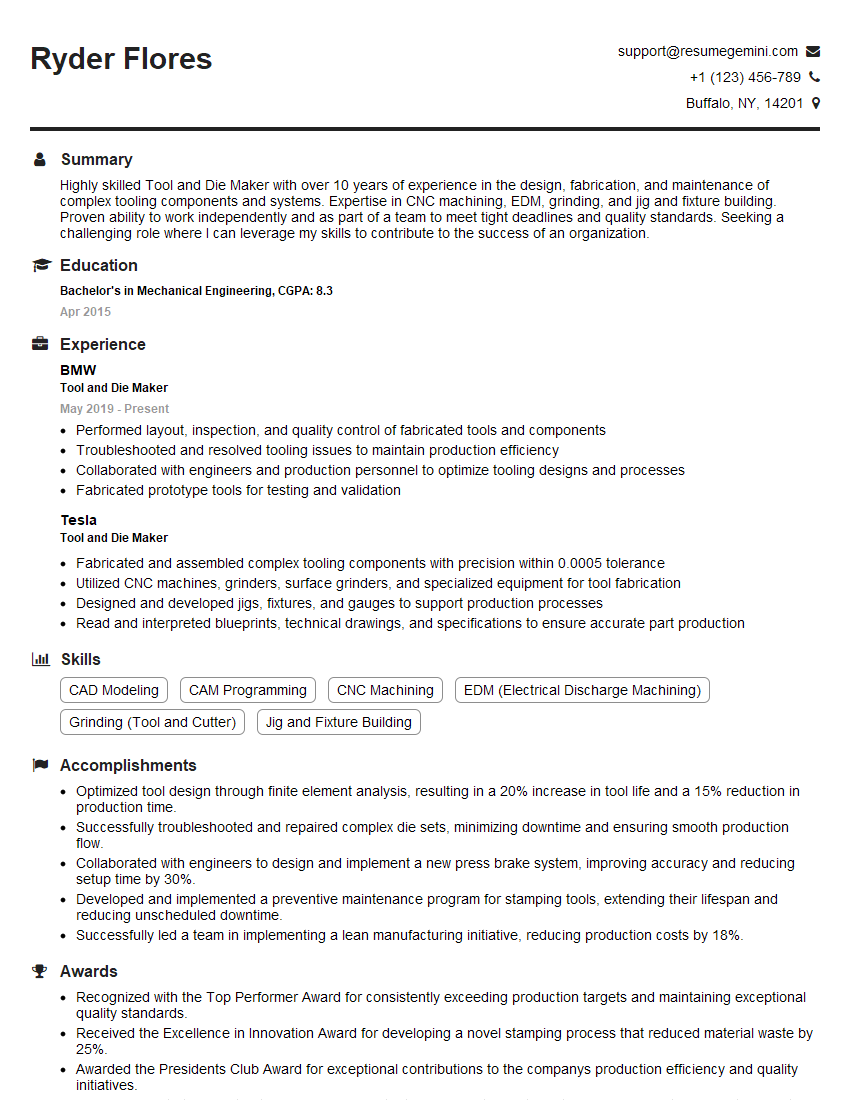
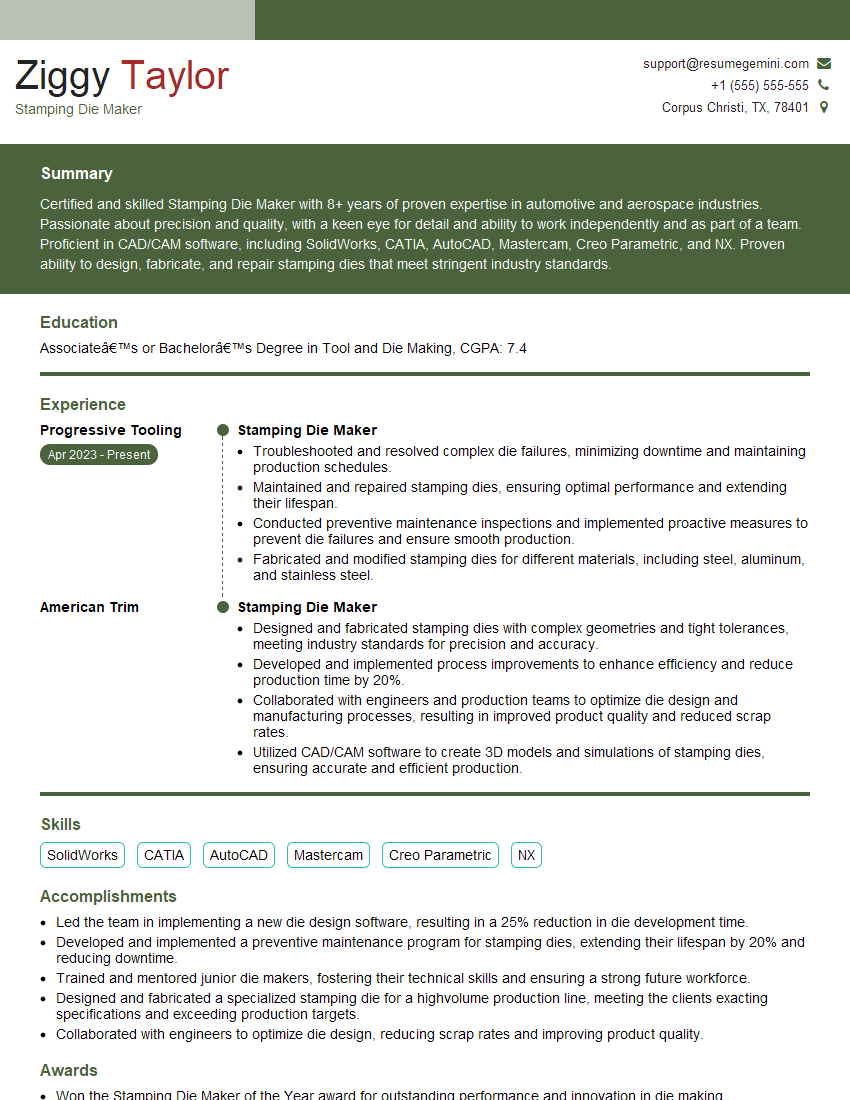
Mastering Stamping Die Design opens doors to exciting career opportunities with significant growth potential in manufacturing and engineering. A strong understanding of these concepts will significantly enhance your interview performance and career prospects. To further boost your chances, create an ATS-friendly resume that highlights your skills and experience effectively. ResumeGemini is a trusted resource to help you build a professional and impactful resume. We offer examples of resumes tailored to Stamping Die Design to help guide you. Invest time in crafting a compelling resume – it’s your first impression on potential employers.

Explore more articles
Users Rating of Our Blogs
Share Your Experience
We value your feedback! Please rate our content and share your thoughts (optional).
What Readers Say About Our Blog
Very informative content, great job.
good