Unlock your full potential by mastering the most common Steel Structures Analysis and Design interview questions. This blog offers a deep dive into the critical topics, ensuring you’re not only prepared to answer but to excel. With these insights, you’ll approach your interview with clarity and confidence.
Questions Asked in Steel Structures Analysis and Design Interview
Q 1. Explain the different types of steel sections used in structural design.
Steel sections, the fundamental building blocks of steel structures, come in various shapes, each optimized for specific loading conditions. Think of them as the ‘bones’ of a building. The most common types include:
- I-sections (Wide Flange Beams): These are the workhorses, efficient in bending, with a large moment of inertia. Imagine them as a very strong, rectangular ‘I’ shape. They are used extensively in beams and columns.
- H-sections (Universal Columns): Similar to I-sections, but often deeper and more slender, making them better suited for columns that need to resist compression.
- T-sections (Tee sections): These ‘T’-shaped sections are often used as secondary members or in situations requiring a flange for attachment.
- Angles: L-shaped sections, often used for bracing and connections.
- Channels: U-shaped sections, frequently employed in purlins (horizontal beams in roofs) and other secondary elements.
- Circular Hollow Sections (CHS) and Square Hollow Sections (SHS): These are tubular sections offering good strength-to-weight ratios and are frequently seen in railing systems, and structures where aesthetics matter.
The choice of section depends critically on the load, span, and overall structural design. For example, a long-span bridge might require deep I-sections to manage bending moments, while a smaller structure might utilize angles for simplicity and cost-effectiveness.
Q 2. Describe the process of designing a steel column for axial compression.
Designing a steel column for axial compression involves a systematic approach. It’s like ensuring a sturdy, vertical support capable of holding a heavy weight without buckling. The process generally involves these steps:
- Determine the load: This includes dead load (weight of the structure itself) and live load (variable loads like people or equipment).
- Select a trial section: Based on experience and preliminary calculations, choose a suitable steel section (e.g., an H-section).
- Check for buckling: This is crucial. Columns fail not just by crushing, but by buckling – bending under compression. We use Euler’s formula or more advanced methods (like the interaction equations in relevant design codes, like AISC 360 or Eurocode 3) to determine the critical buckling load. This considers the column’s length, support conditions (fixed or pinned), and the section’s properties (moment of inertia and area).
- Check for compressive strength: Even if buckling isn’t an issue, the column material must not yield (permanently deform) under the load. This is determined by comparing the applied stress to the yield strength of the steel.
- Iterative process: If either the buckling or compression check fails, we select a different, stronger section and repeat steps 3 and 4. This continues until both checks are satisfied.
- Connection design: The column’s ends must be properly connected to the rest of the structure; this is key for transferring loads effectively. This involves design of suitable base plates and connections that prevent premature failure.
Consider this example: Designing a column to support a 500 kN load. We might start with an H-section. If the analysis reveals that this section buckles before reaching the 500kN load, we would then select a larger, stronger section or shorten the column length if feasible.
Q 3. How do you account for wind loads in the design of a steel structure?
Wind loads are significant for all structures and must be explicitly accounted for in the design, especially for tall buildings and bridges. It’s like preparing for a strong gust of wind.
We determine wind loads using established standards and codes. These codes specify wind pressure coefficients based on the structure’s shape, height, and location (exposure). The process involves:
- Determining the basic wind speed: This value is obtained from meteorological data and relevant building codes for the project location.
- Calculating wind pressure: Using the basic wind speed, appropriate factors (like exposure factor, topographic factor, and gust factor), and wind pressure coefficients (obtained from wind tunnel testing or simplified methods provided in design codes), the wind pressure on different parts of the structure is calculated.
- Applying the wind pressure: The calculated wind pressures are applied to the structure’s surfaces as forces, leading to moments, shears and axial loads in structural elements.
- Structural analysis: The structure is then analyzed to determine the internal forces (bending moments, shear forces, axial forces) and stresses caused by the wind loads.
- Design check: Finally, the designed elements’ capacity are checked against these calculated forces and stresses to ensure they can withstand the applied wind loads.
Software packages are extensively used to automate wind load calculations and structural analysis. Remember to always follow the relevant design codes and standards for accurate wind load calculations.
Q 4. What are the different methods for analyzing steel structures?
Analyzing steel structures involves determining the internal forces and stresses within the members under various load conditions. Several methods exist:
- Manual calculations: Suitable for simpler structures, this involves using statics and mechanics of materials principles to calculate reactions, internal forces and stresses. It’s like solving equations using a calculator.
- Matrix methods: These are numerical techniques that represent the structure using matrices. They are powerful for complex structures and are implemented in software. This method is accurate for analyzing complex load cases.
- Finite Element Analysis (FEA): This is the most sophisticated method and is widely used in software. FEA divides the structure into small elements and solves the equations of equilibrium for each element using numerical techniques. It’s capable of handling complex geometries and nonlinear material behavior.
The choice of method depends on the structure’s complexity, accuracy required, and available resources. Simple structures might be analyzed manually, while complex high-rise buildings or bridges require FEA for accurate analysis.
Q 5. Explain the concept of buckling in steel columns and how to prevent it.
Buckling in steel columns is a sudden sideways failure under compressive loads. Imagine a slender drinking straw; if you push hard enough, it will bend and collapse before it actually crushes. This is buckling.
Preventing buckling involves:
- Selecting appropriate section: Using a section with a higher moment of inertia (resistance to bending) and larger cross-sectional area significantly improves resistance to buckling.
- Reducing column length: Shorter columns are less prone to buckling. This might involve intermediate supports.
- Using bracing: Lateral bracing, provided through beams or other structural elements, stiffens the column and prevents lateral movement leading to buckling.
- Strengthening the connections: Strong connections are key to resisting buckling. The end conditions of the column (fixed, pinned, etc.) affect its buckling behavior.
- Employing high-strength steel: High-strength steel has increased yield strength, which increases the buckling resistance.
Design codes provide formulas and charts to determine critical buckling loads and guide column design to prevent buckling. For instance, we use slenderness ratios to assess the susceptibility to buckling. If a column’s slenderness ratio is too high, we need to choose a stiffer column section to increase its resistance against buckling.
Q 6. How do you select appropriate connection types for steel members?
Selecting appropriate connection types for steel members is vital for overall structural integrity. Think of connections as the ‘joints’ in a skeleton. The choice depends on factors like the type of members, load transfer mechanism, and construction constraints.
Common connection types include:
- Bolted connections: These utilize bolts to transfer loads between members. Different bolt types and configurations exist (e.g., high-strength bolts, shear connections, moment connections). They are easy to fabricate and assemble.
- Welded connections: These use welding to join members. They offer high strength and stiffness, often preferred for moment-resisting connections. Welding requires skilled labor and quality control.
- Riveted connections: These are less common now but were historically widely used. They are suitable for connections experiencing repeated loading cycles.
The design of these connections necessitates checking for shear, tension, bearing, and fatigue stresses. For example, a moment connection in a building frame will transfer both shear and moments, necessitating robust design and careful detailing.
Q 7. What are the advantages and disadvantages of using high-strength steel?
High-strength steel offers significant advantages in structural design, but also presents some challenges:
Advantages:
- Increased strength-to-weight ratio: Less steel is needed to achieve the same strength, leading to lighter structures and reduced material costs.
- Improved slenderness ratios: Allows for the use of more slender members, leading to more aesthetic and efficient designs.
- Reduced overall size: Smaller sections can be used which can reduce the overall footprint of the structure.
Disadvantages:
- Higher cost: High-strength steel is more expensive than standard-strength steel.
- Increased brittleness: High-strength steel can be more brittle, requiring careful consideration of welding and fabrication processes. Greater attention should be paid to controlling weld quality.
- More stringent quality control: Higher precision is needed during fabrication to ensure the integrity of the final product.
The decision to use high-strength steel involves a cost-benefit analysis that weighs the advantages of reduced material costs and efficient designs against the increased initial cost and stricter quality control.
Q 8. Describe your experience with various steel design codes (e.g., AISC, Eurocode).
Throughout my career, I’ve extensively utilized several prominent steel design codes, including the American Institute of Steel Construction (AISC) specifications, primarily the AISC 360, and Eurocode 3. My experience encompasses applying these codes to a wide array of projects, from high-rise buildings and bridges to industrial structures and offshore platforms. I understand the nuances of each code, including differences in their philosophies and approaches to design. For instance, AISC 360 emphasizes a more direct, allowable stress design, while Eurocode 3 leans towards a limit states design approach, focusing on ultimate and serviceability limit states. I’m adept at navigating these differences and selecting the most appropriate design methods depending on the project’s specific requirements and local regulations.
Beyond the core codes, I’m also familiar with supplementary standards and guidance documents associated with these codes, providing me with a deep understanding of best practices and advanced design techniques. This includes familiarity with specific provisions for connection design, fire protection, and fatigue analysis, ensuring a comprehensive and robust approach to structural design.
Q 9. How do you account for seismic loads in the design of steel structures?
Seismic loads are crucial considerations in steel structure design, especially in seismically active regions. The design process begins with a thorough seismic hazard assessment to determine the expected ground motion parameters, typically peak ground acceleration (PGA) and spectral accelerations. These parameters are then used in conjunction with a dynamic analysis, usually employing response spectrum analysis or time-history analysis, to determine the seismic forces acting on the structure. This requires a detailed understanding of the structural system’s dynamic characteristics, including its natural frequencies and mode shapes.
The next step is to design the structural elements to resist these seismic forces. This involves selecting appropriate steel sections, detailing connections to ensure ductile behavior, and incorporating energy dissipation devices where necessary. The design must ensure both strength and ductility, meaning the structure can withstand the seismic forces without collapse while also exhibiting sufficient deformation capacity to absorb energy during an earthquake. Common design strategies include using moment-resisting frames, braced frames, or a combination of both, tailored to the specific characteristics of the project and local seismic codes. Software like ETABS or SAP2000 plays a vital role in carrying out these analyses and design checks.
Finally, detailing is paramount; careful detailing of connections (e.g., ensuring continuity and adequate weld sizes) is crucial for ensuring ductile behavior and preventing premature failure under seismic loading. I have personally worked on several projects implementing these strategies, ensuring the structures can withstand the worst-case seismic event without collapse.
Q 10. Explain the concept of plastic design in steel structures.
Plastic design, also known as limit state design, is a powerful method in steel structure design that leverages the material’s ability to undergo plastic deformation beyond its yield point. Unlike elastic design, which only considers stresses within the elastic range, plastic design allows for controlled yielding in certain sections of the structure. This allows for more efficient use of material, as the structure can redistribute loads more effectively, reducing the overall material requirements compared to elastic design. The concept is based on the idea that if enough ductility is provided, the ultimate load can be reached by redistribution of stresses from one part of the structure to another part that has not yet yielded.
To implement plastic design, several factors must be considered: The steel must possess sufficient ductility to allow for plastic deformation without brittle failure. The connections must be designed to have sufficient capacity to transmit the redistributed forces. Accurate determination of the plastic moment capacity of the members is crucial. Analysis often involves methods such as plastic hinge analysis, which identifies locations where plastic hinges might form under ultimate load conditions. The plastic design method needs to be verified by considering other factors like stability failure mechanisms. I’ve successfully applied this approach in various projects, leading to economical designs while maintaining safety.
Q 11. What is the significance of the yield strength and ultimate tensile strength of steel?
The yield strength (fy) and ultimate tensile strength (fu) are critical material properties defining a steel’s behavior under stress. The yield strength represents the stress at which the steel begins to deform plastically, permanently changing its shape. It’s a key parameter in determining the design strength of steel members. The ultimate tensile strength, on the other hand, is the maximum stress a steel can withstand before fracturing. This value is important for understanding the material’s ultimate capacity and ensuring the structure’s safety.
In design, these properties dictate the allowable stresses and member capacities. Yield strength forms the basis of many design calculations, while the ultimate tensile strength provides a safety margin and serves in fracture-related assessments. The relationship between yield and ultimate strength (the ratio fu/fy) indicates the ductility of the steel – a higher ratio signifies greater ductility. The choice of steel grade (and hence its yield and ultimate strengths) often involves trade-offs between strength, cost, and ductility; higher strength steel is more expensive but may lead to a lighter-weight structure.
Q 12. Describe your experience with Finite Element Analysis (FEA) software.
I have extensive experience using various Finite Element Analysis (FEA) software packages, including ABAQUS, ANSYS, and RISA-3D. My proficiency extends beyond basic modeling and analysis; I’m skilled in developing complex models to simulate various structural behaviors and load cases, accurately representing structural details and material properties. This includes modeling complex connection details, non-linear material behavior, and large deformations.
I utilize FEA to validate design assumptions, assess the performance of unconventional structural systems, and investigate the behavior of structures under complex loading scenarios. For instance, FEA has been instrumental in optimizing the design of connections, identifying potential stress concentrations, and verifying the stability of slender members. Furthermore, I regularly use FEA to assess the impact of fabrication tolerances and construction imperfections on the overall structural performance. The results from FEA are then used to inform design modifications and optimize the structural design for both efficiency and safety.
Q 13. How do you verify the stability of a steel structure?
Verifying the stability of a steel structure involves a multifaceted approach, considering several potential failure modes. One primary concern is buckling, a sudden and catastrophic instability that can occur in slender compression members. This is assessed using various methods, including simple formulas based on effective lengths and section properties, or more advanced analysis techniques like eigenvalue buckling analysis in FEA software. The design must ensure that the critical buckling load significantly exceeds the anticipated axial load on the member.
Another key aspect is lateral-torsional buckling, which affects beams subjected to bending moments. This type of buckling involves simultaneous lateral deflection and twisting of the beam section. Similar to compression member buckling, design checks involve comparing the calculated buckling resistance with the applied bending moment. Furthermore, global stability of the entire structure is also vital; this is checked by considering the interaction between individual members and overall structural behavior. Second-order effects, which account for the amplification of loads due to member deflections, are incorporated to ensure sufficient safety margins.
In practice, we use a combination of simplified hand calculations, advanced analysis tools (like FEA), and the provisions in relevant design codes to comprehensively assess structural stability and prevent buckling failures.
Q 14. How do you design steel connections for shear and moment?
Designing steel connections for shear and moment requires a thorough understanding of connection behavior and the capacity of various connection types. For shear connections, commonly used types include bolted connections (with various bolt arrangements) and welded connections. The design process focuses on ensuring sufficient shear strength of the bolts or welds to resist the applied shear forces. This involves considering factors such as bolt diameter, number of bolts, weld size, and the material properties of the connected members.
For moment connections, the design becomes more complex. These connections must transmit both shear and moment, often requiring more elaborate detailing. Typical moment connections include fully welded connections, bolted moment connections with appropriately sized and detailed bolts and plates, and high-strength bolted connections. The design process accounts for the moment capacity of the connection, considering potential failure modes such as bolt shear, bolt tension, weld failure, and yielding of connected members. Proper detailing, such as the use of sufficient weld sizes or appropriately sized and spaced bolts, and employing the right type of connection, is critical to ensure the stability and the capacity of the connection under both service and ultimate loads.
My experience includes designing connections for various applications using different connection types, always selecting the most efficient and cost-effective solution while maintaining sufficient safety margins.
Q 15. What is the importance of detailing in steel structures?
Detailing in steel structures is paramount; it’s the bridge between design intent and successful construction. Think of it as the precise recipe that ensures the final ‘dish’ – the structure – is safe, efficient, and performs as designed. Poor detailing can lead to costly rework, delays, and even structural failure. It encompasses everything from member connections and bolt specifications to the placement of welds and the overall fabrication sequence. Effective detailing minimizes fabrication time and costs, improves the quality of the final product, and ensures the structural integrity of the entire system.
- Connection Design: Proper detailing of connections – the points where structural members join – is crucial. This includes specifying the type of connection (e.g., bolted, welded), the number and size of fasteners, and the weld details. A poorly detailed connection might not transfer loads effectively, leading to premature failure.
- Weld Details: Welding symbols and specifications must be clear and unambiguous, indicating the type of weld, the size, and the required penetration. Incorrect welding can result in weak points and structural instability.
- Fabrication Sequence: The detailing process must consider the order in which components are fabricated and assembled. A well-defined sequence reduces fabrication time and improves the overall quality of the structure.
For example, imagine a high-rise building. Detailed drawings showing exactly how each beam connects to the column, including precise bolt placement and weld sizes, are absolutely essential to ensure the stability and load-bearing capacity of the entire building. Without precise detailing, even minor errors can have significant consequences.
Career Expert Tips:
- Ace those interviews! Prepare effectively by reviewing the Top 50 Most Common Interview Questions on ResumeGemini.
- Navigate your job search with confidence! Explore a wide range of Career Tips on ResumeGemini. Learn about common challenges and recommendations to overcome them.
- Craft the perfect resume! Master the Art of Resume Writing with ResumeGemini’s guide. Showcase your unique qualifications and achievements effectively.
- Don’t miss out on holiday savings! Build your dream resume with ResumeGemini’s ATS optimized templates.
Q 16. Explain the concept of fatigue in steel structures and how to address it.
Fatigue in steel structures refers to the progressive and localized structural damage that occurs when a material is subjected to repeated cyclic loading. Think of bending a paperclip back and forth – eventually, it’ll break. Similarly, repeated stress cycles in a steel structure, even if below the yield strength, can cause micro-cracks to form and propagate, ultimately leading to failure. This is particularly relevant in components like bridges experiencing continuous traffic loads or offshore structures facing wave action.
Addressing fatigue involves several strategies:
- Proper Design: Avoiding stress concentrations is key. This can be achieved through careful design of connections, using smooth transitions between members, and avoiding sharp corners or abrupt changes in geometry.
- Material Selection: Higher strength steels often exhibit better fatigue resistance. The choice of steel grade should be carefully considered based on the expected loading conditions and fatigue life requirements.
- Fatigue Detailing: Specifying appropriate weld details and avoiding defects minimizes stress concentration at weld locations.
- Inspection and Maintenance: Regular inspections can help identify fatigue cracks at an early stage, allowing for timely repairs or replacements.
- Fatigue Analysis: Sophisticated finite element analysis (FEA) can be used to simulate cyclic loading conditions and predict the fatigue life of the structure. This allows engineers to design structures with a sufficient safety margin against fatigue failure.
For instance, in bridge design, fatigue analysis is critical for components like weld connections in the bridge deck, subjected to millions of cycles of traffic loading. The design must ensure that these connections can withstand the repeated stress without experiencing fatigue failure over their design lifespan.
Q 17. What are the common types of steel failures and their causes?
Steel failures can manifest in several ways, each with specific causes:
- Yielding: This occurs when the applied stress exceeds the yield strength of the steel, causing permanent deformation. This is usually due to overload or unexpected loading conditions.
- Fracture: This is a complete separation of the material, often caused by brittle fracture (sudden failure without significant plastic deformation) due to low temperatures, high stress concentrations, or material defects. Ductile fracture, on the other hand, involves significant plastic deformation before failure.
- Buckling: This is a sudden sideways collapse of a slender member under compressive loads. This can occur if the member is too thin or long compared to its cross-sectional area.
- Fatigue Failure (as explained above): Progressive cracking and eventual failure due to repeated cyclic loading.
- Corrosion: This degrades the steel’s cross-section, reducing its load-carrying capacity. This can be caused by exposure to moisture, salts, or other corrosive agents.
For example, a column might yield under excessive load, resulting in permanent bending, while a poorly welded beam might fracture unexpectedly due to stress concentration. Proper material selection, detailed design, and regular inspections are critical to prevent these types of failures.
Q 18. How do you account for corrosion in the design of steel structures?
Corrosion significantly affects the long-term durability and structural integrity of steel structures. We account for it through several design strategies:
- Protective Coatings: Applying coatings like paint, zinc galvanization (hot-dip galvanizing), or other protective layers is a common way to prevent corrosion. The choice of coating depends on the environment and the level of protection required.
- Material Selection: Using corrosion-resistant steels, such as weathering steels (Corten steel), can reduce the need for extensive protective coatings.
- Design Considerations: Designing the structure to minimize water accumulation and promote drainage helps to prevent corrosion. Details such as proper slope and adequate ventilation are crucial.
- Increased Section Sizes: To account for the loss of steel due to corrosion over the design life, section sizes may be increased to maintain sufficient load-bearing capacity. This is usually determined based on corrosion rate estimates and the design life of the structure.
- Cathodic Protection: For structures immersed in seawater or other highly corrosive environments, cathodic protection (e.g., sacrificial anodes) can be employed to prevent corrosion.
For instance, in offshore structures, aggressive marine environments necessitate using corrosion-resistant steels, protective coatings, and potentially cathodic protection to ensure longevity.
Q 19. Explain your understanding of fire protection for steel structures.
Fire protection for steel structures is crucial because steel loses its strength significantly at elevated temperatures. Our strategies include:
- Intumescent Coatings: These coatings expand when exposed to fire, creating a thick insulating layer that protects the steel from the heat.
- Spray-Applied Fire-Resistive Materials (SFRM): These materials, such as cementitious or gypsum-based products, are sprayed onto the steel members to provide fire protection.
- Fire-Resistant Encasements: Enclosing steel members in concrete or other fire-resistant materials is another effective method. This can involve full encasement or partial protection, depending on the fire rating required.
- Protected Steel Sections: Some steel sections are designed with a hollow core that can be filled with fire-resistant material, increasing its fire resistance.
- Fire Sprinkler Systems: Installing fire sprinkler systems can help suppress fires quickly, limiting the amount of heat exposure to the steel members.
The choice of fire protection method depends on factors such as the required fire rating, the structural configuration, and the overall building design. For instance, a high-rise building will typically require more robust fire protection strategies than a smaller, low-rise structure.
Q 20. Describe your experience with steel construction detailing and fabrication.
Throughout my career, I have been extensively involved in steel construction detailing and fabrication. I have used software like Tekla Structures and AutoCAD to create detailed shop drawings, including connection details, weld symbols, and fabrication sequences. I’ve worked on projects ranging from simple steel frames to complex industrial structures and high-rise buildings.
My experience includes reviewing shop drawings for accuracy and compliance with design specifications, resolving discrepancies between the design and fabrication, and working closely with fabricators to ensure efficient and safe construction practices. I have a deep understanding of fabrication processes, including cutting, welding, and bolting, and I can effectively communicate technical information to both engineering and fabrication teams. I have also been involved in site visits to monitor construction progress and ensure the structures are being built as per the design and detailed drawings. One notable project involved a large industrial warehouse. The complex geometry required a meticulous detailing process to ensure efficient fabrication, and my involvement ensured minimal delays and cost overruns.
Q 21. How do you assess the structural integrity of an existing steel structure?
Assessing the structural integrity of an existing steel structure involves a multi-faceted approach:
- Visual Inspection: A thorough visual inspection is the first step, checking for signs of corrosion, damage, cracks, deformation, or other defects. This should include checking welds, connections, and the overall condition of the members.
- Non-Destructive Testing (NDT): NDT methods such as ultrasonic testing, magnetic particle inspection, and radiographic testing can be used to detect internal defects without damaging the structure.
- Load Testing: In some cases, load testing may be performed to verify the structure’s capacity to support the intended loads. This might involve applying controlled loads to the structure and monitoring its response.
- Material Testing: Samples of steel may be extracted and tested in a laboratory to determine their mechanical properties (e.g., yield strength, ultimate tensile strength) and assess the extent of any material degradation due to corrosion or other factors.
- Review of Design Drawings: Examining the original design drawings provides valuable information about the structure’s design intent and original capacity.
- Finite Element Analysis (FEA): FEA can be employed to analyze the structure’s behavior under various loading conditions, taking into account any observed damage or degradation.
Based on these assessments, a structural engineer can determine the remaining capacity of the structure and whether any repairs or strengthening measures are required. For instance, I once assessed a bridge showing signs of corrosion. Using a combination of visual inspection, NDT, and FEA, we determined the extent of corrosion and its effect on the bridge’s capacity, enabling us to develop a suitable repair and strengthening plan.
Q 22. What are the different types of bracing used in steel structures?
Bracing in steel structures is crucial for enhancing lateral stability and resisting forces like wind and seismic loads. Different types of bracing systems exist, each suited to specific structural requirements and architectural constraints.
- Diagonal Bracing: This is the most common type, employing diagonal members to form triangles within the frame, effectively transferring lateral loads to the foundation. Think of it like the support struts on a bicycle wheel – they prevent it from collapsing.
- K-Bracing: Similar to diagonal bracing but forms a ‘K’ shape, offering greater stiffness and resistance to buckling in certain directions. Often preferred in taller structures where space is at a premium.
- X-Bracing: Two diagonal members arranged in an ‘X’ pattern, providing excellent stability and redundancy. However, it can be more complex to detail and connect.
- Eccentric Bracing: The brace is connected away from the column centerline, allowing for larger brace forces and reduced member sizes compared to concentric bracing. This is more sophisticated and is often used when optimizing space or minimizing structural depth.
- Moment Frame: While not strictly bracing, moment frames provide lateral stability through their rigid connections between beams and columns. They rely on the bending capacity of the members to resist lateral forces. They are more complex and expensive than bracing systems, but offer excellent performance under seismic conditions.
The choice of bracing system depends on factors such as the building’s height, geometry, loading conditions, and aesthetic considerations. For instance, diagonal bracing might be cost-effective for a low-rise building, while a moment frame would be more appropriate for a high-rise building subject to significant seismic activity.
Q 23. How do you design for lateral stability of steel structures?
Designing for lateral stability is paramount in ensuring the safety and longevity of steel structures. It involves considering and resisting forces from wind, earthquakes, and other lateral loads. The process generally involves these steps:
- Load Determination: Accurately determining the magnitude and distribution of lateral loads based on location, building height, and code requirements (e.g., ASCE 7). This often involves wind tunnel testing or complex software simulations for higher structures.
- Structural System Selection: Choosing an appropriate structural system to resist lateral loads. Options include braced frames, moment frames, shear walls, or a combination of these systems. The selection depends on factors like cost, aesthetics, and site conditions.
- Structural Analysis: Performing a thorough analysis to determine the forces and moments in each member of the structure. Software like ETABS or SAP2000 is typically employed for this task.
- Member Design: Designing individual members (beams, columns, braces) to resist the calculated forces and moments, checking for strength, stability (buckling), and deflection limits according to relevant codes and standards (e.g., AISC 360). This step ensures each component can withstand the applied loads.
- Connection Design: Designing the connections between members, ensuring they have sufficient strength and stiffness to transfer forces efficiently and maintain structural integrity. This is a critical aspect, as connection failures can lead to catastrophic structural collapse. Connections are often detailed with the aid of advanced software and are checked against local buckling and shear.
- Drift Check: Verifying that the lateral displacement (drift) of the structure remains within acceptable limits defined by building codes. Excessive drift can lead to damage and discomfort for occupants.
For example, in a high-rise building in a seismic zone, a moment frame system with ductile connections would be critical to ensure adequate energy dissipation and prevent collapse during an earthquake. Detailed analysis and design calculations are necessary to ensure the structure meets all safety criteria.
Q 24. Explain your experience with different types of steel beams.
My experience encompasses a wide range of steel beams, each with unique characteristics and applications:
- Wide-Flange Beams (W-shapes): These are the workhorses of steel construction, widely used for beams and columns due to their high strength-to-weight ratio and readily available sizes. I’ve used them extensively in various projects, from simple industrial buildings to complex multi-story structures. Their versatility allows for various loading conditions and span lengths.
- Hollow Structural Sections (HSS): These offer excellent torsional stiffness and are particularly suitable for applications requiring high slenderness, such as columns in tall buildings or tubular structures. The hollow nature makes them lighter than equivalent solid sections, useful for minimizing dead loads.
- I-Beams: Similar to W-shapes but with a simpler cross-section, often found in less demanding applications or situations where cost is a primary concern. They are widely utilized, particularly in smaller structures and projects with less stringent requirements.
- Built-up Sections: These are fabricated from multiple smaller sections (plates, angles, channels) welded or bolted together to create custom sections tailored to specific needs. This approach is valuable in situations where standard sections aren’t suitable or when optimizing for specific strength or stiffness requirements in unusual geometries.
The selection of the appropriate beam type involves considering factors such as span length, loading conditions, available space, aesthetic requirements, and cost. For example, in a situation requiring high torsional rigidity, I’d favor HSS sections, whereas for a simple warehouse structure, cost-effective I-beams might suffice.
Q 25. Describe the process of designing a steel frame for a building.
Designing a steel frame for a building is a multi-stage process requiring expertise in structural analysis and design. Here’s a typical workflow:
- Architectural Design and Client Consultation: Understanding the client’s needs, functional requirements, and aesthetic preferences. This will inform the preliminary layout and design concepts.
- Preliminary Structural Design: Selecting a suitable structural system (braced frame, moment frame, etc.), and determining preliminary member sizes and configurations. This involves sketching and basic calculations for sizing members appropriately.
- Load Determination and Analysis: Determining the various loads acting on the structure (dead loads, live loads, wind loads, seismic loads, snow loads). Advanced software like ETABS, SAP2000, or RISA is used for analyzing the structure and determining member forces and reactions.
- Member Design: Designing individual steel members (beams, columns, braces) to meet strength, stability, and deflection criteria according to relevant building codes and standards. This step ensures the structural elements have sufficient load-carrying capacity to resist the calculated forces. Software such as AISC Steel Designer is also very beneficial.
- Connection Design: Designing the connections between steel members (bolts, welds, etc.) to ensure they are adequately strong and stiff enough to transfer loads without failure. This includes selecting appropriate fasteners, detailing connections to prevent local buckling and providing necessary access.
- Construction Drawings and Specifications: Creating detailed construction drawings and specifications that clearly communicate the structural design to the fabricator and erection crew. Drawings need to be very clear and completely detailed for ease of construction.
- Shop Drawings Review: Reviewing the shop drawings submitted by the fabricator to verify that the fabricated members and connections conform to the design specifications.
- Construction Observation: Monitoring the construction process to ensure that the steel structure is erected correctly and complies with the design intentions.
Throughout this process, iterative design refinement is typical. Initial designs are optimized based on analysis results and cost considerations. For example, I may adjust member sizes to reduce weight and material costs without compromising structural integrity.
Q 26. How do you select appropriate fasteners for steel structures?
Selecting appropriate fasteners is critical to ensuring the strength and reliability of steel structures. The choice depends on several factors:
- Load Capacity: The fastener must have sufficient shear and tensile strength to carry the loads imposed on the connection.
- Connection Type: Different connection types (e.g., bolted, welded) require different fastener types and designs. For instance, high-strength bolts are often preferred for bolted connections in seismic zones.
- Material Compatibility: The fastener material must be compatible with the steel grade being used. For instance, high-strength bolts must be used with high-strength steels to avoid premature failure.
- Corrosion Resistance: The fasteners should be selected to provide adequate corrosion protection in the expected environmental conditions. Galvanized or stainless steel fasteners are commonly used to improve durability.
- Installation Method: The selection process must also include considerations for installation methods. It might be important to consider the difficulty of field installation when selecting connection type.
For example, in a high-rise building subject to high wind loads, high-strength bolts with superior shear and tension capabilities would be necessary. In corrosive environments, stainless steel fasteners might be chosen to ensure long-term durability. Proper detailing of the connections, such as edge distances and bolt spacing, is also crucial to prevent premature failure.
Q 27. What are your experiences working with different steel grades and their properties?
I have extensive experience working with various steel grades, each possessing unique mechanical properties that influence the design process:
- ASTM A36: This is a common structural steel grade, known for its good balance of strength and weldability. It’s widely used in many construction applications due to its cost-effectiveness and readily available supply.
- ASTM A992: A high-strength low-alloy steel, commonly used in large-span structures and high-rise buildings. Its higher yield strength allows for more efficient designs with reduced member sizes.
- ASTM A572 Grade 50: Another high-strength steel commonly used in bridge construction and other applications requiring high strength and durability.
- Weathering Steels (e.g., COR-TEN): These steels develop a protective oxide layer that reduces the need for painting, offering cost savings and aesthetic benefits. They are often employed in exterior applications, particularly in locations with high humidity or rainfall.
The selection of steel grade involves balancing factors such as strength, weldability, cost, and corrosion resistance. Higher-strength steels lead to more efficient designs but might be more expensive or challenging to weld. For example, in a large-span bridge, using ASTM A992 would be more efficient because it leads to reduction of material and transportation costs. In a coastal structure prone to corrosion, weathering steel might be a better choice.
Q 28. How would you approach designing a steel structure in a high-wind region?
Designing a steel structure for a high-wind region requires careful consideration of wind loads and their impact on the structure’s stability. The process builds upon the general principles discussed earlier, with a special emphasis on these factors:
- Detailed Wind Load Analysis: Conducting a comprehensive wind load analysis, potentially involving wind tunnel testing for complex geometries or tall structures, to accurately determine the magnitude and distribution of wind pressures on the building’s surfaces.
- Aerodynamic Shape Optimization: Optimizing the building’s shape to minimize wind-induced forces. This might involve reducing the building’s surface area exposed to the wind, using aerodynamic cladding, or incorporating windbreaks.
- Increased Structural Stiffness: Designing the structure with increased stiffness to resist wind-induced deformations and prevent excessive drift. This might involve using heavier sections, adding bracing, or employing a moment frame system with rigid connections.
- Redundancy: Incorporating redundancy in the structural system to ensure that the structure can withstand partial member failure due to high wind loads. This redundancy might be provided through multiple load paths or systems.
- Connection Design: Special attention must be paid to the design of connections, ensuring sufficient strength and stiffness to transfer wind loads effectively. This often involves using high-strength bolts and welded connections.
- Dynamic Analysis: Depending on the building’s height and location, a dynamic analysis might be needed to account for the structure’s response to fluctuating wind forces. This analysis can be performed using advanced structural analysis software.
For instance, a high-rise building in a hurricane-prone area would require significantly higher wind load resistance than a low-rise building in a less windy region. This necessitates robust structural systems, sophisticated analysis techniques, and careful attention to detail in the design and construction process.
Key Topics to Learn for Steel Structures Analysis and Design Interview
- Load Path and Structural Behavior: Understanding how loads transfer through steel structures, including axial, bending, shear, and torsion. Practical application: Analyzing a simple beam structure subjected to various load combinations.
- Steel Material Properties: Familiarity with stress-strain curves, yield strength, ultimate strength, and the influence of different steel grades on structural design. Practical application: Selecting appropriate steel sections based on strength and ductility requirements.
- Connection Design: Mastering the design of bolted and welded connections, understanding shear capacity, moment capacity, and fatigue considerations. Practical application: Designing a connection for a beam-column joint in a multi-story building.
- Stability Analysis: Comprehending concepts like buckling, lateral-torsional buckling, and effective lengths. Practical application: Analyzing the stability of a slender column under compressive load.
- Limit State Design: Understanding the philosophy behind limit state design and applying relevant design codes (e.g., AISC, Eurocode). Practical application: Designing a steel beam to satisfy strength and serviceability limit states.
- Analysis Methods: Proficiency in using different analytical techniques such as hand calculations, linear elastic analysis (FEA), and plastic analysis. Practical application: Comparing the results of different analysis methods for a given structure.
- Design Codes and Standards: Thorough understanding of relevant design codes and standards and their application in practice. Practical application: Checking the compliance of a steel structure design with the relevant code provisions.
- Practical Considerations: Understanding fabrication tolerances, detailing practices, and construction sequencing. Practical application: Identifying potential detailing issues that might affect the structural performance of a steel structure.
Next Steps
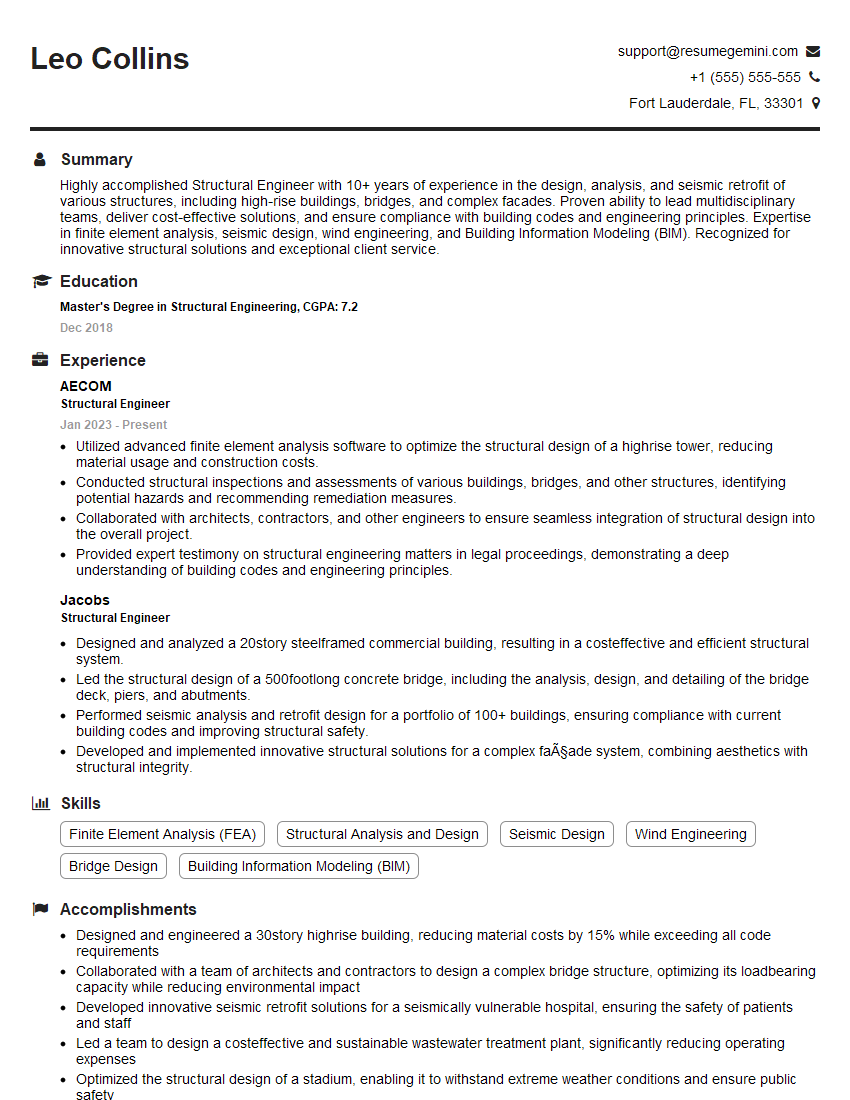
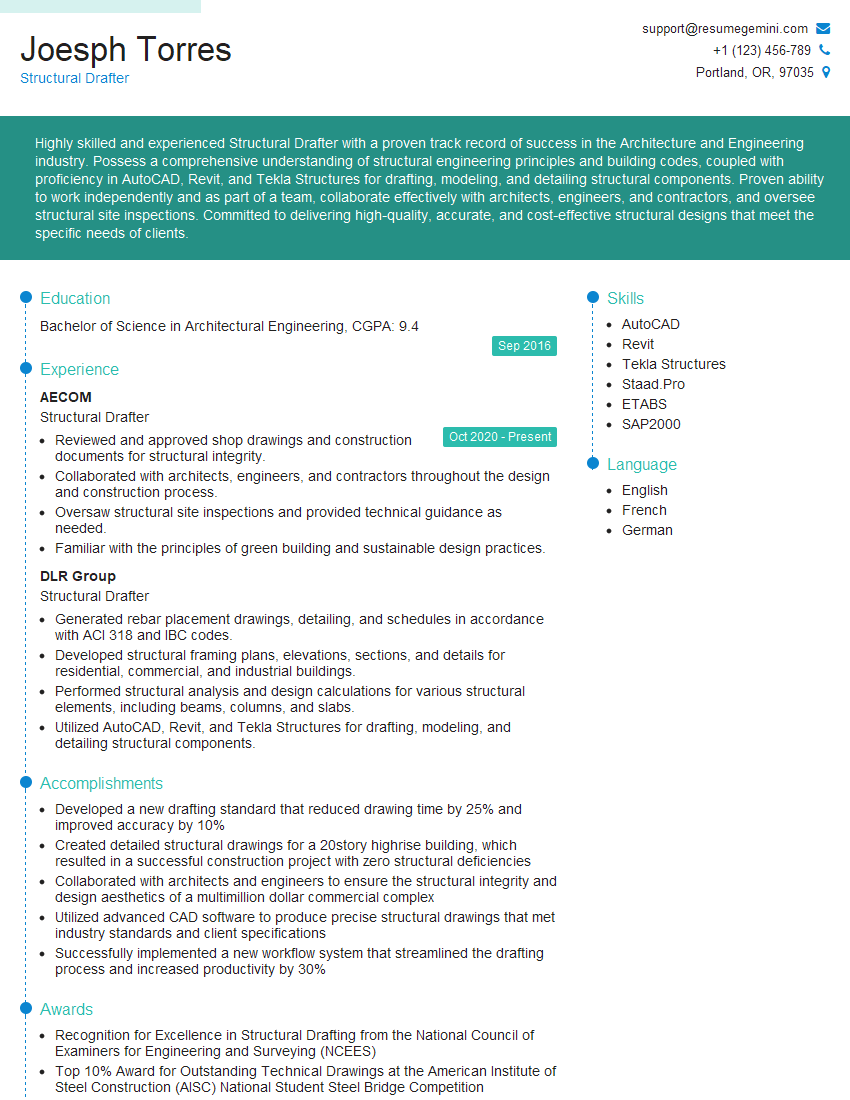
Mastering Steel Structures Analysis and Design is crucial for a successful and rewarding career in structural engineering, opening doors to exciting projects and leadership opportunities. To maximize your job prospects, it’s essential to present your skills effectively. Creating an ATS-friendly resume is key to getting your application noticed. ResumeGemini is a trusted resource that can help you build a professional and impactful resume, significantly increasing your chances of landing your dream job. Examples of resumes tailored to Steel Structures Analysis and Design are available to help guide you.



Explore more articles
Users Rating of Our Blogs
Share Your Experience
We value your feedback! Please rate our content and share your thoughts (optional).
What Readers Say About Our Blog
Very informative content, great job.
good