Every successful interview starts with knowing what to expect. In this blog, we’ll take you through the top Stitching Machine Operation interview questions, breaking them down with expert tips to help you deliver impactful answers. Step into your next interview fully prepared and ready to succeed.
Questions Asked in Stitching Machine Operation Interview
Q 1. What types of stitching machines have you operated?
Throughout my career, I’ve had extensive experience operating a wide variety of stitching machines. This includes industrial single-needle lockstitch machines (like those used for mass production of jeans or shirts), industrial double-needle lockstitch machines (ideal for creating parallel seams), overlock (serger) machines for finishing seams and preventing fraying, blind stitch machines for creating nearly invisible hems, and even some specialized machines like buttonhole stitchers and bartack machines.
I’m proficient in both mechanical and computerized models, understanding the nuances of each type and their respective applications.
Q 2. Describe your experience with different stitch types (e.g., lockstitch, overlock, chainstitch).
My experience encompasses a broad range of stitch types. The lockstitch, a fundamental stitch in most sewing, creates a strong, secure seam by interlacing the upper and lower threads in a zig-zag pattern. I’ve used this extensively, mastering its tension and stitch length adjustments for various fabrics. Overlock stitches, created with a serger, enclose the raw edges of fabric to prevent unraveling, providing a clean and professional finish. This is crucial for creating durable garments and preventing fraying. Chain stitch is a simpler stitch type, typically used for decorative purposes or temporary stitching. I’m experienced in adjusting the stitch density and tension to create the desired effect for each application. The differences between these stitches are fundamental to achieving the desired quality and durability in the finished product.
Q 3. How do you troubleshoot common sewing machine malfunctions?
Troubleshooting sewing machine malfunctions is a critical part of my skill set. My approach is systematic. First, I visually inspect the machine for obvious problems like broken needles, tangled thread, or obstructions in the bobbin case. Then, I listen for unusual noises, which can often pinpoint the source of the problem. For example, a clicking sound might indicate a timing issue, while a grinding sound suggests a lubrication problem.
If the issue persists, I check the tension, making sure the upper and lower tensions are balanced. Incorrect tension can lead to skipped stitches or uneven seams. I also examine the needle and bobbin for damage, ensuring they are the correct type for the fabric. If the problem persists after these initial checks, I’ll consult the machine’s manual or look online for more specific troubleshooting guidance based on the machine’s make and model.
For example, recently, a machine was skipping stitches. After a thorough check, I found the needle was slightly bent – a simple replacement solved the problem.
Q 4. What is your experience with maintaining and cleaning sewing machines?
Regular maintenance is paramount for extending the life and performance of sewing machines. This includes daily cleaning, removing lint and thread buildup around the bobbin area, needle plate, and feed dogs. I always use a soft brush and compressed air for this task. I lubricate the moving parts as needed using the manufacturer’s recommended lubricant. This prevents friction and ensures smooth operation. I also check the timing of the machine regularly, ensuring the hook and needle timing are precise. In addition to daily cleaning, I conduct more thorough servicing at regular intervals, which may include replacing worn parts like needles, belts, and bobbins. This ensures optimal performance and prevents costly repairs.
Q 5. What safety precautions do you follow when operating stitching machines?
Safety is always my top priority. Before operating any stitching machine, I ensure the area around the machine is clear of obstructions and that I’m wearing appropriate safety gear, including safety glasses to protect my eyes from flying debris. I always keep my fingers clear of the needle and moving parts of the machine. I regularly inspect the power cord and plug to ensure they are in good condition, and never operate the machine with a frayed cord. Additionally, I’m familiar with the emergency stop procedures for each machine and follow strict safety guidelines as outlined by the manufacturer and relevant occupational health and safety regulations. Long hair is always tied back, loose clothing is avoided, and the area remains well-lit. This prevents accidents and maintains a safe work environment.
Q 6. How do you ensure consistent stitch quality and speed?
Consistent stitch quality and speed are achieved through a combination of factors. First, I carefully select the appropriate needle and thread for the fabric type. The correct needle size and type are crucial. Then, I adjust the stitch length and tension based on the fabric weight and type. Lighter fabrics require shorter stitches and lower tension to avoid puckering. Heavier fabrics need longer stitches and potentially higher tension for durability. I maintain a consistent sewing speed to avoid uneven stitches. Speed is balanced with precision; rushing leads to errors.
Regular cleaning and maintenance of the machine contribute to consistent performance. A well-maintained machine operates smoothly and produces consistent stitches. Finally, I always conduct test stitches on a scrap of the same fabric before starting the main project to verify the stitch quality and make adjustments as needed. Practicing consistency is a skill developed over time.
Q 7. Explain your experience with different types of fabrics and their appropriate needle and thread combinations.
My experience working with diverse fabrics has taught me the importance of matching the needle and thread to the fabric type. Delicate fabrics like silk or chiffon require fine needles and lightweight threads to prevent damage. Heavy fabrics like denim or canvas need stronger needles and heavier threads to create durable seams. Different needle types exist; ballpoint needles are essential for knit fabrics, while sharp needles are better suited for woven fabrics. The wrong needle can lead to skipped stitches or damage the fabric.
For example, working with silk, I use a size 8 or 10 sharps or microtex needles paired with a fine silk thread. When working with denim, I’d opt for a heavier-duty needle (size 16-18) and a stronger thread, perhaps a cotton or polyester thread. This understanding of material properties and associated tools is key to producing high-quality results and efficient workflow.
Q 8. How familiar are you with computerized sewing machines?
I’m highly proficient with computerized sewing machines. My experience spans various models, from basic programmable machines to advanced systems with intricate stitch patterns and automated features. I understand how to program stitch patterns, adjust needle position and speed, and utilize the various functionalities offered by different brands, such as Brother, Singer, and Juki. For example, I’ve used computerized machines to create intricate embroidery designs and to automate repetitive tasks in high-volume production runs, significantly increasing efficiency and precision. I am also adept at troubleshooting computerized machine errors and performing routine maintenance.
Q 9. Describe your experience with pattern reading and following instructions.
Pattern reading and instruction following are fundamental to my work. I can effectively interpret technical drawings, grading charts, and written instructions to accurately construct garments or other sewn products. My experience includes working with both simple and complex patterns, ranging from basic t-shirts to elaborate couture designs. I meticulously check measurements, identify seam allowances, and understand the implications of different pattern markings. For instance, I recently worked on a project involving a complex draped pattern. Through careful interpretation of the markings and thorough attention to detail, I successfully replicated the designer’s vision. If there is ambiguity, I will always seek clarification from the designer or supervisor before proceeding to avoid costly mistakes.
Q 10. How do you handle production deadlines and quotas?
Meeting production deadlines and quotas is a critical aspect of my work. I’m highly organized and efficient, capable of prioritizing tasks to ensure timely completion. I use time management techniques such as breaking down large tasks into smaller, manageable steps and setting realistic daily/weekly goals. In a previous role, we had a significant order with a tight turnaround. By carefully planning my workflow and optimizing my machine settings, I exceeded expectations and delivered all items on time and to the high quality standards expected. I also understand the importance of communicating any potential delays proactively to supervisors.
Q 11. What is your experience with quality control procedures in sewing?
My experience with quality control procedures is extensive. I understand the importance of consistent quality throughout the production process. My routine includes checking fabric for flaws before cutting, regularly inspecting stitch quality and seam finishes, and performing final quality checks on completed items. This includes ensuring that seams are aligned, stitches are even, and the overall garment conforms to the specifications outlined in the pattern. I’m familiar with various quality control methodologies, including visual inspection, dimensional measurements, and testing for durability. I always document any quality issues and actively contribute to finding solutions to prevent recurrence.
Q 12. How do you identify and correct stitching errors?
Identifying and correcting stitching errors is a crucial skill. Common errors I encounter include skipped stitches, inconsistent stitch length, puckering, and broken threads. My troubleshooting process involves systematically checking the machine’s tension, needle condition, thread type, and feed dog alignment. For instance, if I notice skipped stitches, I’ll first check the needle for bending or damage, then adjust the tension and try a different thread. If the problem persists, I’ll investigate the feed dog and potentially call for machine maintenance. Once identified, errors are corrected immediately to avoid wasting material and ensure the highest standard of work. I thoroughly inspect each stitch to ensure accuracy.
Q 13. Describe your experience with different sewing machine attachments.
I have extensive experience using various sewing machine attachments, including different types of presser feet (e.g., zipper foot, buttonhole foot, walking foot), rolled hems, and blind stitch attachments. The walking foot, for example, is invaluable when sewing multiple layers of fabric, ensuring that the fabric feeds evenly and prevents slippage. I am proficient in selecting and using the appropriate attachment for a given task, optimizing the machine’s performance and producing high-quality results. My experience extends to understanding the specific settings required for each attachment to achieve optimal results and I am comfortable training others on their proper use.
Q 14. How do you maintain consistent tension in your stitching?
Maintaining consistent stitch tension is paramount for producing professional-quality work. This involves understanding the interaction between the upper and lower tensions, needle type, thread type, fabric type, and stitch length. I systematically adjust the tension dials based on the fabric and thread I am using. For instance, heavier fabrics typically require higher tension, while lighter fabrics require lower tension. If I encounter uneven stitching, I systematically adjust the tension, testing after each small adjustment, to find the optimal balance. I also regularly check the bobbin winding to make sure it is filled correctly to ensure that the thread is feeding correctly. Consistent practice and attention to detail are key to mastering this.
Q 15. What is your understanding of different needle types and their applications?
Choosing the right needle is crucial for a successful stitch. Different fabrics and sewing tasks require needles with varying points, shafts, and sizes. Think of it like choosing the right tool for the job; you wouldn’t use a hammer to screw in a screw!
- System Needles: These are the most common, identified by a number indicating size (e.g., 11/70, where 11 is the size and 70 the metric equivalent). Larger numbers mean thicker needles. They’re versatile and suitable for most woven fabrics.
- Ballpoint Needles: These have a rounded point designed for knit fabrics. The rounded point slides between the fabric loops, preventing skipped stitches and fabric damage. Imagine trying to sew through a chain link fence with a sharp needle versus a blunt one.
- Sharp Needles: Perfect for sewing woven fabrics like denim, canvas, and leather. Their sharp point pierces the fabric cleanly, creating strong, durable seams. They’re excellent for quilting and heavier weight fabrics.
- Embroidery Needles: These have a longer eye and are designed to accommodate embroidery threads. They provide a smoother flow of thread through the fabric, making detailed embroidery much easier.
- Jeans Needles: These needles are reinforced to handle thick, multiple layers, such as denim or leather. Their durability prevents needle breakage from frequent stress.
Selecting the incorrect needle type can lead to broken needles, skipped stitches, fabric damage, or uneven stitching. Always match your needle to your project and fabric.
Career Expert Tips:
- Ace those interviews! Prepare effectively by reviewing the Top 50 Most Common Interview Questions on ResumeGemini.
- Navigate your job search with confidence! Explore a wide range of Career Tips on ResumeGemini. Learn about common challenges and recommendations to overcome them.
- Craft the perfect resume! Master the Art of Resume Writing with ResumeGemini’s guide. Showcase your unique qualifications and achievements effectively.
- Don’t miss out on holiday savings! Build your dream resume with ResumeGemini’s ATS optimized templates.
Q 16. How do you deal with fabric jams or other operational issues?
Fabric jams and operational issues are inevitable, even for seasoned professionals. The key is a methodical approach.
- Identify the problem: Is the thread tangled, is the fabric caught, is the needle bent or broken? Carefully inspect the machine and the fabric path.
- Turn off the machine: Safety first! Always disconnect the power before undertaking any repairs or adjustments.
- Address the jam: Gently remove any tangled fabric or thread from the feed dogs, needle plate, and bobbin area. Use tweezers if necessary to pull out small bits of fabric.
- Check the needle: Examine the needle for bends or damage. A bent or damaged needle can cause consistent jams. Replace if necessary.
- Check tension: Incorrect thread tension can contribute to jamming. Adjust the upper and lower tension dials as needed, referring to your machine’s manual. Observe the consistency of the stitching; even loops indicate correct tension.
- Clean the machine: Dust and lint build-up can affect the machine’s operation. Regular cleaning, using a soft brush or compressed air, helps to maintain optimal performance.
If the problem persists, consult your machine’s manual or seek professional help. It’s always better to consult than to force a solution and risk further damage to the machine or fabric.
Q 17. What are your preferred methods for repairing damaged seams?
Repairing damaged seams requires precision and attention to detail. The method depends on the type of damage and the fabric.
- Small tears or holes: A small, carefully placed patch on the underside of the garment is a simple fix. For delicate fabrics, hand-sewing a darning stitch over the hole can be effective.
- Loose seams: Re-sew the seam by hand or machine, using a backstitch to secure the thread. Press the seam afterwards to create a smooth finish.
- Broken seams: Carefully unpick the damaged section. Depending on the fabric, you might need to reinforce the area with interfacing before re-sewing. Re-sew using a zig-zag stitch for extra strength.
- Stretching or distortion: This may require re-construction of the garment section. This might involve taking in or letting out seams and possibly hand-sewing to reshape the fabric.
Remember to match the thread color and type to the original garment. Good lighting and sharp needles are essential for clean, invisible repairs. Practice on scrap fabric before working on the garment itself.
Q 18. How do you adapt to different sewing machine models and brands?
Adapting to different sewing machine models and brands is a key skill for any professional. While the fundamental principles remain the same (threading, needle insertion, tension adjustment), the specifics of the machine interface and functionality can vary considerably.
My approach is a combination of careful reading of the machine’s manual, hands-on practice, and utilizing online resources and tutorials specific to that model. I begin with basic functions: threading the machine, adjusting stitch length and width, and testing different stitch types. I then move to more complex features, working through any challenges incrementally. It’s similar to learning a new software program – you start with the basics and gradually progress to advanced features.
Each machine has its idiosyncrasies, so experience and attention to detail are essential. The more models you work with, the more readily you can adapt to new ones.
Q 19. Describe your experience with industrial sewing machine maintenance.
Maintaining industrial sewing machines is crucial for both productivity and safety. My experience includes regular lubrication (using appropriate oils), cleaning (removing lint and debris), and inspecting critical components like the needle bar, feed dogs, and bobbin case for wear and tear. I’m proficient in identifying and replacing worn or damaged parts, such as needles, belts, and presser feet. I can also identify and solve basic electrical problems.
Preventive maintenance is paramount. Regularly scheduled servicing extends machine life, reduces downtime, and ensures consistent high-quality stitching. This involves understanding the specific maintenance requirements for each machine model and following manufacturers recommendations.
I’m also trained in using the necessary tools for industrial machine maintenance, including specialized lubricants and cleaning agents, and troubleshooting techniques using various diagnostic measures. Safety is always my primary concern, so I ensure that all maintenance procedures are carried out in accordance with safety guidelines.
Q 20. How do you calculate stitch density and its impact on fabric quality?
Stitch density refers to the number of stitches per inch (SPI) or stitches per centimeter (SPC). A higher SPI/SPC results in a denser, stronger seam, while a lower SPI/SPC creates a looser, more open seam. Think of it like weaving a basket – more threads (stitches) lead to a tighter, stronger basket.
The ideal stitch density depends on the fabric, the project’s intended use, and the desired aesthetic. For instance, a garment intended for heavy use might require a higher stitch density than a decorative item. Some machines allow for direct SPI/SPC adjustment, while others require adjusting the stitch length to influence density. Calculating stitch density usually involves measuring a section of seam and counting the number of stitches within that length.
Too low a stitch density can lead to weak seams prone to breakage. Too high a stitch density can cause puckering or damage the fabric, particularly delicate materials. Finding the sweet spot ensures the perfect balance between durability and aesthetic appeal.
Q 21. What is your experience with different types of thread and their properties?
Thread is an integral part of sewing; understanding its properties is crucial for high-quality stitching. Different threads have different strengths, textures, and finishes, each suited to specific applications.
- Cotton: A natural fiber, cotton thread is versatile, relatively inexpensive, and suitable for a wide range of fabrics. It’s durable but can be susceptible to shrinking or fading.
- Polyester: A synthetic fiber offering high strength and durability. Polyester thread is resistant to shrinking, fading, and stretching, making it ideal for projects requiring longevity, like upholstery.
- Silk: A luxurious natural fiber producing a smooth, lustrous stitch. Silk thread is delicate and is best suited for fine fabrics and decorative stitching.
- Rayon: A semi-synthetic fiber with a soft, lustrous finish, suitable for various projects. It blends well with other fibers and offers a good balance of strength and smoothness.
- Nylon: A very strong synthetic fiber commonly used in industrial sewing, particularly for heavier materials. Its strength and durability are unmatched.
Choosing the correct thread for the project is vital. Consider the fabric type, stitch type, project durability requirements, and desired finish. Different thread weights are also available; matching the thread weight to the needle and fabric is critical for achieving the best results.
Q 22. How familiar are you with different types of sewing machine feet?
Sewing machine feet are specialized attachments that significantly impact the stitch quality and type. My familiarity extends to a wide range, encompassing basic feet like the general-purpose foot, zipper foot, buttonhole foot, and blind stitch foot, as well as more specialized ones such as the walking foot (for multiple layers), cording foot, and even quilting feet with various feed dog configurations.
- General-purpose foot: Used for most basic sewing tasks.
- Zipper foot: Allows for precise stitching close to the zipper teeth.
- Walking foot: Prevents fabric slippage when sewing thick or multiple layers.
- Blind stitch foot: Creates nearly invisible hems.
Understanding the nuances of each foot allows for efficient and high-quality stitching, crucial for meeting production demands and creating various garment types.
Q 23. How do you ensure the ergonomic safety of your workstation?
Ergonomic safety is paramount in sewing machine operation. I prioritize this by maintaining a well-organized workstation with everything within easy reach. This prevents unnecessary stretching and twisting. My chair is adjustable to provide proper lumbar support, and I take regular breaks to stretch and walk around, reducing strain on my back, neck, and wrists. Proper lighting is essential to avoid eye strain, and I ensure the machine is set at a comfortable height. I also use ergonomic tools like cushioned wrist rests and anti-fatigue mats.
For instance, during a particularly intensive project involving hundreds of identical pieces, I implemented a system of small, frequent breaks to minimize fatigue. I’d set a timer for every 30 minutes to perform simple stretches and rest my eyes. This prevented repetitive strain injuries and maintained consistent quality throughout the entire process.
Q 24. What experience do you have working with specific sewing machine brands (e.g., Juki, Brother, Singer)?
I possess extensive experience with Juki, Brother, and Singer industrial sewing machines. My experience with Juki includes working with their high-speed, direct-drive models for heavy-duty applications like denim stitching. With Brother, I’ve worked on their computerized models with intricate stitch patterns for finer fabrics. My Singer experience includes the older mechanical models as well as their newer computerized machines, giving me a broad understanding of different technologies and maintenance techniques. I’m adept at troubleshooting and maintaining all three brands.
For example, I was able to quickly diagnose and resolve a recurring bobbin tension issue on a Juki machine by simply adjusting the bobbin case tension screw, saving significant downtime. This experience underscores my ability to efficiently resolve mechanical issues across different machine brands.
Q 25. Describe your experience working with different types of industrial sewing machine drives (e.g., direct drive, belt drive).
I’ve worked extensively with both direct-drive and belt-drive industrial sewing machines. Direct-drive machines offer precise speed control and are typically quieter and more efficient, ideal for delicate fabrics and intricate stitching. Belt-drive machines are usually more robust and capable of handling heavier fabrics and high-speed production, but they require more frequent maintenance.
In a previous role, we transitioned from belt-drive to direct-drive machines for a specific line of fine silk garments. The direct-drive machines provided a significant improvement in stitch quality and reduced noise pollution in the workspace. This transition required training and adaptation but ultimately enhanced productivity and product quality.
Q 26. How would you handle a situation where a machine breaks down during peak production?
In a peak production situation, a machine breakdown is critical. My immediate response would be to assess the problem. If it’s a minor issue I can handle, like a jammed needle or thread breakage, I’d fix it quickly. However, if the problem is more complex, I would immediately inform my supervisor and follow established protocols for machine repair. Simultaneously, I would work with my team to redistribute workload to other operational machines to minimize production delays. Proper documentation and communication are crucial in this situation to prevent recurrence and facilitate faster repairs.
For example, during a rush order, a crucial overlock machine malfunctioned. I quickly assessed the situation, confirmed it needed professional repair, and immediately informed management while simultaneously re-routing work to other overlock machines. This quick response minimized the impact on our production schedule.
Q 27. What is your experience with pre-sewing operations like cutting and marking?
My experience with pre-sewing operations such as cutting and marking is substantial. I’m proficient in using various cutting tools, from electric shears to rotary cutters, ensuring accurate and efficient cutting patterns. I’m familiar with different marking techniques using chalk, tracing wheels, and other specialized tools, ensuring precise placement of markings to guide the sewing process. Accurate pre-sewing preparation is essential to quality stitch work and consistent output.
For instance, using a laser cutter for pattern cutting on delicate fabrics significantly improves precision and reduces fabric waste compared to traditional hand methods. This showcases my commitment to employing the most effective and efficient techniques available.
Q 28. How do you contribute to a team environment in a fast-paced production setting?
In a fast-paced environment, teamwork is crucial. I actively contribute by assisting colleagues when needed, sharing my expertise, and maintaining open communication. I’m comfortable providing support or training to newer team members, fostering a collaborative and supportive atmosphere. Proactive problem-solving and efficient task management also contribute to the overall team effectiveness. It’s about leveraging everyone’s strengths to achieve the collective goal.
For instance, during a tight deadline, I volunteered to assist a struggling colleague on a particularly intricate stitching task. By sharing my knowledge and efficient techniques, we finished the task on time and maintained the overall project timeline.
Key Topics to Learn for Your Stitching Machine Operation Interview
- Machine Operation & Maintenance: Understanding the different types of stitching machines (e.g., lockstitch, overlock), their functions, and routine maintenance procedures (cleaning, lubrication, needle changes).
- Fabric Handling & Selection: Knowing how different fabrics behave during stitching (stretch, drape, thickness), and selecting appropriate needles, threads, and stitch types for optimal results. Practical application includes demonstrating your ability to identify fabric types and recommend suitable stitching techniques.
- Stitch Types & Applications: Mastering various stitch types (straight stitch, zigzag, blind stitch, etc.) and their appropriate uses in different garment construction scenarios. This includes understanding stitch length, tension, and their impact on the final product.
- Troubleshooting & Problem Solving: Demonstrating your ability to identify and resolve common stitching machine problems (e.g., skipped stitches, broken needles, thread jams). This includes understanding the root causes of these issues and implementing effective solutions.
- Safety Procedures & Regulations: Understanding and adhering to all safety regulations related to operating stitching machines, including proper handling of needles, threads, and fabrics to prevent injuries.
- Production & Efficiency: Demonstrating knowledge of efficient work practices, including optimizing stitch settings, minimizing downtime, and achieving high-quality results within a reasonable timeframe. This could include understanding production targets and meeting deadlines.
- Quality Control: Understanding quality control procedures for stitched garments, including identifying defects, performing quality checks, and ensuring consistent stitch quality throughout production.
Next Steps
Mastering stitching machine operation is key to a successful and rewarding career in the garment industry. It opens doors to diverse roles and opportunities for advancement. To enhance your job prospects, creating a strong, ATS-friendly resume is crucial. ResumeGemini is a trusted resource to help you build a professional and impactful resume that highlights your skills and experience effectively. Examples of resumes tailored to Stitching Machine Operation are available to guide you. Take the next step towards your dream job!
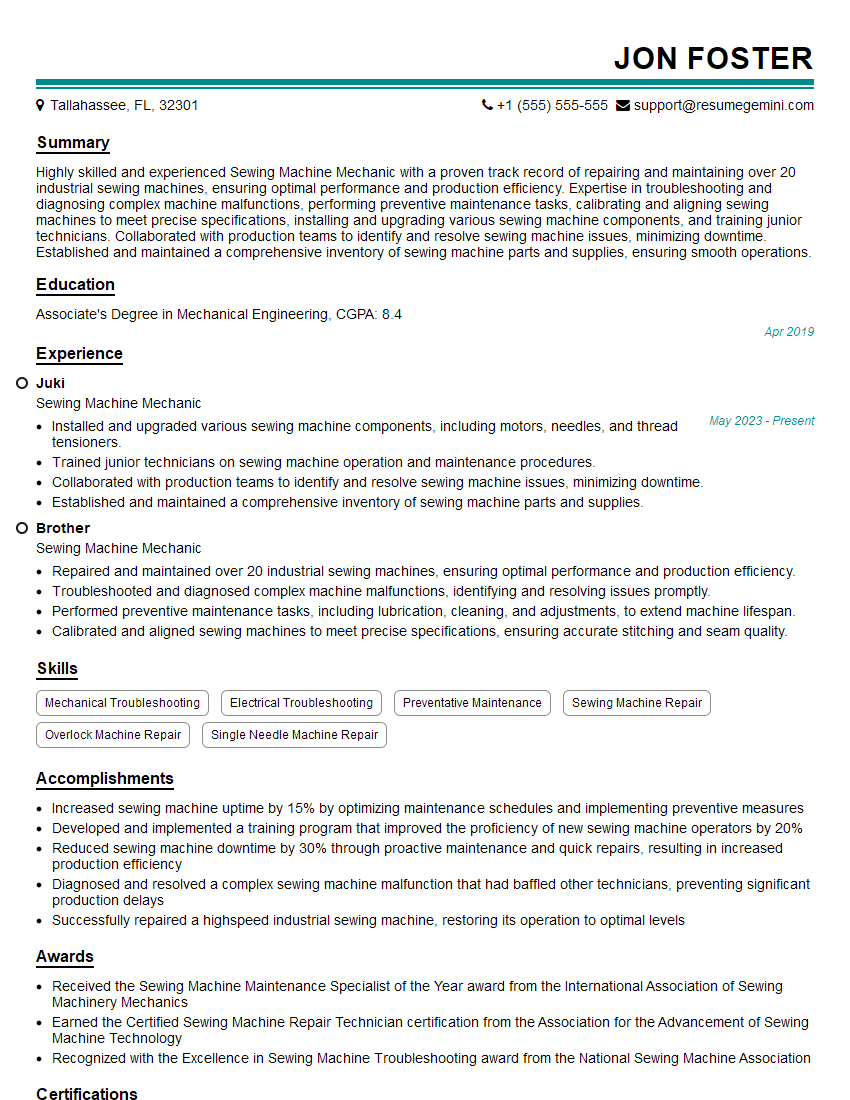
Sewing Machine Mechanic Resume Sample
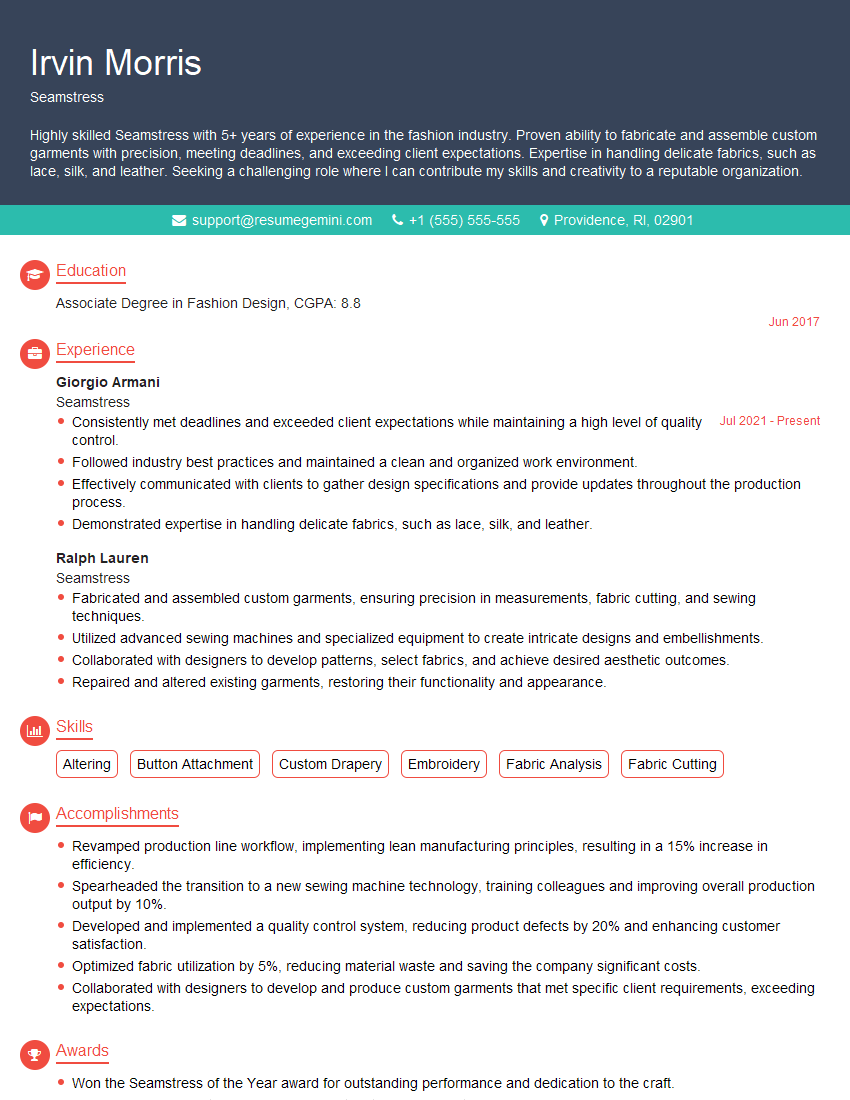
Seamstress Resume Sample
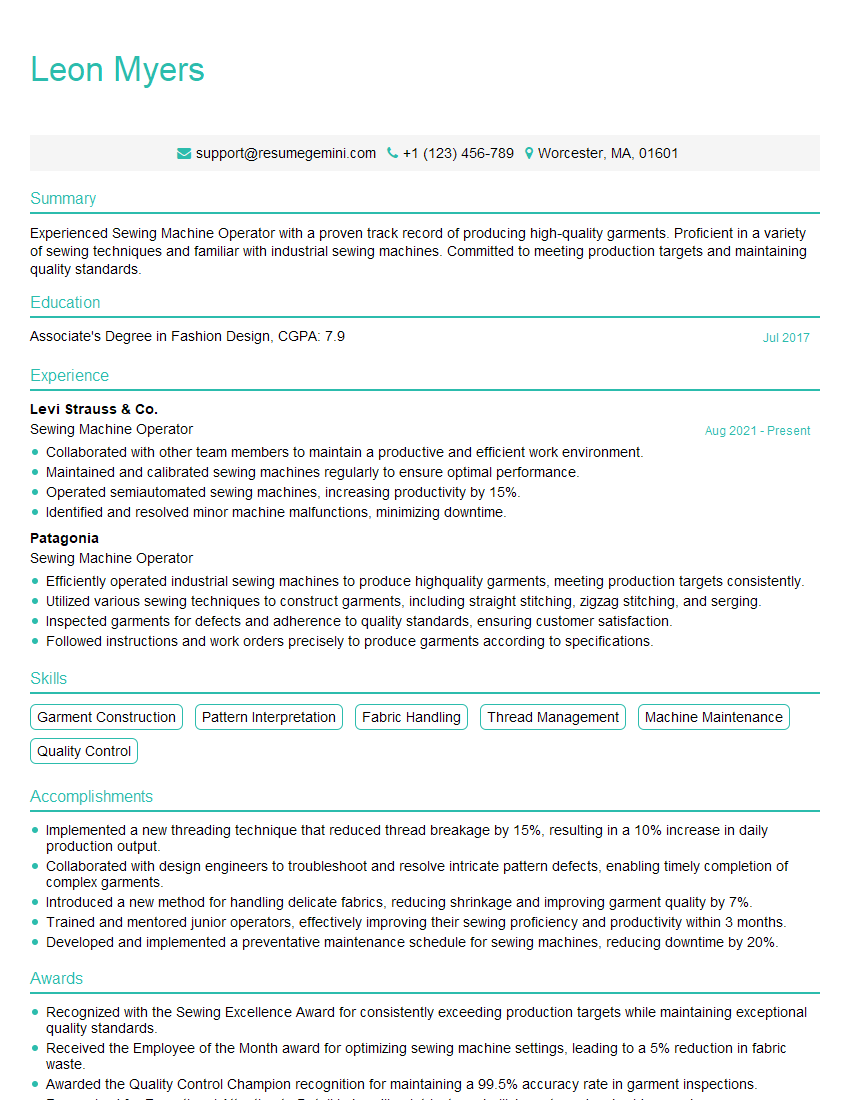
Sewing Machine Operator Resume Sample
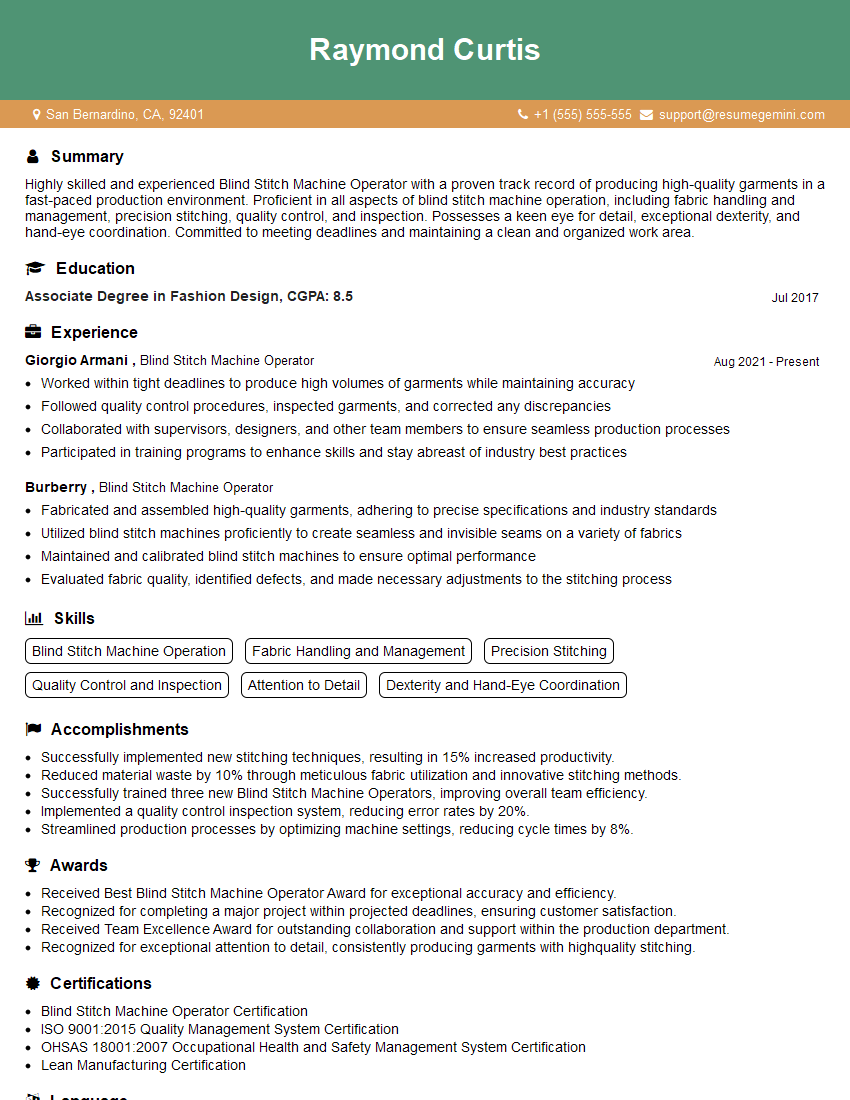
Blind Stitch Machine Operator Resume Sample
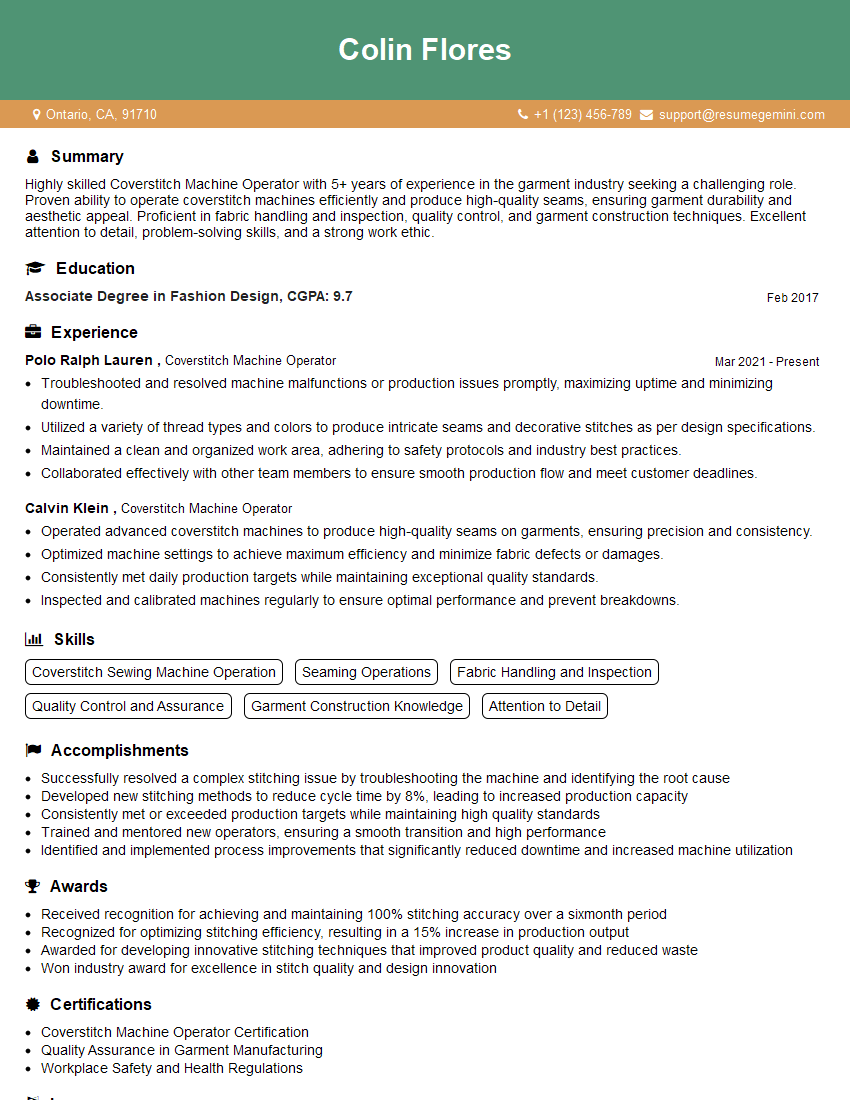
Coverstitch Machine Operator Resume Sample

Embroidery Machine Operator Resume Sample
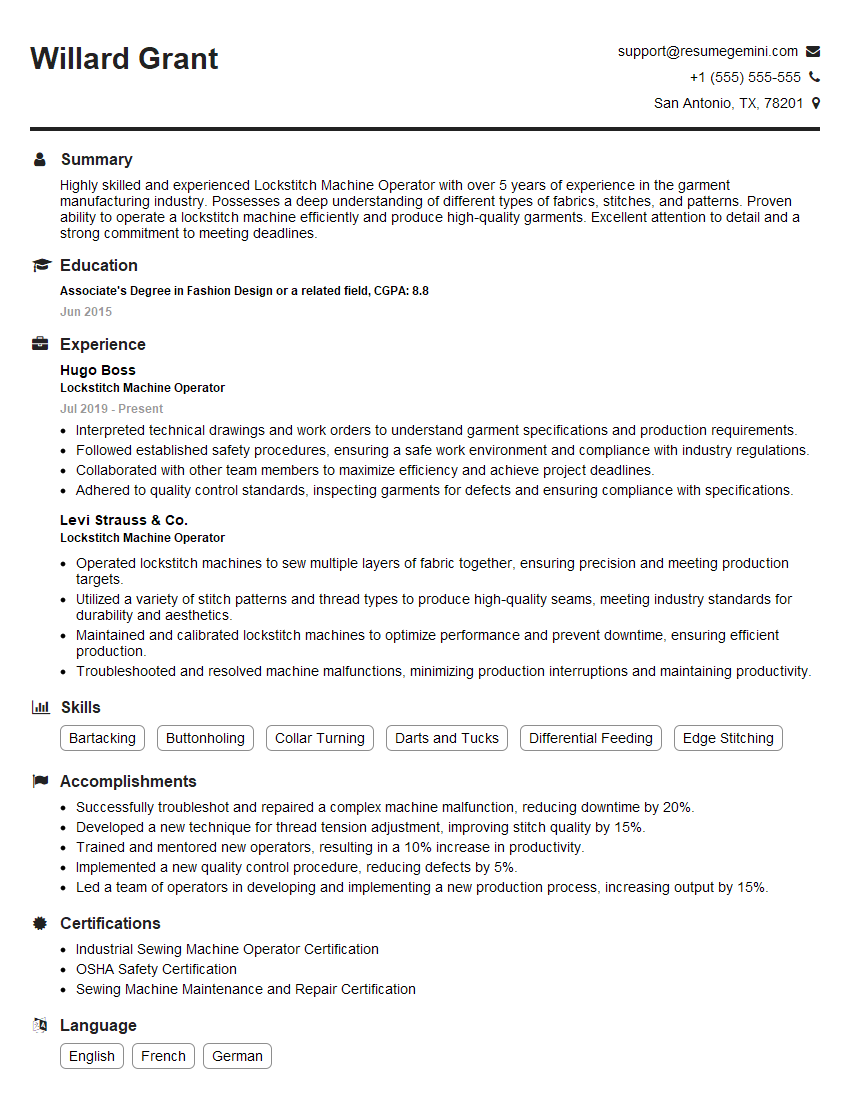
Lockstitch Machine Operator Resume Sample
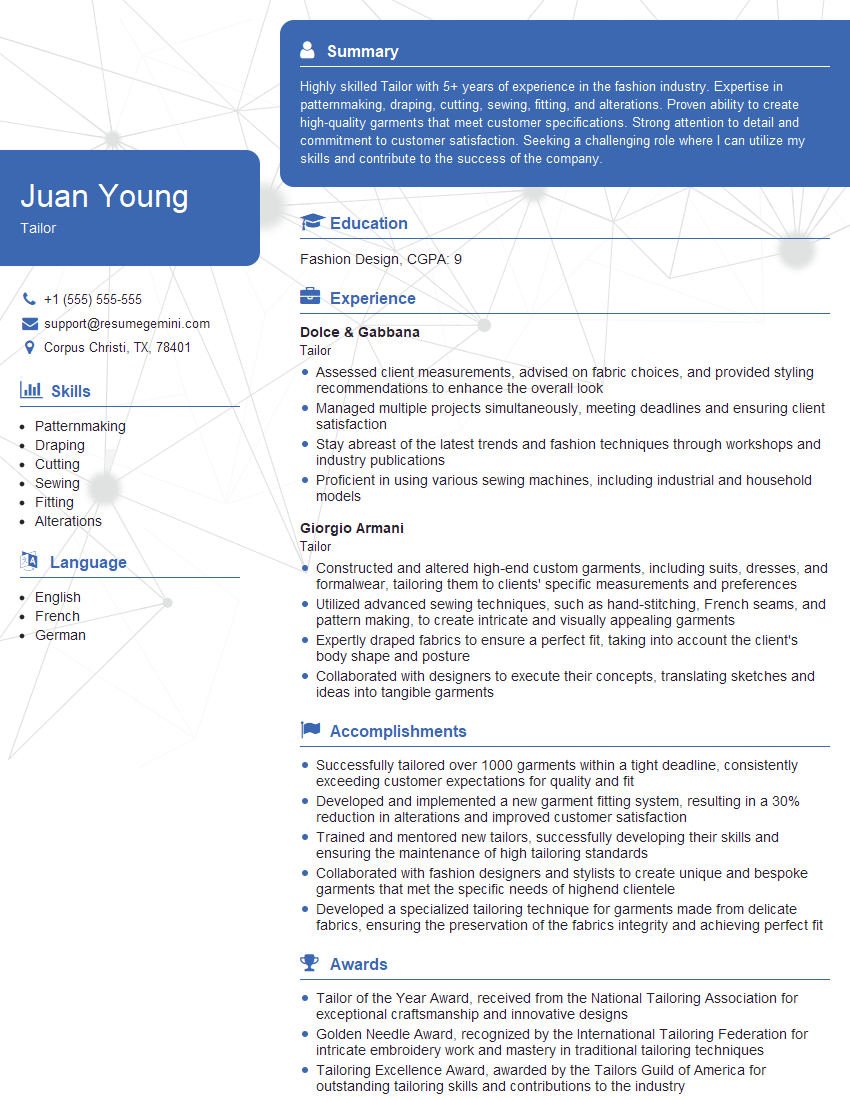
Tailor Resume Sample
Explore more articles
Users Rating of Our Blogs
Share Your Experience
We value your feedback! Please rate our content and share your thoughts (optional).
What Readers Say About Our Blog
Very informative content, great job.
good