The thought of an interview can be nerve-wracking, but the right preparation can make all the difference. Explore this comprehensive guide to Stone Cutting and Fabrication interview questions and gain the confidence you need to showcase your abilities and secure the role.
Questions Asked in Stone Cutting and Fabrication Interview
Q 1. What types of stone are you experienced working with?
My experience encompasses a wide range of natural and engineered stones. I’ve extensively worked with granites, known for their durability and varied colors; marbles, prized for their elegance and veining; limestones, offering a softer, more classic aesthetic; and quartzites, which boast incredible strength and resistance to wear. Beyond these, I’m proficient in handling travertines, onyx, and engineered stones like quartz and porcelain, each with unique properties requiring specialized handling. For example, the porous nature of limestone necessitates different sealing techniques compared to the denser granites. Understanding these inherent differences is key to achieving the best possible results.
Q 2. Describe your experience with different cutting tools and techniques.
My toolset includes a variety of cutting equipment, each suited to specific tasks and materials. For rough cutting of large slabs, I utilize bridge saws, employing diamond blades to slice through the stone with precision. For more intricate work, I rely on smaller, more maneuverable tools like chop saws and hand-held angle grinders with diamond discs. Water-cooled cutting is always employed to manage heat and extend blade life, especially when working with harder stones like granite. Different blade types, from segmented to continuous rim, are selected based on the stone type and desired finish. For example, a segmented blade is ideal for fast removal of material during rough cutting, whereas a continuous rim blade is preferred for smoother cuts and intricate details. I’m also skilled in using various hand tools for fine shaping and detail work, including chisels, hammers, and various polishing tools.
Q 3. How do you ensure precise measurements and cuts in stone fabrication?
Precise measurements are paramount in stone fabrication. I begin with meticulous template creation using digital measuring tools and CAD software. These templates are then transferred to the stone slabs using precision marking tools. For larger pieces, laser measurement systems ensure accuracy down to the millimeter. During cutting, I regularly check measurements against the templates to avoid discrepancies. This rigorous approach minimizes waste and guarantees a perfect fit for every project. A recent project involved creating a complex countertop with multiple curves and angles; the use of digital templates and continuous measurement checks ensured a flawless installation.
Q 4. Explain your process for polishing and finishing various stone types.
Polishing and finishing techniques vary depending on the stone type and desired level of sheen. Granites, for instance, typically undergo a multi-step process involving progressively finer grit diamond pads, starting with rough grinding and culminating in a high-gloss finish. Marbles, being softer, might require a gentler approach with fewer steps to avoid scratches. Honing or satin finishes can also be achieved by using specific polishing compounds. Onyx, with its translucency, often requires a specialized polishing process to enhance its unique properties. Each step involves careful inspection to ensure an even, uniform finish. The final step often involves the application of sealers to protect the stone from staining and damage.
Q 5. What safety measures do you follow when working with stone cutting equipment?
Safety is my top priority. I always wear appropriate personal protective equipment (PPE), including safety glasses, hearing protection, dust masks, and cut-resistant gloves. The equipment is regularly inspected for proper functioning and safety interlocks. Stone dust is minimized using water-cooled cutting and appropriate dust collection systems. Emergency shut-off switches are readily accessible, and all personnel are briefed on safety protocols before commencing work. Safe handling procedures for heavy stone slabs are strictly adhered to, including the use of appropriate lifting equipment. A recent safety training refresher covered the latest dust mitigation techniques and improved our procedures.
Q 6. How do you handle challenging cuts or intricate designs?
Challenging cuts or intricate designs often require a combination of techniques and tools. For complex curves, I might employ CNC routing or waterjet cutting for precision. Hand tooling, such as chiseling and shaping, is used for fine detailing. In one instance, we had to fabricate a stone inlay featuring a delicate floral pattern. A combination of CNC cutting for the initial shape and hand carving for the intricate details resulted in a stunning piece. Careful planning, precise measurements, and a methodical approach are vital to successfully tackle such projects.
Q 7. Describe your experience with CNC machinery in stone fabrication.
I have extensive experience operating CNC machinery for stone fabrication. This technology allows for incredibly precise and repeatable cuts, particularly beneficial for complex designs and high-volume production. I’m proficient in programming and operating various CNC routers and waterjet cutters, adapting the programs to accommodate different stone types and desired finishes. CNC machining allows for the efficient creation of intricate shapes and patterns that would be impossible or impractical to achieve manually. For example, we recently used a CNC router to create a series of identical stone panels with a highly detailed geometric pattern, significantly increasing efficiency and reducing errors compared to manual methods.
Q 8. What software are you proficient in for stone design and fabrication?
Proficiency in stone design and fabrication software is crucial for efficient and accurate work. I’m highly skilled in several leading programs, including Autodesk AutoCAD for precise 2D and 3D modeling, allowing me to create detailed drawings and plans for complex stone projects. I also utilize StoneCAD, specialized software for stone fabrication that optimizes cutting patterns, minimizing waste and maximizing material yield. Furthermore, I have experience with SketchUp for 3D visualization and client presentations, enabling clients to see their projects come to life before installation. My expertise extends to using software for CNC machine programming, ensuring smooth and accurate automated cutting and shaping of stone materials. This ensures precision and consistency in every project.
Q 9. How do you manage material waste and optimize efficiency?
Managing material waste and optimizing efficiency is paramount in stone fabrication, impacting both profitability and environmental responsibility. My approach involves a multi-faceted strategy. First, precise templating and measuring are essential. Inaccurate measurements lead to significant waste. Secondly, I leverage specialized software like StoneCAD, as mentioned previously, to generate optimized cutting patterns that minimize scrap. Thirdly, I implement a systematic remnant management system. Smaller pieces are meticulously cataloged and stored for use in future projects (like creating smaller items or mosaic work), minimizing waste to an absolute minimum. Finally, we partner with recycling facilities to ensure responsible disposal of any unavoidable waste materials. Think of it like a puzzle – I’m constantly trying to find the best fit for each piece of stone to reduce waste as much as possible.
Q 10. Explain your understanding of different stone sealing and protection methods.
Stone sealing and protection are crucial for preserving the beauty and longevity of stone surfaces. The choice of sealant depends heavily on the stone type and its intended use. For instance, porous stones like limestone benefit from penetrating sealers which soak into the stone, protecting it from water damage and staining without altering its appearance. Topical sealers, on the other hand, form a protective film on the surface, offering excellent protection against scratches and abrasion, ideal for high-traffic areas. For polished stones, a high-gloss enhancer can be used to amplify their natural shine. I also utilize impregnating sealers which enhance the stain resistance and water repellency of the stone without altering the look and feel. Selecting the right sealant requires understanding the specific characteristics of the stone and the environmental conditions it will be exposed to. Regular maintenance and resealing according to the manufacturer’s instructions are also vital for optimal protection.
Q 11. Describe your experience with installation and setting procedures.
My experience with stone installation and setting procedures spans numerous projects of varying complexities. This includes everything from installing simple countertops to intricate wall cladding and fireplace surrounds. I understand the importance of precise leveling, proper anchoring, and the use of appropriate adhesives and grouts. The process begins with careful preparation of the substrate to ensure a stable and secure base. Accurate installation is critical to prevent cracking or shifting over time. I am proficient in using a variety of setting methods, adapting my techniques to the specific stone type, thickness, and the substrate. For example, installing a marble countertop requires a different approach than setting a granite fireplace surround. I meticulously inspect every installation and address any concerns to ensure the client receives a flawless outcome. Quality control checks, including inspecting levels and alignment throughout the process, are essential.
Q 12. How do you handle customer requests and address their concerns?
Handling customer requests and addressing concerns is a critical aspect of my role. I believe in proactive communication and transparency. From the initial consultation, I take the time to understand the client’s vision, budget, and aesthetic preferences. I offer professional advice based on my expertise, suggesting materials and designs that best suit their needs while ensuring feasibility. I present realistic timelines and transparent pricing structures, avoiding any surprises during the project. If concerns arise during the project, I address them promptly and effectively, finding solutions that meet both my professional standards and the client’s satisfaction. My philosophy is that a happy client is a testament to our commitment to quality and service.
Q 13. What is your experience with templating and measuring for stone installations?
Templating and measuring for stone installations are fundamental steps that ensure a perfect fit and avoid costly mistakes. I use precise measuring tools, including laser levels and digital measuring devices, to capture accurate dimensions of the installation area. Templates are then created carefully to mirror the exact shape and size of the area. This is a critical stage; inaccuracies here could lead to significant rework and delays. For complex installations, I utilize 3D scanning technology to create highly accurate digital models, enhancing precision and minimizing errors. I always double-check measurements and templates before proceeding with fabrication to ensure a flawless installation. Thorough templating is the cornerstone of successful stone installation projects.
Q 14. How do you troubleshoot common problems encountered during stone fabrication?
Troubleshooting is an integral part of stone fabrication. Common problems include cracks during cutting, chipping during polishing, and staining after installation. My approach is systematic: First, I identify the root cause. A crack during cutting could be due to improper blade alignment or material defects; chipping during polishing might be due to excessive pressure or a dull polishing pad. Once the cause is identified, I implement the appropriate solution. This could range from adjusting machine settings and replacing worn parts to selecting a more suitable fabrication technique or using different adhesives for installation. Preventative measures are also crucial; regular machine maintenance, proper material handling, and adhering to best practices significantly reduce the likelihood of these problems. Documentation of the troubleshooting process and implemented solutions is paramount for continuous improvement and avoiding recurring issues.
Q 15. Describe your experience with repairing damaged stone surfaces.
Repairing damaged stone surfaces requires a keen eye for detail and a precise approach. The process heavily depends on the type of damage and the stone itself. For minor chips or scratches, I typically use diamond polishing compounds, starting with a coarser grit and gradually moving to finer grits to restore the shine and smooth the surface. More significant damage, such as cracks or deep gouges, may necessitate more extensive repairs. This might involve epoxy resin fillers carefully matched to the stone’s color, followed by grinding and polishing to seamlessly integrate the repair. For instance, I once repaired a significant crack in a marble countertop using a two-part epoxy resin pigmented to match the veining. After curing, I meticulously ground and polished the area until it was virtually invisible. For larger sections of damage, replacement might be the only viable option.
The key is always to minimize the impact on the aesthetic appearance and structural integrity of the stone. Careful planning and a steady hand are crucial for successful repairs.
Career Expert Tips:
- Ace those interviews! Prepare effectively by reviewing the Top 50 Most Common Interview Questions on ResumeGemini.
- Navigate your job search with confidence! Explore a wide range of Career Tips on ResumeGemini. Learn about common challenges and recommendations to overcome them.
- Craft the perfect resume! Master the Art of Resume Writing with ResumeGemini’s guide. Showcase your unique qualifications and achievements effectively.
- Don’t miss out on holiday savings! Build your dream resume with ResumeGemini’s ATS optimized templates.
Q 16. What is your familiarity with different stone joining techniques?
Stone joining techniques vary based on the type of stone, the desired aesthetic, and the structural requirements. Common methods include mechanical fastening (using pins, dowels, or anchors), adhesives (epoxy resins, cement-based mortars), and interlocking techniques (where shaped pieces fit together like a puzzle). For example, I’ve used stainless steel pins to join large slabs of granite for a kitchen countertop installation, ensuring stability and strength. For more delicate or intricate work, like mosaic installations, epoxy resins provide a stronger, more seamless bond. For certain types of limestone, a cement-based mortar may be more appropriate, though careful consideration of the curing process is essential to prevent staining or discoloration. The choice of technique is always informed by the specific project requirements and the properties of the stone being used.
Q 17. How do you ensure the quality and consistency of your work?
Quality and consistency are paramount in stone cutting and fabrication. My approach involves several key strategies. Firstly, I meticulously inspect all stone slabs before beginning any work, noting any inherent imperfections or variations in color and texture. This allows for careful planning and optimal utilization of materials. Secondly, I utilize state-of-the-art equipment, regularly calibrated to ensure accuracy and precision in cutting, shaping, and finishing. Thirdly, I strictly adhere to detailed drawings and specifications, paying close attention to tolerances and dimensions throughout the entire process. Finally, I conduct rigorous quality checks at each stage of production, using various tools and techniques to evaluate flatness, smoothness, and overall finish. For example, we use laser leveling to ensure perfect flatness in large format projects.
Q 18. What is your understanding of different stone finishing techniques (e.g., honed, polished, flamed)?
Stone finishing techniques dramatically impact the final appearance and feel of a project.
- Honed: Creates a smooth, matte finish with a low sheen, ideal for a more understated, elegant look. It’s less susceptible to showing scratches than polished finishes.
- Polished: Achieves a high-gloss, reflective finish, enhancing the stone’s natural color and veining. It’s more susceptible to showing scratches, requiring more care.
- Flamed: Uses high-temperature torches to create a textured, rough surface with a slightly anti-slip quality. This finish is often preferred for outdoor applications or areas where slip resistance is important.
Q 19. Describe your experience working with large-scale stone projects.
I have extensive experience in large-scale stone projects, including cladding for high-rise buildings, intricate flooring installations in expansive lobbies, and monumental sculptures. These projects require meticulous planning, precise execution, and seamless coordination between various teams. For instance, I oversaw the fabrication and installation of granite cladding for a 20-story building. This involved careful planning of transportation, precise cutting to accommodate irregular building shapes, and detailed scheduling to ensure the project was completed on time and within budget. The success of such projects relies on robust project management, detailed CAD drawings, and careful consideration of logistics.
Q 20. How do you manage time and deadlines effectively in a fast-paced environment?
Managing time and deadlines effectively in a fast-paced environment requires a structured and organized approach. I use project management software to track progress, allocate resources, and monitor deadlines. Prioritization is key, and I focus on critical path activities first. Effective communication with clients and team members is crucial to anticipate and address potential delays proactively. In addition, I regularly review the schedule and adjust it as needed, based on the project’s progress and any unforeseen circumstances. For instance, we regularly hold team meetings to address challenges and maintain efficient workflow.
Q 21. What are your preferred methods for edge profiling?
My preferred methods for edge profiling depend on the desired aesthetic and the stone’s properties. Common profiles include:
- Eased Edge: A slightly rounded edge, providing a softened look and feel.
- Bevel Edge: An angled edge, adding a touch of sophistication.
- Bullnose Edge: A fully rounded edge, offering a classic and traditional look.
- Ogee Edge: A more complex, S-shaped edge, providing a decorative and elegant finish.
Q 22. What experience do you have with different types of stone adhesives and mortars?
My experience with stone adhesives and mortars is extensive, encompassing a wide range of products suitable for various stone types and applications. I’ve worked with everything from epoxy-based adhesives for intricate mosaics and thin-set mortars for large-format tile installations to specialized mortars designed for exterior cladding projects in challenging weather conditions.
- Epoxy Adhesives: These are ideal for bonding delicate or intricate stone pieces, offering exceptional strength and durability. I’ve used them successfully in projects involving intricate marble inlays and repairing damaged stone carvings. The key is careful mixing and precise application to avoid voids.
- Thin-set Mortars: These are versatile and commonly used for setting larger stone tiles and slabs. Choosing the right type depends on the stone’s porosity and the substrate. For example, a modified thin-set mortar is preferred for porous stones like limestone to ensure proper adhesion and prevent moisture issues. Proper mixing consistency is crucial to achieve a strong and even bond.
- Exterior Mortars: These are formulated to withstand freeze-thaw cycles and UV exposure. I have significant experience specifying and using these mortars for projects like exterior wall cladding and paving, selecting appropriate mortars based on factors such as stone type, climate, and substrate conditions. I am familiar with the latest advancements in polymer-modified mortars that offer enhanced flexibility and longevity.
Understanding the chemical properties of different adhesives and mortars is vital. For instance, knowing which adhesive is suitable for a specific stone type and application prevents future issues like delamination or cracking. It’s not just about choosing the strongest adhesive; it’s about selecting the one that’s most compatible with the specific project requirements.
Q 23. How do you identify and address potential quality issues in stone materials?
Identifying quality issues in stone materials requires a keen eye and a thorough understanding of stone properties. My approach involves a multi-step process starting from the initial inspection at the quarry or supplier.
- Visual Inspection: This includes checking for cracks, fissures, staining, pitting, and variations in color or texture. I look for inconsistencies that might indicate structural weakness or aesthetic flaws.
- Physical Testing: This involves testing for hardness, density, and water absorption. For instance, a simple water absorption test can highlight stones with high porosity, which could be more susceptible to staining or damage from freeze-thaw cycles. I am experienced in using standardized tests to measure these properties.
- Sample Testing: I frequently request samples of the stone before starting a project. These samples allow me to conduct more thorough tests in a controlled environment, ensuring that the entire batch meets the project’s requirements.
Addressing quality issues depends on their severity and nature. Minor flaws might be addressed through careful selection during fabrication, while significant defects may require sourcing alternative materials. For example, if a crack is discovered, I assess its depth and direction to determine whether it compromises the structural integrity of the stone. If deemed unacceptable, the stone piece would be rejected.
Documentation is key. I maintain detailed records of all inspections and tests, including photographic evidence, to ensure traceability and accountability throughout the project.
Q 24. Describe your experience with different types of stone machinery maintenance.
My experience with stone machinery maintenance encompasses a wide range of equipment, from CNC routers and bridge saws to polishing machines and sandblasters. Regular preventative maintenance is critical to ensure efficient operation and prolong the life of these machines.
- Preventive Maintenance: This includes regular cleaning, lubrication, and inspection of critical components such as bearings, belts, and blades. I follow manufacturer’s guidelines and develop customized maintenance schedules based on the specific equipment and its usage.
- Troubleshooting and Repair: I’m adept at diagnosing and resolving mechanical and electrical issues. This involves understanding the workings of the machinery, identifying the source of the problem, and carrying out the necessary repairs or replacements. I often utilize diagnostic tools and manuals to assist in troubleshooting.
- Calibration and Adjustment: Precision is paramount in stone fabrication. Regular calibration of cutting and polishing machines is essential to ensure accuracy and consistency. I have extensive experience in calibrating these machines to achieve the desired level of precision.
For example, I regularly check the alignment of bridge saw blades to ensure clean, straight cuts and minimize blade wear. Similarly, I regularly calibrate CNC router settings to maintain accuracy in intricate cutting operations. Proper maintenance not only prevents costly downtime but also ensures the safety of operators and the quality of the finished product.
Q 25. What are your strengths and weaknesses in stone cutting and fabrication?
My strengths lie in my detailed understanding of stone properties, my proficiency in operating and maintaining various stone fabrication machinery, and my commitment to delivering high-quality workmanship. I excel in translating complex designs into precise stone fabrication projects. I am also adept at problem-solving and can quickly identify and resolve potential issues during the fabrication process.
One area I’m continuously working to improve is my project management skills when juggling multiple large-scale projects simultaneously. While I manage my time effectively, streamlining my workflow processes through improved software utilization would enhance efficiency.
Q 26. How do you prioritize tasks and manage multiple projects simultaneously?
Prioritizing tasks and managing multiple projects simultaneously requires a systematic approach. I utilize a combination of techniques including:
- Project Prioritization: I start by identifying project deadlines and critical path activities. I then prioritize tasks based on their urgency and importance, focusing on those with the most immediate deadlines or those that impact other tasks.
- Time Management: I use project management software and tools to schedule tasks, track progress, and allocate resources effectively. Time blocking allows for focused work on specific tasks, minimizing distractions.
- Communication: Clear and consistent communication with clients and team members is essential. Regular progress updates and proactive problem-solving prevent delays and misunderstandings.
- Delegation: Where applicable, I delegate tasks to competent team members, optimizing resource utilization and allowing me to focus on more complex aspects of the projects.
For example, in a scenario where I have multiple projects with overlapping deadlines, I might use a Gantt chart to visually represent the timeline and dependencies between tasks. This allows me to identify potential conflicts and proactively adjust my schedule to meet all deadlines.
Q 27. What is your experience with working drawings and blueprints?
I have extensive experience interpreting and working from architectural drawings and blueprints. My expertise extends to understanding various drawing formats, including CAD files (AutoCAD, Revit, etc.), and hand-drawn sketches. I can accurately extract the necessary information for material selection, dimensions, cutting patterns, and fabrication details.
For instance, I can interpret elevation drawings to determine the size and placement of stone cladding elements, or section drawings to understand the thickness and complexity of stone components. My ability to visualize the three-dimensional representation from two-dimensional drawings is critical in accurate and efficient stone fabrication.
I’m also familiar with various annotation methods used in architectural drawings and can understand specific instructions regarding tolerances, finishes, and installation methods.
Q 28. Describe your experience with health and safety regulations in stone fabrication.
Health and safety is paramount in stone fabrication. My experience encompasses a comprehensive understanding and strict adherence to all relevant regulations and best practices. This includes:
- Personal Protective Equipment (PPE): I ensure that all team members consistently utilize appropriate PPE, including safety glasses, dust masks, hearing protection, and safety footwear. This is crucial to minimize risks associated with dust inhalation, noise exposure, and flying debris.
- Machine Safety: I am meticulous in following safety procedures when operating machinery. This involves regular machine inspections, proper lockout/tagout procedures for maintenance, and ensuring that all safety guards and interlocks are in place and functioning correctly.
- Material Handling: Safe handling and storage of heavy stone materials are critical. We use appropriate lifting equipment, such as forklifts and cranes, following all relevant safety protocols. Proper stacking and securing of materials prevent accidents due to falling objects.
- Emergency Procedures: I’m familiar with emergency procedures and ensure that all team members are adequately trained in first aid and emergency response.
Beyond compliance, I foster a safety-conscious work environment where proactive hazard identification and risk mitigation are prioritized. Regular safety meetings and training sessions ensure that everyone is aware of potential hazards and knows how to prevent accidents.
Key Topics to Learn for Stone Cutting and Fabrication Interview
- Stone Selection and Properties: Understanding different stone types (granite, marble, quartz, etc.), their characteristics (hardness, porosity, grain structure), and suitability for various applications.
- Cutting Techniques: Mastering various cutting methods (e.g., diamond sawing, wire sawing, waterjet cutting), their applications, and the associated safety precautions.
- Fabrication Processes: Familiarizing yourself with shaping, polishing, finishing, and edge profiling techniques, including the use of various tools and machinery.
- Blueprint Reading and Interpretation: Demonstrating the ability to accurately interpret technical drawings and specifications to ensure precise fabrication.
- Machinery Operation and Maintenance: Understanding the safe and efficient operation of cutting and fabrication equipment, including preventative maintenance procedures.
- Health and Safety Regulations: Knowledge of relevant safety regulations, personal protective equipment (PPE) requirements, and hazard mitigation strategies within the stone industry.
- Quality Control and Inspection: Understanding quality control procedures, defect identification, and the importance of adhering to industry standards.
- Project Management Basics: Demonstrating an understanding of project timelines, resource allocation, and problem-solving within a fabrication setting.
- Waste Management and Sustainability: Understanding environmentally conscious practices related to stone cutting and fabrication, including material handling and disposal.
- Troubleshooting and Problem-Solving: Ability to identify and resolve common issues encountered during the cutting and fabrication process.
Next Steps
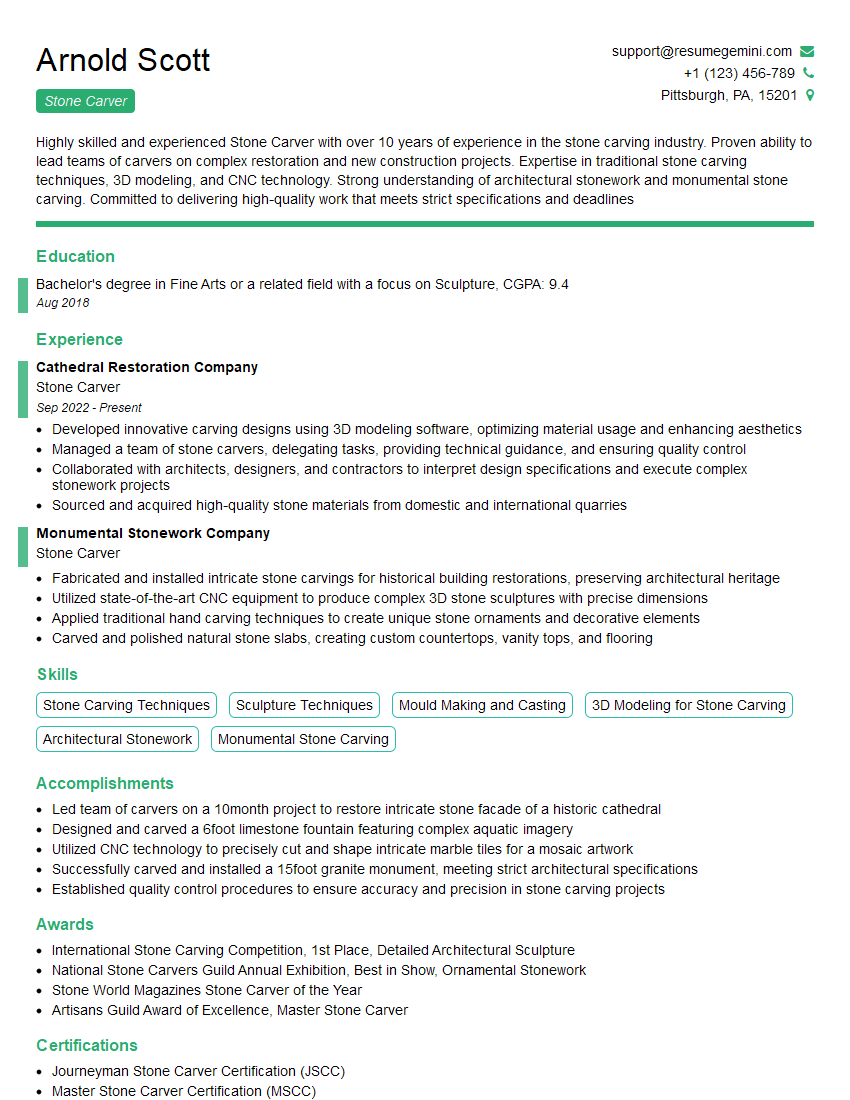
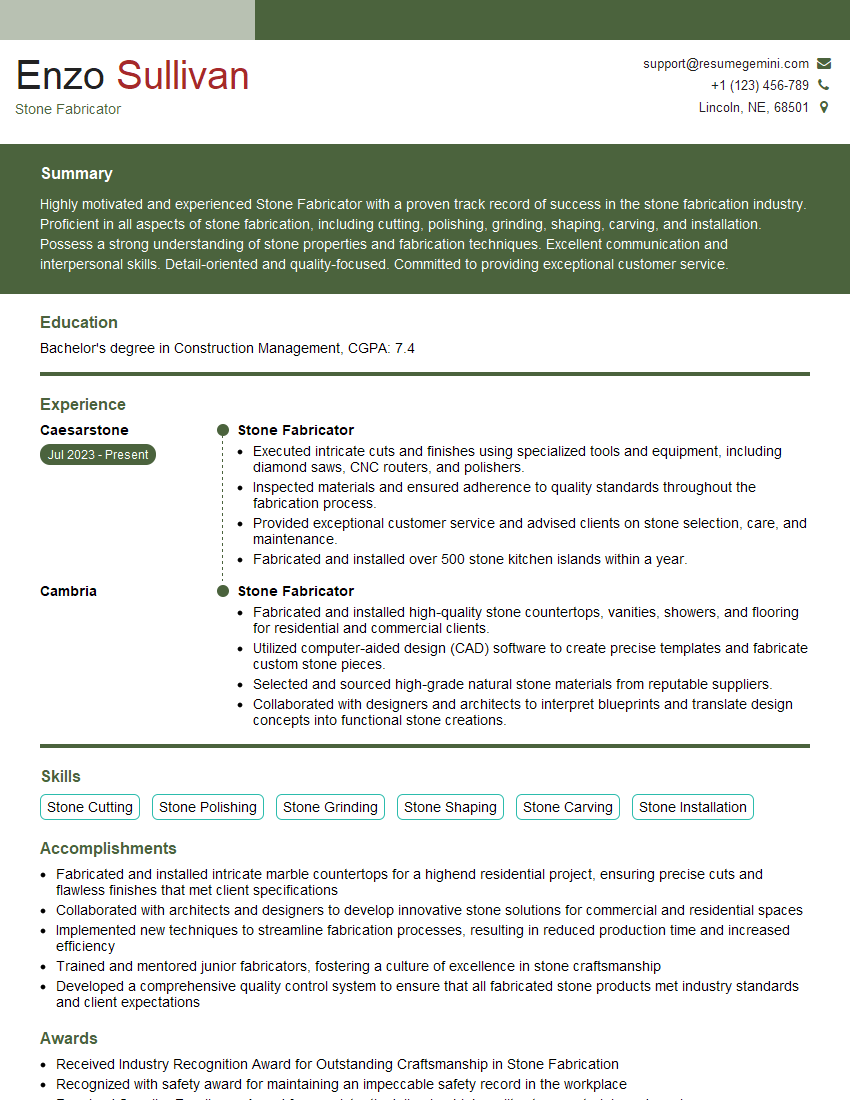
Mastering Stone Cutting and Fabrication opens doors to a rewarding career with diverse opportunities for growth and specialization. To maximize your job prospects, creating a strong, ATS-friendly resume is crucial. ResumeGemini is a trusted resource that can help you build a professional and impactful resume tailored to your skills and experience. Examples of resumes specifically designed for Stone Cutting and Fabrication professionals are available to guide you. Invest time in crafting a compelling resume – it’s your first impression on potential employers.


Explore more articles
Users Rating of Our Blogs
Share Your Experience
We value your feedback! Please rate our content and share your thoughts (optional).
What Readers Say About Our Blog
Very informative content, great job.
good