Preparation is the key to success in any interview. In this post, we’ll explore crucial Stone Grinding and Finishing interview questions and equip you with strategies to craft impactful answers. Whether you’re a beginner or a pro, these tips will elevate your preparation.
Questions Asked in Stone Grinding and Finishing Interview
Q 1. What types of stone are you experienced in grinding and finishing?
My experience encompasses a wide range of stones, including but not limited to granite, marble, limestone, travertine, and quartzite. I’ve worked with both domestically sourced and imported stones, each presenting unique challenges in terms of hardness, porosity, and grain structure. For instance, granite, known for its hardness, requires different techniques compared to the more porous nature of marble. Understanding these inherent properties is crucial for selecting the appropriate grinding and finishing methods.
- Granite: High hardness, requires aggressive grinding and polishing.
- Marble: Softer, more susceptible to scratching, requires gentler techniques.
- Limestone: Porous, requires careful attention to prevent staining.
Q 2. Describe your experience with different grinding techniques (e.g., wet grinding, dry grinding).
Wet grinding and dry grinding are two fundamental techniques, each with its own advantages and disadvantages. Wet grinding, which involves using water as a lubricant, is generally preferred for its ability to reduce dust, prolong the life of abrasives, and produce a cooler, cleaner cut. It’s particularly useful for softer stones like marble, where dry grinding could lead to excessive heat and damage. Dry grinding, on the other hand, is sometimes used for harder stones, especially when working outdoors or in areas where water is limited. However, it produces significantly more dust and requires robust dust collection systems.
My experience includes proficiency in both techniques. I select the appropriate technique based on factors like stone type, desired finish, environmental conditions, and the available equipment.
Q 3. What are the common abrasives used in stone grinding and polishing, and how do you select the appropriate one?
A wide array of abrasives is used in stone grinding and polishing, each with different grit sizes to achieve various levels of smoothness. Common abrasives include diamond, silicon carbide, and aluminum oxide. Diamond abrasives are the hardest and are typically used for the initial grinding stages on harder stones like granite. Silicon carbide is a versatile abrasive suitable for both coarse and fine grinding on a variety of stones. Aluminum oxide is often used in the later stages of polishing for a finer finish.
Selecting the appropriate abrasive involves considering several factors: the type of stone, the desired level of finish, and the stage of the process. For example, a coarse diamond grit would be used for initial shaping and grinding of granite, while finer diamond or silicon carbide grits would be used for subsequent stages leading up to polishing. Experience and a thorough understanding of stone properties guide this selection process.
Q 4. Explain the process of achieving a high-gloss finish on granite.
Achieving a high-gloss finish on granite is a multi-step process that requires precision and attention to detail. It typically involves the following steps:
- Initial Grinding: Using coarse diamond abrasives to remove imperfections and level the surface.
- Intermediate Grinding: Progressively finer diamond grits are used to refine the surface and remove scratches from the previous stages.
- Polishing: Finer abrasives, often in the form of polishing compounds, are used to achieve the desired high gloss. This stage usually involves several steps, using progressively finer polishing compounds.
- Buffing: A final buffing step with a very fine polishing compound or a soft cloth helps to eliminate any remaining fine scratches and enhance the shine.
The entire process involves careful control of factors like water flow, abrasive pressure, and machine speed to prevent heat buildup and damage.
Q 5. How do you identify and address common defects during the stone grinding and finishing process?
Identifying and addressing defects during stone grinding and finishing requires a keen eye and a thorough understanding of the process. Common defects include scratches, pitting, staining, and uneven surfaces. These defects can arise from various sources, including improper abrasive selection, excessive pressure, inadequate water lubrication, or the presence of contaminants in the stone itself.
Addressing these defects requires a methodical approach. Scratches can be removed by re-grinding with finer abrasives. Pitting may require filling and re-polishing. Staining may necessitate specialized cleaning or sealing techniques. Uneven surfaces require careful re-grinding to achieve a uniform finish. Prevention is key; meticulous attention to detail during each stage can significantly reduce the occurrence of defects.
Q 6. What safety precautions do you take when operating grinding and polishing equipment?
Safety is paramount in stone grinding and finishing. Operating grinding and polishing equipment requires adherence to strict safety protocols. These include:
- Eye protection: Safety glasses or face shields are essential to prevent eye injuries from flying debris.
- Respiratory protection: Dust masks or respirators are needed to protect against inhaling stone dust, especially during dry grinding.
- Hearing protection: Earplugs or earmuffs are crucial to mitigate noise exposure.
- Proper clothing: Protective clothing, such as long sleeves and sturdy gloves, should be worn to prevent cuts and abrasions.
- Machine safety: Ensuring machines are properly maintained and operated according to manufacturer’s instructions is crucial.
Regular machine inspections and adherence to all safety guidelines are critical to preventing accidents and ensuring a safe working environment.
Q 7. What experience do you have with different types of polishing compounds?
My experience encompasses a range of polishing compounds, from diamond polishing compounds used in earlier stages of polishing to cerium oxide and other fine polishing compounds used for achieving a high-gloss finish. Diamond polishing compounds come in various grit sizes, providing a graded approach to achieving smoothness. Cerium oxide is particularly effective in producing a brilliant shine on granite and marble. The choice of polishing compound is carefully considered based on the stone type and the desired level of gloss.
I also have experience with various formulations and brands of polishing compounds, each possessing unique properties regarding effectiveness, application method, and overall finishing results. Understanding these nuances is vital in selecting the optimal compound for specific situations.
Q 8. How do you ensure consistent quality and finish throughout a large project?
Maintaining consistent quality and finish across a large stone project requires meticulous planning and execution. Think of it like baking a large wedding cake – each layer needs to be identical to achieve the final masterpiece. We start with rigorous quality control of the raw materials, ensuring consistent color, density, and texture within each batch. This is crucial because variations in the stone itself will directly impact the final finish.
- Detailed Project Plans: We create comprehensive plans outlining the specific grinding and polishing steps for each section, including the type of abrasive, the pressure applied, and the duration of each stage. This ensures uniformity across the entire project.
- Calibration and Maintenance: Regular calibration and preventative maintenance of all equipment are non-negotiable. A poorly calibrated grinder can lead to uneven surfaces and inconsistencies in the final polish. We meticulously check equipment before each session.
- Skilled Personnel: Our team undergoes extensive training on consistent techniques. We emphasize visual inspection and tactile feedback – experienced hands can often detect minor inconsistencies that machines might miss. Regular training sessions and quality checks ensure everyone maintains high standards.
- Sample Panels: We often create sample panels to test different techniques and materials before applying them to the main project. This allows us to fine-tune our process and address any unforeseen challenges early on.
By implementing these methods, we minimize variations and ensure a consistently high-quality finish throughout even the most extensive projects.
Q 9. Describe your experience with CNC stone machinery.
My experience with CNC stone machinery spans over 10 years, encompassing various models and applications. I’m proficient in programming and operating CNC routers, waterjet cutters, and 5-axis CNC polishing machines. I’ve used these machines for everything from intricate detailing on countertops to large-scale projects involving the creation of complex three-dimensional stone sculptures.
For instance, on a recent project involving a large mosaic wall, the CNC waterjet cutter allowed us to precisely cut intricate shapes from various marble slabs with incredible accuracy and speed, far exceeding the capabilities of manual cutting. Later, a 5-axis CNC polishing machine ensured a uniform and flawless finish across all pieces. Understanding the capabilities and limitations of each machine is key to leveraging its full potential. This includes knowing how different bit types and parameters affect the surface texture and precision of the cut or polish.
Beyond operation, I’m familiar with the maintenance and troubleshooting procedures for these machines, including routine checks, tool changes, and addressing any software or mechanical issues that may arise.
Q 10. Explain the process of edge profiling and shaping.
Edge profiling and shaping is a crucial aspect of stone finishing, adding aesthetic appeal and functionality. It involves creating specific shapes and profiles along the edges of stone slabs or pieces, often using specialized tooling and machinery. Think of it as adding the perfect finishing touch to a beautifully cut gemstone.
- Selection of Profile: The desired profile is chosen based on the overall design and intended use. Common profiles include eased edges, bevels, bullnoses, ogees, and cove edges. Each offers a unique aesthetic.
- Machining: This is generally done with CNC routers or automated edge profilers equipped with diamond tooling. The precise control offered by these machines ensures consistent and accurate shaping across all pieces.
- Manual Finishing: Often, a finishing touch using hand tools like diamond grinders or polishing pads is needed to refine the edge profile, smooth out imperfections, and achieve the desired finish. This is where the craftsman’s touch ensures perfection.
- Safety Considerations: Appropriate safety precautions, including the use of personal protective equipment (PPE), are paramount when working with high-speed machinery and sharp diamond tools.
The entire process demands precision and skill, as even minor inconsistencies can detract from the overall visual appeal. For example, a slightly uneven bullnose on a countertop can be noticeable and affect the quality perception of the entire job.
Q 11. What are the differences between honing, polishing, and buffing?
Honing, polishing, and buffing are sequential steps in the stone finishing process, each using progressively finer abrasives to achieve a smoother, glossier surface. Imagine smoothing a rough stone down to a mirror shine.
- Honing: This is the initial step, using relatively coarse abrasives to remove scratches and level the stone surface. It produces a matte or satin finish.
- Polishing: Following honing, polishing involves finer abrasives to create a higher gloss. This stage refines the surface, reducing the scratches left by honing and increasing the shine.
- Buffing: The final step, buffing utilizes very fine abrasives or polishing compounds to achieve the highest level of gloss and enhance the luster. It minimizes micro-scratches, improving clarity and reflectivity.
The difference between them lies in the grit size of the abrasives used and the resulting surface finish. Honing creates a less shiny finish, while polishing and buffing progressively increase the gloss, with buffing producing the highest degree of shine.
Q 12. How do you repair minor scratches and imperfections in stone surfaces?
Repairing minor scratches and imperfections in stone surfaces involves a meticulous process depending on the severity of the damage and the type of stone. It’s like carefully restoring a chipped piece of artwork.
- Assessment: The first step is to carefully assess the damage, determining its depth and extent. Minor scratches can often be addressed with polishing, whereas deeper scratches or chips may require more extensive repair.
- Cleaning: Thorough cleaning of the affected area is essential to remove dirt, debris, or any existing sealants that might hinder the repair process. This ensures a clean working surface.
- Abrasive Materials: For minor scratches, targeted polishing with progressively finer abrasives, starting with coarser grits and gradually moving to finer ones, can often effectively remove the imperfections.
- Fillers: For more severe damage, such as chips or cracks, color-matched resinous or epoxy fillers may be necessary. These are applied to fill the void, carefully matched to the stone’s color. Once cured, the filled area is then ground and polished to blend seamlessly with the surrounding surface.
The key to successful repair is precision and patience. The goal is to make the repair virtually invisible, restoring the stone’s original appearance and integrity.
Q 13. What is your experience with resinous and epoxy fillers in stone restoration?
Resinous and epoxy fillers are invaluable tools in stone restoration, allowing us to repair chips, cracks, and other imperfections. Think of them as specialized adhesives tailored for stone.
Resinous fillers are typically used for smaller imperfections, offering good adhesion and color matching capabilities. Their lower viscosity often makes them ideal for filling hairline cracks or minor chips. Epoxy fillers are generally stronger and more durable, suitable for larger repairs and areas subject to stress. They offer excellent bonding strength and can be used to consolidate damaged areas.
Choosing the right filler depends on the specific needs of the repair. The selection is often guided by the stone’s properties, the size and depth of the damage, and the desired outcome. Proper mixing and curing are essential to ensure a strong and durable repair. After filling, the area needs careful grinding and polishing to achieve a seamless blend with the surrounding stone. I’ve used both extensively in a variety of projects from repairing minor chips in granite countertops to stabilizing significant cracks in marble statues. Experience dictates the proper filler and application method to achieve an invisible repair.
Q 14. How do you maintain and troubleshoot grinding and polishing equipment?
Maintaining and troubleshooting grinding and polishing equipment is crucial for ensuring optimal performance and longevity. It’s similar to maintaining a high-performance vehicle; regular maintenance prevents major problems and extends lifespan.
- Regular Inspections: Routine visual inspections are conducted to detect any signs of wear, damage, or loose components. This includes checking belts, bearings, motors, and cooling systems.
- Preventative Maintenance: We adhere to strict schedules for preventative maintenance, which includes lubrication, cleaning, and replacing worn parts before they fail. This minimizes downtime and prevents costly repairs.
- Abrasive Management: Proper storage and handling of abrasive materials are essential to prevent contamination and extend their life. Using the correct abrasive for the job is also crucial for efficient and effective grinding and polishing.
- Troubleshooting: When issues arise, a systematic approach is used to identify and resolve the problem. This might involve checking electrical connections, motor performance, water flow (for water-cooled machines), or the condition of the abrasive pads or tools.
- Documentation: We maintain detailed records of maintenance activities, repairs, and any problems encountered. This helps track the equipment’s history and facilitates troubleshooting.
By prioritizing maintenance and developing problem-solving skills, we keep our equipment running smoothly, leading to increased productivity and ensuring high-quality results. A well-maintained machine is essential for consistent and high-quality work.
Q 15. Describe your experience with different types of stone sealers and protectants.
Selecting the right stone sealer is crucial for preserving the beauty and longevity of a stone surface. My experience encompasses a wide range of sealers, categorized primarily by their chemical composition and intended effect. For example, penetrating sealers, often solvent-based, soak into the stone, protecting it from within while allowing it to breathe. These are ideal for porous stones like limestone or sandstone. Conversely, surface sealers, like acrylics or topical sealants, form a film on the surface, offering excellent protection against staining and abrasion, particularly suitable for polished marble or granite. I’ve also worked extensively with enhancing sealers that not only protect but also deepen the stone’s color and enhance its natural beauty. The choice depends heavily on the stone type, its porosity, the desired level of protection, and the expected wear and tear.
Furthermore, I consider factors like the environment the stone will be exposed to (e.g., high traffic areas, outdoor applications) when making a recommendation. For instance, a high-traffic commercial space might require a more durable, abrasion-resistant sealer than a residential bathroom. I also account for potential maintenance requirements; some sealers require periodic reapplication while others boast longer-lasting protection. My experience includes testing sealers for water absorption, stain resistance, and durability using standardized industry tests to ensure the optimal choice for each project.
Career Expert Tips:
- Ace those interviews! Prepare effectively by reviewing the Top 50 Most Common Interview Questions on ResumeGemini.
- Navigate your job search with confidence! Explore a wide range of Career Tips on ResumeGemini. Learn about common challenges and recommendations to overcome them.
- Craft the perfect resume! Master the Art of Resume Writing with ResumeGemini’s guide. Showcase your unique qualifications and achievements effectively.
- Don’t miss out on holiday savings! Build your dream resume with ResumeGemini’s ATS optimized templates.
Q 16. How do you determine the appropriate level of gloss or sheen for a given project?
Determining the appropriate gloss level is a crucial aesthetic and functional decision. The desired sheen depends heavily on the project’s context, the stone type, and the client’s preference. A highly polished, high-gloss finish, achieved through extensive polishing, is often preferred for elegant applications such as high-end countertops or feature walls. It enhances the stone’s color and reveals its veining beautifully. However, it can also be more prone to scratching and showing fingerprints.
Conversely, a matte or honed finish, which has a low to no gloss, is often chosen for outdoor applications or areas where slip resistance is paramount (like bathroom floors), or for a more understated, contemporary look. A satin or semi-gloss finish offers a middle ground – it provides enough shine to enhance the stone’s beauty without being overly glossy or susceptible to showing imperfections. I often discuss these options visually with clients, presenting samples with different finishes to help them visualize the final look. The process often involves balancing the aesthetic preferences with the practical considerations of the space.
Q 17. What is your experience with measuring flatness and surface irregularities?
Precise measurement of flatness and surface irregularities is critical for ensuring a high-quality finish in stone grinding and polishing. I utilize a variety of tools and methods, from simple levels and straight edges for initial assessments to more sophisticated laser-based surface profilers for detailed analysis. Straight edges help check for larger deviations from flatness. Laser profilers allow me to measure microscopic variations in surface elevation, ensuring the surface is not only flat but also consistently smooth.
For larger projects, I might even create a 3D surface map to identify areas requiring more attention during the grinding and polishing process. The accuracy of these measurements dictates the success of the project. Any significant imperfections must be addressed before polishing to prevent uneven wear and tear or a compromised final look. The chosen method is tailored to the project’s scale and the required level of precision; a small countertop requires less rigorous measurement than, say, a large floor installation.
Q 18. How do you handle challenging stone materials that are difficult to grind or polish?
Handling challenging stone materials requires a deep understanding of their properties and an adaptable approach. Some stones, like quartzite or certain types of granite, are notoriously difficult to grind and polish due to their hardness and abrasive resistance. I address such challenges through careful selection of abrasives, employing multiple stages with progressively finer grits. I may also adjust the grinding parameters, like speed and pressure, to minimize damage and maximize efficiency. Understanding the grain structure of the stone is essential – grinding along the grain often yields better results than grinding across it.
In cases with particularly stubborn materials, diamond tooling is often employed, owing to its superior hardness and cutting ability. I might utilize specialized diamond pads or tools designed for these specific types of stone. Careful monitoring of the grinding process is crucial, observing for any signs of chipping or cracking. In some situations, pre-treatments, such as the use of specific chemicals to soften the stone surface or to enhance its structure may be required. The key is patience and persistence, coupled with an iterative approach, adapting techniques based on the stone’s unique response to the grinding and polishing process.
Q 19. What experience do you have with working from blueprints and detailed specifications?
Working from blueprints and detailed specifications is fundamental to my work. I thoroughly review these documents to fully understand the project scope, stone type, desired finish, and tolerances. This includes understanding the scale drawings for large projects, checking for detailed finish specifications for specific areas, and confirming the stone’s dimensions. Careful attention is paid to any notes or specific requirements, such as the placement of seams or cutouts.
For example, if the blueprint specifies a specific bevel on the edge of a countertop, I ensure that this is accurately reflected in the final product. I cross-reference the specifications with material samples to verify that the stone chosen meets the required standards and characteristics. This meticulous approach prevents misunderstandings and ensures the finished product aligns precisely with the client’s and designer’s vision. Any ambiguities are clarified before commencing work to avoid costly mistakes down the line.
Q 20. How do you calculate the amount of abrasives needed for a specific project?
Calculating abrasive consumption requires careful estimation, taking into consideration several factors. The primary factors are the stone’s type and its surface area, the desired finish (rough, honed, polished), and the existing condition of the stone surface. A rough stone requires more abrasives than a polished one. Larger projects will obviously need more abrasives than smaller projects. Moreover, the hardness of the stone will affect the rate of abrasive wear – harder stones may cause faster wear on the abrasives.
I typically use a combination of experience-based estimates and calculations based on the project’s square footage. I often utilize historical data from similar projects to refine these calculations. For example, I might know from past experience that a certain type and quantity of diamond pads are needed to achieve a specific level of polish on a particular type of granite per square foot. This data allows for relatively accurate predictions, although I always include a safety margin to account for unforeseen circumstances. The more experience one has, the better they become at accurately calculating the amount of abrasives needed.
Q 21. What is your familiarity with dust collection and environmental regulations?
Dust collection and adherence to environmental regulations are paramount in stone grinding and finishing. The process generates significant amounts of fine stone dust, which can pose respiratory hazards and environmental concerns. I’m fully familiar with relevant OSHA and local environmental regulations pertaining to dust control and disposal. This includes understanding permissible exposure limits (PELs) for various types of stone dust and appropriate personal protective equipment (PPE).
On every project, we utilize high-efficiency particulate air (HEPA) filtration systems to capture and contain the majority of the dust. This includes specialized vacuum systems, dust containment enclosures, and local exhaust ventilation. We also follow strict protocols for waste disposal, properly classifying and disposing of the stone dust in accordance with all applicable regulations. I am meticulous about maintaining these systems and regularly inspect them to ensure optimal performance, minimizing both environmental impact and health risks to workers and the surrounding area. Regular maintenance and updates on changing regulations are crucial for responsible and legal operation.
Q 22. Explain the process of calibrating and maintaining grinding wheels.
Calibrating and maintaining grinding wheels is crucial for achieving consistent surface finishes and preventing damage to both the wheel and the stone. It’s like keeping a chef’s knife razor-sharp – precision is paramount.
Calibration involves ensuring the wheel is perfectly balanced and true. An unbalanced wheel vibrates, leading to uneven grinding. This is typically done using a wheel dresser, a tool that removes small amounts of material from the wheel’s surface to correct imperfections. We use a variety of dressers depending on the wheel type and material being ground – diamond dressers for harder materials, and silicon carbide for softer ones. After dressing, the wheel should spin freely and smoothly without any noticeable wobble.
Maintenance includes regular cleaning to remove embedded stone particles and debris. A clogged wheel is less effective and can lead to scratching. We use compressed air or a wire brush for cleaning, being mindful of the wheel’s structural integrity. Proper storage is also critical; wheels should be protected from moisture and extreme temperature fluctuations to avoid cracking or warping. Regular inspection for wear and tear is essential – a worn wheel won’t perform efficiently and needs to be replaced before it becomes a safety hazard.
For example, when working with granite, we might use a diamond dresser to create a precise profile on the grinding wheel before each project, and then use a wire brush to clean the wheel after each use, ensuring optimal performance and surface quality.
Q 23. How do you manage multiple projects simultaneously and prioritize tasks effectively?
Managing multiple stone grinding projects effectively requires a structured approach. I employ a project management methodology that balances prioritization and efficient task allocation. I utilize project management software to track deadlines, resource allocation, and project status updates for each project.
Prioritization is based on several factors: deadlines, client urgency, complexity of the project, and the potential impact of delays. I use a combination of the Eisenhower Matrix (urgent/important) and a weighted scoring system to rank projects and tasks. This ensures that critical tasks receive immediate attention, while less urgent tasks are scheduled strategically.
For instance, I might prioritize a high-value project with a tight deadline over a smaller project, even if the smaller project is already underway. This ensures timely delivery for high-priority clients and avoids potential penalties for missed deadlines.
Q 24. Describe your experience working as part of a team.
I thrive in collaborative environments. Throughout my career, I’ve consistently worked effectively as part of a team, contributing my expertise while actively listening to and learning from my colleagues. My experience includes collaboration with fabricators, designers, and other stone specialists.
In one instance, we faced a challenge with a complex marble installation requiring intricate cuts and polishing. The team, which included experienced installers and a master polisher, collaborated closely, leveraging each individual’s strengths. I contributed my expertise in grinding techniques to achieve a flawless finish. Open communication, mutual respect, and a shared commitment to excellence were key to our success. The result was a stunning installation, completed on time and exceeding client expectations.
Q 25. Describe your problem-solving skills related to stone grinding and finishing.
Problem-solving is integral to stone grinding and finishing. I approach challenges systematically, combining theoretical knowledge with practical experience. My process typically involves:
- Identifying the problem: Careful observation and analysis of the stone’s surface, including assessing the type of stone, the defects, and the tools used.
- Identifying potential causes: Considering factors such as improper grinding technique, tool wear, material inconsistencies, and environmental conditions.
- Developing solutions: Experimenting with different grinding wheels, adjusting techniques, or employing supplementary processes like honing or polishing to address the specific issue.
- Testing and refining: Implementing the chosen solution and evaluating the results. Iterative adjustments are often necessary to achieve the desired outcome.
For example, if I encounter pitting on a limestone surface, I’d investigate whether it’s due to aggressive grinding, an unsuitable wheel, or inherent flaws in the stone. I might then adjust the grinding pressure, change to a softer wheel, or implement a targeted polishing process to smooth the surface. This methodical approach ensures that I effectively address the underlying cause rather than just masking the symptoms.
Q 26. How do you handle customer complaints or issues with a finished product?
Handling customer complaints is a critical aspect of the job. I believe in proactive communication and transparency. When a complaint arises, my approach is to:
- Listen empathetically: Understanding the customer’s perspective is paramount.
- Investigate thoroughly: Examine the finished product to pinpoint the cause of the issue.
- Offer a solution: Depending on the nature of the problem, this might involve reworking the piece, providing a partial refund, or offering a replacement.
- Maintain professionalism: Throughout the process, I maintain a calm and courteous demeanor, reassuring the customer that their concern is valued.
For example, if a customer complains about uneven polishing on a countertop, I would examine the surface, discuss the possibilities (e.g., inconsistencies in the stone itself, a slightly flawed polishing process), and offer a solution that satisfies the client, perhaps by re-polishing the specific area or offering a small discount on a future service.
Q 27. What are the common causes of pitting or uneven surfaces in stone?
Pitting and uneven surfaces in stone can stem from various factors, many of which are avoidable with proper techniques and equipment maintenance. Some common causes include:
- Improper grinding techniques: Too much pressure, incorrect wheel selection, or inconsistent movements can all cause pitting and unevenness.
- Worn or damaged grinding wheels: A damaged wheel can leave uneven marks or create small pits in the stone surface.
- Inconsistent stone properties: Variations in the stone’s density or hardness can make certain areas more prone to damage during grinding.
- Contaminants in the grinding process: Grit or other debris in the grinding process can leave scratches or pits.
- Inadequate cooling: Overheating during grinding can cause cracks and pitting, especially in more sensitive stone types.
For instance, excessive pressure while grinding marble with a coarse diamond wheel can create pitting. Similarly, using a wheel that’s too coarse for a delicate stone like travertine can result in unevenness. Understanding these factors is key to preventative measures.
Q 28. What are your future career goals related to stone grinding and finishing?
My future career goals center around continuous improvement in stone grinding and finishing techniques, and sharing my knowledge. I aim to stay abreast of the latest advancements in machinery, materials, and techniques. This includes exploring the use of new generation polishing compounds and researching sustainable and environmentally friendly processes within the industry. I’m also interested in mentoring and training others, passing on my expertise to the next generation of stone artisans.
Ideally, I envision a role where I can combine my practical skills with a leadership position, perhaps managing a team of stone finishers or contributing to the development of innovative grinding techniques. My long-term goal is to contribute to the advancement of the field, enhancing both the quality of workmanship and the sustainability of the industry.
Key Topics to Learn for Stone Grinding and Finishing Interview
- Stone Selection and Preparation: Understanding the properties of different stone types (granite, marble, limestone, etc.) and their suitability for various finishing techniques. This includes assessing stone quality and identifying potential issues before processing.
- Grinding Techniques: Mastering various grinding methods, including dry and wet grinding, the use of different abrasives (diamond, silicon carbide), and understanding the impact of grit size on surface finish. Practical application includes knowing when to switch grits for optimal results.
- Polishing and Honing: Understanding the process of achieving high-gloss finishes using polishing compounds and techniques. This also includes knowledge of honing techniques to create a smooth, even surface prior to polishing.
- Equipment Operation and Maintenance: Familiarity with various grinding and polishing machines (e.g., bridge saws, edge polishers, automatic polishing lines), their operation, safety procedures, and routine maintenance to ensure optimal performance and longevity.
- Surface Finishing Techniques: Understanding different surface finishes (e.g., honed, polished, satin, flamed) and the techniques required to achieve them. This includes recognizing the desired finish and adjusting techniques accordingly.
- Quality Control and Inspection: Knowing how to inspect finished stone for defects, ensuring consistency in finish across batches, and understanding quality control measures to meet customer specifications.
- Health and Safety: Understanding and adhering to all safety regulations and procedures related to stone grinding and finishing, including the use of personal protective equipment (PPE).
- Problem-Solving and Troubleshooting: Developing the ability to identify and resolve common problems encountered during the grinding and finishing process, such as uneven surfaces, scratches, or discoloration.
Next Steps
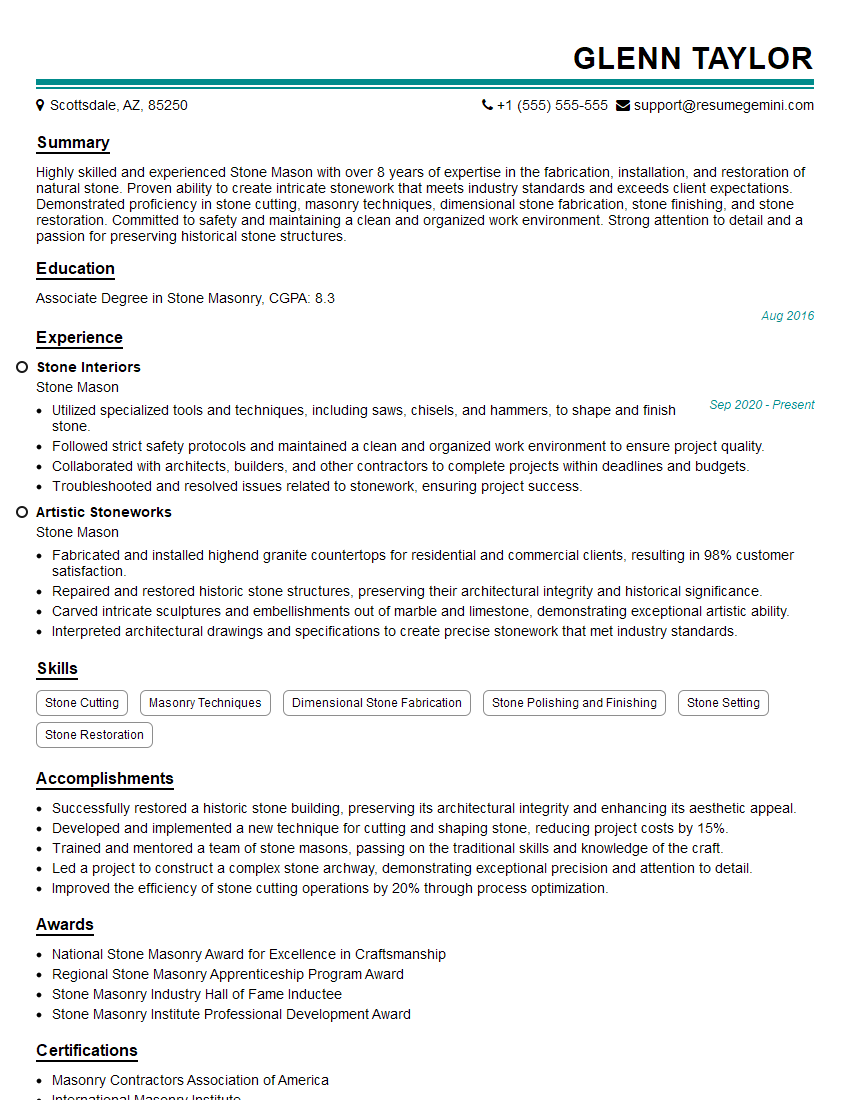
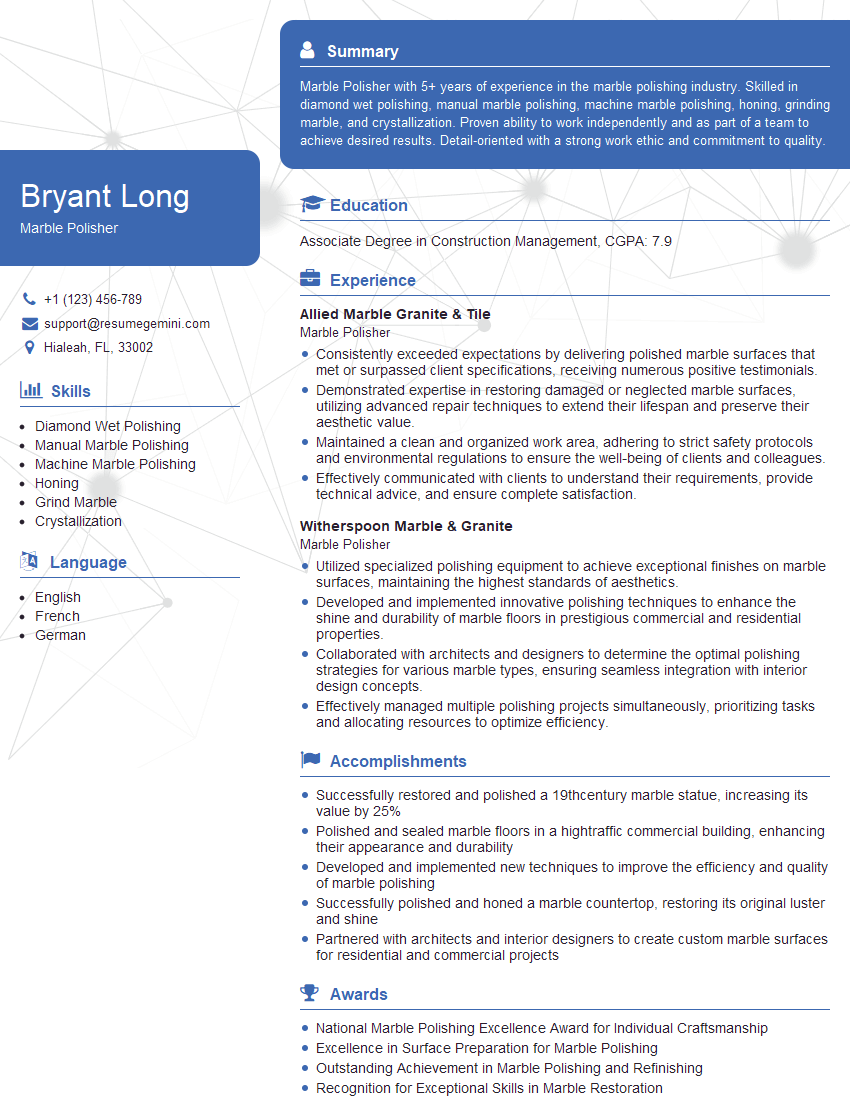
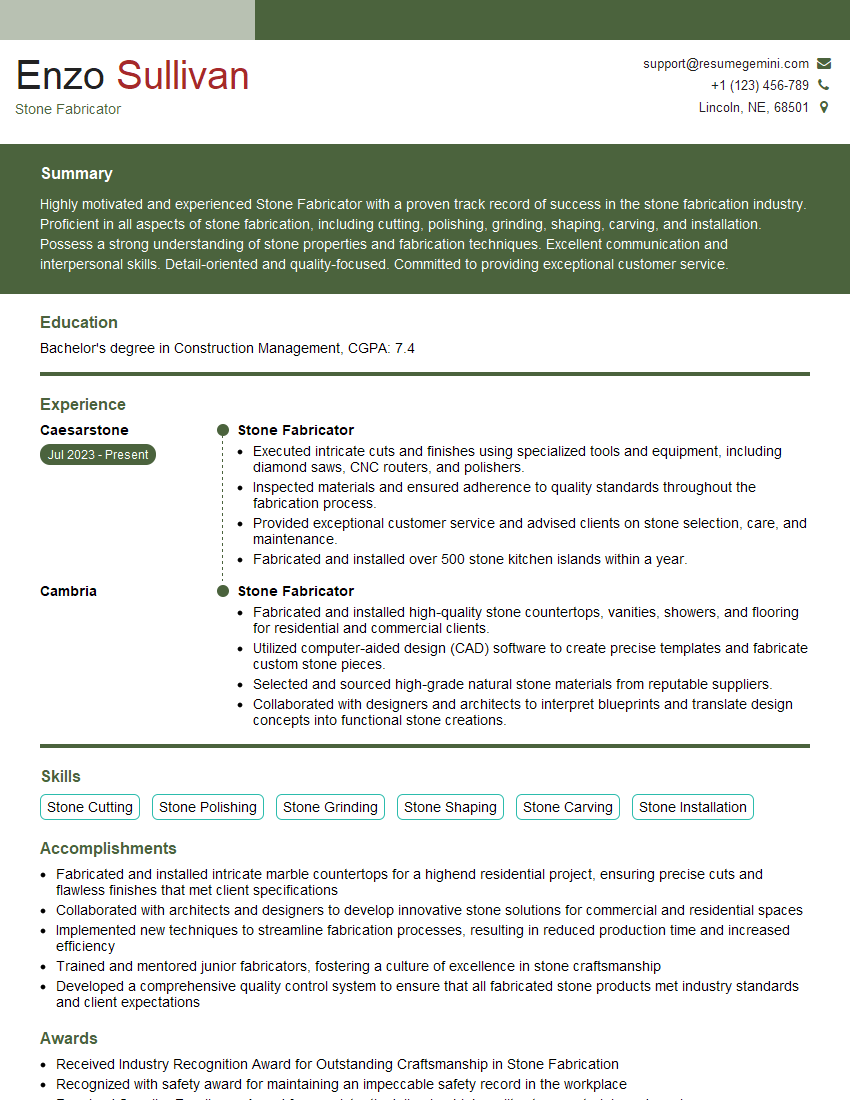
Mastering Stone Grinding and Finishing opens doors to rewarding careers with excellent growth potential in the construction, design, and manufacturing industries. To maximize your job prospects, a well-crafted, ATS-friendly resume is crucial. ResumeGemini is a trusted resource to help you build a professional and impactful resume that highlights your skills and experience effectively. Examples of resumes tailored to Stone Grinding and Finishing are available to guide you. Take the next step in your career journey – build a resume that showcases your expertise and lands you your dream job.



Explore more articles
Users Rating of Our Blogs
Share Your Experience
We value your feedback! Please rate our content and share your thoughts (optional).
What Readers Say About Our Blog
Very informative content, great job.
good