The thought of an interview can be nerve-wracking, but the right preparation can make all the difference. Explore this comprehensive guide to Straight Sewing interview questions and gain the confidence you need to showcase your abilities and secure the role.
Questions Asked in Straight Sewing Interview
Q 1. What types of straight stitches are you familiar with?
Straight stitch sewing machines primarily create one type of stitch: the straight stitch itself. However, variations exist depending on stitch length and the machine’s capabilities. These variations subtly alter the appearance and strength of the stitch, allowing for adaptation to different fabrics and sewing projects. You might encounter adjustments labelled as ‘normal’, ‘fine’, or ‘medium’ straight stitch, referring to the density or closeness of the stitches.
- Normal Straight Stitch: This is your standard stitch, ideal for most general sewing projects.
- Fine Straight Stitch: Used for delicate fabrics where a tighter, more refined stitch is needed to avoid damage.
- Medium Straight Stitch: A balance between the normal and fine stitches, often used for medium-weight fabrics.
Beyond these general types, some machines offer decorative straight stitches which subtly alter the stitch formation through variations in stitch length and spacing. Think of them as adding a touch of subtle texture.
Q 2. Explain the difference between a lockstitch and a chainstitch.
The key difference between a lockstitch and a chainstitch lies in how the threads interlock to form the stitch. Imagine building a wall: a lockstitch is like carefully interweaving bricks, while a chainstitch is more like linking paperclips together.
Lockstitch: This is the workhorse of straight stitch machines. The needle thread interlocks with the bobbin thread in a series of loops, forming a strong, secure stitch that’s equally strong on both sides of the fabric. This is reversible, meaning the stitch looks essentially the same from both the front and the back. Think of denim jeans – their durability relies heavily on the lockstitch.
Chainstitch: This type forms a series of interlocking loops of thread from the needle thread only. The bobbin thread isn’t involved in the interlacing process. It’s less durable than a lockstitch because it can easily unravel if a single loop breaks. While it is quicker, it’s rarely used in garment construction due to its lack of strength and tendency to easily fray.
Q 3. How do you adjust stitch length and tension on a straight stitch machine?
Adjusting stitch length and tension is crucial for achieving a professional finish. Most straight stitch machines have dedicated dials or controls for each.
Stitch Length: This is usually controlled by a dial marked with numbers representing stitches per inch (SPI). A lower number means longer stitches, while a higher number indicates shorter stitches. For example, a setting of 2.5 might be perfect for a seam allowing for stretch, while 12 SPI might be better for a more durable, less stretchy seam. Experimentation is key to find the right length for your fabric and project.
Tension: This dial typically ranges from 0 to 9. It controls how tightly the needle thread and bobbin thread interlock. Too loose, and the stitches will be loose and easily pulled apart. Too tight, and it could cause puckering or breakage. Start with a setting of 4 or 5 as a baseline and adjust as needed, observing the stitch formation on a scrap piece of fabric.
Incorrect tension can lead to puckering, skipped stitches, or the threads bunching on the underside of your fabric. The best way to master this is through practice and close observation.
Q 4. Describe the process of threading a straight stitch sewing machine.
Threading a straight stitch sewing machine might seem daunting, but it becomes second nature with practice. The process generally involves these steps (note that specifics vary slightly between machine models; always refer to your machine’s manual):
- Raise the presser foot and needle: This gives you clear access to the threading path.
- Wind the bobbin: Ensure you have a correctly wound bobbin; this is the foundation of a good stitch.
- Insert the bobbin: Place the bobbin in its designated case and close the cover.
- Thread the needle: Following the threading diagram, carefully guide the thread through the tension disks, take-up lever, and ultimately, into the needle. Some machines might have separate thread guides for each step.
- Test the stitch: Always stitch on a scrap fabric to check stitch quality before starting your project.
If you encounter issues, review your machine’s manual. Sometimes a simple mistake like a slightly misplaced thread can prevent the machine from working.
Q 5. What are common causes of skipped stitches and how do you troubleshoot them?
Skipped stitches are a common frustration, but often have simple solutions. The most frequent causes are:
- Bent or broken needle: This is the most common culprit. Replace the needle immediately.
- Incorrect threading: Double-check that the thread is correctly threaded through all the guides and into the needle. Missing even one step can lead to skipped stitches.
- Incorrect tension: If the tension is too loose or too tight, the threads won’t interlock properly. Adjust the tension dial accordingly.
- Poor quality thread: Using cheap or damaged thread can contribute to skipped stitches. Choose high-quality thread appropriate for your fabric.
- Dirty machine: Lint and debris can obstruct the machine’s internal mechanisms. Regular cleaning is essential.
Troubleshooting: Start by visually inspecting the needle for any damage. If it’s fine, check the threading and tension. Then, clean the machine, paying particular attention to the areas around the needle and bobbin case.
Q 6. How do you identify and repair a broken needle?
Identifying a broken needle is usually straightforward; you’ll often see a visible bend or break in the needle itself. However, a needle might be damaged even without obvious visual cues. This is why a thorough inspection is important.
Identification: Look closely at the needle for any bends, nicks, or breaks, particularly near the eye or point. Skipped stitches, sudden thread breakage, or a loud, unusual sound during stitching could also indicate a damaged needle, even if no visible damage is apparent.
Repair: You cannot repair a broken needle; you must replace it with a new one. Always use the correct needle size and type for your fabric to prevent further damage.
Q 7. How do you maintain and clean a straight stitch sewing machine?
Regular maintenance prolongs the life of your sewing machine and ensures consistent stitch quality. A clean machine is a happy machine!
Cleaning: Regularly brush away lint and dust from the machine’s exterior and interior using a soft brush or compressed air. Carefully remove the bobbin case and clean it thoroughly. Some machines have easily accessible compartments for cleaning lint build-up.
Lubrication: Depending on your machine’s manual, you might need to apply sewing machine oil to the moving parts to reduce friction and wear. Only use oil specifically designed for sewing machines.
Frequency: How often you clean depends on how much you sew. For frequent users, a quick cleaning after each session and a more thorough cleaning every few weeks is a good practice.
Q 8. What safety precautions do you follow when operating a sewing machine?
Safety is paramount when working with sewing machines. Before I even begin, I always ensure the area is well-lit and free of clutter to prevent accidents. I make sure my hands are clear of the needle before starting or stopping the machine. I never reach under the needle while it’s moving. It’s crucial to keep fingers away from moving parts, using a seam ripper for removing stitches instead of trying to pull the fabric away manually. The machine should always be unplugged when making adjustments or performing maintenance. Finally, I always follow the manufacturer’s safety guidelines specific to my machine model.
Think of it like driving a car – you wouldn’t drive recklessly; the same care should be taken with sewing equipment.
Q 9. What types of fabrics are best suited for straight stitch sewing?
The best fabrics for straight stitch sewing are those that are relatively stable and not overly stretchy or delicate. Woven fabrics like cotton, linen, and twill are excellent choices. They hold their shape well and produce clean, even stitches. Medium-weight fabrics generally work best, while very heavy or extremely lightweight fabrics can present challenges.
For example, a crisp cotton is ideal for shirts, while a sturdy linen works well for tote bags. However, I would avoid highly textured fabrics that might snag, or extremely delicate silks, unless I’m using specialized needles and techniques.
Q 10. How do you select the appropriate needle and thread for different fabrics?
Needle and thread selection is crucial for achieving quality stitches. The needle size and type need to match the fabric weight and type. For lightweight fabrics like silk or chiffon, a fine needle (size 60/8 or smaller) and fine thread are necessary to prevent holes. Medium-weight fabrics such as cotton or poplin generally work well with a universal needle (size 70/10 or 80/12) and a corresponding thread weight. Heavier fabrics like denim or canvas may require a heavier needle (size 90/14 or larger) and stronger thread. The needle should also be appropriate for the type of fabric (universal for most woven fabrics, ballpoint for knits). The thread should be the same type, or at least compatible with the needle to prevent breakage or damage.
Imagine trying to sew delicate lace with a heavy-duty needle and thick thread – it would be a disaster! The right needle and thread create a beautiful, even stitch and prevent damage to the fabric.
Q 11. How do you ensure consistent stitch quality throughout a sewing project?
Consistent stitch quality relies on several factors. First, ensure your machine is properly threaded and the tension is correctly adjusted. Test your stitch length and tension on a scrap of the same fabric before starting the project. Maintain a steady and even speed while sewing, avoiding jerky movements. Properly guide the fabric through the machine, preventing pulls or wrinkles. Keep the fabric taut, but don’t stretch it excessively. Regular maintenance of your machine, including cleaning and oiling, is essential for optimal performance.
Think of it as writing a perfectly straight line – you need a steady hand, the right tool (the pen), and the right surface (the paper). The same principles apply to sewing.
Q 12. Describe your experience with different types of sewing machine feet.
I have extensive experience with various sewing machine feet. The general-purpose foot is my go-to for straight stitching and most basic projects. For more specialized tasks, I use zipper feet for installing zippers, buttonhole feet for creating buttonholes, and walking feet for handling multiple layers of fabric or slippery materials. I’ve also worked with rolled-hem feet for creating delicate rolled hems and edge stitching feet for precise edge work. Each foot has its own design and function, maximizing efficiency and achieving a clean finish.
Each foot is like a specialized tool – selecting the correct one is crucial for the job’s efficiency and quality.
Q 13. How do you handle fabric wrinkles or puckering while sewing?
Wrinkles and puckering are common problems in sewing. To prevent them, I pre-press the fabric before starting. I ensure that the fabric is smoothly fed into the machine without pulling or stretching. I use pins strategically, removing them just before the needle reaches them. For tricky fabrics, I might use a walking foot to help distribute tension evenly. I also adjust the stitch length and tension to suit the fabric and ensure it’s not pulling or bunching. If puckering occurs, I may need to adjust the machine’s tension or use a lighter weight of thread.
Think of it like painting a smooth wall – you wouldn’t try to paint a textured surface without preparing it first. Similar preparation is needed for fabrics to avoid wrinkles.
Q 14. Explain the importance of proper seam allowance.
Proper seam allowance is essential for several reasons. It provides stability to the seam, allowing for easy alterations or adjustments if needed. It ensures that the finished garment fits correctly and lies flat. The standard seam allowance is typically 5/8 inch (1.5 cm), but this can vary depending on the project and pattern. Maintaining a consistent seam allowance throughout the garment creates a professional and well-finished look. Inaccurate seam allowances can lead to a poorly fitting and unprofessional final product.
Imagine building a house without accurate measurements – it wouldn’t stand! Consistent seam allowances are the foundation of a well-made garment.
Q 15. How do you measure and mark seam allowances accurately?
Accurate seam allowance measurement is fundamental to professional sewing. It ensures consistent garment fit and a polished finish. I typically use a combination of techniques. First, I check the pattern instructions; they usually specify the required seam allowance (typically 5/8 inch or 1.5cm, but this can vary). Then, I use a ruler and tailor’s chalk or a marking pen to precisely mark the seam allowance on the fabric. For larger projects, I might use a rotary cutter and cutting mat for even greater precision. To ensure accuracy, I double-check my markings before cutting and sewing. Imagine building a house – if your measurements are off, the whole structure is compromised. The same applies to garment construction.
For example, if a pattern piece requires a 5/8 inch seam allowance, I’ll place the ruler along the edge of the pattern piece and mark a line 5/8 inch away. This line guides my cutting, ensuring consistent seam allowances on all pieces. For curved edges, I use a flexible ruler or tailor’s curve for more precise marking. This approach guarantees uniform seams, leading to a professionally finished garment.
Career Expert Tips:
- Ace those interviews! Prepare effectively by reviewing the Top 50 Most Common Interview Questions on ResumeGemini.
- Navigate your job search with confidence! Explore a wide range of Career Tips on ResumeGemini. Learn about common challenges and recommendations to overcome them.
- Craft the perfect resume! Master the Art of Resume Writing with ResumeGemini’s guide. Showcase your unique qualifications and achievements effectively.
- Don’t miss out on holiday savings! Build your dream resume with ResumeGemini’s ATS optimized templates.
Q 16. How do you finish seams to prevent fraying?
Seam finishing is crucial to prevent fraying and add durability to a garment. Untreated edges will unravel and look unprofessional. The method you choose depends on the fabric type and the garment’s intended use. For delicate fabrics, I prefer a narrow zig-zag stitch on the sewing machine, which encloses the raw edge. For heavier fabrics, I might use a serger (overlock machine) for a more professional and durable finish. Alternatively, techniques like pinking shears, bias binding, or French seams are excellent options depending on the fabric and desired aesthetic.
For instance, when working with a lightweight silk, a narrow zig-zag stitch will prevent fraying without adding excessive bulk. On the other hand, a heavy denim jacket would benefit from a serged finish for both durability and a clean look. Choosing the right finish is part of the artistry of sewing – it’s about understanding the fabric’s properties and choosing the appropriate technique to enhance the longevity and beauty of the final product.
Q 17. What are some common seam finishes and when are they appropriate?
Several seam finishes address fraying and provide different aesthetic qualities.
- Zig-zag stitch: A basic machine stitch that encloses the raw edge. Best for lightweight to medium-weight fabrics.
- Serged/Overlocked seam: A professional finish created by a serger, providing a neat and durable edge. Suitable for various fabric weights.
- Pinking shears: Creates a jagged edge that resists fraying, suitable for quick, less visible seams.
- French seam: Encloses raw edges completely, creating a clean and durable finish, especially for sheer or lightweight fabrics.
- Bias binding: A neat finish, ideal for curved edges and visible seams, offering a professional touch.
Q 18. How do you identify and correct common sewing errors?
Identifying and correcting sewing errors is a key skill. Common errors include uneven seam allowances, skipped stitches, puckering, and fabric distortion. I systematically approach error correction. First, I carefully examine the seam to understand the cause. Uneven seam allowances often result from inconsistent marking or guiding. Skipped stitches might indicate a dull needle, incorrect tension, or a problem with the bobbin. Puckering points to issues with fabric tension or needle choice. Then, I take corrective action.
For example, if a seam allowance is uneven, I might carefully unpick a small section and re-sew it with attention to my markings. If there are skipped stitches, I’d change the needle, check the tension, and ensure the bobbin is properly wound. Puckering can be addressed by adjusting the machine tension or using a different needle size or type more appropriate for the fabric. Systematic problem-solving ensures that the final result is impeccable, reflecting my dedication to detail and quality.
Q 19. Describe your experience with different types of sewing machine needles.
My experience with sewing machine needles is extensive. The right needle is crucial for a successful project. Different needle types are designed for specific fabrics. I use universal needles for most woven fabrics, ballpoint needles for knits to avoid snagging, and sharp needles for heavier fabrics like denim or canvas. Microtex needles are great for delicate, fine fabrics like silk or chiffon. I always consider the fabric weight and fiber type when selecting a needle. Using the wrong needle can lead to skipped stitches, broken needles, or damaged fabric. I even keep a selection of needles for different sewing applications, including embroidery and quilting needles. Think of it as choosing the right tool for a specific job – you wouldn’t use a hammer to screw in a screw!
Q 20. What are the different types of bobbins used in straight stitch machines?
Straight stitch machines generally use either Class 15 or Class 66 bobbins. Class 15 bobbins are the more common type, featuring a metal or plastic casing and a central spindle. Class 66 bobbins are primarily found in industrial machines, slightly larger in diameter and more robust. Both types ensure smooth stitch formation but have slight dimensional differences, so it is imperative to use the correct bobbin for your specific machine to avoid issues.
The choice of bobbin depends solely on the sewing machine’s design. Checking the machine’s manual is crucial to determine the appropriate bobbin type. Using the wrong bobbin can lead to malfunctions like poor stitch quality, thread jams, or even damage to the machine itself.
Q 21. How do you handle different types of fabric weights on a straight stitch machine?
Sewing different fabric weights requires adjustments to the sewing machine’s settings. For heavier fabrics like denim or canvas, I increase the stitch length and the pressure foot pressure to ensure the needle penetrates the fabric properly and creates a strong, even stitch. I also might need to slow down the sewing speed to maintain control. Conversely, lighter fabrics like silk or chiffon require a shorter stitch length and reduced pressure foot pressure to prevent puckering or damage to the delicate fibers. The needle selection also plays a vital role here – as mentioned before, selecting the correct needle type for the fabric is crucial for a high-quality result.
For instance, sewing a heavy canvas tote bag requires a longer stitch length and greater pressure foot pressure compared to sewing a flowing silk scarf, which necessitates a shorter stitch length, lower pressure foot pressure and a microtex needle. Adaptability and understanding of the relationship between fabric weight, machine settings, and needle type are critical for successful straight stitch sewing.
Q 22. What is your experience with high-speed sewing machines?
My experience with high-speed sewing machines spans over eight years, encompassing various models from brands like Juki, Singer, and Brother. I’m proficient in operating machines with speeds ranging from 4,000 to 7,000 stitches per minute, depending on the fabric and stitch type. This experience includes not only operating the machines but also performing routine maintenance, such as needle and bobbin changes, tension adjustments, and lubrication. I’m comfortable working with different feed dogs and presser feet to manage various fabric weights and thicknesses efficiently. For example, on a recent project involving high-volume production of lightweight cotton shirts, I utilized a Juki high-speed lockstitch machine with a specialized Teflon foot to prevent fabric sticking, maintaining consistent stitch quality even at top speed. I also understand the safety protocols essential for high-speed machines and always prioritize safety during operation.
Q 23. Explain your understanding of different stitch densities and their applications.
Stitch density refers to the number of stitches per inch (SPI) or stitches per centimeter (SPC). Different stitch densities are crucial for achieving the desired durability, appearance, and functionality of a sewn product. A lower stitch density (e.g., 8-10 SPI) is often suitable for less-stressed areas or where flexibility is required, such as seams on a loosely fitted garment. Conversely, a higher stitch density (e.g., 12-18 SPI or even higher for certain applications) provides greater strength and durability, making it ideal for areas under significant stress, like the stress points on a pair of jeans or the seams on a heavy-duty bag. The choice of stitch density also depends on the fabric type; delicate fabrics might require a lower stitch density to avoid puckering, while heavier fabrics can tolerate a higher density. I have extensive experience adjusting stitch density based on project specifications and fabric properties. For example, when sewing heavy canvas for a tote bag, I use a higher SPI for superior durability. On the other hand, I use a lower SPI for lighter fabrics like silk to prevent damage.
Q 24. Describe your experience working with patterns and specifications.
My experience with patterns and specifications is extensive. I’m proficient in reading and interpreting technical drawings, grading patterns for different sizes, and accurately following detailed specifications regarding stitch types, seam allowances, and finishes. I’m adept at identifying potential issues from pattern inconsistencies, ensuring the finished product matches the design intent. I use various pattern-making tools, including rulers, curves, and marking tools for precise pattern manipulation and fabric cutting. For instance, I’ve worked on projects where minute variations in seam allowances could compromise the garment’s fit. Therefore, meticulous adherence to pattern specifications is paramount. I’m also familiar with different pattern formats (e.g., paper patterns, CAD-generated patterns) and have experience adapting patterns as needed, ensuring that final output adheres to the client’s needs and specifications.
Q 25. How do you maintain consistent speed and accuracy while sewing?
Maintaining consistent speed and accuracy requires a combination of skill, practice, and machine proficiency. Firstly, I ensure proper machine setup, including appropriate needle and thread selection, correct tension adjustments, and optimal stitch length. Secondly, I focus on maintaining a steady hand and a rhythmic sewing motion, avoiding jerky movements. I pay close attention to the fabric feed, ensuring it moves smoothly through the machine without bunching or stretching. I regularly inspect my work for consistent stitch formation and straight seams. I always practice mindful stitching, paying attention to small details that contribute to the overall quality. Think of it like playing a musical instrument – steady rhythm and consistent pressure are key. Regular breaks also help in maintaining focus and avoid fatigue, which can impact accuracy. Regular self-checks and quality control checkpoints throughout the sewing process further enhance consistent output.
Q 26. How do you manage your time effectively to meet production goals?
Effective time management is crucial for meeting production goals. I use several strategies, including prioritizing tasks based on deadlines and complexity. I create detailed work plans, breaking down large projects into smaller, manageable steps. This allows for tracking progress and identifying any potential delays early on. I also employ techniques such as time blocking, allocating specific time slots for particular tasks. This approach helps avoid distractions and maintain focus. Furthermore, I utilize efficient workflow techniques, such as optimizing my sewing station and minimizing unnecessary steps. For example, I pre-cut fabric to minimize downtime while operating the sewing machine. Regularly reviewing my progress against the schedule allows for necessary adjustments to meet deadlines without compromising quality. I am always looking for ways to streamline my workflow for better efficiency.
Q 27. Describe your experience working in a team environment.
I thrive in team environments. In previous roles, I’ve collaborated effectively with other sewers, pattern makers, and quality control personnel. I understand the importance of clear communication, ensuring everyone understands their roles and responsibilities. I’m comfortable sharing knowledge and assisting colleagues where needed, fostering a collaborative atmosphere. I actively participate in team meetings, providing constructive feedback and offering solutions to challenges. For instance, in one project, we faced a challenge with a specific seam finishing technique. By sharing my experience and knowledge, we were able to devise a more efficient method, improving team output and product quality. Respectful collaboration and mutual support are crucial for effective teamwork, and I always prioritize a positive and productive team environment.
Q 28. How do you ensure quality control in your sewing work?
Quality control is paramount in my work. My quality control process begins with careful fabric inspection to detect any defects before sewing. Throughout the sewing process, I regularly inspect my work for consistent stitch formation, accurate seam allowances, and proper finishing techniques. I use various tools, such as rulers and seam gauges, to ensure precision. At the end of each task, I perform a thorough final inspection, checking for any flaws, inconsistencies, or missed details. I’m also adept at identifying and correcting errors quickly, minimizing waste and maximizing efficiency. If an error is identified, I carefully analyze the root cause and implement corrective measures to prevent recurrence. Documenting the quality control checks and keeping records of any identified issues enables continuous improvement and enhances the overall quality of our output. Ultimately, my aim is to deliver consistently high-quality sewn products that meet or exceed expectations.
Key Topics to Learn for Straight Sewing Interview
- Machine Operation & Maintenance: Understanding different sewing machine types, their functionalities, and basic troubleshooting procedures. Practical application includes demonstrating competency in setting up, operating, and maintaining various machines.
- Stitch Types & Applications: Mastering various straight stitch variations (length, width, density) and their appropriate uses in different fabrics and projects. Practical application includes identifying the best stitch for a given fabric and project requirement.
- Fabric Selection & Handling: Knowledge of different fabric types, their properties, and appropriate handling techniques for optimal sewing results. Practical application involves demonstrating the ability to choose the right fabric for a specific garment or project and handle it effectively to avoid damage.
- Seam Construction & Finishing: Understanding different seam types (e.g., French seams, flat felled seams) and appropriate finishing techniques for durability and aesthetics. Practical application includes demonstrating proficiency in creating neat and durable seams.
- Pattern Interpretation & Alterations: Ability to read and understand sewing patterns, make necessary alterations, and accurately transfer markings onto fabric. Practical application involves demonstrating pattern manipulation skills to create a well-fitting garment.
- Quality Control & Inspection: Developing a keen eye for detail to identify and correct inconsistencies in stitching, fabric handling, and overall garment construction. Practical application includes identifying and correcting errors in your own work and assessing the quality of finished products.
- Safety Procedures & Best Practices: Understanding and adhering to safety protocols related to sewing machine operation and handling of fabrics and tools. Practical application includes demonstrating safe and efficient work habits.
Next Steps
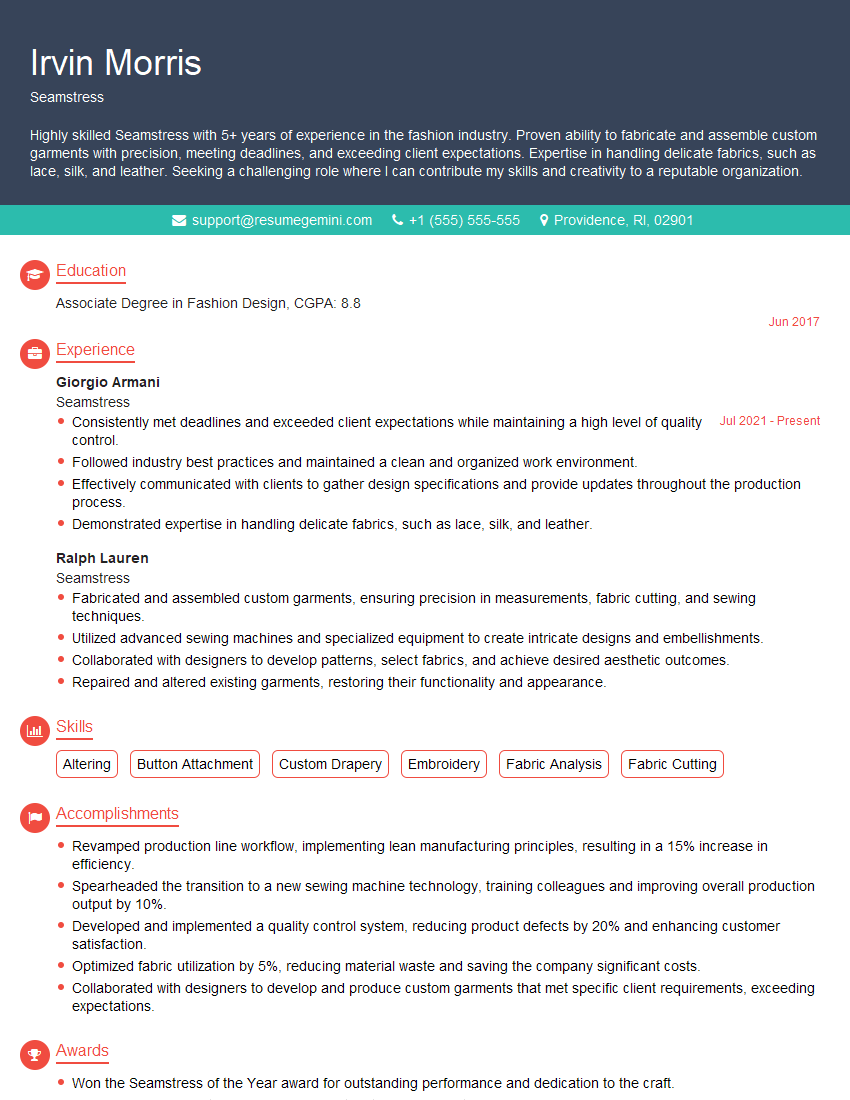
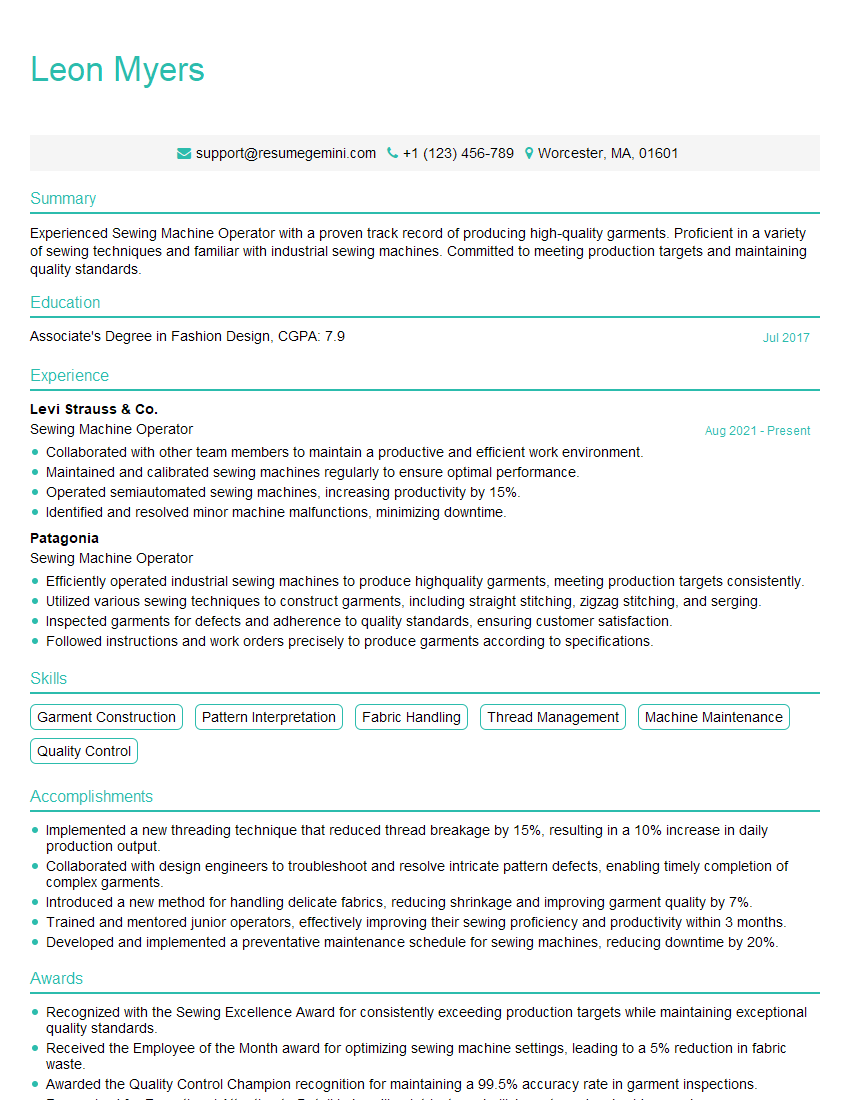
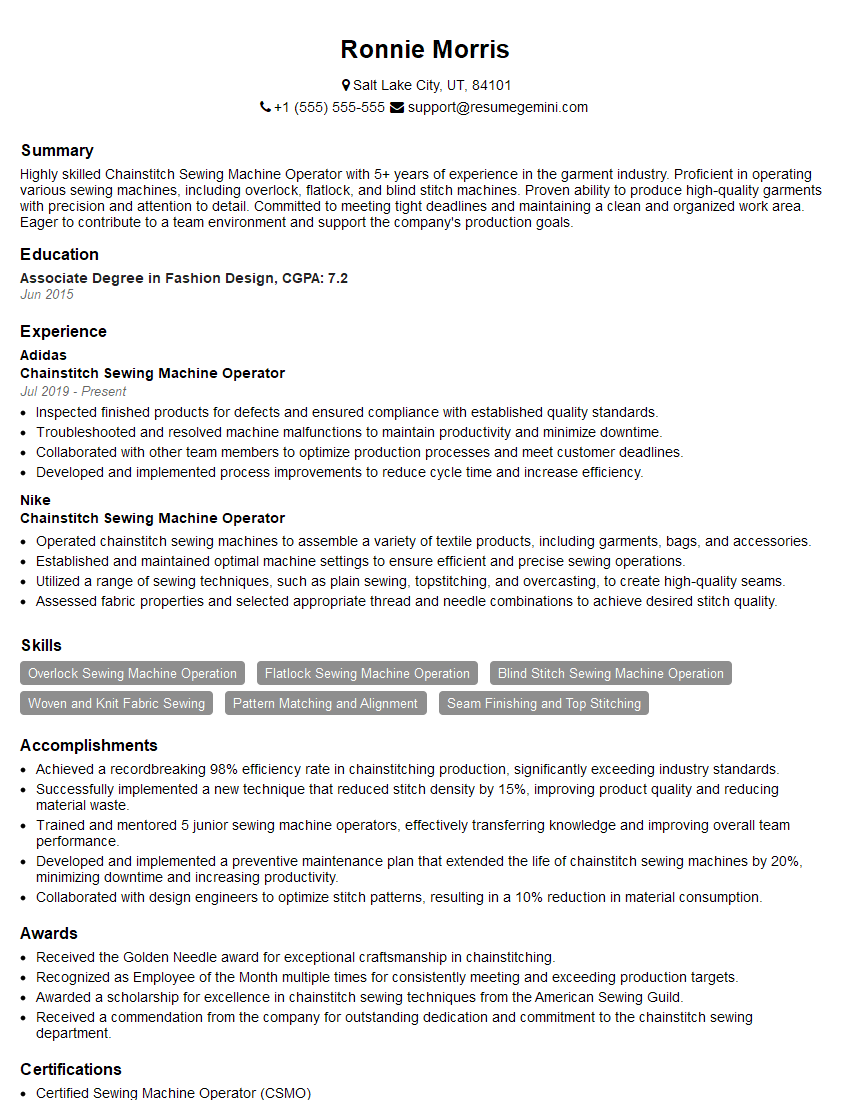
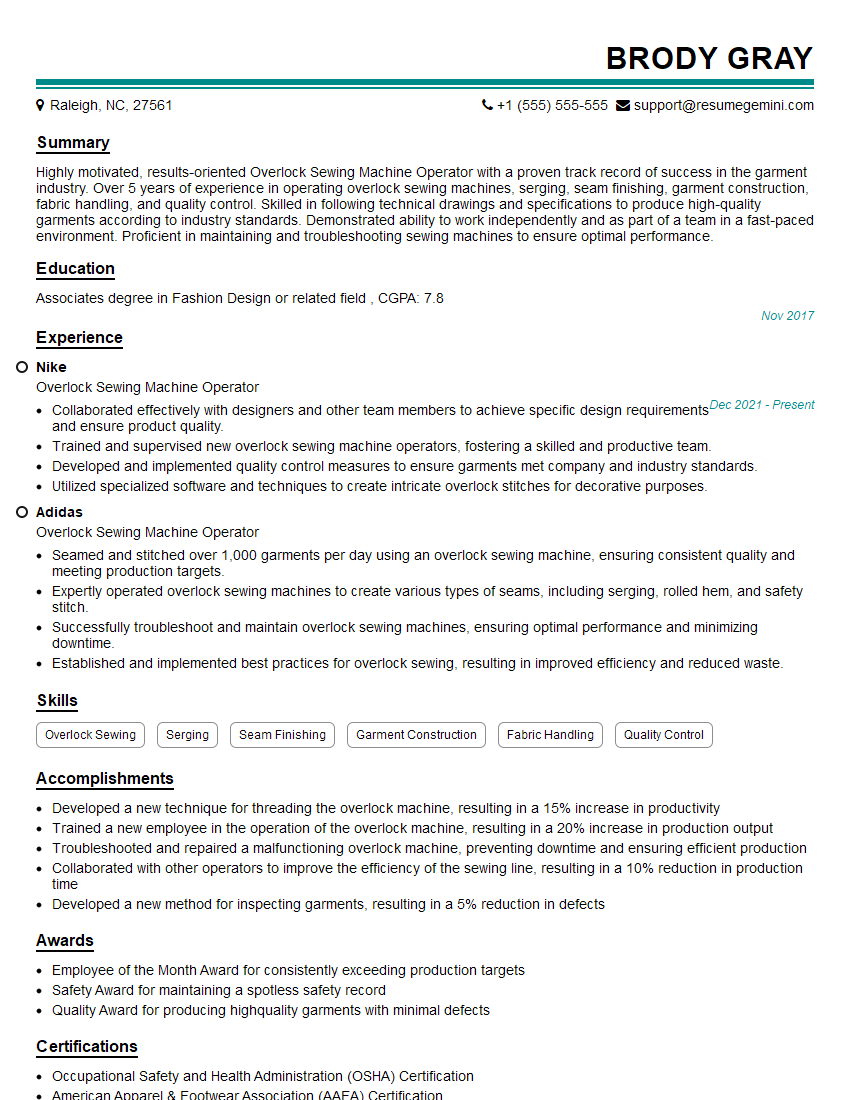
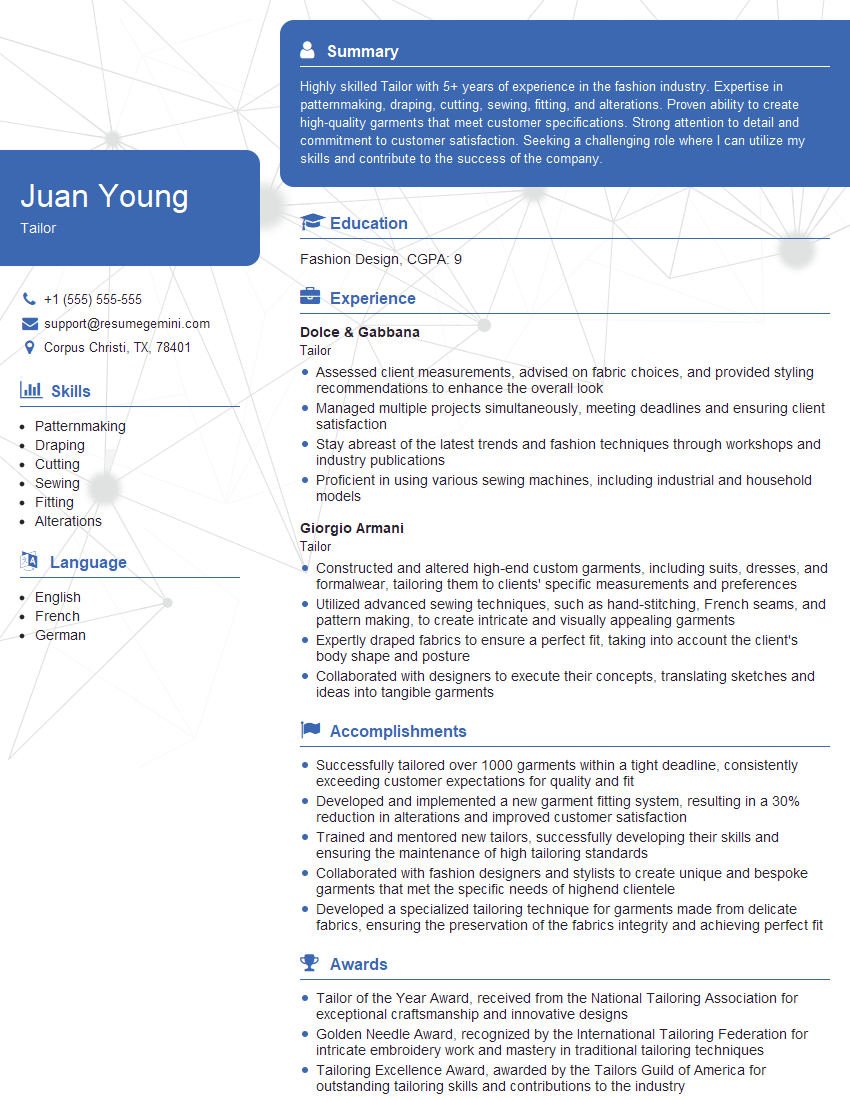
Mastering straight sewing techniques is crucial for building a solid foundation in garment construction and opens doors to various roles in the apparel industry, from production to design. An ATS-friendly resume is essential to showcase your skills effectively to potential employers. To maximize your job prospects, consider using ResumeGemini to craft a compelling and targeted resume that highlights your achievements and experience in straight sewing. ResumeGemini provides examples of resumes tailored to Straight Sewing to help guide your resume creation process.
Explore more articles
Users Rating of Our Blogs
Share Your Experience
We value your feedback! Please rate our content and share your thoughts (optional).
What Readers Say About Our Blog
Very informative content, great job.
good