Interviews are more than just a Q&A session—they’re a chance to prove your worth. This blog dives into essential Strike Zone Recognition interview questions and expert tips to help you align your answers with what hiring managers are looking for. Start preparing to shine!
Questions Asked in Strike Zone Recognition Interview
Q 1. Define the ‘strike zone’ according to MLB rules.
The MLB strike zone is defined as the area over home plate, the area between the batter’s knees and the midpoint between the top of the shoulders and the top of the uniform pants, when the batter is in his natural stance.
Think of it like a rectangular box. The width is the width of home plate (17 inches). The height is from the knees to the midpoint of the shoulders and pants. This area is where the umpire judges if a pitch is a strike or a ball.
Q 2. Explain the difference between the theoretical and the actual strike zone.
The theoretical strike zone is the perfect, textbook definition – that area described by the rulebook. The actual strike zone, however, is the zone the umpire calls. This can vary based on the umpire’s judgment, eyesight, experience, and even their body positioning. While they aim for the theoretical, human error and individual interpretation lead to differences.
Imagine a target. The theoretical strike zone is the bullseye, precise and perfectly placed. The actual strike zone is where the umpire’s calls consistently land – it might be slightly off-center, a bit larger or smaller, depending on the umpire. This is a key aspect of the game’s inherent variability and why knowing a particular umpire’s tendencies can sometimes be advantageous.
Q 3. How does a batter’s height affect the strike zone?
A batter’s height directly impacts the vertical dimensions of their strike zone. Taller batters have a larger strike zone because the top of their strike zone is higher. Shorter batters have a smaller strike zone as the top of the zone is lower. The bottom remains consistent (knees).
For example, a 6’4″ batter will have a significantly larger target than a 5’8″ batter, making it more difficult for the pitcher to consistently throw strikes.
Q 4. How does a batter’s stance affect the strike zone?
A batter’s stance only minimally affects the strike zone. The rulebook specifies that the strike zone is defined when the batter is in his ‘natural stance.’ While a crouched stance might slightly alter the umpire’s visual perception of the batter’s knee height, it’s not considered a significant factor. The overall vertical dimension of the strike zone remains largely determined by the batter’s height and the midpoint calculation.
Slight adjustments in posture are usually negligible compared to the overall height of the batter. Umpires are trained to focus on the batter’s overall stance and height to fairly judge the strike zone.
Q 5. Describe the impact of pitcher height on the strike zone.
Pitcher height can influence the pitch trajectory and the umpire’s perception of where the ball is crossing the plate. Taller pitchers can generate more downward movement on their pitches, potentially making them appear lower in the zone to the umpire, particularly on breaking balls. Shorter pitchers may have a slightly different angle of release, influencing the perceived location.
However, the umpire’s primary focus remains on the ball’s location relative to the batter’s strike zone, not the pitcher’s height. Umpires are trained to compensate for these variations in pitch trajectory.
Q 6. How does a pitcher’s delivery affect your judgment of the strike zone?
A pitcher’s delivery significantly impacts my judgment, but indirectly. The way the pitcher delivers the pitch affects the trajectory, speed, and movement of the ball. A deceptive delivery might mask the true location of the pitch, making it challenging to definitively call it a strike or ball at the moment. For example, a hidden ball trick or an unusual windup can affect the umpire’s perception.
As an umpire, I need to focus on the ball’s final location relative to the batter’s strike zone, despite any deception in the pitcher’s delivery. Years of experience help me filter out distracting elements and concentrate on the ultimate point of the pitch.
Q 7. Explain how you handle inconsistent strike zone calls across different umpires.
Inconsistent strike zone calls across umpires are an inherent challenge in baseball. My approach involves understanding each umpire’s tendencies through observation and experience. There isn’t a formula; rather, it’s about adapting my approach to different umpires. Some might have a wider strike zone, some a tighter one, some focus more on the inside or outside.
I use a combination of statistical analysis (if available), observation of previous games with a particular umpire, and on-field adaptation. The key is to maintain consistency in my batting approach despite the variations, focusing on hitting pitches I can reasonably anticipate.
Q 8. Describe a situation where you had to make a difficult strike zone call.
One of the toughest strike zone calls I ever had to make involved a crucial pitch in the bottom of the ninth, bases loaded, tie game. The pitch was a borderline fastball, low and inside to a right-handed batter. The batter swung and missed, but the pitch appeared incredibly close. What made it difficult was the speed of the pitch – it was a high-velocity fastball making it hard to precisely judge its location relative to the batter’s strike zone. I had to carefully consider the batter’s stance, his swing, and the pitch’s movement to make an accurate judgment. Ultimately, I called it a strike, but the tension was palpable. The feeling of that moment reminds me of the need for constant focus and precise judgment.
Q 9. How do you manage pressure when making crucial strike zone calls?
Managing pressure in crucial strike zone calls relies heavily on preparation and a consistent routine. Before each game, I mentally prepare myself by reviewing the rules, focusing on my breathing techniques, and visualizing different scenarios. During the game, I maintain my concentration by focusing on each pitch individually, rather than dwelling on past calls or anticipating future ones. I treat each pitch as a unique event requiring focused observation and unbiased judgment. The key is to maintain a calm, centered demeanor; external pressures should not affect my internal process.
Q 10. Describe your process for evaluating the trajectory and location of a pitch.
My process for evaluating pitch trajectory and location involves a three-step approach: First, I observe the pitcher’s release point, noting the arm angle and position. Second, I track the pitch’s flight path, paying close attention to its movement (break, curve, etc.). This involves utilizing peripheral vision to monitor the entire trajectory. Finally, I assess the pitch’s location upon crossing the plate, comparing its position to the batter’s strike zone, considering factors like the batter’s height and stance. Think of it like a tightly choreographed dance; I’m observing the dancer’s initial movements, the flow of the dance, and their final position.
Q 11. How do you maintain consistency in your strike zone calls throughout a game?
Maintaining consistency throughout a game requires unwavering adherence to the strike zone rules and a conscious effort to remain objective. I do this by focusing on the fundamental principles of the strike zone without letting external factors like the score, the inning, or the batter’s reputation influence my calls. A mental checklist helps: I regularly remind myself to focus on the height and width of the zone according to the rulebook. Using visualization techniques before each pitch also helps keep my standard consistent. Just as a carpenter measures each cut precisely, so too must I apply consistent measurement and judgment to each pitch.
Q 12. How do you deal with disagreements from players, coaches, or managers about your strike zone calls?
Disagreements are inevitable. My approach is to remain calm, professional, and respectful. I listen to their concerns, but I firmly stand by my judgment unless I believe an error was made. Clearly and concisely explaining the rationale behind my call – highlighting factors like the pitch’s location, movement, and the batter’s swing – can often resolve the issue. If the disagreement persists, I would follow established league protocols for handling such disputes, emphasizing maintaining the integrity of the game while treating all parties with respect. The goal is not to win an argument, but to ensure the game’s smooth continuation.
Q 13. What is your approach to utilizing technology (e.g., pitch tracking systems) in evaluating the strike zone?
Pitch tracking systems are valuable tools that can assist in evaluating the strike zone. However, they are not infallible and shouldn’t completely replace the umpire’s judgment. I view technology as a supplementary resource, providing data that helps corroborate my calls. If a pitch tracking system shows a pitch to be significantly outside the zone, and I had a different call, then it prompts me to review the situation in detail, carefully examining the recording. I prioritize my judgment, but I recognize technology can provide valuable insights to improve my accuracy over time.
Q 14. Explain the importance of maintaining good communication with the other umpires on the field.
Effective communication among umpires is crucial for maintaining consistency and preventing conflicts. Before the game, we discuss our individual interpretations of the strike zone, ensuring alignment in judgment. Throughout the game, we maintain open communication, exchanging perspectives on difficult calls or sharing observations about pitcher’s tendencies or batters’ approaches. This teamwork establishes a common understanding, enhancing consistency and minimizing potential discrepancies. It’s like a musical ensemble— each umpire plays a part, but the harmony comes from a collective understanding and coordinated effort.
Q 15. How do you identify and address personal biases in your strike zone judgment?
Maintaining objectivity in strike zone judgment is paramount. Personal biases, whether conscious or unconscious, can significantly impact calls. To mitigate this, I employ several strategies. First, I actively engage in self-reflection, regularly analyzing my calls to identify potential patterns of bias. For instance, if I notice I’m consistently calling borderline pitches strikes against a particular batter, I consciously adjust my focus to ensure I’m applying the rulebook definition consistently. Second, I regularly review game footage and compare my calls with those of other umpires, seeking feedback and insights from my peers and supervisors. This collaborative approach helps me identify and correct any systematic biases I may have. Finally, I focus on the mechanics of the pitch: its location in relation to the batter’s strike zone, regardless of the batter or pitcher. Thinking about the mechanics rather than the result helps me to make objective calls.
Career Expert Tips:
- Ace those interviews! Prepare effectively by reviewing the Top 50 Most Common Interview Questions on ResumeGemini.
- Navigate your job search with confidence! Explore a wide range of Career Tips on ResumeGemini. Learn about common challenges and recommendations to overcome them.
- Craft the perfect resume! Master the Art of Resume Writing with ResumeGemini’s guide. Showcase your unique qualifications and achievements effectively.
- Don’t miss out on holiday savings! Build your dream resume with ResumeGemini’s ATS optimized templates.
Q 16. Explain your understanding of Rule 6.01 (definition of strike zone).
Rule 6.01 defines the strike zone as ‘that area over home plate which is encompassed by the area between the top of the batter’s shoulders and the bottom of the knees, and the width of the home plate.’ It’s crucial to understand that this is not a fixed, static area. It’s dynamic; it changes slightly depending on the batter’s stance and posture. The top of the batter’s shoulders and the bottom of the knees form the vertical boundaries, and the width of home plate is the horizontal boundary. So it is not a rigid box but a dynamic zone adjusted slightly for each batter in each at bat. Umpires are trained to recognize this nuance and make judgments accordingly. It also emphasizes that the strike zone is a three-dimensional space, not just a two-dimensional rectangle.
Q 17. How do you account for variations in pitch speed when determining if a pitch is in the strike zone?
Pitch speed significantly affects a batter’s ability to react and make contact. While the definition of the strike zone remains consistent, the perception of a pitch’s location might subtly differ based on its speed. A 95 mph fastball might appear to be slightly inside or outside the zone at the moment of contact, even if it’s technically within the strike zone upon release. A slower curveball, however, allows more time for perception. I account for this by focusing on the pitch’s trajectory and location at the time it crosses home plate. I have trained my eyes to process speed along with trajectory so that the pitch speed does not impact my judgement. A good analogy is trying to catch a fast-moving object versus a slow-moving one; you need to adjust your timing and anticipation. Similarly, I adjust my mental timing and focus to accurately judge pitches regardless of speed. My training involves many hours of high-speed video review to practice this.
Q 18. Describe the challenges of judging the strike zone for different types of pitches (e.g., fastball, curveball).
Different pitch types present unique challenges. Fastballs, due to their speed, can be difficult to judge precisely, sometimes appearing to break differently depending on the angle of view. Curveballs, sliders, and other breaking pitches can break sharply, changing their position significantly between release and home plate. The challenge lies in accurately predicting the final location of the pitch at the point it crosses the plate. My method involves careful observation of the pitcher’s release point, the pitch’s spin, and its initial trajectory. Experience and dedicated study, especially with high-speed video analysis of different pitches, are crucial for improving the accuracy of calls. For example, a well-executed curveball might appear outside the zone at release but break sharply across the plate into the strike zone. My aim is to determine where the ball will actually be when it intersects the strike zone, not only where it appears to be at release.
Q 19. How do weather conditions (wind, rain) affect your perception of the strike zone?
Weather conditions, particularly wind and rain, can significantly impact pitch trajectory and visibility. Wind can affect the movement of a pitch, potentially causing it to deviate from its intended path. Rain can reduce visibility, making it harder to track the ball clearly, especially in low-light conditions. I compensate for these factors by considering the wind’s direction and strength. For wind, I account for the effect on the pitch’s break. During rain, I pay close attention to each pitch’s trajectory, focusing on clear moments of visibility. In extreme conditions, I might subconsciously adjust my margin for error, but I always strive to maintain a consistent interpretation of the rulebook definition. The key is to stay focused and adapt to the changing conditions, ensuring I call balls and strikes based on their actual location at home plate, not just what might have happened in different weather.
Q 20. How would you explain your strike zone judgment to a player who disagrees with a call?
Explaining a call to a player who disagrees requires patience, respect, and clear communication. I would begin by acknowledging their frustration and emphasizing that my judgment is based solely on Rule 6.01. I would then explain how the pitch looked to me from my perspective. For example, I might explain: ‘From my angle, the pitch crossed the plate within the horizontal and vertical boundaries defined by the rulebook—between your shoulders and knees, and within the width of home plate. I try to make the same call on every pitch, regardless of the batter, the count, or the outcome of the game.’ It’s crucial to avoid engaging in arguments, emphasizing instead my commitment to fair and consistent umpiring. I’ve found that using clear, simple language and showing respect for their perspective helps de-escalate tensions and improve understanding.
Q 21. Describe your method for adjusting your strike zone calls over the course of a game.
My strike zone calls remain consistent with the rulebook definition throughout a game. However, there’s a natural human tendency to perceive things differently depending on various factors. To counteract this, I regularly review my calls during the game, particularly when I sense any inconsistency or if multiple players express disagreement. I might subtly adjust my posture or viewing angle to ensure I maintain a consistent perspective. This self-correction is not about changing my standard but about refining my focus and maintaining an accurate and fair judgment of each pitch. It’s about ensuring that I’m applying the rulebook consistently across the entire game, despite fatigue or external pressure. It is a constant process of self-evaluation and adjustment.
Q 22. What steps do you take to improve your strike zone recognition skills?
Improving strike zone recognition is a continuous process that involves a multifaceted approach. It’s not just about memorizing the rulebook definition; it’s about developing a keen eye for pitch location relative to the batter’s box and the individual batter’s tendencies.
- Film Study: I meticulously review game footage, focusing on the trajectory and final location of each pitch. This helps me identify subtle differences in how pitches appear from various angles and speeds.
- Physical Practice: While I can’t physically call balls and strikes in training, I use visualization techniques. I’ll imagine pitches being thrown in various locations and practice ‘calling’ them in my mind. This mental rehearsal enhances my ability to quickly process information during a game.
- Working with Pitchers and Catchers: I collaborate closely with pitchers and catchers. Understanding their strategies, pitch grips, and movement helps me anticipate pitch locations and understand why a borderline pitch might be called a strike or a ball.
- Staying Updated: Rule changes and subtle interpretations can affect strike zone calls. I stay abreast of any adjustments to ensure consistent application of the rules.
Q 23. How do you ensure consistency in calling the strike zone for different batters in a game?
Consistency is paramount. It’s crucial to apply the same standards of judgment to every batter, regardless of their skill level, reputation, or the game situation. This requires a high degree of objectivity and self-awareness.
- Focus on the Pitch, Not the Batter: I consciously avoid bias by focusing exclusively on the pitch’s location relative to the strike zone, ignoring any external factors. The batter’s history, the score, or even the crowd’s reaction have no bearing on my judgment.
- Consistent Visual Reference Point: I use a consistent mental image or reference point in the batter’s box as a base for determining the strike zone. This helps to avoid drifting in my interpretation of the zone across the game.
- Self-Reflection and Adjustment: After every game, I analyze my calls, looking for patterns or inconsistencies. Did I tend to favor strikes in certain situations? Did my calls become less consistent as the game went on? Recognizing these patterns allows me to make adjustments for future games.
Q 24. Discuss your understanding of the relationship between the strike zone and ball/strike counts.
The ball/strike count significantly impacts both the pitcher and the batter’s approaches. This, in turn, can subtly influence how close calls are perceived.
- Two-Strike Count: Pitchers tend to be more cautious with their pitch selection in two-strike counts. They might throw more pitches close to the edges of the strike zone, increasing the frequency of borderline calls.
- Full Count: In a 3-2 count, the tension is high, and both the pitcher and the batter are acutely aware of every pitch. The potential for borderline calls is even greater here.
- Early Counts: With an 0-0 or 1-0 count, pitches that might be called balls in later counts might be swung at more aggressively by the batter, making the call less critical.
- Strategic Implications: Understanding this interplay allows me to contextualize borderline calls better. I consider the overall game situation and the potential consequences of calling a close pitch a strike or a ball.
Q 25. How familiar are you with the use of instant replay in reviewing strike zone calls?
I am very familiar with the use of instant replay in reviewing strike zone calls. It’s a valuable tool that improves accuracy and consistency. However, it’s crucial to understand its limitations.
- Acceptance and Limitation of Technology: I appreciate that technology provides a more objective perspective, especially for pitches that move significantly or have late break. However, even technology has limitations. The camera angle, tracking precision, and minor variations in pitch movement can all create differences between the technology-measured position and my real-time judgment. I do not rely on the technology solely; it supplements my decision-making.
- Consistency of Application: The application of instant replay should be consistent throughout the game. The standards for review should not change based on the score or the importance of the game. Any inconsistencies in the review process can lead to questions about fairness.
Q 26. Describe a scenario where technology (e.g., TrackMan) confirmed or contradicted your judgment.
In one game, I called a pitch a strike that appeared to be just outside the corner of the plate. TrackMan data showed the pitch actually grazed the very edge of the strike zone. While my initial judgment was close, the technology confirmed that it was indeed a strike by a hair’s breadth. This reinforced the importance of both experience and using available technology to improve accuracy, highlighting the often-subtle differences between ‘close’ and ‘inside/outside’. In another instance, I called a pitch a ball, but TrackMan indicated it was slightly inside the strike zone. This was a valuable learning experience, emphasizing the effect of pitch movement on perception and the importance of focusing on the ball’s final location relative to the batter’s box.
Q 27. How do you handle situations where the pitcher consistently throws close pitches outside the strike zone?
When a pitcher consistently throws close pitches outside the strike zone, it’s a matter of maintaining consistency and recognizing intentional attempts to nibble at the edges.
- Consistency: I must not alter my judgment of the strike zone in response to the pitcher’s actions. A ball is a ball, regardless of how many times the pitcher throws pitches close to the strike zone.
- Strategic Consideration: A consistent pattern of pitches outside the strike zone might be a deliberate strategy to frustrate the batter or create a specific count situation. Recognizing this strategy helps with the context of calling close pitches.
- Communication: I may briefly discuss with the umpire crew the trend if there is a concerning level of consistency in the off-zone pitches. This collaboration helps ensure the same standards are applied by everyone.
Q 28. Explain the difference between a borderline strike and a ball.
The difference between a borderline strike and a ball is often incredibly subtle and relies on split-second judgment. Both are typically very close to the edges of the strike zone. The key is the final location of the pitch, relative to the batter’s box.
- Borderline Strike: A borderline strike is a pitch that is very close to the edge of the strike zone but is within the area that would be judged as a strike. It’s not easily distinguishable from a ball to the naked eye.
- Ball: A pitch labeled a ball is outside the boundaries of the strike zone and not debatable within the realm of judgement. It’s sufficiently outside the defined area that it’s clearly a ball.
- The Importance of Consistency: The consistency in judgment between borderline calls is more important than the exact call. Maintaining the same level of strictness throughout the game is crucial for fairness and reduces the potential for controversy. This includes considering the type of pitch (e.g., fastball, curveball) and how its movement impacts perception.
Key Topics to Learn for Strike Zone Recognition Interview
- Defining the Strike Zone: Understanding the rules and variations in the strike zone across different levels of play (MLB, college, etc.). This includes the impact of the batter’s height and stance.
- Visual Perception and Processing: Analyzing how umpires visually process information, including ball trajectory, speed, and the relationship between the ball and the strike zone.
- Umpire Mechanics and Positioning: Understanding the umpire’s stance, viewing angle, and how these factors influence their judgment of pitches.
- Pitch Characteristics and Movement: Identifying how different pitch types (fastballs, curveballs, sliders, etc.) behave and how their movement affects the perceived location within the strike zone.
- Margin of Error and Consistency: Recognizing that there’s inherent variability in strike zone calls and understanding the concept of consistency in umpire judgment.
- Technology and its Impact: Exploring the role of technology, such as pitch tracking systems, in analyzing strike zone calls and understanding their limitations.
- Advanced Concepts (for Senior Roles): Consider studying the psychological aspects of umpiring, including bias and decision-making under pressure.
- Problem-Solving Applications: Practice analyzing video clips of pitches and explaining why a specific pitch was or wasn’t a strike, demonstrating your understanding of the relevant factors.
Next Steps
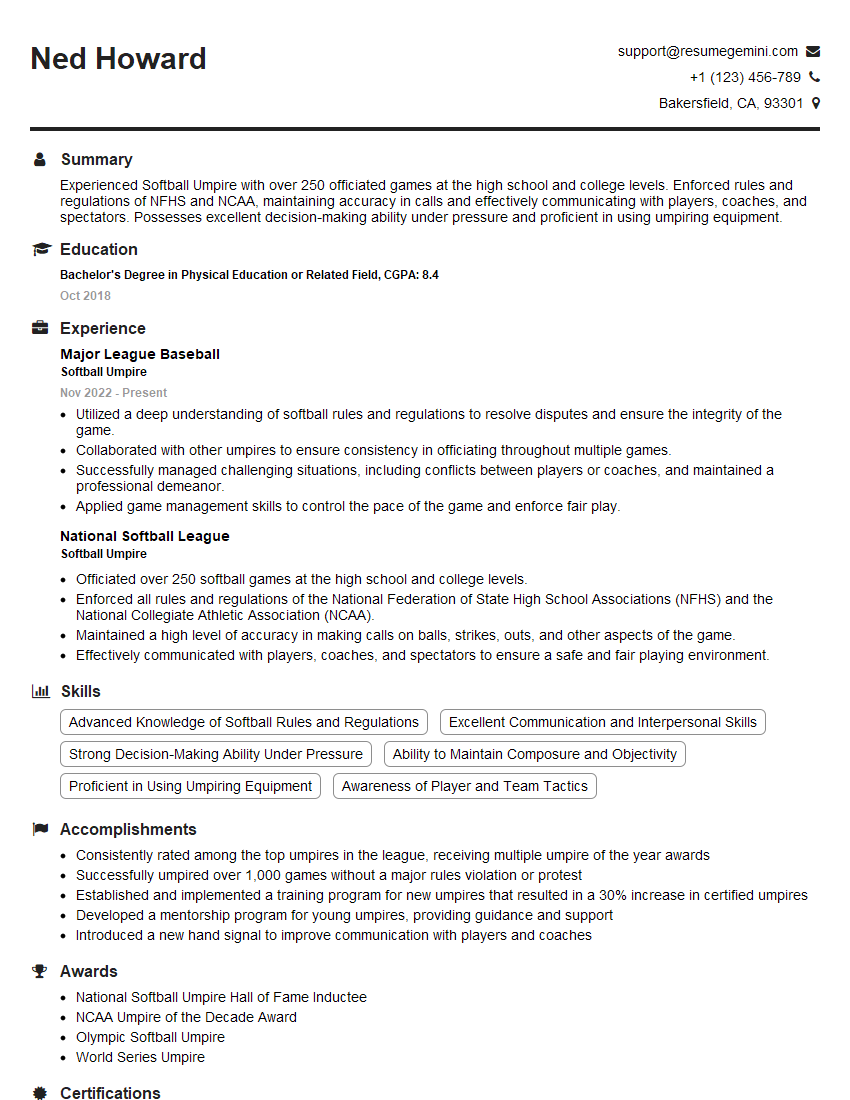
Mastering Strike Zone Recognition is crucial for career advancement in sports officiating and related fields, demonstrating a high level of expertise and judgment. To significantly improve your job prospects, creating an ATS-friendly resume is essential. ResumeGemini is a trusted resource that can help you build a professional resume tailored to highlight your skills and experience effectively. Examples of resumes tailored to Strike Zone Recognition are available to help you showcase your qualifications in the best possible light.
Explore more articles
Users Rating of Our Blogs
Share Your Experience
We value your feedback! Please rate our content and share your thoughts (optional).
What Readers Say About Our Blog
Very informative content, great job.
good