The thought of an interview can be nerve-wracking, but the right preparation can make all the difference. Explore this comprehensive guide to Structural Analysis and Finite Element Modeling interview questions and gain the confidence you need to showcase your abilities and secure the role.
Questions Asked in Structural Analysis and Finite Element Modeling Interview
Q 1. Explain the difference between static and dynamic analysis in FEA.
The core difference between static and dynamic analysis in Finite Element Analysis (FEA) lies in how they handle time. Static analysis assumes that loads applied to a structure are unchanging over time, leading to a constant state of equilibrium. Think of a bridge supporting a constant weight. The stresses and displacements are calculated for this steady-state condition. Dynamic analysis, on the other hand, considers loads that vary with time, such as vibrations from machinery, seismic events (earthquakes), or impact loads. This means we need to consider inertia and acceleration, making the analysis significantly more complex. A classic example is analyzing the response of a building to an earthquake. Static analysis is simpler and computationally less expensive, while dynamic analysis provides a more realistic representation of real-world scenarios involving time-varying loads, often needing more advanced solvers and techniques.
Q 2. Describe various element types used in FEA and their applications.
Finite Element Analysis employs a variety of element types, each suited to specific applications. The choice depends on the geometry, material properties, and the type of analysis being performed. Some common element types include:
- 1D elements (Truss, Beam): These elements are ideal for modeling structures where one dimension is dominant, like beams, columns, or cables. Truss elements resist only axial forces, while beam elements account for bending, shear, and torsion. Imagine analyzing a simple bridge structure – beam elements would be the perfect choice.
- 2D elements (Plane stress, Plane strain, Axisymmetric): These elements are used for modeling structures where the geometry is essentially two-dimensional. Plane stress elements are suitable for thin plates, plane strain for thick bodies, and axisymmetric elements for structures with rotational symmetry, such as pipes under pressure. For example, analyzing a thin sheet metal panel under load would employ plane stress elements.
- 3D elements (Tetrahedral, Hexahedral): These are versatile elements for modeling complex 3D geometries where 2D elements are insufficient. Hexahedral elements generally offer greater accuracy than tetrahedral elements but can be more challenging to mesh.
- Shell elements: These are specialized 2D elements that model thin-walled structures like shells and curved surfaces, considering both membrane and bending effects. Think of an aircraft fuselage.
The selection of element type significantly impacts accuracy and computational cost. A proper understanding of the element’s capabilities and limitations is crucial for obtaining reliable results.
Q 3. What are the advantages and disadvantages of using different FEA solvers?
Different FEA solvers offer various advantages and disadvantages. The best choice depends on the problem’s complexity, computational resources available, and desired accuracy.
- Direct solvers: These solvers solve the system of equations directly, offering high accuracy and reliability but can be computationally expensive for large models. They are well-suited for smaller, more complex problems needing high precision.
- Iterative solvers: These solvers approach the solution iteratively, making them more efficient for large models. However, they might not always converge to a solution, and accuracy can be less precise than direct solvers. These are often preferred for massive models where direct solvers become impractical.
The choice between a direct or iterative solver often involves balancing speed and accuracy. The characteristics of the problem and the available computational resources will guide this decision. Some commercial FEA packages provide both types of solvers, giving you the flexibility to choose the most appropriate option for your specific needs.
Q 4. How do you handle boundary conditions in a FEA model?
Boundary conditions define how a structure interacts with its surroundings. Accurately defining them is paramount for obtaining realistic results. These conditions can include:
- Fixed supports: These restrain all degrees of freedom (translation and rotation) at a specific point or surface. Imagine clamping a beam to a wall.
- Hinges: These allow rotation but prevent translation. Think of a door hinge.
- Roller supports: These allow translation in one direction but prevent translation in the other directions and rotation. Picture a wheel on a track.
- Prescribed displacements: These enforce specific displacements at certain nodes, for example, simulating a thermal expansion scenario.
- Loads (Forces, pressures, moments): Loads applied to the structure. These are not strictly boundary conditions, but they’re closely related in defining the system’s behavior.
Incorrectly specified boundary conditions can lead to inaccurate or even nonsensical results. Careful consideration and understanding of the physical system are critical for accurate modeling.
Q 5. Explain the concept of mesh convergence and its importance.
Mesh convergence refers to the process of refining the FE mesh (dividing the model into smaller elements) until the solution no longer significantly changes. It’s a crucial aspect of ensuring the accuracy and reliability of the FEA results. A too-coarse mesh may not capture the details of the stress distribution and may lead to inaccurate results, while an excessively fine mesh dramatically increases computational cost without significantly improving accuracy.
The process usually involves analyzing the results with progressively finer meshes. If the solution converges, meaning the changes in the results between successive mesh refinements are negligible, you can be confident that the results are accurate within a reasonable tolerance. If the results continue to change significantly with mesh refinement, further refinement is necessary until convergence is achieved.
Mesh convergence is important because it verifies the accuracy of the FEA solution, ensuring that the results are not simply artifacts of the mesh discretization. This is a quality check fundamental to a reliable analysis.
Q 6. What are different types of loads considered in structural analysis?
Structural analysis considers several types of loads, each influencing the structural response differently:
- Concentrated loads: These are forces applied at a single point on the structure. Think of a heavy weight placed at a specific location on a beam.
- Distributed loads: These are loads spread over a length, area, or volume. Examples include the weight of a bridge deck, wind pressure on a building facade, or the weight of a liquid in a tank.
- Point moments: Moments (torques) applied at a single point, like a twisting force.
- Thermal loads: Temperature changes cause thermal expansion or contraction in materials, leading to stresses. Consider expansion joints in bridges or aircraft structures.
- Centrifugal loads: These arise in rotating structures like flywheels or turbine blades.
- Seismic loads: Earthquakes produce dynamic loads causing significant structural response.
The accurate representation of these loads is vital to obtain meaningful and reliable results. A thorough understanding of the loading conditions is paramount for an accurate and safe structural design.
Q 7. Describe the process of creating a FEA model from scratch.
Creating an FEA model from scratch involves a structured process:
- Problem definition: Clearly define the engineering problem, including geometry, materials, loads, boundary conditions, and desired outputs.
- Geometry creation: Generate the geometry of the structure using CAD software or directly in the FEA pre-processor. Accuracy in geometry is crucial.
- Mesh generation: Divide the geometry into a mesh of elements. The mesh density should be appropriate for the problem’s complexity and desired accuracy. This step often requires careful consideration to balance computational efficiency and accuracy.
- Material properties definition: Assign appropriate material properties (Young’s modulus, Poisson’s ratio, density, etc.) to each element in the model.
- Boundary condition definition: Apply the appropriate boundary conditions, carefully considering supports, restraints, and prescribed displacements.
- Load application: Apply loads (forces, moments, pressures, etc.) as per the defined loading conditions.
- Solver selection and execution: Choose an appropriate solver (direct or iterative) and run the analysis.
- Post-processing and result interpretation: Review the results (displacements, stresses, strains, etc.) using visualization tools and interpret the results in the context of the original problem. This is a critical step for validation and understanding the behavior of the structure.
Throughout the process, validation and verification steps are essential to ensure the model’s accuracy and reliability. This iterative approach allows for adjustments and refinements until a satisfactory and accurate representation of the actual structure is achieved.
Q 8. How do you validate your FEA results?
Validating FEA results is crucial to ensure the accuracy and reliability of your analysis. It’s not enough to simply get numbers; you need to assess their meaning within the context of the real-world problem. We use a multi-pronged approach:
Comparison with Analytical Solutions: For simple geometries and loading conditions, analytical solutions exist. Comparing FEA results to these provides a benchmark. For example, calculating the stress in a simply supported beam under a central point load can be verified against a well-established formula.
Experimental Validation: This is the gold standard. Conducting physical experiments (e.g., strain gauge measurements, photoelasticity) and comparing the measured data to your FEA results is essential for high-stakes applications. Differences need careful investigation to identify sources of error, whether in the model, the experiment, or material properties.
Mesh Sensitivity Study: Refining the mesh (increasing the number of elements) helps assess the convergence of the solution. If the results change significantly with mesh refinement, it indicates that the mesh was too coarse and needs further refinement. This process is repeated until the change in results becomes negligible.
Verification of the FEA Model: This involves checking the model setup for accuracy. This includes verifying the geometry, material properties, boundary conditions, and load application. Errors in any of these areas can lead to inaccurate results. Peer review of the model can be beneficial.
Engineering Judgment: Experienced engineers use their understanding of the physics of the problem to judge the reasonableness of the results. Unrealistic stress or displacement values can be detected and investigated.
Ultimately, validation is an iterative process that involves a combination of these methods, ensuring confidence in the final FEA predictions.
Q 9. Explain the concept of stress concentration and its significance.
Stress concentration refers to the localized increase in stress that occurs around geometric discontinuities such as holes, fillets, notches, or sudden changes in cross-section. Imagine a smooth, wide river suddenly narrowing – the water flow speeds up and pressure increases locally. Similarly, in a structural component, the stress lines crowd together near these discontinuities, resulting in significantly higher stresses than the average stress in the component.
Its significance lies in its potential to cause premature failure. Even if the average stress in a component is well below the material’s yield strength, high stress concentrations can lead to localized yielding, crack initiation, or fracture at these points of stress concentration, causing the structure to fail much earlier than expected. Therefore, understanding and managing stress concentrations through design modifications (e.g., using larger fillets, optimizing geometry) is crucial in engineering design. FEA is an invaluable tool for identifying and quantifying these localized stress regions.
Q 10. What are different failure criteria used in FEA?
Several failure criteria are used in FEA to predict when a material will fail. The choice depends on the material’s behavior and the type of loading. Some common criteria include:
Von Mises Stress: This is a widely used criterion, particularly for ductile materials. It considers the combined effect of normal and shear stresses and predicts failure when the equivalent Von Mises stress exceeds the material’s yield strength.
Tresca Stress (Maximum Shear Stress): This criterion predicts failure when the maximum shear stress in a material reaches the material’s shear yield strength. It is simpler to calculate than the Von Mises criterion but might be less accurate for some materials.
Maximum Principal Stress: This criterion predicts failure when the largest principal stress exceeds the material’s tensile strength. It is suitable for brittle materials where tensile failure is dominant.
Maximum Shear Strain: This criterion is useful for ductile materials and predicts failure based on the maximum shear strain experienced by the material.
Mohr-Coulomb Criterion: This is specifically designed for materials exhibiting brittle behavior, such as concrete or rock, considering the influence of both normal and shear stresses.
The selection of the appropriate failure criterion is crucial for accurate prediction of structural failure. It should be based on both the material’s properties and the nature of the applied loading. Often, multiple criteria are considered to gain a comprehensive understanding of potential failure modes.
Q 11. How do you deal with non-linearity in FEA?
Non-linearity in FEA arises from various sources, including material non-linearity (plasticity, hyperelasticity), geometric non-linearity (large deformations), and contact non-linearity (interactions between bodies). Addressing this requires specialized techniques:
Incremental/Iterative Solution Procedures: Non-linear problems are solved incrementally by breaking the load or displacement into smaller steps. Within each increment, iterative methods (Newton-Raphson) are used to solve the non-linear equations of equilibrium until convergence is achieved. This iterative process accounts for the changing stiffness of the structure as it deforms.
Appropriate Material Models: Selecting accurate constitutive models is essential. For plastic deformation, models like the J2 plasticity model are used. For large deformations, hyperelastic models are employed. These models describe the material’s non-linear stress-strain relationship.
Contact Algorithms: Contact problems require specialized algorithms to handle the interactions between surfaces. These algorithms must account for the changing contact area and forces during deformation.
Arc-Length Method: This method helps overcome difficulties in convergence for highly non-linear problems by controlling the load increment size during the solution process.
Handling non-linearity significantly increases computational cost and complexity compared to linear analysis. Careful consideration of the problem’s non-linear aspects and the selection of appropriate solution techniques are vital for obtaining accurate results.
Q 12. Explain the concept of modal analysis and its applications.
Modal analysis is an FEA technique used to determine the natural frequencies and mode shapes of a structure. Think of it like finding the structure’s preferred ways of vibrating. Each mode shape represents a specific pattern of deformation, and the natural frequency corresponds to the rate at which the structure will oscillate if disturbed.
Applications are extensive:
Earthquake Engineering: Identifying the natural frequencies helps understand how a building might respond to seismic excitation. Proper design avoids resonance with the earthquake’s dominant frequencies.
Rotating Machinery: Analyzing the natural frequencies of rotating components (like turbine blades) is crucial to avoid resonance with rotational speeds, preventing potential failures due to vibration.
Acoustic Analysis: Modal analysis can be used to predict the acoustic response of structures, such as the noise generated by a vehicle’s components or the reverberation in a concert hall.
Structural Dynamics: Understanding the structure’s dynamic behavior, including its response to transient loads or impacts, is critical to preventing failure.
In essence, modal analysis provides crucial information about the dynamic characteristics of a structure, allowing engineers to design systems that avoid resonance and operate safely and efficiently under dynamic loads.
Q 13. What are different types of boundary conditions and how to apply them?
Boundary conditions define how a structure interacts with its surroundings. Applying them accurately is crucial for obtaining meaningful results in FEA. Common types include:
Fixed Support: This completely restricts all degrees of freedom (displacements and rotations) at a specific point or surface. Think of a beam clamped to a wall.
Hinged Support: This restricts translations but allows rotations. This is similar to a pin joint.
Roller Support: This only restricts translation in one direction, allowing free movement in the other directions and rotations. This is analogous to a roller on a track.
Symmetric/Anti-symmetric Boundary Conditions: For structures with symmetry, applying symmetric or anti-symmetric boundary conditions reduces the computational effort by modeling only a portion of the structure.
Prescribed Displacement: This applies a specified displacement to a node or surface, which is often used to simulate forces or imposed deformations.
Prescribed Pressure: This applies a uniform or non-uniform pressure to a surface.
Improper boundary conditions lead to inaccurate results. Careful consideration of the actual physical constraints on the structure is essential for realistic modeling. The application method depends on the FEA software; usually, this involves selecting nodes or surfaces and specifying the desired constraints in the software interface.
Q 14. Describe your experience with different FEA software packages.
Throughout my career, I have gained extensive experience with a variety of FEA software packages. My expertise includes:
ANSYS: I’ve used ANSYS extensively for various projects, including linear and non-linear static and dynamic analyses, and have a strong understanding of its capabilities for complex simulations, especially in structural mechanics.
ABAQUS: I’m proficient in ABAQUS, particularly its strengths in handling non-linear materials, large deformations, and contact problems. I’ve used it successfully for several high-fidelity simulations requiring advanced material models.
Nastran: My experience with Nastran includes modal analysis, harmonic response analysis, and various linear static analyses. Its robustness and efficiency make it a valuable tool for many engineering tasks.
LS-DYNA: For explicit dynamic simulations involving impacts and crashes, LS-DYNA has been a key tool in my toolbox. I am familiar with its capabilities in modeling high-velocity impact scenarios.
My experience spans across these packages allows me to select the most appropriate software for each specific project based on its capabilities and the requirements of the analysis. I’m also comfortable learning new software packages as needed.
Q 15. How do you select appropriate mesh density for your FEA model?
Mesh density in Finite Element Analysis (FEA) is crucial; it dictates the accuracy and computational cost of your simulation. Think of it like painting a picture – a coarser brush (less dense mesh) gives a general idea, while finer brushstrokes (denser mesh) capture intricate details. The optimal mesh density balances accuracy and computational efficiency.
Selection involves several considerations:
- Geometry complexity: Regions with sharp features or high curvature gradients require finer meshes to accurately capture stress concentrations. Imagine trying to paint a sharp corner; you need more detail there than on a flat surface.
- Stress gradients: Areas expected to experience significant stress variations (e.g., around holes, fillets, or weld joints) need a finer mesh than regions with relatively uniform stress distribution. Think of areas where your painting needs to be the most detailed to be realistic.
- Element type: Different element types (linear, quadratic, etc.) have different convergence properties. Higher-order elements often require fewer elements to achieve the same accuracy, but are computationally more expensive.
- Mesh convergence studies: This is a crucial step. You progressively refine the mesh in critical areas and observe the changes in the results. If the results stabilize, you’ve likely reached a sufficient level of mesh refinement. If they continue to change significantly, further refinement is needed. It’s like checking that adding more details to your painting doesn’t change the overall image significantly.
Software often provides tools like mesh sizing controls and adaptive mesh refinement to facilitate this process. It’s iterative and requires engineering judgment.
Career Expert Tips:
- Ace those interviews! Prepare effectively by reviewing the Top 50 Most Common Interview Questions on ResumeGemini.
- Navigate your job search with confidence! Explore a wide range of Career Tips on ResumeGemini. Learn about common challenges and recommendations to overcome them.
- Craft the perfect resume! Master the Art of Resume Writing with ResumeGemini’s guide. Showcase your unique qualifications and achievements effectively.
- Don’t miss out on holiday savings! Build your dream resume with ResumeGemini’s ATS optimized templates.
Q 16. Explain the concept of buckling analysis.
Buckling analysis is a crucial aspect of structural analysis, particularly for slender members like columns, beams, and shells. It focuses on determining the critical load at which a structure transitions from a stable equilibrium state to an unstable one, undergoing a significant deformation or collapse. Think of a long, thin ruler; if you apply enough force to the end, it will buckle (bend) rather than simply compress.
The analysis typically involves solving an eigenvalue problem, identifying the lowest critical buckling load (eigenvalue) and associated mode shape (eigenvector). The mode shape illustrates how the structure will deform when it buckles. Several methods exist, including:
- Linear buckling analysis: This is a linearized approach that assumes small deflections and is suitable for predicting the critical buckling load.
- Nonlinear buckling analysis: This considers geometric nonlinearities and large deflections, providing a more accurate prediction, especially for complex structures or loads that approach the buckling load.
Factors influencing buckling include geometry, material properties, boundary conditions, and loading conditions. Software like ANSYS, Abaqus, and Nastran provide sophisticated tools for buckling analysis.
Q 17. How do you interpret the results of a FEA analysis?
Interpreting FEA results requires a thorough understanding of the model, boundary conditions, and the nature of the analysis. It’s not simply about looking at numbers; it’s about understanding what those numbers represent in the context of the real-world problem.
The process involves:
- Visual inspection: Examining deformed shapes and stress contours provides a qualitative understanding of the structural response. Areas with high stress concentrations are immediately apparent.
- Quantitative analysis: Examining numerical results like displacement, stress, strain, and reaction forces at critical locations. This is often done using tools within the FEA software to query specific nodes or elements. Spreadsheets and other post-processing tools are also employed.
- Comparison to design criteria: The obtained results must be compared to relevant design codes and standards (e.g., ASME, Eurocode) to ensure the structure meets safety and performance requirements.
- Sensitivity studies: Understanding the impact of varying model parameters (material properties, geometry, loads) on the results can reveal critical design considerations.
Careful consideration of uncertainties in the model (material properties, boundary conditions, loading assumptions) is crucial for drawing reliable conclusions. Documenting the assumptions and limitations is equally important.
Q 18. What are the limitations of FEA?
While FEA is a powerful tool, it’s essential to acknowledge its limitations. Over-reliance on FEA without proper understanding can lead to inaccurate or misleading results.
- Model Simplifications: FEA relies on idealized models. Simplifying complex geometries, material behavior, and boundary conditions can introduce errors. The model is never a perfect replica of reality.
- Mesh dependency: The accuracy of FEA results depends on the mesh density. Insufficient mesh refinement can lead to inaccurate stress predictions, especially in areas with stress concentrations.
- Boundary condition assumptions: Inaccurate representation of boundary conditions can significantly affect the results.
- Computational cost: Complex models can be computationally expensive, requiring significant processing power and time.
It’s crucial to use FEA judiciously, combining it with engineering judgment and experimental validation whenever feasible.
Q 19. Describe your experience with experimental verification of FEA results.
Experimental verification is paramount in validating FEA results and building confidence in the model’s accuracy. In my experience, this involves a systematic approach:
- Test plan development: Defining the objectives, selecting appropriate testing methods (e.g., strain gauge measurements, photogrammetry), and developing a detailed procedure to collect and process experimental data are vital. For example, in a bridge design, we might instrument a prototype with strain gauges and load cells to measure stresses and deflections under various load conditions.
- Correlation and comparison: Directly comparing the numerical predictions obtained from FEA with experimental measurements is critical. This may involve comparing stress values, displacement fields, or natural frequencies.
- Model refinement: Discrepancies between FEA results and experimental data often necessitate model refinement. This could involve adjusting material properties, mesh density, or boundary conditions. Often this iterative process significantly increases accuracy and confidence in the FEA.
- Uncertainty quantification: Acknowledging and quantifying the uncertainties associated with both the experimental measurements and FEA results is essential for a fair comparison.
For example, in a project involving a pressure vessel, we conducted strain gauge measurements and compared them to our FEA stress predictions. Minor discrepancies led to refinements in the material model to better capture the vessel’s non-linear behavior under pressure. This process allowed us to create a more reliable and accurate model.
Q 20. How do you handle contact problems in FEA?
Contact problems in FEA involve interactions between bodies where surfaces are in contact, potentially sliding or separating. Handling them correctly is crucial as inaccurate modeling can lead to significant errors.
Key aspects include:
- Contact algorithm: Choosing an appropriate contact algorithm (e.g., penalty method, Lagrange multiplier method) that suits the problem’s characteristics. The penalty method applies a penalty force to prevent penetration, while the Lagrange multiplier method enforces the impenetrability condition directly. The choice depends on factors such as computational efficiency and accuracy.
- Contact parameters: Properly defining contact parameters such as friction coefficient, contact stiffness, and surface properties is crucial. Inappropriately chosen parameters can lead to convergence issues or inaccurate results.
Handling contact problems often requires iterative refinement of the contact parameters and mesh to ensure accurate and reliable results. It’s often more computationally expensive than other types of analyses.
Q 21. Explain the concept of fatigue analysis.
Fatigue analysis assesses a structure’s ability to withstand cyclic loading over time. Unlike static analysis, which considers a single load application, fatigue analysis accounts for the cumulative damage caused by repeated stress cycles. Imagine repeatedly bending a paperclip – eventually, it will break, even if the load in each cycle is significantly below its ultimate strength. This is fatigue failure.
Key aspects of fatigue analysis include:
- Stress-life approach: This method estimates fatigue life based on the cyclic stress amplitude and material fatigue properties (S-N curve). This curve shows the relationship between the number of cycles (N) to failure and the stress amplitude (S).
- Crack initiation and propagation: Advanced fatigue analysis considers the crack initiation and propagation phases, providing a more comprehensive assessment of fatigue life.
- Fatigue criteria: Different fatigue criteria (e.g., Soderberg, Goodman, Gerber) are used to predict fatigue failure based on the mean stress and stress amplitude. The selection is material dependent.
Fatigue analysis is critical in designing components subjected to cyclic loading, such as aircraft wings, automotive parts, or bridges. Accurate modeling of cyclic loading and material fatigue properties is essential for reliable predictions.
Q 22. What is the difference between linear and nonlinear finite element analysis?
Linear Finite Element Analysis (FEA) assumes a linear relationship between load and displacement. This means that if you double the load, the displacement will also double. The material properties remain constant, and large deformations are not considered. This simplifies the calculations significantly, making it computationally efficient. Think of a simple spring: within its elastic limit, the extension is directly proportional to the applied force (Hooke’s Law). This is a perfect example of a linear system.
Nonlinear FEA, on the other hand, accounts for complexities like material nonlinearity (plasticity, hyperelasticity), geometric nonlinearity (large displacements and rotations affecting stiffness), and contact between components. Imagine bending a metal rod until it starts to permanently deform – that’s plasticity, a nonlinear behavior. Or consider the contact between two parts: the interaction forces change dynamically as the parts deform and move relative to each other. Nonlinear FEA is computationally more intensive but necessary for accurately simulating real-world scenarios where linear assumptions break down.
In summary: Linear FEA is faster and simpler for small deformations and elastic materials, while nonlinear FEA is more accurate for large deformations, complex material behavior, and contact problems, but it requires more computational resources and expertise.
Q 23. How do you address modeling errors in FEA?
Addressing modeling errors in FEA is a crucial aspect of obtaining reliable results. It’s a systematic process involving several steps. First, we must understand the sources of error. These can stem from meshing (element size, type, and quality), material property definition (inaccuracies in material models or input data), boundary conditions (incorrectly representing supports and loads), and the choice of FEA solver itself.
Mesh refinement is a common approach. By using a finer mesh in critical areas (regions of high stress concentration), we can improve accuracy. However, excessive refinement increases computational cost. Mesh independence studies are essential to determine the optimal mesh density beyond which further refinement doesn’t significantly impact the results. We also need to carefully review the material data, validating them through experimental data or literature. An incorrect Young’s modulus or Poisson’s ratio can significantly skew the results. Accurate boundary conditions are just as important; incorrect constraints can lead to unrealistic stress and displacement distributions.
Verification and validation are key steps to ensure accuracy. Verification involves checking the FEA model’s accuracy itself (are the equations solved correctly?), while validation compares the FEA results with experimental data or analytical solutions. Discrepancies require a thorough investigation, revisiting each step of the modeling process.
Q 24. Discuss your experience with optimization techniques in FEA.
Optimization techniques are invaluable in FEA for designing efficient and robust structures. My experience includes utilizing various methods, such as topology optimization, shape optimization, and size optimization.
Topology optimization allows finding the optimal material distribution within a design space to achieve a specific objective (e.g., minimizing weight while maintaining stiffness). This is ideal for creating lightweight yet strong components. Shape optimization focuses on altering the shape of existing components to improve performance, for instance, by reducing stress concentrations. Size optimization involves adjusting the dimensions of structural elements, such as beams or plates, to meet design constraints.
I have used optimization algorithms like genetic algorithms and gradient-based methods to solve these problems. A recent project involved optimizing the design of a turbine blade to reduce weight while maintaining its fatigue strength. We used topology optimization coupled with a fatigue life prediction model to achieve a significant weight reduction without compromising the blade’s lifespan. The optimization process was iterative, involving multiple FEA simulations guided by the chosen algorithm until a satisfactory design was achieved.
Q 25. Explain your understanding of different material models used in FEA.
FEA employs a wide range of material models to capture the behavior of different materials under various loading conditions. The choice of material model depends heavily on the material’s properties and the expected response.
- Linear Elastic: This is the simplest model, assuming a linear relationship between stress and strain, applicable to materials like steel under small deformations.
- Elastic-Plastic: This model accounts for yielding and permanent deformation. It’s suitable for metals subjected to significant loads beyond their yield strength, utilizing material parameters such as yield strength and hardening behavior.
- Hyperelastic: Used for materials that undergo large elastic deformations, like rubber or silicone, with material models like Mooney-Rivlin or Ogden models defining the stress-strain relationship.
- Viscoelastic: This accounts for time-dependent behavior, where stress and strain are related through both elastic and viscous components. It’s useful for polymers and other materials exhibiting creep and relaxation.
- Damage Models: These models incorporate material degradation and failure under loading, representing phenomena like cracking or void formation.
Understanding the limitations of each model is crucial. For instance, using a linear elastic model for a highly ductile material undergoing plastic deformation would lead to inaccurate predictions.
Q 26. How would you approach analyzing a complex structure using FEA?
Analyzing complex structures with FEA requires a structured approach. It begins with simplification and idealization. The first step is to create a simplified representation of the structure, focusing on the key features and neglecting minor details that won’t significantly affect the results. This often involves symmetry considerations or the use of sub-modeling techniques to focus on critical regions. Next, you need to define the appropriate element type. Shell elements might be suitable for thin-walled structures, while solid elements are used for thicker components. The choice of element type influences accuracy and computational cost.
Meshing is a critical step, requiring careful consideration of element size and distribution. Finer meshes are needed in areas of high stress gradients or geometric complexity. Automated meshing tools can help, but manual review and refinement are often necessary. Once the mesh is prepared, you define the material properties, loads, and boundary conditions. This requires careful consideration of the physics involved and a deep understanding of the structure’s behavior. Finally, you run the analysis and post-process the results, interpreting them in the context of the original problem. Large, complex models may require high-performance computing resources or parallel processing to reduce computation time.
Q 27. What are your preferred methods for post-processing FEA results?
Post-processing FEA results is as important as the analysis itself. My preferred methods involve a combination of visual inspection and quantitative analysis. I utilize visualization tools within the FEA software to examine stress contours, displacement fields, and other relevant results. This allows for quick identification of high-stress regions, potential failure points, and areas of significant deformation.
Quantitative analysis is equally important. I typically extract numerical data, such as maximum stresses, displacements, and reaction forces, to validate the results against design criteria or experimental data. I also generate reports and plots summarizing the key findings, focusing on communicating the results in a clear and concise manner. Furthermore, animation capabilities within FEA software allow visualization of the structure’s dynamic response under loading, providing further insights into its behavior. This visual and numerical approach ensures a comprehensive understanding of the simulation’s outcome.
Q 28. Describe a challenging FEA project you worked on and how you overcame the challenges.
One challenging project involved analyzing the structural integrity of a large offshore wind turbine tower under extreme environmental loading conditions. The tower’s geometry was complex, featuring varying wall thicknesses and multiple support structures. The analysis required a nonlinear FEA approach to account for large deflections due to wind and wave loads, as well as material nonlinearity in the welds.
The primary challenge was managing the computational cost. The model was extremely large, requiring significant computational resources and time. To overcome this, we employed sub-modeling techniques, focusing the detailed analysis on critical regions of the tower. We also leveraged parallel processing capabilities of the FEA software, substantially reducing the analysis time. Another challenge was validating the model. Direct experimental validation on a full-scale tower was impractical. Instead, we validated the model against smaller-scale experimental data and compared the results with predictions from simplified analytical models. This iterative process of refinement and validation led to a reliable analysis, contributing to the safe and efficient design of the wind turbine tower.
Key Topics to Learn for Structural Analysis and Finite Element Modeling Interview
- Statics and Dynamics: Understanding equilibrium, stress, strain, and the behavior of structures under static and dynamic loads. Practical application: Analyzing bridge stability under wind loads.
- Material Behavior: Knowledge of constitutive models (linear elastic, plastic, viscoelastic) and their application in FEA. Practical application: Simulating the response of a composite material under impact.
- Finite Element Method Fundamentals: Understanding meshing techniques, element types (beam, shell, solid), and the process of solving FEA equations. Practical application: Optimizing the mesh density for accurate results in a complex geometry.
- Structural Analysis Techniques: Proficiency in methods like superposition, influence lines, and energy methods. Practical application: Determining the maximum bending moment in a continuous beam.
- FEA Software Proficiency: Demonstrating experience with popular software packages (e.g., ANSYS, ABAQUS, Nastran). Practical application: Post-processing FEA results to identify critical stress points.
- Buckling and Stability Analysis: Understanding Euler buckling, critical loads, and stability criteria. Practical application: Designing slender columns to prevent buckling failure.
- Nonlinear Finite Element Analysis: Familiarity with nonlinear material behavior, large deformations, and contact analysis. Practical application: Simulating the crashworthiness of a vehicle.
- Model Verification and Validation: Understanding the importance of comparing FEA results with experimental data or analytical solutions. Practical application: Ensuring the accuracy of a FEA model through benchmark testing.
- Failure Theories: Knowledge of different failure criteria (e.g., Tresca, von Mises) and their applications. Practical application: Predicting the failure location in a pressure vessel.
Next Steps
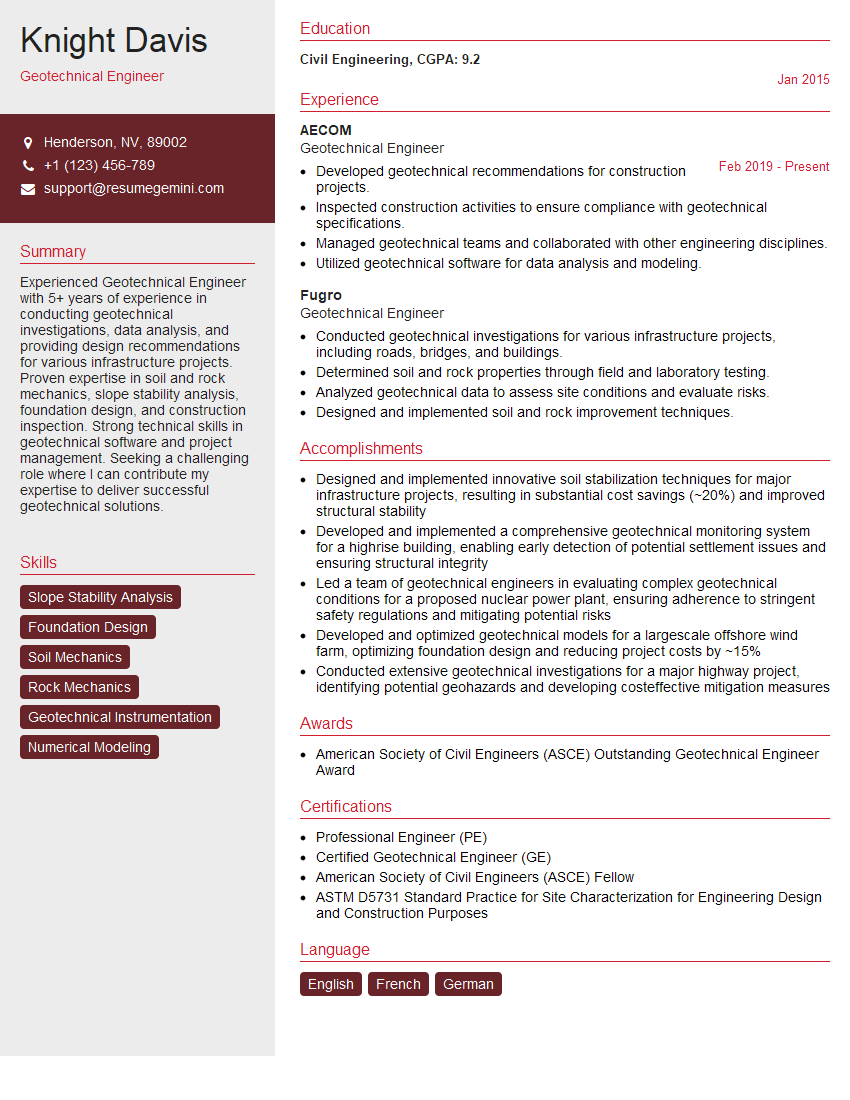
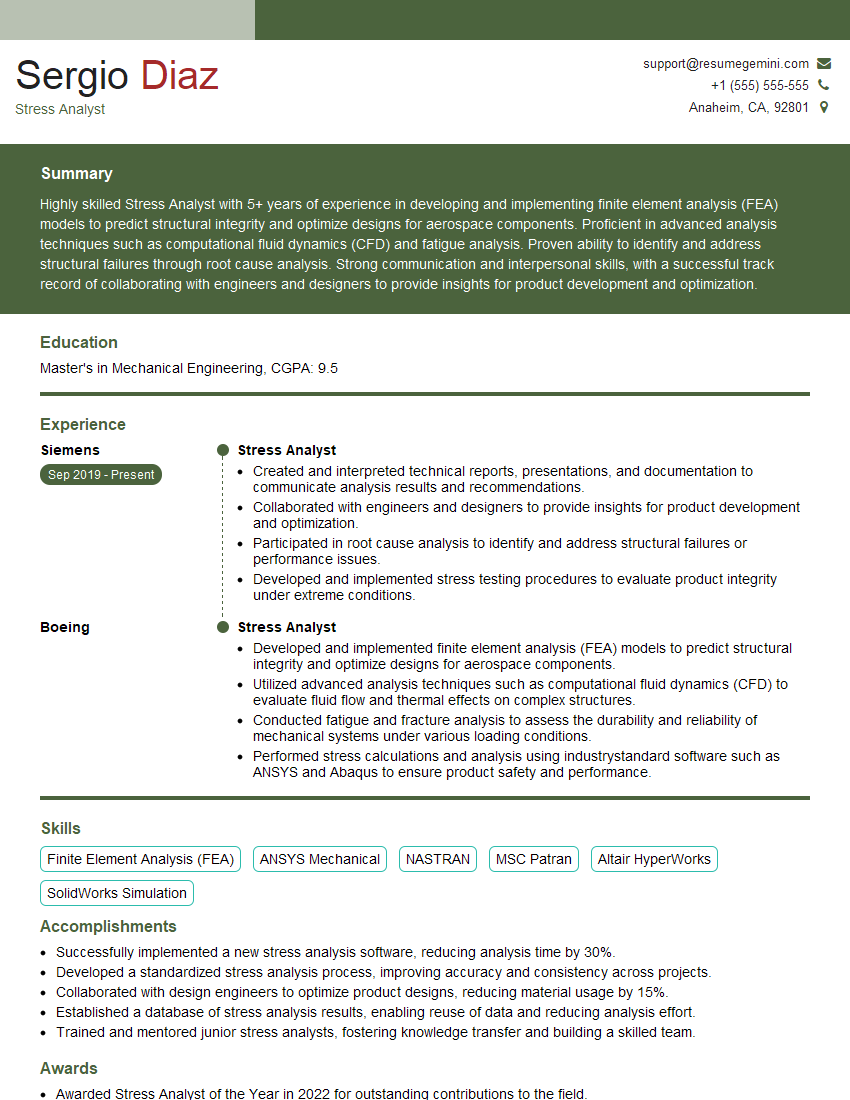
Mastering Structural Analysis and Finite Element Modeling opens doors to exciting career opportunities in aerospace, automotive, civil engineering, and many more fields. A strong understanding of these principles is highly sought after by employers. To maximize your job prospects, focus on creating an ATS-friendly resume that highlights your skills and experience effectively. ResumeGemini is a trusted resource to help you build a professional and impactful resume. Examples of resumes tailored to Structural Analysis and Finite Element Modeling are available to guide you in crafting the perfect application. Invest the time to create a compelling resume—it’s your first impression and a critical step in securing your dream job.

Explore more articles
Users Rating of Our Blogs
Share Your Experience
We value your feedback! Please rate our content and share your thoughts (optional).
What Readers Say About Our Blog
Very informative content, great job.
good