The thought of an interview can be nerve-wracking, but the right preparation can make all the difference. Explore this comprehensive guide to Structural Engineering Analysis interview questions and gain the confidence you need to showcase your abilities and secure the role.
Questions Asked in Structural Engineering Analysis Interview
Q 1. Explain the difference between static and dynamic analysis.
The core difference between static and dynamic analysis lies in how they treat the applied loads. Static analysis assumes that loads are applied slowly and gradually, with no significant acceleration or inertia effects. Think of slowly stacking books on a table – the table reacts to the increasing weight but without any sudden movements. The structural response is analyzed at equilibrium, meaning the forces are balanced at each point in time. This simplifies the analysis considerably.
Dynamic analysis, on the other hand, considers loads that change rapidly over time, introducing inertia and acceleration effects. Imagine dropping the books onto the table – the impact force is much higher, and the table’s response is far more complex and dynamic. Examples include earthquake loading, wind gusts, or the impact of a vehicle. This type of analysis needs to account for the time-varying nature of the loads and involves more computationally intensive methods, such as time-history analysis or modal analysis.
In essence: Static analysis is simpler, suitable for steady loads, and often provides a conservative estimate. Dynamic analysis is more complex, necessary for time-varying loads, and accounts for the inertial effects that can significantly impact structural behavior.
Q 2. Describe your experience with Finite Element Analysis (FEA) software.
I have extensive experience using various FEA software packages, including ANSYS, ABAQUS, and SAP2000. My proficiency extends beyond simple model building; I’m adept at mesh generation, material model selection, boundary condition definition, load application, and result interpretation and validation. For instance, in a recent project involving a high-rise building design, I used ABAQUS to perform a comprehensive nonlinear dynamic analysis under seismic loading conditions. This involved creating a detailed 3D model of the building, incorporating complex material models for concrete and steel, defining appropriate boundary conditions to simulate soil-structure interaction, and applying seismic ground motions to evaluate the building’s response. The results were instrumental in optimizing the structural design to meet seismic safety standards.
Beyond specific software, my expertise lies in understanding the underlying FEA principles and applying them effectively. This allows me to choose the appropriate software and techniques for a given project and interpret results with critical judgment.
Q 3. What are the different types of structural elements used in analysis?
Structural elements in FEA are simplified representations of real-world components. Common types include:
- Trusses: These consist of interconnected members subjected to axial forces only (tension or compression). Think of a simple bridge or roof truss.
- Beams: These are members that primarily resist bending moments and shear forces. Examples include floor joists or building columns.
- Frames: These are assemblages of beams and columns, capable of resisting axial, bending, and shear forces. Typical in buildings and frameworks.
- Shells: These are 2D elements used to model thin curved surfaces like roofs or tanks, considering bending and membrane stresses.
- Solids: These are 3D elements used to model thicker components where 3D stress variations are important. This is often used for complex geometries.
- Link elements: These represent connections with specific stiffness characteristics and are used to model joints, bearings, or other components.
The selection of appropriate elements depends on the geometry, material properties, and the loading conditions of the structure. A careful choice is crucial for obtaining accurate results.
Q 4. How do you handle uncertainties and assumptions in structural analysis?
Uncertainties and assumptions are inherent in any structural analysis. Handling them effectively involves a combination of engineering judgment, probabilistic methods, and sensitivity analysis. We address uncertainties by:
- Defining load factors: Loads (dead, live, wind, seismic) are rarely precisely known. We use load factors, derived from codes and standards, to increase the design loads and account for variations.
- Material property variations: Material strengths vary, and we use partial safety factors on the material properties to consider this uncertainty.
- Probabilistic analysis: Techniques like Monte Carlo simulations can account for the probability distributions of various input parameters (loads, materials) to obtain a probabilistic assessment of the structural response.
- Sensitivity analysis: This involves systematically varying input parameters and observing their effect on the output. This helps to identify critical parameters requiring more detailed investigation or stricter controls.
- Code compliance checks: Comparing the analytical results with the requirements of relevant building codes is crucial to ensure safety.
Experienced engineers understand the significance of uncertainties and employ a combination of these methods to create robust and safe designs that account for inevitable variations.
Q 5. Explain the concept of load path in structural design.
The load path describes how loads are transferred from the point of application through the structural system to the ultimate support. Imagine a simple house: the roof load is initially transferred to the rafters, then to the supporting walls, and finally to the foundation, which transmits the load to the soil. Understanding the load path is critical for effective design. A properly designed structure efficiently guides the loads through the chosen path, minimizing stresses and deformations.
Designing around a clear and efficient load path avoids stress concentrations and potential failure points. A poorly designed load path might overload specific members or lead to unexpected behavior. For example, neglecting a proper load path in a multi-story building can lead to disproportionate forces on some columns or foundations and increased risk of collapse.
Q 6. What are the common methods for determining the ultimate strength of a structural member?
Determining the ultimate strength of a structural member involves considering different failure modes. Common methods include:
- Limit state design: This method, widely used in modern codes, focuses on preventing specific failure modes (e.g., yielding, buckling, fracture) by comparing the predicted strength with the design loads, accounting for safety factors.
- Plastic analysis: This assumes that some parts of the structure can reach their yield point without causing overall collapse. It’s often used for ductile materials like steel to predict the ultimate load-carrying capacity.
- Nonlinear FEA: Sophisticated FEA models, using nonlinear material models and considering geometric nonlinearities, can accurately predict the ultimate strength and failure mode by simulating the structural behavior up to collapse.
- Experimental testing: Physical testing of specimens or even full-scale structures provides empirical data that validates analytical predictions and improves our understanding of structural behavior under extreme loads.
The choice of method depends on the material, member type, and the level of accuracy required. For instance, a simple beam might be adequately assessed using limit state design equations, while a complex structure would benefit from nonlinear FEA.
Q 7. Describe your experience with different material models (e.g., steel, concrete, timber).
My experience encompasses various material models, including:
- Steel: I’m proficient in using both linear elastic and elastoplastic models for steel, including considerations of strain hardening and yielding. I have used this knowledge extensively in the design of steel structures, including bridges, buildings and industrial structures.
- Concrete: I understand the complex behavior of concrete, including its nonlinear stress-strain relationship, cracking, and confinement effects. I have experience using models like the Modified Compression Field Theory (MCFT) in FEA to accurately predict the behavior of reinforced concrete members.
- Timber: I understand the orthotropic nature of timber (different strength properties in different directions) and use appropriate material models that consider the influence of grain orientation and moisture content. This is critical for accurate modelling of timber structures.
The choice of material model directly impacts the accuracy of the analysis. For example, using a linear elastic model for concrete under high loads will overestimate its capacity significantly. Selecting and accurately implementing the appropriate material model is crucial for obtaining realistic and reliable results.
Q 8. How do you account for seismic loads in structural design?
Accounting for seismic loads in structural design is crucial for ensuring the safety and stability of structures in earthquake-prone regions. We achieve this primarily through a dynamic analysis, considering the structure’s response to ground motion. This isn’t a simple calculation; it involves understanding the specifics of the site’s seismicity (obtained from geological surveys and hazard maps), defining the building’s dynamic properties (mass, stiffness, damping), and then using sophisticated software to simulate the structure’s response to various earthquake scenarios.
The process typically involves:
- Seismic Hazard Analysis: Determining the expected ground motion intensity at the site based on historical data and geological conditions. This often involves using probabilistic seismic hazard analysis (PSHA) to consider the uncertainty in earthquake occurrence.
- Structural Modeling: Creating a detailed computer model of the structure, incorporating material properties, geometry, and boundary conditions. This might be a 3D model using finite element analysis (FEA) software.
- Response Spectrum Analysis: A common approach that uses a response spectrum, which shows the maximum response of a single-degree-of-freedom system (like a simple mass-spring system) to a particular earthquake record. This allows us to determine the maximum forces and displacements at various points in the structure.
- Time History Analysis: A more detailed method that uses actual recorded earthquake accelerograms (ground motion recordings). This provides a more accurate representation of the structure’s dynamic behavior, particularly for irregular structures or those subjected to complex ground motions.
- Design for Strength and Ductility: The analysis results are used to design members capable of resisting the calculated seismic forces. Important considerations are the strength of individual elements and the overall ductility of the structure, which allows it to deform significantly without collapsing.
For example, in designing a high-rise building in a seismic zone, I would use a combination of response spectrum analysis and time history analysis to ensure that the structure meets the required safety factors defined in the relevant building codes (such as ASCE 7 in the US or Eurocode 8 in Europe). The results will dictate the size and detailing of structural elements like columns, beams, and shear walls, ensuring they can withstand the anticipated earthquake forces.
Q 9. Explain the concept of buckling in columns.
Buckling in columns refers to a sudden and often catastrophic sideways failure that occurs when a slender column is subjected to a compressive load. Imagine pushing on a perfectly straight straw: at a certain point, it will suddenly bend and collapse, even though the applied force might seem relatively small. This is buckling.
The phenomenon is governed by the column’s slenderness ratio (the ratio of its effective length to its least radius of gyration). A higher slenderness ratio means a greater susceptibility to buckling. Euler’s formula provides a theoretical critical load (the load at which buckling initiates) for an ideal column:
Pcr = (π²EI) / (KL)²Where:
Pcris the critical buckling loadEis the modulus of elasticity of the column materialIis the area moment of inertia of the column cross-sectionLis the effective length of the column (depends on the end conditions)Kis the effective length factor (accounts for end conditions)
In practice, columns are not perfectly straight or homogeneous, and imperfections will cause them to buckle under loads less than the Euler critical load. Therefore, design codes often incorporate factors of safety to account for these imperfections and ensure a safe design. Effective bracing and careful selection of column cross-sections are crucial to mitigate buckling.
For instance, in a tall building, preventing column buckling is essential. We may use a combination of techniques, such as choosing high-strength steel, increasing column cross-sectional area, providing lateral bracing, and using a robust structural system that can redistribute the load effectively in case of minor buckling in one column.
Q 10. What are the different types of boundary conditions used in structural analysis?
Boundary conditions define how a structure interacts with its surroundings. They specify the constraints on the displacement and/or forces at the structure’s edges or supports. Accurate boundary conditions are essential for accurate structural analysis results. Common types include:
- Fixed Support: A completely restrained support that prevents all movement (translation and rotation) in all three directions (x, y, and z). Think of a column fixed firmly into a concrete foundation.
- Pinned Support (Hinged Support): Allows rotation but prevents translation in all directions. This is analogous to a hinge. Imagine a beam resting on a pin at one end.
- Roller Support: Allows translation in one direction but prevents translation in other directions and rotation. Think of a beam resting on a roller, allowing movement along the support surface.
- Free End: No constraints on displacement or rotation. This is a completely unrestrained end.
- Guided Support (Sliding Support): Allows translation in one direction but prevents translation in other directions and rotation. A good example is a column guided on a track allowing movement along its axis.
The choice of appropriate boundary conditions directly affects the results of a structural analysis. For example, modeling a beam with fixed supports instead of pinned supports will lead to significantly different bending moments and reactions. Therefore, careful consideration of the actual support conditions is crucial for obtaining accurate and reliable results.
Q 11. How do you verify the accuracy of your structural analysis results?
Verifying the accuracy of structural analysis results is a critical aspect of ensuring structural integrity. We employ various methods, including:
- Comparison with Hand Calculations: For simpler structures, I perform hand calculations to check against the software’s output for key parameters such as reactions, moments, and deflections. This serves as a sanity check.
- Mesh Sensitivity Analysis: For FEA, refining the mesh (reducing the element size) and observing the convergence of results is essential. If results change significantly with mesh refinement, it indicates potential inaccuracies in the model or analysis.
- Independent Software Verification: Running the analysis in different software packages can help identify errors or inconsistencies that may be specific to a particular software. This comparison provides valuable cross-validation.
- Code Checks: Ensuring the design meets all relevant code requirements (ASCE 7, Eurocode, etc.) is paramount. The code provides established limits and safety factors that must be adhered to.
- Peer Review: Having a colleague review the analysis, model, and results helps detect potential mistakes and improves the overall quality assurance.
- Experimental Validation: Where possible, comparing analysis results with physical testing data (e.g., from laboratory experiments on scaled models) can provide a strong validation of the analysis.
For instance, in analyzing a complex bridge structure, I would perform mesh sensitivity studies, compare results from different FEA software, check code compliance, and potentially review it with a colleague with bridge design experience. I would also look for discrepancies between results and investigate the potential sources of error. Only after careful consideration and cross-validation, would I consider the results reliable.
Q 12. Describe your experience with code compliance (e.g., ASCE 7, Eurocode).
I have extensive experience with code compliance, primarily using ASCE 7 (American Society of Civil Engineers) and Eurocode for seismic design. My experience goes beyond simple compliance; I understand the underlying philosophy and rationale behind the code provisions. This allows me to make informed design decisions and justify engineering choices.
Understanding these codes involves more than just looking up numbers in tables. It requires deep comprehension of the various load combinations, design factors, and detailing requirements. I have been involved in projects across the spectrum, ranging from small residential structures to large industrial facilities. For each project, I diligently check against all relevant code provisions, considering aspects such as:
- Load Combinations: Applying appropriate load combinations as per the code to capture the effects of dead loads, live loads, wind loads, seismic loads, etc.
- Strength and Serviceability Limits: Ensuring that the structural elements satisfy both strength and serviceability limit states, ensuring not just structural integrity but also functionality and avoiding excessive deflections.
- Ductility and Detailing Requirements: Paying particular attention to code-specified detailing requirements, particularly for ductile design in seismic zones. This is crucial in preventing brittle failure and ensuring the structure’s ability to withstand significant deformations during an earthquake.
- Material Properties: Using appropriate material properties from recognized standards.
I’m also familiar with the nuances of these codes and how they are interpreted and applied in practice. I understand that a strict, literal interpretation isn’t always appropriate and that engineering judgment must be applied to account for unique design challenges.
Q 13. Explain the concept of structural detailing and its importance.
Structural detailing is the process of specifying the precise dimensions, connections, and fabrication techniques for structural elements. It bridges the gap between the analysis results and the actual construction. While structural analysis determines the sizes and capacities required, detailing ensures that these members are properly connected and built to perform as intended.
Its importance cannot be overstated. Poor detailing can compromise even the most well-analyzed design. Imagine a perfectly designed beam that is poorly connected to the supporting columns—the whole structure’s integrity would be at risk. Key aspects of structural detailing include:
- Connection Design: Specifying the type and strength of connections (welds, bolts, rivets, etc.) to ensure adequate transfer of forces.
- Member Details: Defining precise dimensions, shapes, and reinforcement arrangements for concrete and steel members.
- Fabrication Drawings: Providing clear and accurate drawings for fabrication purposes.
- Construction Tolerances: Accounting for potential variations during construction and specifying tolerances to ensure the structure meets design requirements.
- Code Compliance: Ensuring detailing practices comply with all relevant building codes and standards.
For example, in designing a steel structure, proper detailing includes specifying the type of welds, bolt sizes and patterns, and detailing the connections at the base of the column to ensure adequate transfer of forces. Similarly, in designing a concrete structure, proper detailing entails the specific reinforcement placement, detailing of the connection between beams and columns, and proper detailing of the foundation. Proper detailing is crucial to the ultimate success of the project and ensures safe and reliable performance.
Q 14. What are the limitations of linear elastic analysis?
Linear elastic analysis, a common approach in structural analysis, assumes that the material behaves linearly (stress is proportional to strain) and elastically (it returns to its original shape after load removal). While efficient and widely applicable, it has limitations:
- Material Non-linearity: Many materials exhibit non-linear behavior, particularly at high stresses. Concrete, for example, demonstrates non-linear stress-strain behavior, and steel may yield beyond its elastic limit. Linear analysis cannot capture these effects, which may lead to underestimation of deflections or even failure.
- Geometric Non-linearity: Large displacements or rotations can alter the structure’s geometry significantly. Linear analysis assumes small displacements, which is often violated in flexible structures or under significant loads. Ignoring geometric non-linearity can lead to inaccurate estimations of stress and deformation.
- Fracture and Failure: Linear elastic analysis does not consider the failure mechanisms of materials. It cannot predict when or how a structure might fail (e.g., cracking in concrete, yielding in steel).
- Creep and Relaxation: Some materials exhibit time-dependent deformation (creep) or stress relaxation. Linear elastic analysis cannot directly account for these effects.
- Impact Loads: Linear analysis is generally unsuitable for impact loading situations (e.g., collisions or explosions) which involve high strain rates and dynamic effects.
For instance, analyzing a long-span bridge under its own weight would benefit from consideration of geometric nonlinearity, as significant deflections can impact the internal stresses. Similarly, analyzing a concrete structure under earthquake loads needs to consider the material non-linearity, accounting for concrete cracking. For scenarios where these limitations are significant, non-linear analysis techniques must be employed.
Q 15. How do you model non-linear behavior in structural analysis?
Modeling non-linear behavior in structural analysis is crucial for accurately predicting the response of structures under extreme loads or when material properties change significantly. Unlike linear analysis, which assumes a proportional relationship between load and displacement, non-linear analysis accounts for effects like material non-linearity (e.g., plasticity, cracking), geometric non-linearity (large displacements, significant changes in geometry), and contact non-linearity (interactions between different structural elements).
Material Non-linearity: This is modeled using constitutive models that describe the stress-strain relationship beyond the elastic limit. For concrete, models like the Modified Compression Field Theory (MCFT) or concrete damage plasticity models are used. For steel, plasticity models with yield criteria (e.g., von Mises) are employed. These models capture the material’s behavior under yielding and failure.
Geometric Non-linearity: This accounts for changes in the structure’s stiffness due to large displacements or rotations. Imagine a slender column buckling – its stiffness changes dramatically as it bends. Geometric non-linearity incorporates these changes into the analysis. Software often uses iterative solution techniques to account for these evolving geometric configurations.
Contact Non-linearity: This involves modeling interactions between structural components, such as the contact between a foundation and a building. Special algorithms are needed to handle the opening and closing of contact interfaces during the analysis. This often involves sophisticated techniques to prevent numerical instability.
Implementation: Non-linear analysis is usually performed using the Finite Element Method (FEM) with iterative solution procedures (e.g., Newton-Raphson). The analysis involves multiple steps and iterations to converge to a solution, as the stiffness matrix changes throughout the process.
Career Expert Tips:
- Ace those interviews! Prepare effectively by reviewing the Top 50 Most Common Interview Questions on ResumeGemini.
- Navigate your job search with confidence! Explore a wide range of Career Tips on ResumeGemini. Learn about common challenges and recommendations to overcome them.
- Craft the perfect resume! Master the Art of Resume Writing with ResumeGemini’s guide. Showcase your unique qualifications and achievements effectively.
- Don’t miss out on holiday savings! Build your dream resume with ResumeGemini’s ATS optimized templates.
Q 16. Explain your experience with different analysis techniques (e.g., linear, non-linear, dynamic).
My experience encompasses a wide range of structural analysis techniques. I’ve extensively used linear analysis for preliminary design and for situations where the loads and deformations remain within the elastic range of the materials. Linear analysis is efficient, but it has limitations when dealing with significant non-linearities.
Non-linear analysis forms a significant part of my expertise. I have experience with both material and geometric non-linearity, employing various constitutive models and iterative solution techniques. For instance, I’ve used non-linear analysis to model the behavior of reinforced concrete structures subjected to seismic loads, accurately predicting crack propagation and ultimate load capacity. This involved using advanced concrete constitutive models within FEA software.
Dynamic analysis is another key area of my expertise. I have experience performing both linear and non-linear dynamic analyses, using techniques like time-history analysis and response spectrum analysis to assess the structural response to dynamic loads such as earthquakes or wind gusts. This often requires careful consideration of damping effects and soil-structure interaction.
For example, in one project involving a tall building design, I used response spectrum analysis to determine the building’s response to a design-basis earthquake. This informed the design of the structural system to ensure adequate seismic performance.
Q 17. Describe your experience working with different structural software packages.
I am proficient in several leading structural analysis software packages. My primary experience is with ABAQUS, known for its robust capabilities in non-linear analysis and its ability to handle complex material models and boundary conditions. I’ve also worked extensively with SAP2000, a widely used software for linear and non-linear analysis of buildings and other structures. My experience includes using ETABS for building analysis and design and RISA-3D for 3D modeling and analysis.
Beyond these, I possess familiarity with other specialized software packages, which enables me to adapt to various project requirements and leverage the strengths of each software. The choice of software often depends on the specific project needs, considering factors such as the complexity of the geometry, material models required, and the type of analysis needed.
Q 18. How do you deal with complex geometry in FEA?
Handling complex geometry in FEA requires a strategic approach. Simply throwing a mesh at a complex geometry without careful consideration often results in a computationally expensive and potentially inaccurate analysis. Therefore, my approach involves:
- Geometry Simplification: Where feasible, I simplify complex geometries by approximating curved surfaces with simpler shapes (e.g., a series of planes) while maintaining accuracy within an acceptable tolerance. This reduces the computational burden without sacrificing much accuracy.
- Adaptive Meshing: I often use adaptive meshing techniques where the mesh density is automatically adjusted based on the solution’s gradients. This concentrates finer mesh elements in regions of high stress gradients or large curvature, improving accuracy where it matters most.
- Meshing Software Expertise: I’m skilled in using specialized meshing software (e.g., HyperMesh) for pre-processing complex geometries. This allows me to create high-quality meshes tailored to the specific problem, ensuring accurate stress and displacement fields.
- Structured vs. Unstructured Meshes: The choice between structured and unstructured meshes depends on the geometry. Structured meshes are easier to create for simple geometries, while unstructured meshes are more flexible and better suited for complex geometries.
For example, when analyzing a bridge deck with complex curvatures, I would use a combination of geometry simplification, adaptive meshing, and a specialized meshing program to ensure an accurate and efficient FEA analysis.
Q 19. How do you select appropriate mesh density for FEA?
Selecting appropriate mesh density in FEA is a critical aspect of obtaining accurate results. Too coarse a mesh can lead to inaccurate results, while too fine a mesh unnecessarily increases computational time and resources. My approach involves:
- Mesh Convergence Studies: I perform mesh convergence studies by systematically refining the mesh and observing the changes in the results (stress, displacement). The process continues until the results converge to a stable value within an acceptable tolerance, ensuring the mesh is sufficiently refined.
- Element Size Considerations: I base the element size on the geometry’s features and the anticipated stress gradients. Regions with high stress concentrations or rapid geometry changes typically require finer meshes.
- Element Type Selection: The choice of element type (e.g., linear or quadratic elements) affects the accuracy and computational cost. Higher-order elements generally provide greater accuracy but require more computational resources.
- Experience-Based Guidelines: Years of experience have provided me with rules of thumb for element size based on the characteristic dimensions of the structure and the anticipated stress levels.
In practice, for instance, while modeling a pressure vessel, I might employ a finer mesh around welds and areas with potential stress concentrations, while utilizing a coarser mesh in areas where stress levels are expected to be lower.
Q 20. Explain the concept of modal analysis.
Modal analysis is a technique used to determine the natural frequencies and mode shapes of a structure. These natural frequencies represent the frequencies at which the structure will vibrate freely if disturbed. The mode shapes illustrate the displacement pattern of the structure at each natural frequency.
Concept: Imagine a guitar string. It vibrates at specific frequencies depending on its tension, length, and mass. Similarly, structures have multiple natural frequencies at which they tend to vibrate. Understanding these frequencies is critical, as they can be excited by external forces (e.g., wind, earthquake). If an external force’s frequency matches a structure’s natural frequency, resonance can occur, leading to amplified vibrations and potential damage.
Applications: Modal analysis is crucial for:
- Earthquake Engineering: Identifying the structure’s vulnerability to earthquake excitation.
- Wind Engineering: Assessing the structure’s susceptibility to wind-induced vibrations.
- Machine Design: Determining the resonant frequencies of machinery to avoid excessive vibration.
- Structural Health Monitoring: Detecting changes in the structure’s natural frequencies that may indicate damage.
The analysis involves solving an eigenvalue problem, which yields the natural frequencies (eigenvalues) and corresponding mode shapes (eigenvectors). Software packages typically automate this process.
Q 21. How do you handle load combinations in structural design?
Handling load combinations in structural design is critical for ensuring the structure’s safety and serviceability. Building codes (e.g., ASCE 7, Eurocode) specify load combinations to consider various loading scenarios simultaneously, reflecting realistic conditions. The objective is to determine the most critical combination that leads to the highest stresses and displacements.
Load Combinations: Load combinations typically include:
- Dead Load (D): The weight of the structure itself.
- Live Load (L): Variable loads, such as occupancy loads, furniture, and snow loads.
- Wind Load (W): Forces exerted by wind.
- Seismic Load (E): Forces generated by earthquakes.
- Other Loads: Such as rain, snow, temperature changes, etc.
Combination Methods: Codes prescribe different methods for combining loads. These often involve factors to account for the probability of different loads occurring simultaneously. A common approach is to use linear combinations such as:
1.4D (Dead Load Factor = 1.4)
1.2D + 1.6L (Dead Load Factor = 1.2, Live Load Factor = 1.6)
1.2D + 1.6W (Dead Load Factor = 1.2, Wind Load Factor = 1.6)
The software automatically calculates these combinations and identifies the most critical one for design.
Software and Calculations: Structural analysis software automatically performs load combinations as per the specified code provisions. The results are then used for sizing structural members to satisfy the design criteria.
Q 22. What are the different types of failure modes in structures?
Structural failures can be broadly categorized into several modes, each stemming from different causes and mechanisms. Understanding these modes is crucial for effective structural design and preventing catastrophic events.
- Tensile Failure: This occurs when a material is subjected to excessive pulling forces, leading to elongation and eventual fracture. Think of a rope snapping under too much weight. In concrete, this typically manifests as cracking in tension zones.
- Compressive Failure: This happens when a material is subjected to excessive squeezing forces, causing crushing or buckling. A classic example is a column collapsing under its own weight or excessive load. In concrete, this can lead to crushing of the concrete itself.
- Shear Failure: This involves failure due to forces acting parallel to a surface. Imagine trying to cut a piece of wood with a dull knife; the wood will fail in shear before it cleaves cleanly. In structures, shear failures are common in beams and connections.
- Flexural Failure (Bending Failure): This arises from bending moments causing a combination of tension and compression. Think of a bending ruler – the top is in compression, and the bottom in tension. Beams often fail in flexure.
- Torsional Failure: This occurs when a structure is subjected to twisting forces. This is less common than other failure modes but crucial in structures subject to significant torque, such as shafts or bridge decks.
- Fatigue Failure: This occurs when a structure is subjected to repeated cycles of loading and unloading, eventually leading to crack initiation and propagation. Bridge components and aircraft structures are susceptible to fatigue.
- Buckling Failure: This happens when a slender structural member under compressive load loses its stability and bends laterally. Think of a long, thin column bending under its own weight. This is a stability issue.
Identifying the potential failure modes for a given structure is a key part of risk assessment and design optimization. Design codes and standards often explicitly address these failure modes.
Q 23. How do you perform a serviceability analysis?
Serviceability analysis focuses on ensuring a structure remains functional and aesthetically pleasing throughout its lifespan. It goes beyond just preventing collapse and considers factors that impact the user experience. This analysis usually involves assessing:
- Deflections: Excessive deflections can cause cracking in finishes, impact the aesthetics, and even compromise the functionality of the structure (e.g., excessive floor deflection making it uncomfortable to walk on).
- Vibrations: Excessive vibrations can be uncomfortable or even damaging to sensitive equipment. This is particularly important in structures like bridges and tall buildings.
- Crack Widths: In concrete structures, controlling crack widths is crucial to prevent corrosion of the reinforcement and maintain the structural integrity and visual appeal.
- Story Drift: This refers to the lateral displacement of one floor relative to another in multi-story buildings. Excessive drift can create discomfort for occupants and damage non-structural elements.
The process typically involves using analytical models, often simplified compared to ultimate limit state analysis, to predict these serviceability criteria under various loading scenarios. Limit states are defined for these criteria, and the analysis must ensure the predicted performance stays within these limits. For example, codes may specify maximum permissible deflections as a fraction of the span length of a beam.
Q 24. Explain the concept of drift and its importance in structural design.
Drift, in structural engineering, refers to the lateral displacement of a structure, typically in tall buildings or other laterally loaded structures. It’s expressed as a ratio of the lateral displacement to the height of the structure. Understanding and managing drift is paramount for several reasons:
- Occupant Comfort: Excessive drift can make occupants uncomfortable, causing a swaying or unsettling feeling. This is especially true in high-rise buildings during wind events.
- Non-structural Damage: Large drift can damage non-structural elements like partitions, cladding, and finishes, leading to costly repairs.
- Structural Integrity: In extreme cases, excessive drift can compromise the structural integrity of the building, potentially leading to collapse. This is why drift limits are specified in design codes.
Drift is controlled through careful structural design, including the selection of materials, the choice of structural system (e.g., braced frames, shear walls), and the provision of adequate stiffness. Structural analysis software is used to predict drift under different loading conditions, such as wind, seismic events, and live loads. The results are then compared against design code limits to ensure the structure meets serviceability requirements. For example, many design codes specify that the interstory drift should not exceed a certain percentage of the story height to ensure structural safety and prevent damage.
Q 25. Describe your experience with reinforcement detailing for concrete structures.
My experience with reinforcement detailing for concrete structures is extensive, encompassing various project types and design approaches. I’m proficient in using detailing software to create accurate and comprehensive reinforcement drawings that comply with relevant codes and standards.
My responsibilities have included:
- Developing reinforcement layouts: Creating detailed drawings illustrating the size, spacing, and placement of reinforcing bars in beams, columns, slabs, and foundations.
- Preparing bar bending schedules: Generating schedules specifying the length, shape, and quantity of each bar, facilitating efficient fabrication and construction.
- Ensuring code compliance: Adhering to local building codes, industry standards (like ACI 318 in the US or similar international standards), and client-specific requirements.
- Coordination with other disciplines: Collaborating with architects, structural engineers, and contractors to ensure the reinforcement design is integrated seamlessly into the overall project.
- Reviewing shop drawings: Checking fabricated reinforcement against the design specifications to ensure accuracy and quality.
I have a strong understanding of detailing principles, including aspects like lap lengths, bar spacing limitations, development length requirements, and detailing for various construction methods (e.g., cast-in-place vs. precast). I am also experienced in using BIM software to integrate reinforcement detailing into the overall 3D model.
Q 26. How do you manage and interpret analysis results effectively?
Effective management and interpretation of analysis results are critical for successful structural engineering. My approach involves a systematic process:
- Verification of Model: Before interpreting results, I carefully verify the accuracy of the analytical model, including geometry, material properties, boundary conditions, and loading scenarios. This ensures that the results reflect the actual structure.
- Review of Output: I systematically review the analysis output, paying close attention to key parameters like displacements, stresses, reactions, and internal forces. I use visualization tools (like contour plots and diagrams) to better understand the behavior of the structure.
- Code Check: I compare the calculated values to relevant design code limits. This helps determine whether the structure meets the required safety and serviceability criteria. Any violation of these limits requires further investigation and design modifications.
- Sensitivity Analysis: To understand the impact of uncertainties in input parameters, I often perform sensitivity analyses to gauge the robustness of the design. This helps to identify critical parameters and inform decisions about further investigation or design refinements.
- Documentation: I meticulously document the analysis process, including the assumptions, methods, results, and conclusions. This is crucial for communication with other engineers and stakeholders, as well as for future reference.
Using this structured approach ensures the analysis is thorough, the results are understood and interpreted correctly, and any necessary actions are identified promptly.
Q 27. Explain your approach to resolving discrepancies between analysis and design.
Discrepancies between analysis and design are inevitable in complex structural projects. My approach involves a systematic investigation to identify the root cause and determine the appropriate resolution:
- Identify the Discrepancy: First, I clearly define the nature and magnitude of the discrepancy. What are the specific parameters showing disagreement? What are the orders of magnitude of these discrepancies?
- Review the Analysis Model: I thoroughly review the analytical model, checking for errors in geometry, material properties, boundary conditions, loads, and the analysis itself. Were simplifications made in the model that may have significantly affected the results?
- Review Design Assumptions: I examine the design assumptions and check for any inconsistencies or errors. Were any simplifying assumptions made in the design phase that could explain the difference?
- Check Code Compliance: I confirm that both the analysis and design adhere to relevant design codes and standards. Are both using the same code and the same interpretation of that code?
- Iterative Refinement: Based on the findings, I refine either the analysis model or the design (or both) to resolve the discrepancy. This may involve iteratively modifying the model, adjusting design parameters, or selecting alternative design approaches. This is an iterative process; sometimes this requires numerous cycles of refinement before agreement is reached.
- Documentation: I carefully document the entire process, including the identification of the discrepancy, the investigation steps, the proposed solutions, and the final reconciled results. This helps to ensure transparency and maintain a clear record for future reference.
This methodical approach ensures that any discrepancies are thoroughly investigated and resolved, leading to a robust and reliable structural design.
Q 28. Describe a challenging structural analysis project you worked on and how you overcame the challenges.
One challenging project involved the structural analysis of a complex, irregularly shaped museum addition attached to an existing historical building. The challenge lay in the interaction between the new and existing structures, which had vastly different material properties and structural systems. The existing building had unpredictable stiffness and strength due to its age and lack of detailed construction drawings.
To overcome this, I implemented a multi-stage approach:
- Detailed Site Investigation: We conducted a thorough site investigation to assess the condition of the existing structure, including non-destructive testing to estimate the material properties.
- Advanced Modeling Techniques: I used advanced finite element analysis (FEA) techniques to model the complex geometry and material nonlinearities, accurately capturing the interaction between the new and existing structures.
- Substructuring: We employed substructuring techniques to simplify the model and improve computational efficiency. This involved creating separate models for the new addition and the existing building and then coupling them together.
- Iterative Refinement: We iteratively refined the model based on the analysis results and comparisons to existing conditions and the expected behavior.
- Collaboration and Communication: Close collaboration with the architects, historians, and construction team was essential to ensure that the design met both structural and preservation requirements.
Through this rigorous process, we successfully designed a structurally sound addition that complemented the existing building while respecting its historical significance. The project demonstrated my ability to adapt to complex challenges, utilize advanced analytical tools, and effectively manage a multidisciplinary team to deliver a successful outcome.
Key Topics to Learn for Structural Engineering Analysis Interview
- Statics and Equilibrium: Understanding forces, moments, and reactions in statically determinate and indeterminate structures. Practical application: Analyzing the stability of a bridge deck.
- Stress and Strain Analysis: Mastering concepts like stress, strain, elasticity, and plasticity. Practical application: Designing a column to withstand compressive loads.
- Structural Mechanics: Developing a strong grasp of beam theory, including bending moments, shear forces, and deflection calculations. Practical application: Analyzing the deflection of a floor beam under live load.
- Finite Element Analysis (FEA): Familiarizing yourself with the fundamentals of FEA and its application in structural analysis. Practical application: Modeling and analyzing complex structural systems using FEA software.
- Material Properties and Behavior: Understanding the mechanical properties of various construction materials (steel, concrete, timber) and their behavior under different loading conditions. Practical application: Selecting appropriate materials for a specific structural element based on strength and durability requirements.
- Load Combinations and Design Codes: Learning how to apply relevant building codes and standards to determine appropriate load combinations and design factors. Practical application: Ensuring the structural integrity of a building according to local regulations.
- Buckling and Stability Analysis: Understanding the principles of buckling and column stability. Practical application: Designing slender columns to prevent buckling failure.
- Dynamic Analysis: Gaining foundational knowledge of dynamic loading and vibration analysis. Practical application: Assessing the seismic response of a building structure.
Next Steps
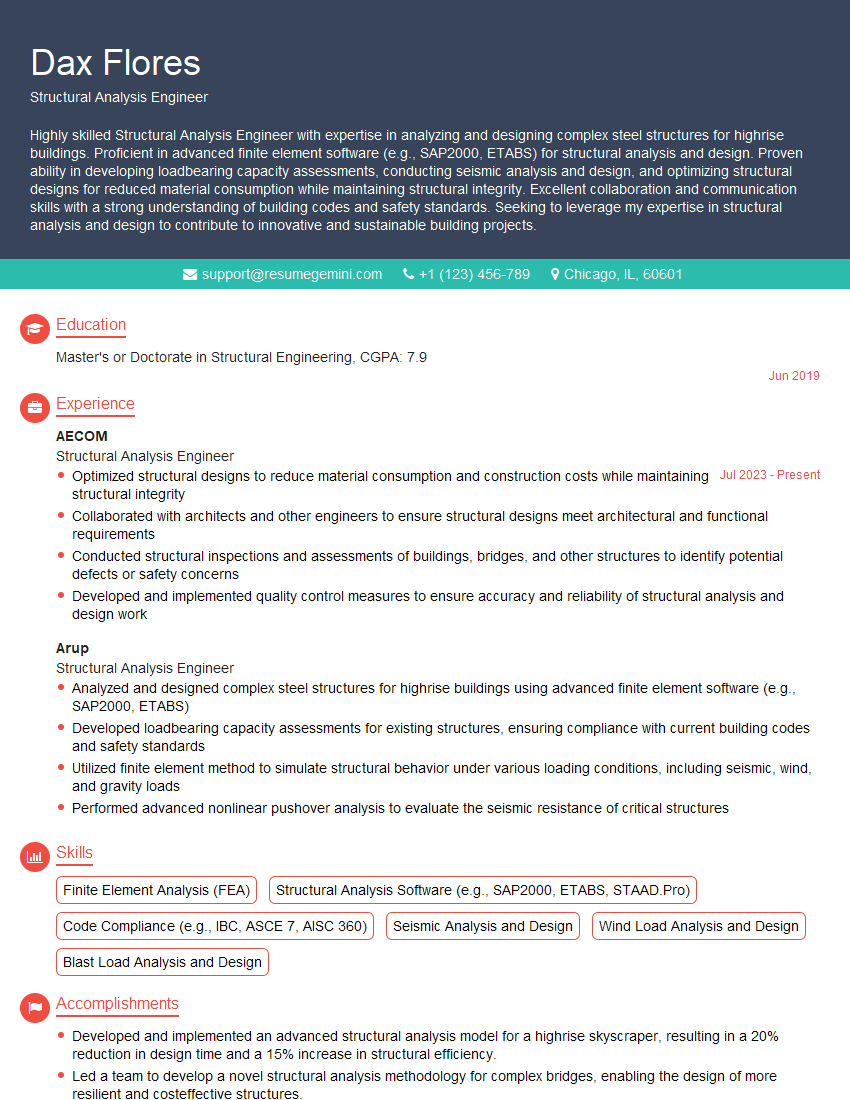
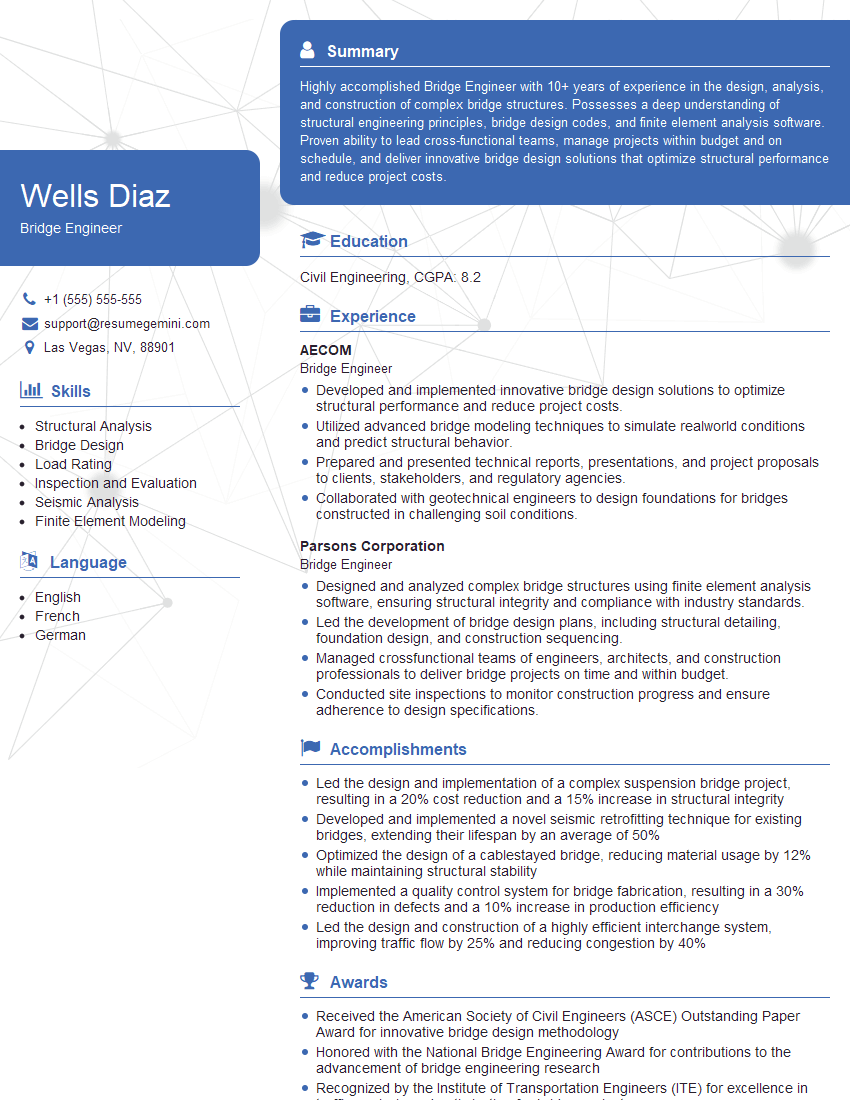
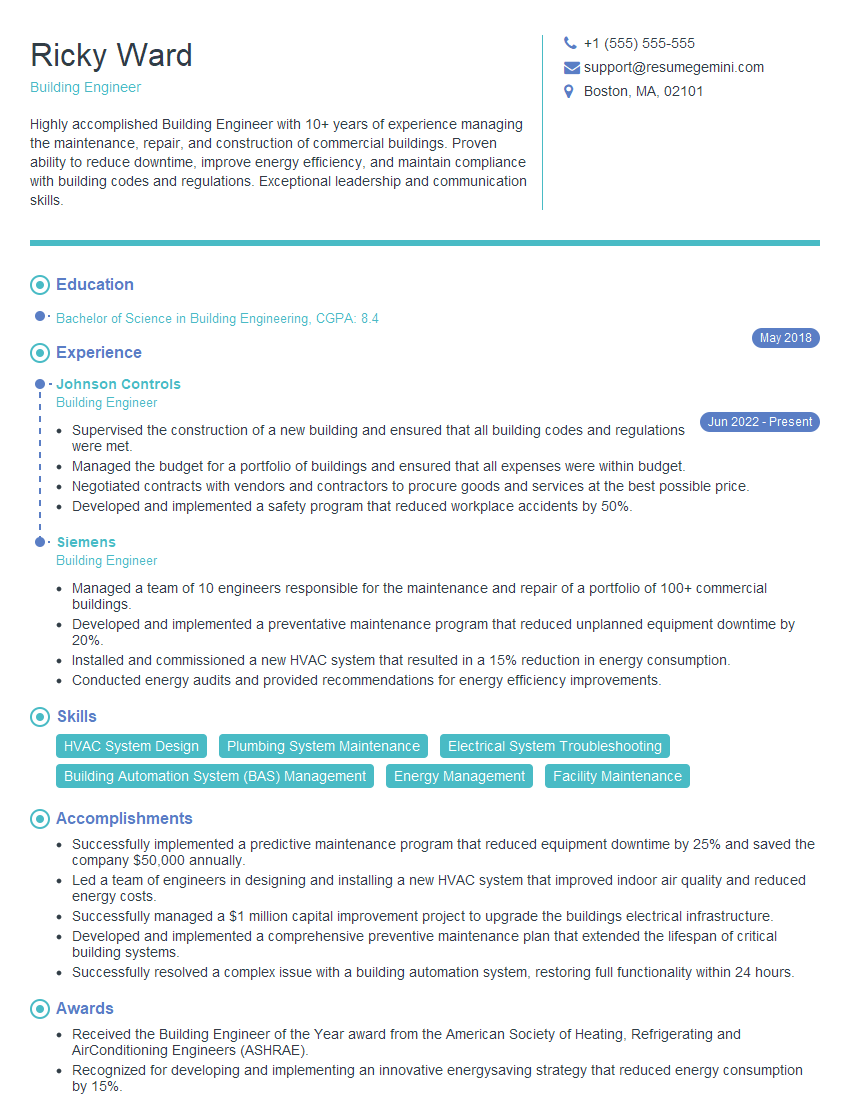
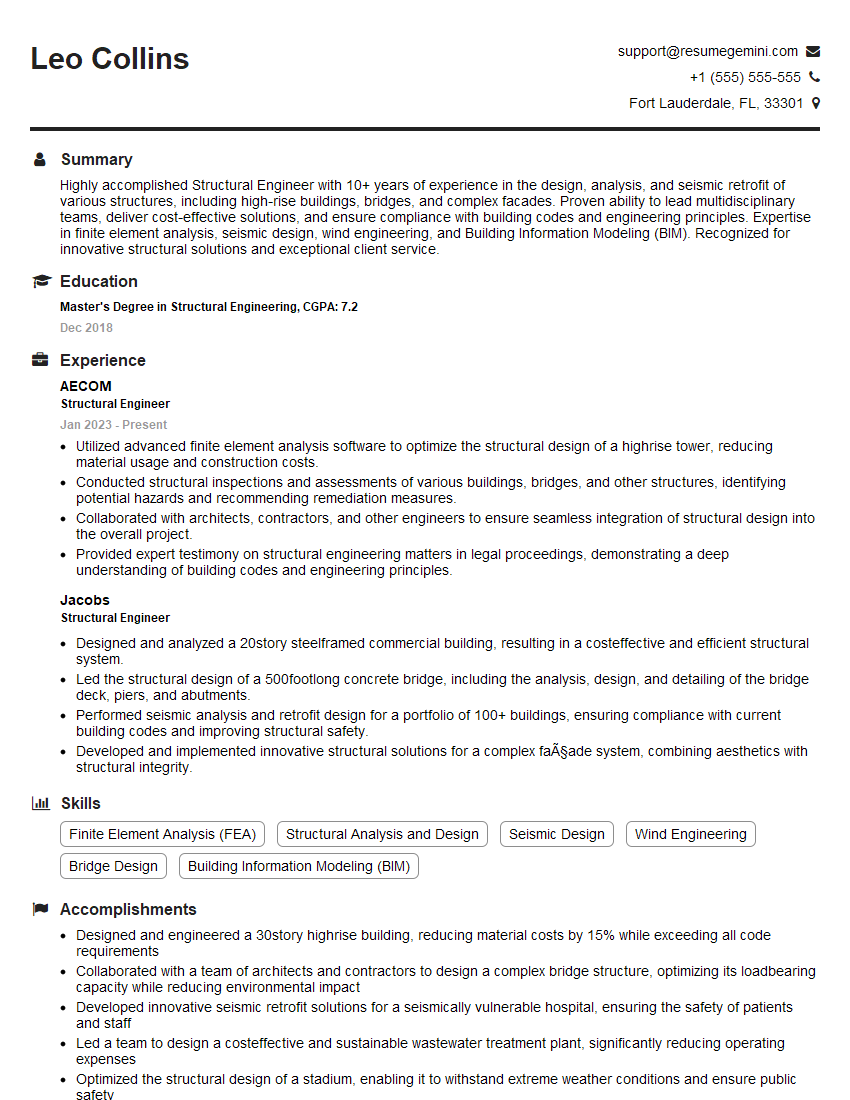
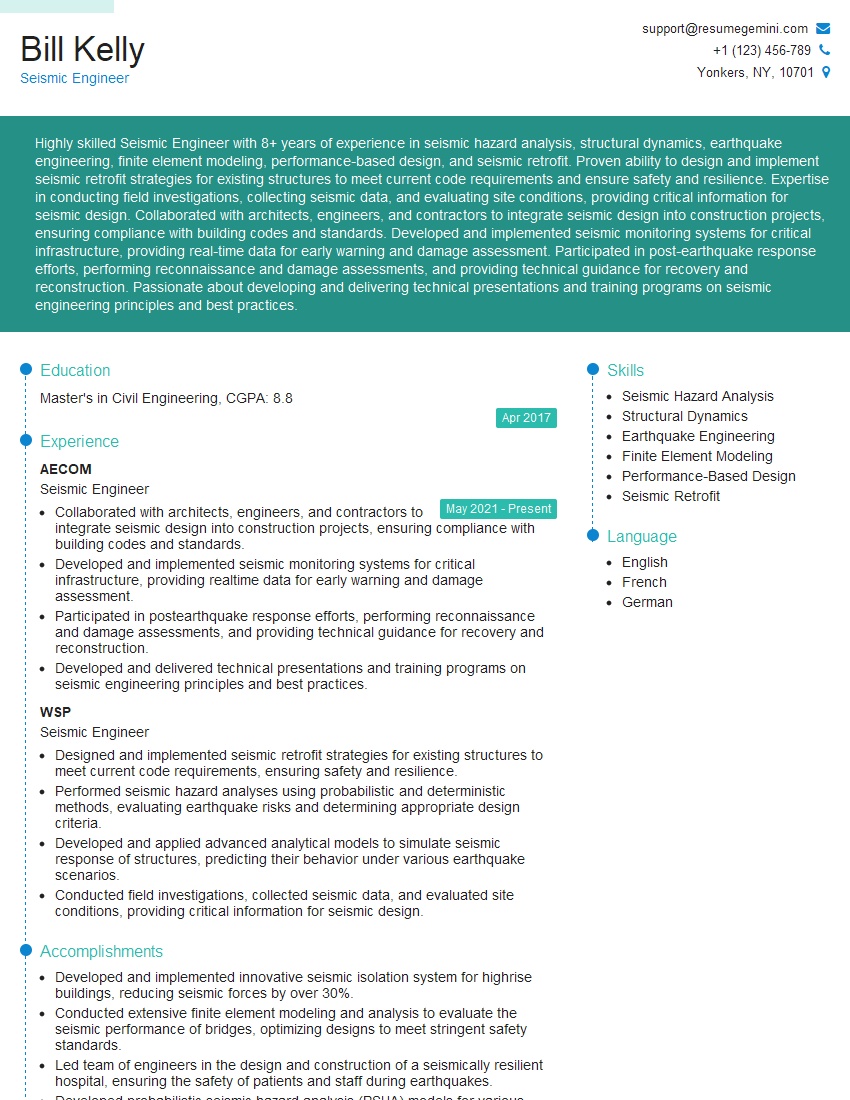
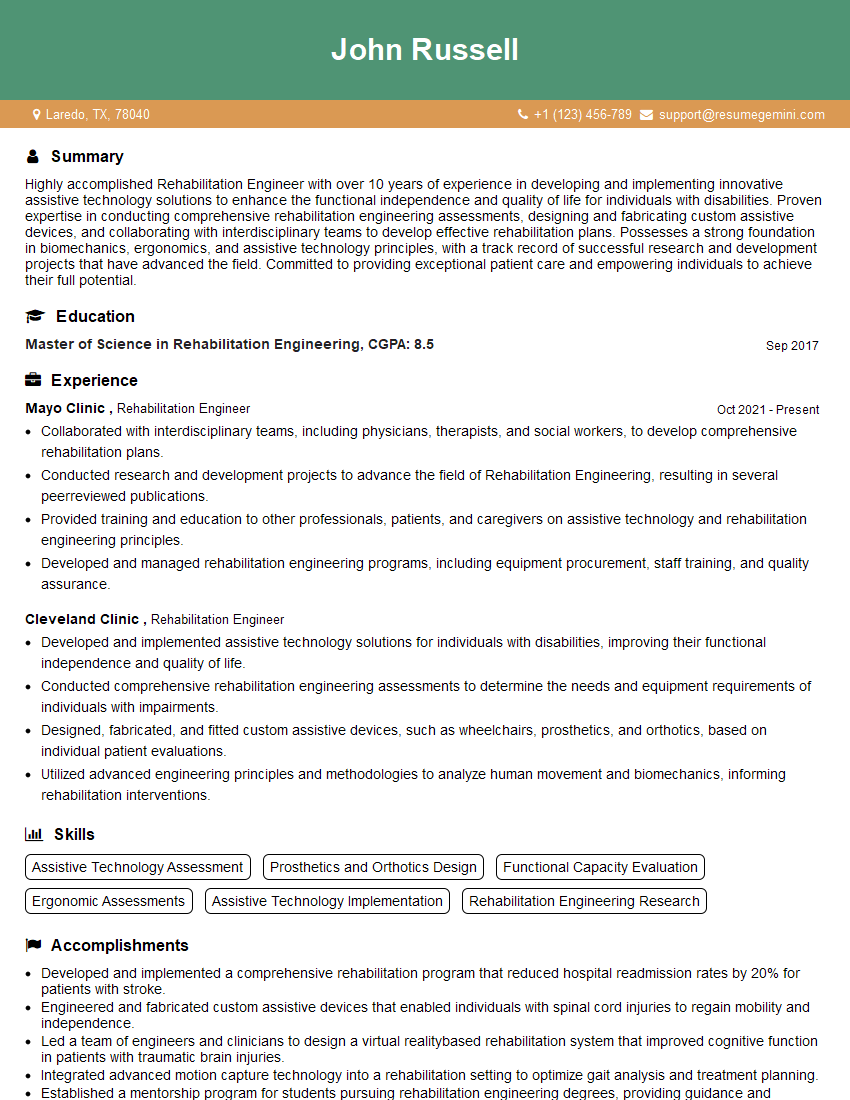
Mastering Structural Engineering Analysis is crucial for advancing your career and securing your dream role. A strong understanding of these concepts demonstrates your technical expertise and problem-solving abilities to potential employers. To significantly increase your chances of landing your target position, crafting a compelling and ATS-friendly resume is essential. ResumeGemini can be your trusted partner in this process. Leverage their expertise to build a professional resume that showcases your skills effectively. Examples of resumes tailored to Structural Engineering Analysis are available to guide your creation, giving you a significant advantage in the job market.

Explore more articles
Users Rating of Our Blogs
Share Your Experience
We value your feedback! Please rate our content and share your thoughts (optional).
What Readers Say About Our Blog
Very informative content, great job.
good