Every successful interview starts with knowing what to expect. In this blog, we’ll take you through the top Subcontractor Management and Supervision interview questions, breaking them down with expert tips to help you deliver impactful answers. Step into your next interview fully prepared and ready to succeed.
Questions Asked in Subcontractor Management and Supervision Interview
Q 1. Describe your experience in selecting and vetting subcontractors.
Selecting and vetting subcontractors is crucial for project success. It’s a multi-step process that begins with defining clear requirements for the specific scope of work. Then, I identify potential subcontractors through various channels like industry directories, online platforms, and referrals. The vetting process is rigorous and includes:
- Reviewing their experience and qualifications: I examine their past project portfolio, checking for relevant experience and successful completion of similar projects. I look for a track record of on-time and within-budget delivery.
- Checking references: I contact previous clients to assess their reliability, professionalism, and communication skills. This provides valuable insights beyond what’s on paper.
- Assessing their financial stability: I review their financial statements to ensure they have the resources to complete the project. This helps mitigate the risk of project delays or abandonment due to financial difficulties.
- Verifying insurance and licensing: Ensuring they possess the necessary insurance coverage (liability, workers’ compensation) and licenses protects both the project and the company from potential risks.
- Conducting site visits (where applicable): For specialized projects, a site visit allows for an in-person assessment of their equipment, personnel, and overall operational capabilities.
For example, on a recent large-scale construction project, we meticulously vetted electrical subcontractors. We not only reviewed their qualifications but also conducted site visits to their previous projects to assess their safety protocols and workmanship firsthand. This rigorous process ensured we chose a reliable and competent team.
Q 2. How do you ensure subcontractors adhere to project timelines?
Ensuring subcontractors adhere to project timelines requires proactive planning and consistent monitoring. My approach involves:
- Establishing clear milestones and deadlines: The project schedule is broken down into manageable tasks with specific deadlines for each subcontractor. This is clearly outlined in the contract.
- Regular progress meetings: I hold regular meetings with subcontractors to discuss progress, identify potential issues, and address any roadblocks. This fosters open communication and allows for early intervention if needed.
- Utilizing project management software: Tools like Asana or Monday.com allow for real-time tracking of progress, task assignments, and potential delays. This provides a centralized platform for monitoring and reporting.
- Implementing a system for reporting and escalation: Subcontractors are required to provide regular progress reports. A clear escalation path is established for addressing significant delays or unforeseen challenges.
- Incentivizing on-time completion: In some cases, performance-based incentives can be included in the contract to motivate timely completion.
For instance, during a software development project, we used a Kanban board to visualize tasks and deadlines. This ensured transparency and allowed for swift identification and resolution of bottlenecks, keeping the project on track.
Q 3. Explain your approach to managing subcontractor performance issues.
Managing subcontractor performance issues requires a structured and fair approach. My strategy focuses on:
- Early identification and communication: Performance issues are addressed promptly as soon as they are identified. Open communication is essential, allowing for a collaborative problem-solving approach.
- Documentation of issues: All performance issues are meticulously documented, including dates, specific issues, and attempts to rectify the situation. This creates a clear record for future reference.
- Formal written warnings: If issues persist despite initial communication, formal written warnings are issued outlining the specific concerns and required improvements.
- Performance improvement plans (PIPs): In more serious cases, a PIP is developed, outlining specific actions the subcontractor must take to improve performance within a defined timeframe.
- Termination of contract (if necessary): If the subcontractor fails to meet the agreed-upon performance standards despite multiple interventions, contract termination may become necessary. This is always a last resort and involves following the legal clauses in the contract.
For example, on a construction project, a subcontractor experienced delays due to equipment malfunction. We worked collaboratively to find a solution, including providing alternative equipment and adjusting the project timeline accordingly. This proactive approach prevented significant project disruption.
Q 4. What methods do you use to track subcontractor progress and costs?
Tracking subcontractor progress and costs is essential for effective project management. My methods include:
- Regular progress reports: Subcontractors submit regular progress reports detailing completed tasks, remaining work, and any potential challenges.
- Time sheets and invoicing systems: Subcontractors use time sheets to track hours worked, and their invoices are carefully reviewed to ensure accuracy and alignment with the contract.
- Project management software: Software like Primavera P6 or Microsoft Project can be used to track progress against the schedule and budget.
- Cost tracking spreadsheets: Spreadsheets are used to monitor actual costs against the budgeted amounts for each subcontractor.
- Regular cost and progress meetings: Meetings are held to discuss progress, cost updates, and any budget variances.
We often use a combination of these methods, tailoring the approach to the specific needs of the project and the subcontractor. This ensures that all data is accurately captured and readily available for analysis and reporting.
Q 5. How do you handle disputes or disagreements with subcontractors?
Handling disputes or disagreements with subcontractors requires a diplomatic yet firm approach. My strategy emphasizes:
- Early and open communication: Addressing disagreements promptly and openly is critical. A collaborative approach is favored, focusing on finding mutually agreeable solutions.
- Review of the contract: The contract is carefully reviewed to clarify responsibilities, obligations, and dispute resolution mechanisms.
- Mediation or arbitration: If a resolution cannot be reached through direct communication, mediation or arbitration may be employed as a neutral third-party intervention.
- Legal counsel: In complex or escalated disputes, seeking legal counsel ensures that the company’s rights and interests are protected.
- Documentation of all communications: All communications, agreements, and decisions related to the dispute are meticulously documented.
For example, in a case involving a payment dispute, we used mediation to reach a settlement that was acceptable to both parties, avoiding costly and time-consuming litigation.
Q 6. What strategies do you employ to mitigate risks associated with subcontractors?
Mitigating risks associated with subcontractors requires a proactive and multi-faceted approach. This includes:
- Thorough due diligence during selection: Rigorous vetting helps identify and mitigate potential risks associated with unqualified or unreliable subcontractors.
- Comprehensive contracts: Clearly defined contracts that outline responsibilities, payment terms, dispute resolution mechanisms, and insurance requirements minimize potential disputes.
- Regular monitoring and communication: Consistent monitoring of progress and open communication help identify and address potential issues early on.
- Insurance and bonding requirements: Requiring appropriate insurance coverage and surety bonds protects the company from financial losses resulting from subcontractor defaults or accidents.
- Risk assessments: Conducting regular risk assessments helps identify potential challenges and develop appropriate mitigation strategies.
For instance, requiring subcontractors to have adequate liability insurance protects the company from potential claims arising from accidents or injuries on the project site.
Q 7. Describe your experience with subcontractor payment processes.
Subcontractor payment processes require accuracy, transparency, and adherence to contractual agreements. My experience involves:
- Clear payment terms: Contracts clearly define payment schedules, methods, and any applicable retention percentages.
- Accurate invoicing and verification: Subcontractor invoices are carefully reviewed for accuracy and compliance with the contract before payment is processed.
- Established payment procedures: A formal procedure is in place to ensure timely and accurate payments. This often includes multiple levels of approval.
- Prompt payment: Payments are made promptly according to the agreed-upon schedule to maintain good relationships and avoid disputes.
- Retention clauses: Retention clauses are employed to ensure quality of work and protect against potential defects or non-compliance.
We typically use a combination of electronic payment systems and manual checks, depending on the subcontractor’s preferences and contractual agreements. Detailed records are maintained for auditing and compliance purposes.
Q 8. How do you ensure subcontractors maintain appropriate safety standards?
Ensuring subcontractors uphold safety standards is paramount. It’s not just about compliance; it’s about fostering a culture of safety across the entire project. My approach is multifaceted:
- Pre-qualification: Before any subcontractor is hired, I rigorously review their safety records, insurance coverage (including workers’ compensation and liability), and safety programs. This includes verifying certifications like OSHA 10 or 30.
- Contractual Obligations: The contract explicitly outlines safety expectations, referencing relevant OSHA standards and requiring adherence to our project’s safety plan. Penalties for non-compliance are clearly defined.
- Regular Inspections: I conduct regular site visits to observe safety practices firsthand. This isn’t about catching people making mistakes, but about proactively identifying potential hazards and offering guidance.
- Safety Training and Communication: Subcontractors are required to attend safety orientations and briefings specific to our project. Open communication channels are vital for reporting hazards and near misses. We use daily safety huddles to address immediate concerns.
- Incident Reporting and Investigation: A robust system for reporting and investigating accidents is crucial. This ensures prompt remediation and preventative measures to prevent future occurrences. Thorough documentation is key here.
For example, on a recent high-rise construction project, a subcontractor’s scaffolding was deemed unsafe during a routine inspection. Instead of immediate penalties, I worked with them to correct the issue, providing resources and training to ensure future compliance. This collaborative approach fosters a better safety culture.
Q 9. Explain your understanding of subcontractor contracts and agreements.
Subcontractor contracts are legally binding agreements that define the scope of work, payment terms, timelines, and responsibilities. They are crucial for managing risk and ensuring a smooth project execution. A comprehensive contract includes:
- Scope of Work: A detailed description of the tasks the subcontractor will perform, including specifications, drawings, and any relevant technical documents.
- Payment Schedule: Clear payment terms, including milestones, percentages of completion, and payment methods. This minimizes disputes later on.
- Insurance Requirements: Specifies the types and amounts of insurance the subcontractor must carry, protecting both the subcontractor and the main contractor from liability.
- Liability and Indemnification: Outlines responsibility for damages, injuries, or other liabilities that may arise during the project. This often involves indemnification clauses protecting the main contractor.
- Dispute Resolution: Specifies the process for resolving disputes, such as mediation or arbitration, to avoid lengthy and costly legal battles.
- Termination Clause: Defines the conditions under which the contract can be terminated, protecting both parties’ interests.
Think of the contract as the project’s roadmap – it guides everyone and helps prevent misunderstandings. A well-drafted contract is an investment in a successful project.
Q 10. How do you build and maintain positive relationships with subcontractors?
Building positive relationships with subcontractors is essential for project success. It’s about mutual respect, open communication, and fair treatment. My strategy includes:
- Open and Honest Communication: Regular meetings, both formal and informal, are key. I prioritize active listening and addressing concerns promptly.
- Fair and Timely Payments: Paying subcontractors on time, as agreed upon in the contract, builds trust and demonstrates professionalism.
- Collaboration and Problem-Solving: Instead of dictating, I strive for collaboration, viewing subcontractors as partners in achieving the project’s goals. This fosters a problem-solving mindset, where issues are addressed collectively.
- Recognition and Appreciation: Acknowledging good work and showing appreciation goes a long way in strengthening relationships. A simple ‘thank you’ can make a big difference.
- Building Personal Relationships: Taking the time to get to know subcontractors on a personal level, within professional boundaries, helps build rapport and trust.
In one instance, a subcontractor faced unforeseen challenges due to material delays. By proactively working with them, offering support, and adjusting the timeline slightly, we maintained the relationship and avoided significant delays to the overall project.
Q 11. How do you ensure subcontractors comply with relevant regulations and laws?
Ensuring subcontractor compliance with regulations and laws is a critical aspect of responsible project management. My approach includes:
- Pre-qualification Checks: Thorough checks of licenses, permits, and insurance certifications are conducted before subcontractors are even considered.
- Contractual Compliance Clauses: Contracts explicitly state compliance requirements, referencing specific laws and regulations (e.g., OSHA, EPA, local building codes).
- Regular Audits and Inspections: Periodic site inspections and audits ensure compliance with safety regulations, environmental protection standards, and other relevant legal frameworks.
- Training and Education: Subcontractors receive regular updates and training on relevant regulations to keep them informed and compliant. We may provide supplementary training in specific areas.
- Documentation and Reporting: All compliance-related documentation is meticulously maintained, ensuring easy access for audits or investigations.
For instance, on a recent project, a subcontractor was initially not compliant with certain environmental regulations. We provided training and support, ensuring they obtained the necessary permits before proceeding. This not only prevented legal issues but also ensured environmental responsibility.
Q 12. What metrics do you use to evaluate subcontractor performance?
Evaluating subcontractor performance requires a multifaceted approach that goes beyond simply meeting deadlines. Key metrics I use include:
- On-Time Completion: Meeting project milestones and deadlines as per the contract is a fundamental measure of performance.
- Quality of Workmanship: Regular inspections and quality checks are performed to assess the quality of the subcontractor’s work, ensuring it meets specifications.
- Budget Adherence: Tracking expenses against the agreed budget to identify any cost overruns and to assess cost-effectiveness.
- Safety Record: Tracking the number of safety incidents, near misses, and adherence to safety protocols is vital.
- Communication and Responsiveness: Assessing the subcontractor’s responsiveness to queries, requests, and issue resolution.
- Client Satisfaction (if applicable): If the subcontractor’s work directly impacts the client, their feedback is crucial for assessing performance.
These metrics are regularly reviewed, and performance feedback is provided to subcontractors to encourage continuous improvement. A combination of quantitative and qualitative data offers a holistic view of performance.
Q 13. Describe a situation where you had to negotiate a change order with a subcontractor.
On a recent commercial building project, a subcontractor responsible for the HVAC system requested a change order due to unforeseen complexities in the ductwork design. The original design underestimated the size of certain ducts. The situation involved a negotiation process:
- Documentation: The subcontractor provided detailed documentation outlining the modifications needed, including revised drawings and calculations.
- Impact Assessment: We jointly assessed the impact of the changes on the project timeline and budget, considering potential delays and additional costs.
- Cost Breakdown: The subcontractor provided a detailed cost breakdown, justifying the additional expenses. We verified this cost breakdown using our own pricing model.
- Negotiation: We negotiated a mutually agreeable price, taking into account the subcontractor’s additional expenses and our project’s constraints. We worked towards finding a compromise that protected our budget as much as possible.
- Formal Change Order: The revised scope, the agreed-upon price, and the adjusted timeline were formally documented and signed by both parties, making the change order legally binding.
This situation highlights the importance of clear communication and collaborative problem-solving in managing change orders effectively.
Q 14. How do you handle subcontractor delays and their impact on the project?
Subcontractor delays can significantly impact a project’s timeline and budget. My approach involves:
- Immediate Communication: As soon as a delay is identified, I initiate immediate communication with the subcontractor to understand the cause of the delay and potential solutions.
- Impact Assessment: A thorough assessment is conducted to determine the impact of the delay on the overall project schedule and budget.
- Mitigation Strategies: We collaboratively develop mitigation strategies to minimize the impact of the delay. This might involve re-sequencing tasks, resource reallocation, or negotiating an accelerated work schedule.
- Documentation and Reporting: The delay, its causes, mitigation strategies, and resulting impact are meticulously documented and reported to relevant stakeholders.
- Contractual Considerations: The contract is reviewed to determine the subcontractor’s responsibilities regarding delays and potential penalties for non-performance.
In one instance, a subcontractor experienced equipment failure, causing a significant delay. We worked closely with them, helping them source replacement equipment and coordinating a revised schedule to minimize the overall project disruption. Open communication and collaborative problem-solving are key to navigating these challenges successfully.
Q 15. What is your experience with subcontractor insurance and bonding requirements?
Subcontractor insurance and bonding are crucial for mitigating risk. Insurance protects against potential liabilities arising from accidents, injuries, or property damage caused by the subcontractor’s work. Common types include general liability insurance, workers’ compensation insurance, and commercial auto insurance. Bonding, on the other hand, provides financial protection to the general contractor (or client) should the subcontractor fail to perform their contractual obligations. Performance bonds guarantee the completion of the work, while payment bonds ensure that laborers and material suppliers are paid.
My experience involves rigorously reviewing subcontractor insurance certificates and bond documents to ensure adequate coverage and compliance with project requirements. I utilize checklists to confirm that all necessary policies are in place and that the coverage limits are sufficient. For example, on a recent high-rise construction project, I insisted on a minimum $2 million general liability policy for each subcontractor involved in critical work at height, exceeding the standard requirements for increased risk mitigation. I also regularly verify the validity of the insurance and bonds throughout the project duration.
Career Expert Tips:
- Ace those interviews! Prepare effectively by reviewing the Top 50 Most Common Interview Questions on ResumeGemini.
- Navigate your job search with confidence! Explore a wide range of Career Tips on ResumeGemini. Learn about common challenges and recommendations to overcome them.
- Craft the perfect resume! Master the Art of Resume Writing with ResumeGemini’s guide. Showcase your unique qualifications and achievements effectively.
- Don’t miss out on holiday savings! Build your dream resume with ResumeGemini’s ATS optimized templates.
Q 16. How do you manage multiple subcontractors on a single project?
Managing multiple subcontractors effectively on a single project requires meticulous planning and coordination. Think of it like conducting an orchestra – each instrument (subcontractor) plays a vital role, and the conductor (project manager) ensures harmony and timely execution. My approach involves a detailed project schedule, clearly defined scopes of work for each subcontractor, and regular communication meetings.
- Detailed Schedule: I develop a comprehensive schedule outlining the sequence of work for each subcontractor, considering dependencies and potential conflicts. This schedule is shared with all involved parties and updated regularly.
- Clear Scopes of Work: Each subcontractor receives a clear, written scope of work defining their responsibilities, deliverables, and timelines. This minimizes ambiguity and prevents disputes.
- Regular Communication Meetings: I hold regular meetings with subcontractors, either individually or as a group, to discuss progress, address concerns, and resolve potential issues proactively. These meetings are documented, and action items are assigned and tracked.
- Centralized Communication Platform: Utilizing project management software allows all parties to easily access project documents, schedules, and communication updates in one central location.
For instance, on a recent renovation project, I used a collaborative online platform to manage the schedules of the electrician, plumber, and drywall contractor, ensuring each trade completed their work in the correct sequence without delays or overlaps.
Q 17. Describe your approach to conflict resolution with subcontractors.
Conflict resolution with subcontractors requires a fair, impartial, and proactive approach. My strategy prioritizes open communication, collaboration, and documentation. It’s important to address disagreements early to prevent escalation.
- Open Communication: I encourage open dialogue and actively listen to all perspectives involved in a conflict. I strive to understand the root cause of the problem before proposing a solution.
- Collaborative Problem Solving: I work collaboratively with the involved subcontractors to find mutually acceptable solutions. This often involves compromise and negotiation.
- Documentation: All communication, agreements, and resolutions are thoroughly documented. This helps to prevent future misunderstandings and provides a clear record of the events.
- Escalation Protocol: In cases where amicable solutions cannot be reached, a clear escalation protocol is in place, involving higher management or potentially legal counsel.
For example, a dispute once arose between the framing and drywall subcontractors regarding responsibility for a section of damaged drywall. By reviewing the contract documents, conducting a site inspection, and facilitating a discussion between both parties, I was able to determine the responsible party and agree on a fair resolution for repairs.
Q 18. How do you ensure the quality of work provided by subcontractors?
Ensuring the quality of subcontractor work is paramount. My approach is multi-faceted and relies on careful planning, rigorous inspections, and effective communication.
- Pre-qualification: Subcontractors undergo a thorough pre-qualification process, including verifying their experience, qualifications, and past performance. References and samples of previous work are reviewed.
- Detailed Specifications: Clear and detailed specifications, drawings, and samples are provided to the subcontractors to ensure a shared understanding of the required quality standards.
- Regular Inspections: Regular site inspections are conducted at critical stages of the project to monitor the quality of work and address any issues proactively. These inspections are documented with photos and detailed reports.
- Quality Control Checklists: Checklists are used to systematically verify compliance with specifications and quality standards.
- Acceptance Criteria: Clear acceptance criteria are defined in the contract to provide a benchmark for evaluating the quality of the completed work.
For instance, on a recent project involving intricate millwork, I implemented a rigorous inspection process, including detailed checklists and photographic documentation, to ensure that the final product met the high-quality standards specified in the design documents. This prevented costly rework and ensured the project’s overall quality.
Q 19. What software or tools do you use for subcontractor management?
Effective subcontractor management requires robust software and tools. I utilize a combination of platforms to streamline processes and enhance collaboration.
- Project Management Software: Tools like Asana, Monday.com, or similar platforms help manage project schedules, tasks, communication, and document sharing. This centralized system ensures everyone is on the same page.
- CRM Software: Customer Relationship Management (CRM) software assists in managing subcontractor information, including contact details, performance history, insurance details, and certifications.
- Document Management Systems: Platforms like Dropbox or SharePoint facilitate the secure storage and sharing of project documents.
- Payroll and Invoice Management Software: Dedicated software streamlines subcontractor payment processes, ensuring timely and accurate payments.
By combining these software tools, I can track project progress, communicate effectively with subcontractors, manage documents, and handle financial transactions efficiently. This reduces administrative overhead and minimizes the risk of errors.
Q 20. How do you identify and address potential subcontractor risks?
Identifying and addressing potential subcontractor risks is a proactive process. It begins with thorough due diligence during the selection process and continues throughout the project lifecycle.
- Financial Stability: Assessing a subcontractor’s financial stability through credit reports and financial statements helps mitigate the risk of non-performance or delays due to financial difficulties.
- Experience and Qualifications: Verifying a subcontractor’s experience and qualifications through references and previous project reviews ensures they have the skills and capacity to perform the work effectively.
- Insurance and Bonding: Ensuring adequate insurance and bonding coverage protects the project from potential losses due to accidents, injuries, or non-performance.
- Safety Practices: Reviewing a subcontractor’s safety record and procedures helps identify and mitigate potential safety risks.
- Project Specific Risks: Assessing project-specific risks, such as potential weather delays or material shortages, allows proactive planning and contingency measures to be implemented.
For instance, on a project located in a flood-prone area, I identified the risk of weather delays and worked with subcontractors to develop contingency plans, including alternative work locations and accelerated schedules to minimize potential disruptions.
Q 21. What is your process for onboarding new subcontractors?
Onboarding new subcontractors is a structured process aimed at ensuring a smooth transition and minimizing potential problems.
- Pre-qualification: This involves a thorough review of the subcontractor’s credentials, insurance, bonding, experience, and references.
- Contract Negotiation: A detailed contract is negotiated, outlining scope of work, payment terms, timelines, and responsibilities.
- Orientation: The new subcontractor receives an orientation that includes introductions to the project team, site safety procedures, and project-specific requirements.
- Access and Security: Access credentials, including site keys and security passes, are issued to authorized personnel.
- Communication Channels: Clear communication channels are established to ensure effective collaboration and reporting.
For example, when onboarding a new electrical subcontractor, I provided them with detailed project plans, safety manuals, and introduced them to the site superintendent and other relevant project personnel. This ensured a seamless integration into the project team and minimized the risk of misunderstandings or delays.
Q 22. How do you monitor subcontractor compliance with project specifications?
Monitoring subcontractor compliance with project specifications is crucial for project success. My approach involves a multi-layered system of checks and balances, starting with a robust initial selection process that verifies their capabilities and experience. Then, it’s all about proactive monitoring and verification.
Regular Site Visits and Inspections: I conduct frequent on-site inspections to visually verify that work is being performed according to the approved plans and specifications. This involves checking materials, workmanship, and adherence to safety protocols.
Detailed Progress Reports and Reviews: Subcontractors provide regular progress reports, which I meticulously review against the project schedule and deliverables. Discrepancies are immediately addressed.
Quality Control Checks: I implement a system of quality control checks at various stages of the project. This could include independent testing of materials or inspections by a third-party quality control firm. This ensures objective verification of compliance.
Documentation Review: I meticulously review all submitted documentation, including permits, certifications, and testing results, to ensure compliance with all relevant regulations and standards. Any inconsistencies are investigated and rectified.
For example, on a recent highway project, I noticed a subcontractor using a slightly different type of concrete than specified. Through immediate intervention, we avoided significant delays and potential structural issues. This early detection prevented a costly rework down the line.
Q 23. How do you ensure accurate and timely reporting from subcontractors?
Accurate and timely reporting is the backbone of effective subcontractor management. I ensure this by establishing clear reporting requirements upfront, including the format, frequency, and content of reports. Furthermore, I foster a collaborative relationship to facilitate open communication.
Clearly Defined Reporting Requirements: My subcontractor agreements explicitly outline the required reporting formats, frequency (e.g., daily, weekly), and key performance indicators (KPIs). This leaves no room for ambiguity. For example, daily reports might include hours worked, materials used, and any encountered challenges.
Regular Communication Channels: I establish consistent communication channels – such as weekly meetings, email updates, or project management software – for quick issue resolution and status updates.
Technology Integration: Leveraging project management software allows for real-time data tracking, enabling proactive identification of potential delays or discrepancies in the subcontractor’s reporting. This proactive approach ensures early intervention and keeps projects on schedule.
Performance Incentives: I often incorporate performance incentives in contracts to reward timely and accurate reporting, further motivating subcontractors to meet expectations.
In one instance, a subcontractor consistently missed deadlines for their progress reports. By implementing a system of automated reminders and escalating late submissions to the project manager, I quickly resolved the issue and improved the quality and timeliness of reporting.
Q 24. Describe your experience with subcontractor termination processes.
Subcontractor termination is a last resort, used only when all other efforts to address performance issues or breaches of contract have failed. It’s a formal process requiring careful documentation and legal consideration. My approach emphasizes fairness and due process.
Formal Written Notice: The process always starts with a formal written notice specifying the reasons for the potential termination, citing specific breaches of contract or performance failures. This notice clearly outlines the subcontractor’s opportunity to rectify the situation.
Documentation of Issues: I maintain comprehensive documentation of all communication, performance issues, and attempts at remediation. This documentation is crucial should legal action be necessary.
Legal Counsel: In complex situations, I consult with legal counsel to ensure compliance with all applicable laws and regulations.
Transition Plan: In case of termination, I develop a detailed transition plan to minimize disruption to the project. This involves identifying replacement subcontractors, ensuring a smooth handover of work, and managing any potential disputes.
I recall a situation where a subcontractor consistently failed to meet deadlines. After multiple warnings and attempts at collaboration failed, we had to terminate the contract. The detailed documentation and transition plan allowed us to replace them swiftly, minimizing disruption to the overall project.
Q 25. How do you manage subcontractor communication and collaboration?
Effective communication and collaboration with subcontractors are paramount for successful project delivery. I foster a collaborative environment through open communication channels and regular interaction.
Regular Meetings: I schedule regular meetings with subcontractors, either in person or virtually, to discuss project progress, address challenges, and ensure everyone is aligned.
Open Communication Channels: I maintain open communication channels, utilizing email, instant messaging, and project management software for quick and efficient updates and issue resolution.
Conflict Resolution: I proactively address potential conflicts through open dialogue and collaboration, seeking mutually acceptable solutions. This ensures a positive working relationship.
Collaboration Tools: Utilizing collaborative platforms and project management software allows for real-time updates, document sharing, and progress tracking, enhancing collaboration and reducing communication delays.
For instance, on a recent large-scale construction project, regular communication meetings between myself, the general contractor, and subcontractors resolved several potential conflicts early, preventing significant delays and cost overruns.
Q 26. Explain your approach to training and development for subcontractors.
Training and development for subcontractors are essential to ensure consistent quality and safety standards. My approach involves a combination of pre-project training and ongoing support.
Pre-Project Training: Before commencing work, I conduct or coordinate training on project-specific requirements, safety protocols, and quality standards. This ensures everyone is on the same page from the start.
On-the-Job Training: I provide ongoing support and on-the-job training to address specific needs and challenges. This could include demonstrations, mentoring, or the provision of updated work instructions.
Safety Training: Safety is paramount. I insist on comprehensive safety training for all subcontractors, covering site-specific hazards and the use of appropriate safety equipment.
Continuing Education: I encourage subcontractors to participate in industry-recognized continuing education programs to enhance their skills and knowledge.
For example, on a recent project involving complex equipment, we provided specialized training to the subcontractor’s team, resulting in improved efficiency and reduced safety incidents.
Q 27. How do you ensure subcontractors adhere to environmental regulations?
Ensuring subcontractors adhere to environmental regulations is a crucial aspect of responsible project management. My approach involves a combination of pre-project due diligence, ongoing monitoring, and compliance verification.
Pre-Project Environmental Review: Before awarding contracts, I conduct a thorough review of the subcontractor’s environmental compliance history and ensure they possess the necessary permits and licenses.
Environmental Management Plan: Subcontractors are required to develop and implement an environmental management plan outlining their procedures for waste management, pollution prevention, and compliance with relevant regulations.
Regular Inspections and Audits: I conduct regular inspections and audits to verify compliance with the environmental management plan and applicable regulations. This involves checking waste disposal practices, emissions control measures, and adherence to spill response protocols.
Reporting and Record-Keeping: Subcontractors maintain detailed records of their environmental activities, including waste generation, disposal, and any environmental incidents. I regularly review these records.
On a previous project, a subcontractor inadvertently released a small amount of hazardous material. Our proactive environmental monitoring system quickly identified the issue, allowing for immediate containment and remediation, minimizing environmental impact and preventing regulatory penalties.
Key Topics to Learn for Subcontractor Management and Supervision Interview
- Contract Negotiation and Management: Understanding contract terms, risk mitigation strategies, and dispute resolution processes. Practical application: Analyzing a sample contract for potential pitfalls and negotiating favorable terms.
- Subcontractor Selection and Qualification: Developing effective selection criteria, conducting thorough due diligence, and evaluating bids. Practical application: Creating a scoring matrix to objectively compare potential subcontractors.
- Performance Monitoring and Evaluation: Establishing clear performance expectations, tracking progress, and addressing performance issues proactively. Practical application: Designing a system for regular performance reviews and reporting.
- Safety and Compliance: Ensuring subcontractors adhere to safety regulations and legal requirements. Practical application: Implementing a safety program and conducting regular safety inspections.
- Communication and Collaboration: Fostering effective communication channels and building strong working relationships with subcontractors. Practical application: Developing a communication plan to address potential delays or conflicts.
- Project Planning and Scheduling: Integrating subcontractor tasks into the overall project schedule and managing dependencies. Practical application: Using project management software to track subcontractor progress.
- Budget Management and Cost Control: Monitoring subcontractor costs, identifying potential overruns, and implementing corrective actions. Practical application: Analyzing cost reports to identify areas for improvement.
- Risk Management: Identifying, assessing, and mitigating risks associated with subcontractor relationships. Practical application: Developing a risk management plan that includes contingency measures.
Next Steps
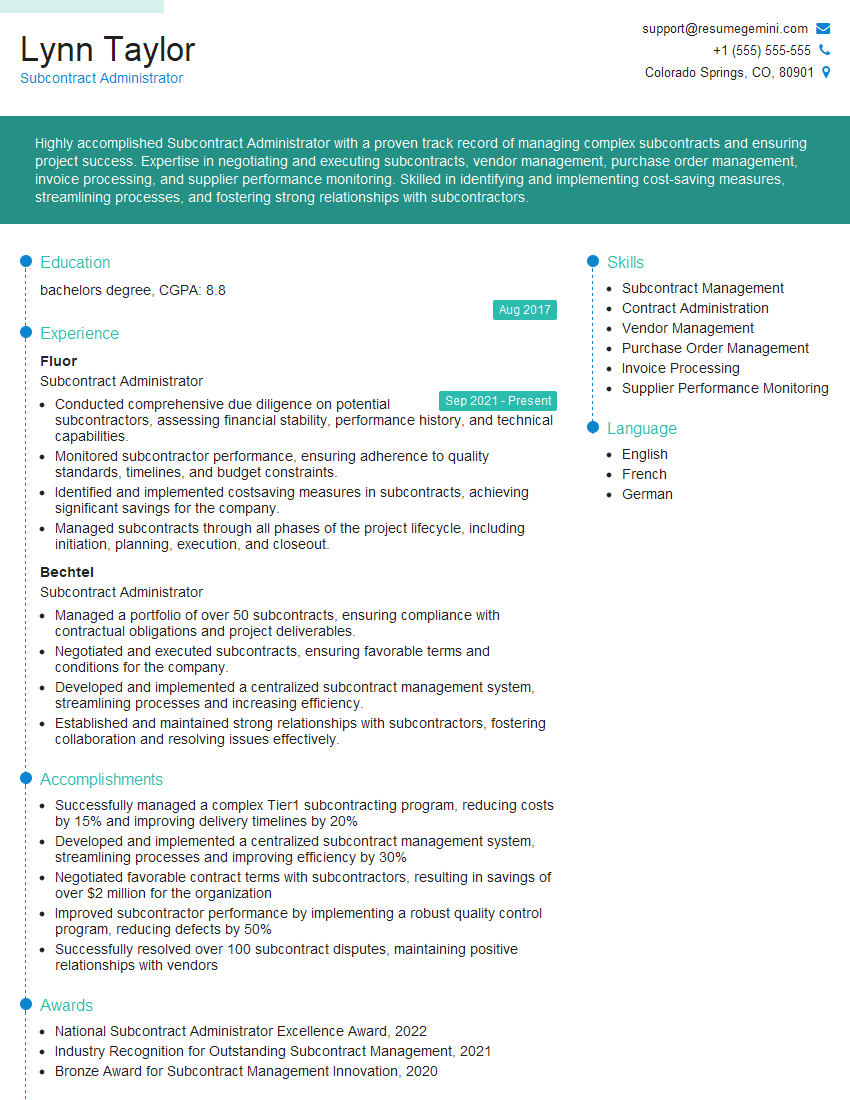
Mastering Subcontractor Management and Supervision is crucial for career advancement in construction, engineering, and other related fields. It demonstrates strong leadership, organizational, and problem-solving skills – highly valued attributes in today’s competitive job market. To maximize your chances of landing your dream role, creating an ATS-friendly resume is paramount. ResumeGemini is a trusted resource to help you craft a compelling and effective resume that highlights your skills and experience. They offer examples of resumes tailored to Subcontractor Management and Supervision, allowing you to present your qualifications in the best possible light. Invest the time to build a strong resume – it’s your key to unlocking exciting career opportunities.
Explore more articles
Users Rating of Our Blogs
Share Your Experience
We value your feedback! Please rate our content and share your thoughts (optional).
What Readers Say About Our Blog
Very informative content, great job.
good