Are you ready to stand out in your next interview? Understanding and preparing for Substation Design and Analysis interview questions is a game-changer. In this blog, we’ve compiled key questions and expert advice to help you showcase your skills with confidence and precision. Let’s get started on your journey to acing the interview.
Questions Asked in Substation Design and Analysis Interview
Q 1. Explain the different types of substation grounding systems.
Substation grounding systems are crucial for safety and equipment protection. They provide a low-impedance path for fault currents, minimizing voltage rise and protecting personnel from hazardous voltages. There are several types:
- Solid Grounding: The neutral point of the transformer is directly connected to the earth through a low-impedance path. This is the most common method for lower voltage systems, ensuring quick fault clearing and limiting transient overvoltages. Think of it like a direct lightning rod, immediately diverting any surge to the earth.
- Resistance Grounding: A resistor is inserted between the neutral point and the ground. This limits the fault current to a safe level, reducing stress on equipment. This is a good compromise between safety and the potential damage of high fault currents. Imagine a valve controlling the flow of water (fault current), preventing a flood (system damage).
- Reactance Grounding: A reactor (inductor) is used instead of a resistor. This offers similar current-limiting benefits to resistance grounding but with better transient performance. It’s like a more sophisticated valve that adjusts its resistance based on the flow, offering fine-tuned control.
- Peterson Coil Grounding: Used mainly in ungrounded systems, a Peterson coil is tuned to neutralize the capacitive current of the system. This is efficient but more complex to implement and requires precise tuning. This is like a sophisticated filter, eliminating the unwanted current component.
- Arc Suppression Coil Grounding (ASCG): This system aims to extinguish ground faults quickly, limiting damage and interrupting the arc. This provides a very high level of protection for the system. This acts as a highly responsive fire extinguisher, rapidly quelling the fault.
The choice of grounding system depends on factors such as voltage level, system configuration, soil resistivity, and fault current levels. A thorough analysis is needed to ensure the selected system provides optimum protection.
Q 2. Describe the function of a protective relay in a substation.
Protective relays are the brain of a substation’s protection system. They constantly monitor the electrical parameters of the system, such as current, voltage, and frequency. When an abnormal condition, like a fault, is detected, the relay initiates a rapid response to isolate the faulty section and protect the rest of the system. This prevents widespread damage and ensures continued power supply to the healthy parts of the network.
Think of them as highly sensitive security guards constantly scanning for anomalies. If something is wrong, they instantly trigger alarms (protective devices) to contain the issue.
Different types of relays protect against various faults: overcurrent relays, differential relays, distance relays, and many others, each tailored to a specific fault type. They’re sophisticated devices, and the selection and coordination are critical to the overall safety and reliability of the substation.
Q 3. What are the common types of busbars used in substations?
Busbars are the central conducting components within a substation, acting as the distribution point for power flow. They are essentially large, heavy conductors designed to carry high currents with minimal losses. Common types include:
- Rigid Busbars: These are sturdy, solid conductors, usually made of copper or aluminum. They are simple to install and maintain, suitable for lower voltage applications. Imagine a thick, inflexible pipe carrying water (power).
- Flexible Busbars: Made from multiple copper or aluminum conductors, bundled together and often insulated. More adaptable to thermal expansion and contraction than rigid busbars, better suited to higher voltages and larger power capacities. Like a flexible hose, easily adjusting to changes.
- Insulated Busbars: These have an insulating layer wrapped around the conductor, providing additional insulation and protection. This is safer for personnel and better suited to higher voltages and tighter spaces. Think of it as the pipe having an outer insulating layer to prevent leakage.
- Air Insulated Busbars: The busbars are exposed to the air for insulation. This design is simple but requires more space compared to other types and may be affected by environmental conditions. This is like an open channel carrying water.
- Gas Insulated Busbars (GIS): The busbars are enclosed in a sealed compartment filled with sulfur hexafluoride (SF6) gas, providing excellent insulation and superior arc-quenching capabilities. They are compact and safe but require more specialized maintenance. This is a high-tech sealed system for safe and efficient operation.
The selection of busbars considers voltage level, fault current, space limitations, and environmental factors.
Q 4. Explain the difference between a single-line diagram and a three-line diagram.
Both single-line and three-line diagrams are used in substation design, but they serve different purposes. They both show the arrangement of the equipment but differ in their level of detail.
- Single-line Diagram: This is a simplified representation of the substation, showing only the main components and their connections. It uses a single line to represent each phase. They’re excellent for overview purposes and planning.
- Three-line Diagram: This provides a more detailed representation showing all three phases explicitly. It’s beneficial for detailed analysis and design purposes. Think of it as a more technical blueprint of the system.
In essence, the single-line diagram is like a road map showing major routes, whereas the three-line diagram is like a detailed city map showing individual streets and buildings.
Q 5. How do you calculate fault currents in a substation?
Calculating fault currents in a substation is a critical step in design and protection coordination. It involves understanding the system’s impedance and applying the short-circuit calculation methods, often employing software tools. Generally, it follows these steps:
- Identify fault locations: Determine potential fault points in the system.
- Obtain system data: Gather information on transformer ratings, impedance values of cables, reactances of reactors, and other components.
- Develop a network model: Create a simplified representation of the substation using appropriate software (ETAP, EasyPower, etc.).
- Apply fault calculation methods: Use symmetrical component analysis or other methods to calculate fault currents for various fault types (e.g., three-phase fault, single-line-to-ground fault).
- Consider transient effects: Include factors that can influence the initial fault current, like the DC offset component.
- Verify results: Compare calculated fault currents with equipment ratings to ensure adequate protection.
Software is widely used as manual calculations become extremely complex for large substations. The results determine the appropriate settings for protective relays and the ratings of circuit breakers and other equipment to safely handle the fault currents.
Q 6. What are the safety precautions when working in a substation?
Safety is paramount when working in a substation. High voltages, heavy equipment, and complex systems pose significant risks. Crucial precautions include:
- Lockout/Tagout Procedures: Before any work begins, all power sources must be isolated and locked out using established procedures. This prevents accidental energization of equipment.
- Personal Protective Equipment (PPE): Appropriate PPE, including insulated gloves, safety glasses, arc flash suits, and safety shoes must be worn at all times.
- Grounding and Bonding: Equipment must be properly grounded and bonded to prevent stray voltages and electrical shocks.
- Awareness of Hazards: Workers should be trained to identify and avoid hazards, such as overhead conductors, energized equipment, and potential fall hazards.
- Permit-to-Work System: A formal system is needed to authorize work, ensure risk assessment, and communicate potential dangers to workers.
- Emergency Response Plan: A clear plan for emergency situations, including first aid and contacting emergency services, should always be available.
Safety is not merely a set of rules; it’s a culture and should be continuously emphasized and actively followed.
Q 7. Describe the process of substation commissioning.
Substation commissioning is a systematic process to verify that the newly built or upgraded substation meets design specifications and safety requirements before energization. The process generally includes these phases:
- Inspection and Testing of Equipment: Meticulous inspection of all equipment, including transformers, breakers, relays, and protection equipment, to ensure proper installation and functionality.
- Interconnection Testing: Verification of correct wiring and connections between all components. Testing includes continuity checks and insulation resistance measurements.
- Protection System Testing: Thorough testing of the protection relays and their coordination with other protective devices to ensure the system operates as designed.
- Control System Testing: Testing of the SCADA system and other control systems to ensure seamless communication and proper operation.
- Grounding System Testing: Checking the effectiveness of the substation grounding system. This includes measuring the earth resistance and checking the integrity of the grounding connections.
- Commissioning Report: Documentation of all tests performed, results, and any necessary corrective actions, compiled into a formal report to demonstrate that the substation meets requirements.
Commissioning is crucial to ensure the substation operates reliably and safely and provides a crucial record for future maintenance.
Q 8. What are the different types of circuit breakers used in substations?
Substations employ various circuit breaker types, each suited for different voltage levels and fault interruption requirements. The choice depends on factors like voltage, current, and the type of fault expected.
- Oil Circuit Breakers (OCBs): These older breakers use oil as an arc-quenching medium. While effective, they are bulky, require significant maintenance, and pose environmental concerns due to oil spills. They are less commonly used in new designs.
- Air Circuit Breakers (ACBs): These breakers use air as the arc-quenching medium, often employing magnetic blowouts to quickly extinguish the arc. They are generally simpler and cheaper than OCBs but have lower interrupting capabilities.
- Vacuum Circuit Breakers (VCBs): These breakers utilize a vacuum within a sealed chamber to interrupt the arc. They are compact, require minimal maintenance, and are very reliable, making them popular for medium-voltage applications.
- SF6 Circuit Breakers (SF6 CBs): Sulfur hexafluoride (SF6) gas is used as an arc-quenching medium. SF6 CBs offer high interrupting capacities and are commonly used in high-voltage substations. However, SF6 is a potent greenhouse gas, raising environmental concerns.
- Solid-State Circuit Breakers (SSCBs): These emerging technologies use semiconductor switches (like IGBTs or thyristors) to interrupt the circuit. They offer fast fault clearing times and precise control but are currently more expensive and less common than other types.
For example, a large, high-voltage substation might use SF6 circuit breakers for main lines and VCBs for smaller feeder circuits, reflecting a balance of performance and environmental considerations.
Q 9. Explain the role of insulators in a substation.
Insulators play a crucial role in substations by providing electrical insulation between energized conductors and the ground, preventing short circuits and ensuring personnel safety. They are designed to withstand high voltages and environmental stresses.
- Post Insulators: These are commonly used to support conductors on transmission towers and within substations. They consist of a porcelain or composite material housing with a metal cap and base.
- Strain Insulators: These insulators are designed to withstand high tensile forces, typically found at the ends of transmission lines entering the substation. They often have a string of discs to distribute the stress evenly.
- Suspension Insulators: These are used to suspend conductors from transmission towers. The individual discs are connected in series to increase the overall voltage withstand capability.
- Bushings: These insulators provide insulation for conductors passing through a grounded metal structure, like a transformer tank or a circuit breaker enclosure.
Imagine insulators as carefully designed barriers preventing electricity from taking unwanted paths. Failure of an insulator can lead to dangerous short circuits and equipment damage. Therefore, regular inspection and maintenance of insulators are crucial for reliable substation operation.
Q 10. What are the different types of transformers used in substations?
Substations utilize different transformer types depending on the voltage transformation needed and specific application. The primary purpose is to step voltage up or down to match the needs of the power system.
- Power Transformers: These are large transformers used for bulk power transmission and distribution, stepping voltage up at generating stations and down at substations closer to consumers. They typically handle high voltages and large power ratings.
- Instrument Transformers: These smaller transformers are used to provide safe and manageable voltage and current levels for measurement and protection equipment (relays and meters). They include current transformers (CTs) and potential transformers (PTs).
- Autotransformers: These transformers share a common winding between the primary and secondary circuits, providing a voltage change with fewer windings than a typical two-winding transformer. They’re often used for voltage regulation and tap changing.
- Distribution Transformers: These smaller transformers reduce voltage further to supply end-users such as homes and businesses. They are commonly found on utility poles or in underground vaults.
For example, a large substation might use a massive power transformer to step down the high voltage from transmission lines, followed by smaller distribution transformers to supply the local area. Instrument transformers are essential throughout the substation for monitoring and protection.
Q 11. Describe the function of a surge arrester.
Surge arresters protect substation equipment from transient overvoltages caused by lightning strikes, switching operations, or other disturbances. These overvoltages can severely damage expensive components.
A surge arrester, also known as a lightning arrester, acts as a voltage-limiting device. Under normal operating conditions, it presents a high impedance to the power system, allowing power to flow normally. However, when a surge voltage exceeds a predetermined threshold, the arrester’s impedance drops drastically, providing a path to ground for the surge current. This limits the voltage seen by the protected equipment.
Think of a surge arrester as a pressure relief valve in a boiler. It normally remains closed, but if the pressure gets too high, it opens to prevent an explosion. Similarly, the arrester protects equipment from damaging voltage spikes.
Q 12. Explain the principles of impedance relaying.
Impedance relaying is a protection scheme that measures the impedance (resistance and reactance) between the relay location and the fault point on the power system. This measurement helps to isolate the faulty section of the power line.
The principle is based on the relationship between fault impedance and the distance to the fault. A lower impedance indicates a closer fault. The relay compares the measured impedance to pre-defined zones. If the impedance falls within a specific zone, the relay trips the corresponding circuit breaker, isolating the faulted section.
Example: Imagine a transmission line with impedance relaying at both ends. A fault occurs closer to one end. The relay at the closer end will measure a lower impedance and trip first, isolating the fault quickly and limiting the disruption. The relay at the further end will measure a higher impedance and will not trip.
Impedance relaying offers high selectivity and sensitivity, making it well-suited for protecting long transmission lines where distance to the fault is critical for quick isolation.
Q 13. What is the significance of short-circuit calculations in substation design?
Short-circuit calculations are fundamental to substation design because they determine the magnitude and impact of potential faults. These calculations are essential for selecting appropriate equipment ratings and protective devices.
Accurate short-circuit calculations help determine:
- Fault current levels: This information is crucial for sizing circuit breakers, busbars, and other equipment to withstand the immense currents during a fault.
- Relay settings: Protective relay settings are adjusted based on the calculated short-circuit current magnitudes to ensure proper and timely fault clearing.
- Equipment ratings: Transformers, switchgear, and cables must be rated for the maximum expected short-circuit currents to prevent damage.
- Cable sizing: Calculations help determine the appropriate size and type of cables to handle the high thermal stresses associated with fault currents.
Neglecting short-circuit calculations can lead to equipment failures, safety hazards, and costly repairs or replacements. These calculations often involve sophisticated software and detailed network models to simulate potential fault scenarios.
Q 14. How do you ensure the proper coordination of protective relays?
Proper coordination of protective relays is crucial to ensure that the correct circuit breaker trips to isolate a fault quickly and selectively, minimizing service disruption and preventing cascading outages.
Coordination involves setting the operating times of relays and circuit breakers to ensure a specific order of operation. A downstream relay should operate faster than an upstream relay, thus isolating the fault closest to its origin. This is often visualized using a time-current coordination curve.
Achieving proper coordination involves:
- Understanding relay characteristics: Different relay types have different operating characteristics, which must be considered during coordination.
- Analyzing system impedance: Accurate system impedance values are needed to estimate fault currents and determine relay settings.
- Using coordination software: Specialized software packages help simulate various fault scenarios and ensure proper relay coordination.
- Testing and verification: After setting relays, testing is essential to validate the coordination scheme under actual or simulated fault conditions.
Imagine a series of dominoes. Proper coordination ensures that the dominoes fall in the right order, isolating the fault without triggering an unnecessary cascade. Poor coordination, on the other hand, could lead to a widespread outage.
Q 15. Explain the application of SCADA in substation automation.
SCADA, or Supervisory Control and Data Acquisition, is the nervous system of a modern substation, enabling remote monitoring and control of all its equipment. Think of it as a sophisticated dashboard providing real-time insights into the substation’s operations. It allows operators to monitor voltage, current, power flow, and the status of breakers, transformers, and other critical components from a central location, often hundreds of miles away.
In substation automation, SCADA plays a crucial role in several ways:
- Remote Monitoring: SCADA systems continuously collect data from various devices within the substation and transmit it to a central control room. This allows operators to quickly identify potential issues and take corrective actions.
- Remote Control: Operators can remotely control substation equipment, such as opening or closing circuit breakers, switching transformers, and adjusting tap changers. This enhances operational efficiency and improves response times during emergencies.
- Alarm Management: SCADA systems generate alarms when abnormal conditions occur, alerting operators to potential problems. This helps prevent major outages and ensures system stability.
- Data Logging and Reporting: SCADA systems log vast amounts of data, which can be used for performance analysis, trend identification, and predictive maintenance. This helps optimize substation operations and reduce maintenance costs.
For example, if a transformer’s temperature exceeds a predefined threshold, the SCADA system will automatically generate an alarm, alerting the operator to take necessary action, such as reducing the load on the transformer or scheduling maintenance.
Career Expert Tips:
- Ace those interviews! Prepare effectively by reviewing the Top 50 Most Common Interview Questions on ResumeGemini.
- Navigate your job search with confidence! Explore a wide range of Career Tips on ResumeGemini. Learn about common challenges and recommendations to overcome them.
- Craft the perfect resume! Master the Art of Resume Writing with ResumeGemini’s guide. Showcase your unique qualifications and achievements effectively.
- Don’t miss out on holiday savings! Build your dream resume with ResumeGemini’s ATS optimized templates.
Q 16. What are the common communication protocols used in substations?
Substations utilize a variety of communication protocols, each with its own strengths and weaknesses. The choice of protocol depends on factors such as distance, speed requirements, reliability, and security needs. Some of the most common protocols include:
- IEC 61850: This is a widely adopted standard specifically designed for substation automation. It uses Ethernet for communication and provides a robust and flexible framework for data exchange between devices. It’s known for its ability to handle large amounts of data efficiently and its support for various communication services.
- Modbus: A simpler, widely used protocol, particularly for legacy systems. It’s relatively easy to implement and offers good compatibility with various devices, but it might not be as robust or feature-rich as IEC 61850.
- DNP3: Another popular protocol known for its reliability and security features, especially in utility environments. It’s often used for remote terminal units (RTUs) and other supervisory control applications.
- Profibus: Primarily used in industrial automation, it offers high speed and deterministic communication, suitable for critical real-time applications in substations.
Many modern substations employ a mix of these protocols, leveraging the advantages of each. For instance, IEC 61850 might be used for high-speed data exchange between intelligent electronic devices (IEDs), while Modbus might be retained for communication with older legacy devices.
Q 17. Describe the different types of substation control schemes.
Substation control schemes dictate how the various devices within a substation interact and coordinate to maintain safe and reliable operation. The complexity varies significantly depending on the size and importance of the substation.
- Local Control: The simplest scheme, where each device operates independently with its own local control logic. This is suitable for small substations with limited functionalities.
- Remote Control: The substation is controlled from a remote location using a SCADA system. This allows centralized monitoring and control of multiple substations, enhancing operational efficiency.
- Supervisory Control: The SCADA system supervises and monitors the substation’s operation but doesn’t directly control all devices. This combines the benefits of local control with the advantages of centralized monitoring.
- Automatic Control: Sophisticated schemes that utilize intelligent electronic devices (IEDs) to automatically respond to various events, such as faults or abnormal conditions. This enhances reliability and speeds up fault clearance.
- Distributed Control: Control functions are distributed among various intelligent devices, enabling decentralized control with enhanced fault tolerance and redundancy.
Choosing the appropriate control scheme depends on the substation’s size, complexity, and the desired level of automation. Larger, critical substations usually employ more sophisticated schemes like distributed control with advanced fault detection and protection mechanisms.
Q 18. Explain the importance of arc flash studies in substation design.
Arc flash studies are crucial in substation design because they assess the potential for arc flash hazards – dangerous electrical arcs that can cause severe burns, blindness, and even fatalities. These studies are mandated by safety regulations (like OSHA in the US) to protect workers.
The studies determine the incident energy levels at various locations within the substation during a potential arc flash event. This information is used to:
- Specify appropriate Personal Protective Equipment (PPE): The results guide the selection of PPE, such as arc-rated clothing, gloves, and face shields, providing the necessary protection for personnel working near energized equipment.
- Design safer work practices: The studies identify areas with high incident energy levels, leading to the development of safer work procedures and lockout/tagout (LOTO) protocols.
- Improve substation design: The findings can influence the design of the substation itself, such as incorporating better grounding, improved shielding, and equipment placement to minimize the risk of arc flash incidents.
Imagine a scenario where a worker needs to perform maintenance on a switchgear. Without an arc flash study, the worker might be exposed to potentially lethal levels of incident energy. The study helps determine the appropriate PPE and procedures to ensure the worker’s safety during the maintenance activity.
Q 19. What are the different types of substation grounding grids?
Substation grounding grids are critical for safety and reliable operation. They provide a low-impedance path for fault currents to flow to the earth, preventing voltage surges and protecting equipment and personnel. Different types exist, chosen based on soil conditions and the substation’s size and requirements:
- Conventional Ground Grids: These are typically made of interconnected conductors, such as copper wires or rods, buried in the ground. They’re relatively simple and cost-effective but might not be ideal for highly resistive soils.
- Counterpoise Grounding: Involves using a separate grid of conductors laid above the main grounding grid to improve grounding performance, especially in high-resistivity soil.
- Mesh Grounding: A more elaborate grid consisting of closely spaced conductors that form a mesh-like network. This provides better current distribution and reduces ground impedance.
- Plate Grounding: Uses large metal plates buried in the ground, particularly effective in areas with rocky or highly resistive soil.
- Rod Grounding: Employing vertical ground rods driven into the earth. Often used as a supplemental grounding method.
The design of the grounding grid involves careful consideration of soil resistivity, fault current levels, and the need to minimize potential differences between various points in the substation. Soil resistivity testing is crucial to determine the appropriate design parameters.
Q 20. How do you select the appropriate size of conductors for a substation?
Selecting the appropriate conductor size for a substation involves a careful balance between cost and performance. Several factors need to be considered:
- Current Carrying Capacity: The conductor must be large enough to carry the expected current without excessive heating. This is dictated by the ampacity ratings of the conductors and the anticipated load currents.
- Voltage Drop: The conductor size must limit the voltage drop along its length to acceptable levels. Excessive voltage drop can affect the performance of connected equipment.
- Short Circuit Current: The conductors need to withstand the high short-circuit currents without damage. This requires careful consideration of the mechanical strength of the conductors.
- Economic Factors: Larger conductors are more expensive. Finding the optimal balance between performance and cost is crucial.
The process typically involves using specialized software or hand calculations based on established standards (like IEEE and IEC standards). These calculations consider the conductor material (copper or aluminum), temperature, and ambient conditions. For instance, a larger conductor would be necessary for a busbar carrying heavy currents compared to a conductor for a control circuit.
Q 21. Explain the principles of power system stability.
Power system stability refers to the ability of the system to maintain synchronism between generators and remain in a steady operating state after being subjected to disturbances, such as faults or changes in load. Loss of synchronism can lead to widespread blackouts.
Several aspects contribute to power system stability:
- Rotor Angle Stability: Relates to the ability of synchronous generators to maintain synchronism with each other. This involves the ability of generators to accelerate or decelerate to match changing power demands.
- Voltage Stability: Focuses on the ability of the system to maintain acceptable voltage levels at all buses under various operating conditions. Voltage collapse can occur if the system’s voltage falls below acceptable limits.
- Frequency Stability: Concerns the ability of the system to maintain a stable system frequency. Significant frequency deviations can cause equipment damage or instability.
Maintaining stability involves careful planning and operation of the power system, including the proper design and placement of equipment, reactive power compensation, and effective control strategies. Sophisticated simulations and analysis tools are employed to assess system stability under various scenarios.
Imagine a large power plant suddenly tripping offline. The power system must be stable enough to absorb this significant loss of generation without causing widespread blackouts. This requires the remaining generators to quickly increase their output, while the voltage and frequency remain within acceptable limits. This stability is a complex interplay of mechanical and electrical factors carefully managed through system design and control.
Q 22. What are the different types of protective relay settings?
Protective relay settings are crucial for ensuring the safe and reliable operation of a substation. They define the thresholds and actions taken by the relay in response to various fault conditions. The specific settings depend heavily on the type of relay and the equipment it protects. There are many types, but some common ones include:
- Overcurrent Relays: These respond to excessive current flow, often indicating a short circuit. Settings include pick-up current (the current level at which the relay operates), time delay (the time it takes to trip), and operating characteristic (the relationship between current and time). For instance, a very fast setting might be used to protect a transformer winding, whereas a slower setting with a time delay is often used for downstream feeder protection to allow for coordination with other relays.
- Differential Relays: These compare the current entering and leaving a protected zone (like a transformer). A significant difference indicates an internal fault. Settings include percent differential (the allowed difference before tripping), harmonic restraint (to prevent tripping due to harmonic currents), and restricted earth fault (to protect against earth faults within the zone).
- Distance Relays: These measure the impedance to a fault along a transmission line. Settings include distance zones (measuring the distance to a fault, with multiple zones offering backup protection), and reach (the maximum distance the relay can protect).
- Ground Fault Relays: These detect ground faults, which are faults involving ground. Settings usually include ground fault current pick-up and time delay. Different types exist for residual current (detecting unbalance) and directional ground fault relays.
- Busbar Protection Relays: These protect the busbars, which are the central connection points in the substation. They might utilize differential or overcurrent principles, along with specialized settings for busbar fault detection.
Proper setting of protective relays is critical; incorrect settings can lead to unnecessary tripping, causing power outages, or failure to trip during actual faults, resulting in damage to equipment.
Q 23. Describe the process of testing protective relays.
Testing protective relays is paramount to ensure their proper function and the overall reliability of the substation. The process typically involves a combination of methods:
- Simulation Testing: This involves using a relay test set to simulate various fault conditions. The test set injects precisely controlled currents and voltages to mimic real-world scenarios. The relay’s response is then observed and recorded to verify its operation within the pre-defined settings. This is commonly done offline.
- In-Service Testing: This involves energizing the relays during normal operation and monitoring their behavior. This can sometimes be done by injecting small current impulses. This is less common due to the potential for disrupting the power supply.
- Communication Testing: Modern relays often communicate with other protection systems and control centers. Testing the communication channels, protocols, and interfaces is crucial for seamless data exchange and remote control capabilities. This includes testing of fiber optic links and other communication protocols.
- Calibration: The accuracy of the relay’s measurements must be verified and adjusted if needed. This ensures that the relay operates correctly within its defined settings. This step involves using calibrated instrumentation to check the accuracy of the internal measurements of the relay.
A comprehensive testing plan, documenting all tests, results, and any necessary adjustments, should always be prepared and followed. This ensures that the protective system is functioning as designed and ready to respond effectively in the event of a fault. Detailed reports need to be kept, demonstrating compliance with industry standards and best practices.
Q 24. What are the common causes of substation failures?
Substation failures can stem from a variety of causes, often interacting in complex ways. Some of the most common include:
- Equipment Failure: This is a broad category encompassing faults in transformers, circuit breakers, insulators, and other substation components. Ageing, wear and tear, manufacturing defects, and environmental factors like extreme temperatures contribute to equipment failure. For example, a faulty bushing on a transformer can lead to an internal fault and possibly a fire.
- Switching Surges: These high-voltage transients occur during switching operations and can damage sensitive equipment. Proper surge protection devices (SPDs) are critical to mitigate these surges.
- Lightning Strikes: Direct lightning strikes can cause significant damage to equipment, leading to cascading failures throughout the substation. Effective lightning protection systems, including air terminals, down conductors, and grounding grids, are essential to minimize the risk.
- Human Error: Mistakes in operation, maintenance, or design can lead to failures. This includes improper configuration of protection relays or incorrect connection of equipment. Proper training and adherence to safety protocols are imperative to minimize human error.
- Environmental Factors: Extreme weather conditions, such as storms, floods, and extreme temperatures, can damage equipment and lead to failures. Robust design and proper maintenance are needed to withstand these conditions.
A proactive approach, incorporating rigorous maintenance schedules, regular testing, and advanced protection systems, is crucial in preventing substation failures and ensuring grid reliability.
Q 25. Explain the importance of proper earthing in substations.
Proper earthing (grounding) in substations is critical for several reasons:
- Safety: It provides a low-impedance path for fault currents to flow to the earth, reducing the risk of electric shock and preventing dangerous voltage build-up on exposed conductive parts. This protects personnel and equipment.
- Protection: It helps to limit the magnitude and duration of fault currents, protecting equipment from damage during faults. The low impedance path limits the voltage rise during faults which can be detrimental to equipment.
- Lightning Protection: It provides a path for lightning currents to safely dissipate into the earth, preventing damage to substation equipment. Lightning strikes are a major threat and proper earthing minimizes the effects of these strikes.
- Voltage Stabilization: Grounding helps to stabilize system voltages, preventing voltage surges and imbalances. The stable reference point for grounding helps in minimizing voltage fluctuations.
Substation grounding systems typically consist of a complex network of grounding conductors, electrodes, and bonding connections, designed to ensure low impedance paths to earth. The design should account for soil resistivity, fault current levels, and other factors. Regular inspection and maintenance of the grounding system are crucial to ensure its effectiveness.
Q 26. Describe the impact of harmonics on substation equipment.
Harmonics are non-sinusoidal components of current and voltage that can have significant adverse effects on substation equipment. These are caused by non-linear loads like power electronic devices (inverters, rectifiers, etc.).
- Overheating: Harmonics cause increased current flowing through transformers and other equipment, leading to additional heat generation and potential overheating, reducing the equipment’s lifespan. The increased losses translate to higher temperatures.
- Increased Losses: Harmonics can increase power losses in transformers and cables. The extra current generates additional heat and reduces efficiency.
- Resonance: Harmonics can interact with the substation’s electrical system to create resonance, causing excessive voltage or current amplification, further stressing equipment.
- Equipment Malfunction: Excessive harmonic currents can lead to premature aging and failure of equipment, such as protective relays that may mis-operate due to distorted waveforms.
- Capacitor Failures: Power capacitors are particularly vulnerable to harmonic currents, which can lead to overheating and premature failure. Capacitors are often used to improve power factor; however, incorrect design considering harmonics can lead to premature capacitor failure.
Mitigation strategies include using harmonic filters, properly sizing transformers and cables to handle harmonic currents, and employing harmonic-resistant equipment. Careful load planning and considering the impact of nonlinear loads are also critical. Detailed harmonic analysis is often necessary during the substation design phase to properly account for these effects.
Q 27. What are the different types of metering used in substations?
Substations employ various metering systems to monitor and record energy consumption, system performance, and fault data. These are crucial for billing, system analysis, and fault diagnosis.
- Energy Meters: These measure the total energy consumed, usually in kilowatt-hours (kWh). They are fundamental for billing purposes.
- Power Meters: These measure real power (kW), reactive power (kVAR), and apparent power (kVA) in real-time. They provide insight into power quality and system efficiency.
- Demand Meters: These measure the maximum power demand over a specified time interval (e.g., 15 minutes, 30 minutes). They’re useful for load management and planning.
- Protective Relay Metering: Many modern protective relays incorporate metering capabilities. They can record fault currents, voltage levels, and other relevant parameters during fault events. This is critical for post-fault analysis.
- Power Quality Meters: These measure various power quality parameters, such as voltage sags, swells, harmonics, and power factor. They help identify and address power quality issues.
- Digital Fault Recorders (DFRs): These capture high-resolution data during fault events, providing detailed information for detailed analysis and improved system protection design. They provide a time-stamped record of the fault event.
The type and quantity of metering equipment depend on the substation’s size, complexity, and specific requirements. Data acquisition systems (DAS) often collect and manage data from multiple metering devices, facilitating data analysis and reporting.
Q 28. Explain the use of GIS (Geographic Information System) in substation design.
Geographic Information Systems (GIS) play a vital role in modern substation design. They provide a powerful platform to manage and visualize spatial data related to the substation and its surroundings.
- Site Planning: GIS allows for efficient site planning by incorporating topographical data, property boundaries, existing infrastructure, and environmental constraints into a single, integrated map. This helps optimize substation layout and minimize environmental impact.
- Cable Routing: GIS facilitates optimal cable routing by considering factors such as distances, obstacles (roads, buildings), and underground utilities. This minimizes construction costs and reduces the risk of cable damage.
- Equipment Placement: GIS aids in determining the optimal placement of substation equipment, considering factors such as clearances, accessibility, and future expansion needs. The visual representation helps to avoid clashes and optimize space usage.
- Coordination with Utilities: GIS can be used to coordinate with other utilities and infrastructure owners to avoid conflicts and ensure seamless integration of the substation into the existing infrastructure.
- Asset Management: GIS can create a digital twin of the substation, providing a comprehensive database of all substation assets, their location, and maintenance history. This supports better asset management.
By combining spatial data with other relevant information (equipment specifications, electrical diagrams), GIS enables a more efficient and informed design process, ultimately leading to a safer, more reliable, and cost-effective substation.
Key Topics to Learn for Substation Design and Analysis Interview
- Substation Physical Layout and Design: Understand the principles behind efficient substation layout, including busbar arrangements, equipment placement, and safety clearances. Consider practical applications like optimizing space utilization and minimizing conductor lengths.
- Protection and Relaying Systems: Master the theory and application of various protective relays, including their function, settings, and coordination. Be prepared to discuss practical scenarios involving fault detection and isolation.
- Power System Analysis Techniques: Gain a strong understanding of load flow studies, short circuit calculations, and transient stability analysis. Practice applying these techniques to real-world substation problems.
- Insulation Coordination and Lightning Protection: Familiarize yourself with the principles of insulation coordination and the design of effective lightning protection systems for substations. Consider the practical implications of different insulation levels and lightning strike probabilities.
- Grounding and Earthing Design: Understand the importance of effective grounding systems in ensuring safety and proper equipment operation. Be able to discuss different grounding techniques and their applications.
- Substation Automation and SCADA Systems: Explore the role of automation and supervisory control and data acquisition (SCADA) systems in modern substation design and operation. Be ready to discuss the benefits and challenges associated with these systems.
- Standards and Codes: Demonstrate familiarity with relevant industry standards and codes (e.g., IEEE, IEC) related to substation design and safety. Be prepared to discuss their practical application.
- Economic Considerations in Substation Design: Understand the importance of cost optimization and lifecycle analysis in the design process. Be able to discuss the trade-offs between different design choices and their cost implications.
Next Steps
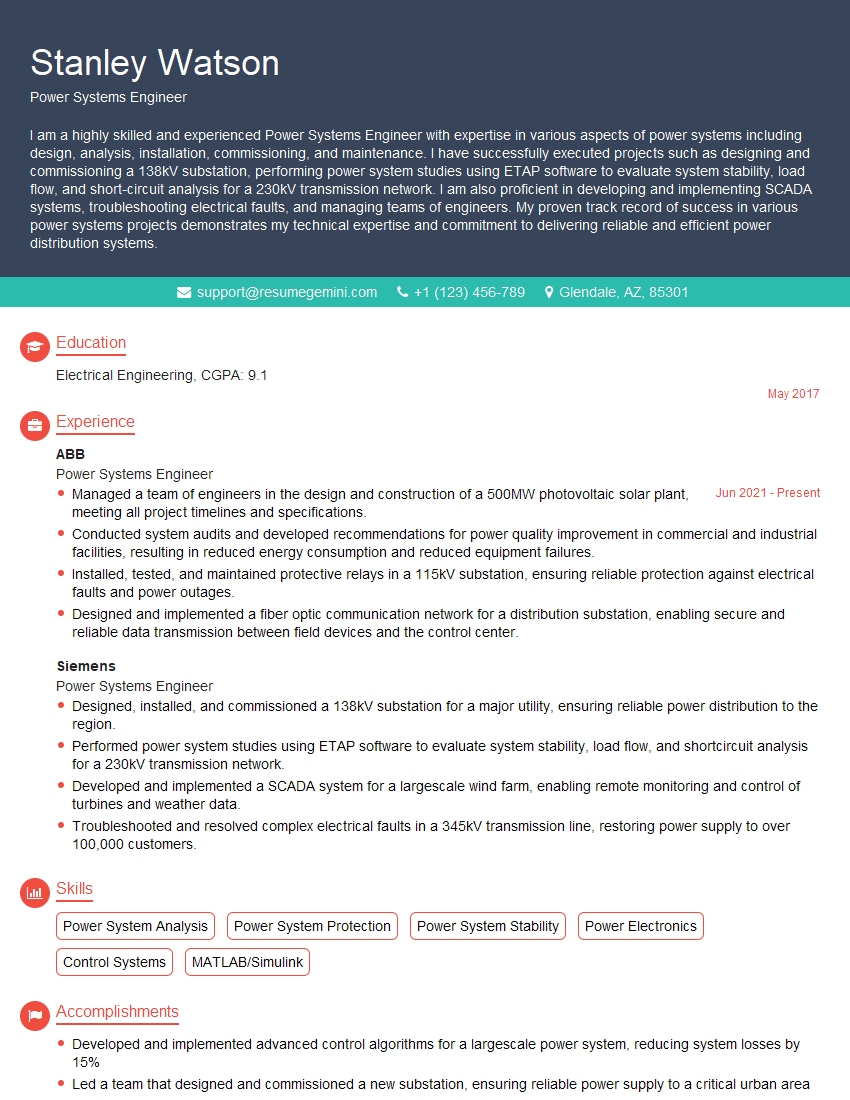
Mastering Substation Design and Analysis opens doors to exciting career opportunities in the power industry, offering diverse roles with excellent growth potential. To maximize your chances of landing your dream job, creating a strong, ATS-friendly resume is crucial. ResumeGemini is a trusted resource that can help you build a professional and impactful resume tailored to the specific requirements of Substation Design and Analysis roles. Examples of resumes tailored to this field are available to guide you, showcasing the best ways to highlight your skills and experience.
Explore more articles
Users Rating of Our Blogs
Share Your Experience
We value your feedback! Please rate our content and share your thoughts (optional).
What Readers Say About Our Blog
Very informative content, great job.
good