Every successful interview starts with knowing what to expect. In this blog, we’ll take you through the top Subsurface irrigation system design interview questions, breaking them down with expert tips to help you deliver impactful answers. Step into your next interview fully prepared and ready to succeed.
Questions Asked in Subsurface irrigation system design Interview
Q 1. Explain the advantages and disadvantages of subsurface irrigation compared to surface irrigation.
Subsurface irrigation, where water is applied below the soil surface, offers several advantages over surface irrigation methods. It’s like giving your plants a secret drink, directly to their roots!
- Increased water use efficiency: Less water is lost to evaporation and runoff, crucial in arid and semi-arid regions. Think of it as minimizing water spills.
- Reduced weed growth: The lack of surface water discourages weed germination and growth, saving on herbicides and labor.
- Improved soil aeration: The absence of surface ponding helps maintain better soil aeration, beneficial for root development. This is like giving roots room to breathe.
- Better control over water application: Subsurface irrigation allows for precise control of water application, optimizing irrigation scheduling and minimizing over-irrigation.
- Less land preparation: Compared to surface irrigation, the need for land leveling and shaping is significantly reduced, simplifying installation.
However, subsurface irrigation also has some drawbacks:
- Higher initial cost: The installation of subsurface systems can be more expensive than surface systems.
- Maintenance challenges: Clogging of emitters and pipe deterioration can be problematic, necessitating regular maintenance and potentially costly repairs. This is like unclogging a plumbing system.
- Limited applicability: Subsurface irrigation isn’t suitable for all soil types, particularly those with high clay content or poor drainage.
- Potential for salinity buildup: If not managed properly, salts can accumulate in the root zone.
Q 2. Describe different types of subsurface irrigation systems (e.g., drip, porous pipe).
Subsurface irrigation systems come in various types, each with its own strengths and weaknesses. The choice depends on factors like soil type, crop requirements, and budget.
- Drip Irrigation: This involves using individual emitters or drippers, delivering water directly to the plant’s root zone. It’s like giving each plant its own personal watering can. This is highly efficient but needs careful emitter spacing and pressure regulation.
- Porous Pipe Irrigation: Water seeps through the porous walls of the pipe, uniformly wetting the surrounding soil. Think of it like a slow-release watering system, simple but less precise than drip.
- Subsurface Trickle Irrigation: This combines the benefits of drip and porous pipe systems, using small-diameter laterals that distribute water through small openings. It balances precision with lower installation cost.
- Tile Drainage Systems (for drainage rather than irrigation, but relevant): While primarily used for drainage, these buried systems can sometimes be adapted for managed aquifer recharge or controlled subsurface irrigation in specific scenarios.
Q 3. How do you determine the appropriate spacing and depth for subsurface irrigation emitters?
Determining the appropriate spacing and depth for subsurface irrigation emitters is crucial for uniform water distribution and efficient water use. It’s a balancing act between ensuring adequate wetting and avoiding waterlogging.
Factors to consider include:
- Soil type: Sandy soils require closer spacing and shallower depths compared to clayey soils, which retain water longer and require wider spacing and potentially deeper placement.
- Crop type and root system: Deep-rooted crops need emitters placed deeper, whereas shallow-rooted crops might only need shallow placement.
- Water application rate: Higher application rates may allow for wider spacing.
- Emitter type and discharge characteristics: The design of the emitters directly affects spacing requirements.
Determining the Optimal Spacing and Depth: This often involves field trials, soil water monitoring, and modeling techniques. Hydrological simulations and empirical formulas based on soil hydraulic properties and plant water requirements are frequently used. For example, a commonly used approach involves analyzing soil water content profiles after irrigation to evaluate distribution uniformity and adjust emitter placement.
Q 4. What factors influence the selection of pipe materials for subsurface irrigation?
The choice of pipe material for subsurface irrigation significantly impacts the system’s longevity, cost-effectiveness, and overall performance. It’s like choosing the right building materials for a house.
- Polyethylene (PE): A common choice due to its flexibility, durability, and relatively low cost. PE pipes come in high-density (HDPE) and low-density (LDPE) types, each with varying properties.
- Polyvinyl chloride (PVC): Offers good resistance to chemical corrosion, making it suitable for areas with saline water. However, it’s less flexible than PE.
- Thermoplastic Polyurethane (TPU): Used in flexible driplines, offering excellent durability and resistance to kinking. Its cost is higher than PVC or PE.
Factors influencing material selection:
- Soil conditions: Aggressive soils might necessitate pipes with high chemical resistance.
- Water quality: Salinity and pH can affect pipe material selection.
- Project budget: Cost is a primary consideration.
- System lifespan: Long-term performance requirements inform material choices. Longer lifespans often justify higher initial costs.
Q 5. Explain the role of soil properties (texture, permeability) in subsurface irrigation design.
Soil properties are paramount in subsurface irrigation design. Ignoring them is like building a house on a weak foundation. The soil’s texture and permeability dictate how water moves through it.
- Texture: Soil texture (sand, silt, clay) significantly affects water infiltration rates. Sandy soils are highly permeable; water moves through them easily, requiring closer emitter spacing. Clayey soils, with their smaller pore sizes, retain water longer, allowing for wider emitter spacing but potentially leading to waterlogging if not carefully managed.
- Permeability: Soil permeability, a measure of how readily water flows through the soil, is crucial. Low permeability necessitates careful emitter placement to prevent ponding. We need to ensure water reaches the roots without accumulating.
Practical implications: A detailed soil survey is essential before designing a subsurface irrigation system. This survey should include analyses of soil texture, permeability, and other hydraulic properties. This information is used to model water movement in the soil and optimize emitter placement and water application rates.
Q 6. How do you calculate water application rates for subsurface irrigation systems?
Calculating water application rates for subsurface irrigation involves determining how much water needs to be applied to meet the crop’s water requirements while avoiding over-irrigation or under-irrigation. It’s like carefully measuring ingredients in a recipe.
Factors involved:
- Crop evapotranspiration (ET): This is the amount of water lost by the crop through evaporation and transpiration. It’s a key factor that depends on factors such as temperature, humidity and wind speed. ET estimates are often obtained from weather data and crop coefficients.
- Soil water holding capacity: The amount of water the soil can hold at its field capacity.
- Irrigation frequency: The interval between irrigation events.
- Emitter discharge: The amount of water each emitter delivers per unit time.
- Emitter spacing: The distance between emitters.
Methods: Several methods exist, including using empirical formulas, water balance equations, and computer simulations. These are often calibrated against field data to ensure accuracy.
Example: A simplified calculation might involve determining the total water requirement for a given area, dividing that by the number of emitters, and then dividing again by the irrigation duration. However, this is highly simplistic. Real-world calculations necessitate considerations of soil properties and other factors.
Q 7. Describe methods for evaluating the uniformity of water distribution in subsurface irrigation.
Evaluating the uniformity of water distribution in subsurface irrigation is crucial to ensure efficient and effective irrigation. It’s like ensuring all parts of a cake are equally moist.
Methods for evaluation:
- Soil moisture sensors: Installing soil moisture sensors at various points in the irrigated area provides direct measurements of soil water content, revealing areas of under-irrigation or over-irrigation. These can be simple tensiometers or more advanced sensors.
- Water application uniformity (WAU) measurements: This involves collecting data on water application rates at different points using water meters or by assessing the water content within the soil profile. The coefficient of uniformity (CU) is then calculated to quantify the uniformity.
- Plant growth monitoring: Observing plant growth patterns can provide qualitative indications of water distribution uniformity. Consistent growth indicates uniform water application; patchy growth indicates non-uniform water distribution.
- Dye tracing: Introducing a dye into the irrigation water can help visualize water movement and identify areas where water doesn’t reach. This is a simpler method often useful to visualize potential problems and diagnose areas for improvement.
Data analysis: The collected data are analyzed to quantify the uniformity of water distribution using appropriate indices like the Christiansen’s uniformity coefficient (CU). A CU value closer to 100% indicates better uniformity. Adjustments in emitter placement, flow rates, or other parameters are made based on the analysis to improve uniformity.
Q 8. How do you design for pressure regulation in a subsurface irrigation system?
Pressure regulation in subsurface irrigation is crucial for uniform water distribution and preventing emitter damage. High pressure can lead to emitter clogging and reduced lifespan, while low pressure results in insufficient water delivery. We achieve this using pressure regulating valves strategically placed within the system.
Design Considerations:
- Initial Pressure Assessment: We start by evaluating the source water pressure and the required pressure at the emitters. This dictates the type and location of pressure-regulating devices.
- Valve Selection: Pressure-regulating valves come in various types – pressure-compensating emitters, pressure-reducing valves, and flow control valves. The choice depends on the system’s size, topography, and emitter type. For example, pressure-compensating emitters maintain a constant flow rate regardless of the inlet pressure variations, ideal for uneven terrain.
- Valve Placement: Valves are placed at strategic points to manage pressure in different zones or sections of the system. This ensures uniform pressure along the laterals, preventing over- or under-watering. A larger system might require multiple pressure regulators in a staged approach.
- Monitoring: Regular pressure monitoring at key points is vital to verify the effectiveness of the regulation system. Pressure gauges are installed at various points to facilitate this monitoring. Any deviation from the designed pressure needs prompt attention to prevent problems.
Example: Imagine a hillside vineyard. The upper section of the vineyard receives higher pressure, whereas the lower section has lower pressure. In this case, we’d employ pressure-reducing valves in the upper section to control pressure before it reaches the emitters and ensures uniform irrigation throughout the entire vineyard. We’d also monitor the pressure at the lowest and highest point regularly.
Q 9. Explain the principles of emitter selection and design for subsurface irrigation.
Emitter selection is paramount for successful subsurface irrigation. The right emitter ensures proper water distribution, minimizes clogging, and matches the crop’s water requirements.
Principles:
- Flow Rate: The emitter’s flow rate (liters per hour or gallons per hour) must be carefully selected based on the crop’s water needs, soil type, and spacing between emitters. A higher flow rate might be suitable for thirsty crops in sandy soils, while a lower flow rate suits clay soils and less demanding crops.
- Emitter Type: Various emitter types exist, including drippers, micro-sprinklers, and porous tubes. Drippers are commonly used for their efficiency and reduced clogging potential. The choice also depends on factors like soil type and application rates.
- Emitter Spacing: Emitter spacing depends on the flow rate and the desired water application rate. Closer spacing is necessary for higher flow rates or crops with high water demands.
- Self-Cleaning Mechanism: Self-cleaning emitters with larger orifices are less prone to clogging, especially in areas with high silt or suspended solids in the water source.
Example: For a high-value citrus orchard, we’d opt for high-quality, pressure-compensating drippers with larger self-cleaning orifices, spaced strategically to provide a consistent water application and prevent clogging. In a field with coarse sandy soil, we might choose a higher flow rate dripper with larger spacing to overcome rapid percolation.
Q 10. What are the common maintenance issues associated with subsurface irrigation systems?
Common maintenance issues in subsurface irrigation systems often stem from clogging, leaks, or malfunctioning components.
Common Issues:
- Clogging: Accumulation of sediment, algae, or root intrusion restricts water flow through emitters or pipes. This is particularly common in areas with poor water quality or high organic matter in the soil.
- Leaks: Leaks develop in pipes or fittings due to deterioration, damage, or improper installation. This wastes water and reduces efficiency.
- Component Failure: Pressure regulators, valves, and other components may malfunction due to wear and tear, requiring replacement.
- Root Intrusion: Roots can grow into the system, blocking emitters or puncturing the pipes. This can cause severe disruptions.
- Emitter Degradation: Over time, emitters can become less efficient due to wear, leading to inconsistent water distribution.
Example: A reduced flow rate from an emitter is the first sign of a potential clog. If you notice wilting in the plants despite the system being on, then you must immediately inspect the system for leaks or clogs. Addressing these issues promptly is key to preserving water and yields.
Q 11. How do you address clogging problems in subsurface drip irrigation systems?
Addressing clogging in subsurface drip irrigation requires a multi-pronged approach, combining preventative measures with reactive solutions.
Strategies:
- Preventative Measures:
- Water Filtration: Installing a filter upstream helps remove sediment and other particles from the irrigation water before it enters the system. The filter type (e.g., screen filter, sand filter) will be dictated by the water quality.
- Regular Flushing: Periodic flushing of the system with clean water helps remove accumulated sediment. This can involve reversing the flow direction of the irrigation water.
- Chemical Cleaning: Certain chemical solutions are effective in dissolving organic matter or mineral deposits that lead to clogging. However, ensure the chosen chemicals are compatible with your system materials.
- Proper Design: Choosing self-cleaning emitters with larger orifices reduces the likelihood of clogging in the first place.
- Reactive Solutions:
- Identify Clogged Emitters: Systematically inspect the lines for low or no flow. Sometimes, this is simple visual inspection, but it could require more sophisticated testing, like pressure testing.
- Manual Cleaning: For localized clogs, manual removal using a small probe might be sufficient.
- Section Flushing: Isolate affected sections of the system and flush them with water or chemical solutions under high pressure.
- Replacement: Severely clogged or damaged emitters should be replaced.
Example: If a section of the system shows reduced flow, we begin by flushing that section. If that doesn’t resolve the issue, we might perform a chemical cleaning, followed by inspecting individual emitters and replacing any severely clogged ones. If a particular water quality problem persists, we may upgrade the filtration system.
Q 12. Describe different methods for monitoring soil moisture in subsurface irrigation systems.
Monitoring soil moisture is vital for optimizing water use and preventing water stress or overwatering. Several methods are available for subsurface irrigation systems.
Methods:
- Tensiometers: These measure the soil water tension, indicating the soil’s water availability to plants. They provide accurate measurements but require calibration and are susceptible to damage.
- Soil Moisture Sensors: These sensors use various technologies (capacitance, time domain reflectometry) to measure the volumetric water content in the soil. They offer real-time data, but their accuracy can vary depending on the soil type.
- Neutron Probes: These measure soil moisture using neutron scattering. They are accurate and can measure soil moisture at various depths but require specialized training and are expensive.
- Data Loggers: Combining sensors with data loggers provides automated data collection and analysis, allowing for better irrigation scheduling based on actual soil moisture levels.
- Plant-Based Monitoring: Assessing plant growth, leaf water potential, or stomatal conductance can indirectly infer soil moisture status. It’s a relatively low-tech solution that requires experience and observation.
Example: In a large field, we might employ a network of soil moisture sensors linked to a data logger. This provides real-time information about soil moisture levels at various points throughout the field, allowing us to adjust irrigation based on actual needs rather than a schedule.
Q 13. How do you incorporate water quality considerations into subsurface irrigation system design?
Water quality significantly impacts the longevity and efficiency of subsurface irrigation systems. Poor water quality can cause clogging, corrosion, and damage to components.
Considerations:
- Chemical Analysis: A thorough water quality analysis is essential to determine the levels of suspended solids, dissolved salts, and other potential contaminants. This guides the selection of appropriate filtration systems and materials.
- Filtration System Design: Based on the water quality analysis, we select the right type and size of filters (e.g., sand filters, screen filters, multimedia filters) to remove suspended solids. The choice also considers the flow rate and system pressure.
- Material Selection: Choosing materials resistant to corrosion and chemical attack is crucial. For example, high-density polyethylene (HDPE) pipes are commonly used for their durability and resistance to various chemicals. The use of specific materials depends on the water chemistry and soil conditions.
- Fertigation Considerations: If fertigation (applying fertilizers through the irrigation system) is planned, careful consideration of fertilizer compatibility with the irrigation system materials and water quality is essential. This is critical for both efficacy and avoiding component damage.
Example: In an area with high salinity, we must select pipes and emitters resistant to corrosion from salts. A robust filtration system, perhaps incorporating reverse osmosis, is crucial to remove salts and prevent clogging. We also evaluate the soil salinity to prevent salt accumulation in the root zone, which can affect plant health.
Q 14. Explain the impact of topography on subsurface irrigation system design.
Topography significantly affects subsurface irrigation system design, influencing pressure distribution and water application uniformity.
Impact and Solutions:
- Uneven Terrain: Sloped land leads to uneven pressure distribution. This necessitates the use of pressure-regulating devices (pressure-compensating emitters, pressure-reducing valves) at different points to ensure uniform water application. We might use mainlines on contours rather than straight lines to even the pressure distribution.
- Elevation Changes: Significant elevation changes affect the water flow rate and the potential for hydrostatic pressure to affect the system. Careful design and layout of the system with strategic placement of pressure regulators are needed. We may incorporate gravity flow sections and pressure-compensated sections to leverage topography effectively.
- Drainage Considerations: Poor drainage on flat or low-lying areas can lead to waterlogging. This requires careful planning of the system layout and potential incorporation of drainage measures.
- System Layout: The topography dictates the optimal layout. In hilly areas, following contours might be necessary for efficient and uniform irrigation. This avoids overly high pressure in low-lying areas and inadequate pressure in uphill areas. Software applications may be used to plan efficient layouts considering the topography.
Example: In a vineyard on a steep hillside, we’d use a combination of gravity flow and pressure-compensating emitters. The system is designed to follow the contours of the land, with pressure-regulating valves strategically placed to mitigate the effects of varying elevation and maintain a consistent water supply to the plants.
Q 15. How do you handle design challenges related to saline or sodic soils in subsurface irrigation?
Designing subsurface irrigation in saline or sodic soils requires a multifaceted approach focusing on minimizing salt accumulation near the roots. These soils have high salt concentrations (saline) or high sodium levels (sodic), both of which hinder plant growth. We can’t just ignore the salinity; we have to actively manage it.
- Careful Site Selection and Soil Testing: Thorough soil analysis is crucial to determine the type and extent of salinity/sodicity. This informs the design, including emitter spacing, water application rates, and leaching requirements.
- Improved Drainage: Incorporating subsurface drainage systems can help leach excess salts from the root zone. This might involve installing perforated pipes at a depth below the root zone to facilitate drainage.
- Controlled Water Application: Using low-pressure, low-flow emitters allows for precise water delivery, minimizing surface runoff and preventing further salt accumulation. The goal is to apply water slowly and steadily.
- Leaching Fraction: We need to calculate and incorporate a leaching fraction into the irrigation schedule. This means applying extra water beyond the plant’s water needs to flush out accumulated salts. The leaching fraction is a percentage, and the optimal value depends on the soil type and salt concentration.
- Use of Saline-Tolerant Crops: Selecting crops that have a higher tolerance to saline conditions can significantly reduce the impacts of soil salinity. This is a crucial long-term strategy.
- Amendment Application: In some cases, soil amendments like gypsum can help to improve soil structure and reduce sodium levels in sodic soils.
For example, in a project in a coastal area with high salinity, we incorporated a combination of subsurface drip irrigation with closely spaced emitters, a higher leaching fraction, and selected salt-tolerant varieties of vegetables resulting in successful crop production.
Career Expert Tips:
- Ace those interviews! Prepare effectively by reviewing the Top 50 Most Common Interview Questions on ResumeGemini.
- Navigate your job search with confidence! Explore a wide range of Career Tips on ResumeGemini. Learn about common challenges and recommendations to overcome them.
- Craft the perfect resume! Master the Art of Resume Writing with ResumeGemini’s guide. Showcase your unique qualifications and achievements effectively.
- Don’t miss out on holiday savings! Build your dream resume with ResumeGemini’s ATS optimized templates.
Q 16. Describe your experience with different types of filtration systems used in subsurface irrigation.
Filtration is critical in subsurface irrigation to prevent clogging of emitters and maintain system efficiency. The choice of filter depends on the water source’s quality and the emitter type. I have extensive experience with several filtration methods:
- Disc Filters: These are effective for removing larger sediments and debris. They are relatively simple to maintain and are suitable for various flow rates.
- Screen Filters: These are often used as pre-filters to protect more delicate filters like disc filters. They are less efficient than disc filters but are cheaper and easier to clean.
- Sand Filters: Excellent for removing fine particles and are commonly used when the water source is heavily laden with sediment. They require backwashing for cleaning.
- Membrane Filters: Used for high-quality water filtration, especially removing bacteria and other microorganisms. These are more expensive to operate and maintain.
In one project, we used a combination of screen and disc filters to treat water sourced from a shallow well containing a moderate level of sediment. The screen filter removed larger particles, extending the lifespan of the disc filter.
Q 17. How do you design for expansion or modification of an existing subsurface irrigation system?
Expanding or modifying an existing subsurface irrigation system requires careful planning to minimize disruption and ensure compatibility with the existing infrastructure. The design process will be iterative, and we need a solid understanding of existing conditions.
- System Assessment: A thorough evaluation of the current system is needed, including emitter spacing, pipe layout, water pressure, and overall efficiency. We check for leaks and assess the hydraulic performance.
- Demand Analysis: Determine the increase in irrigation demand resulting from the expansion or modification. This will influence the choice of pipes, pumps, and emitters.
- New Design Integration: The new design should seamlessly integrate with the existing system. This could involve adding new laterals, manifolds, or pump capacity.
- Hydraulic Modeling: Using specialized software to simulate the flow and pressure within the modified system is essential to avoid over-pressurizing or under-watering any part of the expanded system. We want to maintain uniformity of water distribution.
- Phased Implementation: Where possible, a phased implementation approach reduces disruption to ongoing agricultural activities. This allows for testing and adjustments along the way.
For instance, in a vineyard expansion, we added new laterals to the existing subsurface drip system while maintaining consistent water pressure across both the old and new sections by carefully adjusting the pressure regulators and pipe diameters.
Q 18. What are the key design considerations for subsurface irrigation in arid and semi-arid climates?
Designing subsurface irrigation in arid and semi-arid climates presents unique challenges due to limited water availability and high evaporation rates. Efficiency is paramount.
- Water Conservation: The primary design goal is to maximize water use efficiency. This involves using precise irrigation techniques like pressure compensating drippers to deliver the exact amount of water needed to each plant.
- Reduced Evaporation: Subsurface irrigation minimizes water loss through evaporation, a significant concern in these climates. The water is delivered directly to the root zone.
- Soil Moisture Monitoring: Implementing soil moisture sensors to monitor water levels in the root zone ensures that irrigation is only applied when needed, preventing overwatering and conserving precious water resources.
- Appropriate Emitter Selection: Selecting emitters with low discharge rates reduces the risk of runoff and ensures uniform water distribution even in low-permeability soils.
- Mulching: Mulching the soil surface further reduces evaporation and helps maintain soil moisture.
In one project in a desert region, we implemented a subsurface drip irrigation system with soil moisture sensors and pressure-compensating drippers, resulting in a 30% reduction in water usage compared to traditional surface irrigation.
Q 19. Explain how you would address issues related to root intrusion in subsurface irrigation systems.
Root intrusion into subsurface irrigation emitters can cause blockages and reduce system efficiency. Several strategies can mitigate this:
- Emitter Selection: Choosing root-resistant emitters made from durable materials, such as high-density polyethylene (HDPE) with smaller orifices and labyrinthine internal pathways can help.
- Physical Barriers: Installing physical barriers around the emitters, such as fine-mesh filters or protective sleeves, can deter root growth. These need to be durable.
- Chemical Treatments: Applying root-restricting chemicals is another option, though environmental considerations and potential soil impact must be carefully evaluated. This is typically a last resort.
- Regular System Maintenance: A proactive maintenance program is crucial. This involves regularly flushing the system to clear any minor blockages and identifying any sections with significant root intrusion.
- Strategic System Design: Placing emitters at depths that are less prone to root intrusion can be effective. We need to understand the rooting depth of the plant.
In a citrus orchard, we used a combination of root-resistant emitters and regular flushing, effectively managing root intrusion and extending the system’s lifespan.
Q 20. Describe your experience with computer-aided design (CAD) software for irrigation system design.
I have extensive experience using CAD software for irrigation system design, primarily AutoCAD and specialized irrigation design software like IrriCAD. CAD allows for efficient and accurate design, incorporating topographical data, soil information, and crop requirements.
- Accurate Layout: CAD software facilitates precise mapping of the field, pipe layout, emitter locations, and valve placements. It helps us to create a comprehensive plan.
- Hydraulic Modeling: Many CAD packages now integrate hydraulic modeling capabilities, allowing us to simulate water flow and pressure within the system, ensuring uniform water distribution.
- Component Selection: The software assists in selecting appropriate pipes, fittings, and emitters based on the design parameters.
- Cost Estimation: CAD software can be used to generate detailed cost estimates for materials and labor, aiding in project budgeting.
- Collaboration and Communication: CAD drawings provide clear and concise communication tools for contractors, clients, and stakeholders.
Using CAD software in a recent project allowed for a 15% reduction in material costs by optimizing pipe sizing and minimizing unnecessary fittings.
Q 21. How do you incorporate sustainability principles into subsurface irrigation system design?
Incorporating sustainability is paramount in subsurface irrigation design. It means designing systems that conserve water, protect the environment, and ensure long-term viability.
- Water-Efficient Technologies: Using pressure-compensating drippers, soil moisture sensors, and variable rate irrigation (VRI) techniques reduces water consumption and enhances water use efficiency.
- Renewable Energy Sources: Powering the irrigation system with renewable energy, like solar power, reduces reliance on fossil fuels and minimizes the carbon footprint.
- Reduced Fertilizer Use: Subsurface irrigation allows for precise application of fertilizers, reducing runoff and minimizing environmental contamination.
- Sustainable Materials: Using recycled and recyclable materials in pipe and emitter production promotes environmental responsibility. Choosing durable materials also extends the lifespan of the system and reduces replacement needs.
- Minimizing Land Disturbance: Careful planning and trenchless installation techniques can minimize soil disturbance during system construction.
A recent project involved designing a system using solar-powered pumps and pressure-compensating drippers, resulting in significant water savings and a reduced environmental impact.
Q 22. How do you estimate the cost of a subsurface irrigation system?
Estimating the cost of a subsurface irrigation system requires a meticulous breakdown of various components. It’s not a simple sum, but rather a process of careful quantification and pricing.
- Material Costs: This includes the cost of pipes (considering material type – PVC, HDPE, etc., and diameter), emitters (drip tapes, porous pipes, or bubblers), fittings, valves, pump (if required), and any necessary filtration systems. I typically get quotes from multiple suppliers to ensure competitive pricing. For example, the cost of HDPE pipe is generally higher than PVC, but its durability might justify the extra expense in the long run.
- Labor Costs: Installation is a significant portion of the overall cost. This includes excavation (depending on soil type and depth of installation), pipe laying, emitter placement, connection of components, backfilling, and system testing. The labor costs can vary greatly based on location and the complexity of the terrain. In areas with rocky soil, excavation costs can be considerably higher.
- Design and Engineering Costs: Professional design is crucial for optimal system performance. This includes site assessment, hydraulic modeling, system layout, and preparation of detailed plans and specifications. The cost here depends on the project’s size and complexity.
- Permitting and Inspection Fees: Obtaining necessary permits and undergoing inspections adds to the total cost. These fees vary depending on the local regulations and the system’s size.
- Contingency Costs: Always include a contingency of 10-15% to account for unforeseen issues or price fluctuations. This is crucial for preventing cost overruns.
To provide a precise estimate, I use cost estimation software and detailed spreadsheets, factoring in all these elements and potentially incorporating historical data from similar projects. For instance, I might use a spreadsheet that calculates costs based on pipe length, emitter spacing, and labor rates, automatically adjusting based on chosen materials.
Q 23. Explain your experience with hydraulic modeling software for irrigation design.
I have extensive experience using hydraulic modeling software for irrigation design, primarily focusing on programs like AquaCrop, IrriCalc, and CygNet. These programs are crucial for accurately predicting water flow, pressure distribution, and emitter discharge within the subsurface system. They allow us to optimize emitter spacing, pipe sizing, and pump selection for efficient water distribution.
For example, when designing a system for a vineyard, IrriCalc helps me to model the water flow through a network of buried laterals and determine the appropriate emitter discharge rate required to satisfy the crop’s water demand while ensuring uniform moisture distribution across the rows. If pressures are too high in some areas, the software helps identify the appropriate valve placement or pipe diameter adjustments to resolve the issue.
Using simulation software is vital because it prevents costly mistakes during installation. By virtually testing different designs, we can identify potential issues—like uneven water distribution or excessively high pressures—before they occur in the real-world application, saving time and resources.
Q 24. Describe your experience with different types of control systems for subsurface irrigation systems.
Subsurface irrigation systems utilize various control systems to ensure efficient and effective water delivery. My experience encompasses several types:
- Time-Based Controllers: These are the simplest, using pre-programmed schedules to activate and deactivate the irrigation system. They are cost-effective but lack flexibility in response to changing environmental conditions.
- Sensor-Based Controllers: These controllers utilize soil moisture sensors, weather stations, or other sensors to monitor environmental conditions. This allows for adaptive irrigation scheduling, optimizing water usage based on real-time data. For example, if a sensor detects sufficient soil moisture, the system will automatically reduce or postpone irrigation.
- Remote Control Systems: These enable remote monitoring and control of the irrigation system, often through a web interface or mobile app. This offers flexibility and allows for adjustments based on weather forecasts or field observations, even when not physically present.
- SCADA Systems (Supervisory Control and Data Acquisition): For large-scale systems, SCADA systems offer comprehensive monitoring and control, integrating data from multiple sensors and providing real-time visualizations of system performance. This enhances operational efficiency and aids in troubleshooting.
Choosing the appropriate control system depends on factors like the system’s size, budget, and the level of automation desired. For a small residential garden, a simple time-based controller might suffice. However, for a large-scale agricultural operation, a sensor-based or SCADA system is more appropriate to optimize water usage and minimize wastage.
Q 25. How do you ensure the long-term performance and efficiency of a subsurface irrigation system?
Ensuring long-term performance and efficiency requires a multi-faceted approach:
- Proper Design and Installation: Accurate hydraulic modeling and meticulous installation are paramount. This includes proper pipe slope, emitter spacing, and filtration to prevent clogging. Regular inspections during and after installation are also key.
- Regular Maintenance: A well-established maintenance schedule is critical. This typically involves flushing the system to remove sediment, checking for leaks, inspecting emitters for clogging, and ensuring the proper functioning of valves and controllers.
- Appropriate Material Selection: Choosing durable materials that are resistant to corrosion and clogging is essential for extending the system’s lifespan. Consider the soil type and water quality when making material choices.
- Monitoring and Data Analysis: Regular monitoring of system performance, including water usage, pressure readings, and sensor data, allows for early detection of problems and facilitates timely corrective actions. Using data logging systems can be beneficial here.
- Documentation: Maintaining detailed records of the system’s design, installation, maintenance, and performance data is crucial for troubleshooting and future upgrades.
For example, annual system flushing is crucial in areas with high sediment levels in the water source to prevent emitter clogging and maintain uniform water distribution. Similarly, routine inspections can prevent small leaks from developing into major problems and ensuring the system’s continued efficient operation.
Q 26. How do you address challenges related to energy efficiency in subsurface irrigation design?
Energy efficiency is a crucial consideration in subsurface irrigation design. Several strategies can minimize energy consumption:
- Optimize Pump Selection: Selecting a pump with the right capacity and efficiency for the system’s needs is crucial. Using energy-efficient pumps with variable speed drives (VSDs) can significantly reduce energy consumption. VSDs adjust the pump speed based on the system’s demand, reducing energy waste when the full pump capacity isn’t needed.
- Efficient Pipe Sizing and Layout: Minimizing pipe lengths and using appropriately sized pipes reduces friction losses, lowering the energy required for pumping. A well-designed layout can optimize water distribution while minimizing energy consumption.
- Pressure Management: Maintaining optimal pressure throughout the system minimizes energy wastage. Pressure-regulating valves can be incorporated to ensure uniform pressure distribution and prevent excessive pressure that increases energy use.
- Smart Irrigation Controllers: Using sensor-based controllers allows for adaptive irrigation scheduling, reducing unnecessary water application, and therefore, reducing energy needed for pumping.
- Renewable Energy Sources: In appropriate situations, integrating renewable energy sources, like solar panels, can power the irrigation system, reducing reliance on grid electricity.
For instance, in a large-scale project, simulating different pump options with varying efficiencies using hydraulic modeling software can allow us to select a cost-effective pump while minimizing long-term energy costs. The savings generated through energy efficiency can often offset the initial higher investment.
Q 27. What are the key regulatory requirements for designing and installing subsurface irrigation systems in your region?
Regulatory requirements for subsurface irrigation systems vary significantly depending on the specific region. However, some common aspects include:
- Water Rights Permits: Obtaining the necessary permits for water usage is usually the most critical requirement. This involves demonstrating the system’s efficiency and ensuring it complies with local water allocation policies.
- Environmental Regulations: Regulations related to environmental protection might involve guidelines for minimizing groundwater contamination, protecting sensitive habitats, and ensuring responsible water resource management.
- Building Codes and Permits: Depending on the location, building permits or other related permits might be required for the installation of the subsurface irrigation system, particularly if it’s near structures or involves significant excavation.
- Health and Safety Regulations: Regulations regarding worker safety during the installation process are typically in place, including requirements for trench safety, handling of chemicals, and proper disposal of construction materials.
- Accessibility Standards: Accessibility requirements might be necessary to ensure the system is designed and installed in a way that complies with disability access standards.
It’s vital to consult with local authorities and relevant regulatory bodies early in the design process to ensure full compliance. Failure to obtain the necessary permits or adhere to regulations can result in significant delays, fines, or even project termination. I always proactively work with local agencies and authorities to ensure all permits and approvals are secured before installation begins.
Key Topics to Learn for Subsurface Irrigation System Design Interviews
- Hydraulic Design Principles: Understanding flow rates, pressure head, and energy losses within subsurface systems. This includes selecting appropriate pipe diameters and layouts.
- Soil Considerations: Analyzing soil texture, infiltration rates, and water holding capacity to optimize emitter spacing and water application strategies. Practical application involves field testing and data interpretation.
- Emitter Selection and Placement: Choosing the right emitter type (e.g., porous pipe, drip tape) based on soil conditions and crop requirements. This includes understanding the implications of different emitter discharge rates and spatial distribution.
- System Layout and Design: Mastering the techniques of designing efficient and effective subsurface irrigation layouts, considering topography, field size, and crop needs. This includes understanding manifold design and pressure regulation strategies.
- Water Management Strategies: Developing strategies for efficient water use, including scheduling irrigation based on soil moisture sensors and weather data. This involves practical knowledge of irrigation control technologies and automation.
- Cost Analysis and Optimization: Evaluating the economic feasibility of different subsurface irrigation system designs. This includes estimating material costs, installation costs, and long-term operational expenses.
- Troubleshooting and Maintenance: Identifying and resolving common problems in subsurface irrigation systems, such as clogged emitters, leaks, and malfunctioning control systems. Practical experience with maintenance techniques is crucial.
- Environmental Impacts: Understanding the environmental benefits and potential drawbacks of subsurface irrigation systems, such as water conservation and potential for nutrient leaching. This includes knowledge of sustainable irrigation practices.
Next Steps
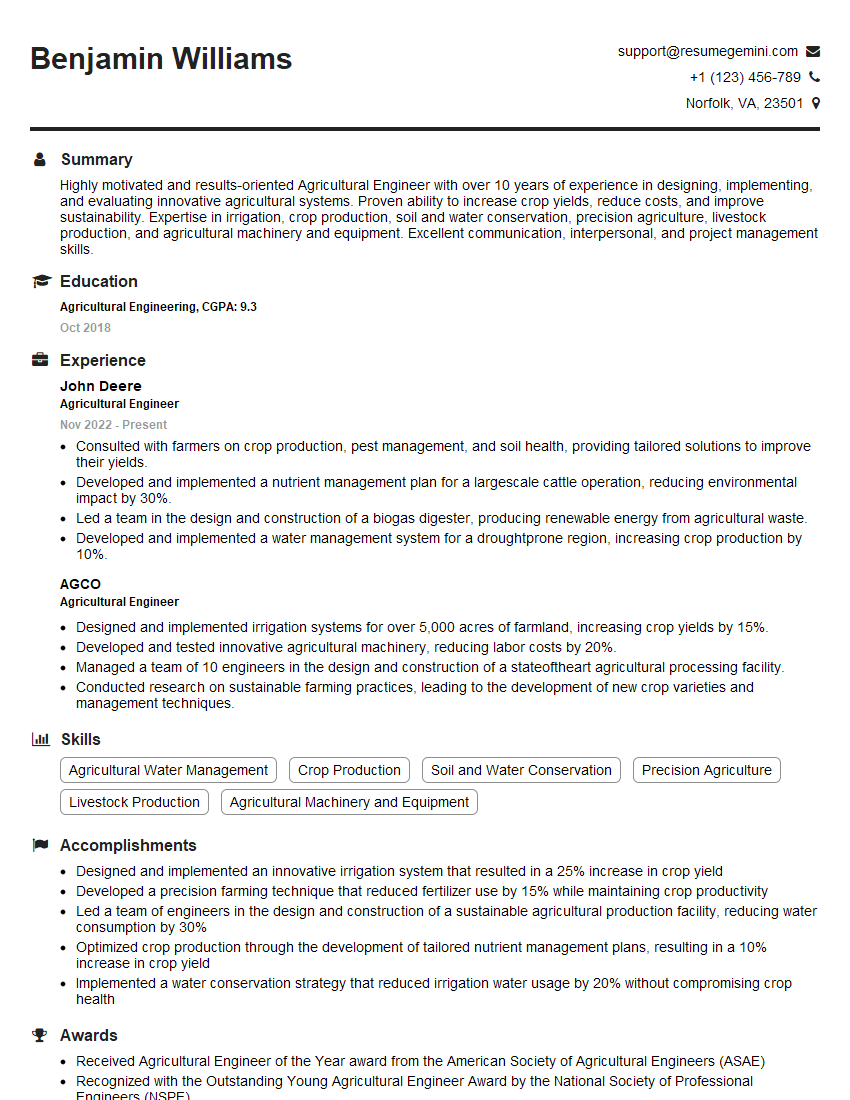
Mastering subsurface irrigation system design opens doors to exciting career opportunities in agriculture, landscape architecture, and water resource management. To maximize your job prospects, a strong resume is essential. Creating an ATS-friendly resume that highlights your skills and experience is crucial for getting noticed by recruiters. ResumeGemini is a trusted resource that can help you build a professional and effective resume tailored to the specific requirements of this field. Examples of resumes tailored to Subsurface irrigation system design are available to help you craft the perfect application.


Explore more articles
Users Rating of Our Blogs
Share Your Experience
We value your feedback! Please rate our content and share your thoughts (optional).
What Readers Say About Our Blog
Very informative content, great job.
good