Interviews are more than just a Q&A session—they’re a chance to prove your worth. This blog dives into essential Suspect Profiling interview questions and expert tips to help you align your answers with what hiring managers are looking for. Start preparing to shine!
Questions Asked in Suspect Profiling Interview
Q 1. Explain the difference between inductive and deductive profiling.
Inductive and deductive profiling represent two distinct approaches to criminal profiling. Inductive profiling, also known as statistical profiling, starts with a large dataset of known offenders and their characteristics. By analyzing common traits among these offenders, profilers can create a statistical profile of a typical offender for a specific crime type. Think of it like creating a general sketch based on many similar images; it’s a broad overview. For example, analyzing numerous bank robbery cases might reveal a statistical profile showing a disproportionate number of offenders are male, under 30, and use firearms. This doesn’t necessarily describe *any* individual bank robber but offers probability insights.
Deductive profiling, on the other hand, focuses on a specific crime scene and the behavior displayed by the offender within that specific instance. It involves analyzing the forensic evidence, victim characteristics, and the method of operation (MO) to create a profile of the offender who committed *that particular* crime. It’s a bottom-up approach based on the uniqueness of the crime scene. For instance, if a killer shows unusual restraint in a murder or leaves clues in a specific pattern, deductive profiling attempts to infer characteristics about that individual killer from their unique actions at the specific scene.
Q 2. Describe the Geographic Profiling method and its limitations.
Geographic profiling is a technique used to predict the most likely area of residence or operational base of a serial offender. It uses the locations of multiple crimes, usually linked geographically by the offender, to create a spatial model that predicts the most probable area of the offender’s base. It leverages the principle of ‘distance decay’ – that offenders generally commit crimes closer to their home or operational base.
This is often visualized as a ‘buffer zone’ or ‘center of gravity’ around the crime locations. Software programs are often used to analyze crime locations and generate probabilistic maps. The accuracy of Geographic Profiling is directly dependent on the quality of the crime data, the number of crimes, and the offender’s mobility.
Limitations of geographic profiling include the following:
- Incomplete data: If crime data is incomplete or inaccurate, the profile will be unreliable.
- Offender mobility: The model assumes a relatively stable base, but highly mobile offenders can be difficult to profile.
- Multiple offenders: If multiple offenders are involved, the profile may be inaccurate or unclear.
- Complex behaviours: Offenders with complex travel patterns or specific target selection methodologies may not fit the model’s assumptions.
- False positive issues: The output is a probability map and there is always the possibility of false positive identifications.
Q 3. What are the key components of a psychological autopsy?
A psychological autopsy is a post-mortem investigative approach used to determine the behavioral and psychological state of a deceased individual, primarily in cases of suicide or equivocal death where the cause of death is unclear. It relies on a reconstruction of the deceased’s psychological state leading up to their death. It’s not a ‘real’ autopsy, but a thorough investigative process to interpret their life circumstances, behaviors and state of mind. It’s essentially a ‘psychological reconstruction’ of the deceased’s life.
Key components usually include:
- Review of medical and psychological records: Examining past medical, psychological, and psychiatric records to identify any existing conditions or treatments.
- Interviews with family, friends, and colleagues: Gathering information on the individual’s personality, relationships, stressors, behaviors and recent events in their life. This offers valuable insight into the deceased’s perspective and challenges.
- Analysis of personal documents: Examining diaries, journals, letters, and other personal documents, including social media activity for clues regarding their feelings, plans, and intentions.
- Crime scene analysis (if applicable): Examining details related to the crime scene for context and insights into the final moments of the victim’s life.
- Forensic evidence: Analyzing any physical or digital evidence that might help reconstruct the circumstances.
The goal is to construct a profile of the individual’s psychological state prior to death, allowing for more informed conclusions about the cause and manner of death.
Q 4. How do you assess the reliability of witness testimony in profiling?
Assessing the reliability of witness testimony is crucial in profiling because such accounts heavily influence the investigative process. The reliability of a witness’s statement isn’t simply about honesty but also about the accuracy of their observation and recollection. A witness might be truthful but still provide inaccurate information due to factors unrelated to their intention.
Several factors influence reliability, including:
- Stress and trauma: High-stress situations can negatively impact memory accuracy. Eyewitnesses to violent crimes often experience a heightened level of stress which compromises their ability to accurately recall details.
- Weapon focus: The presence of a weapon may narrow attention, reducing the recall of other details.
- Cross-racial identification: Studies have shown that people are less accurate at identifying individuals from a different race than their own.
- Time elapsed: Memory fades with time, leading to inaccuracies in recalling details.
- Leading questions: The way questions are phrased can influence the witness’s response; leading questions can contaminate memories.
- Memory bias: Preconceptions and biases can distort memories.
To assess reliability, profilers use techniques such as:
- Multiple witness comparisons: Comparing accounts from different witnesses to identify consistency or discrepancies.
- Cognitive interviewing techniques: Employing techniques designed to enhance the retrieval of accurate memories through specific questioning strategies.
- Statement analysis: Examining the content and structure of witness statements to detect potential inconsistencies or deception.
Q 5. Discuss the ethical considerations involved in suspect profiling.
Ethical considerations in suspect profiling are paramount. The primary concern is the potential for bias and discrimination. Profiles, if misused, can reinforce stereotypes and lead to discriminatory practices, targeting innocent individuals based on their characteristics rather than evidence. For example, a profile emphasizing a certain racial group might lead investigators to focus their resources disproportionately on that group.
Other ethical concerns include:
- Privacy violation: Data gathering for profiling may intrude on an individual’s privacy rights.
- Misinterpretation of data: Overreliance on profiling data, neglecting other evidence, can lead to flawed conclusions.
- Self-fulfilling prophecy: If investigators hold strong expectations based on a profile, they might unconsciously steer the investigation toward confirming those expectations.
- Lack of transparency: The lack of transparency in profiling methods can compromise accountability and prevent proper scrutiny.
To address these concerns, it’s crucial to:
- Use profiling as a tool, not a definitive conclusion: Emphasize the probabilistic nature of profiles.
- Maintain rigorous scientific standards: Regularly scrutinize profiling methods and data used.
- Ensure diversity and inclusion in profiling teams: Avoid biases resulting from homogeneous perspectives.
- Respect legal and privacy rights: Maintain strict adherence to legal and ethical guidelines.
Q 6. Explain the concept of ‘signature’ in criminal profiling.
In criminal profiling, a ‘signature‘ refers to the unique behaviors a criminal exhibits that go beyond what’s necessary to commit the crime. It reflects their psychological needs and fantasies, often providing insights into the offender’s motivations and personality. It’s different from the *modus operandi* (MO), which is the methods used to commit the crime (e.g., specific tools or steps involved). The MO is practical and functional, whereas the signature is emotionally driven and personally fulfilling for the offender.
For example, an offender who commits burglaries might have a specific MO – entering through a rear window at night, disabling alarms efficiently. However, their signature might be leaving a specific symbol at the crime scene, such as a playing card, suggesting a particular psychological meaning or personal expression for the offender that is not necessary for committing the burglary itself.
Understanding the signature can be invaluable in linking crimes committed by the same individual, as it demonstrates a pattern beyond practical needs. It provides a window into the offender’s mindset, making it a critical aspect of behavioral analysis and investigation.
Q 7. How can social media data be utilized in suspect profiling?
Social media data has become a valuable resource in suspect profiling. Publicly available information on platforms like Facebook, Twitter, Instagram, and others can provide insights into an individual’s personality, habits, beliefs, social networks, and even potential criminal behaviors. However, it is crucial to remember this data is often self-curated and might not represent reality completely. It requires careful analysis, avoiding biased interpretations.
Utilizing social media data for profiling can involve:
- Identifying potential suspects: Analyzing social media posts that may indicate involvement in a crime or proximity to the crime scene.
- Understanding the offender’s personality and motivations: Analyzing posts and online interactions to reveal personality traits, beliefs, and potential motives for committing a crime.
- Reconstructing the offender’s timeline: Tracking social media activity to reconstruct the offender’s whereabouts and actions leading up to or after a crime.
- Identifying potential associates or accomplices: Examining connections and relationships to identify potential collaborators.
- Assessing the offender’s level of sophistication: Analyzing the way an individual presents themselves online and the sophistication of their digital footprint can provide clues about their personality and methods of operation.
It’s important to note that using social media data in profiling requires careful consideration of legal and ethical implications, including privacy concerns and the potential for misinformation. Any use of this data should be in line with legal guidelines and appropriate warrants. Further, the reliability of the data must be evaluated meticulously.
Q 8. Describe different types of offenders based on their behavior patterns.
Offender profiling categorizes criminals based on observable behaviors at the crime scene and their actions during the crime. These behavioral patterns often reveal underlying psychological characteristics and motivations. There are several ways to categorize offenders, and these categories are not mutually exclusive; an offender may exhibit traits from multiple categories.
- Organized vs. Disorganized Offenders: This is a classic typology. Organized offenders plan their crimes meticulously, often targeting victims, showing control, and leaving little evidence. Disorganized offenders act impulsively, with crimes often reflecting their chaotic lifestyle and leaving behind significant evidence at the scene. For example, a serial killer who meticulously chooses victims based on a specific profile and disposes of bodies in remote, concealed locations would be considered organized, whereas a killer who acts spontaneously on opportunity and leaves the body at the scene of the crime would be considered disorganized.
- Power Assertive vs. Power Reassurance Rapists: In sexual assault cases, this typology focuses on the offender’s motivation. Power assertive rapists use force to dominate and control their victims, while power reassurance rapists seek to validate their masculinity and self-worth through the act. The crime scene might reflect the difference: A power assertive rape might involve significant violence and brutality, whereas a power reassurance rape might involve less physical violence and more attempts to engage the victim in conversation.
- Mission-Oriented vs. Hedonistic Killers: This applies to serial homicide. Mission-oriented killers have a specific goal, such as eliminating a particular type of person. Hedonistic killers commit murder for pleasure or thrills. A mission-oriented killer might target prostitutes in an attempt to ‘cleanse’ the city, while a hedonistic killer might derive sexual gratification from their crimes.
It’s crucial to remember that these are typologies, not rigid categories. Real-world cases often present a complex mix of traits, making accurate profiling challenging. The goal is to generate investigative leads, not definitive conclusions.
Q 9. What are the limitations of relying solely on profiling in investigations?
While suspect profiling can be a valuable investigative tool, relying solely on it has significant limitations. It’s crucial to understand its inherent weaknesses to avoid misleading investigations.
- Bias and Subjectivity: Profiling relies on interpretation of behavioral evidence, which is inherently subjective. The profiler’s own biases, experiences, and even the information presented can influence their conclusions. This can lead to inaccurate predictions or missed leads.
- Oversimplification: The use of typologies can oversimplify complex human behavior. Offenders are individuals with unique motivations and backgrounds, and assigning them to a pre-defined category ignores the nuances of their behavior.
- Lack of Empirical Evidence: The effectiveness of profiling lacks rigorous scientific validation. Many of the core principles are based on observational studies and case studies, not controlled experiments. This lack of solid evidence base limits the reliability and validity of the approach.
- Confirmation Bias: Investigators may selectively focus on evidence that confirms their initial profiling assumptions, ignoring contradictory evidence. This can lead to flawed investigations and missed opportunities.
Profiling should always be used in conjunction with other investigative methods to increase its reliability and mitigate its limitations. It’s just one piece of a much larger puzzle.
Q 10. How do you integrate profiling with other investigative techniques?
Suspect profiling is most effective when integrated with other investigative techniques. It shouldn’t stand alone but rather inform and guide the investigative process.
- Forensic Evidence: DNA, fingerprints, and other forensic evidence can corroborate or contradict profiling predictions. For instance, if the profile suggests an offender with a specific skill set, the crime scene might contain evidence supporting that (e.g., tools, techniques).
- Witness Testimony: Witness statements can provide critical information about the offender’s appearance, behavior, and method of operation. Profiling can help assess the reliability of this information and direct further investigation.
- Geographic Profiling: This technique analyzes the location of crimes to predict the offender’s most likely residence or operational base. Profiling can help define the characteristics of the offender and their preferences, further refining geographic predictions.
- Behavioral Analysis: This involves examining patterns in the offender’s behavior to understand their motives, triggers, and psychological makeup. Profiling can inform the creation of behavioral models and aid in anticipation of future behavior.
Think of it as a detective using a map (geographic profiling) to narrow their search, a compass (profiling) to guide the direction, and the clues they find along the way (forensics, witness testimony) to confirm or refute their course.
Q 11. Explain the concept of victimology in suspect profiling.
Victimology is the study of the victim’s characteristics and their relationship to the offender. It’s a crucial component of suspect profiling because it can reveal important information about the offender’s selection process, motives, and potential characteristics.
- Victim Selection: Understanding why a particular victim was chosen can provide insights into the offender’s preferences, targeting strategies, and potential psychological profile. Were they chosen randomly or based on specific traits (age, gender, occupation)?
- Victim-Offender Relationship: Determining if there was a pre-existing relationship between the victim and offender can significantly shape the investigation. If there was a known relationship, the pool of suspects narrows considerably.
- Lifestyle and Routine: The victim’s lifestyle and daily routine can reveal opportunities for the crime to have occurred and information about the offender’s modus operandi (method of operation).
By carefully studying the victim, investigators can gain clues about the offender that might not be directly apparent at the crime scene. For example, if a victim was targeted because of their profession (e.g., a nurse), this may indicate an offender with access to or knowledge of healthcare settings.
Q 12. How would you approach profiling an unknown offender based on a single crime scene?
Profiling an unknown offender based on a single crime scene is challenging but possible. A systematic approach is essential.
- Thorough Crime Scene Analysis: Begin with a comprehensive examination of the crime scene to gather all available evidence, including physical evidence (e.g., weapons, DNA, fingerprints), circumstantial evidence (e.g., items moved, time of death), and behavioral evidence (e.g., staging, lack of staging).
- Modus Operandi (MO) Analysis: Analyze the offender’s method of operation, paying close attention to details such as the means of entry, the type of weapon used, the level of violence, and the disposal of evidence.
- Signature Analysis: Determine if there’s a unique signature, or behavior beyond what’s needed to commit the crime, suggesting personal gratification or psychological needs. A signature might involve specific forms of torture, positioning of the body, or unusual items left at the scene.
- Victimology: As discussed earlier, this is crucial. Analyze the victim’s background, lifestyle, and relationship to the crime. Understanding how the victim was chosen can give insights into the offender’s motives and potential characteristics.
- Hypothesis Generation: Based on the analysis, formulate hypotheses about the offender’s demographic, psychological, and behavioral characteristics. This will be a preliminary profile.
- Verification and Refinement: As more information becomes available (e.g., through witness statements, further forensic analysis), refine the profile to ensure it reflects the ongoing investigation and evidence.
The goal is to develop a profile that helps narrow the suspect pool, provides investigative leads, and guides further investigation, acknowledging that this is a preliminary profile likely requiring updates as the case unfolds.
Q 13. Discuss the challenges of profiling serial offenders.
Profiling serial offenders presents unique challenges because their crimes often span extended periods, involve multiple victims, and may reflect evolving behaviors.
- Evolving MO and Signature: Serial offenders often refine their methods over time, making it difficult to identify consistent patterns early in the investigation. Their signature can change or even disappear completely.
- Geographic Dispersion: Their crimes may occur across wide geographical areas, making it difficult to establish a clear link between the crimes and the offender’s base of operation.
- Long Time Intervals: The time between offenses can be considerable, making it challenging to maintain investigative momentum and connect the crimes conclusively.
- Psychological Complexity: Serial offenders often have complex psychological profiles that make prediction and categorization difficult.
In these cases, geographic profiling, combined with thorough analysis of MO and signature evolution, is vital. Analyzing the changes in the offender’s behavior over time can be as important as identifying initial patterns. Collaboration with behavioral scientists and investigators experienced in serial offender cases is crucial.
Q 14. Describe the role of technology in modern suspect profiling.
Technology plays an increasingly significant role in modern suspect profiling. It enhances several stages of the process:
- Data Analysis: Advanced software can analyze large datasets (crime statistics, demographics, social media information) to identify patterns and correlations that might not be apparent through manual analysis. Machine learning algorithms are improving the speed and precision of this analysis, but are often limited by the quality and scope of the data being analyzed.
- Geographic Profiling Software: Specialized software programs utilize algorithms to analyze crime scene locations and predict the offender’s most likely residential or operational area. This helps to greatly narrow down the focus of the investigation.
- DNA Databases: DNA technology allows for linking suspects to crime scenes through a vast network of data, significantly reducing investigative time and improving the accuracy of profiles.
- Facial Recognition and Image Analysis: Advances in facial recognition technology can help identify suspects from surveillance footage or witness descriptions, improving both the efficiency and accuracy of the process. Image analysis tools can help refine forensic evidence (like blood splatter patterns) to aid profiling conclusions.
However, it’s vital to use technology ethically and responsibly. Privacy concerns must be carefully considered, and algorithms should be regularly audited to minimize bias and ensure accuracy. Technology is a tool to enhance the process, not replace the expertise of human investigators.
Q 15. What are the legal and evidentiary implications of suspect profiling?
Suspect profiling, while a valuable investigative tool, carries significant legal and evidentiary implications. Its primary limitation lies in its potential for bias and the risk of misidentification. Profiling conclusions, unlike forensic evidence, are generally not admissible as direct evidence in court. They’re considered investigative leads, aiding in narrowing the suspect pool. For example, a profile suggesting a suspect is a white male aged 25-35 with a history of domestic violence cannot be presented as conclusive proof, but it can guide investigations toward individuals matching this description. Legally, relying solely on a profile to arrest or convict someone would be problematic and likely violate due process rights. The admissibility of profiling evidence rests heavily on its foundation – the rigorous methodology used, the reliability of the data, and the expert’s qualifications. The court will scrutinize whether the profiler’s conclusions were drawn from objective analysis or subjective assumptions.
Improper use of profiling can lead to wrongful accusations and discrimination. The focus should always be on using it ethically, transparently, and as a guide to investigation rather than a definitive judgment.
Career Expert Tips:
- Ace those interviews! Prepare effectively by reviewing the Top 50 Most Common Interview Questions on ResumeGemini.
- Navigate your job search with confidence! Explore a wide range of Career Tips on ResumeGemini. Learn about common challenges and recommendations to overcome them.
- Craft the perfect resume! Master the Art of Resume Writing with ResumeGemini’s guide. Showcase your unique qualifications and achievements effectively.
- Don’t miss out on holiday savings! Build your dream resume with ResumeGemini’s ATS optimized templates.
Q 16. How do you assess the credibility of different types of evidence in profiling?
Assessing the credibility of evidence in profiling requires a critical and multi-faceted approach. I prioritize evidence based on its source, reliability, and relevance to the profile being developed. Forensic evidence, such as DNA or fingerprints, carries high credibility due to its scientific basis and relative objectivity. Witness testimony, while valuable, requires careful evaluation for potential biases, inaccuracies, or inconsistencies. For example, a witness recalling the suspect’s eye color may be less reliable than forensic evidence placing the suspect at the crime scene. Similarly, circumstantial evidence, like the suspect’s proximity to the crime scene or opportunity to commit the crime, should be viewed within the context of other evidence. I employ a weighted approach, assigning higher credibility to scientific evidence and carefully scrutinizing less objective information, using triangulation of evidence sources to build a robust picture.
Q 17. How do you deal with ambiguity and uncertainty in profiling?
Ambiguity and uncertainty are inherent in profiling, especially when dealing with limited information or complex crimes. My approach involves acknowledging these limitations upfront. Instead of seeking definitive answers, I focus on generating plausible hypotheses and probabilities. I use statistical modeling, where appropriate, to quantify uncertainty. For instance, a profile might suggest a suspect is likely male with a particular skill set, but acknowledges the possibility of a female suspect possessing those skills. Qualitative data interpretation involves understanding the context, considering alternative explanations, and building profiles that highlight ranges of possibilities, rather than making absolute claims. This approach minimizes the risk of bias and increases the investigative usefulness of the profile by providing a range of potential suspects and avenues of inquiry.
Q 18. Describe your experience in analyzing crime scene evidence for profiling purposes.
In my experience, analyzing crime scene evidence for profiling involves a systematic approach. I start by thoroughly reviewing all available information: crime scene photos, forensic reports, victim statements, and witness accounts. I pay particular attention to the details indicating the offender’s behavior, including the method of entry, the type of weapon used, the level of violence or aggression displayed, the staging of the scene (if any), and the presence or absence of any personal belongings left behind. For example, the meticulous organization of a crime scene might suggest a highly controlled individual, while a chaotic scene might point to a disorganized or impulsive offender. Analyzing the victim selection process is crucial. Was there a specific pattern or characteristic linking the victims? This analysis allows for the development of behavioral patterns and characteristics that can help to narrow down the pool of potential suspects.
Q 19. How do you communicate your profiling findings to law enforcement?
Communicating profiling findings to law enforcement requires clarity, precision, and an understanding of their needs. I present my findings in a clear and concise report, avoiding technical jargon where possible. The report begins with a summary of the case and the limitations of the profile. I then present my conclusions systematically, outlining the different hypotheses, associated probabilities, and the evidence supporting them. I also highlight the potential limitations and uncertainties involved. Following the report, I am usually available to provide verbal explanations, clarifying ambiguous points and answering questions from the investigators. The goal is to provide a useful investigative tool that aids law enforcement in efficiently targeting their resources.
Q 20. Explain the process of developing a suspect profile from limited information.
Developing a suspect profile with limited information is a challenging but crucial aspect of this field. I employ a deductive reasoning approach based on what little information is available. This involves identifying the key features of the crime, such as the type of crime, the method used, and the circumstances. I then consult behavioral databases and literature to identify common patterns associated with those types of crimes. This allows me to build a tentative profile by exploring multiple potential explanations, focusing on aspects of the crime that are likely to reveal information about the offender. For instance, the type of weapon used may suggest the offender’s level of planning or aggression. I also rely on victimology— studying the victim’s characteristics, lifestyle, and relationships—to understand why they were chosen as a target. This iterative process continuously refines and adjusts the profile as more information becomes available.
Q 21. How do you validate and refine a suspect profile during an investigation?
Validating and refining a suspect profile is an ongoing process throughout the investigation. As new evidence emerges, the profile must be tested against this information. This involves continuously comparing the profile’s predictions with the emerging facts. For example, if the profile suggests a suspect with a particular skill set, and a suspect with that skill set is identified, then this corroborates the profile. Conversely, if evidence contradicts aspects of the profile, modifications must be made. This iterative process reduces inaccuracies and improves the profile’s accuracy over time. The profile remains a working hypothesis, continuously updated and refined throughout the investigative process, until the case is resolved or the profile is deemed no longer useful.
Q 22. Describe the process of building a psychological profile of a suspect.
Building a psychological profile involves a systematic process of analyzing crime scene details, victim characteristics, and witness accounts to infer the likely characteristics of the offender. It’s a bit like a detective puzzle, where each piece of evidence helps to build a picture of the suspect’s personality, behavior, and background.
- Data Collection: This crucial first step involves meticulously gathering all available information from the crime scene, including forensic evidence, witness statements, and any available personal details of the victim. This data forms the foundation for the profile.
- Crime Scene Analysis: Here, we examine the crime scene for clues about the offender’s modus operandi (MO), signature behaviors, and level of planning. For example, a meticulously planned crime suggests a more organized offender, while a chaotic scene might indicate a disorganized one.
- Victimology: Understanding the victim’s characteristics and relationship (or lack thereof) with the offender is crucial. This helps to determine the offender’s motivation and target selection.
- Profile Construction: Based on the analyzed data, we construct a profile outlining likely characteristics such as age, gender, occupation, marital status, personality traits (e.g., impulsive vs. organized), and geographical location. This isn’t a precise prediction but a range of probabilities.
- Profile Validation: The final stage involves reviewing the profile and testing its accuracy against new evidence as the investigation progresses. This iterative process allows for refinement and adjustment of the profile as more information becomes available.
For example, in a case of a series of burglaries targeting only elderly women living alone, the profile might suggest a male offender, possibly unemployed, living locally, and potentially driven by financial need rather than sexual gratification.
Q 23. How do you handle conflicting information when creating a suspect profile?
Handling conflicting information is a key challenge in profiling. It requires critical evaluation and a nuanced understanding of human behavior. We can’t simply disregard conflicting data; instead, we must find ways to reconcile or explain the discrepancies.
- Multiple Hypotheses: Often, we develop multiple working hypotheses, each attempting to explain the conflicting information. This allows us to explore different scenarios and avoid premature conclusions.
- Weighting Evidence: Some evidence will be more reliable than others. For example, forensic evidence often holds more weight than witness statements, which can be subjective or inaccurate. We assess the reliability and validity of each piece of information before incorporating it into the profile.
- Consider Context: The context in which the information was obtained is vital. A seemingly contradictory statement might make sense if viewed within the emotional or psychological state of the witness at the time.
- Openness to Revision: It’s crucial to remain open to revising the profile as new information emerges. A flexible and adaptable approach is essential.
Imagine a case where a witness describes the suspect as tall and thin, while forensic evidence suggests a shorter, heavier build. We might hypothesize that the witness was mistaken due to poor lighting or stress, while the forensic evidence provides a more accurate representation.
Q 24. What are the most common pitfalls to avoid in suspect profiling?
Several pitfalls can undermine the effectiveness of suspect profiling. Awareness and proactive mitigation are crucial.
- Confirmation Bias: This is the tendency to favor information that confirms pre-existing beliefs while ignoring contradictory evidence. It’s vital to remain objective and consider all possibilities.
- Overreliance on Stereotypes: Profiling should not rely on simplistic stereotypes or generalizations about specific groups. This can lead to inaccurate and potentially discriminatory conclusions.
- Ignoring Contextual Factors: Failing to consider the specific circumstances of the crime, including geographical location, socio-economic factors, and cultural influences, can result in an incomplete or inaccurate profile.
- Insufficient Data: Drawing conclusions based on insufficient or unreliable information can lead to flawed and misleading profiles. A robust investigation is vital before attempting to build a profile.
- Treating Profiles as Definitive Facts: Profiles are tools to assist investigations, not definitive predictions of the offender’s characteristics. They are probabilities, not certainties.
For example, assuming all serial killers are male and white because most documented cases reflect that pattern is a clear example of overreliance on stereotypes and ignoring contextual factors.
Q 25. Discuss the importance of staying current with research and advancements in profiling.
Staying current with research and advancements is crucial in suspect profiling. The field constantly evolves with new understandings of criminal behavior, forensic techniques, and psychological theory.
- Advances in Forensic Science: New DNA analysis techniques, digital forensics, and improved crime scene investigation methods provide increasingly sophisticated data.
- Neuroimaging and Neuroscience: Understanding brain function and behavior from a neuroscientific perspective improves our understanding of decision-making and criminal behavior.
- Developments in Psychology: Advances in psychological research, especially in areas like behavioral analysis, cognitive psychology, and psychopathology, contribute significantly to improving profiling techniques.
- Interdisciplinary Collaboration: Effective profiling necessitates close collaboration among psychologists, law enforcement professionals, forensic scientists, and other relevant experts.
For instance, research on the neural correlates of aggression can provide insights into the motivations and behaviors of violent offenders. Continuous professional development, attending conferences and staying abreast of peer-reviewed journals is paramount.
Q 26. Describe a situation where profiling proved unsuccessful and what you learned from it.
In one case involving a series of arsons, an initial profile suggested a young, male pyromaniac with a history of mental health issues. The profile was based on the perceived level of sophistication of the arson methods and the locations targeted.
However, the actual offender turned out to be a middle-aged woman, motivated by insurance fraud, who had carefully planned and executed the arsons to avoid suspicion. The failure stemmed from relying too heavily on established stereotypes and underestimating the capacity for strategic planning among female offenders.
The key learning was the importance of considering a wider range of possibilities and avoiding premature conclusions based on preconceived notions. We developed a more inclusive approach to data analysis, rigorously considering other potential motivations and offender profiles that didn’t neatly fit the initial assumptions.
Q 27. How do you maintain objectivity and avoid bias in your profiling work?
Maintaining objectivity and avoiding bias is paramount. Personal biases can significantly distort the profiling process, leading to inaccurate and potentially harmful conclusions.
- Structured Approach: Employing a structured and systematic approach minimizes the influence of personal biases. This involves adhering to established methodologies and using objective criteria to evaluate information.
- Data-Driven Decisions: All conclusions should be primarily driven by the available data, not influenced by preconceived notions or assumptions.
- Peer Review: Seeking feedback and review from other experienced profilers can help identify potential biases and ensure the profile is grounded in objective analysis.
- Self-Reflection: Regularly reflecting on one’s own biases and assumptions is crucial. Becoming aware of these potential blind spots allows for greater self-correction.
- Training and Education: Continuous training in areas like implicit bias recognition and cultural awareness is essential.
For example, consciously acknowledging personal biases towards specific demographic groups and actively challenging those assumptions during the analysis is critical. Implementing a checklist ensures all relevant data points are considered, minimizing the impact of personal preferences.
Q 28. How do you utilize different profiling methodologies depending on the crime type?
Different crime types require adaptations in profiling methodologies. A one-size-fits-all approach is ineffective. The nature of the crime – its level of planning, violence, and the offender’s motivation – significantly influences the approach.
- Organized vs. Disorganized Offenders: In cases of violent crimes, differentiating between organized (meticulous planning, controlled crime scene) and disorganized (impulsive, chaotic crime scene) offenders directs the focus of the profile.
- Geographic Profiling: This technique is particularly useful in crimes committed over time and space, identifying likely residential areas or operational bases of the offender.
- Investigative Psychology: This approach uses a broader psychological perspective, examining offender characteristics, behavioral patterns, and decision-making processes in relation to the crime.
- Behavioral Evidence Analysis: This detailed examination of the crime scene uses the physical evidence to infer the offender’s actions, behaviors, and motivations.
For instance, a series of geographically dispersed burglaries would benefit from geographic profiling to narrow down the search area, while a particularly violent crime with little evidence of planning might suggest a disorganized offender, focusing the profile on impulsivity and lack of premeditation.
Key Topics to Learn for Suspect Profiling Interview
- Geographic Profiling: Understanding the spatial behavior of offenders and applying models like the buffer zone and distance decay to predict likely locations.
- Behavioral Analysis: Interpreting crime scene behavior to infer characteristics of the offender, such as personality traits, motivations, and skill level. Practical application includes analyzing evidence to build a profile and narrow down suspect pool.
- Investigative Psychology: Applying psychological theories and principles to understand offender behavior and decision-making processes. This includes understanding different offender typologies and their implications for investigations.
- Crime Linkage Analysis: Identifying patterns and similarities across multiple crimes to determine whether they were committed by the same offender. Practical application includes analyzing case files and evidence to find links.
- Data Analysis & Interpretation: Utilizing statistical methods and software to analyze crime data, identify trends, and support profiling conclusions. This involves understanding different data visualization techniques and statistical measures.
- Interviewing & Interrogation Techniques: Applying appropriate strategies for interviewing suspects based on their profiles and behavioral tendencies. This is crucial for effective communication and obtaining information.
- Legal & Ethical Considerations: Understanding the legal and ethical implications of suspect profiling and ensuring adherence to best practices and due process.
Next Steps
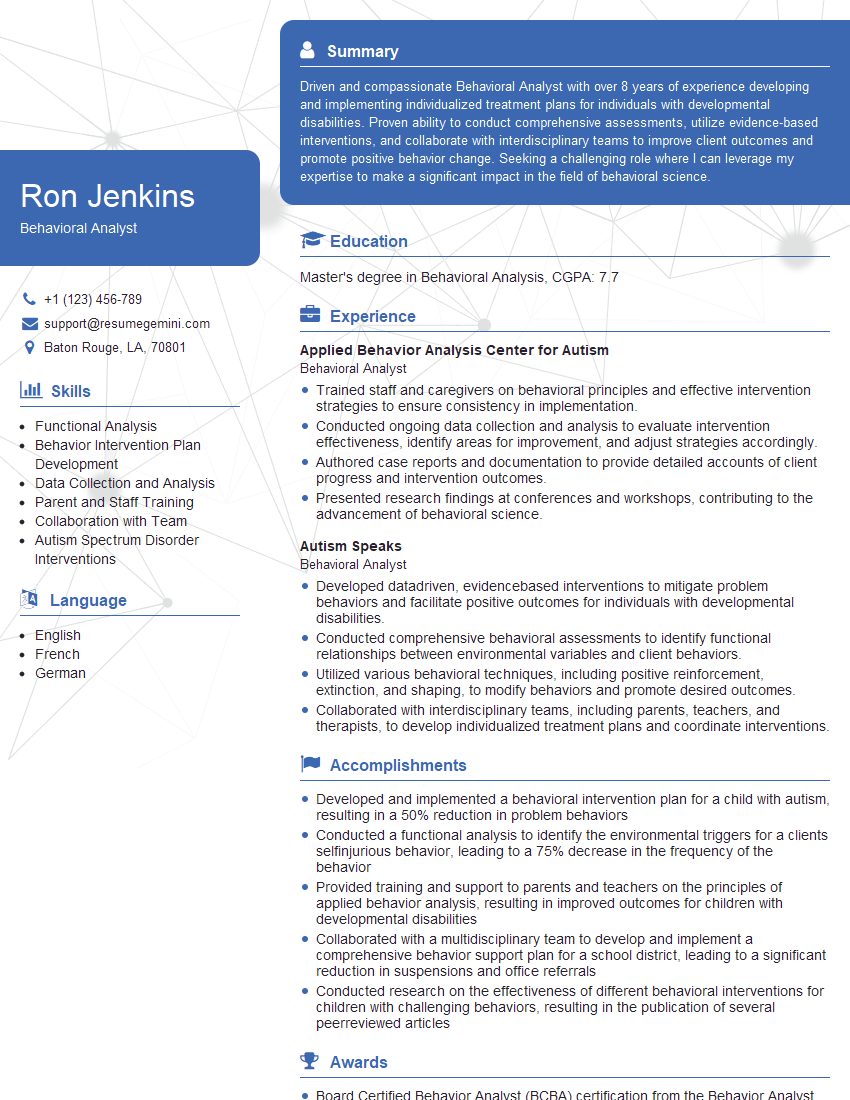
Mastering suspect profiling opens doors to exciting and impactful careers in law enforcement, intelligence agencies, and forensic psychology. To significantly increase your job prospects, it’s crucial to create a resume that effectively highlights your skills and experience to Applicant Tracking Systems (ATS). ResumeGemini is a trusted resource to help you build a professional and ATS-friendly resume that showcases your qualifications in the best possible light. We provide examples of resumes tailored to Suspect Profiling to guide you. Take the next step towards your dream career – build a powerful resume with ResumeGemini today!

Explore more articles
Users Rating of Our Blogs
Share Your Experience
We value your feedback! Please rate our content and share your thoughts (optional).
What Readers Say About Our Blog
Very informative content, great job.
good