Are you ready to stand out in your next interview? Understanding and preparing for Sustainable Irrigation Practices interview questions is a game-changer. In this blog, we’ve compiled key questions and expert advice to help you showcase your skills with confidence and precision. Let’s get started on your journey to acing the interview.
Questions Asked in Sustainable Irrigation Practices Interview
Q 1. Explain the principles of sustainable irrigation.
Sustainable irrigation centers around using water efficiently and responsibly to meet crop needs while minimizing environmental impact. It’s about finding the sweet spot between providing enough water for healthy growth and preventing wasteful overuse. This involves a holistic approach considering factors like water sources, soil conditions, climate, and crop requirements.
- Water Conservation: Employing methods to minimize water loss through evaporation, seepage, and runoff.
- Water Quality Protection: Preventing contamination of water sources and minimizing the use of fertilizers and pesticides that could pollute groundwater.
- Soil Health Improvement: Using practices that improve soil structure and water retention, thus reducing irrigation frequency and volume.
- Energy Efficiency: Utilizing irrigation systems and technologies that require less energy to operate.
- Economic Viability: Ensuring that sustainable irrigation practices are economically feasible for farmers and growers.
Imagine a farmer choosing to install a drip irrigation system instead of flood irrigation. This choice saves water, energy, and reduces the environmental impact by minimizing runoff and soil erosion.
Q 2. Describe different irrigation methods and their water efficiency.
Several irrigation methods exist, each with varying water efficiency. Efficiency is judged by how much water actually reaches the plant roots versus how much is lost.
- Flood Irrigation: Water is applied to the entire field, often by gravity. It’s the least efficient, with high losses through evaporation and runoff. Water use efficiency: ~60%.
- Furrow Irrigation: Water flows along furrows or channels. Better than flooding but still susceptible to runoff. Water use efficiency: ~70-80%.
- Sprinkler Irrigation: Water is sprayed through sprinklers. More efficient than flood or furrow, but susceptible to evaporation and wind drift. Water use efficiency: ~75-85%.
- Drip Irrigation (or Trickle Irrigation): Water is delivered slowly and directly to the plant roots through tubes or emitters. Highly efficient, minimizing water loss. Water use efficiency: ~90-95%.
- Subsurface Irrigation: Water is applied below the soil surface. Highly efficient, minimizing evaporation. Water use efficiency: ~90-95%.
For example, a vineyard might use drip irrigation for highly efficient water delivery to individual vines, while a large-scale wheat farm might opt for sprinkler irrigation due to its scalability.
Q 3. What are the benefits and drawbacks of drip irrigation?
Drip irrigation offers significant benefits but also has some drawbacks.
- Benefits:
- High water use efficiency: Minimizes water waste through evaporation and runoff.
- Reduced weed growth: Targeted watering keeps areas between plants drier.
- Improved crop yields: Consistent moisture at the roots promotes better growth.
- Less soil erosion: No surface water flow to cause erosion.
- Fertilizer application: Fertilizers can be mixed with irrigation water for efficient delivery.
- Drawbacks:
- Higher initial cost: Setting up a drip irrigation system can be expensive compared to simpler methods.
- Clogging issues: Emitters can clog with sediment or debris, requiring regular maintenance.
- Not suitable for all crops: Some crops benefit from more even wetting of the soil surface.
- Salinity issues: In arid areas, salts can accumulate near the emitters.
Imagine a homeowner with a small vegetable garden. Drip irrigation provides the perfect balance between precision and ease of use. However, a large-scale rice paddy would likely find flood irrigation a more economical approach, despite lower efficiency.
Q 4. How does soil type influence irrigation scheduling?
Soil type significantly influences irrigation scheduling because different soils have varying water-holding capacities and drainage rates. Sandy soils drain quickly, requiring more frequent but smaller irrigation events. Clay soils retain water longer, requiring less frequent but potentially larger irrigation events.
- Sandy soils: Low water holding capacity, requires frequent irrigation.
- Clay soils: High water holding capacity, requires infrequent irrigation but potentially high volumes.
- Loamy soils: Good balance of water holding and drainage, moderate irrigation frequency and volume.
For example, a farmer with sandy soil planting tomatoes might need to irrigate every other day, while a farmer with clay soil planting the same crop might only need to irrigate weekly. Soil testing is crucial to understand the specific water-holding characteristics of the soil to properly schedule irrigation.
Q 5. Explain the concept of evapotranspiration and its role in irrigation management.
Evapotranspiration (ET) is the combined process of evaporation from the soil surface and transpiration from plants. It represents the total amount of water lost from the soil-plant-atmosphere system. Understanding ET is crucial because it estimates the amount of water a crop needs.
Irrigation scheduling aims to replace the water lost through ET. Factors influencing ET include temperature, humidity, wind speed, sunlight, and plant type. ET can be measured directly using specialized equipment or estimated using weather data and crop coefficients.
For example, a cotton field in a hot, arid region will have a high ET rate, requiring more frequent and substantial irrigation than the same crop in a cooler, more humid environment. Farmers utilize ET data to optimize their irrigation schedules, ensuring that plants receive the necessary water without over-irrigating.
Q 6. What are the key components of a smart irrigation system?
A smart irrigation system integrates technology to automate and optimize water delivery based on real-time data. Key components include:
- Soil moisture sensors: Measure the water content in the soil, providing real-time data about soil moisture levels.
- Weather station: Collects data on temperature, humidity, wind speed, and rainfall, which are critical inputs for ET calculation.
- Control unit: Processes data from sensors and weather stations to determine irrigation needs.
- Irrigation controllers: Activate and manage irrigation systems based on instructions from the control unit.
- Data logging and analysis software: Stores and analyzes data to optimize irrigation schedules over time.
Imagine a farmer using a smart irrigation system. The system automatically adjusts the irrigation schedule based on current soil moisture and weather conditions, ensuring that crops are optimally watered while conserving water. Data analysis helps identify trends, allowing for further optimization of irrigation practices in the future.
Q 7. How do you assess the water needs of a specific crop?
Assessing a crop’s water needs involves considering various factors. A common approach is using the crop evapotranspiration (ET) method. Here’s a step-by-step approach:
- Determine the crop’s reference evapotranspiration (ET0): This is the evapotranspiration rate for a reference crop (usually grass) under standard conditions. Weather data (temperature, humidity, solar radiation, wind speed) are typically used to calculate ET0.
- Find the crop coefficient (Kc): This factor represents the ratio of a specific crop’s ET to the ET0. Kc values are specific to different crops and growth stages (e.g., early, mid, late season).
- Calculate the crop’s evapotranspiration (ETc): This is done by multiplying ET0 by Kc:
ETc = ET0 * Kc - Consider other factors: Soil type, water holding capacity, and irrigation efficiency must be considered to fine-tune irrigation volumes.
- Schedule irrigation: Based on ETc, soil conditions, and irrigation system efficiency, create an irrigation schedule to provide enough water without over-watering.
For example, if ET0 is 5 mm/day and Kc for corn at its mid-season growth stage is 1.15, then ETc is 5.75 mm/day. This indicates that the corn crop needs 5.75 mm of water per day to meet its evapotranspiration demands. This information is then utilized in conjunction with other factors to develop a practical irrigation schedule.
Q 8. Describe methods for measuring soil moisture.
Accurately measuring soil moisture is crucial for efficient irrigation. We use a variety of methods, each with its strengths and weaknesses. Think of it like checking the water level in a plant’s ‘personal reservoir’.
Tensiometers: These measure the soil water tension, essentially how strongly the soil holds onto water. It’s like a straw that measures the ‘suction’ of the soil. A higher reading means drier soil.
Soil Moisture Sensors (e.g., capacitance, time-domain reflectometry): These sensors directly measure the volumetric water content of the soil. Think of it as a sophisticated ‘water meter’ buried in the ground. Capacitance sensors measure the electrical capacitance of the soil, while time-domain reflectometry uses electromagnetic pulses.
Neutron probes: These use radioactive sources to measure soil moisture. While highly accurate, they require specialized training and licensing due to the radiation involved. This is a powerful but less commonly used method.
Gravimetric method: This ‘old-school’ method involves taking soil samples, weighing them, drying them in an oven, and then re-weighing them. The difference in weight represents the water content. This is simple but time-consuming and can be destructive to the field.
The best method depends on factors such as budget, accuracy requirements, and the scale of the operation. A small garden might use a simple moisture meter, while a large farm might employ a network of sensors and data loggers.
Q 9. What are some strategies for reducing irrigation water waste?
Reducing irrigation water waste is essential for sustainable agriculture. It’s about delivering the right amount of water at the right time, rather than wasting it.
Efficient Irrigation Technologies: Switching from flood or furrow irrigation (think of watering a field with a hose) to drip irrigation (precisely delivering water to plant roots) or sprinkler irrigation (more efficient than flooding but less than drip) drastically reduces water loss through evaporation and runoff. Drip irrigation is like giving plants a personal drink, while sprinklers are more like a light shower.
Soil Moisture Monitoring: Using the methods described above allows for irrigation only when needed. This prevents overwatering, a major cause of waste.
Water Scheduling Software and Algorithms: These tools predict water needs based on weather data, soil type, and crop requirements. It’s like having a ‘smart’ assistant for your irrigation system.
Mulching: Applying mulch (organic matter) around plants reduces evaporation from the soil surface. Think of it as a natural ‘water blanket’.
Improved Water Management Infrastructure: Fixing leaks in canals, pipelines, and other irrigation infrastructure reduces significant water losses. It’s like patching up a leaky bucket.
Improved Water Use Efficiency in Crops: Using drought-tolerant crops reduces water needs. This is like choosing a plant that’s naturally more water-wise.
Q 10. How can remote sensing technologies be used in irrigation management?
Remote sensing technologies are revolutionizing irrigation management. They offer a bird’s-eye view, allowing for large-scale monitoring and analysis.
Satellite Imagery: Satellites provide valuable information on vegetation health (NDVI – Normalized Difference Vegetation Index), soil moisture, and evapotranspiration (water loss from soil and plants). Think of it as a high-resolution picture of your farm from space.
Aerial Imagery (drones): Drones offer more frequent and detailed images at a lower cost than satellites. They can also cover areas inaccessible to satellites. Think of it as a close-up look at your field.
Data Analysis: Processed remote sensing data helps determine the water stress level in crops, enabling targeted irrigation. It’s like getting a diagnostic report on the health of your plants.
For example, low NDVI values indicate water stress, prompting irrigation. By integrating remote sensing with GIS (Geographic Information Systems), we can pinpoint specific areas that need more or less water.
Q 11. Explain the role of GIS in optimizing irrigation strategies.
GIS (Geographic Information Systems) plays a vital role in optimizing irrigation strategies by providing a spatial framework for data analysis and decision-making. It’s like having a map that overlays all the important information about your irrigation system.
Spatial Data Integration: GIS integrates data like soil maps, elevation data, crop types, and sensor readings. This creates a comprehensive picture of the irrigation area.
Irrigation System Design and Planning: It helps design efficient irrigation layouts, optimizing pipeline networks and minimizing water loss. This is like designing the most effective water delivery route.
Precision Irrigation Management: GIS allows for variable rate irrigation, applying water precisely to areas with different water needs. This is like giving each section of your field exactly what it needs.
Monitoring and Evaluation: GIS facilitates tracking irrigation performance, identifying areas with water stress, and evaluating the effectiveness of different management strategies. It’s like keeping a detailed logbook of your irrigation efforts.
Essentially, GIS enables a shift from blanket irrigation to precision irrigation, reducing water waste and increasing efficiency.
Q 12. What are some common irrigation scheduling techniques?
Irrigation scheduling techniques aim to provide water to plants when and where it’s needed, maximizing efficiency and minimizing waste. It’s like having a well-planned watering schedule for your plants.
Climate-Based Scheduling: This relies on weather data (rainfall, temperature, evapotranspiration) to estimate crop water needs. It’s a simple yet effective method.
Soil Moisture-Based Scheduling: This uses soil moisture sensors to determine when irrigation is necessary. It’s the most precise method, adapting to actual soil conditions.
Crop Coefficient Approach: This involves estimating water use based on crop type, growth stage, and climatic conditions. It requires knowledge of crop water requirements.
Pan Evaporation Method: This uses a standardized pan to measure evaporation rates, which are then used to estimate irrigation needs. It is a relatively simple technique.
The choice of technique depends on factors such as the complexity of the irrigation system, the availability of sensors and weather data, and the level of precision desired.
Q 13. How do you deal with irrigation system malfunctions?
Dealing with irrigation system malfunctions requires a systematic approach, focusing on quick detection and effective repair to prevent water loss and crop damage.
Regular Inspection and Maintenance: This is the best prevention – detecting minor issues before they escalate into major problems. This is like regularly servicing your car.
Leak Detection: Using pressure sensors, acoustic leak detectors, or visual inspection to find and fix leaks promptly. It’s like finding and patching up a hole in a pipe.
Sensor Calibration and Monitoring: Ensuring sensors are providing accurate data, and promptly addressing malfunctions. This is like making sure your measuring tools are accurate.
Automated Alert Systems: Setting up systems to alert operators of malfunctions, allowing for immediate response. It’s like having a warning system in place.
Spare Parts and Emergency Repair: Having readily available spare parts and skilled technicians ready for quick repairs. This is like having a well-stocked toolbox.
A well-maintained irrigation system with a proactive maintenance plan minimizes downtime and water loss.
Q 14. Describe the process of designing an efficient irrigation system.
Designing an efficient irrigation system requires careful planning and consideration of several factors. It’s like designing a well-organized water delivery network for your plants.
Site Assessment: Evaluating factors like soil type, slope, water source, and crop requirements. This is the foundation of the design process.
Irrigation Method Selection: Choosing the most suitable method (drip, sprinkler, etc.) based on site conditions and crop needs. It’s like choosing the right tool for the job.
Water Source and Distribution: Designing a reliable water source and efficient distribution network to minimize water loss and ensure adequate pressure. It’s like designing the plumbing for your system.
Hydraulic Design: Calculating pipe sizes, pump capacity, and pressure requirements to ensure optimal water flow. This is the engineering aspect of the design.
Control System Integration: Incorporating automated control systems for precise water scheduling and efficient water management. It’s like adding a control panel to your system.
Environmental Considerations: Minimizing environmental impact by avoiding water pollution and over-irrigation. It’s like designing a system that respects the environment.
Efficient irrigation system design leads to significant reductions in water use, increased crop yields, and reduced environmental impact.
Q 15. What are the environmental impacts of inefficient irrigation practices?
Inefficient irrigation practices have significant environmental consequences, primarily centered around water depletion and degradation of water quality. Think of it like this: using more water than necessary is like leaving the tap running while brushing your teeth – it’s wasteful and unsustainable.
Water Depletion: Over-irrigation leads to excessive groundwater extraction, depleting aquifers and reducing water availability for other uses, including human consumption and ecosystems. This can lead to land subsidence and saltwater intrusion in coastal areas.
Water Pollution: Inefficient irrigation systems often lead to runoff. This runoff carries fertilizers, pesticides, and salts from the fields into water bodies, causing eutrophication (excessive nutrient enrichment leading to algal blooms), harming aquatic life, and contaminating drinking water sources.
Energy Consumption: Pumping and distributing large volumes of water requires significant energy, often from fossil fuels, contributing to greenhouse gas emissions and climate change. Poor irrigation scheduling also means more pumping and energy is used.
Soil Degradation: Excessive irrigation can lead to soil salinization (accumulation of salts) and waterlogging, both of which reduce soil fertility and hamper plant growth. This creates a vicious cycle of needing more water and fertilizer leading to greater environmental problems.
Career Expert Tips:
- Ace those interviews! Prepare effectively by reviewing the Top 50 Most Common Interview Questions on ResumeGemini.
- Navigate your job search with confidence! Explore a wide range of Career Tips on ResumeGemini. Learn about common challenges and recommendations to overcome them.
- Craft the perfect resume! Master the Art of Resume Writing with ResumeGemini’s guide. Showcase your unique qualifications and achievements effectively.
- Don’t miss out on holiday savings! Build your dream resume with ResumeGemini’s ATS optimized templates.
Q 16. How can you incorporate water harvesting techniques into an irrigation system?
Incorporating water harvesting into an irrigation system is a crucial step towards sustainability. Water harvesting involves collecting rainwater and storing it for later use. This stored water can significantly reduce reliance on groundwater and surface water sources.
Rainwater Harvesting Structures: This could involve constructing reservoirs, ponds, or tanks to collect rainwater from rooftops, fields, or larger areas. The size of the structure depends on the scale of irrigation needs and rainfall patterns.
Integrating with Irrigation System: The collected water can be directly pumped into the irrigation system, supplementing the supply from other sources. A simple gravity-fed system can be used for smaller applications.
Soil Water Conservation: Water harvesting techniques can also include measures to improve soil water retention, such as mulching, contour farming, and the use of cover crops. These help reduce runoff and increase the water available for the plants.
Example: A farm in a semi-arid region could collect rainwater from its rooftops and fields into a large reservoir. This water can then be used to irrigate the crops during dry spells, reducing the need to rely heavily on groundwater pumping.
Q 17. What are some water-efficient irrigation technologies?
Several water-efficient irrigation technologies are available to minimize water wastage and improve irrigation efficiency. These technologies focus on delivering water precisely where and when it’s needed.
Drip Irrigation: Delivers water directly to the roots of plants through a network of tubes and emitters. It minimizes evaporation and runoff.
Sprinkler Irrigation: Uses sprinklers to distribute water over a larger area, but modern systems (like center pivot or lateral move) allow for more precise control compared to older systems.
Micro-sprinklers: These are smaller than standard sprinklers, suitable for smaller areas and closer spacing of plants. They offer better water distribution than larger sprinkler systems.
Subsurface Irrigation: Delivers water below the soil surface, reducing evaporation losses and promoting better water infiltration.
Pressure Compensating Emitters: These ensure uniform water distribution even on uneven terrain.
The choice of technology depends on factors like the type of crop, soil type, topography, and water availability.
Q 18. Explain the concept of deficit irrigation.
Deficit irrigation is a water-saving strategy where plants are intentionally subjected to periods of water stress. It’s like giving your plants a controlled workout; a bit of stress makes them stronger in the long run.
It doesn’t mean completely depriving plants of water but rather managing irrigation to optimize water use while minimizing yield reduction. This is achieved by carefully controlling the amount and frequency of irrigation based on the plant’s water requirements at different growth stages.
Benefits:
Reduced water consumption: Significant water savings can be achieved without severely compromising crop yields.
Improved water use efficiency: Plants become more efficient at utilizing the available water.
Potential increase in crop quality: In some cases, deficit irrigation can improve fruit quality and sugar content.
Important Consideration: The level of deficit irrigation and its timing must be carefully managed based on the crop’s tolerance to water stress, soil conditions, and climatic factors. Overdoing it can seriously impact yield.
Q 19. How can you integrate sustainable irrigation practices into precision agriculture?
Integrating sustainable irrigation practices into precision agriculture enhances efficiency and optimizes water use. Precision agriculture relies on data and technology to manage resources effectively.
Sensor Networks: Soil moisture sensors provide real-time information about soil water content, allowing for precise irrigation scheduling. This avoids overwatering and ensures plants receive water only when needed.
Variable Rate Irrigation (VRI): This technology adjusts the amount of water applied based on variations in soil conditions, crop growth, and plant water needs within the field. This creates customized watering for different parts of the field.
GPS and GIS: Geographic Information Systems (GIS) and Global Positioning Systems (GPS) help create detailed maps of the field, allowing for precise targeting of irrigation, reducing water waste in areas that don’t need it.
Remote Sensing: Satellite imagery and aerial photography can be used to monitor crop health and water stress. This allows for proactive irrigation management.
Combining these technologies with efficient irrigation methods like drip or subsurface irrigation maximizes water use efficiency and yields in precision agriculture.
Q 20. What are the economic benefits of sustainable irrigation?
Sustainable irrigation practices offer significant economic benefits beyond simply reducing water costs. These long-term advantages are crucial for the profitability and sustainability of agricultural operations.
Reduced water bills: Efficient irrigation systems save water, which directly translates to lower water costs.
Increased crop yields: Optimized water management leads to healthier plants and higher yields, increasing overall farm income.
Reduced energy costs: Less pumping is needed, resulting in significant savings in energy expenses.
Improved soil health: Sustainable practices prevent soil degradation, preserving its long-term productivity and reducing the need for expensive soil amendments.
Enhanced crop quality: Improved water management can lead to higher-quality crops that command premium prices in the market.
Reduced environmental risks: Avoiding water pollution and soil degradation diminishes risks of fines or penalties related to environmental damage.
Q 21. Describe your experience with different irrigation control systems.
My experience encompasses a range of irrigation control systems, from traditional time-based systems to sophisticated automated controls.
Time-based Systems: These rely on pre-programmed schedules, regardless of actual water needs. While simple, they are often inefficient due to overwatering or underwatering. I’ve worked with these in smaller-scale applications and understand their limitations.
Sensor-based Systems: These use soil moisture sensors or weather data to trigger irrigation. This leads to significant water savings and improved crop performance compared to time-based systems. I’ve designed and implemented several systems utilizing soil moisture sensors and weather stations, integrating them with automated valve controllers.
Computerized Control Systems: These integrate data from multiple sources (weather, soil sensors, evapotranspiration models) to optimize irrigation schedules dynamically. These sophisticated systems deliver the highest efficiency but require expertise in their programming and maintenance. I have considerable experience working with such systems, both in programming and troubleshooting. I’ve even worked with cloud-based systems for remote monitoring and control.
Each system has its advantages and disadvantages; the best choice depends on the specific needs of the farm, the crops being grown, and the available budget. My expertise allows me to assess a client’s needs and recommend the most appropriate system.
Q 22. How do you monitor and evaluate the performance of an irrigation system?
Monitoring and evaluating irrigation system performance is crucial for optimizing water use and crop yield. It involves a multi-faceted approach combining field observations with data analysis.
Firstly, we conduct regular field inspections, checking for leaks in pipes, clogged emitters, and proper functioning of valves and pumps. We also assess soil moisture levels using tools like tensiometers or soil moisture sensors to ensure that irrigation is delivering the right amount of water to the plant roots.
Secondly, we utilize data logging systems. These systems record data on water application rates, irrigation duration, and pressure readings at various points within the system. This data is then analyzed to identify inefficiencies and areas for improvement. For instance, unusually high pressure readings might indicate a leak, while consistently low soil moisture readings despite adequate irrigation time could suggest problems with the distribution system.
Finally, we employ yield monitoring techniques to evaluate the effectiveness of our irrigation strategies. Comparing yield data with irrigation schedules allows us to fine-tune our approach and achieve optimal crop production with minimal water wastage. This often involves using GPS-enabled devices to track yields across different zones within a field, allowing us to identify areas needing specific irrigation adjustments.
Q 23. What are some common challenges in implementing sustainable irrigation practices?
Implementing sustainable irrigation practices faces numerous challenges. A major hurdle is the high initial investment required for technologies like drip irrigation or rainwater harvesting systems. Farmers, particularly smallholders, may struggle to afford this upfront cost despite the long-term benefits.
Another significant challenge is the lack of awareness and technical expertise. Many farmers are unfamiliar with advanced irrigation techniques and require training and support to effectively adopt and manage them. This includes understanding soil types, plant water requirements, and proper system maintenance.
Climate variability also poses a problem. Unpredictable rainfall patterns can make it difficult to accurately predict irrigation needs, leading to either over- or under-irrigation. Effective water management requires accurate weather forecasting and adaptive irrigation scheduling.
Finally, water rights and regulations can be complex and vary regionally, creating obstacles for efficient water allocation and usage. These regulations need to be transparent and accessible to farmers for successful implementation.
Q 24. How do you address water scarcity issues in irrigation management?
Addressing water scarcity in irrigation requires a multi-pronged strategy focused on increasing efficiency and reducing water demand.
Efficient irrigation technologies like drip irrigation and micro-sprinklers significantly reduce water loss compared to traditional flood or furrow irrigation. These methods deliver water directly to the plant roots, minimizing evaporation and runoff.
Water harvesting techniques, such as constructing rainwater harvesting ponds or using infiltration basins, can capture and store rainwater for later use, supplementing irrigation needs during dry periods.
Soil moisture monitoring using sensors helps to accurately determine when irrigation is needed, preventing overwatering and optimizing water use. This approach combined with weather data helps to develop effective irrigation scheduling.
Drought-resistant crops play a crucial role. Selecting crop varieties that have a lower water requirement can significantly reduce water consumption without compromising yield.
Improving water infrastructure through efficient canal lining and reducing conveyance losses is critical for minimizing water waste during transportation from source to fields.
Q 25. What are the regulatory aspects of water use for irrigation in your region?
Water use regulations for irrigation vary significantly by region and depend on factors like water availability, environmental protection, and socio-economic conditions. In many areas, water rights are allocated based on historical usage, with permits or licenses required for drawing water from rivers, groundwater sources, or reservoirs.
Regulations often set limits on the amount of water that can be used for irrigation, particularly in times of drought. Penalties can be imposed for exceeding these limits or for using water inefficiently. There might be specific restrictions concerning the type of irrigation technology permitted, promoting water-efficient practices.
Environmental regulations also come into play. These focus on minimizing the impact of irrigation on water quality and ecosystems, such as preventing the runoff of fertilizers and pesticides into water bodies. It is crucial for farmers to be aware of and comply with all applicable water use regulations to ensure legal and environmentally sound irrigation practices.
Q 26. How do you ensure the sustainability of irrigation systems in the long term?
Ensuring the long-term sustainability of irrigation systems involves a combination of technical, economic, and social considerations.
Regular maintenance and repair of the irrigation system are essential to prevent leaks, clogs, and other problems that lead to water loss and reduced efficiency. A well-maintained system reduces long-term operational costs.
Sustainable water management practices, like crop rotation, cover cropping, and no-till farming, improve soil health, enhance water retention, and reduce the need for irrigation.
Community participation is critical. Involving local farmers in planning, implementation, and monitoring of irrigation projects ensures their ownership and commitment to the system’s sustainability. Regular training and workshops can help farmers adopt better water management practices and troubleshoot system problems independently.
Economic incentives, such as subsidies for water-efficient technologies or payments for ecosystem services, can encourage farmers to adopt sustainable practices. These could incentivize water conservation initiatives that benefit both the farmer and the environment.
Q 27. Explain the role of data analysis in improving irrigation efficiency.
Data analysis plays a vital role in improving irrigation efficiency. By collecting and analyzing data from various sources, we can gain insights into irrigation system performance, water use patterns, and crop water requirements.
For example, data from soil moisture sensors, weather stations, and irrigation flow meters can be used to develop precision irrigation schedules. These schedules optimize water application based on real-time conditions, reducing water waste and improving crop yields.
Statistical analysis of historical yield data can help to identify the relationship between water application and crop production. This allows for better calibration of irrigation systems and optimization of water use based on past performance.
Data visualization techniques such as graphs and maps can help to identify areas within a field that require more or less water, allowing for targeted irrigation management. This precision approach improves efficiency and reduces overall water consumption.
Predictive modeling using weather data and historical irrigation information can forecast future water needs, allowing for proactive water management and improved planning. This approach enables farmers to plan for potential water shortages and make adjustments accordingly.
Q 28. Describe your experience with conducting irrigation audits.
Irrigation audits provide a comprehensive assessment of an irrigation system’s efficiency, identifying areas for improvement and suggesting corrective measures. My experience in conducting audits typically involves a multi-stage process.
First, we conduct a thorough site inspection, documenting the layout and components of the irrigation system. This includes evaluating the condition of pipes, pumps, valves, and other equipment. We assess the distribution uniformity of the irrigation system, checking for even water application across the field.
Second, we collect data on water application rates, irrigation duration, and soil moisture levels. This data provides quantitative evidence of the system’s performance and helps us to pinpoint areas of inefficiency. For example, uneven water distribution or excessive runoff can easily be identified.
Third, we analyze the collected data and use it to prepare a detailed audit report. The report identifies strengths and weaknesses of the system, quantifies water losses, and recommends specific improvements. This could include replacing damaged equipment, implementing water-efficient technologies, or modifying irrigation schedules.
Finally, we provide recommendations and support to the farm owners for implementing the suggested changes. This often includes training and ongoing technical assistance to ensure the successful adoption of sustainable irrigation practices. I’ve had success in helping farmers reduce their water consumption by as much as 30% through effective audit-based improvements.
Key Topics to Learn for Sustainable Irrigation Practices Interview
- Water Resource Management: Understanding water availability, efficient allocation strategies, and the impact of climate change on water resources. Practical application: Analyzing water budgets for different crops and irrigation systems.
- Irrigation Technologies: Proficiency in various irrigation methods (drip, sprinkler, furrow), their efficiency, and suitability for different crops and terrains. Practical application: Designing an irrigation system for a specific farm considering soil type, topography, and water availability.
- Soil Moisture Monitoring: Employing sensors and technologies for accurate soil moisture measurement to optimize irrigation scheduling and minimize water waste. Practical application: Interpreting sensor data to adjust irrigation frequency and duration.
- Water Quality and Salinity Management: Understanding the impact of irrigation water quality on soil health and crop yield, and strategies for managing salinity issues. Practical application: Developing a plan to address salinity build-up in irrigated fields.
- Irrigation Scheduling and Automation: Implementing efficient irrigation scheduling techniques, including weather-based irrigation, and exploring the use of automation technologies for improved water management. Practical application: Programming an automated irrigation system based on real-time weather data and soil moisture levels.
- Sustainable Irrigation Policy and Regulations: Familiarity with relevant environmental regulations and policies related to water usage and irrigation practices. Practical application: Assessing the compliance of an existing irrigation system with environmental regulations.
- Economic and Environmental Impacts: Evaluating the economic and environmental benefits and costs of different irrigation practices, including life-cycle assessments. Practical application: Conducting a cost-benefit analysis of different irrigation technologies for a specific project.
Next Steps
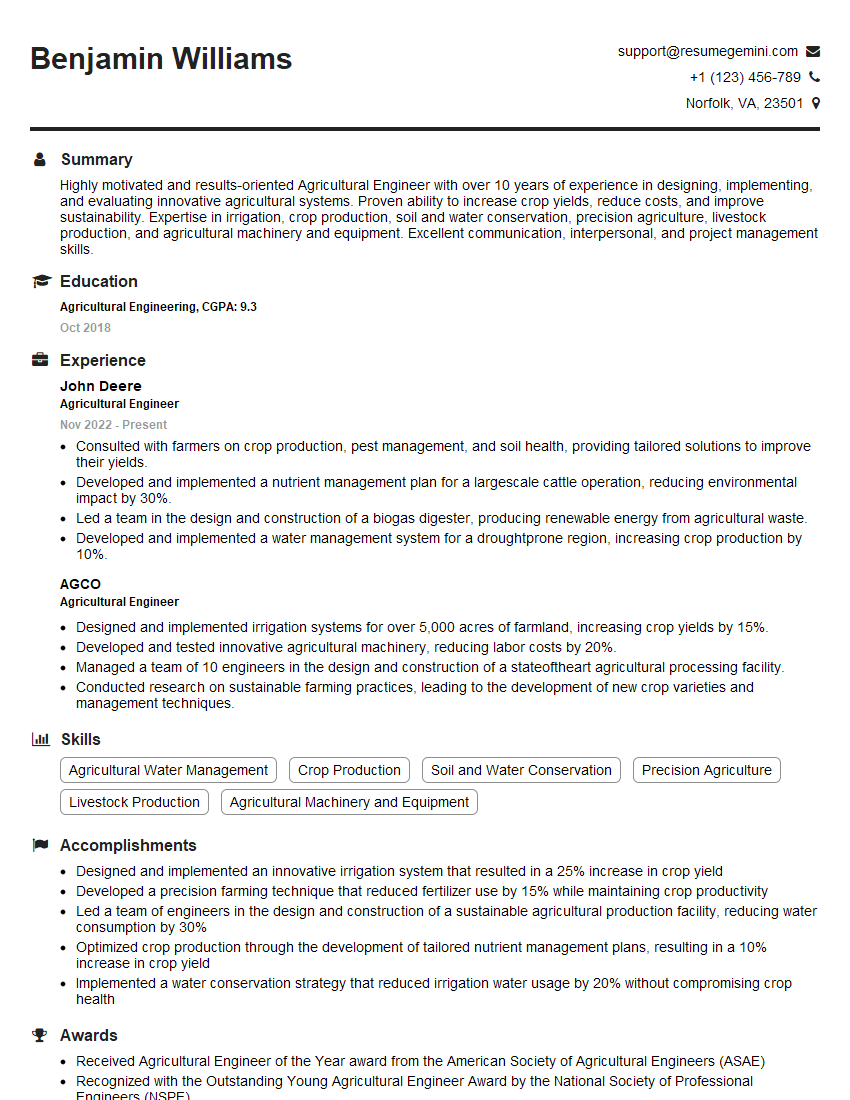
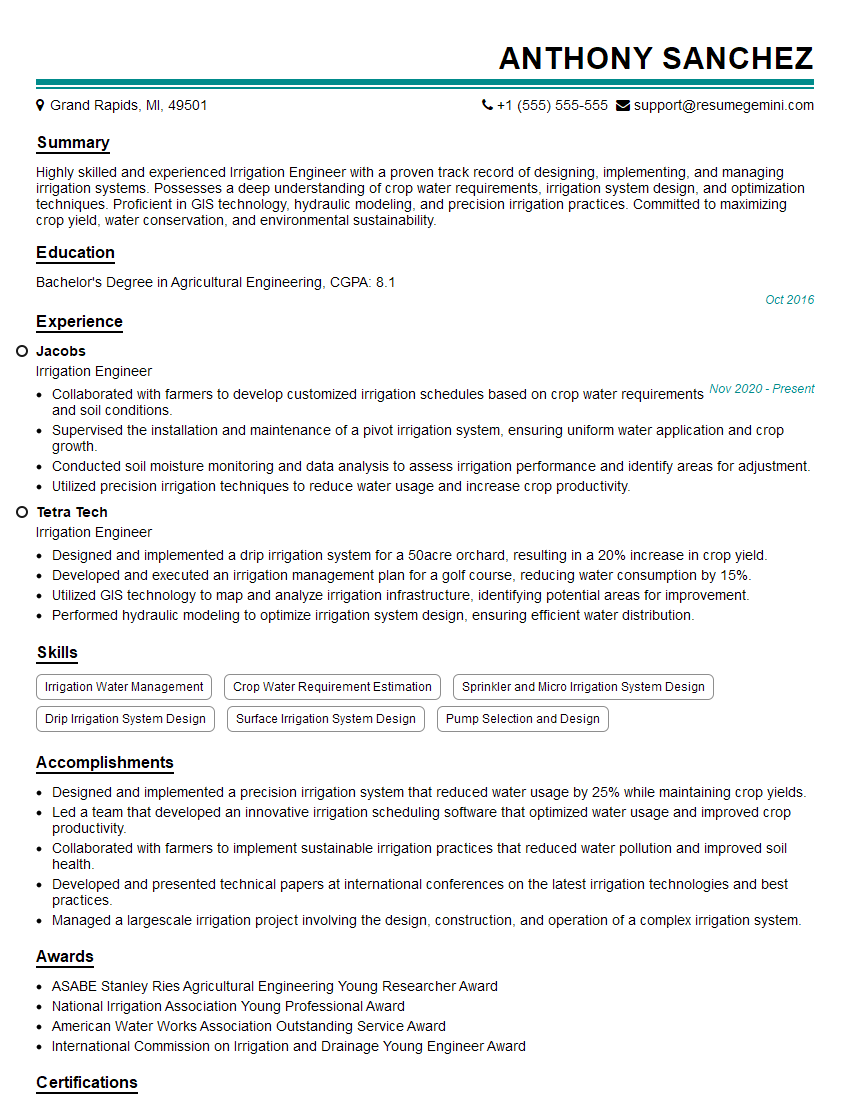
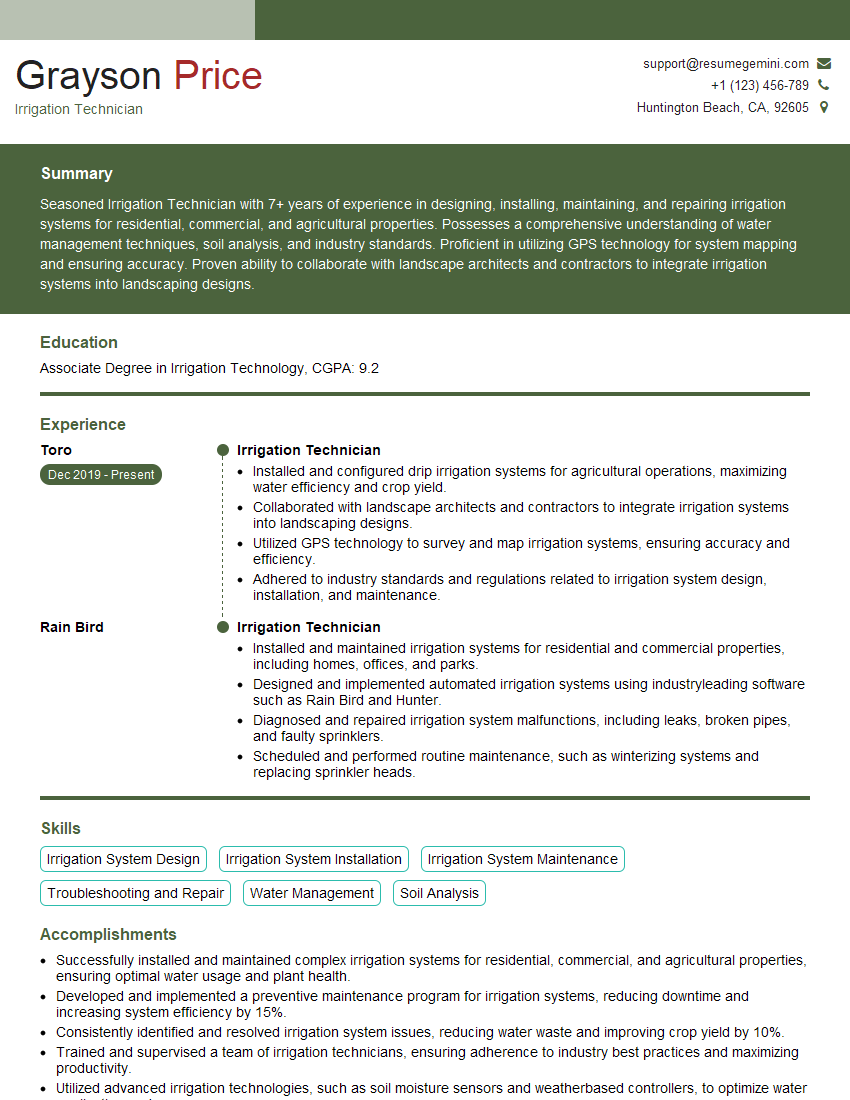
Mastering Sustainable Irrigation Practices is crucial for a successful and rewarding career in agriculture and environmental management. This knowledge is highly sought after by employers committed to environmentally responsible farming and resource conservation. To significantly boost your job prospects, it’s essential to craft a compelling and ATS-friendly resume that highlights your skills and experience. ResumeGemini is a trusted resource that can help you create a professional and impactful resume. Leverage ResumeGemini’s tools to build a strong application, and remember that examples of resumes tailored to Sustainable Irrigation Practices are available to guide you.

Explore more articles
Users Rating of Our Blogs
Share Your Experience
We value your feedback! Please rate our content and share your thoughts (optional).
What Readers Say About Our Blog
Very informative content, great job.
good