The right preparation can turn an interview into an opportunity to showcase your expertise. This guide to Swim Technique Instruction interview questions is your ultimate resource, providing key insights and tips to help you ace your responses and stand out as a top candidate.
Questions Asked in Swim Technique Instruction Interview
Q 1. Describe the different swimming strokes and their key technical aspects.
Swimming strokes are diverse, each requiring specific technique for optimal efficiency and power. Let’s explore the four major competitive strokes:
- Freestyle (crawl): This is arguably the most efficient stroke, characterized by alternating arm movements and a flutter kick. Key aspects include a high elbow catch, a powerful pull-through, and a streamlined body position. Think of it like rowing – the longer your reach and the more powerfully you pull, the faster you’ll move.
- Backstroke: Swum on the back, it uses an over-the-water arm recovery and a six-beat kick. Proper timing and body rotation are crucial for a smooth and powerful stroke. Imagine using your body as a lever, rotating from your core to generate power for each pull.
- Breaststroke: This stroke uses a simultaneous arm pull and an inward frog kick. It’s technically complex, requiring precise coordination between arms and legs, with a brief glide phase after each pull. The timing is akin to a perfectly choreographed dance; each element needs to flow seamlessly into the next.
- Butterfly: The most demanding stroke, butterfly involves a simultaneous arm pull, a dolphin kick, and a strong body undulation. A smooth and powerful pull is combined with a rhythmic body wave to propel the swimmer forward. Think of it as flying underwater; you need a coordinated body motion to achieve lift and forward momentum.
Mastering each stroke involves dedicated practice and attention to detail. Focusing on proper body alignment, breathing, and rhythm is key to improvement.
Q 2. Explain the importance of proper body position in swimming.
Proper body position is paramount in swimming, directly impacting efficiency, speed, and endurance. Think of it as building a stable platform for your power. A horizontal body position minimizes drag and allows for a more effective use of energy. A streamlined posture reduces resistance from the water, enabling faster movement with less effort. It also improves breathing efficiency, as a tilted position can make it harder to breathe correctly.
Imagine trying to push a boat through water: if the boat is tilted, it encounters significantly more resistance. Similarly, a tilted swimmer experiences higher water resistance and uses more energy for the same distance.
Maintaining a horizontal body position involves engaging core muscles, keeping the hips high, and minimizing unnecessary movement. Drills focusing on core stability and body rotation are essential for improving body position.
Q 3. How do you teach swimmers to improve their breathing technique?
Teaching effective breathing involves a gradual process focusing on rhythm and coordination. I start by having swimmers practice exhaling fully underwater, teaching them to use their nose and mouth to efficiently empty their lungs. We then introduce inhaling, emphasizing a quick and controlled intake of air during the recovery phase of the stroke. The goal is to make breathing feel natural and integrated with the swimming motion, not a separate, stressful event.
We work on drills like rhythmic breathing, where swimmers focus on a specific breath pattern (e.g., every three strokes), and bilateral breathing (breathing to both sides) for improved balance and body rotation. Visual cues, such as focusing on a specific point on the pool wall, can help align breathing with the stroke. Positive reinforcement and patient practice are crucial. We always begin with short distances and gradually increase the distance to build stamina and confidence. A common analogy is to compare it to playing a musical instrument; it takes time and practice to coordinate breathing and the rhythm of the stroke.
Q 4. What are common mistakes swimmers make in each stroke, and how do you correct them?
Common mistakes vary by stroke, but some transcend individual techniques. For example, many swimmers hold their breath or breathe inconsistently, leading to fatigue and poor rhythm. Another common mistake is dropping the hips, increasing drag and reducing efficiency. Poor body rotation limits power generation, while improper arm technique (like a late entry or early exit of the hand) reduces propulsion. An inefficient kick in freestyle wastes energy and doesn’t propel the swimmer efficiently. In breaststroke, many fail to properly coordinate the arm pull and kick.
Corrections involve video analysis, specific drills, and personalized feedback. For instance, if a swimmer is breathing incorrectly, we’d use drills focusing on proper exhalation and controlled inhalation. For dropped hips, we might use kickboard drills or body position exercises. We address improper arm technique by focusing on high elbow pull, and inefficient kicks with drills that target range of motion, kick strength, and timing. The process is always iterative, involving continuous feedback and adjustments.
Q 5. How do you assess a swimmer’s skill level and tailor your instruction accordingly?
Assessing a swimmer’s skill involves observation of their technique, speed, endurance, and comfort level in the water. I evaluate their stroke mechanics, looking for key technical elements like body position, arm and leg movements, and breathing patterns. Endurance is assessed by observing their ability to maintain a pace over a specific distance. A simple assessment might involve watching their swimming for a few lengths; a more in-depth assessment might use timed swims and specific stroke drills.
My instruction is always tailored. Beginners might require a lot of attention on fundamental skills, while advanced swimmers might benefit from more refined technique work and high-intensity training. My teaching adjusts to focus on the swimmer’s individual strengths and areas for improvement. For example, someone struggling with freestyle might need more time on body position and arm technique, while someone strong in freestyle but weak in backstroke, would benefit from focused drills on that specific stroke.
Q 6. Describe your teaching methodology for different age groups and skill levels.
My teaching methodology adapts to different age groups and skill levels. Young children need a playful and engaging approach, focusing on water safety, basic skills, and building confidence in the water. Games and activities are integrated into lessons. With teenagers, I emphasize technique refinement, competitive training, and goal setting. Adults often focus on fitness, injury prevention, and specific stroke improvement. Beginners in any age group will receive more instruction on fundamental skills, while advanced swimmers focus on speed, efficiency, and fine-tuning of stroke mechanics.
For example, a beginner’s lesson might involve learning basic strokes, floats, and breath control, while an advanced swimmer’s lesson could involve video analysis and drills to perfect their technique. I always adjust the intensity and complexity of drills based on age and fitness levels. I use positive reinforcement and goal-setting to keep every swimmer engaged and motivated.
Q 7. How do you create a positive and motivating learning environment for swimmers?
Creating a positive and motivating environment is crucial. I foster a supportive atmosphere where swimmers feel comfortable trying new things and making mistakes. Positive feedback, encouragement, and celebrating successes are key elements. Group activities and friendly competition can enhance motivation, and individual goals are established to encourage steady progress. I make sure to create a safe and inclusive environment where every swimmer feels valued and respected.
It’s important to tailor the teaching style to suit individual personalities. For some, a direct, results-oriented approach is beneficial, while others might need more encouragement and positive reinforcement. Building rapport with each swimmer helps create a trusting relationship that fosters improvement. The overall goal is for swimmers to not just learn, but to truly enjoy their time in the water.
Q 8. How do you address swimmer’s fear or anxiety in the water?
Addressing a swimmer’s fear or anxiety in the water requires a patient, understanding, and individualized approach. It’s crucial to build trust and create a safe, supportive environment. I start by understanding the root of their fear – is it a past negative experience, a lack of confidence, or simply a feeling of being overwhelmed?
My strategy involves a gradual desensitization process. We might begin with simple activities like getting comfortable in shallow water, blowing bubbles, and practicing kicking while holding onto the side. I encourage positive self-talk and focus on achievable goals, celebrating even small successes. For example, if a swimmer is afraid of putting their face in the water, we might start by slowly dipping their forehead in, then gradually increase the duration until they are comfortable fully submerging their face. As confidence grows, we progress to deeper water, gradually introducing more challenging activities. Ultimately, the goal is to replace fear with a sense of accomplishment and empowerment.
I also find that incorporating games and playful activities, paired with clear, concise instructions can greatly reduce anxiety and enhance the learning experience. It’s all about building trust and showing them they’re capable of overcoming their fear.
Q 9. Explain the importance of warm-up and cool-down routines in swimming.
Warm-up and cool-down routines are essential for injury prevention, improved performance, and overall well-being in swimming. Think of it like preparing your car engine before a long drive – it needs to be warmed up to perform efficiently and avoid damage.
A proper warm-up typically includes 5-10 minutes of light cardio, like jogging or jumping jacks, followed by dynamic stretching, such as arm circles, leg swings, and torso twists. This increases blood flow to muscles and improves range of motion. In the pool, I usually incorporate gentle swimming drills and kicking sets to prepare the body for more intense activity. This could include easy freestyle, backstroke, or even just water walking.
The cool-down is equally important. It helps to gradually reduce heart rate and blood pressure, minimizing the risk of dizziness or fainting. This usually involves light swimming at a slow pace for 5-10 minutes followed by static stretching, holding each stretch for 20-30 seconds. Focus is placed on major muscle groups used in swimming, like shoulders, back, and legs. By consistently incorporating warm-up and cool-down routines, swimmers can reduce their risk of injury, improve their overall performance, and enjoy a more positive swimming experience.
Q 10. How do you incorporate drills and exercises to improve technique?
Drills and exercises are fundamental to improving swimming technique. They allow for focused practice on specific aspects of the stroke, helping swimmers to refine their movements and develop efficiency. For instance, to improve freestyle arm pull, I might use a drill like ‘fingertip drag,’ where swimmers focus on extending their arm fully and maintaining a high elbow throughout the pull. Or, to improve body rotation, we could use a drill focusing on single arm freestyle emphasizing a strong core engagement to power the pull through the water.
I also incorporate drills that isolate specific movements. For example, to improve kick technique, I might have swimmers practice kicking on their side while holding onto the side of the pool, allowing for more precise feedback and correction. I frequently incorporate the use of kickboards and pull buoys to isolate various muscle groups and refine individual techniques.
Exercises performed out of the water are also very helpful. Land-based exercises, focusing on shoulder mobility, core strength, and overall body flexibility can enhance the swimmer’s strength and power. These can include things like resistance band exercises, planks, and core work. The integration of both in-water drills and land-based exercises create a holistic approach to technique improvement.
Q 11. How do you use technology (video analysis, etc.) to improve swimmer performance?
Technology plays a significant role in modern swim technique instruction. Video analysis is a powerful tool that allows swimmers to visually assess their technique. Using underwater and above-water cameras, I can record swimmers during practice and then review the footage together. This allows for a very detailed examination of body position, arm movements, and leg kick. We can pause, rewind, and analyze specific strokes in slow motion, pinpointing areas for improvement.
Beyond video analysis, there are other technology applications as well. Wearable sensors, such as those that measure stroke rate and distance per stroke, can provide quantifiable data on performance. This data, combined with visual analysis, provides a comprehensive overview of a swimmer’s technique and its effectiveness. This allows me to provide even more tailored and effective feedback.
The use of this technology allows for personalized feedback and creates a more data-driven approach to swimming instruction, resulting in quicker improvements in technique and performance.
Q 12. How do you provide constructive feedback to swimmers?
Providing constructive feedback is critical to a swimmer’s progress. My approach is always positive and focused on improvement. Instead of criticizing what’s wrong, I emphasize the positive aspects of their technique first, building their confidence. Then, I use specific and clear language to identify areas needing improvement, explaining why a change is necessary and how it will lead to better results.
For instance, instead of saying “Your pull is weak,” I might say, “I noticed your elbow is dropping during the pull phase. If we bring your elbow higher, you’ll generate more power and propel yourself through the water more efficiently.” I often demonstrate the correct technique myself, and we break down the stroke into smaller, manageable parts.
I always conclude my feedback by setting achievable goals for the next training session. This positive reinforcement approach, combined with clear explanations and achievable goals creates a much more effective learning environment. This approach promotes self-confidence and the desire to continuously improve technique.
Q 13. How do you manage a group of swimmers with varying skill levels?
Managing a diverse group of swimmers with varying skill levels requires careful planning and adaptable teaching strategies. I often group swimmers according to their skill and experience, forming smaller groups or creating different lanes within the pool. This allows me to provide individualized attention and instruction.
Within these groups, I employ differentiated instruction, adjusting my teaching methods and the complexity of the drills to suit each swimmer’s abilities. Beginners might focus on fundamental skills like proper breathing and body position, while more advanced swimmers can work on more nuanced techniques and strategies. I also employ age-appropriate language and examples, ensuring everyone feels comfortable and understands the concepts being taught.
I use a variety of teaching techniques, including whole-part-whole teaching (teaching the entire skill, then breaking it down into smaller parts for focused practice before putting it back together) and visual aids such as diagrams and videos, to help students at different levels fully grasp the material.
Q 14. How do you adapt your teaching to accommodate swimmers with disabilities?
Adapting my teaching to accommodate swimmers with disabilities requires sensitivity, creativity, and a deep understanding of individual needs. It’s paramount to remember that every swimmer is unique, and a one-size-fits-all approach simply won’t work.
Before designing a lesson plan, I thoroughly discuss the swimmer’s specific needs and limitations with them and, if appropriate, their parents or guardians. This understanding forms the foundation of individualized instruction, where safety and inclusivity are top priorities.
Adaptations might include modifying equipment, adjusting drills, or employing alternative teaching methods. For example, for a visually impaired swimmer, I might use verbal cues and tactile aids to guide them. For a swimmer with limited mobility, I might focus on exercises that strengthen specific muscle groups or modify drills to minimize stress on affected areas. The core principle remains consistent – promoting active participation, fostering a sense of accomplishment, and building their confidence in the water.
Q 15. Describe your experience with different teaching styles (e.g., Total Immersion, etc.).
My approach to swim instruction incorporates elements from various teaching styles, adapting to the individual needs of each swimmer. I’ve found that a blended approach is often most effective. While I don’t strictly adhere to a single methodology like Total Immersion, I appreciate its emphasis on body position and efficiency. Total Immersion’s focus on minimizing drag and maximizing propulsion through streamlined body alignment resonates strongly with my own teaching philosophy. I also draw inspiration from other techniques that prioritize building a strong foundation in fundamental skills before progressing to advanced stroke techniques.
For instance, I might use Total Immersion principles to help a swimmer understand how to maintain a high body position in the water, but then combine that with drills and techniques from other methods to refine their stroke mechanics. This tailored approach allows me to address the specific challenges each swimmer faces, whether it’s improving their breathing technique, increasing their power, or correcting a biomechanical flaw.
Career Expert Tips:
- Ace those interviews! Prepare effectively by reviewing the Top 50 Most Common Interview Questions on ResumeGemini.
- Navigate your job search with confidence! Explore a wide range of Career Tips on ResumeGemini. Learn about common challenges and recommendations to overcome them.
- Craft the perfect resume! Master the Art of Resume Writing with ResumeGemini’s guide. Showcase your unique qualifications and achievements effectively.
- Don’t miss out on holiday savings! Build your dream resume with ResumeGemini’s ATS optimized templates.
Q 16. How do you ensure the safety of swimmers during lessons?
Safety is paramount in my teaching. It’s a proactive, multi-layered approach. Firstly, I always conduct a thorough risk assessment of the environment before each lesson, checking water depth, cleanliness, and the presence of any hazards. I meticulously assess the swimmer’s abilities before determining appropriate drills and exercises and carefully select the teaching environment (pool, lake, ocean) according to the abilities of the swimmers and safety standards. I ensure a proper student-to-instructor ratio (depending on skill levels), making sure that my students can get my immediate assistance when needed.
Secondly, I emphasize clear and consistent communication. Swimmers are always instructed on safety procedures, including entering and exiting the water safely, recognizing signs of fatigue, and knowing how to call for help. Thirdly, I utilize various safety techniques such as appropriate rescue equipment (buoys, rescue tubes), constant supervision, and a buddy system, particularly for open water swimming. For beginners, I insist on appropriate flotation devices to instill confidence and safety.
Q 17. What is your experience with stroke analysis and correction?
Stroke analysis and correction are crucial aspects of my coaching. I use a combination of visual observation, video analysis, and feel to identify areas for improvement. Visual observation allows me to spot immediate problems like inefficient body rotation or improper arm pull. Video analysis provides a more detailed and objective perspective, enabling me to break down the stroke into smaller components and pinpoint subtle flaws. The ‘feel’ aspect comes from years of experience in the water. I often get into the water with my students to demonstrate proper technique and feel the nuances of effective movements.
For example, if a swimmer is experiencing a slow pace, I might analyze their video to see if their body position is causing excessive drag. This could then lead to targeted drills focused on improving their body alignment and core engagement. I wouldn’t simply tell them to ‘swim faster’; I’d help them understand *why* they’re slow and provide specific, corrective exercises to address the root causes.
Q 18. How do you handle challenging or disruptive swimmers?
Handling challenging or disruptive swimmers requires patience, understanding, and a proactive approach. I always start by trying to understand the root cause of the behavior. Is the swimmer bored? Frustrated? Anxious? Once I identify the issue, I can tailor my response. Sometimes, a simple adjustment to the lesson plan—introducing a new game or challenge—is all that’s needed.
Other times, I might need to address the behavior directly, using positive reinforcement and clear communication. For instance, if a swimmer is constantly interrupting the lesson, I might have a quiet conversation with them, explaining the importance of respecting other swimmers’ learning time. In more severe cases, I might need to involve parents or guardians to discuss strategies for managing the behavior outside of the swimming environment. Consistency and clear expectations are key to managing challenging situations.
Q 19. What is your understanding of the principles of hydrodynamics in swimming?
Hydrodynamics is the science of how objects move through fluids, and in swimming, it’s absolutely fundamental. Understanding hydrodynamics allows for efficient swimming. Key principles include minimizing drag (resistance from the water) and maximizing propulsion (force generated to move forward). Reducing drag is achieved through streamlined body position, minimizing surface area, and utilizing efficient body movements. Propulsion is achieved through powerful arm and leg movements, effective body rotation, and utilizing the correct timing and application of force.
For example, a swimmer with a high body position will experience less drag than a swimmer who is sinking low in the water. Similarly, a swimmer who uses a powerful and efficient pull will generate more propulsion than a swimmer with a weak or inefficient stroke. Understanding these principles allows me to design drills and exercises that improve both drag reduction and propulsion, leading to faster and more energy-efficient swimming.
Q 20. Describe your experience with swim meet preparation and coaching.
My experience with swim meet preparation and coaching includes developing training plans, assisting with the selection process, and mentoring young swimmers. I focus on tapering strategies before meets to ensure peak performance, which includes reducing training volume but maintaining intensity. I also address the psychological aspects of competition, such as managing pre-race anxiety and developing positive self-talk techniques.
I’ve coached swimmers at various levels, from local club competitions to regional events. I tailor my approach to each swimmer’s individual needs and goals, whether it’s achieving a personal best time or qualifying for a higher level of competition. This requires an understanding of both physical and mental preparation, including nutrition planning and stress management strategies. The key is to balance intense training with adequate rest and recovery.
Q 21. How do you develop individual training plans for swimmers?
Developing individual training plans involves a thorough assessment of the swimmer’s current abilities, goals, and limitations. This usually begins with a comprehensive needs analysis. I take into consideration age, swimming experience, technique, strength, and endurance levels.
The plan itself is structured around specific goals, with short-term and long-term objectives. For example, a short-term goal might be to improve the swimmer’s 50-meter freestyle time by two seconds, while a long-term goal could be to qualify for a regional meet. The plan incorporates a variety of training methods, such as interval training, distance swimming, and strength training, to work on different aspects of their performance. Regular monitoring and evaluation are crucial, allowing for adjustments to the plan based on the swimmer’s progress and any challenges encountered. Communication and feedback are crucial throughout the process.
Q 22. Explain your approach to setting goals and monitoring progress.
Goal setting and progress monitoring for swimmers are crucial for motivation and improvement. My approach is highly individualized, starting with a thorough assessment of the swimmer’s current skill level, goals (e.g., competition, fitness, water safety), and any physical limitations. We collaboratively create SMART goals – Specific, Measurable, Achievable, Relevant, and Time-bound. For example, instead of ‘improve swimming,’ a SMART goal would be ‘reduce freestyle stroke time by 5 seconds over the next month.’
Progress is tracked through a combination of methods. This includes regular timed swims, video analysis of technique, subjective feedback from both the swimmer and myself, and the use of stroke-analysis technology where available. We regularly review progress against these goals, adjusting the plan as needed. If progress plateaus, we explore potential reasons – physical fatigue, technical issues, or motivational factors – and make adjustments to training or technique.
For instance, I worked with a young swimmer who wanted to compete in a local meet. We set specific goals for each stroke, breaking down the overall goal into smaller, weekly targets. We used video analysis to identify areas for improvement in their freestyle, focusing on body position and arm pull. Regular feedback and adjustments resulted in them achieving their goals and gaining confidence.
Q 23. How do you maintain your own professional development as a swim instructor?
Continuous professional development is vital in the ever-evolving field of swim instruction. I actively pursue opportunities to enhance my skills and knowledge through various avenues.
- Continuing Education Courses: I regularly attend workshops and seminars on topics such as stroke technique refinement, injury prevention, and aquatic safety. These courses keep me updated on the latest research and best practices.
- Certifications and Professional Development Programs: I maintain current certifications from recognized organizations (e.g., American Red Cross, YMCA) and regularly participate in their continuing education programs.
- Professional Networks: Engaging with other swim instructors through professional organizations provides opportunities for collaboration, knowledge sharing, and exposure to different teaching methodologies.
- Self-Study: I dedicate time to reading relevant journals and articles, studying videos of elite swimmers, and exploring new training technologies.
- Mentorship: I actively seek mentorship from experienced instructors to gain insights from their experience.
This commitment to ongoing learning ensures I provide my students with the most effective and up-to-date instruction.
Q 24. What safety procedures do you follow in the aquatic environment?
Safety is paramount in the aquatic environment. My procedures are comprehensive and tailored to the specific setting and participants. They include:
- Pre-Swim Checks: Before any swim lesson or activity, I ensure the pool area is safe, equipment is in good working order, and emergency procedures are clearly understood by all participants.
- Appropriate Supervision Ratios: I maintain appropriate supervision ratios based on the age, skill level, and number of participants. For younger or less skilled swimmers, a lower student-to-instructor ratio is critical.
- Emergency Preparedness: I’m proficient in lifeguarding skills, including rescue techniques, CPR, and first aid. I ensure all staff are properly trained and that emergency equipment, such as rescue tubes and first-aid kits, is readily accessible.
- Water Safety Instructions: I begin each session with clear instructions on water safety rules and procedures, including entry and exit protocols.
- Constant Vigilance: I maintain constant visual contact with all participants while in the water, actively scanning for any signs of distress or difficulty.
- Communication: Clear and consistent communication with participants and other staff members is vital for preventing accidents and responding effectively to emergencies.
I regularly review and refine my safety procedures based on industry best practices and experience.
Q 25. What are the common injuries associated with swimming, and how can they be prevented?
Common swimming-related injuries include:
- Shoulder impingement: Often caused by repetitive overhead movements. Prevention involves proper warm-up, focusing on correct technique, and strengthening shoulder muscles.
- Rotator cuff injuries: Similar to impingement but can involve tears. Prevention involves the same measures as for impingement, plus avoiding overtraining.
- Swimmer’s ear (otitis externa): Infection of the outer ear canal. Prevention involves keeping the ears dry and using earplugs during swimming.
- Muscle strains and pulls: Caused by overexertion or improper technique. Prevention focuses on adequate warm-up and cool-down, gradual progression of training, and proper stretching.
- Neck and back pain: Can result from improper body position or overtraining. Prevention involves emphasizing proper body alignment and using appropriate training loads.
Prevention is key. I educate my students on proper warm-up and cool-down techniques, correct swimming form, and the importance of gradual training progression. I emphasize listening to their bodies and stopping if they experience pain.
Q 26. Describe your experience working with different aquatic facilities and equipment.
My experience encompasses a variety of aquatic facilities, including indoor and outdoor pools, community centers, and private clubs. I’ve worked with different types of equipment, from lane lines and kickboards to pull buoys and underwater cameras. This diverse experience has allowed me to adapt my teaching methods to different environments and resources.
For instance, in a smaller community pool, I’ve had to be creative in designing drills and exercises that maximize space and minimize the need for specialized equipment. In larger facilities, I’ve leveraged advanced technology, such as underwater cameras, to provide detailed feedback on swimmers’ technique.
The key is adaptability. I’m comfortable working with both basic and sophisticated equipment and able to modify my teaching style based on the available resources and the unique characteristics of each facility.
Q 27. What are some common misconceptions about swim technique?
Several misconceptions surround swim technique. Here are a few common ones:
- ‘Kicking harder always equals faster swimming’: While leg drive is important, overly powerful kicking can disrupt body position and reduce overall efficiency. A balanced combination of arm pull and leg drive is more effective.
- ‘High elbow lift guarantees speed’: While a high elbow recovery is beneficial, overly focusing on it can lead to other issues. The focus should be on a fluid, efficient arm pull.
- ‘Breathing only on one side’: While many swimmers favour breathing to one side, bilateral breathing enhances balance and reduces muscle imbalances. It’s beneficial to practice breathing on both sides.
- ‘Swimming is all about strength’: While strength is a component, efficient swimming is more about technique, body position, and mindful muscle engagement rather than raw power.
I address these misconceptions through clear explanations, demonstrations, and video analysis, helping swimmers understand the underlying principles of efficient swimming technique.
Q 28. How do you promote the lifelong benefits of swimming?
I promote the lifelong benefits of swimming by highlighting its multifaceted advantages. It’s not just about fitness; it’s a holistic activity that impacts mental and physical well-being.
- Physical Health: I emphasize the cardiovascular benefits, improved muscle strength and endurance, and increased flexibility. I often share statistics on calorie burn and the impact on overall fitness.
- Mental Well-being: I discuss the stress-relieving effects, the opportunity for mindfulness and focus, and the positive impact on mental clarity.
- Social Benefits: I highlight the opportunities for social interaction and team building through group swim classes or competitive events.
- Low-Impact Nature: I point out swimming’s suitability for all ages and fitness levels, as a low-impact exercise that minimizes stress on joints.
- Lifelong Skill: I emphasize the practicality of swimming as a life-saving skill and recreational activity that can be enjoyed for a lifetime.
By illustrating these diverse advantages, I aim to inspire lifelong participation in this wonderful sport.
Key Topics to Learn for Swim Technique Instruction Interview
- Understanding Different Swim Strokes: Thorough knowledge of freestyle, backstroke, breaststroke, butterfly, and their variations. This includes understanding the biomechanics of each stroke.
- Teaching Methodology: Developing lesson plans tailored to different skill levels and age groups. Consider progressive learning, providing positive feedback, and addressing individual needs.
- Water Safety and Risk Management: Implementing safety procedures in the pool environment, recognizing and responding to emergencies, and ensuring a safe learning environment for all students.
- Effective Communication and Instruction: Clearly explaining techniques, providing constructive criticism, and adapting your communication style to different learners. Active listening and patience are key.
- Stroke Correction and Troubleshooting: Identifying common errors in swimming technique and developing strategies to correct them. This requires a strong understanding of the biomechanics of each stroke.
- Adaptive Teaching Methods: Experience working with individuals with disabilities or specific learning needs. Knowing how to adapt your teaching methods to accommodate varied learning styles is valuable.
- Equipment and Technology: Familiarity with various training aids, like kickboards, pull buoys, and potentially video analysis technology, to enhance instruction.
- Student Motivation and Engagement: Strategies for maintaining student interest and creating a positive and encouraging learning atmosphere. This includes understanding different learning styles and motivational techniques.
Next Steps
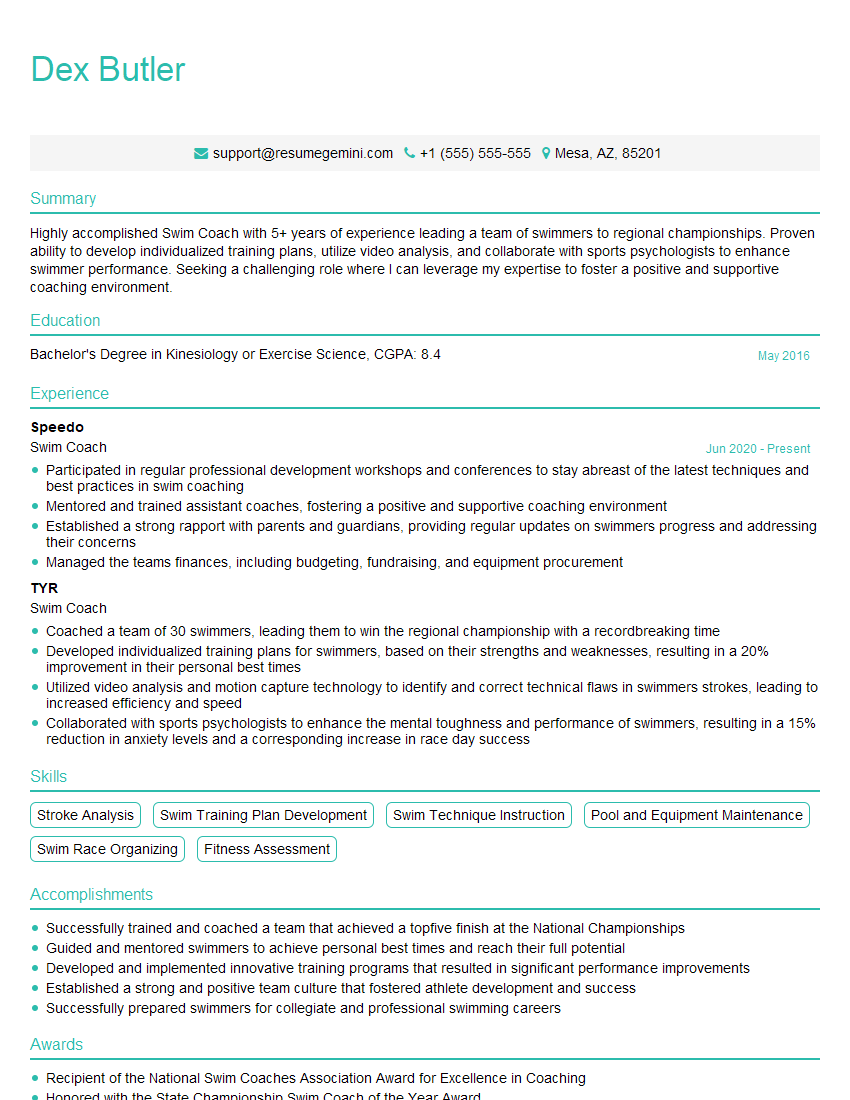
Mastering Swim Technique Instruction opens doors to rewarding careers with diverse opportunities for growth, from coaching competitive swimmers to working with recreational groups or individuals. To maximize your job prospects, a well-crafted, ATS-friendly resume is crucial. ResumeGemini is a trusted resource that can help you build a professional and impactful resume, designed to get noticed by recruiters. We provide examples of resumes tailored specifically to Swim Technique Instruction to help you showcase your skills and experience effectively.
Explore more articles
Users Rating of Our Blogs
Share Your Experience
We value your feedback! Please rate our content and share your thoughts (optional).
What Readers Say About Our Blog
Very informative content, great job.
good