Unlock your full potential by mastering the most common Synthetic Aperture Radar (SAR) Imaging interview questions. This blog offers a deep dive into the critical topics, ensuring you’re not only prepared to answer but to excel. With these insights, you’ll approach your interview with clarity and confidence.
Questions Asked in Synthetic Aperture Radar (SAR) Imaging Interview
Q 1. Explain the principle of Synthetic Aperture Radar (SAR).
Synthetic Aperture Radar (SAR) is a powerful remote sensing technique that uses microwaves to create high-resolution images of the Earth’s surface, regardless of weather conditions or time of day. Unlike optical sensors relying on sunlight, SAR actively transmits microwave signals and receives the backscattered energy. The core principle lies in the synthetic aperture: a long antenna is simulated by cleverly processing signals from a much smaller physical antenna as it moves across the ground. Imagine a small flashlight on a moving car: the car’s movement, coupled with signal processing, creates the effect of a much larger, higher-resolution flashlight illuminating the scene. This synthetic aperture significantly improves the spatial resolution of the resulting image.
In simpler terms: A moving SAR sensor transmits microwave pulses. The reflected signals are received and recorded. By cleverly combining the signals acquired over time, the system creates the impression of having used a much larger antenna, resulting in better spatial resolution than what would be possible with a physically smaller antenna. The longer the synthetic aperture, the finer the resolution. This is achieved using sophisticated signal processing algorithms.
Q 2. Describe the differences between various SAR modes (e.g., stripmap, spotlight, scanSAR).
Different SAR modes cater to various application needs, offering trade-offs between coverage, resolution, and processing complexity:
- Stripmap: The simplest mode. The antenna points sideways and the sensor moves along a straight track. It provides consistent resolution along the flight path, and is good for wide-area coverage. Think of taking a continuous panoramic photo from a moving car.
- Spotlight: This mode focuses the antenna beam on a specific area. By using sophisticated processing techniques to increase the synthetic aperture, it achieves extremely high resolution within a smaller region of interest. Think of zooming in with a camera on a specific object.
- ScanSAR (Scanned SAR): This mode achieves wide swath coverage by electronically scanning the antenna beam across a wide area. While this increases coverage, it generally reduces the resolution compared to stripmap or spotlight. It’s efficient for mapping large regions.
The choice of SAR mode depends largely on the application requirements. For example, high-resolution imagery of a specific building might require spotlight mode, whereas mapping a large forest area might necessitate scanSAR mode for its wider coverage. Stripmap offers a good balance between resolution and coverage for many applications.
Q 3. What are the advantages and disadvantages of SAR compared to optical remote sensing?
SAR and optical remote sensing offer complementary advantages and disadvantages:
- Advantages of SAR over optical:
- All-weather capability: SAR penetrates clouds and operates day or night, making it invaluable in challenging conditions where optical sensors fail.
- Active illumination: SAR’s active illumination provides its own light source, unlike optical sensors relying on external illumination. This enables consistent data acquisition under any lighting condition.
- Penetration capability: Certain SAR frequencies can penetrate some materials (like vegetation and dry soil to a limited extent), providing information about subsurface features.
- Disadvantages of SAR over optical:
- Lower spatial resolution (generally): While advanced techniques like spotlight can achieve very high resolution, generally SAR’s resolution is lower than the best optical systems, at least in the visible and near-infrared portions of the spectrum.
- Speckle noise: SAR images suffer from a granular pattern known as speckle noise, which needs to be mitigated using post-processing techniques. This is often not an issue with optical sensors.
- Higher cost and complexity: SAR systems are usually more expensive and complex than optical systems.
In practice, SAR and optical imagery are often used in combination to exploit the strengths of each. Optical data might provide better color and textural information, while SAR provides crucial all-weather data and information about terrain structure, potentially including topography.
Q 4. Explain the concept of range and azimuth resolution in SAR.
SAR image resolution is characterized by range and azimuth resolution:
- Range Resolution: This refers to the ability to distinguish between targets located at different distances (ranges) from the SAR sensor. It’s primarily determined by the transmitted pulse width. A shorter pulse results in finer range resolution. Think of it as the accuracy with which we can measure the distance to an object.
- Azimuth Resolution: This represents the ability to distinguish between targets located at the same range but in different directions across the flight track (azimuth). It’s primarily determined by the length of the synthetic aperture. A longer synthetic aperture leads to finer azimuth resolution. Think of it as the ability to resolve details along the flight path.
Both range and azimuth resolution are critical for image quality. High resolution in both dimensions is desirable, enabling us to distinguish individual features of interest in the image. The combination of range and azimuth resolution dictates the overall image sharpness.
Q 5. How is range ambiguity resolved in SAR systems?
Range ambiguity occurs when the transmitted pulse returns from a target that is much farther away, but the delay is the same as for a closer target. This happens because the pulse repetition frequency (PRF) is not high enough. The PRF must be chosen carefully to avoid such a problem. To resolve range ambiguity, we need to ensure that the time interval between transmitted pulses (PRT = 1/PRF) is short enough that the farthest anticipated return signal arrives before the next pulse is transmitted. This ensures that a return can be uniquely associated with a specific transmitted pulse. In practice, this involves selecting a suitably high PRF, which is often a tradeoff between ambiguity resolution and other factors like Doppler bandwidth.
If ambiguity is present, advanced signal processing techniques are often applied to separate the ambiguous returns and determine the correct range.
Q 6. What is speckle noise and how can it be mitigated?
Speckle noise is a granular, salt-and-pepper-like pattern that appears in SAR images. It’s a coherent phenomenon caused by the interference of multiple scattering waves returned from a rough surface. Imagine the constructive and destructive interference of waves in a pond; a similar effect occurs with microwave signals scattered by the target area. This results in a noisy image, reducing the ability to accurately interpret details.
Speckle noise negatively impacts image interpretation and analysis. This noise makes it harder to distinguish details and perform accurate measurements (e.g., assessing vegetation density). It is important to mitigate this effect using appropriate methods, which we’ll examine in the following answer.
Q 7. Describe different speckle reduction techniques.
Several techniques exist for speckle reduction in SAR images, each with advantages and disadvantages. These techniques aim to reduce the speckle while preserving important image details:
- Spatial Filtering: These methods, such as averaging filters (e.g., boxcar filtering) and median filters, smooth the image by averaging pixel values within a window. This reduces speckle but can also blur sharp edges, leading to a loss of some detail.
- Adaptive Filtering: These techniques adjust the filtering process based on the local image characteristics. This helps to preserve edges better than simple spatial filtering by adapting to the local variance of the speckle. Examples include Lee filter and Frost filter.
- Wavelet Transform-Based Methods: Wavelet transforms decompose the image into different frequency components. Speckle is often concentrated in high-frequency components, and they can be attenuated selectively, thereby reducing speckle while preserving important features.
- Multi-look Processing: This method involves processing multiple independent SAR images of the same area, acquired with slightly different parameters. By averaging the multiple looks, the speckle noise is reduced.
The best speckle reduction technique depends on factors like the application requirements, the desired level of speckle reduction, and the acceptable level of detail loss. Often, a combination of techniques might yield optimal results.
Q 8. Explain the process of SAR image focusing.
SAR image focusing is the process of converting the raw SAR data, which is a collection of signals received from different positions of the antenna as it moves, into a sharp, focused image of the ground. Think of it like taking a blurry photo and sharpening it. The raw data represents the echoes returning from the ground, but they are spread out in range and azimuth (across-track and along-track directions). Focusing involves using the known motion of the antenna and signal processing techniques to collapse these echoes into their correct spatial locations, creating a high-resolution image.
The most common focusing technique is Range-Doppler processing. This method utilizes the Doppler frequency shift in the received signals, which is caused by the relative motion between the sensor and the target. By analyzing the Doppler shifts, the algorithm can determine the location of each scatterer in the azimuth direction. In the range direction, focusing is achieved using matched filtering, which optimally combines the echoes to sharpen the image. More advanced techniques like Back-Projection and Chirp Scaling also exist, each with its strengths and weaknesses concerning computational complexity and accuracy.
Imagine a pebble dropped in a pond – the ripples spread out. The raw SAR data is like these ripples, and focusing is the process of reconstructing where the pebble landed based on these expanding waves.
Q 9. What are the common geometric distortions in SAR images and how are they corrected?
SAR images are prone to several geometric distortions primarily due to the sensor’s motion and the Earth’s curvature. Common distortions include:
- Range Curvature: Caused by the slant range geometry, where the distance to a target is not perpendicular to the sensor. It results in a curved appearance of straight lines in the image.
- Azimuth Curvature: Results from the non-linear relationship between the Doppler frequency and the azimuth position of targets.
- Foreshortening: Occurs when slopes facing the sensor appear shorter than their actual length.
- Layover: Happens when tall objects are so close to the sensor that their echoes overlap, making them appear out of place in the image.
- Shadowing: Occurs when objects block the radar signal from reaching areas behind them, resulting in dark areas.
These distortions are corrected using various geometric correction techniques. This often involves a combination of knowledge about the sensor’s trajectory (obtained from GPS data) and digital elevation models (DEMs). Sophisticated algorithms are used to rectify the image and to project it onto a map projection, aligning the image coordinates with geographic coordinates. Specialized software like ENVI and SARscape provide tools to perform these corrections efficiently.
Q 10. Describe your experience with SAR data processing software (e.g., ENVI, SARscape).
I have extensive experience with both ENVI and SARscape, having used them for various projects throughout my career. In ENVI, I’ve focused primarily on pre-processing steps like radiometric calibration, speckle filtering, and geometric correction. I’ve also utilized its powerful visualization tools to analyze SAR images and extract features.
My SARscape expertise involves more advanced tasks, particularly InSAR processing. I’ve used it to generate interferograms, perform phase unwrapping, and derive deformation maps from pairs of SAR images. I’m comfortable with the various processing options and parameter tuning necessary to achieve high-quality results. A recent project involved using SARscape to monitor landslide movement in a mountainous region, achieving centimetre-level accuracy in displacement measurements.
My proficiency in these packages extends to scripting and automation. I regularly write batch scripts to streamline the processing workflow and reduce manual intervention, significantly improving efficiency.
Q 11. Explain the concept of SAR interferometry (InSAR).
SAR Interferometry (InSAR) is a technique that uses two or more SAR images of the same area, acquired at slightly different times or from slightly different positions, to measure surface deformation or elevation. The core idea is that by comparing the phases of the radar signals from the two images, subtle differences in the distance between the satellite and the ground can be detected. These differences are translated into changes in elevation or displacement.
Think of it like creating a 3D model by taking two pictures of an object from slightly different angles. The difference in perspective reveals depth information. In InSAR, the ‘perspective’ is provided by the slightly different positions or times of satellite acquisition. The comparison generates an interferogram, a map showing the phase differences. The phase differences, after careful processing (including phase unwrapping to correct for phase ambiguities), reveal surface deformation or elevation changes.
Q 12. What are some applications of InSAR?
InSAR has numerous applications across various fields:
- Ground Deformation Monitoring: Measuring ground subsidence due to mining, earthquake displacements, or volcanic activity.
- Elevation Mapping: Creating high-resolution digital elevation models (DEMs) for topographic studies.
- Glacier Monitoring: Tracking ice flow and melt rates.
- Infrastructure Monitoring: Assessing the stability of bridges, dams, and other structures.
- Urban Planning: Monitoring urban growth and changes in land use.
- Precision Agriculture: Assessing soil moisture and crop health.
For example, InSAR has proven invaluable in monitoring the slow deformation of the ground above underground mines, allowing for proactive measures to prevent potential collapses.
Q 13. Describe the limitations of InSAR.
Despite its numerous advantages, InSAR has some limitations:
- Atmospheric Effects: Variations in atmospheric water vapor can introduce significant errors in phase measurements, affecting the accuracy of deformation or elevation measurements. Atmospheric correction techniques are crucial but not always perfect.
- Temporal Decorrelation: Changes in the ground surface between acquisitions (e.g., vegetation growth) can lead to reduced coherence and make it difficult to accurately measure deformation. This is particularly problematic in areas with high vegetation density.
- Geometric Distortions: Similar to single-look SAR, InSAR data can be affected by geometric distortions. These require accurate correction using DEMs and sensor parameters.
- Phase Unwrapping Issues: Phase unwrapping, the process of converting the wrapped phase to absolute phase, can be challenging and susceptible to errors, particularly in areas with high phase gradients.
- Data Volume and Processing Time: InSAR processing can be computationally intensive and require significant processing time, especially when dealing with large datasets.
Q 14. What is polarimetric SAR and what information does it provide?
Polarimetric SAR (PolSAR) uses multiple polarizations of the transmitted and received radar signals (e.g., HH, HV, VH, VV – where H is horizontal and V is vertical polarization) to obtain more information about the target’s scattering properties. Unlike single-polarization SAR, which only provides intensity information, PolSAR provides the complete scattering matrix, containing amplitude and phase information for each polarization combination.
This extra information allows for a more detailed characterization of the target. For example, different types of land cover exhibit distinct scattering behaviors. PolSAR can distinguish between different vegetation types, soil moisture, and man-made structures based on their unique polarization signatures. This is because the scattering mechanisms (surface scattering, double bounce, volume scattering) interact differently with the different polarizations.
Advanced techniques like decomposition of the scattering matrix allow us to separate and quantify the contributions of various scattering mechanisms, providing a deeper understanding of the target’s physical properties. This is often used in applications like land cover classification, crop monitoring, and target recognition.
Q 15. Explain different polarimetric decomposition techniques.
Polarimetric decomposition techniques are crucial for extracting meaningful information from the complex polarimetric SAR data. These techniques aim to simplify the scattering matrix, which describes the interaction of the radar signal with the target, into more interpretable parameters. Several methods exist, each with its strengths and weaknesses:
Pauli Decomposition: This is the most straightforward method, decomposing the scattering matrix into three images representing the total power, and the degree of linear and circular polarization. Think of it like separating the colors in a picture – each component shows different aspects of the scene.
Freeman-Durden Decomposition: This technique decomposes the data into three components representing surface scattering, double-bounce scattering, and volume scattering. This is highly valuable in differentiating between different types of land cover, for example, distinguishing between a smooth surface like a lake, a rough surface like a field, and a volume scatterer like a forest.
Yamaguchi Decomposition: A more sophisticated method, Yamaguchi decomposition separates the scattering into entropy, anisotropy, and α-angle, offering a more refined characterization of the scattering mechanisms. It provides a more detailed description of the target’s texture and structure.
Cloude-Pottier Decomposition: This approach uses the target decomposition theorem, decomposing the data into a set of scattering mechanisms. It is powerful in identifying dominant scattering mechanisms but requires careful interpretation of the results.
The choice of decomposition technique depends on the specific application and the desired information. For example, Freeman-Durden decomposition is frequently used in land-cover classification, while Cloude-Pottier decomposition is often employed for more advanced analysis of complex scattering environments.
Career Expert Tips:
- Ace those interviews! Prepare effectively by reviewing the Top 50 Most Common Interview Questions on ResumeGemini.
- Navigate your job search with confidence! Explore a wide range of Career Tips on ResumeGemini. Learn about common challenges and recommendations to overcome them.
- Craft the perfect resume! Master the Art of Resume Writing with ResumeGemini’s guide. Showcase your unique qualifications and achievements effectively.
- Don’t miss out on holiday savings! Build your dream resume with ResumeGemini’s ATS optimized templates.
Q 16. How is SAR data calibrated?
SAR data calibration is a critical step to ensure the accuracy and reliability of the data. It involves correcting for various systematic errors introduced during the data acquisition process. These errors can stem from instrument imperfections, atmospheric effects, and antenna characteristics. The process typically involves several stages:
Radiometric Calibration: This corrects for the gain variations within the SAR system, ensuring that the signal intensity accurately represents the backscattered power from the target. This is often done using calibration targets of known reflectivity.
Geometric Calibration: This step addresses distortions in the SAR image geometry due to platform motion, Earth’s curvature, and other factors. It involves correcting for range and azimuth distortions, resulting in a geometrically accurate image.
Phase Calibration: This step focuses on correcting for phase errors introduced by the SAR system. Phase errors can manifest as unwanted phase variations in the image, particularly impacting interferometric applications.
Calibration is typically performed using either internal or external calibration methods. Internal calibration relies on built-in calibrators within the SAR system, whereas external calibration involves utilizing ground targets or specialized calibration sites. The accuracy of the calibration directly impacts the quality and reliability of subsequent analysis.
Q 17. What are the challenges of SAR data acquisition in different environments (e.g., urban, forested)?
Acquiring high-quality SAR data in different environments poses unique challenges. The nature of the backscattered signal is heavily influenced by the environment’s characteristics:
Urban Environments: High density of buildings and complex structures lead to strong multiple scattering effects, shadowing, and layover, making it difficult to extract accurate information about individual buildings or features. The multitude of different scattering mechanisms makes interpretation complex.
Forested Environments: The dense canopy leads to volume scattering, obscuring the ground surface. Speckle noise also becomes significant, reducing the image clarity. The penetration depth of the radar signal is also a factor, influencing the information captured about the forest floor.
Arid Environments: The lack of vegetation and moisture can lead to low backscatter and result in images with limited contrast. The surface roughness also plays a critical role, affecting the signal strength.
Overcoming these challenges involves selecting appropriate SAR parameters (e.g., frequency, polarization, incidence angle), utilizing advanced processing techniques (e.g., speckle filtering, layover and shadow correction), and integrating SAR data with other data sources (e.g., optical imagery, LiDAR).
Q 18. Describe your experience with SAR data analysis for specific applications (e.g., deforestation monitoring, disaster response).
I have extensive experience using SAR data for various applications. For instance, I’ve utilized SAR data for deforestation monitoring using time series analysis. By comparing SAR images acquired over several years, changes in forest cover can be detected and quantified, allowing for the identification of deforestation events and their spatial extent. This involved applying techniques like change detection and classification algorithms.
In disaster response, I’ve leveraged SAR data to assess damage caused by floods and earthquakes. The high penetration capability of SAR allows for detection of damage even under cloud cover, which is crucial in the immediate aftermath of a disaster. This work involved analyzing SAR images to identify flooded areas, building collapses, and infrastructure damage.
Another project involved using polarimetric SAR data to classify agricultural crops. The different scattering characteristics of different crops could be used to distinguish between them based on polarimetric features.
Q 19. Explain your understanding of SAR system design and architecture.
My understanding of SAR system design encompasses several key aspects. A SAR system, at a high level, consists of a radar transmitter, antenna, receiver, and a processing unit. The antenna, often a phased array, emits electromagnetic pulses. As the platform (aircraft or satellite) moves, the antenna’s position changes, effectively synthesizing a much larger aperture than a conventional radar. This results in high-resolution imagery.
The architecture encompasses aspects like the signal generation and processing, data acquisition and storage, and the platform’s navigation and control systems. The choice of parameters such as frequency, bandwidth, polarization, and incidence angle significantly impacts the final image quality and application suitability. Understanding the trade-offs between resolution, swath width, and acquisition time is essential.
Modern SAR systems often incorporate advanced technologies such as advanced signal processing algorithms, data compression methods, and sophisticated calibration techniques to optimize performance and reduce data volume.
Q 20. What are the key performance indicators (KPIs) of a SAR system?
Key Performance Indicators (KPIs) for a SAR system are multifaceted and depend on the specific application. However, some crucial KPIs include:
Spatial Resolution: The ability to distinguish between closely spaced objects. This is typically expressed in meters.
Radiometric Resolution: The precision with which the backscattered power is measured. This determines the sensitivity of the system.
Swath Width: The ground area covered by a single SAR image. A wider swath improves efficiency but might compromise resolution.
Temporal Resolution: The frequency with which data is acquired over the same area. This is crucial for monitoring dynamic processes.
Accuracy: The precision of the geographic location of features within the image. This is dependent on accurate calibration and georeferencing.
Data Rate: The amount of data generated per unit time. This impacts storage and processing requirements.
Other important factors include the system’s reliability, robustness, and cost-effectiveness.
Q 21. How do you assess the quality of SAR imagery?
Assessing SAR image quality involves evaluating several aspects:
Geometric Accuracy: Checking for distortions and ensuring that the image is correctly georeferenced.
Radiometric Accuracy: Verifying that the signal intensities accurately represent the backscattered power. This often involves comparing the data to ground truth measurements or reference data.
Speckle Noise: Evaluating the level of speckle noise, which is inherent in SAR imagery. This often involves computing speckle metrics and applying speckle filtering techniques to assess its impact.
Resolution: Assessing both the spatial and radiometric resolution. This involves analyzing the ability of the image to distinguish between features.
Artifacts: Checking for artifacts such as layover, shadowing, and other image distortions caused by the acquisition process or the environment.
Often, a combination of visual inspection, quantitative metrics, and comparison with reference data is employed to comprehensively assess the quality. The specific criteria used will depend on the intended application of the SAR data.
Q 22. Explain your experience with SAR data visualization and interpretation.
SAR data visualization and interpretation is crucial for extracting meaningful information from raw radar data. It involves transforming complex radar backscatter into images that reveal surface characteristics. My experience encompasses the entire process, from initial data pre-processing to advanced analysis techniques. I’m proficient in using various software packages like ENVI, SARscape, and SNAP to perform geometric correction, speckle filtering, and radiometric calibration. For instance, I once worked on a project involving flood mapping using Sentinel-1 data. After pre-processing, I used different color palettes and overlayed elevation data to clearly differentiate flooded areas from unaffected regions, ultimately providing critical information for disaster response.
Beyond basic image display, I’m experienced in advanced interpretation techniques. This includes identifying different land cover types based on backscatter intensity and texture analysis. For example, I can differentiate between urban areas, forests, and water bodies based on their unique radar signatures. Furthermore, I’m skilled in using polarimetric SAR data to extract information on surface roughness and soil moisture, creating detailed thematic maps.
My interpretation isn’t limited to visual inspection; I frequently employ quantitative analysis methods, such as object-based image analysis (OBIA) and change detection techniques. This allows for objective measurements and data-driven insights, improving the accuracy and reliability of my analysis.
Q 23. Describe your familiarity with various SAR sensor platforms (e.g., airborne, spaceborne).
My familiarity with SAR sensor platforms spans both airborne and spaceborne systems. I have extensive experience working with data from various spaceborne platforms such as Sentinel-1 (C-band), RADARSAT-2 (C-band and X-band), and TerraSAR-X (X-band). Understanding the characteristics of each sensor, including their spatial resolution, wavelength, polarization capabilities, and acquisition geometry, is essential for effective data processing and interpretation. For example, the longer wavelength of C-band data allows for penetration through vegetation, making it ideal for mapping under forested areas, while the higher resolution of X-band data provides greater detail for urban applications.
My experience also extends to airborne SAR systems. I’ve worked with data acquired from systems like the E-SAR and various commercially available systems. Airborne SAR offers higher resolution and flexibility in terms of acquisition geometry compared to spaceborne systems, allowing for tailored data acquisition for specific applications such as infrastructure inspection or high-resolution mapping of smaller areas. The key difference lies in the accessibility and cost; spaceborne data is widely accessible through open archives, while airborne data is often acquired on a project-by-project basis, often resulting in higher costs.
Q 24. What are the current trends and future developments in SAR technology?
The field of SAR technology is constantly evolving, driven by the demand for higher resolution, wider swath, and improved capabilities. Some current trends include the increasing use of:
- Advanced polarimetry: Moving beyond single and dual-polarization data towards fully polarimetric data, enabling more sophisticated analysis of target scattering mechanisms.
- Interferometric SAR (InSAR): Leveraging phase information from multiple SAR acquisitions to generate high-precision digital elevation models (DEMs) and measure ground deformation.
- Polarimetric InSAR (PolInSAR): Combining the benefits of polarimetry and InSAR to extract information on vegetation structure and canopy parameters.
- Synthetic Aperture Radar tomography (TomoSAR): Achieving 3-D imaging capabilities for applications such as urban mapping and forest monitoring.
Future developments are expected to focus on:
- Increased bandwidth and resolution: Pushing the boundaries of spatial resolution to capture finer details.
- Improved processing techniques: Developing more efficient algorithms for handling large datasets and extracting relevant information.
- Integration with other sensor data: Combining SAR data with optical imagery, LiDAR, and other geospatial data for more comprehensive analysis.
- AI and machine learning: Leveraging these powerful techniques for automated feature extraction, classification, and change detection.
These advancements will further expand the applications of SAR technology in various fields, including environmental monitoring, disaster management, infrastructure inspection, and defense.
Q 25. How do you handle large SAR datasets?
Handling large SAR datasets requires efficient strategies involving both hardware and software solutions. My approach involves a multi-pronged strategy:
- Data compression and subsetting: Employing lossless compression techniques to reduce storage requirements and only processing the relevant portions of the data for a given task. This often involves using tools like GDAL or rasterio to selectively extract specific areas of interest.
- Parallel processing: Utilizing parallel processing capabilities of modern computers and high-performance computing clusters to speed up computationally intensive tasks like speckle filtering and geometric correction. I’m familiar with libraries like multiprocessing in Python and parallel computing toolboxes in MATLAB.
- Cloud computing: Leveraging cloud-based platforms like Google Earth Engine or Amazon Web Services for processing and storage of extremely large datasets. These platforms offer scalable computing resources and reduce the need for local infrastructure investment.
- Data tiling: Dividing large datasets into smaller tiles for processing in a distributed manner, allowing for parallel processing and efficient memory management. This is crucial when working with datasets that exceed the memory capacity of a single machine.
For example, I recently processed a 10TB Sentinel-1 dataset using a combination of cloud computing on Google Earth Engine and parallel processing within Python. This involved splitting the dataset into manageable tiles, processing them individually, and then mosaicking the results. The whole process was significantly faster than traditional single-machine processing.
Q 26. Explain your experience with cloud computing platforms for SAR processing.
I have significant experience utilizing cloud computing platforms for SAR processing. Google Earth Engine (GEE) and Amazon Web Services (AWS) are my primary platforms. GEE’s extensive SAR data archive and powerful processing capabilities are particularly valuable for large-scale projects. I’m proficient in using the GEE JavaScript API to perform various SAR processing tasks, including pre-processing, filtering, and analysis. This includes tasks such as creating mosaics from multiple SAR acquisitions, generating indices for change detection, and performing classification using machine learning algorithms directly within the GEE environment.
AWS offers similar capabilities but with more flexibility in terms of customizing the computing environment. I’m familiar with using AWS services like EC2 (Elastic Compute Cloud) and S3 (Simple Storage Service) to manage and process SAR data using various software packages. This includes setting up virtual machines tailored to specific processing needs and utilizing parallel processing resources to reduce processing time. For example, I’ve used AWS to perform computationally intensive InSAR processing on large datasets, leveraging the scalability of the cloud infrastructure to handle the demanding computational requirements.
Q 27. Describe your proficiency in programming languages relevant to SAR processing (e.g., MATLAB, Python).
My proficiency in programming languages relevant to SAR processing is extensive. MATLAB and Python are my main languages. In MATLAB, I’m skilled in using toolboxes such as the Image Processing Toolbox and the Parallel Computing Toolbox for tasks like image filtering, geometric correction, and interferometric processing. I’ve developed custom MATLAB scripts for specific SAR processing workflows, including automated pre-processing pipelines and advanced analysis algorithms.
Python is my preferred language for many SAR processing tasks due to its extensive libraries like Scikit-image, Rasterio, GDAL, and NumPy. These libraries provide powerful tools for image manipulation, geospatial data handling, and numerical computation. I utilize Python for automating workflows, integrating with cloud platforms, and performing advanced analysis using machine learning techniques. For instance, I’ve developed Python scripts to automate the downloading of SAR data from various online archives, perform pre-processing using GDAL, and then classify the data using machine learning algorithms from Scikit-learn.
# Example Python code snippet for reading a SAR image using Rasterio:
import rasterio
with rasterio.open('SAR_image.tif') as src:
    array = src.read()
Q 28. How do you stay up-to-date with the latest advancements in SAR technology?
Staying up-to-date with the latest advancements in SAR technology is paramount. I actively engage in several strategies to ensure my knowledge remains current:
- Regularly attending conferences and workshops: IEEE International Geoscience and Remote Sensing Symposium (IGARSS) and other relevant conferences provide opportunities to learn about the latest research and technologies.
- Reading scientific literature: I subscribe to leading journals in remote sensing and regularly read articles on new SAR techniques and applications. This includes browsing preprint servers like arXiv for early access to research findings.
- Participating in online communities and forums: Engaging in online discussions and forums allows for knowledge exchange and staying informed about the latest advancements and challenges within the SAR community.
- Following key researchers and institutions: Keeping track of publications and presentations from leading experts in the field keeps me informed about cutting-edge research and developments.
- Hands-on experimentation with new software and techniques: I actively experiment with new SAR processing software and techniques to improve my practical skills and gain firsthand experience with the latest advancements.
This multifaceted approach ensures that I remain at the forefront of SAR technology and effectively apply the latest techniques to my projects. It’s a continuous learning process that drives innovation and efficiency in my work.
Key Topics to Learn for Synthetic Aperture Radar (SAR) Imaging Interview
- Fundamentals of Radar: Understanding basic radar principles, including signal propagation, scattering mechanisms, and radar equation.
- SAR Geometry and Imaging Geometry: Grasping the concepts of range, azimuth, and the formation of a synthetic aperture. Understanding different imaging modes (e.g., stripmap, spotlight).
- Signal Processing Techniques: Familiarity with range and azimuth compression, matched filtering, and various algorithms for image formation (e.g., Range-Doppler algorithm).
- SAR Image Speckle and Noise Reduction: Understanding the nature of speckle noise and techniques for its mitigation (e.g., filtering, multi-looking).
- SAR Calibration and Geocoding: Knowledge of radiometric and geometric calibration procedures, and techniques for geo-referencing SAR imagery.
- Polarimetric SAR: Understanding the principles of polarimetric SAR and its applications in extracting information about target properties.
- Interferometric SAR (InSAR): Familiarity with the concepts of InSAR and its applications in generating digital elevation models (DEMs) and measuring ground deformation.
- Applications of SAR: Understanding the practical applications of SAR in various fields, such as Earth observation, remote sensing, defense, and disaster management. Be prepared to discuss specific examples and case studies.
- SAR Data Processing and Software: Familiarity with commonly used SAR processing software packages (mentioning specific software is optional depending on the target audience and job description).
- Problem-solving and critical thinking: Prepare to discuss how you approach challenges in SAR data analysis and interpretation. Be ready to explain your problem-solving methodology.
Next Steps
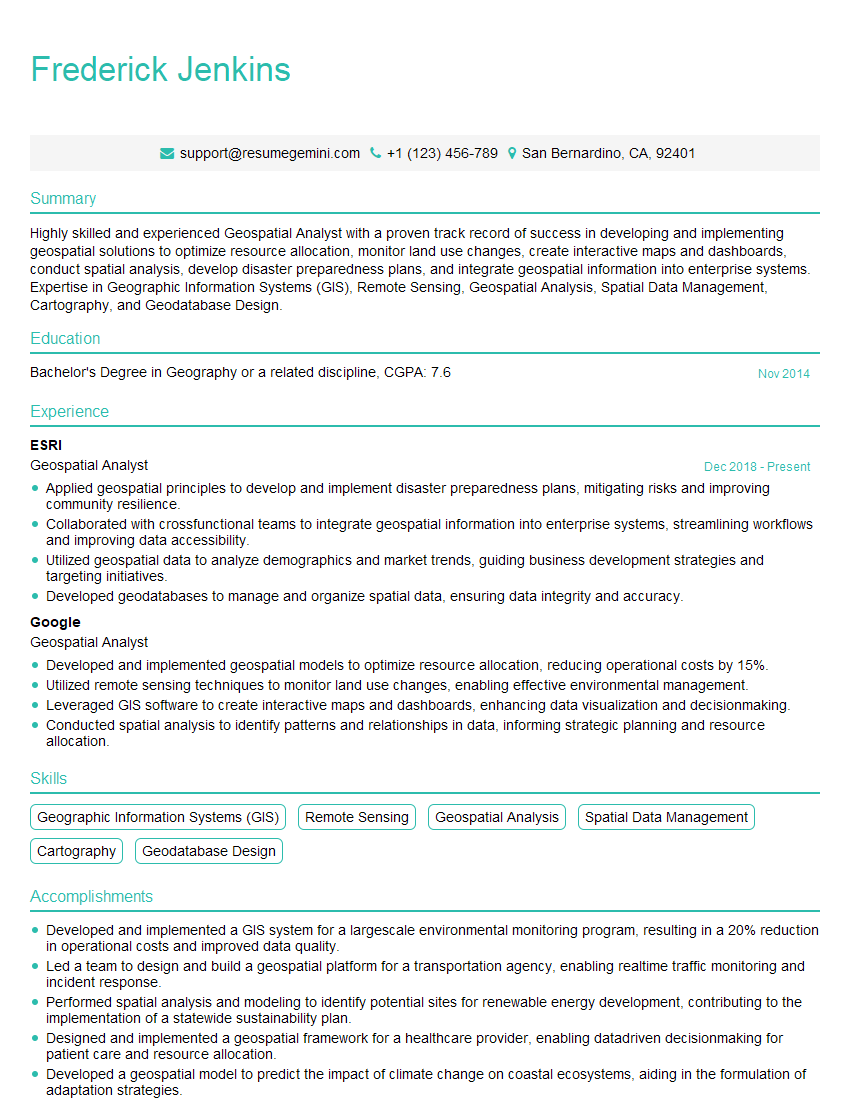
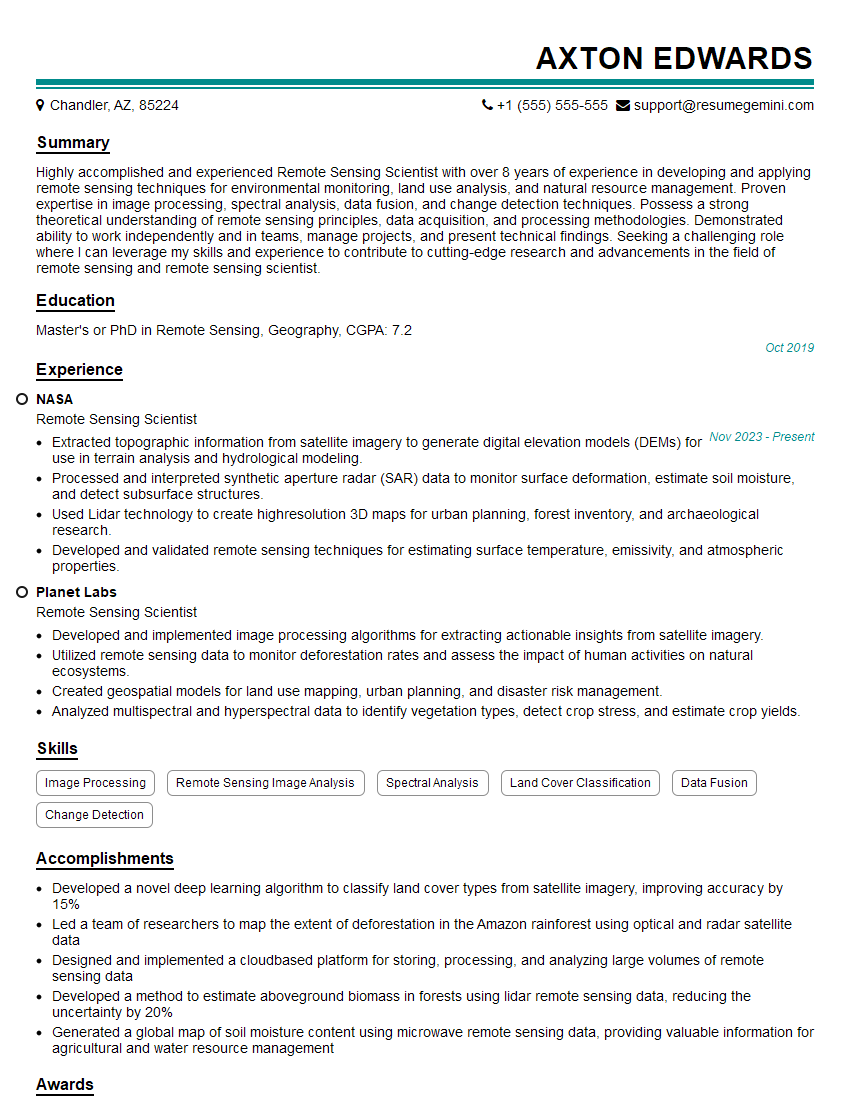
Mastering Synthetic Aperture Radar (SAR) imaging opens doors to exciting and impactful careers in various sectors. A strong understanding of SAR principles and applications is highly valued by employers. To significantly improve your job prospects, it’s crucial to create a resume that effectively showcases your skills and experience to Applicant Tracking Systems (ATS). ResumeGemini is a trusted resource to help you build a professional, ATS-friendly resume that highlights your SAR expertise. We provide examples of resumes tailored to Synthetic Aperture Radar (SAR) Imaging to guide you. Invest in crafting a compelling resume – it’s your first impression and a key step towards your dream career.
Explore more articles
Users Rating of Our Blogs
Share Your Experience
We value your feedback! Please rate our content and share your thoughts (optional).
What Readers Say About Our Blog
Very informative content, great job.
good