The right preparation can turn an interview into an opportunity to showcase your expertise. This guide to Tactical Air Controller interview questions is your ultimate resource, providing key insights and tips to help you ace your responses and stand out as a top candidate.
Questions Asked in Tactical Air Controller Interview
Q 1. Describe your experience coordinating close air support missions.
Coordinating close air support (CAS) missions requires a deep understanding of both ground and air operations. It’s about seamlessly integrating air power with ground forces to achieve a common objective, usually neutralizing enemy threats or providing cover for friendly troops. My experience involves working directly with ground commanders to understand their immediate needs, assessing the battlefield situation, and then directing air assets to engage targets precisely and effectively. This includes everything from selecting the appropriate aircraft and munitions to ensuring the safety of friendly troops throughout the engagement. I’ve been involved in numerous scenarios, ranging from supporting infantry assaults to providing suppression of enemy fire during humanitarian relief operations.
For example, during one operation, we were supporting a unit pinned down by enemy fire. I worked closely with the ground commander to determine the location of the enemy and the best approach for an air strike, taking into account the presence of civilians in the proximity. We opted for precision-guided munitions to minimize collateral damage, successfully neutralizing the threat without civilian casualties. This highlights the importance of detailed communication and strategic planning in executing a successful CAS mission.
Q 2. Explain the process of requesting and controlling air strikes.
Requesting and controlling air strikes is a multi-step process that prioritizes precision and safety. It begins with a ground commander identifying a target requiring air support. They’ll then communicate the request through established channels, typically using a secure radio system, providing details such as target location (coordinates), type, and surrounding environment. This request is then vetted by higher headquarters to confirm the legitimacy of the target and to assess potential risks, particularly regarding civilian presence or friendly forces in the vicinity.
Once approved, the JTAC (Joint Terminal Attack Controller) – that’s me – takes over. I clarify the details with the ground commander, ensuring complete understanding of the situation and their requirements. I then coordinate with the aircrew, providing them with real-time updates on the target and the surrounding environment, including weather conditions and the location of friendly forces. This crucial communication is usually via secure radio channels using standardized terminology and procedures. The aircrew then executes the strike, reporting back to me on their progress and the results of the engagement. Post-strike, I conduct a battle damage assessment (BDA) to evaluate the effectiveness of the strike and to assess any further needs.
Q 3. How do you ensure the safety of friendly forces during air operations?
Ensuring the safety of friendly forces is paramount in any air operation. This is achieved through a combination of meticulous planning, precise communication, and rigorous adherence to safety protocols. Before any air strike, I thoroughly assess the battlefield environment, including the location of friendly forces, civilians, and potential collateral damage. This involves using maps, aerial imagery, and real-time intelligence to build a comprehensive picture of the situation. During the mission, constant communication with the aircrew and ground forces is maintained, providing real-time updates and adjustments to the engagement plan to mitigate any risks. We use specific terminology to precisely define locations, such as grid coordinates and geographic features, leaving no room for miscommunication.
The use of precision-guided munitions (PGMs) is crucial, as they minimize the risk of collateral damage. We also implement strict rules of engagement (ROE) that are followed religiously. A common technique is the use of a ‘danger close’ procedure where we meticulously evaluate the risks to friendly troops when a strike is close to their positions. This involves a detailed risk-benefit analysis and a constant dialogue between the ground commander and the JTAC to balance the military need with safety. Continuous monitoring post-strike is also vital to assess for unintended consequences.
Q 4. What are the key challenges in communicating with aircrews under duress?
Communicating with aircrews under duress presents unique challenges. Stress, time constraints, and the dynamic nature of combat situations can significantly impair communication effectiveness. Noise, interference, and equipment malfunctions can further complicate matters. The key is to maintain clear, concise, and repetitive communication. Using standardized terminology, keeping messages short, and confirming understanding are vital. I’ve found that calmly repeating critical instructions and using multiple methods of communication, when available, improves comprehension and reduces the chance of error.
In high-pressure scenarios, empathy and understanding are also critical. Recognizing that aircrews are operating under extreme stress and maintaining a calm and reassuring demeanor can significantly improve the effectiveness of communication. In addition, pre-mission briefings and establishing clear communication protocols before the mission begins are essential for seamless communication during stressful moments. Regular training and exercises ensure we’re prepared for such scenarios.
Q 5. Describe your experience using communication systems in a tactical environment.
My experience with communication systems in tactical environments is extensive. I’m proficient in using a variety of secure radio systems, including both VHF and UHF frequencies, to communicate with both air and ground assets. I am also experienced with data links that provide real-time situational awareness. This includes the integration of various systems to ensure a complete picture of the operational environment. This often involves coordinating with different units that might use different systems and procedures. Furthermore, I’m skilled at using encrypted communication systems to protect sensitive information and maintain operational security. In addition to secure radios, I have experience using other communication tools such as satellite phones and text messaging, adapting to the changing communication needs of the mission and available technology.
For instance, I have used a combination of radio systems to simultaneously coordinate with an aircrew executing a strike while simultaneously receiving updates from the ground commander regarding the location of friendly forces. This requires the ability to quickly switch between different frequencies and adapt to changing communication priorities. This seamless integration of various communication systems showcases the ability to effectively handle and respond to multiple communication inputs effectively in a fast-paced environment.
Q 6. How do you prioritize targets and manage multiple air assets simultaneously?
Prioritizing targets and managing multiple air assets simultaneously requires a systematic approach. I utilize a layered prioritization scheme based on the urgency of the situation, the threat level, and the capabilities of the available air assets. High-priority targets, such as those posing an immediate threat to friendly forces, are addressed first. Targets are assessed based on their threat to friendly forces, strategic importance, and the availability of suitable munitions and aircraft. This might involve quickly calculating the estimated time of arrival (ETA) for different assets and prioritizing based on their arrival time.
Managing multiple air assets involves constant communication and coordination. I use a system of deconfliction to ensure that different aircraft are not targeting the same area simultaneously, thereby minimizing the risk of fratricide and improving the overall efficiency. I will use a combination of verbal instructions over the radio and visual aids (like marked maps) to maintain clear directions and ensure each asset is aware of the other’s activities. Furthermore, I am capable of adjusting priorities based on changing conditions in real time, adapting to unexpected events, and maximizing the effectiveness of the air assets under my control.
Q 7. Explain your understanding of different types of air-to-ground munitions.
My understanding of air-to-ground munitions encompasses a wide range of capabilities and considerations. These munitions are broadly classified into several categories based on their guidance and effects. Precision-guided munitions (PGMs), such as laser-guided bombs (LGBs) and GPS-guided bombs (GBUs), are crucial for minimizing collateral damage and ensuring accuracy. These require precise targeting data and careful coordination with the aircrew. On the other hand, unguided munitions, such as iron bombs, offer a simpler and often more readily available option, but with reduced accuracy. Their use depends heavily on the situation and the acceptable risk of collateral damage.
Other types include cluster munitions, which are inherently more controversial due to their potential for indiscriminate harm; and rockets, which offer different ranges and payload capabilities. The selection of the appropriate munition depends heavily on the target type, the surrounding environment, the risk of collateral damage, and the overall tactical objectives. For example, an LGB might be ideal for a point target in a populated area, whereas unguided rockets could be used for suppressing enemy positions in a more open area. A comprehensive understanding of the characteristics and limitations of each type of munition is essential for making effective decisions.
Q 8. How familiar are you with the rules of engagement (ROE) for air operations?
Rules of Engagement (ROE) are the directives that govern the use of force by military personnel. For air operations, this is incredibly nuanced, encompassing everything from identifying legitimate targets to the types of weapons and tactics allowed. They are crucial to minimizing civilian casualties and maintaining international law compliance. My familiarity stems from extensive training and practical application, encompassing various scenarios from peace enforcement to full-scale conflict. I’ve participated in numerous ROE briefings and training exercises designed to refine my understanding of these complex legal and ethical boundaries. For instance, I’ve worked through scenarios involving the identification of potential targets in densely populated areas, demanding a careful assessment of the proportionality of force and the minimization of collateral damage. My understanding extends to the chain of command involved in seeking authorization for engagements that may fall outside standard ROE parameters.
Q 9. How do you manage risk in a fast-paced air combat environment?
Risk management in fast-paced air combat is paramount. It’s not just about reacting to immediate threats but proactively mitigating potential hazards. I employ a layered approach, starting with meticulous mission planning. This includes detailed threat assessments, identification of potential vulnerabilities, and development of contingency plans. During the mission, constant communication and situational awareness are key. I regularly cross-check data from multiple sources—radar, intelligence reports, and pilot feedback—to maintain a comprehensive understanding of the battlefield. Decision-making is iterative, adjusting tactics and strategies based on evolving circumstances. For example, if we encounter unexpected enemy activity, I’d immediately assess the risk, communicate changes to the pilots, and redirect assets to mitigate the threat. I also prioritize clear, concise communication with all parties involved, ensuring everyone understands the risks and the plan to manage them.
Q 10. Describe your experience working with different branches of the military.
Throughout my career, I’ve had the privilege of working alongside personnel from various branches of the military – Army, Navy, Marines, and Special Forces. Successful air support relies heavily on seamless interoperability. My experience includes coordinating close air support (CAS) missions with ground troops, often involving rapid information exchange and adaptation to rapidly changing ground situations. I’ve learned to understand the unique communication protocols and priorities of each branch, ensuring effective coordination and minimizing confusion in high-stress environments. For example, coordinating a CAS mission with Army infantry requires a different communication approach than working with a Navy SEAL team, owing to their respective operational needs and communication preferences. Building trust and rapport with personnel from different backgrounds is crucial, enabling efficient teamwork and a shared understanding of the mission objectives.
Q 11. How do you integrate intelligence information into your air control decisions?
Intelligence information is the bedrock of effective air control. I integrate intelligence reports, including satellite imagery, electronic intercepts, and human intelligence, into my decision-making process in several ways. Firstly, I use this information to refine my understanding of the enemy’s capabilities, locations, and likely actions. This helps in targeting enemy assets effectively and prioritizing threats. Secondly, intelligence helps in identifying potential risks, such as enemy air defenses or ambushes, allowing for preemptive measures. For instance, if intelligence suggests an enemy SAM site is active in a specific area, I can direct aircraft to use alternative routes or employ suppression tactics. Finally, intelligence helps in assessing the potential impact of air strikes, reducing civilian casualties. I always strive to leverage intelligence to make informed, timely, and effective decisions.
Q 12. Explain your understanding of the limitations of various air assets.
Understanding the limitations of various air assets is crucial for safe and effective operations. This includes aspects like range, payload capacity, speed, and vulnerability to enemy defenses. For example, a fighter jet might have superior speed and maneuverability but limited payload, while a bomber has heavy payload but is less agile. Similarly, certain aircraft have limitations in low-level flight or adverse weather conditions. I meticulously consider these factors when assigning tasks and planning missions, ensuring the appropriate aircraft are used for the specific task at hand. Mismatching assets to the mission can lead to mission failure or unnecessary risk to aircrew. My knowledge of these limitations allows for the optimal employment of assets, increasing mission effectiveness and safety.
Q 13. How do you maintain situational awareness during complex operations?
Maintaining situational awareness during complex operations relies on a multi-layered approach. I utilize various systems, including radar, communication intercepts, and pilot reports, creating a comprehensive picture of the battlespace. Data fusion is key; combining information from disparate sources allows for a more complete and accurate understanding. I constantly cross-reference information to identify discrepancies and anomalies that might indicate developing threats. Furthermore, I actively seek information from ground troops, providing them with updated air activity and receiving their feedback on the effectiveness of air support. Regular updates and communication with all involved parties ensures everyone operates from the same understanding of the situation, fostering better coordination and reducing confusion. Think of it like a puzzle—each piece of information contributes to the overall picture, and my job is to assemble it accurately and in real-time.
Q 14. What are the common challenges in communicating with ground troops?
Communication challenges with ground troops often stem from several factors: differences in terminology, limited communication bandwidth, and the chaotic nature of ground combat. Ground troops may use terms or acronyms unfamiliar to aircrews, and vice-versa, leading to confusion and misinterpretations. Furthermore, radio channels can become saturated during intense fighting, hindering effective communication. The urgency of the situation can also contribute to incomplete or inaccurate information transfer. To overcome these challenges, I use standardized communication protocols, clear and concise language, and frequent confirmation checks to ensure everyone is on the same page. Using pre-planned callsigns and frequencies minimizes confusion and maximizes efficiency. I also emphasize the importance of brevity and clarity in all communications, given the time-sensitive nature of most ground engagements. Building rapport and familiarity with ground units through prior missions further enhances communication effectiveness.
Q 15. How do you handle unexpected situations or communication failures?
Unexpected situations and communication failures are inherent risks in Tactical Air Control. My approach centers around redundancy, improvisation, and clear communication protocols. First, I rely on multiple communication channels. If one fails (e.g., a radio goes down), I immediately switch to a backup – this could be a satellite phone, a different radio frequency, or even a pre-planned messenger. Second, I have a well-defined fallback plan for every scenario. For example, if I lose contact with a friendly aircraft, I’ve got procedures for attempting to re-establish contact, notifying higher command, and potentially employing alternative assets. Finally, clear and concise communication is crucial. I consistently use standardized terminology and confirm all instructions with the receiving party. I remember one mission where our primary radio frequency was jammed. Quickly, we switched to a secondary frequency and, through precise communication, guided our strike aircraft successfully to the target. The key was adapting to the unexpected and continuing to relay vital information.
Career Expert Tips:
- Ace those interviews! Prepare effectively by reviewing the Top 50 Most Common Interview Questions on ResumeGemini.
- Navigate your job search with confidence! Explore a wide range of Career Tips on ResumeGemini. Learn about common challenges and recommendations to overcome them.
- Craft the perfect resume! Master the Art of Resume Writing with ResumeGemini’s guide. Showcase your unique qualifications and achievements effectively.
- Don’t miss out on holiday savings! Build your dream resume with ResumeGemini’s ATS optimized templates.
Q 16. How do you ensure effective coordination with ground forces?
Effective coordination with ground forces hinges on seamless information exchange and mutual understanding of objectives. This involves several key elements: First, I establish clear communication channels with the ground commander early in the operation. This allows for quick clarification of requests and updates on the tactical situation. Second, I utilize common operational pictures (COPs) – digital maps showing the location of friendly and enemy forces – to ensure we’re all on the same page. This enhances situational awareness and prevents friendly fire incidents. Third, I maintain open dialogue and actively seek updates from ground forces. Understanding their location, capabilities, and limitations is crucial for directing air support effectively. During one operation, continuous communication with advancing ground troops allowed us to shift air strikes dynamically, enabling them to take advantage of a breakthrough in enemy lines while minimizing collateral damage. This emphasizes the importance of real-time collaboration.
Q 17. Explain your experience with different types of communication equipment.
My experience encompasses a wide range of communication equipment, both VHF and UHF radios, satellite communications systems, and secure data links. I’m proficient in operating and troubleshooting these systems, understanding their limitations and capabilities. VHF radios are essential for close-range communications, while UHF radios offer greater range, vital for coordinating with distant assets. Satellite communication provides a reliable backup, particularly in areas with limited ground-based infrastructure. Secure data links allow for the transmission of sensitive information, such as target coordinates, without compromising security. Furthermore, I’m trained in using various encryption methods to ensure secure communication channels. My expertise in these varied systems is crucial for maintaining constant communication under diverse operational conditions. Knowing the nuances of each platform ensures adaptability and mission success.
Q 18. Describe your proficiency in using mapping and navigation systems.
My proficiency in mapping and navigation systems is a cornerstone of my abilities. I am adept at using various mapping software, including digital terrain elevation data (DTED), and integrating real-time data from multiple sources – radar, satellite imagery, and ground reports. This allows me to accurately track both friendly and enemy units. I’m also skilled in using GPS systems and inertial navigation systems (INS) to determine location and coordinate movements. Furthermore, I understand how to interpret various map symbols and notations, which is critical for accurately visualizing the battlefield. The ability to quickly and accurately assess a tactical situation based on map data is critical for effective air support coordination. For example, my ability to quickly identify a suitable landing zone for a downed helicopter based on the terrain and surrounding conditions illustrates the importance of these skills.
Q 19. How do you ensure accurate target identification and location?
Accurate target identification and location are paramount to minimizing collateral damage and maximizing mission effectiveness. I use multiple sources of information for target confirmation, including ground observer reports, intelligence data, and sensor data from aircraft and other assets. I employ techniques such as two-point location (using bearings from two separate sources to pinpoint a target) and cross-referencing data from different sources to verify coordinates. Furthermore, I’m trained in using various targeting systems and understanding their limitations. I emphasize the importance of positive identification (PID) – being absolutely certain of the target before directing an attack. Any uncertainty is addressed through careful verification before committing to an engagement. A real-world example involves confirming a suspected enemy vehicle position through multiple sources before directing an airstrike, thereby preventing collateral damage to civilians in the vicinity.
Q 20. Explain your understanding of air warfare tactics and doctrine.
My understanding of air warfare tactics and doctrine is comprehensive and includes knowledge of various air-ground integration techniques, Close Air Support (CAS) procedures, and rules of engagement (ROE). I’m familiar with different types of air assets and their capabilities and limitations. I understand the principles of air superiority, air interdiction, and close air support and how these elements contribute to overall mission success. My knowledge of doctrine informs my decision-making process, ensuring that I operate within established guidelines while maximizing effectiveness. This includes understanding the chain of command, reporting procedures, and the legal and ethical considerations associated with the use of air power. This knowledge allows me to plan and execute air support missions safely and efficiently, ensuring compliance with all applicable regulations.
Q 21. How do you make critical decisions under pressure?
Making critical decisions under pressure requires a combination of training, experience, and a methodical approach. First, I utilize a structured decision-making process, focusing on analyzing the situation, identifying available options, evaluating the risks and benefits of each option, and making a timely decision. Second, I remain calm and focused, even under intense pressure. Deep breaths and focusing on the task at hand are essential components of my strategy. Third, I rely on my training and experience to guide my choices. Years of experience have honed my ability to assess complex situations quickly and effectively. Fourth, I am always willing to adapt my approach based on new information or changing circumstances. There’s no substitute for practical experience in developing this skill. The ability to make sound judgements under pressure is a critical skill honed through consistent training and experience, ensuring I can handle high-stakes situations with confidence and efficiency.
Q 22. Describe your experience in deconfliction of air assets.
Deconfliction of air assets is crucial for preventing mid-air collisions and ensuring the safe and efficient execution of air operations. It involves coordinating the movement of multiple aircraft, ensuring they maintain safe separation distances and avoid conflicting flight paths. This process relies heavily on real-time situational awareness, precise communication, and a deep understanding of each aircraft’s capabilities and limitations.
In my experience, deconfliction involves a multi-step process. First, I utilize various surveillance tools, including radar data, to obtain a comprehensive picture of the airspace. Next, I analyze the projected flight paths of all involved aircraft, factoring in speed, altitude, and heading. If a potential conflict is detected, I communicate directly with the pilots involved, issuing clear and concise instructions to adjust their flight paths to maintain safe separation. This might involve altering altitude, heading, or speed. For example, I might instruct one aircraft to climb to a higher altitude while another descends, or I might vector one aircraft around another to maintain a minimum separation of at least 5 nautical miles.
One particularly challenging situation involved three helicopters and two fighter jets operating simultaneously in a congested airspace during a search and rescue operation. By meticulously analyzing the flight paths and communication with all pilots, I successfully deconflicted the airspace, ensuring no incidents occurred, and enabling the rescue mission to proceed without compromising safety.
Q 23. How do you maintain your skills and knowledge in this rapidly evolving field?
Maintaining proficiency in this rapidly evolving field requires a multifaceted approach. Continuous learning is paramount. I regularly participate in advanced training courses and workshops focusing on new technologies, evolving tactics, and changes in regulations. This includes simulator training to practice deconfliction scenarios under various pressure situations.
I also actively engage with professional networks and communities, attending conferences and sharing knowledge with fellow Tactical Air Controllers. This peer-to-peer interaction offers valuable insights and perspectives on best practices and emerging challenges. Staying updated on the latest technological advancements is also crucial, including improvements in radar systems, communication technologies, and command and control software. This ensures I am equipped to manage the increasingly complex airspace environments efficiently and safely. Finally, I regularly review operational debriefs to identify areas for improvement in my own performance and understanding of best practices.
Q 24. What are your strengths and weaknesses in a tactical air control role?
My strengths lie in my exceptional situational awareness, quick decision-making abilities under pressure, and clear, concise communication skills. I excel at multitasking and managing multiple aircraft simultaneously while maintaining composure in high-stress environments. I have a proven ability to adapt quickly to changing situations and remain calm under pressure, ensuring the safety of all assets involved.
One area I’m actively working on is improving my proficiency with newly implemented command and control software. While I can use the system effectively, I aim to master advanced features and automation capabilities to further enhance efficiency and reduce workload. My weakness is that I occasionally strive for perfection, sometimes sacrificing speed for accuracy. To mitigate this, I’m practicing efficient workflow strategies and prioritizing the most critical tasks.
Q 25. How do you adapt your communication style to different personnel?
Adapting my communication style is crucial for effective teamwork. I tailor my approach depending on the recipient’s experience, background, and the urgency of the situation. With experienced pilots, I use concise, technical terminology; with less experienced personnel, I employ a more explanatory and supportive approach. For example, I might use precise coordinates and vectors with experienced pilots, while I might use clearer, more directional terms with newer pilots (e.g., ‘Turn slightly to the left,’ instead of ‘Heading 270 degrees’).
Emergency situations demand rapid and decisive communication. I prioritize clear instructions, confirmation of understanding, and reassurances to maintain calm and control. Regardless of the situation, I always maintain a professional and respectful tone, fostering trust and collaboration among all team members. I also actively listen to understand each team member’s perspective and concerns, making them feel heard and valued.
Q 26. Describe your experience handling emergencies during air operations.
During my career, I’ve encountered several emergencies involving aircraft malfunctions, severe weather conditions, and unexpected airspace intrusions. One instance involved a helicopter experiencing engine failure near a populated area. My immediate actions included prioritizing the safe landing of the helicopter while simultaneously coordinating with emergency services on the ground. This involved guiding the pilot to a suitable landing zone, directing other air assets to provide visual support, and communicating with ground teams about the potential impact zone. Through calm and efficient coordination, we secured a safe landing and prevented a potentially catastrophic outcome. Quick thinking and clear communication were essential in this situation.
Q 27. Explain your understanding of the legal and ethical considerations of air warfare.
A thorough understanding of the legal and ethical considerations of air warfare is essential for responsible decision-making. This includes adherence to international humanitarian law, rules of engagement (ROE), and national regulations. I understand the importance of minimizing civilian casualties and collateral damage, and I’m well-versed in the legal frameworks guiding the use of force in various scenarios. I am committed to maintaining the highest ethical standards, ensuring that all my actions align with both legal requirements and moral principles.
For example, I am well-versed in the principles of distinction (differentiating between combatants and civilians) and proportionality (ensuring that the expected military advantage outweighs the risk to civilians). I’m also aware of the legal restrictions on the use of certain weapons and am prepared to adapt my instructions based on the prevailing legal and ethical considerations.
Q 28. How do you contribute to post-mission debriefs and lessons learned?
Post-mission debriefs are critical for continuous improvement and identifying lessons learned. My contribution involves providing a detailed account of my actions during the mission, including the challenges encountered, decisions made, and the effectiveness of communication and coordination. I analyze my own performance and identify areas for improvement. Furthermore, I actively participate in discussions with other team members to share insights, identify potential systemic issues, and develop strategies for mitigating future risks. I believe in a culture of open and honest feedback, ensuring all members can contribute to identifying actionable improvements for future missions.
For instance, after a mission with communication challenges, I would highlight the specific technical or procedural issues encountered, suggesting modifications to protocols or equipment to improve communication reliability in future operations. This collaborative approach to post-mission analysis is key to optimizing efficiency and maintaining a high level of safety and effectiveness.
Key Topics to Learn for Tactical Air Controller Interview
- Air-to-Ground Integration: Understanding the communication protocols and procedures involved in coordinating air and ground assets. Consider practical scenarios involving communication challenges and solutions.
- Target Acquisition and Identification: Mastering techniques for identifying and confirming targets, including utilizing various sensor data and interpreting intelligence reports. Explore potential errors and how to mitigate them.
- Combat Air Patrol (CAP) Management: Learn the strategic deployment and management of CAP aircraft, optimizing their effectiveness in various scenarios. Practice problem-solving regarding aircraft limitations and changing threat landscapes.
- Close Air Support (CAS) Coordination: Deep dive into the intricacies of coordinating CAS missions, including the communication flow, safety procedures, and deconfliction of friendly forces. Consider how to handle unexpected events and prioritize safety.
- Emergency Procedures and Contingency Planning: Prepare for questions about handling emergencies such as downed aircraft, communication failures, or unexpected threats. Discuss strategies for maintaining situational awareness and adapting plans.
- Mission Planning and Execution: Demonstrate understanding of the steps involved in mission planning, execution, and post-mission analysis. Practice applying this knowledge to a variety of scenarios and challenges.
- Tactical Data Links and Communication Systems: Familiarize yourself with the technology and procedures used in tactical communication. Understand the capabilities and limitations of different systems.
- Rules of Engagement (ROE) and Law of Armed Conflict (LOAC): Showcase your understanding of ROE and LOAC and how they impact decision-making in dynamic operational environments.
Next Steps
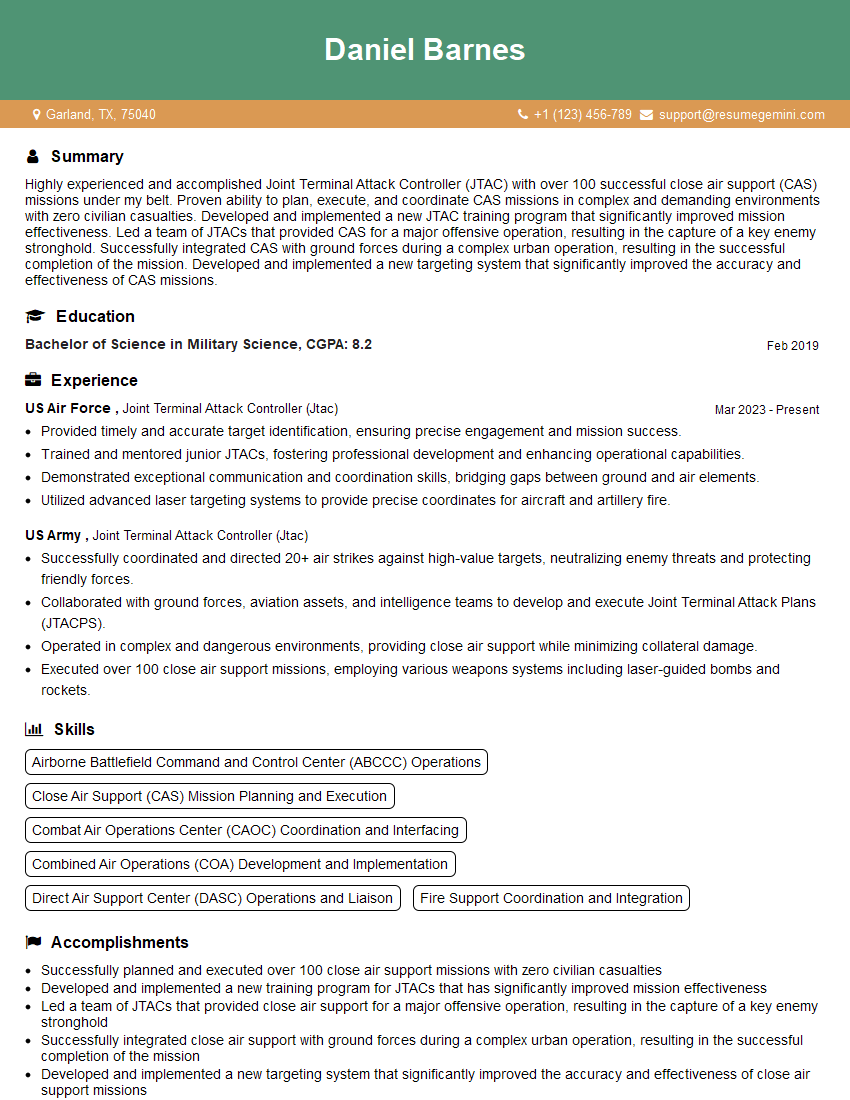
Mastering the skills of a Tactical Air Controller opens doors to a challenging and rewarding career with significant growth potential. To maximize your job prospects, creating a strong, ATS-friendly resume is crucial. ResumeGemini is a trusted resource that can help you build a professional and impactful resume tailored to highlight your unique qualifications. Examples of resumes specifically designed for Tactical Air Controller positions are available to help you craft the perfect application.
Explore more articles
Users Rating of Our Blogs
Share Your Experience
We value your feedback! Please rate our content and share your thoughts (optional).
What Readers Say About Our Blog
Very informative content, great job.
good