Every successful interview starts with knowing what to expect. In this blog, we’ll take you through the top Tactical and Operational Planning in Explosive Environments interview questions, breaking them down with expert tips to help you deliver impactful answers. Step into your next interview fully prepared and ready to succeed.
Questions Asked in Tactical and Operational Planning in Explosive Environments Interview
Q 1. Describe the risk assessment process for handling an unexploded ordnance.
Risk assessment for unexploded ordnance (UXO) is a crucial first step, involving a systematic evaluation of potential hazards. It’s not a one-size-fits-all process; the specific risks change drastically depending on the suspected ordnance type, its condition, the surrounding environment, and the planned actions.
- Identifying Hazards: This involves determining the type of UXO (if known), its potential explosive capacity, the presence of any secondary hazards like unstable structures or toxic materials, and weather conditions that could influence the risk (e.g., rain increasing the risk of corrosion and instability).
- Analyzing Risks: We consider the likelihood of each hazard occurring and the severity of its potential consequences. For example, a small, relatively stable mortar round poses a lower risk than a large, corroded artillery shell.
- Evaluating Controls: This stage focuses on identifying and evaluating control measures to mitigate the risks. These could include using protective equipment (like bomb suits), employing remote handling techniques, or establishing safety zones.
- Risk Acceptance/Mitigation: Based on the risk assessment, a decision is made on whether to proceed with the operation and what safety measures are absolutely necessary. Sometimes, the risk is deemed too high, and alternative solutions, like leaving the UXO undisturbed, must be considered. This is crucial to balancing risk and the operational needs.
For example, during a UXO discovery on a construction site, the risk assessment may highlight the risk of accidental detonation during excavation. This might lead to the implementation of controlled excavation techniques, the use of metal detectors, and the establishment of a large safety zone.
Q 2. Explain the difference between a controlled detonation and a disruption technique.
Controlled detonation and disruption are both techniques used to render explosive devices safe, but they differ significantly in their approach and outcome.
- Controlled Detonation: This involves carefully setting off the explosive charge in a controlled manner, usually at a designated site where the blast effect is minimized. It is preferred when the explosive is relatively stable and the surrounding environment allows for controlled destruction. Safety parameters are critical. We use specialized blasting mats and strategically placed barriers to contain the blast, prioritizing safety above all else. This is often used for larger, more stable explosives like recovered munitions.
- Disruption: This method focuses on rendering the explosive harmless by disabling its critical components without causing a full detonation. This may involve carefully cutting wires, removing detonators, or using specialized tools to mechanically compromise the device. Disruption is preferred when detonation is too risky or impractical – for example, when the device is located in a densely populated area or poses a threat to critical infrastructure. This is frequently the method for improvised explosive devices (IEDs).
Imagine finding a World War II bomb. A controlled detonation at a designated range would likely be the preferred option. However, a homemade IED found in a busy market would likely require a disruption technique due to the high risk of uncontrolled detonation.
Q 3. What safety protocols are essential when working with improvised explosive devices (IEDs)?
Safety protocols for IED handling are paramount and must be strictly followed. A single mistake can have devastating consequences.
- Personal Protective Equipment (PPE): Bomb suits, helmets, eye protection, and respiratory protection are essential to minimize the risk of injury from blast fragments and toxic materials.
- Remote Handling Techniques: Whenever possible, IEDs should be handled remotely using robots or specialized tools to maximize distance from the device.
- Controlled Environment: The area around the IED should be secured and evacuated to prevent unauthorized access and minimize the risk of collateral damage.
- Communication: Clear and concise communication within the team is crucial to coordinate actions and ensure everyone is aware of the situation.
- Pre-blast Survey: A thorough examination is performed to determine the type of explosive, the presence of additional triggering mechanisms, and to assess the overall risk.
- Emergency Procedures: A well-defined emergency plan should be in place in case of unexpected events such as accidental detonation.
- Post-blast procedures: Careful examination of the blast site is crucial to ensure complete neutralization and to collect evidence. This also allows for post-incident analysis of the IED.
For example, before attempting to disable an IED, we’d meticulously examine it from a safe distance using long-range cameras and X-ray equipment. Only then would we decide on the best approach. The safety of the team and the surrounding public is always the top priority.
Q 4. Outline the steps involved in a typical IED disposal operation.
A typical IED disposal operation follows a structured approach to ensure safety and effectiveness.
- Initial Assessment: The scene is secured, and the IED is examined remotely using binoculars, cameras, and X-ray equipment to assess the type of device, triggering mechanisms, and potential hazards.
- Risk Assessment and Planning: A detailed risk assessment is carried out, and a disposal plan is formulated based on the findings. This includes selecting the appropriate disposal technique (disruption or controlled detonation) and identifying necessary equipment and personnel.
- Preparation and Staging: The disposal team prepares the necessary equipment and establishes a safe working area with clearly defined safety zones. Protective measures and communication channels are checked.
- Disposal Execution: The chosen disposal technique is executed according to the plan, with constant monitoring of the situation and communication within the team.
- Post-Disposal Assessment: The area is thoroughly examined to ensure the IED has been completely neutralized and to gather evidence for further investigation.
- Scene Decontamination: If any hazardous materials were involved, the area undergoes decontamination to ensure it is safe for re-entry.
Imagine a scenario where an IED is found near a school. Each step, from initial assessment to post-disposal, would be meticulously planned and executed to ensure the safety of students, staff, and responders, while ensuring effectiveness.
Q 5. How do you determine the safe standoff distance during an explosive operation?
Determining safe standoff distance during an explosive operation is critical. The distance depends on several factors, primarily the type and quantity of explosive material, the type of detonation used, and the surrounding environment.
- Explosive Type and Quantity: High explosives require a much larger standoff distance than low explosives due to their greater destructive power. The mass of the explosive directly affects the blast radius.
- Detonation Type: A controlled detonation with the use of earth-filled containment bunkers often reduces the required standoff distance significantly compared to an uncontrolled detonation.
- Environment: Obstacles such as buildings or other structures can influence the blast wave, potentially increasing the required distance. The presence of flammable or volatile materials further enhances the risk. The terrain also plays a significant role. A confined space will increase the destructive power of a blast.
- Blast radius formulas and established safety guidelines: Experienced EOD technicians frequently use established formulas, charts and guidelines to calculate the minimum safe distance based on the above factors.
Standoff distance isn’t just a guess; it’s a calculated value, based on the unique characteristics of each situation. It could range from several meters for a small IED to hundreds of meters for a large-scale demolition. Our calculations are always conservative to ensure maximum safety.
Q 6. What are the different types of explosive materials you are familiar with?
My familiarity with explosive materials encompasses a wide range, from military-grade high explosives to improvised explosive devices (IEDs).
- High Explosives: These include materials like TNT (Trinitrotoluene), RDX (Research Department Explosive), C4 (Composition C4), and PETN (Pentaerythritol tetranitrate). These are generally used in military munitions and demolition operations and have varying degrees of sensitivity and blast power.
- Low Explosives: These include black powder, smokeless powder, and other pyrotechnic mixtures. They burn relatively slowly compared to high explosives and are used in propellants and some types of blasting agents.
- Improvised Explosive Devices (IEDs): These can consist of a wide variety of materials, including fertilizer-based explosives (like ANFO – Ammonium Nitrate Fuel Oil), homemade blasting agents, and various other commercially available chemicals. The composition and effectiveness of IEDs vary significantly.
Understanding the properties of each material—such as sensitivity, brisance, and detonation velocity—is essential for safe handling and disposal. For example, the sensitivity of a primary explosive like PETN requires significantly different handling procedures compared to the less sensitive TNT. This knowledge directly impacts the safety precautions used in various explosive operations.
Q 7. Explain your experience with X-ray and other detection technologies used in EOD.
X-ray and other detection technologies are indispensable tools in EOD operations. They provide crucial information to assess the contents and construction of suspicious packages and devices, enabling safer disposal procedures.
- X-ray technology: X-ray systems are used to create images of the internal structure of objects, revealing the presence of metallic components, wiring, and potentially explosive materials. Different densities of materials show up in different shades on the X-ray image, which helps in the identification of components of IEDs.
- Other Detection Technologies: Besides X-ray, we utilize a range of technologies, including:
- Ground Penetrating Radar (GPR): For locating buried explosive devices or UXOs.
- Metal detectors: To detect metallic components within IEDs or UXO.
- Spectroscopy techniques: To identify the chemical composition of unknown substances.
- Acoustic sensors: To detect sounds associated with the functioning of certain devices.
In my experience, the effective use of these technologies isn’t just about operating the equipment; it’s about interpreting the data obtained. For example, recognizing subtle differences in X-ray images to differentiate between harmless metal objects and components of an explosive device requires a significant level of expertise. The integration of multiple technologies often provides a more comprehensive picture compared to relying on a single method.
Q 8. Describe your experience with robotic systems used in explosive ordnance disposal.
My experience with robotic systems in explosive ordnance disposal (EOD) is extensive. I’ve worked with a range of robots, from small, lightweight devices for accessing confined spaces to larger, more heavily armored units capable of handling larger explosive devices. These robots are invaluable tools, providing a crucial layer of protection for EOD technicians. For instance, I’ve used PackBot robots to conduct initial assessments of suspicious packages, allowing us to safely determine the presence of explosives before deploying more hazardous response techniques. I’m also proficient in operating and maintaining these systems, understanding their limitations and capabilities. This includes familiarity with different manipulator arms, cameras (including thermal and x-ray imaging), and the software used to control them. Successful operation requires not only technical expertise but also a deep understanding of the specific robot’s capabilities in various environments and scenarios. For example, the terrain can significantly impact a robot’s mobility, requiring careful maneuvering. We often conduct training exercises simulating various scenarios to hone this skillset.
Q 9. How would you handle a situation where a primary disposal method fails?
If a primary disposal method fails, a crucial step is to immediately reassess the situation. This involves reviewing the initial threat assessment, considering any new information or developments, and conferring with the team. The primary goal is to ensure the safety of personnel. We might shift to a different disposal technique. For instance, if a disarming procedure proves too risky, we could switch to controlled detonation at a safe distance. This always entails the development of a new tactical plan that takes into account the factors that caused the initial method to fail. Another critical aspect is documenting everything – the initial plan, the reason for its failure, the new plan and its execution, as well as a post-incident analysis. The failure of one method doesn’t indicate failure of the entire operation, rather it necessitates a flexible and adaptable approach.
Q 10. What are the legal and ethical considerations in dealing with explosives?
Legal and ethical considerations in EOD are paramount. Legally, we must always operate within the bounds of the law, adhering to local, national, and international regulations regarding explosives handling, storage, and disposal. This includes obtaining necessary permits and authorizations, meticulously documenting all procedures, and ensuring compliance with safety standards. Ethically, our decisions must prioritize the safety and well-being of the public and our personnel. This often involves navigating difficult choices, balancing the need for immediate action with careful consideration of potential risks and consequences. Consider a scenario where an IED is located near a school. We have an ethical duty to ensure the safety of the children, while also following legal procedures to prevent unintended harm during the disposal operation. The ethical dimension includes not only the immediate response but also the long-term consequences of the actions taken; our approach must be legally sound and ethically justifiable in both the short-term and the long-term.
Q 11. Explain your knowledge of different types of IED triggers.
IED triggers are diverse, ranging from simple pressure plates or tripwires to sophisticated electronic devices. Understanding these triggers is critical for safe and effective disposal. We categorise them broadly:
- Mechanical triggers: These include pressure plates, tripwires, and pull switches – fairly straightforward to detect but can be cleverly concealed.
- Electrical triggers: These often involve a battery powering a detonator, potentially including timers, remote controls, or even cell phone signals. Detecting these requires specialized equipment.
- Chemical triggers: These might involve substances reacting to produce a detonation. These are less common but pose unique challenges.
- Combination triggers: Many IEDs employ multiple triggers, increasing their lethality. A simple pressure plate might trigger an electrical circuit to arm the device, activating a timer.
Q 12. How do you identify and assess potential threats related to explosives?
Identifying and assessing potential explosive threats is a systematic process. It begins with threat awareness, informed by intelligence, location, and the surrounding context. Physical examination is key; this might involve visual inspection, using tools like x-ray machines, and employing trained canine units for detecting explosive residues. We also consider the potential target, the proximity to other structures, and the potential consequences of detonation. This information feeds into a risk assessment, guiding our choices of disposal methods and safety protocols. Imagine discovering a suspicious package near a heavily populated area. This raises the risk considerably compared to a similar package in an isolated location. The assessment considers various factors to ensure a proportionate response. The assessment process is iterative. As more information becomes available, our threat assessment adapts, leading to adjusted safety protocols and disposal plans.
Q 13. Describe your experience in developing tactical plans for explosive disposal scenarios.
Developing tactical plans for explosive disposal scenarios is a multi-step process, requiring thorough preparation and meticulous attention to detail. First, we conduct a comprehensive risk assessment, identifying potential hazards and vulnerabilities. Next, we develop various response options, considering the type of explosive, its environment, and available resources. The selected plan needs to be clear, concise, and unambiguous, allocating specific roles and responsibilities to team members. It must also include clear communication protocols, contingency plans, and safety procedures. For example, one plan might involve the use of a robot to neutralize the device remotely. But a backup plan might include controlled detonation if the robot fails. Regular simulations and training allow us to test and refine our plans, ensuring our readiness for varied scenarios. This process considers all aspects, from access routes and evacuation procedures to communication strategies and post-incident response.
Q 14. How do you communicate effectively during a high-pressure explosive disposal operation?
Effective communication is crucial during high-pressure EOD operations. We utilize clear, concise language, avoiding jargon unless absolutely necessary, and keeping terminology standardized. We have pre-established communication channels and protocols, ensuring that information flows smoothly and efficiently between team members, command, and any other stakeholders. We typically use radio communication for immediate updates, utilizing a designated team leader to ensure coordinated actions. Nonverbal communication is just as vital. A quick head nod might indicate confirmation, a hand signal might alert the team to an immediate danger. Regular briefings and debriefings both before and after the operation help maintain team cohesion and ensure that everyone is on the same page. During emergencies, concise, unambiguous instructions are critical for preventing confusion and ensuring the safety of personnel. This requires extensive training and practice to ensure seamless communication under duress.
Q 15. What are your skills in using specialized EOD tools and equipment?
My expertise encompasses a wide range of specialized EOD tools and equipment. This includes, but isn’t limited to, X-ray and millimeter-wave scanners for non-destructive inspection of suspicious packages, various types of robotic systems for controlled disabling of devices, and a comprehensive suite of personal protective equipment (PPE), such as bomb suits and specialized eyewear. I’m proficient in the operation and maintenance of these tools, understanding their limitations and capabilities. For instance, I’ve used the Talon robot numerous times for close-up examination and disabling of IEDs, and I’m very familiar with the nuances of different X-ray systems and their applications in identifying various explosive materials.
Beyond the technical aspects, my skillset also involves selecting the right tools for a specific scenario, a critical decision-making aspect in EOD operations. This requires careful consideration of the device’s type, location, and surrounding environment. For example, in a confined space, a smaller, more maneuverable robot would be preferred over a larger, more powerful one. The selection process is always guided by safety protocols and minimizing risk.
Career Expert Tips:
- Ace those interviews! Prepare effectively by reviewing the Top 50 Most Common Interview Questions on ResumeGemini.
- Navigate your job search with confidence! Explore a wide range of Career Tips on ResumeGemini. Learn about common challenges and recommendations to overcome them.
- Craft the perfect resume! Master the Art of Resume Writing with ResumeGemini’s guide. Showcase your unique qualifications and achievements effectively.
- Don’t miss out on holiday savings! Build your dream resume with ResumeGemini’s ATS optimized templates.
Q 16. Explain your understanding of post-blast investigation techniques.
Post-blast investigations are crucial for understanding the nature of an explosion and preventing future incidents. My approach involves a systematic process, beginning with securing the scene to prevent further harm and preserve evidence. This includes establishing a perimeter, controlling access, and documenting the scene through photography and videography. Detailed documentation is paramount. Every piece of debris, even seemingly insignificant fragments, holds clues.
Next, I meticulously collect and analyze evidence, including explosive residues, fragments of the device, and witness statements. We use specialized techniques to identify the type of explosive used, its quantity, and the method of detonation. This might involve chemical analysis in a lab, comparing fragment characteristics to known explosive types, or analyzing the blast pattern to deduce the placement and power of the device. The goal is to reconstruct the event timeline, identify the perpetrators (if possible), and learn from the incident to improve future security measures.
For example, the crater size and debris pattern can provide valuable information about the explosive yield and the direction of the blast. The type and condition of the fragments can help to identify the origin and design of the explosive device.
Q 17. How do you manage risk and uncertainty when dealing with unknown explosive devices?
Managing risk and uncertainty with unknown explosive devices is paramount and demands a methodical, layered approach. The first step is always careful observation and assessment from a safe distance. We employ non-intrusive techniques like X-ray and other remote sensing technologies to gather as much information as possible before getting closer. This reduces risk significantly. Every decision is weighed against the potential consequences, balancing the need for information with the level of risk.
We use a layered approach to risk mitigation, starting with the outermost layers focusing on securing the area and controlling access. Subsequent layers involve increasingly closer inspection and riskier actions, only after the previous layer has mitigated risks as much as possible. This approach allows for a systematic reduction of uncertainty. Containment procedures are crucial, especially for improvised explosive devices (IEDs) which often have unpredictable designs.
A crucial aspect is the use of ‘what if’ scenarios and contingency plans. We meticulously plan for different outcomes, anticipating potential complications and having procedures in place to handle them effectively. It’s akin to a chess game, constantly anticipating the opponent’s (the explosive device) next move.
Q 18. How do you coordinate with other emergency response teams during an explosive incident?
Coordination with other emergency response teams is critical during explosive incidents. This necessitates clear communication and a well-defined command structure. I am experienced in working within incident command systems (ICS), adhering to established protocols and reporting procedures. This often involves utilizing radios and other communication methods to ensure seamless information exchange.
My role involves informing other teams—fire, police, medical—about the situation, providing risk assessments, and coordinating actions to ensure a coordinated and safe response. For example, I might advise firefighters on safe approaches to the scene, and coordinate with police to manage the evacuation of the area and maintain crowd control. Effective communication prevents dangerous overlaps or gaps in response. A clear understanding of everyone’s roles prevents confusion in a high-pressure situation.
Regular joint training exercises with other teams solidify these coordination mechanisms, building trust and familiarity in handling real-world scenarios. Drills provide a safe environment for practicing procedures and improving response efficiency. In fact, simulating complex scenarios can actually highlight shortcomings in the procedures or communication and allow for improvements before a real event.
Q 19. Describe your experience with training others in EOD procedures.
I have extensive experience in training others in EOD procedures, both in classroom settings and in practical field exercises. My training approach emphasizes a balance of theoretical knowledge and hands-on experience. I adapt my teaching style to the different learning needs and levels of experience within a group. It’s essential to move from the basics to more complex scenarios progressively.
Training includes comprehensive instruction on safety protocols, the recognition and identification of different types of explosives, the use of specialized tools and equipment, and the step-by-step procedures for handling and disposing of explosive devices. The curriculum also covers risk assessment, decision-making under pressure, and effective communication during emergency response. Regular assessments and practical exercises ensure that trainees fully grasp the concepts and develop the necessary skills.
A key component is emphasizing ethical considerations and responsible decision-making. EOD work demands careful attention to detail and a commitment to safety for both the EOD team and the public.
Q 20. What are the common safety hazards associated with explosive environments?
Explosive environments present a multitude of significant safety hazards. The most obvious is the risk of detonation, resulting in severe injury or death. This risk is further amplified by the potential for secondary explosions, chain reactions, and the unpredictable behavior of improvised devices. The unpredictability itself is a major hazard.
Beyond the immediate explosion threat, there are numerous other hazards. These include exposure to toxic fumes and chemicals during detonation or handling of explosives. There’s also a risk of burns from heat and flames, shrapnel injuries, and structural collapse due to the blast. Depending on the environment, additional hazards like confined spaces, hazardous materials, and unstable structures can present further challenges.
Proper PPE, including bomb suits, respirators, and protective eyewear, are vital to mitigating these risks. However, even the best equipment can’t guarantee complete protection, highlighting the importance of stringent safety protocols and adherence to standard operating procedures.
Q 21. How do you maintain your professional certifications and competencies in EOD?
Maintaining professional certifications and competencies in EOD is a continuous process. This involves regular participation in advanced training courses and workshops, keeping abreast of the latest advancements in technology and techniques. I actively participate in professional organizations and attend conferences to stay current on best practices and emerging threats.
My certifications require periodic renewal, often involving both written and practical examinations to demonstrate proficiency. I also engage in regular practical training exercises, simulating various scenarios to ensure my skills remain sharp and my reflexes are honed. Staying updated isn’t just about certifications, but also involves a dedication to continuous learning and self-improvement. The field of EOD is constantly evolving, so continuous learning is critical.
Moreover, I actively seek feedback and mentorship from experienced colleagues, reviewing past incidents and learning from both successes and mistakes. This continuous learning approach, combining formal training with real-world experience and peer review, ensures I remain a highly competent and capable EOD professional.
Q 22. Describe a time when you had to make a critical decision under pressure in an explosive environment.
During a bomb threat at a major sporting event, we had only minutes before the scheduled start. Initial assessments indicated a sophisticated device, potentially with multiple triggering mechanisms. The pressure was immense – thousands of lives were at stake. My team and I were faced with two choices: a high-risk, immediate attempt at neutralization, or a controlled evacuation, sacrificing the event but prioritizing safety. After a quick, but thorough risk assessment considering all available intelligence, including the device’s location and potential impact radius, we opted for a phased evacuation, prioritizing vulnerable populations (children, elderly). This bought us valuable time for a more thorough assessment and a safer neutralization strategy later. This experience underscored the importance of methodical decision-making even amidst intense time pressure. Prioritizing safety, even with potential consequences, proved the most effective strategy.
Q 23. Explain your understanding of the different types of blast injuries and their treatment.
Blast injuries are categorized into primary, secondary, tertiary, and quaternary effects. Primary injuries are caused by the direct effect of the blast wave on the body, often affecting air-filled organs like lungs and eardrums. Secondary injuries result from flying debris propelled by the explosion. Tertiary injuries are caused by the victim being thrown against objects, resulting in blunt force trauma. Quaternary injuries encompass all other effects, including burns, toxic exposures, and crush injuries. Treatment varies depending on the type and severity of the injury, but generally involves immediate stabilization, addressing airway, breathing, and circulation (ABCs), wound management, and pain control. Advanced interventions may include surgical repair, hyperbaric oxygen therapy for decompression sickness, and psychological support.
For example, a primary injury like a ruptured eardrum would be treated with observation and pain relief, while a tertiary injury like a fractured femur would require surgical intervention and rehabilitation. Effective treatment requires a coordinated approach involving emergency medical services, trauma surgeons, and specialists familiar with blast injuries.
Q 24. How do you develop and implement emergency action plans for explosive incidents?
Developing emergency action plans for explosive incidents requires a multi-faceted approach involving detailed risk assessment, resource allocation, and clear communication protocols. The plan should cover all phases: pre-incident preparation, response phase, and post-incident recovery. It starts with identifying potential threats and vulnerabilities. Then, we define clear roles and responsibilities for each team member, outlining communication channels and evacuation procedures. We conduct regular drills and training exercises to ensure preparedness. The plan must include detailed procedures for securing the scene, coordinating with emergency services (police, fire, ambulance), and establishing a command post. Regular reviews and updates are crucial to reflect evolving scenarios and technological advancements.
For example, a plan for a suspected IED might involve establishing a cordon, utilizing specialized equipment for remote observation and neutralization, and implementing a robust communication system to keep all personnel informed and coordinated. Post-incident, the plan addresses investigation, evidence collection, and victim support. A thorough plan significantly reduces response time and enhances overall safety and efficiency during a crisis.
Q 25. Explain your knowledge of relevant safety regulations and standards.
My knowledge of safety regulations and standards encompasses national and international guidelines for handling, storage, transportation, and disposal of explosives. This includes compliance with OSHA regulations (in the US context) or equivalent international standards, such as those set by the UN or individual nations. I’m familiar with the safe handling procedures outlined in various industry best practices, including detailed safety data sheets (SDS) for specific explosives and the use of personal protective equipment (PPE). Moreover, I understand the licensing and permitting requirements for working with explosives and the stringent documentation and reporting procedures needed. This covers everything from initial risk assessment to incident reporting and post-incident investigation, ensuring full compliance and the utmost safety for all involved.
Q 26. What are the key elements of a successful tactical plan for an explosive ordnance disposal operation?
A successful tactical plan for an Explosive Ordnance Disposal (EOD) operation hinges on several key elements. First and foremost is thorough reconnaissance – gaining as much information as possible about the device before any intervention. This involves using remote sensing technologies, such as robots and cameras, and intelligence gathering to understand the device’s type, construction, and potential triggering mechanisms. Next, the plan should clearly define roles and responsibilities for each team member, with a designated EOD technician leading the operation. Safety procedures must be rigorously followed, prioritizing the safety of personnel and minimizing collateral damage. The plan should also outline contingency plans in case of unexpected developments or failures. Finally, post-operation procedures, including the secure disposal of the device and a detailed after-action report, are essential for continuous improvement. A well-structured plan increases the likelihood of a safe and successful outcome, reducing risks to both personnel and the environment.
Q 27. How do you adapt your plans based on changes in the operational environment?
Adaptability is crucial in explosive environments. Changes in the operational environment, such as unexpected weather conditions, the discovery of new information regarding the explosive device, or shifts in the surrounding populace, necessitate immediate and strategic adjustments. This might involve revising the tactical approach, altering the timing of the operation, or incorporating additional safety precautions. Effective adaptation often requires quick thinking, decisive decision-making, and effective communication amongst the team. For instance, if during an EOD operation, unexpected unstable ground conditions are encountered, the plan might be altered to use a different approach, minimizing the risk of causing unintended detonations. Regular reassessment and flexibility are key to mission success and personnel safety.
Q 28. What measures do you take to mitigate risks during the transportation of explosives?
Mitigating risks during the transportation of explosives demands meticulous adherence to stringent regulations and protocols. This begins with using properly designed and maintained transport vehicles, specifically designed to contain and secure explosives. The vehicles should be equipped with appropriate safety features, such as emergency shutoff switches and fire suppression systems. The route should be carefully planned to minimize exposure to hazards, such as populated areas, and the transportation should be timed to avoid peak traffic hours. Furthermore, trained and qualified personnel are essential to manage and escort the explosives, ensuring the journey is executed safely and according to established procedures. Detailed documentation, including manifests and tracking information, are crucial for accountability and tracing any potential incidents. Finally, regular vehicle inspections and driver training are critical to maintain safety standards and minimize risks throughout the transportation process.
Key Topics to Learn for Tactical and Operational Planning in Explosive Environments Interview
- Risk Assessment and Mitigation: Understanding hazard identification, vulnerability analysis, and the development of mitigation strategies in explosive environments. Practical application includes scenario planning and resource allocation for safety measures.
- Operational Procedures and Standard Operating Procedures (SOPs): Developing and adhering to clear, concise, and effective SOPs for various scenarios, emphasizing safety protocols and communication strategies. Consider practical applications in diverse operational settings and emergency response.
- Communication and Coordination: Mastering effective communication techniques in high-pressure situations, including clear and concise reporting, efficient use of technology, and teamwork coordination. Think about practical application in multi-agency responses and real-time decision-making.
- Technical Knowledge of Explosives: Demonstrating a fundamental understanding of explosive characteristics, detonation mechanisms, and the potential effects of various explosive types. Focus on practical applications like recognizing potential threats and assessing explosive hazards.
- Incident Response Planning: Developing comprehensive plans for various explosive-related incidents, including pre-incident preparations, immediate response actions, and post-incident analysis and recovery. Consider practical applications like developing evacuation plans and managing resources effectively during crises.
- Legal and Regulatory Compliance: Understanding and adhering to relevant laws, regulations, and safety standards pertaining to handling, storage, and disposal of explosives. Think about the practical implications of non-compliance and the importance of maintaining accurate documentation.
- Technological Applications: Familiarity with relevant technologies used in explosive detection, investigation, and mitigation, including sensors, remote-operated vehicles (ROVs), and data analysis tools. Consider how these technologies improve operational efficiency and safety.
Next Steps
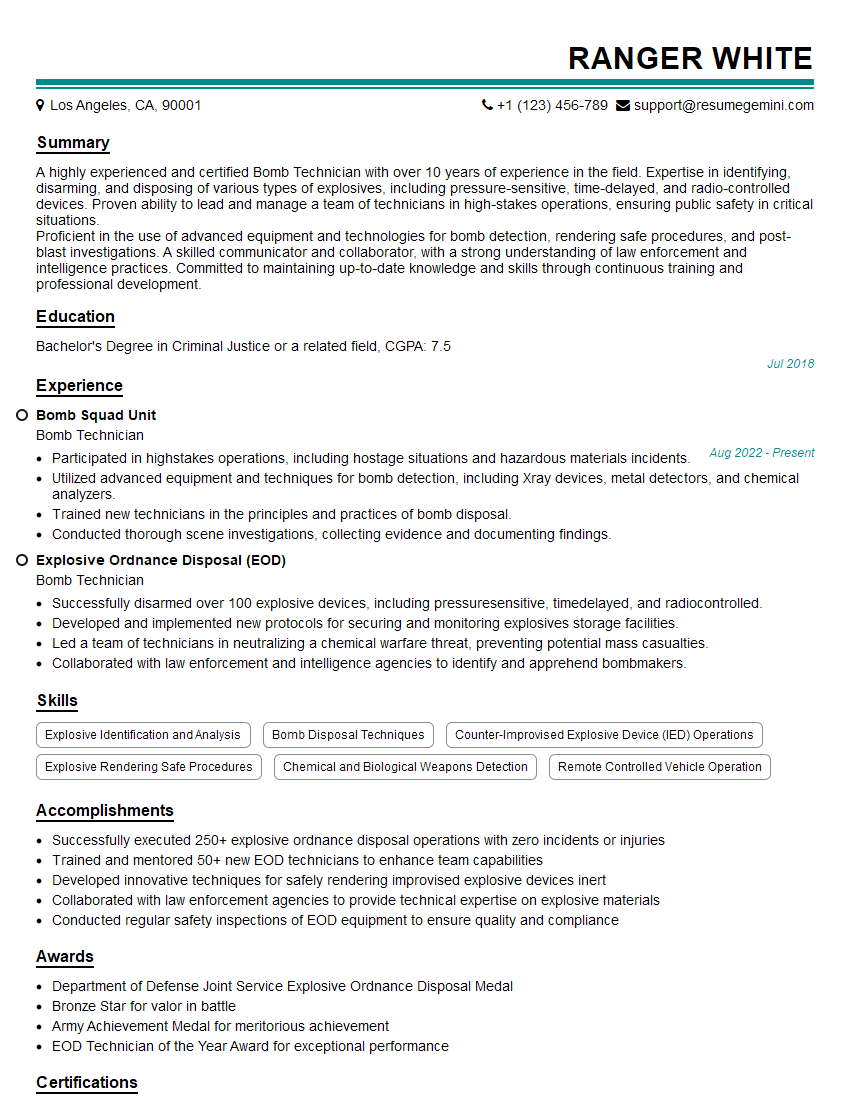
Mastering Tactical and Operational Planning in Explosive Environments is crucial for career advancement in this high-demand field. It demonstrates a commitment to safety, problem-solving, and leadership. To significantly boost your job prospects, crafting an ATS-friendly resume is essential. ResumeGemini is a trusted resource that can help you build a professional resume that highlights your skills and experience effectively. We provide examples of resumes tailored to Tactical and Operational Planning in Explosive Environments to help guide you in showcasing your qualifications. Take the next step and build a resume that gets noticed!
Explore more articles
Users Rating of Our Blogs
Share Your Experience
We value your feedback! Please rate our content and share your thoughts (optional).
What Readers Say About Our Blog
Very informative content, great job.
good