Preparation is the key to success in any interview. In this post, we’ll explore crucial Tattoo Composition and Layout interview questions and equip you with strategies to craft impactful answers. Whether you’re a beginner or a pro, these tips will elevate your preparation.
Questions Asked in Tattoo Composition and Layout Interview
Q 1. Explain your process for translating a client’s concept into a tattoo design.
Translating a client’s concept into a tattoo design is a collaborative process requiring careful listening and visual interpretation. It begins with a thorough consultation, where I delve deeply into their ideas, exploring the symbolism, meaning, and inspiration behind their desired tattoo. I encourage them to bring reference images, descriptions, or even sketches, which serve as a starting point for our creative discussion. I then create several sketches, exploring different compositions and styles to best represent their vision. This iterative process involves refining the design based on client feedback, ensuring we arrive at a final design that resonates deeply with them.
For example, if a client wants a tattoo representing their love for nature, we might discuss specific elements like animals, plants, or landscapes. I’d then sketch several options, perhaps one focusing on a detailed realistic bird, another featuring stylized floral elements, and a third with a more minimalist approach. We collaboratively select the best approach, refining the details until it perfectly captures the client’s emotional connection to nature.
Q 2. Describe your approach to incorporating negative space in tattoo composition.
Negative space, the area surrounding the main elements of a design, is crucial for creating balance and visual breathing room in a tattoo. It’s not simply empty space; it’s a design element itself, enhancing the impact of the positive space (the inked areas). My approach involves strategically using negative space to frame the focal point, allowing the eye to naturally rest and appreciate the details. Too much negative space can make the design feel sparse, while too little creates a cluttered and overwhelming look. The key is finding the right balance.
For instance, in a floral design, the negative space between the petals can be shaped and used to highlight the curvature and fluidity of the flowers. In a more abstract design, large areas of negative space can be utilized to emphasize certain lines or shapes. Ultimately, the goal is to create a harmonious relationship between the positive and negative space, resulting in a visually appealing and well-balanced tattoo.
Q 3. How do you ensure proper scaling and proportion in your tattoo designs?
Ensuring proper scaling and proportion is paramount to creating a successful tattoo. I always start by determining the client’s desired placement and size. I then carefully measure the area and translate those measurements into the digital design. I use digital tools to precisely adjust the size and proportions of elements within the composition, ensuring that the design flows smoothly and harmoniously across the chosen body part. This also involves considering the natural curves and contours of the body to avoid distortion and ensure the tattoo looks its best on the skin.
For example, a large-scale back piece requires a different approach than a small wrist tattoo. The proportions of elements in a back piece will be much larger, but the overall composition needs to remain balanced and aesthetically pleasing despite the increase in size. Using a stencil to transfer the design onto the skin is crucial to maintain accuracy during the tattoo process.
Q 4. What software or tools do you use for tattoo design and layout?
I primarily use Adobe Photoshop and Illustrator for tattoo design and layout. Photoshop’s raster-based capabilities are invaluable for creating detailed realism and photorealistic work, handling textures and blending colors seamlessly. Illustrator, with its vector-based system, allows me to create clean lines, precise shapes, and scalable designs that maintain their sharpness even at larger sizes. This combination provides flexibility and precision for all styles of tattoo designs, from traditional to geometric and beyond.
Beyond software, I also use specialized tools like graphic tablets for creating smooth lines and intricate details. The tablet’s pressure sensitivity allows for dynamic line variation and subtle shading, crucial for achieving a professional and nuanced aesthetic.
Q 5. How do you handle complex designs with multiple elements?
Handling complex designs with multiple elements requires a structured approach. I start by creating a detailed sketch, breaking down the design into smaller, manageable sections. This helps to maintain organization and clarity throughout the design process. I then focus on the relationship between each element, ensuring that they complement each other visually and flow naturally within the overall composition. This often involves creating a hierarchy, prioritizing certain elements to serve as focal points and arranging others in a supporting role.
For example, in a sleeve tattoo with various scenes and characters, I might prioritize a central character or scene, arranging the surrounding elements to complement and enhance it, rather than competing for attention. Using layers in Photoshop and Illustrator is a crucial step to maintaining organization, ensuring that individual elements can be adjusted independently without affecting other parts of the design.
Q 6. Explain your understanding of color theory and its application in tattooing.
Color theory is fundamental to tattoo design. Understanding the color wheel – including primary, secondary, and tertiary colors – is essential for creating harmonious and visually appealing palettes. Complementary colors (opposite each other on the wheel) create a vibrant contrast, while analogous colors (next to each other) provide a more subdued and harmonious effect. I also consider the skin’s undertones when selecting colors, ensuring the chosen hues will appear vibrant and true to the design after being applied to the skin.
For example, warm colors like reds and oranges tend to appear brighter on lighter skin, while cool colors like blues and greens might stand out more on darker skin. Knowing how colors interact and affect each other on the skin is crucial for achieving the desired aesthetic. I use the color wheel as a guideline, but I also experiment and adjust the palette based on the client’s preferences and the overall mood of the design.
Q 7. Describe your experience with different tattoo styles (e.g., traditional, realism, geometric).
My experience spans various tattoo styles, allowing me to adapt my approach to suit each client’s vision. Traditional American tattoos, with their bold lines, solid colors, and classic motifs, require a focus on strong composition and impactful imagery. Realism, on the other hand, demands meticulous detail, accurate shading, and a deep understanding of anatomy and texture. Geometric designs necessitate precision and a mastery of geometric principles, carefully considering the flow and balance of lines and shapes.
I’ve worked extensively in all three styles and find the differences in technique and approach challenging and rewarding. Traditional style demands clean lines and bold coloring, while realism requires a much more subtle and nuanced approach to shading and color blending. Geometric tattoos demand clean lines and careful placement, ensuring that the overall composition is pleasing.
Q 8. How do you adapt your design process for various skin tones and body locations?
Adapting tattoo designs for different skin tones and body locations is crucial for achieving optimal results and client satisfaction. It’s not just about aesthetics; it’s about ensuring the tattoo ages well and looks its best on the individual.
Skin Tone: Darker skin tones require bolder lines and more saturated colors to ensure the tattoo remains visible over time. Lighter skin tones can handle finer lines and more delicate shading. I always consult color palettes that are specifically designed for different skin undertones. For instance, a vibrant red might appear muted on darker skin, so I’d opt for a deeper, richer crimson. I might also adjust the color saturation and value to compensate for how the skin will affect the final look.
Body Location: The placement of the tattoo significantly impacts the design. Areas like the ankles, wrists, and ribs are more prone to stretching and distortion over time, so designs should be adapted accordingly. A detailed, intricate design might distort badly in these areas, whereas a simpler design will hold up better. I often incorporate the natural curves and contours of the body into the design itself. For example, a flowing design might be ideal for a curved area like the rib cage, while a geometric design might be better suited for a flatter surface like the forearm. I also consider the hair growth pattern in the area – hair can significantly impact the healing process and final appearance of a tattoo.
Q 9. How do you incorporate client feedback into your tattoo design process?
Client feedback is the cornerstone of a successful tattoo. I actively encourage clients to express their preferences and concerns throughout the design process. This isn’t just about making changes to the existing design; it’s about building a collaborative relationship where the client feels heard and understood.
My process involves several stages of feedback integration: First, I conduct a thorough consultation, discussing the client’s vision, style preferences, and any existing tattoos. Then I present initial sketches, often multiple options to explore various directions. I encourage clients to provide feedback on each sketch – What resonates? What doesn’t? We refine and iterate based on this input. I find that a strong visual communication strategy (using Pinterest boards or referencing other tattoo artists’ styles) can be very helpful. Before finalizing the design, I create a high-resolution digital rendering, allowing for minute adjustments and a clear picture of the final product. Even then, I’m open to making further changes before the stenciling process begins.
Q 10. Describe a time you had to revise a design based on client feedback.
One client commissioned a large-scale back piece depicting a majestic dragon. My initial design incorporated highly detailed scales and intricate patterns across the dragon’s entire body. After presenting the initial design, the client expressed concern about the density of detail, worrying it might look muddled when tattooed on their skin and overly time-consuming. They preferred a more simplified design to maintain clear lines and enhance readability even after several years.
We had a constructive conversation, and I revised the design by simplifying the scales, focusing on the dragon’s form and expression, and reducing the overall intricacy. This involved removing some smaller details while still maintaining the aesthetic appeal of the original concept. The result was a powerful, streamlined dragon that was both visually striking and practical for the client’s skin type and desired healing outcome. The client was thrilled with the final product, and the tattoo healed beautifully, illustrating the importance of open communication and adaptability.
Q 11. Explain your process for creating a comprehensive tattoo stencil.
Creating a high-quality tattoo stencil is crucial for precise tattoo application. My process begins with a finalized digital design, which I then optimize for stencil creation. The stencil needs to be clear, durable and accurately reflect the design.
I use professional stencil paper, specifically designed for tattooing. This paper is durable, waterproof, and designed for easy transfer. I then print the design onto this paper using a high-resolution printer. I sometimes use a thermal stencil printer for superior quality and detail. Once printed, I meticulously review the stencil for any imperfections or issues. If necessary, I may manually touch up areas, using fine-tip markers or other specialist materials. The final step involves carefully cutting out the design with a sharp blade, ensuring clean and precise edges to prevent smudging or bleeding during application.
Q 12. How do you maintain hygiene and safety standards during the stenciling process?
Maintaining hygiene and safety during stenciling is paramount. My process incorporates several key steps to ensure a sterile environment and prevent cross-contamination:
- Sterile workspace: I work on a clean, disinfected surface.
- Gloves: I wear fresh, disposable gloves throughout the entire process.
- Clean tools: Any tools used for cutting or adjusting the stencil are sterilized before use, typically with an autoclave or medical-grade disinfectant.
- Single-use materials: I use single-use items as much as possible, including stencil paper, and other materials.
- Proper disposal: I ensure all waste materials are disposed of safely and appropriately.
Following these practices helps minimize the risk of infections and ensures the client’s safety and well-being.
Q 13. What are your preferred methods for transferring stencils to skin?
My preferred methods for stencil transfer vary depending on the design’s complexity and the client’s skin. However, I always prioritize accuracy and ease of application. My primary methods are:
- Thermal Stencil Transfer: This method uses heat to transfer the stencil image onto the skin. It’s quick, accurate, and produces crisp lines. However it can require a specific type of paper and machine.
- Stencil Stuff and Transfer Paper: I apply a thin layer of stencil transfer cream (or similar) onto the skin and then place the stencil on top, pressing firmly. The cream acts as an adhesive. This method offers a high degree of control and precision.
Regardless of the method, I always ensure that the stencil is securely adhered to the skin and the image is clearly visible before proceeding with the tattooing process.
Q 14. How do you manage client expectations regarding design complexity and healing time?
Managing client expectations is critical for a positive tattoo experience. I start by clearly explaining the design’s complexity, outlining the time commitment required for both the tattooing process and the healing period. I emphasize that complex designs may necessitate multiple sessions, and healing time increases proportionally with complexity.
Transparency is key. I show examples of similar work, discuss potential challenges specific to the chosen design and location, and provide a realistic timeline. I also offer detailed aftercare instructions, including advice on cleaning, moisturizing, and sun protection. This upfront communication reduces any potential misunderstandings and fosters trust, ultimately leading to more satisfied clients.
Q 15. How familiar are you with different needle types and their applications?
Needle types are crucial for achieving different tattoo effects. The main differences lie in the number of needles grouped together (configuration), their diameter (gauge), and the liner/shader distinction. Liner needles, typically configured in a single row (e.g., 3RL, 7RL), are used for sharp, precise lines, while shader needles, often arranged in multiple rows (e.g., 5M1, 9M1), create softer shading and color blending.
- Round liners (RL): These create clean, fine lines. A 3RL is ideal for smaller, delicate work, while a 7RL is better for bolder outlines.
- Magnum shaders (M1): These create smooth, even shading and color blending. The higher the number (e.g., 9M1 vs. 5M1), the larger the area covered per pass, leading to faster shading but requiring more skill for even application.
- Round shaders (RS): These provide a blend between liner and magnum shader, offering versatility for both line work and subtle shading.
- Flat shaders: Create a broad, flat application of ink ideal for large fills.
Choosing the right needle configuration and gauge depends on the specific design element, the client’s skin type, and the desired effect. For example, a delicate floral design might utilize a 3RL for fine lines and a 5M1 for shading, while a bold tribal design might require a 7RL and a 9M1.
Career Expert Tips:
- Ace those interviews! Prepare effectively by reviewing the Top 50 Most Common Interview Questions on ResumeGemini.
- Navigate your job search with confidence! Explore a wide range of Career Tips on ResumeGemini. Learn about common challenges and recommendations to overcome them.
- Craft the perfect resume! Master the Art of Resume Writing with ResumeGemini’s guide. Showcase your unique qualifications and achievements effectively.
- Don’t miss out on holiday savings! Build your dream resume with ResumeGemini’s ATS optimized templates.
Q 16. Describe your understanding of skin anatomy and its relevance to tattooing.
Understanding skin anatomy is paramount for safe and effective tattooing. The tattoo needle must penetrate the dermis, the second layer of skin, to deposit ink where it will be relatively permanent. The epidermis, the outer layer, is crucial for the healing process, as it acts as a protective barrier. The dermis contains collagen and elastin fibers, which determine how the skin stretches and heals.
Knowing the depth of needle penetration is crucial to avoid damaging the subcutaneous fat (hypodermis) or underlying tissues. Excessive depth can cause bleeding, scarring, and blowouts (ink spreading outside the intended area). Similarly, insufficient depth may result in fading or rejection of the ink. Each client’s skin will respond slightly differently based on their genetics and aftercare methods. This includes understanding the client’s medical history, any medications that might affect healing and potential allergies to dyes or topical solutions.
Consider this analogy: think of the skin as a layered cake. The epidermis is the icing, providing a protective shield. The dermis is the cake layer, where the tattoo ink ‘ingredients’ are integrated. The hypodermis is the cake board, providing a foundation but not to be penetrated.
Q 17. How do you address client concerns or questions about the design process?
Addressing client concerns is a crucial part of the process. I make it a priority to have a thorough consultation before starting any tattoo. This includes discussing the design, placement, size, and aftercare.
I encourage clients to share their ideas, inspiration, and any anxieties. If I feel their expectations aren’t realistic or safe, I carefully guide the conversation toward alternatives while maintaining respect for their vision. I find actively listening and providing clear explanations – often with visual aids like sketches and examples – is key to establishing trust and managing expectations. I always clarify the technical limitations, potential complications, and healing times to prevent misunderstandings down the line.
For example, if a client wants an extremely detailed tattoo in a small area, I might suggest a simpler design or larger placement to avoid potential blurring or distortion. This proactive approach ensures a satisfying outcome for both of us.
Q 18. Describe your experience with various tattoo machine types and settings.
My experience encompasses both coil and rotary tattoo machines. Coil machines are known for their power and ability to create bold lines, while rotary machines are generally quieter, smoother, and provide more versatility, particularly for shading and color packing.
Coil Machines: I understand the nuances of adjusting the contact points, spring tension, and armature bar to achieve optimal performance, for both lining and shading. The power and needle depth are controlled primarily through the machine’s settings and the artist’s hand.
Rotary Machines: These offer greater adjustability through settings like voltage and needle depth. I am familiar with various rotary brands and their unique functionalities. This often involves different voltage adjustments for lining versus shading.
Regardless of the machine type, I always prioritize hygiene and safety by maintaining consistent sanitation practices and adjusting the machine settings to the specific needs of the tattoo, including the client’s skin type and the design.
Q 19. How do you handle difficult clients or challenging design requests?
Handling difficult clients or challenging design requests requires patience, diplomacy, and clear communication. If a client is indecisive or makes unreasonable demands, I guide them towards a design that is both aesthetically pleasing and technically feasible. I emphasize open dialogue, actively listening to their concerns, and offering alternatives without compromising my artistic integrity. It is crucial to set boundaries; if the request is beyond my skillset or ethically problematic, I politely decline.
For challenging design requests, I might collaborate with the client, offering suggestions and modifications to enhance the design while still staying true to their vision. For example, if a client has an intricate design that’s too small for the intended body area, I suggest adjustments or offer a different placement. In some cases, referring the client to another artist may be necessary if the client’s expectations aren’t in line with my expertise.
Q 20. Explain your process for creating a compelling tattoo portfolio.
Building a compelling tattoo portfolio requires a strategic approach. It’s more than just showcasing finished tattoos; it’s about presenting your style, skillset, and artistic vision.
High-Quality Photography: Professional photos are essential. The lighting, angle, and post-processing must make the tattoos stand out. Close-ups are important to showcase detail, while full-body shots offer context.
Diversity of Styles and Subject Matter: A diverse portfolio demonstrates versatility, while still highlighting a consistent artistic style. Include a range of sizes, styles (e.g., traditional, realism, watercolor), and subject matter to appeal to a wider client base.
Client Consent: Always obtain client consent before posting any tattoos. Respect client privacy and ensure that appropriate blurring or cropping is done if needed.
Online Presence: Having a professional website and an active presence on social media platforms are essential for attracting new clients.
Regular Updates: A portfolio should be regularly updated to showcase your latest work and demonstrate ongoing improvement and skill development.
Q 21. How do you stay current with trends and innovations in tattoo design?
Staying current in the tattoo industry involves continuous learning and engagement.
- Industry Publications: Following tattoo magazines, online blogs and other tattoo specific publications keeps you abreast of the newest techniques, trends, and styles.
- Conventions and Workshops: Attending tattoo conventions offers opportunities to network with other artists, see the latest work, and participate in workshops and seminars.
- Social Media: Platforms like Instagram and Pinterest showcase a constant stream of new work from artists worldwide, serving as inspiration and a platform to discover new techniques.
- Continuing Education: Attending advanced workshops and courses on specific techniques (e.g., realism, watercolor) keeps skills sharp.
- Experimentation and Self-Learning: Experimentation with new techniques and styles, practicing on artificial skin, and continuous skill improvement are vital for an evolving career.
Being a part of a community of artists, engaging in discussions, and continuously seeking out new knowledge helps to maintain a fresh perspective and push creative boundaries.
Q 22. Describe your experience with digital tattoo design software.
My experience with digital tattoo design software spans over a decade, encompassing a range of programs from industry-standard options like Adobe Photoshop and Illustrator to specialized tattoo design software. I’m proficient in using these tools to create high-resolution, detailed designs, incorporating various techniques like photo manipulation, vector illustration, and digital painting. I understand the importance of working in a format suitable for tattoo artists, ensuring line weight, color saturation, and shading are optimized for proper skin application and longevity. For instance, I frequently use Photoshop’s layers and adjustment tools for precise control over color and detail, and Illustrator’s vector capabilities for creating clean, scalable line art that won’t pixelate when enlarged.
Beyond the technical skills, I also leverage these digital tools to collaborate effectively with clients, allowing for real-time feedback and revisions. This collaborative process is crucial for ensuring the final tattoo perfectly reflects the client’s vision.
Q 23. How do you troubleshoot common tattoo design problems?
Troubleshooting tattoo design problems often involves a multi-faceted approach. One common issue is poor composition. If a design feels unbalanced or cluttered, I’ll analyze the elements – evaluating negative space, focal points, and the overall flow. I might use techniques like rule-of-thirds or golden ratio principles to guide the rearrangement of elements. Another frequent challenge is poor line weight and shading inconsistency, easily corrected with the digital tools.
Color problems, such as clashing hues or lack of depth, are addressed by adjusting color palettes and using techniques like color theory to create harmony and visual interest. If a client isn’t happy with a design direction, I’ll use open communication to understand their concerns and iterate on the design until we reach a mutually satisfactory result. Essentially, I employ a combination of artistic judgment, technical skills, and client communication to solve any design issues.
Q 24. What are some common mistakes to avoid in tattoo composition?
Several common mistakes can significantly detract from a tattoo’s aesthetic appeal and longevity. One prominent mistake is neglecting negative space. Cramming too many elements into a small area results in a busy, unappealing design. Overly intricate designs, especially for larger areas, can also blur and lose detail upon application. This is because the skin’s natural texture and healing process can affect fine lines and shading.
- Poor line weight consistency: Varying line weights inappropriately can create a messy or unprofessional look.
- Ignoring skin tone and placement: Designs should be adapted to the client’s skin tone and the chosen body location to ensure optimal visual impact and prevent color distortion over time.
- Ignoring the client’s body shape: A design that doesn’t complement the client’s body shape can appear awkward or out of place.
Avoiding these common pitfalls helps ensure the tattoo ages gracefully and maintains its artistic integrity.
Q 25. How do you ensure your designs are original and avoid copyright issues?
Originality and copyright avoidance are paramount in my work. I strive to create unique designs, drawing inspiration from various sources but always transforming those inspirations into something new and distinctly my own. Instead of directly copying existing imagery, I focus on developing my creative process through sketching, experimenting with different styles, and incorporating personal elements into my work.
For instance, I might take inspiration from traditional Japanese woodblock prints, but I’ll reinterpret the motifs and composition in a contemporary style, adding my personal touch to create a truly original design. To avoid any unintentional copyright infringement, I thoroughly research the images and art styles I draw inspiration from, being mindful of not replicating exact elements or closely resembling existing copyrighted works.
Q 26. How do you price your tattoo designs?
Pricing my tattoo designs involves considering several factors: the design’s complexity, size, level of detail, and the time invested in its creation. A simple design with minimal detail requires less time and thus commands a lower price compared to an intricate, large-scale piece requiring extensive work. I also factor in my experience and reputation; more complex designs that demonstrate greater skill and creativity warrant higher fees.
I often provide clients with a detailed breakdown of the pricing, outlining the different aspects that contribute to the total cost. This transparent approach fosters trust and ensures the client understands the value provided. Sometimes, a consultation is included in the overall pricing for more involved projects.
Q 27. Explain your understanding of copyright and intellectual property rights related to tattoo designs.
Copyright and intellectual property rights are fundamental to the tattoo design industry. Copyright protection automatically applies to original tattoo designs upon creation. This means that I, as the designer, own the copyright to my work, granting me exclusive rights to reproduce, distribute, and display the design. This protection prevents unauthorized copying or reproduction of my work by others.
However, it’s crucial to understand that the copyright only protects the design itself; it does not grant me ownership of the tattoo once it’s applied to a client’s skin. The client possesses the right to display the tattoo, but they do not have the right to reproduce the design without my explicit permission. This understanding is crucial for both the artist and the client to ensure legal and ethical practices are followed. I typically have clients sign a release form acknowledging these aspects.
Q 28. How do you balance artistic expression with client preferences?
Balancing artistic expression with client preferences is a crucial aspect of my work. While I offer my professional expertise and creative vision, the tattoo ultimately belongs to the client and should reflect their personal taste and style. I initiate the process by engaging in thorough consultations with the client, actively listening to their ideas, inspirations, and desired outcome.
I might present initial sketches or concepts to gauge their reaction and incorporate their feedback to refine the design. If a client’s request contradicts my artistic judgment, I’ll engage in a respectful dialogue, explaining my reservations and suggesting alternative solutions that maintain both aesthetic integrity and client satisfaction. A collaborative approach ensures both parties are happy with the final result, a truly personalized work of art.
Key Topics to Learn for Tattoo Composition and Layout Interview
- Understanding Client Vision: Learn to effectively communicate with clients to grasp their desired style, concept, and placement preferences. Practice active listening and questioning techniques to clarify ambiguous requests.
- Sketching and Design Development: Master the process of translating initial ideas into detailed sketches, incorporating elements of perspective, anatomy, and style. Explore different sketching techniques and refine your ability to create multiple design options.
- Compositional Principles: Develop a strong understanding of design principles like balance, symmetry, asymmetry, rule of thirds, and negative space as they apply to tattoo composition. Practice applying these principles to create visually appealing and well-balanced designs.
- Style and Theme Integration: Explore diverse tattoo styles (e.g., traditional, Japanese, realism, etc.) and understand how to effectively integrate a client’s chosen style and theme into a cohesive design. Be prepared to discuss your stylistic preferences and influences.
- Color Theory and Palette Selection: Demonstrate knowledge of color theory and its impact on tattoo design. Practice choosing appropriate color palettes that complement the chosen style and skin tone, considering factors like color fading and skin reactions.
- Anatomy and Placement: Develop a keen eye for anatomy and understand how to effectively place a design on the body while considering factors like skin curvature, muscle movement, and potential distortion. Practice sketching on different body parts to demonstrate your understanding.
- Software Proficiency: Showcase your proficiency in relevant design software (e.g., Adobe Photoshop, Illustrator). Be prepared to discuss your workflow and how you utilize these tools to create professional tattoo designs.
- Problem-Solving and Adaptability: Discuss your approach to resolving design challenges, such as client revisions, unexpected complications, or technical difficulties during the design process. Highlight your adaptability and creative problem-solving skills.
Next Steps
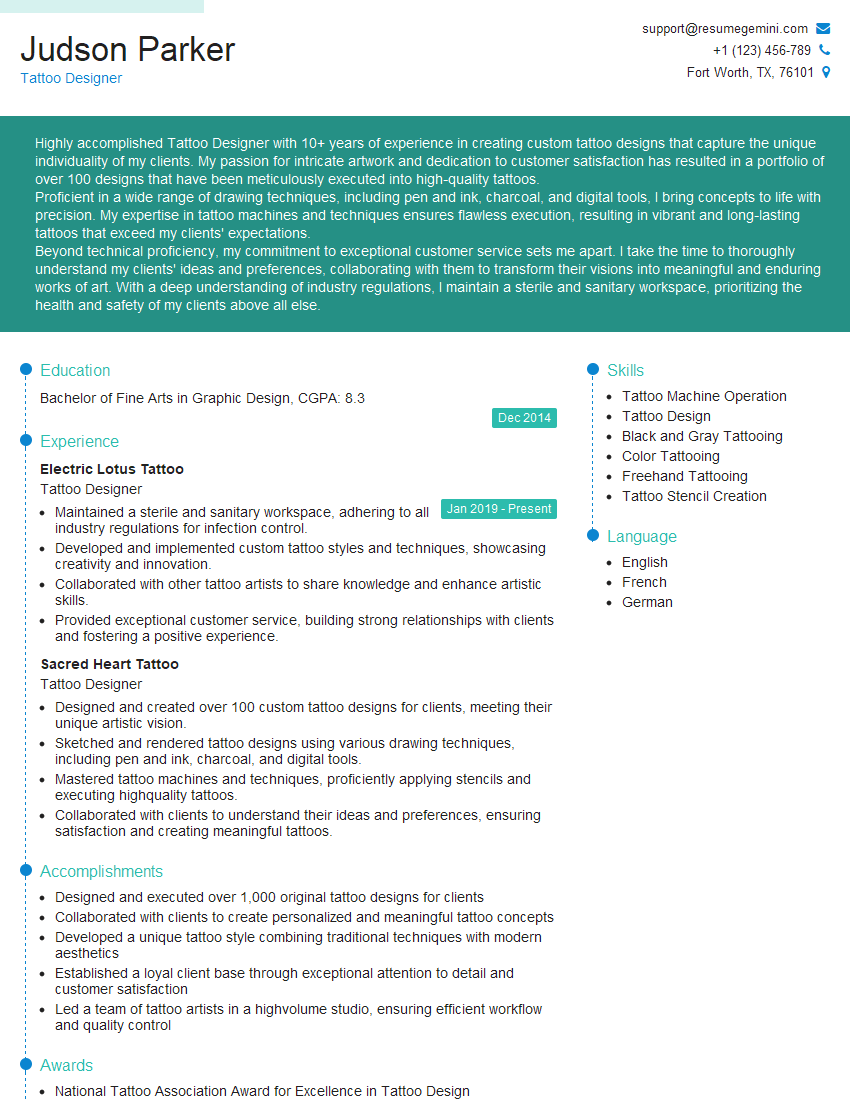
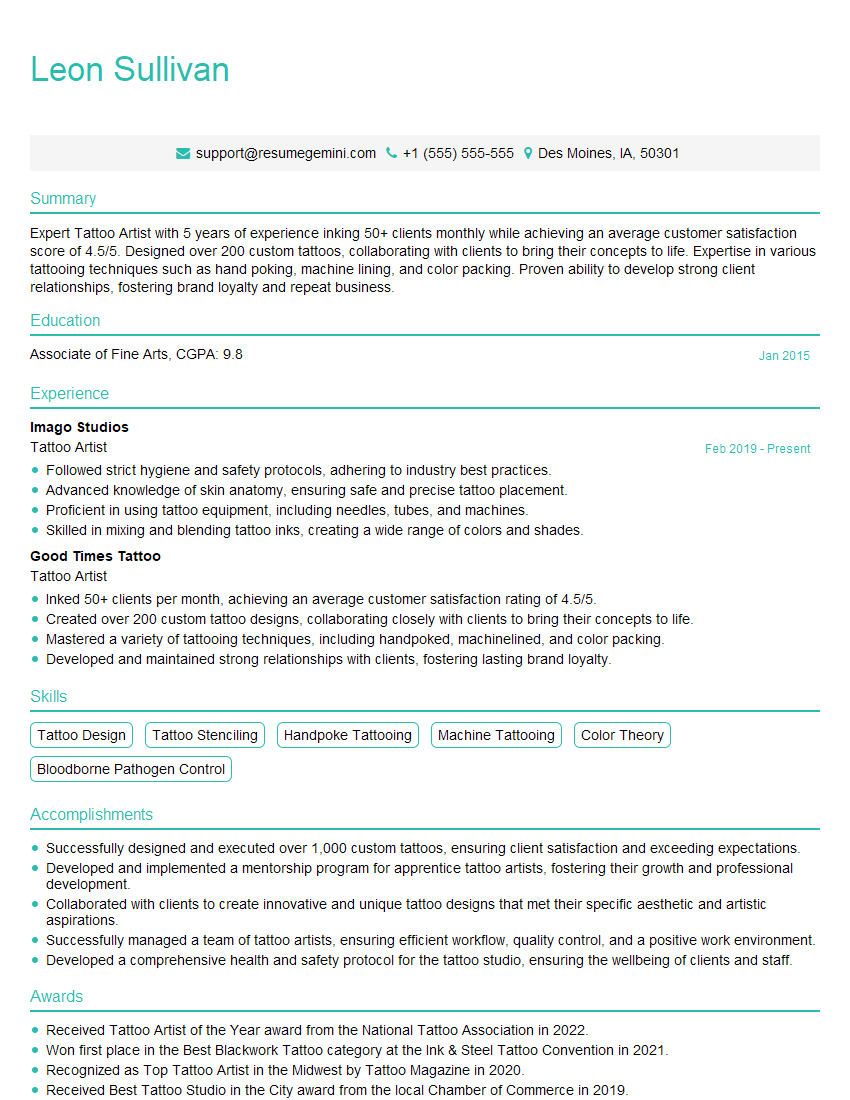
Mastering Tattoo Composition and Layout is crucial for a successful and rewarding career in the tattoo industry. It allows you to create stunning designs that meet client expectations and showcase your artistic talent. To enhance your job prospects, focus on creating an ATS-friendly resume that highlights your skills and experience effectively. ResumeGemini is a trusted resource that can help you build a professional resume tailored to the tattoo industry. Examples of resumes specifically designed for Tattoo Composition and Layout roles are available to guide you.
Explore more articles
Users Rating of Our Blogs
Share Your Experience
We value your feedback! Please rate our content and share your thoughts (optional).
What Readers Say About Our Blog
Very informative content, great job.
good