Cracking a skill-specific interview, like one for Teaching Figure Skating Skills, requires understanding the nuances of the role. In this blog, we present the questions you’re most likely to encounter, along with insights into how to answer them effectively. Let’s ensure you’re ready to make a strong impression.
Questions Asked in Teaching Figure Skating Skills Interview
Q 1. Describe your experience teaching various figure skating skills (e.g., jumps, spins, edges).
My experience in teaching figure skating encompasses a wide range of skills, from fundamental movements to advanced techniques. I’ve worked with students across various proficiency levels, guiding them through the intricacies of jumps (like axels, lutzes, and toe loops), spins (including upright, camel, and sit spins), and edge work (forward and backward inside and outside edges, three turns, and rockers). I break down complex movements into manageable steps, focusing on proper body alignment, technique, and edge control. For example, when teaching a jump, I start with building the necessary strength and conditioning in their legs and core, before moving onto mastering the approach, takeoff and landing. For spins, I start by building the base rotational skills before building on complexity and speed.
I’ve found that a strong foundation in basic skating skills is crucial before introducing more advanced techniques. A student who understands how to control their edges effectively will have an easier time learning jumps and spins. Similarly, a strong core and well-developed leg muscles contribute to higher jumps and faster spins.
Q 2. How do you adapt your teaching methods to different skill levels and learning styles?
Adapting my teaching methods to different skill levels and learning styles is paramount. I believe in a personalized approach. For beginners, I emphasize fundamental skills like balance, posture, and gliding, using positive reinforcement and simple, clear instructions. I often use visual aids like diagrams or videos to help them understand the concepts. For intermediate skaters, I incorporate more challenging drills and progressive exercises, focusing on refining technique and building endurance. Advanced skaters benefit from tailored programs that address their specific strengths and weaknesses, pushing them to refine their skills and develop their own styles. Learning styles also influence my approach; some learners thrive with hands-on demonstrations, others prefer detailed verbal explanations, and some respond best to visual learning aids like videos or charts. I use a blend of teaching methods to cater to diverse learners, for example, some students might learn best through visual demonstrations and others through detailed verbal instructions. I always provide feedback adjusted to the learner’s ability and learning preference.
Q 3. Explain your approach to correcting skating technique and providing constructive feedback.
Correcting skating technique and providing constructive feedback is a delicate balance. I focus on positive reinforcement, highlighting what the student is doing well before addressing areas needing improvement. I use precise, descriptive language, avoiding vague or discouraging comments. For instance, instead of saying “That jump was terrible,” I might say, “Your takeoff was a little rushed; let’s work on maintaining a smoother, more controlled approach.” I often use video analysis to show students their form and identify areas needing improvement. This allows the students to see their technique from an external perspective, promoting self-awareness and facilitating improvement. I also utilize drills and exercises targeting specific technical elements. For example, to improve edge control, we’d focus on exercises that emphasize proper edge placement and transitions between edges. Regular feedback sessions, both formal and informal, are crucial to monitor progress and adjust training plans accordingly.
Q 4. What safety measures do you implement during figure skating lessons?
Safety is my top priority. Before each lesson, I ensure the ice surface is clear of obstacles. I always have a first-aid kit readily available. Students are instructed to wear appropriate safety gear, including helmets (especially for younger skaters), and gloves. I supervise students closely, particularly during jumps and spins, ensuring they maintain adequate spacing and avoid collisions. I teach proper falling techniques to minimize the risk of injury and emphasize the importance of listening to their bodies and taking breaks when needed. I adapt the difficulty of exercises to each student’s skill level and physical condition, ensuring no one is pushed beyond their capabilities. Regular communication with parents or guardians is also important, ensuring they are aware of any potential risks and safety protocols.
Q 5. How do you create a positive and motivating learning environment for students?
Creating a positive and motivating learning environment is essential. I strive to make lessons fun and engaging, incorporating games and challenges to keep students interested. I celebrate successes, both big and small, fostering a sense of accomplishment and building confidence. Positive reinforcement and encouragement are key; I focus on the student’s progress and effort, rather than solely on performance outcomes. I build a rapport with each student, understanding their individual personalities and learning styles. Creating a supportive and collaborative environment, where students feel comfortable asking questions and learning from one another, is equally important. I often use small group learning to promote collaboration and skill development. I encourage students to set their own goals and celebrate their achievements, big or small. This fosters a sense of ownership and motivates them to continue improving.
Q 6. What is your experience with different age groups in figure skating instruction?
I have extensive experience working with various age groups, from young children (as young as 4 years old) to adults. Teaching younger children requires patience, creativity, and a playful approach. I use games, storytelling, and age-appropriate drills to maintain their engagement and build foundational skills. With teenagers, I focus on building independence and developing their own skating styles. Adult learners often have different goals, ranging from recreational skating to mastering specific techniques. My approach adapts to their individual needs and experience levels, emphasizing proper technique and injury prevention. Regardless of age, I always prioritize clear communication, positive reinforcement, and creating a supportive learning environment. My methods adapt based on developmental considerations: for example, I’ll be patient with a young child’s slower pace of learning, while older students are given more freedom and responsibility.
Q 7. How do you assess a student’s progress and adjust training plans accordingly?
Assessing a student’s progress is an ongoing process. I utilize a combination of methods, including regular observation of their skills in practice and informal testing to evaluate skills. This involves direct observation during lessons, video analysis, and regular performance evaluations, which help pinpoint both strength and areas for improvement. I also solicit feedback from students about their own perceived progress and challenges. This allows for more open dialogue and a better understanding of their overall experience. Based on these assessments, I adjust training plans accordingly. If a student is struggling with a particular skill, we might dedicate more time to drills and exercises targeting that specific area. Conversely, if they’re mastering a skill quickly, we can move on to more challenging techniques. This iterative process of assessment and adjustment ensures that training remains relevant, challenging, and rewarding for each student.
Q 8. Describe your experience with lesson planning and curriculum development for figure skating.
Lesson planning and curriculum development in figure skating require a multifaceted approach. I begin by assessing the student’s current skill level, age, and goals. This forms the foundation of a personalized curriculum. For beginners, the curriculum focuses on fundamental skills like balance, gliding, and basic strokes. As they progress, I incorporate more advanced techniques such as spins, jumps, and footwork sequences. I structure lessons progressively, introducing new skills only after mastering the prerequisites. My lesson plans utilize a blend of visual aids, drills, and games to keep students engaged and motivated. For example, I might use a video of a professional skater to demonstrate a particular jump, followed by drills on the ice to help them practice the technique. I also incorporate regular assessments through video analysis and feedback to track progress and adapt the curriculum as needed. This iterative process ensures that each student’s unique needs are addressed and that they continue to progress at an optimal pace.
Q 9. How do you handle student injuries or setbacks during lessons?
Student safety is paramount. When an injury occurs, my immediate response is to assess the situation and provide first aid if needed. I then communicate with the student’s parents or guardians, informing them of the injury and recommending a course of action. This might involve seeking medical attention or simply modifying the training regimen to accommodate the injury. For example, a minor ankle sprain might require reduced time on the ice and focusing on upper body strength training. I work closely with physical therapists or other medical professionals to ensure a safe and effective recovery plan. Setbacks, whether due to injury or other factors, are addressed through open communication and a modified training plan. We redefine short-term goals, emphasizing consistency and gradual progression. I always maintain a positive and supportive environment to maintain motivation during recovery.
Q 10. What resources and tools do you utilize for figure skating instruction?
My arsenal of resources and tools is diverse. On the ice, I use cones, pucks, and other training aids to create drills and exercises. Off the ice, I utilize video analysis software to meticulously review skating technique, identifying areas for improvement. This software allows for slow-motion playback and detailed frame-by-frame analysis. I also frequently employ music to enhance the learning experience, helping students develop rhythm and timing in their movements. Furthermore, I have access to various educational materials, including books, articles, and online courses, to stay updated on the latest coaching techniques and training methodologies. Collaboration with other coaches and professionals in the field provides additional support and insights. These resources together form a comprehensive approach to effective figure skating instruction.
Q 11. Describe your experience with coaching competitive figure skaters.
Coaching competitive figure skaters demands a high level of dedication and a comprehensive understanding of the sport. My experience encompasses working with skaters at various levels, from regional competitions to national championships. I emphasize not only the technical aspects of skating but also the mental and emotional preparation required for competition. This includes developing strategies for handling pressure, improving focus, and building confidence. I work closely with the skaters and their families to set realistic goals and create personalized training plans that consider their strengths, weaknesses, and individual timelines. We use data tracking to monitor progress and adapt training based on performance feedback. A key element is fostering a positive and supportive environment where the skaters feel comfortable taking risks and pushing their boundaries. It’s all about nurturing talent and developing well-rounded athletes.
Q 12. How do you manage student expectations and provide realistic goals?
Managing student expectations is a critical aspect of successful coaching. I begin by having an open conversation with each student and their parents to define realistic goals. We consider the student’s current skill level, their natural aptitude, and the available training time. I avoid setting unattainable expectations, instead focusing on incremental progress and celebrating small victories along the way. For example, instead of focusing solely on landing a triple axel, we might first focus on perfecting the entry and the takeoff. I maintain regular communication to provide updates on progress, address concerns, and adjust expectations as needed. This collaborative approach ensures that the student feels supported, motivated, and ultimately achieves their full potential. It’s all about empowering them to become confident and capable skaters.
Q 13. What is your philosophy on developing proper skating technique?
My philosophy on developing proper skating technique is built on a foundation of fundamental principles. This includes maintaining a strong posture, using efficient edge work, and coordinating movements smoothly. I emphasize correct body alignment and balance from the very beginning. Teaching proper technique is not just about learning the steps; it’s about understanding the biomechanics behind the movements. I use a combination of drills, visual demonstrations, and video analysis to refine each student’s technique. For example, we might use slow-motion video to analyze the timing of a spin entry and then work on drills to correct any imbalances. Consistent practice and focused feedback are key to building proper habits and avoiding the development of bad technique that can be difficult to correct later. It’s an ongoing process of refinement and improvement.
Q 14. How do you integrate physical conditioning into your figure skating training?
Physical conditioning is an integral part of figure skating training. I incorporate off-ice training to enhance strength, flexibility, and endurance. This includes exercises that target specific muscle groups used in skating, such as core strengthening, leg exercises, and plyometrics. We use various training methods including weights, resistance bands, and bodyweight exercises. Flexibility and balance training, using exercises like yoga and Pilates, are equally crucial to prevent injuries and improve performance on the ice. I design conditioning programs tailored to each skater’s individual needs and training goals. The integration of on-ice and off-ice training is a holistic approach, optimizing overall performance and injury prevention. This synergistic approach ensures that the skater is well-prepared physically and mentally for the demands of figure skating.
Q 15. What is your experience with different skating disciplines (e.g., freestyle, ice dance)?
My experience spans both freestyle and ice dance disciplines. In freestyle, I’ve worked with skaters from beginner levels, teaching fundamental skills like skating posture, edges, and jumps, all the way to advanced levels, assisting with perfecting triple jumps and complex spin combinations. My coaching in this area emphasizes technical precision and artistry. In ice dance, my focus is on the intricate footwork, partnering skills, and musical interpretation that are crucial for competitive success. I’ve helped many ice dance pairs develop their lifts, spins, and patterns, understanding the unique challenges of synchronicity and teamwork.
For example, I recently worked with a young freestyle skater who struggled with her Lutz takeoff. Through detailed video analysis and drills focusing on her upper body positioning and edge control, we successfully improved her jump technique. In another instance, an ice dance team I coached had difficulty with a challenging lift. We broke down the lift into smaller components, practicing each separately before putting it together, resulting in a clean and confident execution.
Career Expert Tips:
- Ace those interviews! Prepare effectively by reviewing the Top 50 Most Common Interview Questions on ResumeGemini.
- Navigate your job search with confidence! Explore a wide range of Career Tips on ResumeGemini. Learn about common challenges and recommendations to overcome them.
- Craft the perfect resume! Master the Art of Resume Writing with ResumeGemini’s guide. Showcase your unique qualifications and achievements effectively.
- Don’t miss out on holiday savings! Build your dream resume with ResumeGemini’s ATS optimized templates.
Q 16. How do you motivate students to continue practicing and improving their skills?
Motivation is key. I believe in fostering a positive and encouraging learning environment. I focus on celebrating small victories and setting achievable goals, building confidence along the way. This includes regular feedback, highlighting improvement rather than solely focusing on mistakes. I also incorporate elements of fun and creativity into training, using games and variations in drills to maintain enthusiasm. Individualized goal setting is vital; understanding each student’s aspirations, whether it’s mastering a specific jump or simply enjoying the sport, helps tailor the training to their needs and keep them motivated.
For instance, one of my students was initially intimidated by jumps. Instead of directly pushing her into them, we started with building her confidence on basic skills. Once she felt comfortable and competent, we gradually introduced jump elements, making the process enjoyable and less stressful. This led to a significant increase in her enthusiasm and overall progress.
Q 17. How do you communicate effectively with students and parents/guardians?
Clear and open communication is paramount. I maintain regular dialogue with students and parents/guardians, providing updates on progress, discussing challenges, and setting expectations. I utilize a variety of communication channels, including email, text messages, and in-person meetings, to ensure everyone is informed and feels heard. I always encourage questions and provide constructive feedback, focusing on solutions rather than solely pointing out problems. Active listening is crucial for understanding individual needs and concerns.
For effective parent communication, I send out regular progress reports and invite parents to observe lessons periodically. This transparency builds trust and enables collaborative problem-solving. Open communication builds a strong foundation for trust and ensures everyone is working toward the same goals.
Q 18. Describe your experience with using video analysis to improve skating technique.
Video analysis is an indispensable tool in my coaching arsenal. I regularly record lessons to provide students with visual feedback on their technique. Slow-motion playback allows us to pinpoint areas needing improvement, whether it’s posture, edge work, or jump takeoff. This visual approach helps students understand and correct their mistakes more efficiently than verbal instruction alone. Software like Dartfish or even simple smartphone apps can be used for basic analysis.
For example, by analyzing a video of a student’s spin, we can identify subtle flaws in their posture or edge control leading to instability. This allows for targeted drills to improve rotational speed and control. Video analysis can objectively demonstrate progress, boosting student motivation and providing a clear roadmap for improvement.
Q 19. What are your strengths and weaknesses as a figure skating instructor?
My strengths lie in my ability to build rapport with students, creating a supportive and encouraging learning environment. I’m patient, adaptable, and skilled at breaking down complex skills into manageable steps. My detailed attention to technique and my proficiency in using video analysis are also key assets. However, I’m always working on improving my skills in managing large group lessons efficiently and further refining my strategies for dealing with particularly anxious or highly competitive students. Continuous self-reflection and seeking feedback are important to address these areas.
Q 20. How do you maintain your professional development as a figure skating instructor?
Maintaining professional development is an ongoing commitment. I regularly attend workshops and conferences to stay abreast of the latest coaching techniques and training methodologies. I also actively seek out opportunities for mentorship and collaborate with other coaches to share best practices and learn from their experiences. Continuing education courses focusing on biomechanics, sports psychology, and injury prevention are also invaluable. Reviewing professional literature, such as coaching journals and articles, helps stay informed about the evolution of the sport.
Q 21. How do you deal with challenging or disruptive students?
Dealing with challenging or disruptive students requires a calm and consistent approach. I focus on understanding the root cause of the behavior, whether it’s frustration, boredom, or underlying issues. I use positive reinforcement and clear communication to set expectations and redirect behavior. Collaboration with parents/guardians may be necessary to address underlying issues affecting the student’s behavior. If the situation is severe or persistent, professional assistance may be sought.
For instance, if a student is consistently interrupting the lesson, I will address this calmly and directly, explaining the importance of respect for others’ learning time. If the disruption persists, I may involve the parent and explore solutions, perhaps by adjusting the lesson structure or incorporating strategies to help manage the student’s energy level more effectively. In extreme cases where the behavior negatively impacts other students, I would seek guidance from rink management or other professionals.
Q 22. Describe your experience with working in a team environment.
Throughout my career, I’ve consistently thrived in team environments. In my previous role at the Ice Palace Skating Academy, I collaborated closely with choreographers, other instructors, and the administrative staff. For example, we worked as a team to create a synchronized skating program for our advanced students, each of us contributing our specialized skills. I was responsible for the technical aspects, working alongside the choreographer to ensure the routines were both artistically engaging and technically sound. The success of that program, culminating in a regional championship win, was a direct result of our collective effort and effective communication. We regularly held meetings to discuss student progress, share teaching strategies, and coordinate schedules, ensuring a consistent and high-quality learning experience for all students.
Another example involves the planning and execution of our annual ice show. This involved coordinating costumes, music, stage setup, and the performance schedules of over 50 students, all requiring seamless teamwork and open communication. This collaborative approach fosters a positive and supportive learning environment for everyone involved.
Q 23. How do you handle pressure and manage time effectively?
Managing time and pressure effectively is crucial in this field. I utilize a detailed lesson planning system that allows me to allocate sufficient time to each student’s needs and skill level. I prioritize tasks based on urgency and impact, ensuring that critical elements like safety protocols and individual student goals are always addressed. For instance, I often have multiple students with different lesson times and skill levels scheduled throughout the day. To manage this effectively, I employ a digital calendar system that includes reminders for each lesson and associated preparations. This system allows me to move fluidly between lessons and prepare accordingly.
When under pressure, such as during a competition or a student’s crucial performance, I focus on clear communication and a calm demeanor to reassure the student and ensure their focus is where it needs to be. I often employ breathing exercises to help manage my own stress level and stay present. My experience has taught me that remaining calm under pressure allows me to make better decisions and support my students most effectively. Preparation is key to mitigating pressure; having well-defined lesson plans and pre-emptive solutions for common challenges is essential.
Q 24. What is your salary expectation for this position?
My salary expectation for this position is commensurate with my experience and expertise in figure skating instruction, coupled with my proven track record of success in training students of varying skill levels. I’m open to discussing a competitive salary range based on the specifics of the role and the organization’s compensation structure.
Q 25. What are your long-term goals as a figure skating instructor?
My long-term goals as a figure skating instructor involve continued professional development and the creation of a thriving and inclusive figure skating program. I aspire to mentor other instructors and contribute to advancing the sport through innovation and mentorship. I envision myself developing specialized programs, perhaps focusing on adaptive skating or incorporating cutting-edge technology into training. I would also like to contribute to the overall skating community by coaching competitive skaters to achieve their highest potential and inspiring the next generation of passionate figure skaters.
Q 26. Are you comfortable working evenings and weekends?
Yes, I am comfortable working evenings and weekends. I understand that flexibility is essential in this role, and I am happy to adjust my schedule to meet the needs of the students and the program.
Q 27. Describe a time you had to resolve a conflict with a student or parent.
I once had a conflict with a parent whose child was struggling to grasp a specific jump technique. The parent became frustrated, believing the child wasn’t receiving adequate attention or instruction. I listened empathetically to their concerns, acknowledging their perspective. I then explained, in detail, my teaching methodology, demonstrating how I was patiently tailoring the instruction to the child’s individual learning style and pace. I also showed the parent videos of past students who had mastered the same jump, highlighting the progressive steps involved and the time commitment it required. I reassured them that we were making progress and collaboratively set up a schedule for regular updates on their child’s progress. By actively listening and patiently explaining my approach, I was able to resolve the conflict, rebuilding trust and fostering a positive collaborative relationship with the parent.
Q 28. How would you handle a situation where a student is not progressing as expected?
If a student isn’t progressing as expected, my first step would be to carefully assess the situation. This involves reviewing their training progress, considering any physical limitations, emotional factors, or outside distractions that could be hindering their development. I would then adjust my teaching methods. This may involve breaking down complex skills into smaller, more manageable steps, incorporating alternative teaching techniques, or adjusting the intensity and frequency of training sessions. I would also closely observe their form, looking for subtle errors or areas requiring additional attention.
For example, if a student is struggling with spins, I might start by improving their posture and balance through off-ice exercises. I would also use visual aids like videos or diagrams to explain the proper technique. Open communication with the student is vital; I would create a safe space for them to express any anxieties or challenges they may be facing. If necessary, I’d consult with other professionals, such as a physical therapist or sports psychologist, to ensure a comprehensive and supportive approach to addressing the learning challenges.
Key Topics to Learn for Teaching Figure Skating Skills Interview
- Understanding Different Skill Levels: Knowing how to adapt your teaching style and curriculum for beginners, intermediate, and advanced skaters. This includes recognizing individual learning styles and pacing.
- Curriculum Development & Lesson Planning: Creating engaging and progressive lesson plans that incorporate fundamental skills, choreography, and skating techniques. This also includes assessing student progress and adjusting plans accordingly.
- Effective Communication & Instruction: Mastering clear and concise communication techniques, providing constructive feedback, and building rapport with students of all ages and abilities. Consider how you’ll address different learning styles and personalities.
- Safety Procedures & Risk Management: Implementing safety protocols on and off the ice, recognizing potential hazards, and responding appropriately to accidents or injuries. This includes understanding the importance of proper equipment and ice etiquette.
- Biomechanics & Technique Correction: Understanding the biomechanics of skating, identifying common technical flaws, and providing effective corrective feedback to improve skating technique and prevent injury. This requires a deep understanding of the physics behind skating.
- Ice Management & Logistics: Understanding ice scheduling, equipment management, and other logistical aspects of teaching figure skating. This may involve working with rink staff and managing multiple classes.
- Motivational Strategies & Student Engagement: Developing strategies to maintain student motivation, encourage positive learning behaviors, and foster a fun and supportive learning environment. This includes understanding how to celebrate successes and address challenges.
Next Steps
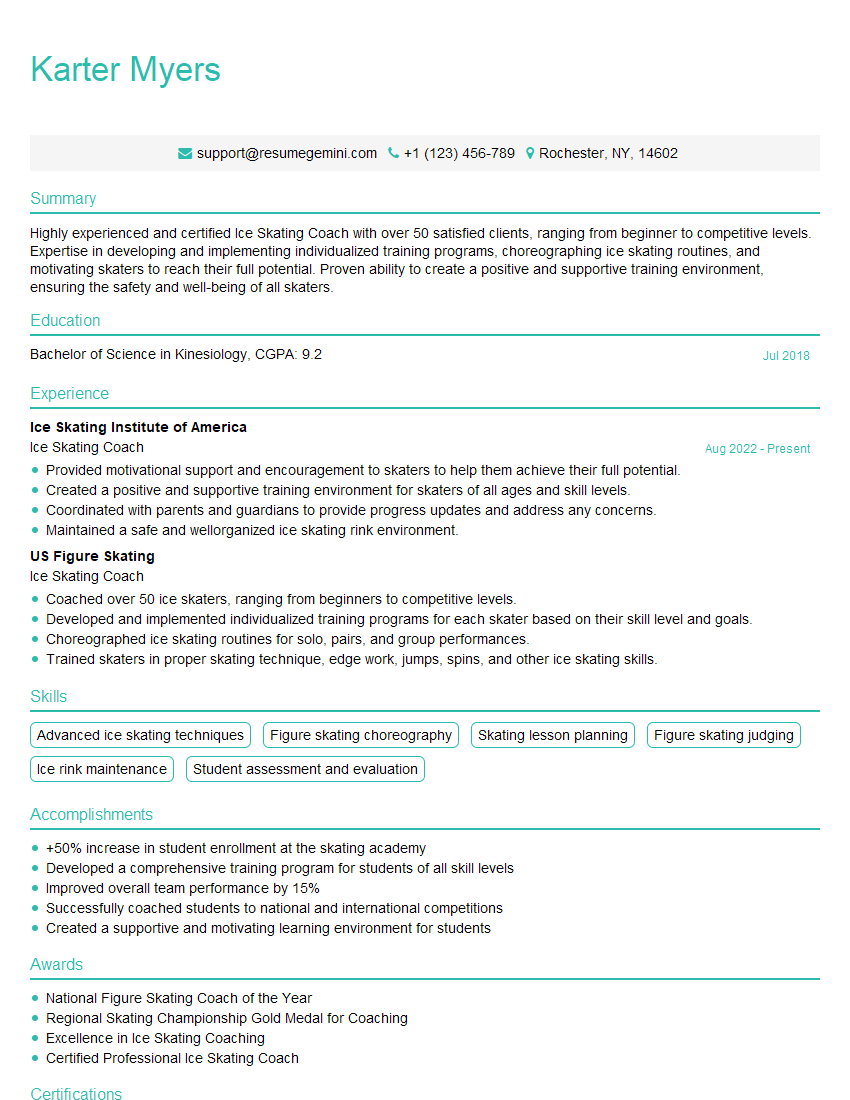
Mastering the art of teaching figure skating skills opens doors to a rewarding career filled with the joy of watching students grow and achieve their skating goals. To significantly boost your job prospects, crafting a compelling and ATS-friendly resume is crucial. ResumeGemini is a trusted resource that can help you build a professional resume that highlights your unique skills and experience. Examples of resumes tailored to Teaching Figure Skating Skills are available to help you get started.
Explore more articles
Users Rating of Our Blogs
Share Your Experience
We value your feedback! Please rate our content and share your thoughts (optional).
What Readers Say About Our Blog
Very informative content, great job.
good