The right preparation can turn an interview into an opportunity to showcase your expertise. This guide to Teaching Judo Techniques interview questions is your ultimate resource, providing key insights and tips to help you ace your responses and stand out as a top candidate.
Questions Asked in Teaching Judo Techniques Interview
Q 1. Explain the basic principles of Judo.
Judo, meaning “gentle way,” is based on several core principles. The most fundamental is maximum efficiency with minimum effort. This involves using your opponent’s weight and momentum against them, rather than brute strength. Another key principle is Kuzushi (breaking balance), which is the art of destabilizing your opponent before executing a technique. Tsukuri (fitting in) involves adapting your technique to your opponent’s posture and movement. Finally, Kake (applying the technique) is the decisive action of throwing or controlling your opponent. Think of it like a perfectly executed martial arts move in a movie – graceful, efficient, and powerful.
These principles underpin all aspects of Judo, from throwing techniques to grappling and groundwork. Mastering them leads to greater effectiveness and minimizes injury risk.
Q 2. Describe the different Judo throws (Nage-waza).
Judo throws (Nage-waza) are categorized into several groups based on the grip and the technique’s execution. Te-waza (hand techniques) use primarily hand grips to execute the throw. Koshi-waza (hip techniques) utilize the hips and legs for power. Ashi-waza (foot techniques) employ foot sweeps and trips. Sutemi-waza (sacrifice techniques) involve the thrower intentionally sacrificing balance to bring the opponent down. Finally, Atemi-waza (striking techniques), while not a primary focus in modern Judo competition, are still a crucial part of the self-defense aspects.
Examples include: Ippon-seoi-nage (one-hand shoulder throw – a Te-waza), Uchi-mata (inner thigh throw – a Koshi-waza), and O-goshi (major hip throw – a Koshi-waza). Each technique requires precise timing, balance, and the application of the Kuzushi principle.
Q 3. Detail the techniques of Judo grappling (Katame-waza).
Judo grappling (Katame-waza) involves controlling and subduing an opponent once they are on the ground. These techniques focus on achieving a dominant position and applying submissions (Kansetsu-waza – joint locks) or controlling holds (Shime-waza – strangulations). Katame-waza is crucial for securing victory in competition and for self-defense scenarios.
Key aspects include: achieving control of the opponent’s posture, securing a dominant position (e.g., mount, side control, guard), applying effective joint locks (e.g., arm bar, wrist lock, knee bar), and applying strangulations (e.g., rear naked choke, guillotine choke). It’s essential to understand the principles of leverage and pressure points to execute these techniques safely and effectively. Effective grappling also requires strong core strength, balance, and a deep understanding of body mechanics.
Q 4. Outline the importance of Judo etiquette (Reigi).
Judo etiquette (Reigi) is paramount, reflecting respect for the art, your training partners, and the dojo (training hall). It involves bowing upon entering and leaving the dojo, bowing to your sensei (instructor) and training partners before and after practice, and maintaining a respectful attitude throughout the training session. Proper bowing shows respect and humility, vital components of Judo’s philosophy.
Reigi also includes maintaining cleanliness of the dojo, showing patience and consideration towards other practitioners, and maintaining appropriate conduct both on and off the mat. It helps build a positive and respectful learning environment. This isn’t just about formalities; it’s about cultivating the character and discipline that are fundamental to Judo.
Q 5. How do you teach Judo to beginners?
Teaching Judo to beginners starts with building a strong foundation in basic movement, falls (Ukemi), and stances (Shisei). Ukemi is absolutely vital to avoid injuries; we begin with forward, backward, and side breaks, progressing to more complex breaks. Stances are taught to develop balance, stability, and the ability to move effectively. Basic grips (Kuzushi) are next, teaching the correct way to grip an opponent’s gi and maintain a strong grip during execution.
We then introduce fundamental throwing techniques, starting with simple ones like Tai-sabaki (body shifting) and Okuri-ashi-harai (sweeping foot throw). We focus on proper technique, safety, and correct body mechanics over speed or power. Drills focusing on Kuzushi are employed extensively. Throughout, we emphasize repetition, patience, and mutual respect.
Q 6. How do you adapt your teaching style to different age groups?
Adapting my teaching style to different age groups requires understanding their developmental stages and learning capabilities. With children, lessons are often more playful and game-based, focusing on fundamental movements, coordination, and building confidence. Simplicity and clear instructions are essential, along with positive reinforcement and encouragement. We use games and drills to keep them engaged and motivated. For adults, the approach is more technical and strategic, focusing on detailed explanations of techniques and their applications. I encourage adult students to be more actively involved in designing their training plan.
Teens require a balance – retaining the enthusiasm of children’s classes while introducing more technical complexity and the strategic aspects of the sport. Always, maintaining a safe and supportive environment is paramount across all age groups.
Q 7. How do you assess a student’s progress in Judo?
Assessing a student’s progress in Judo involves observing several key aspects. We observe their technical proficiency – accuracy, efficiency, and power in executing techniques. Their understanding and application of the basic principles (Kuzushi, Tsukuri, Kake) are carefully evaluated. We also assess their physical conditioning – stamina, strength, and flexibility. Mental preparedness – focus, discipline, and resilience – is equally important. Finally, their understanding and application of Reigi reflects their overall development as a Judoka.
Regular grading systems, often based on a syllabus, are common. However, regular feedback and one-on-one instruction provide essential insights into the areas needing improvement. I always tailor feedback to the individual’s skill level and learning style, creating a structured path for growth.
Q 8. What safety precautions do you emphasize during Judo training?
Safety is paramount in Judo. We begin each class with a thorough warm-up to prepare muscles and joints for training. This includes dynamic stretching and light cardio. Throughout the class, I emphasize controlled movements and proper execution of techniques. Falling safely is a crucial skill; we practice ukemi (breakfalls) extensively, focusing on distributing the impact across the body. Partners are encouraged to communicate during drills, indicating levels of exertion and any discomfort. We strictly enforce rules against dangerous techniques until students demonstrate a solid foundation. For example, we would never allow throws from a standing position until students can safely breakfall. Finally, appropriate mats and a clean training environment are essential to minimize the risk of injury.
Q 9. Explain the Judo ranking system (Kyu and Dan grades).
The Judo ranking system uses Kyu and Dan grades to denote proficiency. Kyu grades (beginner) are represented by numbers, starting from 6th Kyu (white belt) and progressing to 1st Kyu (often a brown belt). Each Kyu grade represents a level of understanding of fundamental techniques and basic Judo principles. Dan grades (black belt), on the other hand, symbolize mastery of Judo skills and techniques. These start from 1st Dan and go up to 10th Dan (the highest rank achievable). Each Dan grade signifies a deeper understanding and application of Judo’s principles, including strategic thinking, tactical skills, and mental discipline. Think of it like climbing a mountain – Kyu grades are the base camp and the ascent, while Dan grades represent summits of increasing difficulty.
Q 10. How do you manage disruptive behavior in a Judo class?
Managing disruptive behavior requires a multi-faceted approach. I start by understanding the root cause – is it boredom, frustration, or something else? For minor disruptions, a verbal reminder of class rules and expectations is usually sufficient. If the behavior persists, I might briefly pause the class to address the issue individually and redirect the student’s focus. Positive reinforcement is key; praising good behavior and participation helps create a more focused environment. In more severe cases, a brief time-out away from active participation, followed by a private conversation to understand their concerns, might be necessary. Maintaining a firm yet supportive demeanor consistently is crucial. This approach is similar to classroom management, adapting to the individual needs of the student.
Q 11. Describe your approach to correcting a student’s technique.
Correcting a student’s technique involves careful observation and positive feedback. I’ll first identify the specific error – is it in the grip, footwork, timing, or something else? Instead of solely criticizing mistakes, I demonstrate the correct technique, emphasizing the subtle nuances. I might use verbal cues like, “Remember to keep your weight centered,” or, “Engage your core more powerfully.” Hands-on correction might be needed, where I gently guide the student to feel the right movement and posture. Breaking down the technique into smaller, manageable steps is often helpful. I’ll use a combination of demonstrations and drills to solidify their understanding of the correct form. The aim is not only to correct the error but also to provide the student with the tools to self-correct in the future.
Q 12. How do you motivate students to improve their Judo skills?
Motivation is crucial in Judo. I strive to create a positive and encouraging atmosphere. Setting achievable goals is very important, starting with smaller milestones that build their confidence. Regular positive feedback and praise for improvement helps encourage consistent effort. I also incorporate elements of fun into training, making it enjoyable. Sparring provides a chance to test their skills and build confidence, and competitions (if the student chooses to participate) provide an external motivator. By creating a sense of community and camaraderie within the class, students can motivate each other. I share stories of Judo’s rich history and the values it teaches (respect, discipline, perseverance). Finally, I encourage them to track their own progress, showcasing improvements over time.
Q 13. What are common injuries in Judo and how do you prevent them?
Common Judo injuries include sprains, strains, and bruises. These are often caused by falls, throws, and grappling. Prevention is key. Proper warm-up exercises prepare the body for exertion. Correct execution of techniques minimizes the risk of injury. Careful practice of ukemi (breakfalls) is essential to mitigate the impact of falls. Gradual progression and building physical fitness help prevent overuse injuries. Regular breaks and hydration are also important. I reinforce the importance of listening to their bodies and stopping if they feel pain. A well-maintained training environment with appropriate mats and equipment also helps reduce injury risks. Finally, if an injury does occur, proper first aid and follow-up medical care are essential.
Q 14. How do you create a positive and encouraging learning environment?
Creating a positive learning environment is fundamental. This begins with establishing clear expectations and rules while promoting respect among students. A supportive environment fosters open communication and encourages asking questions. I emphasize teamwork and camaraderie, through partner drills and group activities. Celebrating both individual and group achievements creates a sense of shared success. Positive reinforcement and encouragement go a long way in boosting students’ confidence and motivation. This approach isn’t limited to the dojo—it’s a mindset that encourages a positive outlook in all aspects of life.
Q 15. Describe your experience teaching specific Judo techniques.
My experience teaching Judo techniques spans over 15 years, encompassing a wide range of skill levels from beginners to advanced competitors. I’ve focused on a systematic approach, starting with fundamental techniques like ukemi (breakfalls), shisei (posture), and basic throws such as seoi-nage (shoulder throw) and o-goshi (major hip throw). As students progress, I introduce more complex techniques, emphasizing proper execution, timing, and understanding of Kuzushi (breaking balance). For example, I’ve spent considerable time teaching the intricacies of asikubi (ankle locks) and osaekomi-waza (pinning techniques), carefully addressing safety and control aspects to prevent injury. I also tailor my instruction to individual student needs and learning paces, providing personalized feedback and drills.
I believe in a hands-on approach, demonstrating techniques multiple times, allowing students to practice with partners, and providing constructive criticism through detailed corrections. I regularly use video analysis to help students identify areas for improvement in their technique. My teaching philosophy emphasizes both the physical and mental aspects of Judo, fostering discipline, respect, and sportsmanship.
Career Expert Tips:
- Ace those interviews! Prepare effectively by reviewing the Top 50 Most Common Interview Questions on ResumeGemini.
- Navigate your job search with confidence! Explore a wide range of Career Tips on ResumeGemini. Learn about common challenges and recommendations to overcome them.
- Craft the perfect resume! Master the Art of Resume Writing with ResumeGemini’s guide. Showcase your unique qualifications and achievements effectively.
- Don’t miss out on holiday savings! Build your dream resume with ResumeGemini’s ATS optimized templates.
Q 16. How do you handle conflicts or disagreements among students?
Conflicts among students are handled with a focus on creating a respectful and supportive learning environment. My approach emphasizes open communication and conflict resolution. Firstly, I encourage students to resolve disagreements amongst themselves using respectful language and active listening. If this proves insufficient, I intervene by facilitating a discussion, helping students understand each other’s perspectives, and collaboratively seeking a solution that respects all involved. I stress that Judo is a martial art that teaches self-control and respect, and any conflict should be resolved in line with those values. Sometimes a brief timeout is needed to allow individuals to calm down before resuming the discussion. Serious or repeated incidents may require stricter disciplinary measures, including warnings and potentially suspension from class.
Q 17. Explain your understanding of Judo’s philosophical aspects.
Judo’s philosophical underpinnings are deeply rooted in the concept of Jita Kyoei – mutual welfare and benefit. It’s not simply about physical prowess; it’s about self-improvement, mutual respect, and the cultivation of character. The emphasis on bowing before and after practice highlights the importance of etiquette and respect for oneself, one’s partner, and the art itself. The rigorous training fosters discipline, perseverance, and mental fortitude. The concept of seiryoku zenyo (maximum efficiency, minimum effort) teaches students to use their energy wisely and effectively, both on and off the mat. In essence, Judo is a journey of self-discovery and personal growth, teaching valuable life lessons alongside physical skills.
Q 18. How do you incorporate Randori (free practice) into your curriculum?
Randori, or free practice, is an integral part of my curriculum and is introduced gradually. Beginners start with simple drills focusing on basic movements and throws, ensuring safety and a gradual increase in intensity. As students progress, Randori sessions become more complex, incorporating a wider range of techniques and strategies. I emphasize controlled sparring, promoting mutual respect and the safe practice of techniques. I actively supervise Randori sessions, offering guidance and corrections where needed. This allows for the application of learned techniques in a dynamic setting, fostering spontaneity and adaptability. The focus is not just on winning, but on refining technique, developing timing, and improving overall Judo skills.
Q 19. How do you teach students self-defense applications of Judo?
Teaching self-defense applications of Judo involves demonstrating how techniques can be used effectively in real-world situations. I focus on practical applications of throws, joint locks, and control holds. For instance, shihonage (shoulder throw) can be adapted for self-defense against a grab from the front. Certain pinning techniques are excellent for controlling an attacker. I emphasize situational awareness, de-escalation techniques, and the importance of self-control even under duress. Students also learn how to identify vulnerable points and how to defend against common attack scenarios. It is crucial to underscore the responsible use of Judo skills, emphasizing that self-defense is about protecting oneself and others, not aggression or violence.
Q 20. What are your strategies for teaching students with different learning styles?
Catering to diverse learning styles is crucial. I incorporate various teaching methods, including visual demonstrations, verbal explanations, physical practice, and written materials. For visual learners, I use diagrams and video analysis. For auditory learners, I provide clear and concise verbal instructions and explanations. Kinesthetic learners benefit from hands-on practice and repetitive drills. I also incorporate games and interactive activities to engage students with different learning preferences. Regular feedback and individual attention ensure that each student receives the support they need to succeed. This personalized approach optimizes learning outcomes and fosters inclusivity within the class.
Q 21. How do you ensure proper hygiene and sanitation in your Judo class?
Maintaining proper hygiene and sanitation is paramount. Before each class, the mats are thoroughly cleaned and disinfected using appropriate cleaning solutions. Students are required to shower before class and practice with clean gi (Judo uniforms). Footwear is not allowed on the mats. Hand sanitizer is readily available, and students are encouraged to use it frequently. I regularly inspect the training area for cleanliness and address any issues promptly. Any injuries or bleeding incidents are handled with appropriate first aid and disinfection procedures. A clean and safe training environment is crucial to prevent the spread of germs and minimize the risk of infection.
Q 22. Describe your experience with Judo competitions and coaching.
My Judo journey began as a competitor, participating in local, regional, and national tournaments for over 15 years. This experience provided invaluable insight into the strategic and tactical aspects of Judo, not just the technical execution. I achieved a national ranking in my weight class and earned my black belt. Transitioning to coaching, I’ve spent the last 10 years working with students of all ages and skill levels, from beginners to advanced competitors. I’ve coached numerous students to success in regional and national competitions, focusing on both technical skill and mental preparation. This blend of competitive experience and coaching allows me to connect deeply with students and understand their unique challenges.
Q 23. What resources do you use to stay updated on Judo techniques and best practices?
Staying current in Judo requires a multi-faceted approach. I regularly attend seminars and workshops led by renowned Judo instructors, both nationally and internationally. These events expose me to cutting-edge techniques and pedagogical approaches. I actively subscribe to Judo journals and online resources, scrutinizing articles and videos from experts around the world. Moreover, I maintain a professional network with fellow instructors, engaging in discussions and sharing best practices. This continuous learning ensures my teaching remains relevant and effective.
Q 24. How do you adapt your teaching to students with physical limitations?
Adapting to students with physical limitations is crucial. My approach is centered on individual assessment. I first identify the specific limitations, collaborating with students and, if necessary, medical professionals, to understand their capabilities. Then, I modify techniques to suit their needs, focusing on body mechanics and leverage rather than brute strength. For example, a student with limited mobility in one leg might learn modified versions of throws that rely less on leg sweeps and more on upper body grips and throws. It’s about finding alternative ways to achieve the same outcome, focusing on the principles of Judo rather than strict adherence to textbook techniques. It’s all about promoting safety and ensuring that the learning experience remains positive and productive.
Q 25. Describe your experience developing or modifying a Judo curriculum.
I’ve been fortunate to develop and modify Judo curriculums for different age groups and skill levels. One recent example involved creating a curriculum for a local school program. I started by analyzing existing programs and identifying areas for improvement. Then I structured the curriculum around a progressive system, starting with fundamental movements and gradually introducing more complex techniques. The curriculum emphasizes both the physical and mental aspects of Judo, including elements of self-defense, fitness training, and character development. The program also incorporates regular assessments to track student progress and adjust the curriculum accordingly. The success of this program, evidenced by increased student participation and improved skill levels, underscored the value of a well-structured and adaptable curriculum.
Q 26. How would you handle an emergency situation in a Judo class?
Safety is paramount. My Judo classes follow strict protocols to minimize the risk of injuries. However, unexpected situations can occur. I’ve received comprehensive first-aid and CPR training and ensure that at least one other qualified individual is present during all classes. My emergency plan includes immediate action to stabilize any injured student, contacting emergency services if necessary, and providing appropriate first aid until professional medical help arrives. Clear communication with parents or guardians is also a critical part of my procedure. The goal is always swift, effective response to ensure student safety and well-being.
Q 27. How do you assess and address the individual needs of your students?
I assess student needs through a combination of observation and feedback. During classes, I carefully watch each student’s performance, noting their strengths and weaknesses in terms of technique, balance, and overall understanding of the principles of Judo. I regularly solicit feedback, encouraging students to express their concerns and challenges. This two-pronged approach allows me to tailor my instruction to address individual needs. For example, a student struggling with a specific technique might receive individualized attention and drills, while a student who excels might be challenged with more advanced techniques or sparring opportunities. Regular progress reports and parent-teacher meetings further enhance this individualized attention.
Q 28. What is your approach to teaching Judo to students of different skill levels?
Teaching Judo to students of different skill levels requires a differentiated approach. I structure classes to include elements suitable for all levels. Beginners focus on fundamental movements and basic techniques, while more advanced students work on more intricate and refined techniques, strategy, and sparring. I use a layered approach, with clear instructions and demonstrations, ensuring everyone understands their current learning objective. I break down complex techniques into smaller, manageable steps. Group work and partner drills allow students to learn from each other, fostering a collaborative learning environment. Regular assessments ensure that students are progressing at their own pace and receive targeted instruction to address individual learning gaps.
Key Topics to Learn for Teaching Judo Techniques Interview
- Understanding Different Learning Styles: Adapt your teaching methods to cater to visual, auditory, and kinesthetic learners. Consider age and experience levels.
- Breaking Down Complex Techniques: Master the ability to dissect advanced Judo techniques into smaller, manageable steps for beginners. Illustrate with clear examples and analogies.
- Safety and Risk Management: Demonstrate a thorough understanding of safety protocols, injury prevention, and appropriate responses to accidents during training sessions.
- Curriculum Development and Lesson Planning: Explain your approach to structuring a Judo curriculum, incorporating progressive skill development and relevant assessment methods.
- Effective Communication and Instruction: Articulate your strategies for clear and concise instruction, incorporating verbal cues, demonstrations, and feedback mechanisms.
- Motivational Techniques and Classroom Management: Discuss your approaches to fostering a positive and engaging learning environment, managing student behavior, and inspiring progress.
- Adapting to Different Skill Levels: Explain how you would modify your teaching approach for students with varying levels of experience and physical capabilities.
- Assessing Student Progress: Describe methods for evaluating student understanding and skill acquisition, providing constructive feedback to facilitate improvement.
- Utilizing Demonstrations and Visual Aids: Explain how you effectively use demonstrations, videos, and other visual aids to enhance learning and understanding.
- Addressing Common Mistakes and Providing Corrective Feedback: Articulate your approach to identifying and addressing common mistakes in Judo techniques, offering constructive and specific feedback.
Next Steps
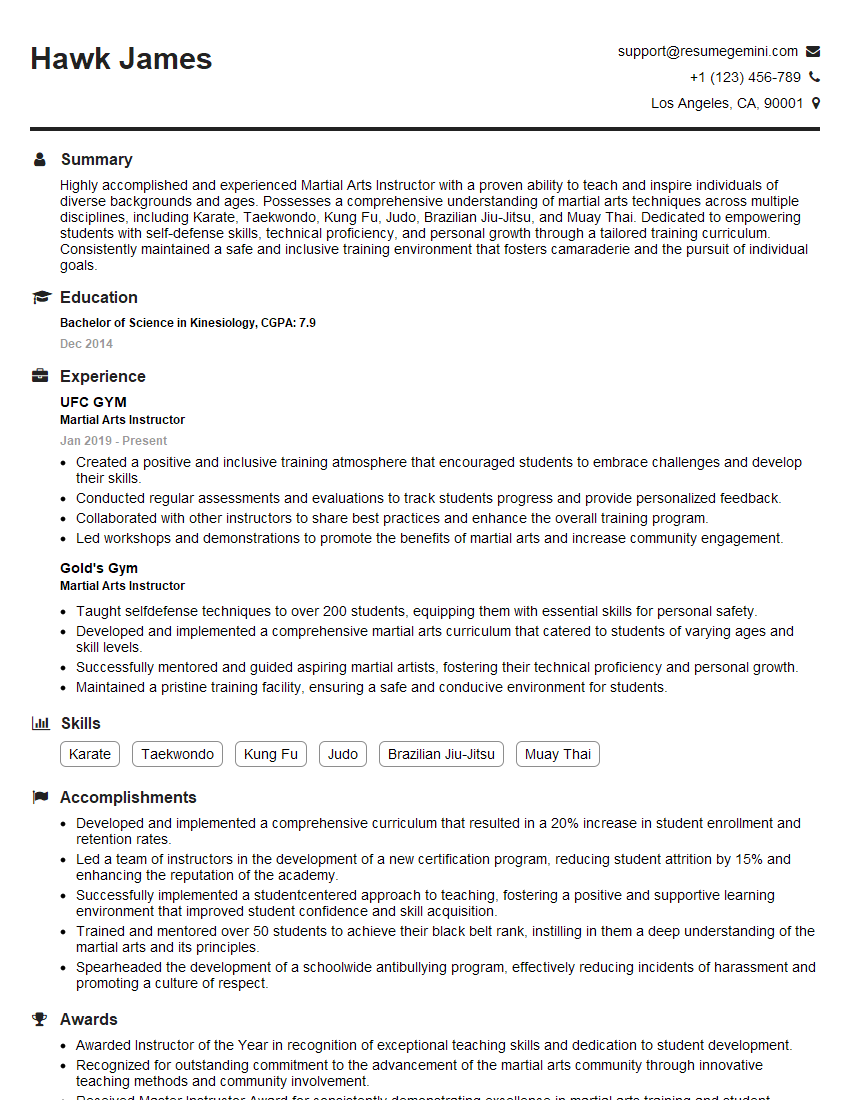
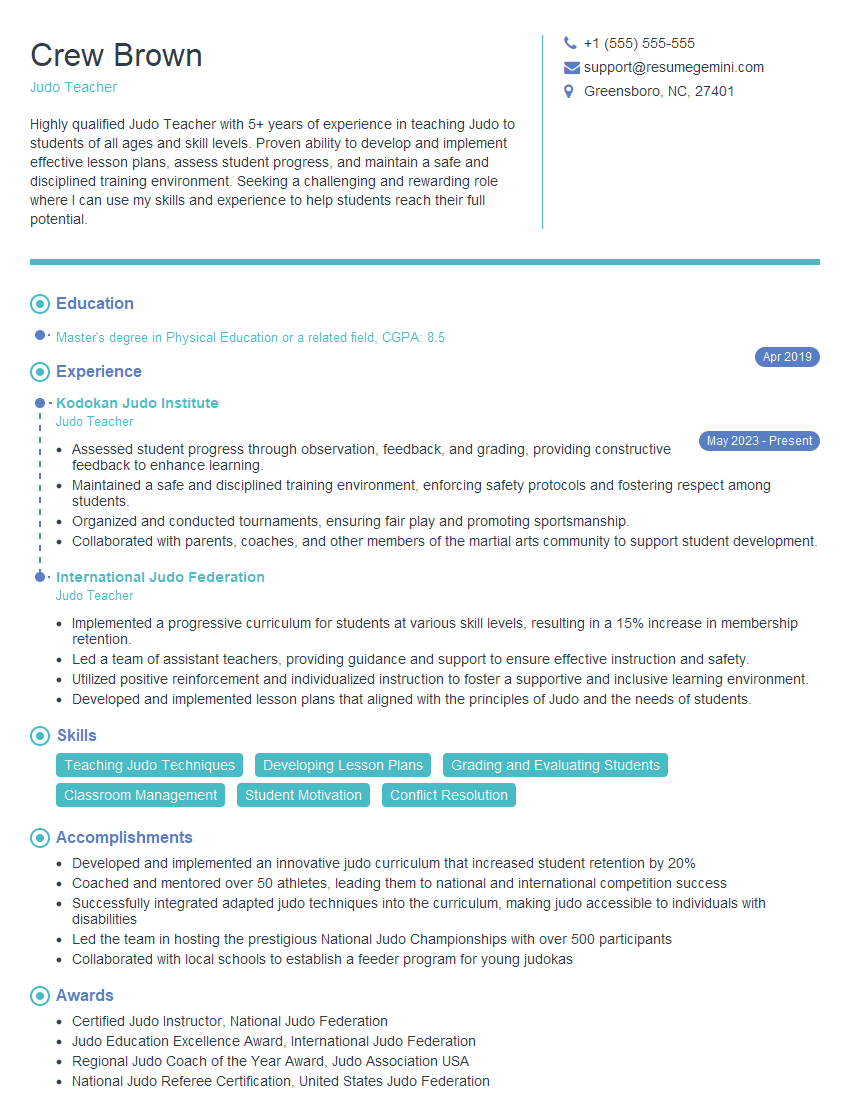
Mastering the art of teaching Judo techniques is crucial for career advancement in the martial arts field. It demonstrates not only your technical expertise but also your pedagogical skills and ability to inspire others. To significantly enhance your job prospects, creating a compelling and ATS-friendly resume is paramount. ResumeGemini is a trusted resource that can help you build a professional and effective resume, tailored to highlight your unique skills and experience. Examples of resumes specifically designed for Teaching Judo Techniques positions are available to guide you.

Explore more articles
Users Rating of Our Blogs
Share Your Experience
We value your feedback! Please rate our content and share your thoughts (optional).
What Readers Say About Our Blog
Very informative content, great job.
good