Feeling uncertain about what to expect in your upcoming interview? We’ve got you covered! This blog highlights the most important Technical Knowledge of Avionics and Radar Systems interview questions and provides actionable advice to help you stand out as the ideal candidate. Let’s pave the way for your success.
Questions Asked in Technical Knowledge of Avionics and Radar Systems Interview
Q 1. Explain the principles of radar signal processing.
Radar signal processing involves manipulating the signals received by a radar system to extract meaningful information about the targets being detected. This is a multi-stage process, starting with the transmitted signal and ending with the display of target data.
It begins with signal transmission, where a carefully crafted electromagnetic pulse is sent out. When this pulse encounters a target, a portion of it is reflected back to the radar receiver. The received signal is then extremely weak and buried in noise, necessitating several processing steps.
Signal reception and amplification is the next stage. The extremely faint reflected signal is captured by the receiver antenna and amplified to a usable level. This amplified signal is then subjected to noise reduction techniques. Think of this as filtering out the static to hear the message clearly. These techniques range from simple averaging filters to sophisticated adaptive algorithms, eliminating unwanted noise while preserving valuable signal information.
Pulse compression, if used, increases the range resolution by compressing the long transmitted pulses into shorter, higher-resolution pulses. Next comes matched filtering, which correlates the received signal with a replica of the transmitted signal to optimize the signal-to-noise ratio and improve target detection.
Target detection involves identifying signals that exceed a certain threshold, indicating the presence of a target. Algorithms for this stage are crucial; false alarms need to be minimized while ensuring all genuine targets are detected.
Finally, the processed data is used to extract parameters like target range, velocity, and angle. This information is then displayed on a radar screen or integrated into a larger system, allowing operators to interpret and act upon the detected information.
For example, in air traffic control, sophisticated signal processing algorithms distinguish between aircraft and birds, minimizing false alarms. In weather radar, signal processing helps differentiate between different types of precipitation.
Q 2. Describe different types of radar systems and their applications.
Radar systems are categorized based on various factors, including the type of signal used, the scanning method, and the application.
- Primary Radar: This type of radar transmits its own signal and receives the reflection from the target. It’s commonly used in air traffic control and weather forecasting. Think of it like shouting and listening for an echo.
- Secondary Radar: This system relies on transponders in aircraft to respond to interrogation signals from the radar. It provides more accurate identification and altitude information. This is like having a conversation with the target.
- Pulse Radar: This is the most common type, transmitting short bursts of electromagnetic energy. The time it takes for the signal to return indicates the target’s range.
- Continuous Wave (CW) Radar: This radar continuously transmits a signal, and the Doppler effect is used to measure the target’s velocity. This is very useful for measuring speed but not range directly.
- Doppler Radar: This radar uses the Doppler effect to measure the radial velocity of targets. It’s commonly used in weather radar to detect wind speed and direction.
- Synthetic Aperture Radar (SAR): This radar uses signal processing techniques to create a high-resolution image of the ground from an airborne platform. It’s extensively used in mapping and reconnaissance.
Applications of these radars span various fields: air traffic control uses primary and secondary radar to track aircraft; weather radar employs Doppler radar to monitor precipitation; military applications utilize SAR for reconnaissance and target acquisition. Each type is best suited for specific tasks, depending on the required accuracy and information needed.
Q 3. What are the key components of a typical avionics system?
A typical avionics system encompasses a range of interconnected subsystems that support various aircraft functions, from navigation and communication to flight control and engine management. The core components include:
- Flight Management System (FMS): This is the brain of the operation, providing navigation, flight planning, and performance monitoring capabilities. It integrates data from various sources and helps pilots efficiently manage the flight.
- Navigation Systems: These include GPS, inertial navigation systems (INS), and radio navigation systems (VOR, ILS), providing position, heading, and other navigational information.
- Communication Systems: These enable communication between the aircraft and ground control, other aircraft, and passengers. They include VHF, HF, and satellite communication systems.
- Autopilot: This system automates flight control functions, relieving pilot workload during long flights or during critical phases of flight.
- Flight Control Systems: These systems manage the aircraft’s flight surfaces, ensuring stability and maneuverability.
- Displays: These display crucial flight parameters and navigational information to the pilots, usually through sophisticated electronic displays (EFIS).
- Air Data System: This system measures parameters like airspeed, altitude, and outside air temperature. It provides data used by other avionics systems.
- Engine Monitoring Systems: These systems monitor engine parameters like thrust, temperature, and fuel consumption, providing alerts for potential engine issues.
The integration of these systems is crucial, ensuring seamless data flow and coordinated operation. For example, the FMS uses data from the air data system and navigation systems to compute optimal flight paths. Modern avionics systems rely heavily on data bus architectures, allowing for efficient data exchange between the components.
Q 4. How does GPS work and what are its limitations?
The Global Positioning System (GPS) relies on a network of satellites orbiting the Earth that transmit radio signals containing precise time and location information. A GPS receiver on the ground or in an aircraft receives these signals from multiple satellites, and by measuring the time it takes for the signals to arrive, it can calculate its position using trilateration (determining a location using the distances from three or more known points).
Limitations of GPS include:
- Signal Blockage: Buildings, trees, and even atmospheric conditions can weaken or block GPS signals, leading to loss of accuracy or signal loss.
- Multipath Errors: Signals reflecting off surfaces can reach the receiver at slightly different times, causing inaccuracies in position calculations.
- Atmospheric Delays: The ionosphere and troposphere can delay the signal, causing errors in the calculation of the distance to the satellite.
- Selective Availability (SA): While no longer active, SA intentionally degraded the accuracy of GPS signals for civilian users.
- Spoofing and Jamming: Malicious actors can transmit false GPS signals to mislead receivers or completely jam the signals.
Despite its limitations, GPS is incredibly accurate for most applications, providing position information with errors typically less than a few meters. However, in situations demanding high accuracy, augmentations such as Differential GPS (DGPS) or Wide Area Augmentation System (WAAS) are employed to correct for some of the errors.
Q 5. Explain the concept of air traffic control radar systems.
Air Traffic Control (ATC) radar systems play a vital role in managing air traffic safely and efficiently. These systems use radar technology to track the position, altitude, and velocity of aircraft within a certain airspace. Primary surveillance radar is used to detect aircraft and determine their position and track. Secondary surveillance radar utilizes transponders aboard aircraft to enhance accuracy and gain additional information, such as altitude and aircraft identity.
The data collected by ATC radar systems is displayed on radar screens in air traffic control towers and centers. Controllers use this information to guide aircraft, separate them safely, and coordinate their movements. They must handle many aircraft simultaneously. The system incorporates several features such as:
- Target Identification: Displays information about each aircraft, like flight number and altitude.
- Conflict Alert: Automatically alerts controllers about potential conflicts between aircraft.
- Weather Information Overlay: Shows weather information, such as precipitation and storms, allowing controllers to plan around these hazards.
- Data Link Communication: Allows for automated data exchange between controllers and aircraft.
ATC radar systems rely on sophisticated signal processing techniques to filter out noise and accurately track aircraft. The accuracy and reliability of these systems are crucial for ensuring aviation safety.
Q 6. Describe different types of aircraft navigation systems.
Aircraft navigation systems use a variety of technologies to determine and maintain position, heading, and track, including:
- Inertial Navigation Systems (INS): These systems use gyroscopes and accelerometers to measure the aircraft’s movements and calculate its position. They work independently of external signals, but their accuracy degrades over time due to drift.
- Global Navigation Satellite Systems (GNSS): These include GPS, GLONASS, Galileo, and BeiDou, providing precise position information via satellite signals.
- Radio Navigation Systems: These systems use ground-based radio beacons to provide navigational guidance. Examples include VHF Omnidirectional Range (VOR), Instrument Landing System (ILS), and Distance Measuring Equipment (DME).
- Area Navigation (RNAV): This system allows aircraft to navigate along predefined routes using GPS or other navigation systems. It offers flexibility in flight planning and allows for more efficient routes.
- Required Navigation Performance (RNP): This specifies the required navigation performance needed for a specific flight procedure, ensuring a high level of accuracy and safety.
The choice of navigation system depends on the specific mission requirements. For long-haul flights, GNSS is often preferred for its accuracy and wide coverage. In more challenging environments, or when GNSS is unavailable, INS or radio navigation systems might be used in conjunction with others.
Q 7. What are the challenges in integrating new avionics systems into existing aircraft?
Integrating new avionics systems into existing aircraft presents several challenges:
- Certification: Meeting stringent safety and regulatory requirements for new avionics installations is a time-consuming and costly process. This involves rigorous testing and documentation to ensure compliance.
- Compatibility: Ensuring compatibility between the new system and the existing avionics suite is crucial. Different systems might use different data protocols or interfaces, potentially causing communication problems.
- Weight and Space Constraints: Aircraft have limited weight and space capacity. Adding new avionics systems may require careful consideration of weight and space limitations.
- Power Requirements: New systems require sufficient power, which may necessitate upgrading the aircraft’s power system.
- Software Integration: Integrating software from various vendors requires careful planning and coordination, ensuring smooth interoperability.
- Maintenance: Training maintenance personnel to handle the new system is also crucial. The availability of spare parts needs to be considered.
- Cost: Upgrading avionics can be a significant expense, including the cost of hardware, software, certification, installation, and training.
Overcoming these challenges requires careful planning, collaboration between different stakeholders, and rigorous testing procedures. Proper risk management and adherence to industry standards are essential to ensure a successful integration process.
Q 8. Explain the importance of redundancy in avionics systems.
Redundancy in avionics systems is paramount for safety and reliability. It’s the practice of incorporating multiple, independent systems to perform the same function. If one system fails, another takes over seamlessly, preventing catastrophic events. Think of it like having a backup generator for your home – if the primary power fails, the backup kicks in.
For example, an aircraft might have two independent flight control computers. If one malfunctions, the other automatically assumes control. This redundancy is critical because a single point of failure in a flight-critical system could lead to an accident. The level of redundancy varies depending on the criticality of the system; safety-critical systems like flight controls have a higher degree of redundancy than less critical systems.
- Increased safety: Redundancy significantly reduces the risk of system failures leading to accidents.
- Improved reliability: Even if one component fails, the system continues to function.
- Enhanced maintainability: Allows for scheduled maintenance of one system while the other remains operational.
Q 9. How do you troubleshoot a malfunctioning avionics component?
Troubleshooting a malfunctioning avionics component is a systematic process that requires a methodical approach. It begins with a thorough understanding of the system’s architecture and the component’s function. Here’s a step-by-step process:
- Identify the symptom: Pinpoint the specific problem. Is there an error message? Is an indicator light illuminated? What is the aircraft’s response?
- Consult documentation: Refer to technical manuals, schematics, and troubleshooting guides for the specific avionics component.
- Perform visual inspection: Check for obvious physical damage, loose connections, or corrosion.
- Use built-in test equipment (BITE): Many avionics components have self-diagnostic capabilities that provide error codes and fault indications.
- Employ external test equipment: Use specialized tools like multimeters, oscilloscopes, and logic analyzers to measure voltages, signals, and data.
- Isolate the fault: Use the information gathered to narrow down the possible causes of the malfunction. Is it a hardware or software issue? Is it a single component failure, or is there a broader systems problem?
- Repair or replace: Once the fault is identified, repair or replace the faulty component. Follow all safety procedures and ensure proper grounding and handling of sensitive equipment.
- Verify functionality: After repair or replacement, thoroughly test the system to ensure it is working correctly.
Remember, safety is paramount. If unsure about any step, consult with experienced technicians or engineers.
Q 10. What are the different types of radar waveforms?
Radar systems use various waveforms to optimize performance for different applications. The choice of waveform depends on factors like the desired range resolution, target detection capabilities, and clutter rejection performance.
- Simple pulse: This is the most basic waveform, consisting of a single pulse of radio frequency (RF) energy. It’s easy to generate and process, but has limited range and velocity resolution.
- Pulse-Doppler: This waveform uses pulses with varying frequencies to measure both range and Doppler shift (velocity) of targets. It’s excellent for moving target indication (MTI) and weather radar.
- Chirp pulse: This waveform uses a pulse with a linearly increasing or decreasing frequency. It allows for pulse compression, which improves range resolution without sacrificing power.
- Frequency-modulated continuous wave (FMCW): This waveform uses a continuous signal with a continuously varying frequency. It’s particularly useful for short-range applications and precision measurements.
- Phase-coded waveforms: These use sequences of pulses with carefully chosen phases to improve range resolution and clutter rejection through pulse compression techniques.
Q 11. Explain the concept of pulse compression in radar systems.
Pulse compression is a signal processing technique used in radar systems to improve range resolution while maintaining high transmitted power. It works by transmitting a long duration pulse with a specific frequency modulation (like a chirp) and then correlating the received signal with a replica of the transmitted waveform.
Imagine sending a long, drawn-out musical note. Instead of being a single frequency, it’s slightly changing its frequency over time (the ‘chirp’). The receiver ‘listens’ for this specific chirp. When it detects a matching chirp reflected from a target, it’s like focusing a powerful magnifying glass on the return signal, making it stand out from the noise. This allows you to distinguish targets that are very close together, even with a long pulse length (that provides strong transmission power).
This improves range resolution because the effective pulse duration is much shorter than the transmitted pulse duration, allowing for finer distinctions in range. The overall transmitted power remains high, resulting in better detection capabilities compared to using a short, low power pulse that would give the same range resolution.
Q 12. Describe different types of antenna used in radar systems.
Radar systems employ various antenna types, each with its strengths and weaknesses:
- Paraboloidal reflector antenna: This is the most common type, using a parabolic dish to focus the RF energy into a narrow beam. They offer high gain and directivity, crucial for long-range detection.
- Horn antenna: A simple, relatively inexpensive antenna type with a wide beamwidth, often used in short-range applications or as a feed for larger reflector antennas.
- Array antenna: This antenna consists of multiple radiating elements arranged in a specific pattern. By controlling the phase and amplitude of the signal fed to each element, the beam can be steered electronically, eliminating the need for mechanical movement.
- Slot antenna: These antennas use slots cut into a conducting surface to radiate energy. They are often found on aircraft, due to their low profile and aerodynamic design.
- Microstrip patch antenna: These planar antennas are compact and lightweight, often used in airborne and spaceborne radar systems.
Q 13. How does clutter rejection work in radar systems?
Clutter rejection is a crucial aspect of radar system design. Clutter refers to unwanted radar echoes from objects like ground, buildings, weather, and birds. These echoes can mask or obscure the targets of interest.
Several techniques are used for clutter rejection:
- Moving Target Indication (MTI): This technique uses the Doppler shift to distinguish between moving targets (aircraft) and stationary clutter (ground). By filtering out signals with low Doppler shifts, MTI enhances the visibility of moving targets.
- Space-time adaptive processing (STAP): This advanced technique uses both spatial and temporal processing to suppress clutter. It’s particularly effective in dealing with ground clutter in airborne radar applications.
- Clutter map: A digital map of the surrounding environment, created from previous scans, is used to predict and subtract clutter echoes from subsequent scans.
- Polarization filtering: Using different polarization of the transmitted and received signal can help to discriminate clutter from targets, exploiting their different polarization properties.
The effectiveness of clutter rejection depends on the specific environment and radar system design. For example, in airborne radar, STAP techniques are extremely useful in minimizing ground clutter, which often overwhelms the return from targets.
Q 14. Explain the concept of target tracking in radar systems.
Target tracking in radar systems involves estimating the position and velocity of a target over time, based on a series of radar measurements. It’s a critical function for many radar applications, such as air traffic control, missile guidance, and weather forecasting.
Several algorithms are used for target tracking, including:
- Kalman filter: This is a widely used recursive algorithm that estimates the target’s state (position and velocity) by combining predictions from a dynamic model with noisy radar measurements. It’s effective in handling noisy data and updating the track continually.
- Alpha-beta filter: A simplified version of the Kalman filter, suitable for applications with limited computational resources.
- Nearest neighbor tracking: This simpler method associates each new measurement with the closest existing track. It’s less robust than Kalman filtering, but computationally less expensive.
The complexity of the tracking algorithm depends on the application. For example, tracking a single aircraft in clear conditions may only require a simple alpha-beta filter, while tracking multiple targets in a complex environment (like a battlefield) requires a more advanced algorithm such as a multiple-model Kalman filter or a more complex data association approach.
Q 15. What are the different types of electronic warfare techniques?
Electronic Warfare (EW) encompasses techniques used to exploit, disrupt, or protect against the use of the electromagnetic spectrum in military operations. It’s essentially a battle fought with radio waves and other electromagnetic energy. There are three main branches:
- Electronic Support (ES): This involves passively receiving and analyzing electromagnetic emissions from enemy systems. Think of it as electronic reconnaissance – listening in on enemy communications and radar signals to gather intelligence. For example, detecting the radar signals from an enemy missile system to determine its location and capabilities.
- Electronic Attack (EA): This is the offensive side of EW, involving actively jamming or disrupting enemy systems. This could be jamming a radar system to prevent it from tracking friendly aircraft, or disrupting enemy communications to hinder coordination. An example would be deploying chaff (metallic strips) to confuse enemy radar systems.
- Electronic Protection (EP): This focuses on protecting friendly systems from enemy EA. This involves techniques like using countermeasures to defeat enemy jamming, or employing stealth technologies to reduce the radar cross-section of a target. Stealth aircraft, for instance, utilize EP to reduce their visibility to radar.
These three branches often work together in a coordinated manner. For instance, ES might identify an enemy radar, EA would then jam it, and EP ensures that friendly systems are protected during the attack.
Career Expert Tips:
- Ace those interviews! Prepare effectively by reviewing the Top 50 Most Common Interview Questions on ResumeGemini.
- Navigate your job search with confidence! Explore a wide range of Career Tips on ResumeGemini. Learn about common challenges and recommendations to overcome them.
- Craft the perfect resume! Master the Art of Resume Writing with ResumeGemini’s guide. Showcase your unique qualifications and achievements effectively.
- Don’t miss out on holiday savings! Build your dream resume with ResumeGemini’s ATS optimized templates.
Q 16. What are the safety regulations and certifications relevant to avionics?
Avionics safety regulations and certifications are crucial for ensuring the safety and reliability of aircraft systems. They are primarily overseen by bodies like the Federal Aviation Administration (FAA) in the United States and the European Union Aviation Safety Agency (EASA) in Europe. Key regulations and certifications include:
- DO-178C (Software Considerations in Airborne Systems and Equipment Certification): This standard dictates the software development processes required for avionics systems, particularly those critical for flight safety. It outlines various levels of safety integrity, with higher levels requiring more stringent development and verification processes.
- DO-254 (Design Assurance Guidance for Airborne Electronic Hardware): Similar to DO-178C, but for the hardware aspects of avionics systems. It specifies the requirements for hardware design, development, verification, and validation.
- RTCA/DO-160G (Environmental Conditions and Test Procedures for Airborne Equipment): This standard defines the environmental conditions that avionics equipment must withstand, including temperature extremes, vibration, humidity, and electromagnetic interference. Manufacturers must demonstrate compliance through rigorous testing.
Certifications are then awarded based on compliance with these standards. For instance, a flight control system would need to meet the requirements of DO-178C at a high integrity level and DO-254. These certifications are not only vital for safety but also for the legal operation of the aircraft.
Q 17. How does ADS-B technology work?
Automatic Dependent Surveillance-Broadcast (ADS-B) is a surveillance technology that enhances situational awareness in air traffic management. It relies on GPS for precise positioning and broadcasts this information, along with other data, to ground stations and other aircraft. Here’s how it works:
- GPS Positioning: The aircraft’s GPS receiver determines its precise latitude, longitude, altitude, and speed.
- Data Transmission: This data is then transmitted via radio signals on specific frequencies, using a dedicated ADS-B transponder.
- Ground Station Reception: Ground stations receive these broadcasts and integrate the data into their air traffic control systems, providing real-time tracking of aircraft.
- Aircraft-to-Aircraft Communication: ADS-B also allows for aircraft-to-aircraft communication, improving awareness of nearby traffic. This is particularly beneficial in areas with limited ground-based radar coverage.
ADS-B offers significant improvements over traditional radar systems by providing more precise and continuous surveillance, enhancing safety and efficiency in air traffic management. Imagine a scenario where traditional radar might have gaps in coverage; ADS-B fills these gaps with the aircraft transmitting their data directly. This is particularly helpful for smaller aircraft that might not always be picked up on traditional radar.
Q 18. Explain the role of TCAS in air traffic management.
Traffic Collision Avoidance System (TCAS) is an onboard system designed to prevent mid-air collisions. It’s an automated system that alerts pilots to potential conflicts and provides instructions to avoid collisions. TCAS doesn’t replace air traffic control, but it acts as a crucial backup system.
TCAS works by using interrogators and transponders. Aircraft equipped with TCAS transponders send out periodic signals indicating their position and altitude. Other aircraft equipped with TCAS receivers (interrogators) pick up these signals and process them to detect potential conflicts. If a threat is detected, the system issues alerts (visual and audible) and provides resolution advisories (RA) to the pilots, such as “Climb” or “Descend.” These advisories are prioritized based on the severity of the threat.
Imagine two aircraft on a potential collision course. Both aircraft have TCAS; the system on each aircraft independently assesses the threat and provides appropriate advisories. This ensures that even if one aircraft’s air traffic controller is not aware of the situation, the TCAS systems will alert the pilots and provide instructions to prevent the collision.
Q 19. Describe the principles of inertial navigation systems.
Inertial Navigation Systems (INS) determine an aircraft’s position, velocity, and orientation without relying on external references like GPS. They achieve this using highly sensitive accelerometers and gyroscopes, which measure acceleration and rotation, respectively. The core principle lies in integrating these measurements over time to compute position.
Imagine a tiny, incredibly precise plumb bob inside the system. The accelerometers measure how quickly the ‘plumb bob’ is changing its velocity. This is integrated to find the change in position. The gyroscopes measure the orientation of the ‘plumb bob’, preventing the calculations from being skewed if the platform rotates. This integrated measurement is constantly updated. However, errors accumulate over time, leading to a phenomenon called ‘drift.’ This drift is then typically corrected using external reference systems like GPS, creating an integrated INS/GPS system.
INS is particularly valuable when GPS signals are unavailable or unreliable, such as in challenging environments or during military operations where GPS spoofing is a threat. However, it’s important to understand the inherent limitations of INS and the necessity of periodic corrections.
Q 20. What is the difference between active and passive radar systems?
The key difference between active and passive radar systems lies in how they detect targets:
- Active Radar: Active radar systems emit their own electromagnetic signals (radio waves) and then receive the signals reflected back from the target. The time taken for the signal to return, and the strength of the reflection, are used to determine the target’s range and other characteristics. Think of it like shouting and listening for an echo. Most weather radars and air traffic control radars are active systems. Examples include primary and secondary surveillance radars.
- Passive Radar: Passive radar systems don’t emit their own signals. Instead, they receive and analyze electromagnetic radiation emitted by other sources, such as radio and television broadcasts, or even radar signals emitted by other systems. By analyzing the changes in these signals as they reflect off a target, they can detect and track the target. It’s like listening to a conversation, and inferring something about the speakers’ position from subtle changes in their voices.
Active radar systems have the advantage of being able to detect targets regardless of whether they’re emitting their own signals, but they’re also easier to detect and jam. Passive radar systems are harder to detect and jam but have the limitation that they need an existing emitter of electromagnetic waves. Each has its own advantages and disadvantages, leading to their use in different applications.
Q 21. Explain the concept of synthetic aperture radar (SAR).
Synthetic Aperture Radar (SAR) is a sophisticated radar technique that uses signal processing to create a high-resolution image of the ground from an airborne or spaceborne platform. Unlike conventional radar, which uses a physical antenna of fixed size, SAR creates a ‘synthetic’ antenna by combining multiple radar signals acquired as the platform moves along a track.
Imagine taking many pictures of the same area from slightly different angles as you move along a path. By combining these images using clever algorithms, you can create a composite image with much higher resolution than any individual picture could provide. This is essentially what SAR does. The motion of the platform acts like a large antenna, resulting in a significantly improved resolution and quality in the produced imagery.
SAR is incredibly useful for creating high-resolution maps of the Earth’s surface, regardless of weather conditions or time of day, because it emits its own signals. It’s widely used in applications such as Earth observation, mapping, disaster relief, and military surveillance.
Q 22. Describe different types of communication systems used in avionics.
Avionics communication systems are diverse, categorized broadly by their function and range. They ensure seamless data exchange between various onboard systems and ground stations. Key types include:
- VHF/UHF Communication: Used for voice communication between the aircraft and air traffic control (ATC). Think of it like a radio for pilots. VHF operates in the very high frequency range (30-300 MHz) for shorter ranges, while UHF (300 MHz – 3 GHz) extends the range, crucial for long-haul flights or satellite communication.
- Satellite Communication (SATCOM): This enables communication over vast distances, connecting aircraft with ground stations even over oceans. Think global phone calls and internet access at 30,000 feet! It relies on geostationary or low-earth orbit satellites acting as relays.
- Data Link Communication (Datalink): This system facilitates the digital exchange of non-voice data, like weather updates, flight plans, and aircraft position information. It’s like sending text messages between the aircraft and ATC, significantly enhancing safety and efficiency. Examples include ADS-B (Automatic Dependent Surveillance-Broadcast) and CPDLC (Controller-Pilot Data Link Communications).
- Aircraft Area Navigation (RNAV): RNAV uses GPS and other navigation aids to enable precise navigation, allowing aircraft to fly specific routes more efficiently. The communication here is primarily the exchange of navigation data with ground-based systems and the onboard GPS receiver.
- Air-to-Ground Data Links: These systems transmit telemetry and diagnostic data from the aircraft to maintenance facilities for real-time monitoring and troubleshooting. It’s like a remote health check for the aircraft.
Q 23. How does data bus communication work in avionics systems?
Data bus communication in avionics is the backbone of the system, connecting numerous electronic units (sensors, actuators, computers) within the aircraft. This eliminates the need for point-to-point wiring, reducing weight and complexity. Popular architectures include:
- ARINC 429: A digital serial data bus using a master-slave architecture. It’s relatively simple and widely used for transmitting single data words (e.g., airspeed, altitude). Think of it as a one-way street for data.
- AFDX (Avionics Full-Duplex Switched Ethernet): A high-speed, deterministic Ethernet-based network that supports both high-bandwidth and low-latency data transfers. This is like a sophisticated highway with multiple lanes, allowing faster and more complex data exchange.
- CAN bus (Controller Area Network): A multi-master serial communication bus offering efficient, robust communication with relatively low cost and complexity. It is used in a variety of automotive and industrial applications, and some avionics applications where high speed and deterministic performance are not critical.
These buses employ protocols to ensure data integrity and prevent collisions. Data is packetized and transmitted according to defined schedules, with error detection and correction mechanisms built-in. Consider how a simple request for altitude information from the altimeter might travel across the AFDX bus, processed by the flight management system, and displayed to the pilot.
Q 24. What are the challenges of designing for electromagnetic compatibility (EMC) in avionics?
Designing for Electromagnetic Compatibility (EMC) in avionics is exceptionally challenging due to the densely packed electronics, high-power systems, and sensitive equipment operating within a confined space. Key challenges include:
- EMI (Electromagnetic Interference): Multiple systems generate electromagnetic fields that can interfere with each other. For instance, a malfunctioning engine sensor might emit spurious signals that interfere with the navigation system’s GPS reception.
- Susceptibility to external interference: Avionics systems must be resilient to external sources of EMI, such as lightning strikes, static electricity, and radio frequency emissions from ground-based sources. The aircraft can act as an antenna!
- Environmental factors: High altitudes, extreme temperatures, and vibrations can impact the EMC performance of avionics systems. For example, temperature extremes might alter the impedance of components, causing EMI or susceptibility.
- Safety implications: EMI-induced malfunctions can have catastrophic consequences, potentially compromising flight safety. The robustness of the systems and protective measures are paramount.
Mitigation strategies involve careful circuit design, shielding, filtering, grounding, and robust testing according to stringent standards like DO-160. The process requires expertise in electromagnetic theory and practical experience in EMC testing and design.
Q 25. Explain the importance of flight testing in avionics development.
Flight testing is crucial in avionics development to verify the functionality, performance, and safety of the systems in their operational environment. It bridges the gap between simulation and real-world operation.
- Validation of functionality: Flight tests verify that systems perform as intended under various flight conditions, such as different altitudes, speeds, and maneuvers.
- Performance assessment: They provide real-world data on system performance parameters (e.g., accuracy of navigation systems, reliability of communication links), that might be difficult to assess through simulation alone.
- Safety verification: Flight testing helps identify potential hazards and safety-critical issues, allowing for necessary design modifications before the system is deployed on a larger scale. This is especially crucial for safety-critical components.
- Integration testing: It is in flight tests that you ensure all systems integrate correctly with one another and interact as expected.
Flight tests often involve a staged approach, starting with ground tests, followed by low-altitude and high-altitude flights. The data collected is meticulously analyzed to validate design assumptions and confirm compliance with regulatory requirements.
Q 26. How do you ensure the reliability and maintainability of avionics systems?
Ensuring reliability and maintainability of avionics systems is paramount for safety and cost-effectiveness. Strategies include:
- Redundancy and fault tolerance: Employing redundant systems or components means that if one fails, a backup takes over, preventing system failure. Think of it as having a spare tire in your car.
- Built-in self-tests (BIST): These automated tests detect faults early on, allowing for prompt corrective action. It’s like your car’s check engine light.
- Modular design: Using modular systems makes maintenance easier because faulty modules can be replaced quickly without impacting the entire system. Think of it like replacing a broken piece in Lego.
- Diagnostics and prognostics: Advanced diagnostic tools and predictive maintenance techniques identify potential issues before they lead to failures. This is similar to preventative maintenance on your car.
- Design for manufacturing and testing: Carefully designed manufacturing processes and rigorous testing procedures are critical to ensure quality and reliability from the start.
- Use of high-reliability components: Selecting components with proven track records and adhering to strict quality control protocols are necessary.
These measures not only enhance safety but also reduce maintenance costs and downtime.
Q 27. Describe your experience with specific avionics or radar systems.
During my previous role at [Company Name], I was deeply involved in the development and integration of the [System Name] avionics suite for the [Aircraft Type] aircraft. My contributions focused on the design and testing of the [Specific Subsystem, e.g., communication system]. This involved working closely with a team of engineers, including software, hardware, and systems engineers, to meet stringent safety and performance requirements. I was responsible for [Specific tasks, e.g., developing the communication protocol, verifying system performance through simulation and testing]. I gained valuable experience in [Specific technologies, e.g., ARINC 429, AFDX, DO-178C software development]. In another project, I worked with a weather radar system, focusing on signal processing algorithms to improve target detection and accuracy in challenging weather conditions.
Q 28. Describe a challenging problem you solved related to avionics or radar systems.
One particularly challenging problem I encountered involved integrating a new GPS receiver into an existing avionics system. The initial integration resulted in intermittent data dropouts. After exhaustive troubleshooting, including simulations, hardware checks, and analysis of communication logs, we discovered that the issue stemmed from a timing incompatibility between the new receiver and the existing data bus protocol. The receiver’s internal clock had a slight jitter, resulting in missed data packets. The solution involved a multi-pronged approach. First, we examined the existing protocol specification in detail to understand the timing requirements. Second, we modified the receiver’s firmware to improve clock synchronization. Third, we added buffer memory to the interface to help handle the timing discrepancies more robustly. This required a close collaboration with the receiver vendor and extensive testing to verify the resolution. After implementing the solution, the system performed reliably and met all certification requirements.
Key Topics to Learn for Technical Knowledge of Avionics and Radar Systems Interview
Ace your upcoming interview by focusing on these key areas within Avionics and Radar Systems. Understanding both the theory and practical applications will significantly boost your confidence and showcase your expertise.
- Radar Fundamentals: Explore different radar types (e.g., primary, secondary, Doppler), signal processing techniques, and target detection algorithms. Consider practical applications like weather radar or air traffic control systems.
- Avionics Systems Integration: Understand the interconnectedness of various avionics systems (e.g., navigation, communication, flight control) and how they interact to ensure safe and efficient flight operations. Think about troubleshooting scenarios and system failures.
- Navigation Systems: Master the principles of inertial navigation systems (INS), GPS, and other navigation aids. Be prepared to discuss their limitations and how they complement each other.
- Communication Systems: Familiarize yourself with various communication systems used in aviation, including VHF, UHF, and satellite communication. Consider the challenges of reliable communication in different environments.
- Flight Control Systems: Gain a solid understanding of flight control principles, including autopilots, flight augmentation systems, and their role in enhancing flight safety and efficiency.
- Data Acquisition and Processing: Explore the methods used to acquire, process, and interpret data from various sensors and systems within an aircraft. Consider data visualization and interpretation techniques.
- Troubleshooting and Problem-Solving: Develop your ability to diagnose and resolve technical issues related to avionics and radar systems. Practice approaching problems systematically and logically.
- Safety Regulations and Standards: Understand relevant safety regulations and standards governing avionics and radar systems. This demonstrates your commitment to safe operation.
Next Steps
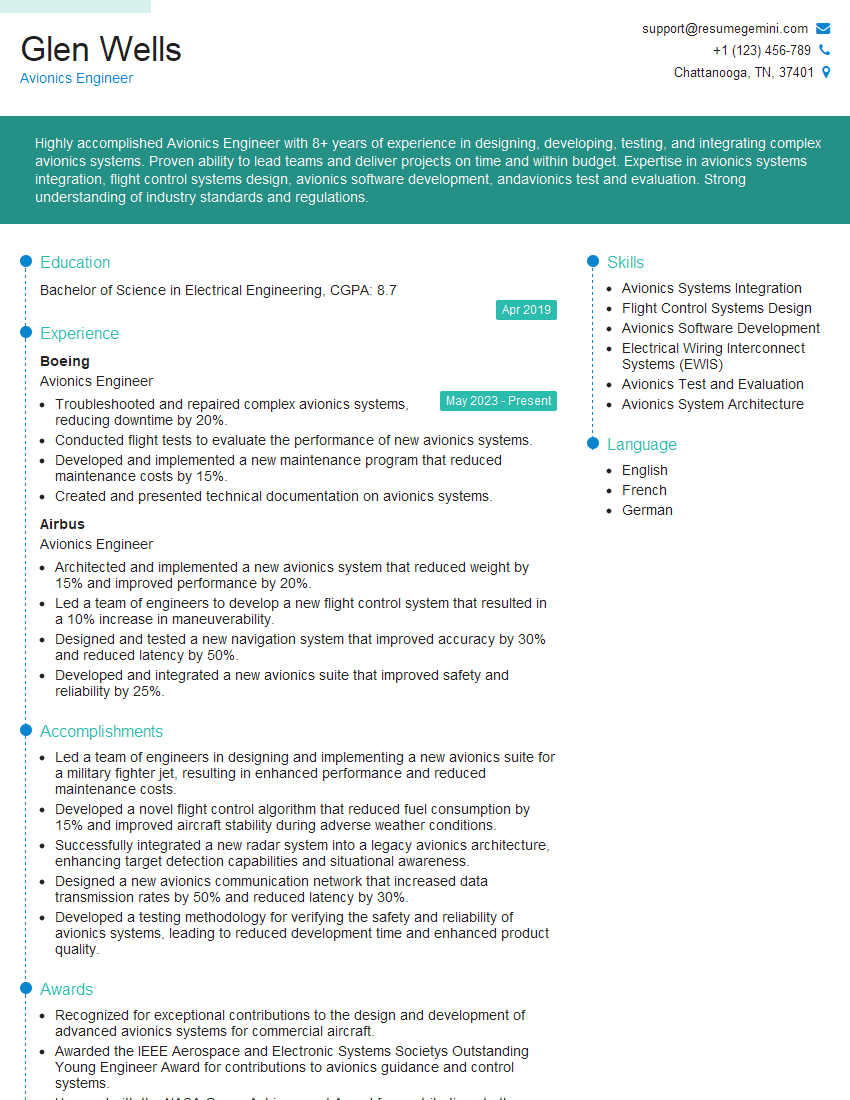
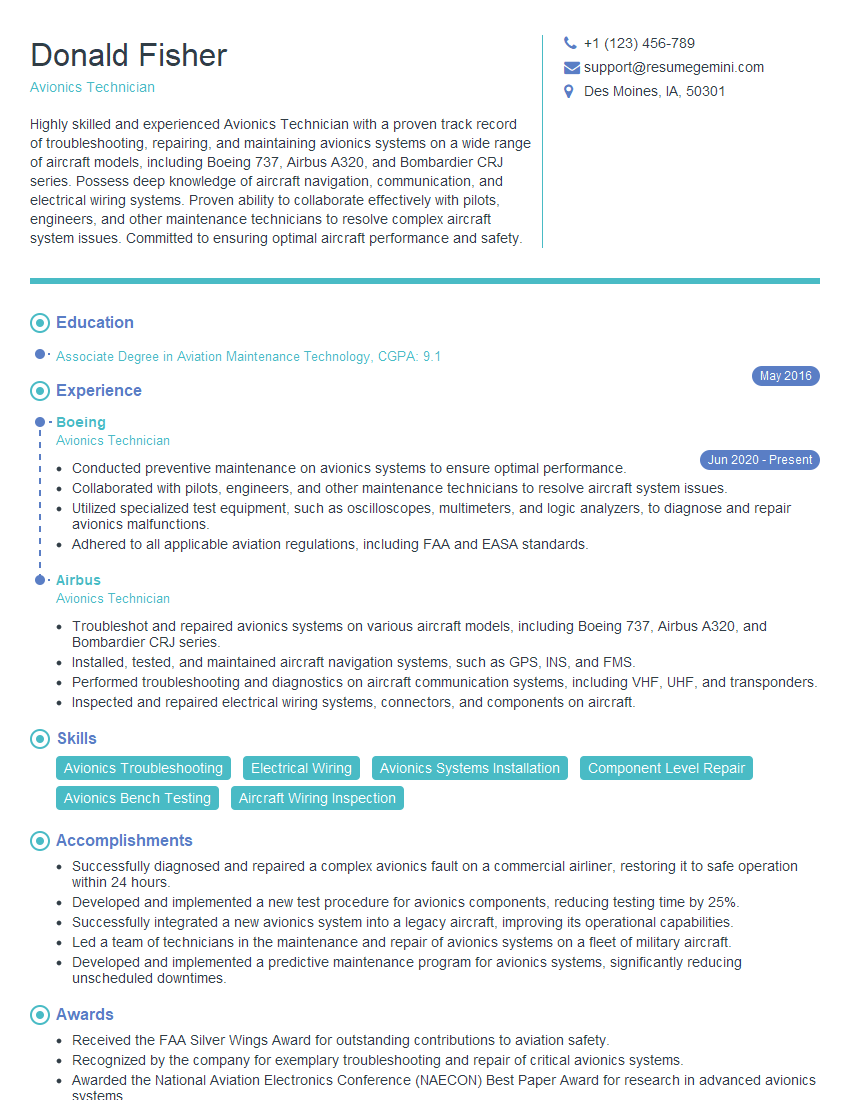
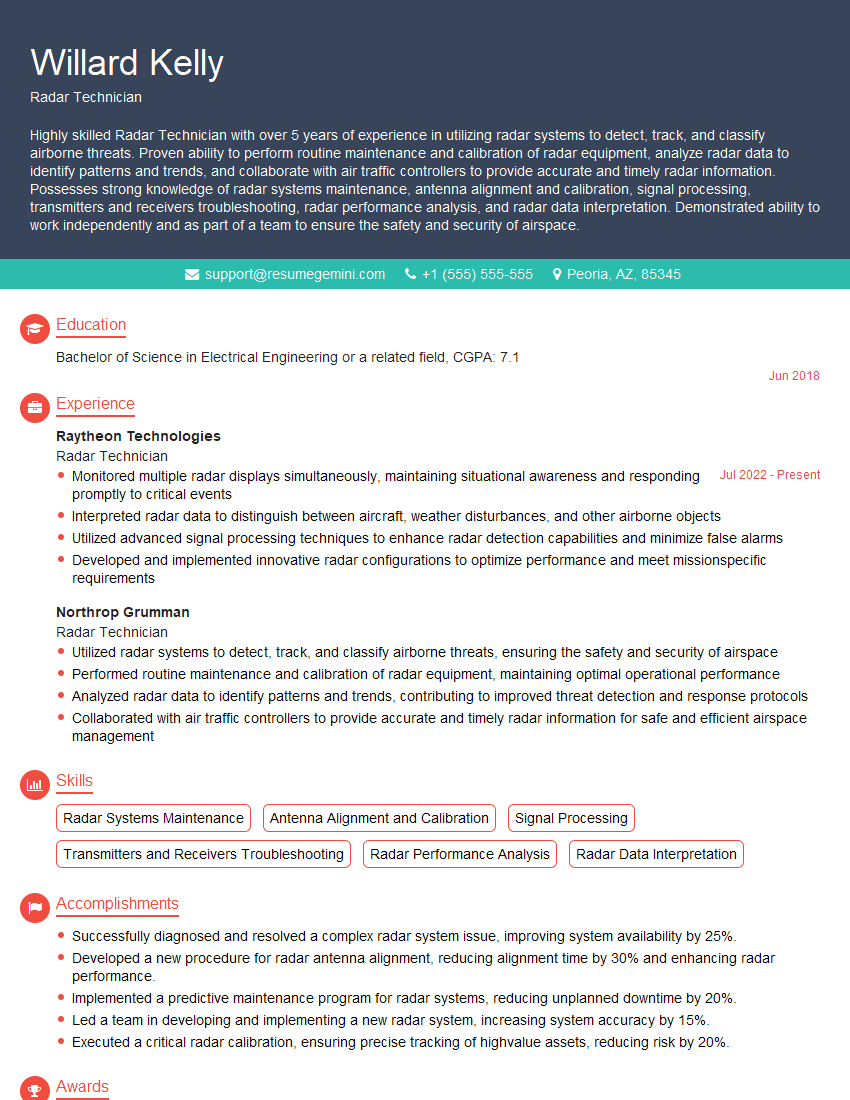
Mastering the technical knowledge of Avionics and Radar Systems is crucial for career advancement in this exciting field. It opens doors to high-demand roles and allows you to contribute significantly to the safety and efficiency of air travel. To maximize your job prospects, create a compelling and ATS-friendly resume that highlights your skills and experience effectively. ResumeGemini is a trusted resource to help you build a professional resume that gets noticed. They provide examples of resumes tailored to the specific requirements of roles in Technical Knowledge of Avionics and Radar Systems, ensuring your application stands out from the competition.
Explore more articles
Users Rating of Our Blogs
Share Your Experience
We value your feedback! Please rate our content and share your thoughts (optional).
What Readers Say About Our Blog
Very informative content, great job.
good