Preparation is the key to success in any interview. In this post, we’ll explore crucial Telecommunications Test Equipment interview questions and equip you with strategies to craft impactful answers. Whether you’re a beginner or a pro, these tips will elevate your preparation.
Questions Asked in Telecommunications Test Equipment Interview
Q 1. Explain the difference between OTDR and OFDR testing.
Both OTDR (Optical Time-Domain Reflectometer) and OFDR (Optical Frequency-Domain Reflectometer) are used to test fiber optic cables, but they differ significantly in their approach. Think of it like this: OTDR is like sending a pulse of light down a hallway and listening for echoes to find obstacles, while OFDR is like shining a powerful flashlight down the same hallway and analyzing the light that returns to identify those obstacles.
OTDR uses pulses of light to measure reflections along the fiber. These reflections indicate events like splices, connectors, or fiber breaks. The time it takes for the light to travel and return gives the distance to the event, while the amplitude of the reflection indicates the severity of the event (e.g., a large reflection might indicate a bad splice). They are relatively simpler and less expensive. However, they are limited in resolution and can struggle with closely spaced events.
OFDR, on the other hand, uses a swept laser source and interferometry to analyze the backscattered light. This technique provides much higher resolution and accuracy, enabling the detection of much smaller events and closely spaced events. OFDR is better suited for high-density fiber networks and complex applications. However, they are typically more expensive and complex to operate.
In short: OTDR is simpler, cheaper, and sufficient for many applications; OFDR offers superior resolution and is necessary for more demanding scenarios like high-count fiber deployments or characterization of complex fiber optic components.
Q 2. Describe your experience with vector network analyzers (VNAs).
I have extensive experience using Vector Network Analyzers (VNAs) for characterizing various RF and microwave components and systems. My experience includes both benchtop and automated testing. I’ve used VNAs to measure S-parameters, which are crucial in understanding the scattering behavior of a component like a filter or amplifier. For example, I’ve used a VNA to verify the return loss and insertion loss of a newly designed antenna, ensuring it met the specified requirements. This involved connecting the antenna to the VNA, calibrating the system using a suitable calibration kit (e.g., SOLT), and then performing a sweep across the frequency band of interest to observe the scattering parameters (S11, S21 etc.).
Furthermore, I’ve used VNAs in troubleshooting complex RF systems. For instance, I once used a VNA to pinpoint the source of attenuation in a long cable run. By comparing the VNA measurements of the cable with its specifications, I quickly identified a faulty section of the cable requiring replacement. My experience extends to using VNAs in conjunction with other test equipment, such as signal generators and power meters, to achieve a comprehensive characterization of the system under test. I’m proficient in analyzing the VNA data using specialized software to identify issues like impedance mismatch, attenuation, and reflections.
Q 3. How do you troubleshoot a failed optical link?
Troubleshooting a failed optical link involves a systematic approach combining visual inspection with specialized test equipment. First, I’d visually inspect the connectors and cables for any physical damage, dirt, or loose connections. Then, I’d use an optical power meter to measure the optical signal strength at various points along the link. This helps identify sections with significant signal loss.
Next, an OTDR would be utilized to pinpoint the location and type of fault. The OTDR trace would reveal events like fiber breaks, macrobends, or poor splices. The trace’s information would be analyzed to determine the location of the fault along the fiber. Based on the OTDR results, I can often narrow down the fault location within a few meters. For example, if the OTDR shows a high reflection event at 1500 meters, I can check for damage at that specific location. If the power meter shows low signal strength after a particular splice point, this will be a further indicator of the cause.
Finally, a power meter and light source would be used for testing the individual components in the link, allowing for the identification of faulty equipment. I would also check for the status of optical transceivers. The systematic approach, using a combination of visual inspection, optical power measurements and OTDR traces allows me to quickly and efficiently isolate the problem and implement a solution.
Q 4. What are the key performance indicators (KPIs) for a 5G network?
Key Performance Indicators (KPIs) for a 5G network are multifaceted and focus on various aspects of the network’s performance, user experience, and operational efficiency. They can be broadly categorized into:
- Coverage and Capacity: This includes metrics like coverage area, data throughput, cell edge user experience, and network load. We need to ensure that the 5G network provides broad coverage and sufficient capacity to handle the growing number of users and devices.
- Latency and Reliability: Low latency is crucial for applications like gaming and autonomous driving. KPIs include average latency, packet loss rate, and availability. High reliability is essential for mission-critical applications.
- Mobility and Handover: Smooth handovers between cells are crucial for a seamless user experience. KPIs here include handover success rate, handover time, and dropped calls.
- Energy Efficiency: Minimizing energy consumption is vital for network sustainability. KPIs include energy consumption per bit and power efficiency of cell sites.
- Security: Protecting the network from threats is essential. KPIs include the number of security breaches, detection and response time, and overall network security posture.
The specific KPIs monitored will depend on the network’s specific goals and operational requirements, but these are some of the critical ones that need to be monitored continuously for optimal performance and user satisfaction.
Q 5. Explain your experience with protocol analyzers (e.g., Wireshark).
I have extensive experience with protocol analyzers, primarily using Wireshark. Wireshark is a powerful tool for capturing and analyzing network traffic. I’ve used it in various scenarios, from troubleshooting network connectivity issues to analyzing application performance and security vulnerabilities.
For instance, I once used Wireshark to diagnose a slow network connection in an office environment. By capturing the network traffic, I identified numerous broadcast storms caused by a misconfigured network device. The broadcast storms were severely affecting network performance leading to the slow connection. Using Wireshark’s filtering capabilities, I was able to isolate the source of the problem and correct the misconfiguration, significantly improving network performance.
I’m proficient in using Wireshark’s filtering, protocol dissection, and statistical analysis features. I can decode various network protocols (e.g., TCP/IP, HTTP, HTTPS, SIP) to analyze their behavior and identify potential problems. My skills with protocol analyzers extend to working with other tools to provide more context about network performance issues.
Q 6. Describe your experience with spectrum analyzers.
Spectrum analyzers are essential tools for analyzing the frequency content of signals. My experience with spectrum analyzers includes using them for measuring signal strength, identifying interference, and characterizing various RF components. I’ve used them extensively in tasks ranging from measuring the radiated power of wireless devices to analyzing noise levels in different frequency bands.
For example, I used a spectrum analyzer to identify a source of interference affecting the performance of a Wi-Fi network. By sweeping across the 2.4 GHz and 5 GHz bands, I detected a strong signal from a nearby device operating on the same frequency. This helped me take steps to mitigate the interference, such as changing the Wi-Fi channel or relocating the interfering device. My experience encompasses utilizing various spectrum analyzer features like marker functions, sweep settings, and different detection modes (peak, average, etc.) to effectively analyze the signals of interest. Understanding the limitations and capabilities of various types of spectrum analyzers (e.g., real-time vs. swept) is an important part of achieving accurate measurements and effective troubleshooting.
Q 7. How do you perform cable testing and fault isolation?
Cable testing and fault isolation are crucial for ensuring reliable network connectivity. My approach involves using a combination of instruments and techniques depending on the type of cable and the nature of the suspected fault. For twisted pair cables (used in Ethernet networks), I would typically use a Time-Domain Reflectometer (TDR) to locate faults such as shorts, opens, or impedance mismatches. The TDR sends a signal pulse down the cable and analyzes the reflections to identify the location and type of fault. The visual representation of the reflected signal gives a clear indication of the damage along the cable.
For coaxial cables (used in many RF systems), I would use a similar TDR or a cable fault locator. These specialized tools help detect faults even in long cable runs. For fiber optic cables, OTDR testing as previously described is essential. This is complemented by visual inspection for physical damage to connectors and fiber. In addition to these specialized test tools, I use basic multimeter tests to check for continuity and opens. A systematic approach is crucial and always begins with a visual inspection to identify any immediately obvious problems.
The whole process follows a logical sequence: visual inspection, basic continuity tests, and finally specialized equipment such as the TDR, or OTDR. The results from each test inform the next steps in the process, helping to quickly and efficiently isolate the fault.
Q 8. What are common error rates in telecommunication systems and how are they measured?
Telecommunication systems strive for perfect data transmission, but errors inevitably occur. Common error rates include Bit Error Rate (BER), Packet Error Rate (PER), and Frame Error Rate (FER). These are measured by comparing transmitted data with received data and counting discrepancies.
Bit Error Rate (BER) measures the ratio of incorrectly received bits to the total number of transmitted bits. A BER of 10-6 means one error for every million bits. Packet Error Rate (PER) focuses on entire packets—it’s the ratio of incorrectly received packets to the total number of transmitted packets. Frame Error Rate (FER) is similar to PER, but works at the frame level, applicable in protocols like Ethernet. Measurement involves specialized test equipment like error rate testers that analyze the received data stream against a known reference, calculating the error rate.
For example, in a high-speed data link, continuous monitoring of BER ensures the quality of service meets required standards. If the BER rises above a predefined threshold, it indicates a problem like signal degradation or equipment malfunction, prompting immediate investigation and remediation.
Q 9. Explain the concept of bit error rate (BER) testing.
BER testing is crucial for evaluating the reliability of a telecommunication system. It involves transmitting a known bit pattern and comparing it to the received pattern to determine the number of bit errors. The BER is then calculated as the ratio of erroneous bits to the total number of transmitted bits.
The process often uses pseudo-random bit sequences (PRBS) as the test pattern, generating predictable yet statistically random data streams. Specialized equipment, like BERT (Bit Error Rate Tester), generates and transmits these sequences, receives the data, compares it to the original, and displays the BER. Different PRBS lengths (e.g., PRBS9, PRBS15, PRBS23, etc.) offer varying degrees of testing stringency. Longer sequences are better for identifying less frequent errors.
For instance, when testing a new high-speed fiber optic link, I’d use a BERT capable of generating and receiving data at the link’s speed. The measured BER will directly indicate the link’s quality, helping us identify issues like poor connector quality, fiber damage, or laser power issues. A high BER necessitates troubleshooting, potentially involving optical power meter measurements, fiber inspection, or equipment replacements.
Q 10. How do you use a power meter in optical fiber testing?
A power meter is essential for optical fiber testing, measuring the optical power levels at various points within an optical network. In optical fiber testing, it helps determine the power loss across the fiber, which provides insight into the health of the fiber and the quality of the connections.
To use a power meter, you first select the appropriate wavelength corresponding to the optical signal’s wavelength. Then you connect the power meter to the optical fiber using a compatible optical connector (typically SC, FC, or LC). The power meter directly displays the optical power level in dBm (decibels relative to one milliwatt). By measuring the power at the transmitter and receiver ends, we can calculate the optical loss in the fiber.
For example, measuring the power at the transmitter end and then at the receiver end allows us to compute the loss: Loss (dB) = Power (transmitter, dBm) – Power (receiver, dBm). Excessive loss indicates problems like fiber bends, poor connector terminations, or fiber damage, requiring further investigation using OTDR (Optical Time Domain Reflectometer).
Q 11. What is the significance of return loss in network testing?
Return loss measures the ratio of reflected power to incident power at a point in a transmission line or network. It’s a crucial parameter, especially in high-speed data networks, because reflections cause signal distortion and reduce performance.
A high return loss (expressed as a positive dB value) indicates that little power is reflected, indicating a good impedance match and minimal signal distortion. Conversely, a low return loss indicates significant reflection, potentially due to mismatched impedances, connector issues, or other network faults. Return loss directly impacts signal integrity and data throughput; high levels improve performance and reduce errors, while low levels can lead to signal degradation and data loss.
Imagine a highway—a low return loss is akin to a massive traffic jam caused by a sudden roadblock (reflection). A high return loss is like a smooth, free-flowing highway, ensuring seamless data transmission. In practice, return loss testing is done using a network analyzer or reflectometer, which measures the reflected signal strength.
Q 12. Describe your experience with automated test equipment (ATE).
I have extensive experience working with automated test equipment (ATE) in various telecommunication applications. My experience spans several ATE platforms from leading manufacturers, including Keysight, Anritsu, and Rohde & Schwarz. I’m proficient in developing and executing automated test sequences for different types of equipment, including modems, routers, and switches.
My work involves programming ATE systems using various languages (e.g., SCPI, LabVIEW), designing test fixtures, and integrating with external instruments. I have a strong understanding of ATE architecture, including hardware configuration, test sequence development, and result analysis. This proficiency allows me to create comprehensive and efficient test plans that cover a broad range of parameters and ensure high throughput.
For instance, in a recent project, I developed a fully automated test system to validate the performance of 5G modems. This system tested numerous parameters, including throughput, latency, error rate, and power consumption, producing comprehensive test reports. The automated process significantly improved testing efficiency compared to manual testing, reducing time and costs while ensuring consistent and repeatable test results.
Q 13. How do you interpret the results of a network sweep?
A network sweep, also known as a cable scan, is a test to identify and analyze the characteristics of a network. The results typically show the frequency response of a transmission path, revealing impedance mismatches, signal attenuation, and potential fault locations.
Interpreting the results involves examining the frequency response plot. Ideally, the plot should show a relatively flat response within the operating frequency range, indicating good signal transmission. Significant dips or peaks in the response reveal impedance mismatches or reflections, which can pinpoint faults. Attenuation, indicated by a gradual decrease in signal level across the frequency range, reflects signal loss within the network.
For example, a dip at a specific frequency might indicate a reflection at that frequency, possibly caused by a poor connector. A significant overall attenuation would suggest substantial signal loss due to cable issues or other network impairments. This allows for targeted troubleshooting, leading to the swift identification and resolution of cable faults or network problems.
Q 14. Explain your experience with different modulation schemes (e.g., QAM, PSK).
I’m familiar with various modulation schemes, including Quadrature Amplitude Modulation (QAM) and Phase-Shift Keying (PSK), commonly used in modern telecommunication systems.
QAM uses both amplitude and phase changes to represent data, offering high spectral efficiency. Different QAM orders (e.g., 16-QAM, 64-QAM, 256-QAM) determine the number of bits per symbol, with higher orders offering greater bandwidth efficiency but increased susceptibility to noise. PSK uses phase shifts to represent data; common types include Binary PSK (BPSK), Quadrature PSK (QPSK), and higher-order variants.
My experience includes testing and analyzing systems using these modulation schemes. I’ve used signal analyzers and spectrum analyzers to measure constellation diagrams, evaluate error vector magnitude (EVM), and assess the performance of various communication systems under different noise conditions and channel impairments. For instance, in the testing of a cable modem, I’d examine the constellation diagram generated by a QAM signal to identify any issues that could cause bit errors.
Understanding these modulation techniques is crucial for optimizing network performance and troubleshooting transmission problems. The choice of modulation scheme depends on factors like bandwidth availability, power constraints, and required bit error rate.
Q 15. Describe your experience with different types of telecom cables (coaxial, fiber optic).
My experience with telecom cables spans both coaxial and fiber optic technologies. Coaxial cables, using a central conductor surrounded by insulation and a shield, are well-suited for carrying analog and lower-bandwidth digital signals. I’ve worked extensively with different coaxial cable types like RG-59, RG-6, and RG-11, troubleshooting impedance mismatches and signal attenuation issues using time domain reflectometers (TDRs) and cable analyzers. These tools help pinpoint faults such as shorts, opens, and impedance irregularities along the cable’s length.
Fiber optic cables, on the other hand, transmit data as light pulses through optical fibers. My experience includes working with single-mode and multi-mode fibers, testing their optical power using optical power meters and optical time-domain reflectometers (OTDRs). OTDRs are crucial for identifying breaks, splices, and bends within the fiber optic cable, helping to locate fault areas precisely. I’ve also worked with fusion splicing and connectorization techniques for fiber optic cables, ensuring low signal loss and high reliability in optical network deployments.
Career Expert Tips:
- Ace those interviews! Prepare effectively by reviewing the Top 50 Most Common Interview Questions on ResumeGemini.
- Navigate your job search with confidence! Explore a wide range of Career Tips on ResumeGemini. Learn about common challenges and recommendations to overcome them.
- Craft the perfect resume! Master the Art of Resume Writing with ResumeGemini’s guide. Showcase your unique qualifications and achievements effectively.
- Don’t miss out on holiday savings! Build your dream resume with ResumeGemini’s ATS optimized templates.
Q 16. How do you troubleshoot issues with TDM and VoIP systems?
Troubleshooting TDM (Time Division Multiplexing) and VoIP (Voice over Internet Protocol) systems requires a systematic approach. For TDM, issues often involve timing, synchronization, or line quality. I start by checking the clock signals and verifying synchronization between different parts of the system. Line testing using a bit error rate tester (BERT) or an error performance monitoring (EPM) device helps in identifying noise or bit errors. Signal tracing using a TDR can help in locating physical layer faults.
With VoIP, troubleshooting involves a broader range of considerations. I typically begin by checking network connectivity and examining Quality of Service (QoS) parameters. Packet sniffers and network analyzers help to identify network congestion, dropped packets, jitter, and latency – all common causes of VoIP call quality problems. I also utilize VoIP testing tools to assess codec performance, echo cancellation, and voice quality metrics like Mean Opinion Score (MOS). For example, if calls are experiencing high latency, I’d investigate network routing, QoS settings, or bandwidth limitations.
Q 17. Explain the different types of network topologies and their impact on testing.
Network topologies significantly impact testing strategies. Common topologies include star, bus, ring, mesh, and tree. In a star topology, with all devices connecting to a central hub or switch, testing is often centralized, focusing on the hub’s performance and individual device connections. Faults are easier to isolate compared to other topologies.
A bus topology, where devices share a single cable, requires more comprehensive testing because a fault on the bus affects all devices. Ring and mesh topologies, characterized by redundant paths, necessitate more complex testing procedures as well as specialized tools to map traffic flow and identify bottlenecks.
Testing in a tree topology, which combines aspects of star and bus, involves assessing both the central nodes and the individual branches. The choice of testing equipment and methodology depends heavily on the specific network topology and its size and complexity. For instance, a large mesh network might require automated network monitoring tools and sophisticated traffic analysis techniques.
Q 18. Describe your experience with different types of test equipment calibration procedures.
My experience includes calibrating various types of telecom test equipment, including signal generators, spectrum analyzers, oscilloscopes, BERTs, and power meters. Calibration involves comparing the equipment’s readings to known standards, using traceable standards and calibration equipment. The process usually involves applying known input signals and comparing the device’s output to the expected value. Deviations are then documented and adjustments made to maintain accuracy within the manufacturer’s specifications.
Calibration procedures vary based on the equipment and standards used. For example, calibrating a spectrum analyzer involves verifying frequency accuracy, amplitude accuracy, and noise floor level. The procedures are usually documented and must be followed meticulously to ensure accuracy and traceability. Frequency counters and signal generators are used for this purpose, alongside documented procedures and software supporting the calibration. Proper record-keeping is crucial to ensure compliance with standards and regulations.
Q 19. How do you ensure the accuracy and reliability of your test results?
Ensuring accuracy and reliability of test results involves several key steps. First, proper calibration of test equipment is paramount, as mentioned earlier. Second, I follow standardized test procedures and methodologies to minimize human error. Third, I use appropriate test equipment for the specific task and always check the equipment’s condition before conducting any measurements.
Repeating measurements and comparing results helps to detect anomalies. Statistical analysis can also be employed to assess the reliability and consistency of the data. Maintaining a detailed record of test procedures, equipment used, and results is essential for traceability and audit purposes. Furthermore, regular maintenance and recalibration schedules further contribute to the accuracy and reliability of the test equipment and, as a result, the measured data.
Q 20. Explain the concept of signal-to-noise ratio (SNR) and its importance.
Signal-to-noise ratio (SNR) is a measure of the strength of a desired signal compared to the level of background noise. It’s expressed in decibels (dB) and indicates the quality of a signal. A higher SNR means a stronger signal relative to noise, leading to better signal clarity and less distortion. For example, a higher SNR in a digital communication system leads to fewer bit errors.
SNR is crucial in various telecom applications. In wireless communication, a low SNR can result in poor reception, dropped calls, and data errors. In fiber optic systems, SNR affects the accuracy and reliability of data transmission. Monitoring SNR is essential to maintaining the quality of service (QoS) in any communication system. A low SNR is often addressed by improving signal strength, reducing noise sources, or employing error correction techniques.
Q 21. What are the different types of network protocols you are familiar with?
I’m familiar with a wide range of network protocols, including:
- OSI Model Layers: I understand the functions of each layer and how they interact, impacting protocol implementation and testing.
- Ethernet: Various Ethernet standards, including 10BASE-T, 100BASE-TX, Gigabit Ethernet, and 10 Gigabit Ethernet, and their impact on network performance.
- IP (Internet Protocol): IPv4 and IPv6 addressing, routing protocols (RIP, OSPF, BGP), and IPsec for security.
- TCP/IP: The TCP/IP suite and its role in reliable data transfer across networks.
- UDP (User Datagram Protocol): Understanding UDP’s role in applications requiring lower latency, such as VoIP and streaming video.
- MPLS (Multiprotocol Label Switching): Experience with MPLS networks, including testing its performance and label swapping.
- SONET/SDH (Synchronous Optical Network/Synchronous Digital Hierarchy): Knowledge of these protocols for high-bandwidth optical transmission.
- Frame Relay and ATM (Asynchronous Transfer Mode): Familiar with these legacy protocols and their associated testing techniques.
This knowledge allows me to effectively troubleshoot network issues and design appropriate test strategies for various network environments. For example, understanding TCP/IP helps to diagnose connection problems by analyzing packet captures and identifying potential issues like routing problems or firewall limitations.
Q 22. How would you approach testing a new telecommunications device or system?
Testing a new telecommunications device or system is a multi-stage process requiring a structured approach. It begins with a thorough understanding of the device’s specifications and intended functionality. This includes reviewing the design documents, understanding the protocols it uses (e.g., GSM, LTE, 5G, Wi-Fi), and identifying the key performance indicators (KPIs) to be measured.
Next, we develop a comprehensive test plan. This plan outlines the various tests to be conducted, the test equipment needed, the expected results, and the pass/fail criteria. For instance, for a new 5G modem, tests might include signal strength measurements, data throughput tests, latency tests, and power consumption analysis. We’d use equipment like signal generators, spectrum analyzers, network emulators, and protocol analyzers.
The testing itself proceeds systematically. We’d start with unit testing, focusing on individual components. This is followed by integration testing, where we verify the interaction between different parts of the system. Finally, system testing assesses the complete device’s performance under real-world conditions, often using a test environment that mimics real network scenarios. Throughout the process, rigorous documentation is crucial, detailing each test performed, the results obtained, and any anomalies encountered.
For example, during system testing of a new router, we might simulate high network traffic to assess its stability and throughput under stress. We’d use specialized network stress testing tools to generate realistic traffic patterns and monitor the router’s performance metrics. Any failures or unexpected behaviour would be carefully documented and investigated.
Q 23. Explain your experience with generating and analyzing test reports.
Generating and analyzing test reports is a critical part of the telecommunications testing process. I’ve extensive experience creating comprehensive reports that clearly communicate the test results, their implications, and any necessary recommendations. These reports typically include a summary of the test plan, the test equipment used, a detailed log of all tests performed, and a comprehensive analysis of the results.
I leverage various tools to automate parts of this process, for instance, scripting tools can automatically extract relevant data from test equipment and generate tables and graphs. This automation improves efficiency and reduces the risk of human error. My reports incorporate clear visuals, such as graphs and charts, to effectively illustrate complex data. For example, a graph showing the bit error rate (BER) over different signal strengths provides a much clearer picture than a simple table of numerical data.
The analysis section of the report goes beyond just presenting the data. It explains the significance of the findings in relation to the specifications, highlights any deviations from the expected results, and offers recommendations for corrective actions if needed. For instance, if the BER is consistently higher than acceptable limits, the report would analyze the potential causes (e.g., antenna problems, software bugs) and suggest appropriate remedies.
Q 24. What are some common challenges in telecommunications testing?
Telecommunications testing presents numerous challenges. One major hurdle is the complexity of modern telecommunication systems. These systems often involve multiple technologies, protocols, and interfaces, making comprehensive testing a significant undertaking. Another challenge is the need to emulate real-world network conditions. It’s difficult and expensive to perfectly replicate the variations and complexities of a real-world network in a lab setting.
Reproducing intermittent faults is another significant problem. Many issues only occur under specific circumstances, which can be hard to identify and consistently reproduce during testing. This often requires advanced debugging techniques and specialized test equipment. Lastly, staying abreast of rapidly evolving standards and technologies is a constant challenge. New protocols, modulation schemes, and frequencies are constantly being introduced, demanding continuous learning and adaptation of testing methodologies.
Consider the difficulty in testing a 5G device’s performance in a dense urban environment. Emulating the interference from multiple cell towers, Wi-Fi networks, and other devices is a complex task requiring sophisticated channel emulators and sophisticated test procedures. Also, troubleshooting issues with a device exhibiting intermittent connectivity problems requires methodical investigation, perhaps involving advanced protocol analysis tools to pinpoint the cause.
Q 25. Describe your experience with using test equipment for compliance testing (e.g., FCC, ETSI).
I have significant experience conducting compliance testing to meet regulatory requirements, such as those set by the FCC (Federal Communications Commission) in the US and ETSI (European Telecommunications Standards Institute) in Europe. This involves using specialized test equipment to verify that a device meets the specified emission limits and immunity requirements. For example, for FCC compliance, we use spectrum analyzers to measure radiated emissions and conducted emissions, ensuring they fall within the allowable levels.
For EMC (electromagnetic compatibility) testing, I’ve used various chambers – anechoic chambers for radiated emissions and shielded enclosures for conducted emissions testing – to minimize external interference. The testing process often involves using specialized probes and antennas to accurately capture emissions and ensuring the device is tested according to the prescribed test procedures. Detailed documentation is crucial, including photographs of the setup, calibration certificates for equipment, and meticulous recording of measurements. The reports generated are detailed and designed to meet the specific requirements of the regulatory bodies.
For example, during FCC testing of a new wireless router, we would use a spectrum analyzer to measure its radiated emissions across different frequency bands. We would carefully follow the FCC’s specified test procedures, ensuring our equipment is properly calibrated and the test environment is controlled to minimize external interference. If any emissions exceed the limits, we would carefully analyze the results to identify the source of the problem and implement corrective actions.
Q 26. How do you stay updated on the latest technologies and advancements in telecommunications testing?
Staying current in the dynamic field of telecommunications testing requires a multifaceted approach. I actively participate in industry conferences and workshops to learn about the latest technologies and trends. Attending these events provides invaluable insights into new testing methodologies, equipment advancements, and evolving regulatory requirements. Trade publications, both print and online, are crucial sources of information. I regularly subscribe to relevant journals and online resources, keeping up-to-date on new research and developments.
Furthermore, I engage with online communities and forums focused on telecommunications testing. These platforms facilitate the exchange of knowledge and experiences with other professionals in the field. Manufacturer websites and training materials provide valuable insights into new equipment capabilities and best practices. I also pursue continuing education opportunities, such as online courses and webinars, to strengthen my knowledge of specific technologies and testing techniques. This ongoing professional development ensures I am equipped to handle the challenges of evolving telecommunications technology.
For example, to keep updated on 5G testing, I regularly check resources from organizations like 3GPP, attend relevant industry conferences, and follow online discussions amongst testing engineers. This continuous learning helps me to adapt to the specific needs of 5G testing, including the nuances of new waveforms and higher frequencies.
Q 27. Explain your proficiency with scripting languages for test automation (e.g., Python, LabVIEW).
I am proficient in several scripting languages used for test automation, primarily Python and LabVIEW. Python’s versatility makes it ideal for automating various aspects of telecommunications testing, from data analysis to test equipment control. I’ve extensively used Python libraries like PyVISA to interface with test equipment via GPIB, USB, or Ethernet, enabling automated control and data acquisition. This automation drastically reduces testing time and minimizes human error.
# Example Python code snippet for controlling a signal generator using PyVISA import pyvisa rm = pyvisa.ResourceManager() instrument = rm.open_resource('GPIB0::12::INSTR') instrument.write('*RST') # Reset the instrument instrument.write('FREQ 1000 MHz') # Set frequency instrument.write('POWER 10 dBm') # Set power reading = instrument.query('READ?') # Read some value print(reading) instrument.close() rm.close()
LabVIEW, with its graphical programming environment, is particularly well-suited for creating interactive test interfaces and managing complex test sequences. I leverage LabVIEW’s capabilities for creating custom user interfaces (UIs) that allow for easy interaction with test equipment and intuitive visualization of test results. This improves the usability of test setups and streamlines data analysis. Both Python and LabVIEW have allowed me to significantly enhance my testing efficiency and create robust, repeatable test processes.
Key Topics to Learn for Telecommunications Test Equipment Interview
- Network Protocols: Understanding protocols like TCP/IP, Ethernet, SONET/SDH, and various cellular protocols (e.g., LTE, 5G) is fundamental. Consider the practical application of these protocols in troubleshooting network issues.
- Signal Analysis: Mastering concepts like signal-to-noise ratio (SNR), bit error rate (BER), and modulation techniques. Practice analyzing signal waveforms and identifying impairments.
- Test Equipment Functionality: Become proficient with the operation and applications of common test equipment, including spectrum analyzers, oscilloscopes, network analyzers, protocol analyzers, and power meters. Understand their limitations and capabilities.
- Optical Fiber Testing: Familiarize yourself with optical power meters, OTDRs (Optical Time-Domain Reflectometers), and their use in characterizing fiber optic links. Understand concepts like attenuation and dispersion.
- Troubleshooting & Problem Solving: Develop a systematic approach to troubleshooting telecommunications systems using test equipment. Practice diagnosing faults based on test results and applying your knowledge of network protocols and signal analysis.
- Test Plan Development & Execution: Understand the process of developing comprehensive test plans and executing tests effectively. Know how to document results and report findings.
- Test Automation: Explore the use of scripting and automation tools for streamlining testing procedures and improving efficiency (if applicable to the roles you’re targeting).
Next Steps
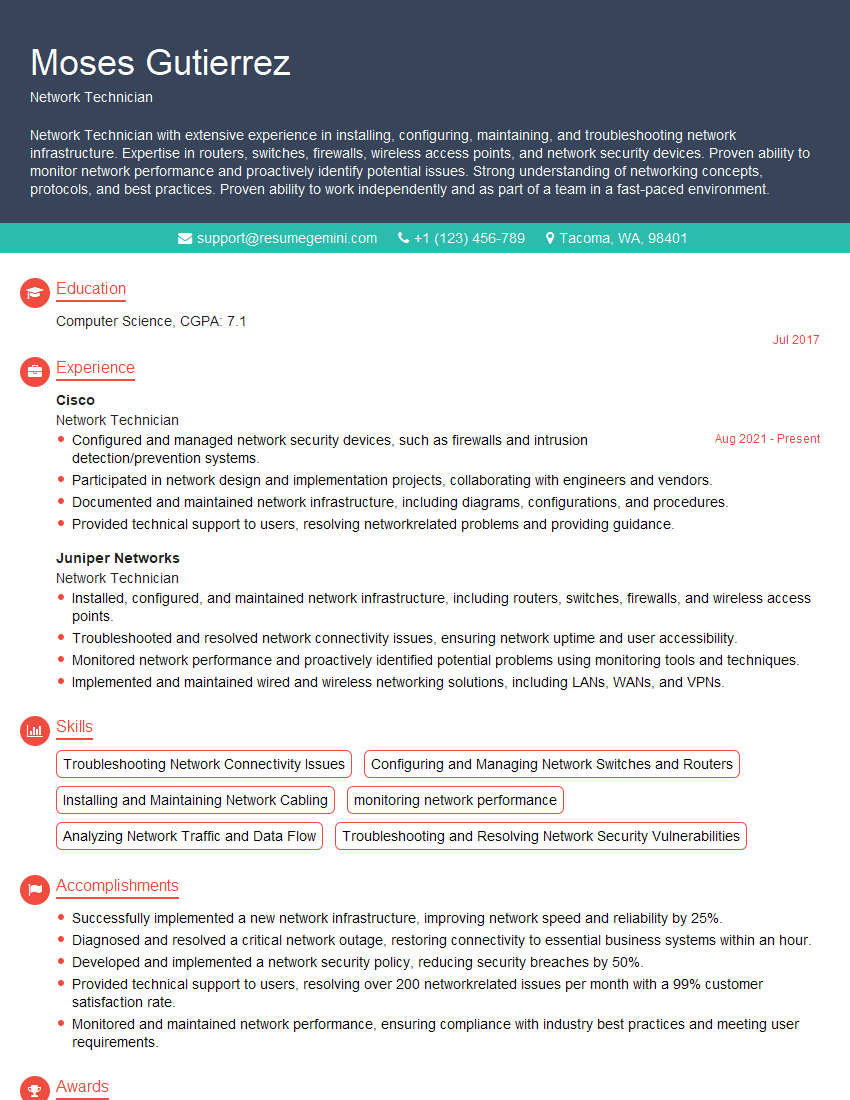
Mastering Telecommunications Test Equipment opens doors to exciting and rewarding careers in a rapidly evolving industry. Proficiency in this area significantly enhances your value to potential employers, leading to better opportunities and higher earning potential. To maximize your job prospects, crafting a strong, ATS-friendly resume is crucial. ResumeGemini is a trusted resource that can help you build a professional resume that showcases your skills and experience effectively. ResumeGemini provides examples of resumes tailored specifically to Telecommunications Test Equipment roles, providing you with valuable templates and guidance.
Explore more articles
Users Rating of Our Blogs
Share Your Experience
We value your feedback! Please rate our content and share your thoughts (optional).
What Readers Say About Our Blog
Very informative content, great job.
good