Preparation is the key to success in any interview. In this post, we’ll explore crucial Telephone Cable Splicing interview questions and equip you with strategies to craft impactful answers. Whether you’re a beginner or a pro, these tips will elevate your preparation.
Questions Asked in Telephone Cable Splicing Interview
Q 1. Describe the different types of telephone cable splices.
Telephone cable splicing involves several methods, each chosen based on the cable type, environment, and required performance. The primary types include:
- Mechanical Splices: These use connectors or sleeves to physically join the cable conductors. They are relatively quick and easy to install, suitable for low-bandwidth applications and situations where minimal disruption is crucial. Examples include crimp-on connectors and wire nuts.
- Fusion Splices: These involve melting the ends of optical fibers together to create a seamless connection. They offer superior performance and longevity, especially important in high-bandwidth applications like fiber optic telecommunications. Precision is key here to ensure minimal signal loss.
- Gel-Filled Splices: Often used in outdoor environments, these splices encapsulate the connections within a waterproof gel, protecting them from moisture and environmental damage. This is especially important to prevent corrosion and maintain signal integrity over time.
- Compression Splices: These utilize specialized connectors that mechanically compress the conductors together, creating a secure and reliable connection. These are robust and commonly used for copper cables.
The choice of splice depends heavily on the cable’s characteristics (e.g., fiber optic vs. copper) and the specific application requirements.
Q 2. Explain the process of preparing a cable for splicing.
Preparing a cable for splicing is a crucial step that directly impacts the splice’s quality and longevity. The process involves:
- Cable Identification and Testing: Verify the cable type and conduct thorough tests to ensure its integrity before beginning. Check for existing faults or breaks.
- Cleaning: Remove any dirt, grease, or moisture from the cable’s sheath and conductors. A clean surface ensures a proper connection.
- Stripping: Carefully remove the outer jacket and any protective layers to expose the individual conductors. Using the correct stripping tool is crucial to avoid damaging the wires. Too much stripping can weaken the wires, while too little can compromise the connection.
- Conductor Preparation: Trim and clean the conductor ends to ensure they are straight and free of any imperfections. This improves the mechanical or fusion process.
- Stranding (if necessary): For stranded wire, carefully untwist and straighten the strands before splicing to ensure proper contact.
- Organizing: If multiple pairs or fibers need to be spliced, carefully organize them to avoid confusion and ensure a clear, manageable workflow.
Proper preparation prevents errors and maximizes the splice’s effectiveness.
Q 3. What safety precautions are essential during telephone cable splicing?
Safety is paramount during telephone cable splicing. Essential precautions include:
- Lockout/Tagout (LOTO): Always de-energize the cable before starting any work. Use LOTO procedures to prevent accidental energization.
- Personal Protective Equipment (PPE): Wear safety glasses, gloves (insulated if working with energized cables), and appropriate clothing to protect against cuts, shocks, and other hazards.
- Grounding: Ensure the cable is properly grounded to prevent static electricity buildup, which could damage sensitive electronics.
- Working at Heights: If working at heights, use appropriate fall protection equipment and follow all safety regulations.
- Traffic Control: If working near roads or in public areas, implement traffic control measures to protect yourself and others.
- Awareness of Underground Utilities: Before digging, use utility locating services to avoid damaging other underground cables or pipes.
A thorough risk assessment before beginning any work is crucial. Ignoring safety protocols can lead to serious injury or death.
Q 4. How do you test a completed splice for continuity and signal strength?
Testing a completed splice verifies its integrity and performance. This usually involves:
- Continuity Test: This checks for a complete electrical path between the spliced conductors using a multimeter. A continuous reading indicates a good connection. The lack of continuity signals a break in the circuit.
- Signal Strength Test: This measures the signal strength at both ends of the splice to verify that no significant signal loss has occurred. Specialized equipment like an optical power meter (for fiber optic cables) or a signal level meter (for copper cables) is used.
- Return Loss Test (for Fiber): In fiber optic splicing, return loss checks for reflections that could cause signal degradation. Low return loss indicates a good splice.
These tests provide a quantitative assessment of the splice’s quality. Failure to pass these tests indicates a need for correction or replacement.
Q 5. What are the common causes of cable faults and how do you troubleshoot them?
Common cable faults include breaks, shorts, opens, and signal degradation. Troubleshooting steps involve:
- Visual Inspection: Carefully examine the cable for any visible damage.
- Continuity Testing: Identify the location of the fault using a continuity tester. This helps pinpoint the broken or shorted segment.
- Signal Tracing: If the problem is signal degradation, use signal tracing equipment to pinpoint the location of the attenuation.
- Testing for Shorts and Opens: Isolate sections of the cable to check for shorts (unintended connections between conductors) and opens (breaks in the conductor).
- Environmental Factors: Check for external factors that might be impacting the signal, such as water ingress, corrosion, or physical damage.
Systematic troubleshooting, using the right testing equipment, and a methodical approach helps isolate the fault and implement the necessary repairs.
Q 6. Explain the difference between a mechanical splice and a fusion splice.
Mechanical and fusion splices differ significantly in their method and application:
- Mechanical Splices: These use mechanical means to connect conductors. Think of them as using connectors or sleeves to hold wires together. They’re relatively simple, quick to install, and less expensive. However, they may introduce higher resistance and are more susceptible to degradation over time, particularly in harsh environments.
- Fusion Splices: These permanently join fibers by melting their ends together. It is a precise process requiring specialized equipment. Fusion splices provide superior performance, higher bandwidth capacity, and superior longevity, but are more expensive and require specialized training and tools. They’re often the preferred method for fiber optic cables where signal integrity is critical.
The best choice depends on the specific cable type (copper or fiber) and the desired performance and lifespan of the connection.
Q 7. What tools and equipment are necessary for telephone cable splicing?
The tools and equipment necessary for telephone cable splicing vary depending on the type of splice and cable. However, essential items include:
- Cable Strippers: To remove the outer jacket and insulation without damaging the conductors.
- Wire Cutters/Diagonal Cutters: To cleanly cut the conductors.
- Crimping Tool: For mechanical splices using crimp connectors.
- Soldering Iron & Solder: For some types of splices (though less common now).
- Multimeter: To test continuity and check for shorts or opens.
- Fusion Splicer (for fiber optic cables): A specialized machine that melts and fuses the ends of optical fibers.
- Optical Power Meter (for fiber optic cables): To measure the signal strength after splicing.
- Safety Glasses, Gloves, and other PPE: Essential for personal protection.
- Cable Splicing Kit: A kit containing various connectors, sleeves, and other accessories.
The availability of specialized tools often dictates the type of splice a technician can perform. Proper tool selection is key to a successful splice.
Q 8. Describe the process of terminating a telephone cable.
Terminating a telephone cable involves preparing the cable end for connection to a device or another cable. It’s like preparing the end of a rope to tie a knot – you need a clean, organized end to work with. The process typically involves:
- Stripping the outer sheath: Carefully remove the outer protective jacket, exposing the inner cable pairs. Be mindful not to damage the individual wires.
- Separating the pairs: Gently separate the twisted pairs of wires, ensuring they remain untangled. Think of it as carefully untangling a messy ball of yarn.
- Preparing the individual wires: This often involves stripping a small amount of insulation from the ends of each wire to expose the bare copper conductors. The length of the stripped wire depends on the type of connector being used.
- Connecting to a connector: This step involves using the appropriate connector (e.g., RJ11, RJ45 for different cable types) and securely connecting each wire to its corresponding terminal according to a specific wiring diagram. This is crucial – incorrect wiring leads to faulty connections.
- Testing the connection: After terminating, test the connection using a continuity tester to ensure all wires are correctly connected and there are no shorts or opens.
For example, when terminating a cable for a standard telephone jack, you’ll use an RJ11 connector and a specific wiring scheme for voice transmission. Failure to follow this scheme accurately will result in a non-functional line.
Q 9. How do you identify different types of telephone cables?
Identifying telephone cables involves checking several key features. Just like recognizing different types of trees by their leaves, you can identify telephone cables by their:
- Outer jacket color and markings: Different cable manufacturers and applications use distinct color-coding systems. A cable’s color might indicate its gauge, application (e.g., inside wiring vs. outdoor), or other specifications.
- Number of pairs: Telephone cables contain twisted pairs of wires. The number of pairs (e.g., 25-pair, 50-pair) determines the cable’s capacity.
- Gauge of the wires: The gauge indicates the thickness of the copper conductors. Thicker gauges (lower number) offer better performance and carry signals further.
- Shielding: Some cables have metallic shielding to reduce electromagnetic interference. This is usually indicated by a metallic layer under the outer jacket.
- Manufacturer markings: Reputable manufacturers often print identification information directly on the cable jacket.
For instance, a common cable used in homes might have a beige or white outer jacket and contain two or four pairs, while a larger cable used in a telephone exchange will contain many more pairs and be significantly thicker.
Q 10. What are the standards and regulations you follow during splicing?
Standards and regulations for telephone cable splicing are crucial for ensuring reliable communication and safety. These standards vary by region but generally include adherence to:
- TIA/EIA standards: These standards define the specifications for twisted-pair cabling, connectors, and installation practices.
- National Electrical Code (NEC) requirements: These regulations address safety concerns related to electrical wiring and grounding in building installations.
- Local regulations: Many jurisdictions have specific regulations that apply to telecommunications infrastructure installations, including guidelines for cable placement, trenching, and handling.
- Best practices: Following industry best practices contributes to a high-quality splice with minimal signal degradation and long-term durability. This involves using the right tools, techniques and following manufacturer guidelines.
Ignoring these standards can lead to signal loss, communication failures, fire hazards, or even injury. For example, improper grounding can result in electric shock, and incorrect splicing can cause signal degradation or cross-talk between different circuits.
Q 11. How do you handle damaged or deteriorated cable sections?
Handling damaged or deteriorated cable sections requires careful assessment and appropriate action. Imagine trying to mend a torn piece of fabric – you need to first assess the damage and then determine the best way to repair it.
- Assessment: The extent of damage dictates the repair strategy. Minor damage might involve cleaning and re-insulating the affected area. Significant damage often necessitates cable replacement.
- Repair or Replacement: Minor damage might be fixed by splicing in a short section of new cable. Severe damage, such as water intrusion or extensive corrosion, necessitates complete section replacement.
- Safety Precautions: Always ensure the cable is de-energized before working on it. Follow safety protocols for working with potentially hazardous materials.
- Documentation: Document any repairs or replacements thoroughly, noting the location, extent of damage, and repair methods used.
For example, if a cable is severed, careful splicing using appropriate connectors and techniques is necessary to restore the connection. If a section is heavily corroded, it’s safer and more effective to replace that entire section.
Q 12. Explain the importance of proper grounding and bonding during splicing.
Proper grounding and bonding are essential during splicing for safety and signal quality. It’s like connecting the earth to a wire – grounding stabilizes the electrical system and helps prevent surges and static buildup.
- Safety: Grounding protects against electric shock by providing a low-resistance path to the earth for stray currents. This is especially critical when working with live circuits.
- Signal Quality: Bonding reduces the impact of electromagnetic interference (EMI) and radio frequency interference (RFI), ensuring clear and stable signal transmission.
- Lightning Protection: Grounding provides a safe path for lightning strikes, preventing damage to equipment and potentially dangerous electrical surges.
- Methods: Grounding involves connecting the cable shield (if present) and the splice enclosure to an appropriate grounding system using proper grounding wires and connectors.
Failure to properly ground and bond can result in equipment damage, signal noise, and serious safety hazards. A properly grounded and bonded splice helps to ensure the safety and reliability of the telephone system.
Q 13. What is the significance of maintaining accurate splicing records?
Maintaining accurate splicing records is crucial for several reasons. It’s like keeping a detailed logbook for a ship – accurate documentation allows for easy troubleshooting, maintenance, and future planning.
- Troubleshooting: Accurate records help pinpoint fault locations and facilitate quick repair. Knowing the exact location and details of a previous splice speeds up repairs in the future.
- Maintenance Planning: Knowing the history of splices enables preventive maintenance and reduces the likelihood of future issues.
- Future Upgrades: Detailed splice records are essential for planning network expansions or modifications. It is crucial to understand the existing infrastructure before making changes.
- Compliance: Maintaining detailed records ensures compliance with industry regulations and standards.
Imagine having to locate a splice in a vast underground network with no records – it would be an immensely challenging and time-consuming task. Accurate records greatly increase efficiency.
Q 14. How do you manage different cable gauges and types during a splicing job?
Managing different cable gauges and types during splicing involves using appropriate techniques and connectors. It’s like using different tools for different jobs – you wouldn’t use a hammer to screw in a screw.
- Gauge Compatibility: Different gauges of wire have different electrical characteristics, and directly splicing dissimilar gauges can lead to signal degradation. Splicing similar gauges will ensure better signal continuity.
- Connector Selection: The choice of connector depends on the cable type and gauge. Using the wrong connector can lead to loose connections and signal loss.
- Splicing Techniques: Different splicing techniques (e.g., twisting, crimping, using specialized connectors) might be required depending on the cable type and gauge.
- Color-Coding: Careful wire identification and color-coding are crucial to ensure correct connections during splicing.
For example, when splicing a large-gauge cable to a smaller-gauge one, using a reduction sleeve or an appropriate connector that accommodates both gauges is often necessary to avoid poor electrical contact.
Q 15. Describe your experience with various splicing techniques.
My experience encompasses a wide range of splicing techniques, tailored to various cable types and applications. I’m proficient in both mechanical splicing, using tools like crimp connectors and compression splices, and fusion splicing, which involves melting the fiber ends together for superior performance in fiber optic cables. Mechanical splicing is great for quick, field repairs, especially on copper cables. For instance, I’ve extensively used butt connectors and twist-on connectors for telephone lines, ensuring a reliable connection within minutes. With fusion splicing, precision is key; I’ve worked with various fusion splicing machines, ensuring minimal signal loss and superior connection strength in fiber optic lines. I’ve also had experience with various types of solder splices, particularly in older installations requiring specialized techniques.
- Mechanical Splicing: Crimping, twisting, butt connectors, compression splices.
- Fusion Splicing: Using specialized equipment for precise fiber optic connection.
- Solder Splicing: For applications requiring high durability and precise electrical connections.
Career Expert Tips:
- Ace those interviews! Prepare effectively by reviewing the Top 50 Most Common Interview Questions on ResumeGemini.
- Navigate your job search with confidence! Explore a wide range of Career Tips on ResumeGemini. Learn about common challenges and recommendations to overcome them.
- Craft the perfect resume! Master the Art of Resume Writing with ResumeGemini’s guide. Showcase your unique qualifications and achievements effectively.
- Don’t miss out on holiday savings! Build your dream resume with ResumeGemini’s ATS optimized templates.
Q 16. How do you ensure the integrity and longevity of your splices?
Ensuring splice integrity and longevity is paramount. This involves meticulous attention to detail at every step. For mechanical splices, I always use the correct connector type for the cable gauge and apply consistent pressure during crimping to prevent failures. Regular testing with a TDR (Time Domain Reflectometer) is crucial to check for signal loss. With fusion splices, cleaving the fiber precisely is critical to avoid any signal degradation. I then carefully align the fibers before fusion and conduct rigorous testing post-splice to guarantee low loss. Proper sealing and protection against the elements are essential to prevent environmental damage. For example, I’ve used heat-shrink tubing and sealant compounds to protect splices from moisture and UV degradation. Regular maintenance checks help to catch and resolve potential issues before they cause significant disruptions.
Think of it like building a bridge: every component needs to be precisely fitted and protected from the elements for it to stand the test of time. A poorly constructed splice can be a weak link, causing signal loss, noise, and ultimately, service interruptions.
Q 17. What are the challenges you have faced during cable splicing and how did you overcome them?
Challenges arise frequently, especially in the field. One memorable challenge involved splicing underground cables during a severe rainstorm. The water ingress made it difficult to maintain a dry workspace and hindered the splicing process. To overcome this, I used waterproof covers and protective sheeting, and worked methodically to keep the splices as dry as possible. Another instance involved working with severely deteriorated cables, where the insulation was brittle and prone to damage. In this case, I had to carefully remove the damaged sections, clean the conductors thoroughly, and use extra support to ensure the integrity of the new splice. In both cases, meticulous preparation, adaptable problem-solving skills, and a focus on safety were crucial for successful completion.
Q 18. Explain your experience working with different types of connectors.
My experience with connectors is extensive, ranging from simple RJ11/RJ45 jacks for residential phone lines to specialized connectors used in high-bandwidth fiber optic systems. I’m comfortable working with various types of compression connectors, BNC connectors for coaxial cables, and various fiber optic connectors like SC, ST, and LC. Proper connector selection is crucial for optimal performance; for instance, using a wrong type of connector can lead to poor signal quality or even damage to the cable. Each connector type has its own installation procedure that I follow precisely. I’ve also worked with field-installable connectors, frequently used for quick repairs or terminations in a tight space, and understand the tradeoffs in terms of performance versus speed of installation.
Q 19. How do you manage your time effectively during a splicing project?
Effective time management is crucial during a splicing project. I start by carefully reviewing the project specifications, identifying all the materials required and preparing them in advance to avoid delays. I prioritize tasks based on their urgency and complexity, ensuring that critical steps are completed promptly. I utilize checklists and detailed work orders to keep track of my progress and to maintain focus. Maintaining a clean, organized workspace significantly boosts efficiency; the less time spent searching for tools, the more time is available for splicing. Also, open communication with the team and project managers helps avoid unnecessary delays or misunderstandings.
Q 20. Describe your experience working in diverse weather conditions.
Working in diverse weather conditions is a common aspect of the job. I’ve spliced cables in extreme heat, freezing temperatures, and heavy rain. Safety is always the priority. In extreme heat, I take regular breaks to avoid heatstroke, utilizing proper hydration and sun protection. In cold weather, keeping tools and materials from freezing becomes a critical factor, as does protecting myself from hypothermia. Heavy rain requires waterproof clothing and additional care to protect the splices themselves. Adaptability is crucial; I use different techniques and materials to address the challenges posed by these variable conditions.
Q 21. How do you maintain a clean and organized workspace during splicing?
Maintaining a clean and organized workspace is vital for safety and efficiency. I start by clearing the area around the splice location, removing any debris or obstructions. I organize my tools and materials systematically, using labelled containers to avoid mix-ups. As I complete steps, I immediately clean up any excess materials or waste. This approach allows me to work efficiently, avoid accidents, and ensures the quality of the completed splice. A clean space allows for better visibility and reduces the risk of damage to cables or equipment. It’s a simple habit, but it makes a big difference in the quality and speed of my work.
Q 22. Explain the use of a splice closure and its importance.
A splice closure is a protective enclosure used to house and protect the splices made in telephone cables. Think of it as a mini-weatherproof shelter for the delicate connections within the cable. Its importance lies in safeguarding the splices from environmental hazards like moisture, dust, and rodents, which could cause signal degradation or complete failure. Without a properly sealed and installed splice closure, the integrity of the entire telephone line is compromised, leading to service disruptions and costly repairs.
For example, imagine a splice in an underground cable. Without a splice closure, water could seep in, corroding the wires and causing shorts. A properly sealed closure prevents this, ensuring the longevity and reliability of the connection.
Q 23. How do you ensure proper cable strain relief?
Proper cable strain relief is crucial to prevent damage to the cable and the splice itself. Sudden pulling or tension can easily break wires or damage the delicate connections within the splice closure. This is accomplished in several ways.
- Using strain relief clamps: These secure the cable to the closure, distributing the tension evenly and preventing direct stress on the splice.
- Using proper cable slack: Sufficient slack in the cable before entering the closure allows for movement and prevents stress from being transferred to the splice. Imagine a tightrope walker; too little slack equals a fall. With cable, too little slack equals a break.
- Using sealing compounds/gels: These fill any gaps and provide extra protection and strain relief against movement and vibration.
In practice, I always meticulously check and double-check the strain relief to make sure the cable is securely held but not excessively tight. I’ve seen firsthand what happens when it’s overlooked—broken cables and hours spent fixing it.
Q 24. How do you diagnose and repair a faulty splice?
Diagnosing a faulty splice involves a systematic approach. I begin by visually inspecting the splice closure for any obvious damage. Then I use a line tester to check for continuity and signal strength. If there’s a break in continuity, the location of the fault is narrowed down, and further testing (like resistance measurements) helps pinpoint the exact problem.
Repairing the fault depends on the nature of the problem. If it’s a simple break, it’s a matter of reconnecting the wires. For more complex issues, such as corroded wires or damaged insulation, I might need to replace a section of cable or even the entire splice. Properly cleaning and preparing the wire ends for re-splicing is critical to ensure a reliable connection. Thorough testing after the repair is essential to verify its success.
For instance, if the line tester shows high resistance, that suggests corrosion. I’d then carefully open the closure, examine the wires, clean them properly, and make a new splice, ensuring a good, clean connection. A clear understanding of resistance values is crucial for accurate fault diagnosis.
Q 25. Describe your understanding of color coding in telephone cables.
Color coding in telephone cables is critical for efficient installation and repair. Each wire is usually color-coded to identify its specific function. The specific color codes vary by country and cable type, but the purpose remains consistent: rapid and error-free identification. For example, a common system uses different colors to represent different pairs or lines within a cable, allowing for easy tracing and connection during installation or troubleshooting.
Using a color code chart specific to the cable is imperative to prevent errors. Incorrect connections can lead to signal crosstalk and faulty communication. Understanding and applying the color code consistently is a fundamental skill for efficient and accurate work.
Q 26. What is your experience with fiber optic cable splicing?
My experience with fiber optic cable splicing is extensive. While different from traditional copper cable splicing, the principles of precision and careful handling remain the same. Fiber optic splicing requires specialized tools and techniques to achieve a low-loss fusion splice, which is critical for maintaining signal strength. I’m proficient in using fusion splicers, cleavers, and optical time-domain reflectometers (OTDRs) to test and ensure the quality of the splices.
I have personally worked on several projects involving fiber optic cable splicing in various environments, from underground infrastructure to aerial installations. One project involved repairing a critical fiber line for a major internet service provider, which required working under stringent time constraints and maintaining a high level of accuracy to avoid extensive service disruptions. Working with fiber optics demands an acute attention to detail and precision.
Q 27. Explain your experience using specialized splicing tools.
My experience includes the use of various specialized splicing tools, including:
- Wire strippers and cutters: For precise removal of insulation without damaging the conductors.
- Crimping tools: To secure connectors reliably.
- Soldering irons: For creating robust, low-resistance connections.
- Fusion splicers (for fiber optics): These machines precisely fuse fiber optic strands together for a low-loss connection.
- OTDRs (Optical Time Domain Reflectometers): Used for testing and locating faults in fiber optic lines.
Regular maintenance and calibration of these tools is key to accurate and efficient splicing. In fact, a poorly calibrated tool can lead to faulty splices and costly repairs later. I always carefully inspect my tools before each job and keep them in optimal condition.
Q 28. How do you stay up-to-date with advancements in telephone cable splicing technology?
Staying current in the rapidly evolving field of telephone cable splicing involves ongoing professional development. This includes:
- Attending industry conferences and workshops: These events provide updates on the latest technologies and techniques.
- Reading industry publications and journals: Staying informed about advancements through relevant literature.
- Participating in online training courses: Many online platforms offer specialized training in splicing techniques.
- Networking with other professionals: Sharing knowledge and experiences with colleagues within the field.
For example, I recently completed a course on the latest advancements in fiber optic splicing techniques, including the use of automated fusion splicers, and the benefits of these more advanced techniques.
Key Topics to Learn for Telephone Cable Splicing Interview
- Cable Identification and Testing: Understanding different cable types, color codes, and using testing equipment to ensure cable integrity before and after splicing.
- Splicing Techniques: Mastering various splicing methods (e.g., fusion splicing, mechanical splicing) and their applications based on cable type and environment. Practical experience detailing successful splicing procedures will be highly valuable.
- Safety Procedures and Regulations: Demonstrating a thorough understanding of safety protocols, including working at heights, handling hazardous materials, and adhering to industry best practices.
- Troubleshooting and Repair: Explaining your approach to diagnosing cable faults, isolating problems, and implementing effective repair strategies. Be prepared to discuss specific scenarios and your problem-solving methodology.
- Documentation and Reporting: Highlighting your ability to accurately document splicing procedures, maintain clear records, and generate comprehensive reports.
- Tools and Equipment: Demonstrating familiarity with common tools and equipment used in telephone cable splicing, including their proper use and maintenance.
- Network Topology and Design: Understanding basic network concepts and how cable splicing contributes to overall network functionality and performance.
Next Steps
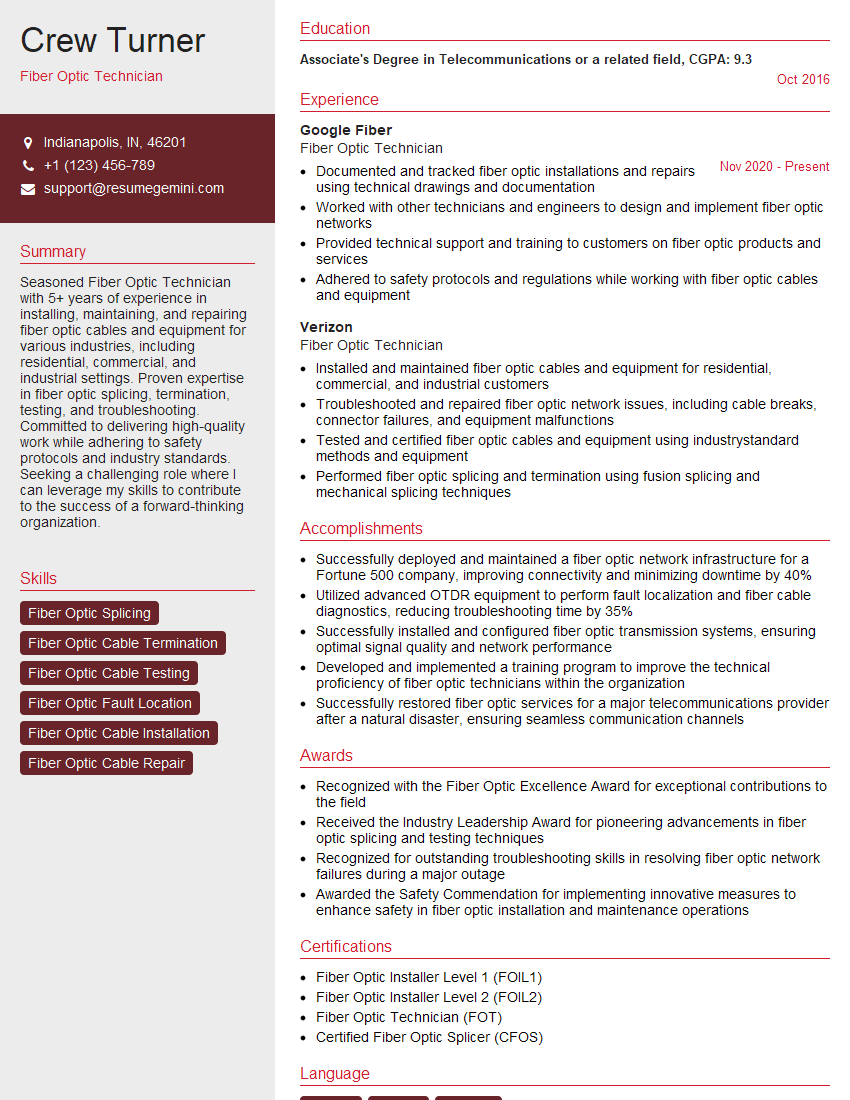
Mastering telephone cable splicing opens doors to a rewarding career with excellent growth potential in the telecommunications industry. Your skills are highly sought after, and showcasing your expertise effectively is key to landing your dream job. Creating a strong, ATS-friendly resume is crucial for maximizing your job prospects. ResumeGemini is a trusted resource to help you build a professional and impactful resume that highlights your skills and experience. We provide examples of resumes tailored to Telephone Cable Splicing to help you craft the perfect application.




Explore more articles
Users Rating of Our Blogs
Share Your Experience
We value your feedback! Please rate our content and share your thoughts (optional).
What Readers Say About Our Blog
Very informative content, great job.
good