The right preparation can turn an interview into an opportunity to showcase your expertise. This guide to Test Equipment Calibration and Maintenance interview questions is your ultimate resource, providing key insights and tips to help you ace your responses and stand out as a top candidate.
Questions Asked in Test Equipment Calibration and Maintenance Interview
Q 1. Explain the difference between calibration and maintenance.
Calibration and maintenance are distinct but related processes crucial for ensuring the accuracy and reliability of test equipment. Think of it like this: maintenance keeps your car running smoothly, while calibration ensures your speedometer accurately reflects your speed.
Calibration is the process of adjusting a measuring instrument to match a known standard. It verifies the accuracy of the equipment against a traceable standard and corrects any deviations. Calibration ensures that your measurements are trustworthy and meet required tolerances.
Maintenance, on the other hand, involves all activities aimed at preserving the equipment’s functionality and extending its lifespan. This includes cleaning, lubrication, replacing worn parts, and performing preventative checks to avoid failures. It keeps the equipment in good working order.
For example, you might maintain a digital multimeter (DMM) by cleaning its contacts and checking its battery, but calibrating it involves comparing its readings against a known voltage source with high accuracy.
Q 2. What are the common types of calibration standards used?
Calibration standards are essential for ensuring traceability and accuracy. They are instruments or artifacts of known and verified values used to check and adjust the accuracy of test equipment. Common types include:
- National Standard: These are the highest level standards maintained by national metrology institutes (like NIST in the US). They are the foundation of the entire measurement system.
- Working Standards: These are highly accurate standards used in calibration laboratories to calibrate other test equipment. They are calibrated against national standards.
- Transfer Standards: Used to transfer calibration from the working standard to the test equipment being calibrated. These offer a level of accuracy between the working and the equipment.
- Reference Standards: Highly accurate standards used for precise calibration within a specific range or application.
The choice of standard depends on the accuracy required for the test equipment being calibrated. For instance, calibrating a precision voltage source might require a national standard or a working standard, while a basic multimeter might only need a transfer standard.
Q 3. Describe the process of calibrating a digital multimeter (DMM).
Calibrating a DMM involves comparing its readings against known voltage, current, and resistance values. Here’s a step-by-step process:
- Gather necessary equipment: This includes the DMM to be calibrated, a calibrated voltage source (e.g., a precision voltage reference), a calibrated current source (if calibrating current functions), a calibrated resistance decade box (for resistance functions), and calibration documentation.
- Prepare the DMM: Turn the DMM on and allow it to warm up according to the manufacturer’s instructions. Ensure the leads are clean and properly connected.
- Voltage Calibration: Apply known voltages from the calibrated voltage source to the DMM and compare the readings. Note any deviations and record them in the calibration log.
- Current Calibration: Use the calibrated current source to measure current using the DMM. Compare and record deviations as in the voltage calibration.
- Resistance Calibration: Use the calibrated resistance decade box to check the DMM’s resistance readings across various resistance values. Compare and record deviations.
- Document the results: Record all readings, deviations, and any adjustments made in a calibration certificate. This certificate provides evidence that the DMM has been calibrated and confirms its accuracy within specified limits.
- Adjustments (if needed): Some DMMs may allow for internal adjustments; however, many modern DMMs are factory-sealed and adjustments are only done by a calibration specialist using more advanced procedures.
Remember to always follow the manufacturer’s instructions and use appropriate safety precautions.
Q 4. How do you determine the calibration interval for a piece of test equipment?
Determining the calibration interval depends on several factors: the equipment’s criticality, its usage frequency, its environment, its stability, and manufacturer recommendations. Think of it like this: a frequently used medical device requires more frequent calibration than a rarely used lab instrument.
Several factors influence the calibration interval:
- Criticality of the measurement: Equipment used in safety-critical applications needs more frequent calibration than those used for less critical measurements.
- Usage frequency: Equipment used frequently is more likely to drift, so more frequent calibrations are needed.
- Environmental conditions: Harsh environments (high temperature, humidity, vibration) can affect equipment stability, necessitating more frequent calibration.
- Equipment stability: Some instruments are inherently more stable than others, allowing for longer calibration intervals.
- Manufacturer recommendations: Manufacturers usually provide guidelines for recommended calibration intervals based on testing and experience.
A risk assessment is often performed to determine the appropriate interval. This typically involves considering the potential consequences of inaccurate measurements.
Q 5. What are the key indicators of a malfunctioning piece of test equipment?
Several signs indicate a malfunctioning piece of test equipment. These should never be ignored because inaccurate readings could lead to incorrect diagnoses, faulty products, and safety hazards.
- Inconsistent readings: Repeated measurements of a stable signal should yield consistent results. Significant variations indicate a potential problem.
- Readings outside expected ranges: If measurements are consistently outside the expected range for a known standard, it suggests a calibration issue or malfunction.
- Erratic behavior: Unexpected jumps or fluctuations in readings might point to internal component failure or a power supply problem.
- Physical damage: Visible damage such as cracks, burns, or loose connections can affect equipment performance.
- Unusual noises or smells: Unusual sounds or odors (burning components) are clear signs of a problem.
- Calibration alerts: Some instruments have built-in mechanisms that alert users when the equipment is outside its calibration limits.
If you observe any of these indicators, immediately remove the equipment from service and initiate troubleshooting or repair procedures.
Q 6. Explain the concept of traceability in calibration.
Traceability in calibration is essential for ensuring the reliability and validity of measurement results. It’s a chain of comparisons that links the calibration of your equipment all the way back to a national standard. Imagine a family tree for your measurements.
Traceability means that the calibration of a particular instrument can be linked back through a documented chain of calibrations to national or international standards. This chain ensures the accuracy and reliability of the measurements made by the instrument. If a problem arises, the traceability allows investigators to determine where any inaccuracies might have entered the measurement chain.
This unbroken chain is established through calibration certificates and reports. These documents demonstrate that the equipment was calibrated using standards traceable to recognized authorities.
Q 7. What are some common calibration uncertainties and how are they addressed?
Calibration uncertainties are unavoidable, representing the range of possible error associated with a measurement. They arise from various sources:
- Standard uncertainty: The uncertainty associated with the calibration standard itself.
- Measurement uncertainty: The uncertainty in the measurement process due to factors like resolution of the instrument, operator error, and environmental conditions.
- Method uncertainty: Uncertainty inherent in the calibration method used.
Addressing these uncertainties involves:
- Using high-quality standards: Choosing standards with low uncertainties minimizes their contribution to the overall uncertainty.
- Employing proper calibration procedures: Following established procedures minimizes measurement and method uncertainties.
- Controlling environmental conditions: Maintaining stable temperature, humidity, and other environmental factors reduces uncertainty.
- Proper instrument handling: Correct handling and operation of the instrument minimizes human error.
- Statistical analysis: Analyzing multiple measurements and applying statistical methods helps quantify uncertainty.
- Reporting uncertainty: Clearly documenting all uncertainties ensures transparency and facilitates proper interpretation of calibration results.
By carefully managing these factors, we can reduce uncertainties to acceptable levels, ensuring that our measurements are sufficiently accurate for the intended application.
Q 8. How do you handle discrepancies found during calibration?
Handling discrepancies during calibration is crucial for maintaining the accuracy and reliability of our test equipment. When a discrepancy is found – meaning the equipment’s reading deviates from the standard within its acceptable tolerance – a systematic approach is followed. First, we verify the discrepancy. Is it a consistent error? Could it be due to environmental factors like temperature or humidity? We carefully recheck the calibration procedure, scrutinizing every step. If the discrepancy persists, we investigate the potential root causes. This could involve inspecting the equipment for physical damage, checking for faulty components, or even considering operator error.
For instance, I once encountered a discrepancy in a digital multimeter. After careful re-testing, it turned out a loose internal connection was causing erratic readings. Once identified, the issue is documented, and corrective actions are taken – be it repair, adjustment, or even replacement of the equipment. Finally, the recalibrated equipment is retested to ensure it’s within the acceptable tolerance range. The entire process is meticulously documented, including the discrepancy, its investigation, and the corrective actions.
Q 9. What are the different types of calibration methods?
Calibration methods fall broadly into two categories: direct and indirect. Direct calibration involves comparing the equipment under test (UUT) directly to a traceable standard. Think of comparing a newly calibrated weight scale to certified standard weights. The UUT’s reading is compared directly against the known standard.
Indirect calibration uses a secondary standard or a known good instrument that has recently been calibrated to trace the UUT back to a primary standard. For example, we might calibrate an oscilloscope using a signal generator that’s already been calibrated against a high-precision timebase. This method is often used when the direct comparison is not feasible due to cost, time, or technical limitations. Each method is selected based on the type of equipment, its accuracy requirements, and available resources. Both are essential to ensuring the integrity of our calibration processes.
Q 10. Describe your experience with different calibration software.
My experience with calibration software spans several platforms, from simple spreadsheet-based systems to sophisticated, dedicated calibration management software (CMS). Spreadsheet software can be adequate for smaller labs, allowing tracking of calibration dates and results. However, they often lack features for managing certificates, generating reports efficiently, and providing alerts for upcoming calibrations. I’ve extensively used Fluke Calibration software and a few other proprietary CMS solutions. These offer comprehensive features: automated reporting, data management, instrument tracking, and alert systems for upcoming calibrations. A well-designed CMS greatly enhances efficiency, traceability, and compliance with industry standards. For example, using a CMS ensures that calibration certificates are always available and up-to-date, simplifying audits. The ability to automatically generate reports also saves time and reduces administrative overhead.
Q 11. How do you maintain calibration records and documentation?
Maintaining accurate calibration records is paramount. We utilize a combination of electronic and paper-based systems to ensure compliance and traceability. All calibration data, including the date, equipment identification, results, and any discrepancies, are documented in our CMS. This creates a comprehensive audit trail. Calibration certificates, which serve as proof of the calibration process, are stored both electronically and physically in a secure location. We adhere to a strict file management system, ensuring easy retrieval and organization of records. The paper records are stored in secure, climate-controlled environment to prevent damage. This meticulous record-keeping enables easy traceability and ensures our compliance with ISO 17025, or any other relevant standards, simplifying audits and demonstrating our commitment to quality.
Q 12. What safety precautions do you take when working with test equipment?
Safety is always my top priority. When working with test equipment, several precautions are consistently followed. This starts with a thorough risk assessment before commencing any work. We ensure that all equipment is properly grounded to prevent electrical shocks. Eye protection is mandatory when working with lasers or high-intensity light sources. Proper handling procedures are followed for potentially hazardous materials, and appropriate personal protective equipment (PPE), including gloves, are utilized as needed. Furthermore, all equipment is regularly inspected for any signs of damage or wear before use. I always follow the manufacturer’s safety guidelines and keep up-to-date with safety training, particularly concerning new equipment or updated procedures. For instance, we have specific protocols for handling high-voltage equipment and ensure that only trained personnel are involved.
Q 13. Explain your experience with preventative maintenance procedures.
Preventative maintenance (PM) is a crucial aspect of our calibration processes, ensuring the longevity and accuracy of our equipment. A scheduled PM program is followed for all test equipment. This includes routine cleaning, visual inspections for damage, and functional checks to identify potential problems before they escalate. PM procedures vary depending on the equipment type. For instance, an oscilloscope might require cleaning its internal components and checking for proper signal integrity, whereas a multimeter might need cleaning its terminals and verifying its calibration settings. Each PM activity is documented, along with any findings or corrective actions taken. By proactively addressing potential issues, we minimize downtime, extend the equipment’s lifespan, and maintain its accuracy, contributing to overall operational efficiency and cost savings. This ensures high quality calibration procedures and minimizes unexpected interruptions.
Q 14. How do you troubleshoot common problems with test equipment?
Troubleshooting test equipment issues requires a systematic approach. I usually begin by examining the obvious – are there any visible signs of damage, loose connections, or incorrect settings? Then, I consult the equipment’s manual and troubleshooting guides. If the issue persists, I proceed to more advanced diagnostic techniques, which may include using test equipment to isolate the problem. For instance, if a signal generator is producing an incorrect output, I might use an oscilloscope to check the signal’s waveform and a multimeter to verify the voltage levels. A faulty component might be traced through systematic checks, or, if the fault is more complex, external help might be required. I meticulously document each troubleshooting step, recording observations and the corrective actions implemented, which helps with future reference. This structured process ensures that issues are resolved efficiently, minimizing downtime and maintaining the accuracy of our equipment.
Q 15. Describe your experience with different types of test equipment.
Throughout my career, I’ve worked extensively with a wide array of test equipment, encompassing various measurement disciplines. This includes electrical instruments like multimeters, oscilloscopes, and function generators; environmental chambers for temperature and humidity testing; mechanical measurement devices such as calipers and micrometers; and specialized equipment specific to industries like telecommunications or aerospace. For example, in my previous role, I was responsible for the calibration and maintenance of high-precision network analyzers used in 5G testing, requiring specialized knowledge of RF calibration techniques. Another instance involved calibrating environmental chambers used in the aerospace industry, demanding stringent accuracy and detailed documentation to meet stringent aerospace standards.
My experience extends beyond the basic operation of these instruments. I’m proficient in performing both preventative maintenance (cleaning, lubrication, etc.) and corrective maintenance (troubleshooting and repair). I understand the intricacies of instrument design and can identify potential issues impacting measurement accuracy. This allows me to optimize maintenance schedules and reduce downtime.
Career Expert Tips:
- Ace those interviews! Prepare effectively by reviewing the Top 50 Most Common Interview Questions on ResumeGemini.
- Navigate your job search with confidence! Explore a wide range of Career Tips on ResumeGemini. Learn about common challenges and recommendations to overcome them.
- Craft the perfect resume! Master the Art of Resume Writing with ResumeGemini’s guide. Showcase your unique qualifications and achievements effectively.
- Don’t miss out on holiday savings! Build your dream resume with ResumeGemini’s ATS optimized templates.
Q 16. What are the ISO standards related to calibration?
Several ISO standards are crucial for calibration, with ISO/IEC 17025 being the cornerstone. This standard specifies general requirements for the competence of testing and calibration laboratories. It ensures traceability to national or international standards, ensuring consistent and reliable results. Other relevant standards include ISO 9001 (Quality Management Systems) which provides a framework for managing quality processes, including calibration, and ISO 10012 (Measurement Management Systems) that offers a specific guide for establishing and improving a measurement management system within an organization.
These standards aren’t just checklists; they represent a commitment to accuracy and reliability. For example, adhering to ISO/IEC 17025 necessitates meticulous record-keeping, detailed procedures, and regular audits, all vital to maintaining the integrity of our calibration processes.
Q 17. How do you ensure the accuracy of calibration results?
Ensuring the accuracy of calibration results is paramount. We achieve this through a multi-layered approach. First, we use calibrated standards traceable to national metrology institutes (NMIs). Think of these standards as the ‘gold standard’—they’re meticulously calibrated and their accuracy is verified. Second, we employ rigorous calibration procedures, documented in detailed work instructions. This eliminates variability and ensures consistency. Third, we use appropriate statistical methods to analyze the results, such as calculating uncertainty budgets to assess the overall measurement uncertainty. Finally, regular internal audits and external proficiency testing help us identify and correct any systematic errors or biases.
For instance, if we’re calibrating a multimeter, we wouldn’t just compare it to a single, possibly faulty, reference. Instead, we’d use multiple calibrated standards across the instrument’s range, documenting each measurement and analyzing the data statistically to assess its accuracy and identify any potential drifts.
Q 18. How do you manage calibration workload and prioritize tasks?
Managing calibration workload involves careful planning and prioritization. I typically use a calibration management system (CMS) software to track instruments, schedule calibrations, and manage due dates. Prioritization is based on several factors, including instrument criticality (safety-critical instruments are prioritized), frequency of use, and impending due dates. A risk-based approach helps to allocate resources effectively, focusing on instruments with the highest potential impact on product quality or safety.
Imagine a scenario with multiple instruments needing calibration—a vital safety device, a frequently used oscilloscope, and a rarely used power supply. The safety device takes priority due to its critical role. The oscilloscope follows due to its frequent use and potential impact on production. The power supply is scheduled based on its due date and risk assessment.
Q 19. What is your experience with statistical process control (SPC)?
Statistical Process Control (SPC) is an integral part of maintaining calibration accuracy. We use control charts to monitor the performance of our calibration processes over time. These charts track key metrics such as measurement bias and standard deviation. By analyzing these charts, we can identify trends, outliers, or shifts indicating potential problems that need addressing. This prevents small issues from escalating into major inaccuracies.
For example, if a control chart for a particular calibration process starts to show an increasing bias, it signals a need for investigation. This might involve reviewing the calibration procedures, recalibrating our standards, or even identifying a problem with the equipment used in the calibration process. Early identification prevents inaccurate calibrations.
Q 20. How do you handle equipment out of calibration?
Equipment found out of calibration is immediately tagged as ‘Out of Service’ to prevent its further use. A detailed investigation is then initiated to determine the root cause. This might involve examining the calibration records, reviewing the instrument’s maintenance history, and assessing its physical condition. Once the cause is determined, corrective actions are taken, which could range from simple repairs to a complete recalibration or even replacement.
The affected equipment is then recalibrated, and all impacted test results are reviewed to assess their validity. Appropriate notifications are sent to relevant stakeholders, and corrective actions are documented in a non-conformance report. This ensures that the issue is resolved, and steps are taken to prevent recurrence.
Q 21. Explain your experience with different calibration certificates.
My experience includes various calibration certificates, each with specific attributes. A common type is the ISO/IEC 17025 compliant certificate, issued by accredited calibration laboratories. These certificates provide a high level of confidence in the calibration results, as the laboratory’s competence is independently assessed. Other certificates might be manufacturer-issued, providing basic calibration information but lacking the same level of assurance. In some cases, we might also encounter certificates from non-accredited laboratories, requiring a careful evaluation of their capabilities and the reliability of their results. The critical aspect is always understanding the scope, limitations, and traceability of the certificate.
Choosing between different certificates involves careful consideration of the application. For critical applications, an ISO/IEC 17025 compliant certificate is always preferred. For less critical applications, a manufacturer’s certificate might suffice. In all cases, proper documentation and verification are crucial.
Q 22. What are the common causes of equipment drift?
Equipment drift, the gradual change in a measuring instrument’s output over time, stems from several factors. Think of it like a clock slowly getting out of sync – it’s not a sudden jump, but a creeping inaccuracy.
- Environmental Factors: Temperature fluctuations, humidity changes, and even vibrations can significantly affect the internal components of test equipment, leading to drift. For instance, a digital multimeter’s resistance readings might be slightly off in a humid environment.
- Component Aging: Like any physical device, components within the equipment age and degrade over time. Capacitors can lose their capacitance, resistors can change their resistance, and this gradual deterioration impacts the overall accuracy. This is akin to a car’s engine wearing down over many miles.
- Power Supply Issues: Inconsistent power supply can cause instability in the equipment’s internal circuits, leading to drift in readings. Imagine a delicate musical instrument – it needs a stable power source to function correctly. Any fluctuations will affect the ‘tune’.
- Calibration Degradation: Even after calibration, equipment might drift due to the limitations of the calibration process itself. Think of it as a perfectly calibrated scale – it might be accurate now, but the accuracy might decrease over time due to use and environmental effects.
Understanding these causes is crucial for implementing preventative maintenance and establishing appropriate calibration intervals to minimize the impact of drift on measurement accuracy.
Q 23. How do you validate calibration procedures?
Validating calibration procedures involves verifying that the methods and standards used are accurate, reliable, and consistent. It’s about making sure our methods really do what we say they do!
- Traceability: We must ensure our calibration standards are traceable to national or international standards. This establishes a chain of custody for accuracy, so we know our measurements are reliable and comparable across different labs and countries.
- Method Validation: We should validate the calibration methods themselves using known accurate standards or by comparing results with multiple calibrated instruments. This cross-checking verifies the procedure’s accuracy. Think of it like double-checking your math – you wouldn’t just trust the first answer.
- Uncertainty Analysis: Performing an uncertainty analysis of the entire calibration process is vital. This quantifies the potential errors and uncertainties associated with our measurements. We want to know how much our results might vary.
- Regular Audits: Internal and external audits of the calibration lab’s practices, equipment, and documentation are essential to identify any inconsistencies and areas for improvement. Regular checks prevent minor issues from turning into major problems.
- Competency Assessment: We ensure that personnel performing calibrations are competent and trained in the procedures. Well-trained people reduce errors in execution.
By rigorously validating our procedures, we build confidence in the accuracy and reliability of all measurements performed in our lab.
Q 24. Describe your experience working with different calibration labs.
I’ve worked with a diverse range of calibration labs, both large and small, accredited and non-accredited. This exposure has given me a broad understanding of best practices and various approaches to calibration.
For example, I worked with a National Metrology Institute (NMI) which had incredibly sophisticated equipment and stringent procedures. Their emphasis was on extremely high accuracy, which is crucial for establishing national standards. In contrast, I’ve collaborated with smaller labs specializing in specific equipment types, like oscilloscopes or temperature sensors, where the focus was on practical, efficient calibration for specific industries. Each lab had its unique strengths and approaches, allowing me to gain diverse experience and adapt my techniques to different contexts.
This exposure has enhanced my understanding of various calibration scopes, methodologies, and documentation requirements across different industries and regulatory frameworks. Ultimately, I’ve learned the importance of tailoring approaches to meet specific needs while upholding the highest standards of accuracy.
Q 25. How do you maintain the integrity of a calibration laboratory?
Maintaining the integrity of a calibration laboratory requires a multifaceted approach, focusing on several key areas:
- Environmental Control: Maintaining stable temperature, humidity, and clean air conditions is crucial to prevent equipment drift and ensure measurement accuracy. This involves using climate-controlled environments and regular monitoring of environmental parameters.
- Equipment Maintenance: Regular preventative maintenance, including cleaning, adjustments, and repairs, ensures the reliability of calibration equipment. This is akin to regular servicing of a car to keep it running smoothly.
- Traceability and Calibration: Regular calibration of the lab’s own equipment using traceable standards is paramount. This ensures the accuracy of all measurements performed in the lab.
- Quality Management System: Implementing a robust quality management system, such as ISO/IEC 17025, provides a structured framework for managing processes and ensuring compliance with standards. This system establishes clear procedures and accountability.
- Personnel Training: Thorough training and competency assessments for personnel is essential to ensure calibration procedures are performed correctly and consistently.
- Documentation and Record Keeping: Meticulous record keeping, including calibration certificates, reports, and maintenance logs, is critical for maintaining traceability and complying with regulatory requirements.
By focusing on these areas, a calibration lab maintains its integrity and ensures the reliability and accuracy of all its measurements.
Q 26. What are your skills in using specialized calibration tools?
My experience encompasses a broad range of specialized calibration tools, including:
- Multi-meters (Digital and Analog): Proficient in calibrating various types, including precision multimeters used in critical measurements.
- Oscilloscope Calibrators: Experienced in using dedicated calibrators to test and calibrate oscilloscopes for accurate time-base and amplitude measurements.
- Temperature Calibrators: Skillful in using various types, from dry-block calibrators to liquid baths and temperature sensors, ensuring accuracy in temperature measurements across different ranges.
- Calibration Software: Proficient in using various calibration software packages for data acquisition, analysis, and report generation.
- Pressure Calibrators: Skilled in calibrating pressure gauges, transducers, and other pressure-measuring devices using deadweight testers and other precision equipment.
I am comfortable adapting to new calibration tools and technologies as needed. I am always seeking opportunities to expand my skills and keep up-to-date with the latest advancements in calibration equipment.
Q 27. Explain your experience with calibration reports and data analysis.
My experience with calibration reports and data analysis is extensive. I understand the importance of clear, concise, and unambiguous reporting in accordance with ISO/IEC 17025 standards. This is crucial for ensuring that the information is readily understood and accepted by clients.
I am proficient in analyzing calibration data to identify trends, outliers, and potential sources of error. For instance, in analyzing temperature calibration data, I might notice a consistent deviation at a certain temperature point, indicating a potential problem with the equipment or calibration procedure. This necessitates investigation and corrective action.
I use statistical analysis techniques to evaluate calibration results, determine measurement uncertainty, and assess the overall accuracy of the calibrated equipment. I generate comprehensive reports that include all relevant data, analysis, and conclusions. These reports are vital for ensuring the reliability and validity of our services.
Q 28. How do you stay current with the latest calibration techniques and standards?
Staying current with calibration techniques and standards is crucial in this ever-evolving field. I employ several strategies to ensure I remain up-to-date:
- Professional Organizations: Active membership in professional organizations like the American Society of Mechanical Engineers (ASME) or similar organizations keeps me informed about emerging standards and best practices through publications and conferences.
- Industry Publications and Journals: I regularly review industry publications and journals focused on metrology and calibration to stay abreast of the latest research, technological advancements, and regulatory changes.
- Training Courses and Workshops: I participate in continuing education courses and workshops to expand my knowledge of new calibration techniques and technologies. Hands-on training is particularly valuable.
- Networking and Collaboration: Networking with other calibration professionals, attending conferences and workshops, and participating in industry forums provides opportunities for knowledge sharing and learning from others’ experiences.
- Regulatory Updates: I monitor regulatory changes, updates, and compliance requirements to ensure our calibration procedures align with the latest standards.
Continuous learning is vital to maintain high standards of proficiency and ensure our calibration services remain at the forefront of accuracy and reliability.
Key Topics to Learn for Test Equipment Calibration and Maintenance Interview
- Calibration Standards and Traceability: Understanding ISO 17025, NIST, and other relevant standards; explaining the importance of traceable calibration certificates and their role in ensuring measurement accuracy.
- Types of Calibration Procedures: Describing different calibration methods (e.g., comparison, substitution, direct measurement) and their application to various test equipment (e.g., oscilloscopes, multimeters, power supplies).
- Measurement Uncertainty Analysis: Explaining the concept of measurement uncertainty, its sources, and how to quantify and minimize it during calibration processes.
- Preventive Maintenance Procedures: Discussing routine maintenance tasks, such as cleaning, inspection, and lubrication, to prolong equipment lifespan and maintain accuracy.
- Troubleshooting and Repair Techniques: Demonstrating problem-solving skills by describing approaches to diagnose and resolve common equipment malfunctions, including the use of diagnostic tools and schematics.
- Calibration Software and Data Management: Familiarity with calibration software for managing calibration records, generating reports, and tracking equipment history.
- Safety Procedures and Regulations: Understanding and adhering to relevant safety regulations and protocols in handling and maintaining test equipment.
- Calibration Documentation and Reporting: Creating clear, concise, and accurate calibration reports that comply with industry standards.
- Statistical Process Control (SPC): Applying SPC principles to monitor calibration data and identify trends that may indicate equipment drift or degradation.
Next Steps
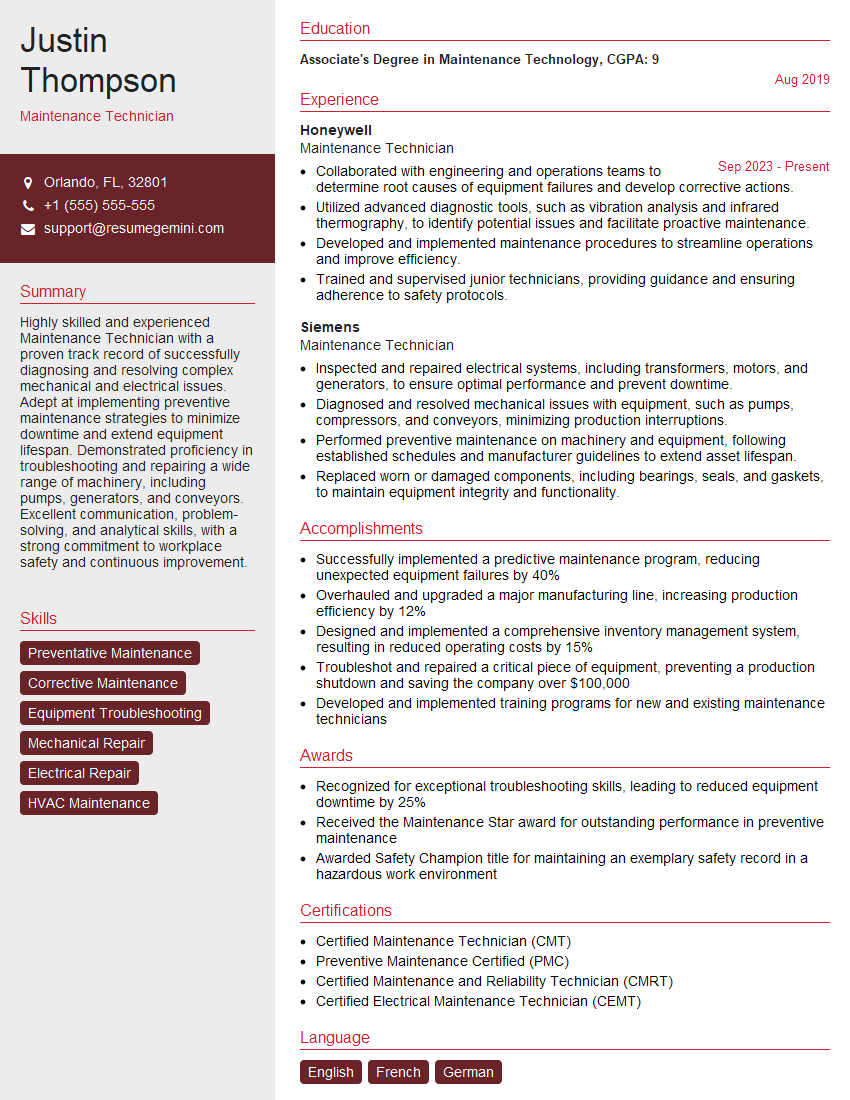
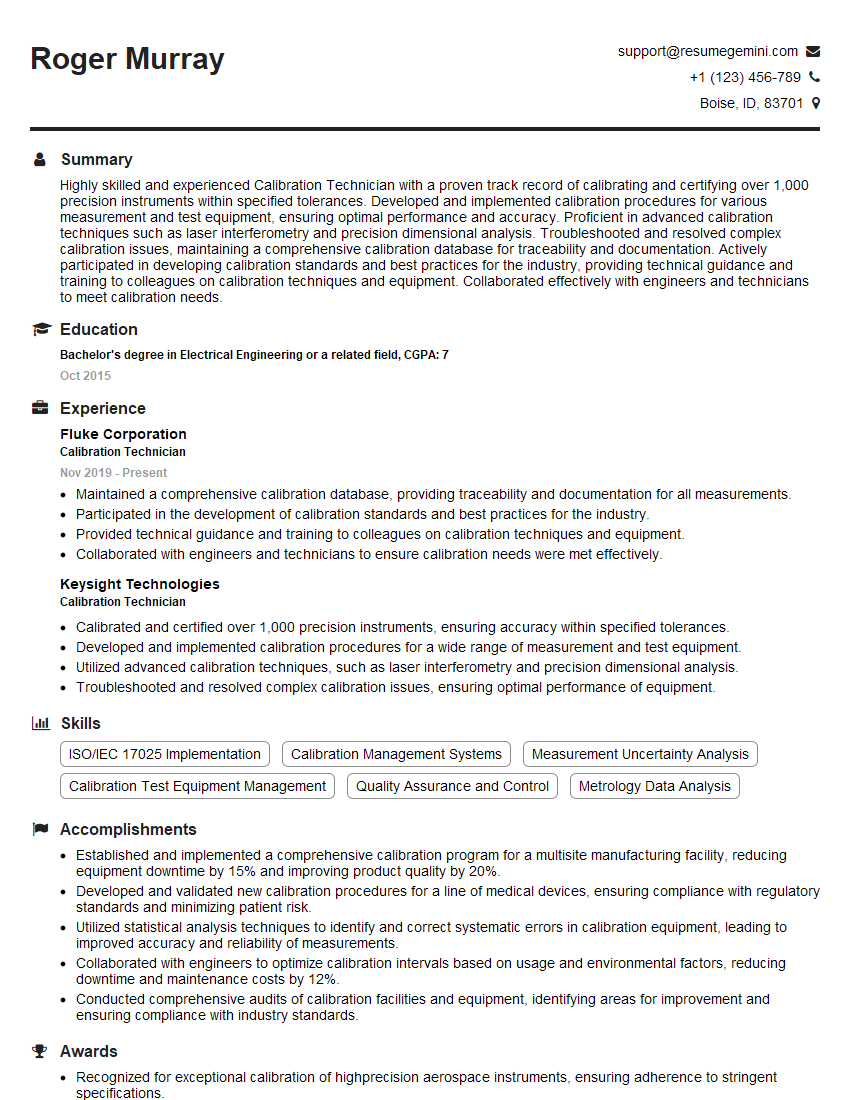
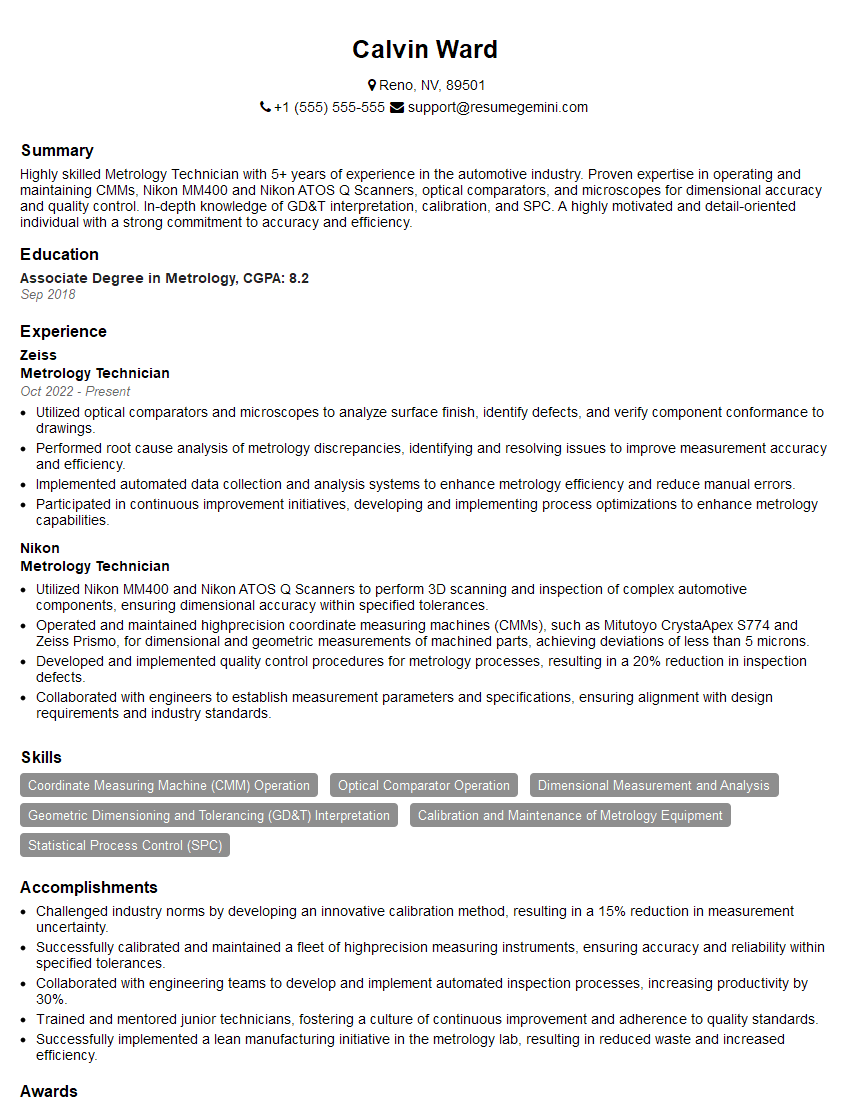
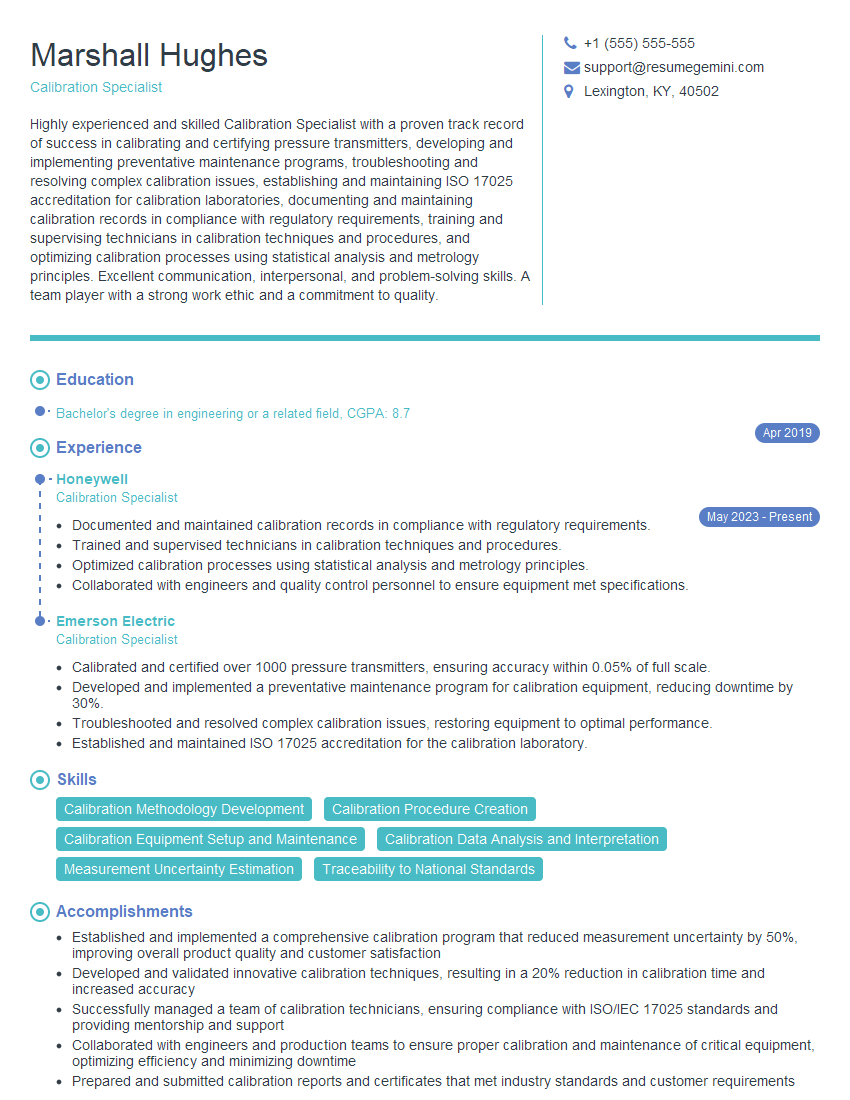
Mastering Test Equipment Calibration and Maintenance is crucial for a successful and rewarding career in engineering and technical fields. Proficiency in these skills opens doors to diverse opportunities and positions you for leadership roles. To maximize your job prospects, it’s essential to create a compelling and ATS-friendly resume that showcases your expertise effectively. ResumeGemini is a trusted resource that can help you build a professional resume that stands out from the competition. They offer examples of resumes tailored specifically to Test Equipment Calibration and Maintenance, enabling you to present your skills and experience in the most impactful way possible. Take the next step in your career journey – invest in your resume today!

Explore more articles
Users Rating of Our Blogs
Share Your Experience
We value your feedback! Please rate our content and share your thoughts (optional).
What Readers Say About Our Blog
Very informative content, great job.
good