Cracking a skill-specific interview, like one for Texturing (Substance Painter, Mari), requires understanding the nuances of the role. In this blog, we present the questions you’re most likely to encounter, along with insights into how to answer them effectively. Let’s ensure you’re ready to make a strong impression.
Questions Asked in Texturing (Substance Painter, Mari) Interview
Q 1. Explain your workflow for creating a realistic wood texture in Substance Painter.
Creating realistic wood textures in Substance Painter involves a layered approach, mimicking the natural process of wood formation and aging. I typically start with a base layer using a wood procedural generator, adjusting parameters like grain direction, roughness, and color variation to match my target wood type. This provides a foundation of realistic wood grain.
Next, I add layers for imperfections. This might include using noise generators to simulate knots, cracks, and wormholes. I use layer masks extensively to control the placement and intensity of these imperfections, ensuring they appear natural and not randomly scattered. For example, I might create a mask based on the existing grain pattern to make knots appear more organically along the grain lines.
I then incorporate color variations using fill layers and blending modes like Overlay or Multiply to simulate depth and shading. Finally, I add a subtle dirt and grime layer using a dark brown or black grunge texture, again using masks to control the accumulation in crevices and worn areas. This process builds a complex texture from simple base layers, giving a highly realistic and nuanced result. The key is iterative refinement – I’ll constantly adjust and tweak parameters until I’m satisfied with the overall appearance. I might also utilize photoscanned wood textures as a base or for specific details, further augmenting the realism.
Q 2. How do you optimize texture maps for real-time rendering?
Optimizing texture maps for real-time rendering focuses on reducing the size and complexity of the maps without sacrificing visual quality. This is crucial for maintaining performance in games and other interactive applications. My strategies include:
- Reducing Resolution: Using the appropriate resolution for the level of detail needed. A highly detailed close-up might need a 4K texture, while a distant object can use a 512×512 texture.
- Compression: Employing efficient compression algorithms like BC7 (for normal maps) or ASTC (for diffuse and specular maps). These minimize file size without noticeable loss of quality.
- Normal Map Baking: Baking high-poly details into normal maps reduces the polygon count of the 3D model while maintaining detail. This significantly reduces the rendering load.
- Texture Atlasing: Combining multiple textures into a single atlas to reduce draw calls. This is particularly helpful when dealing with multiple similar assets.
- Mipmapping: Generating mipmaps to provide different levels of detail depending on the object’s distance from the camera. This prevents blurry textures and enhances performance.
I often use Substance Painter’s export settings to fine-tune these parameters. For instance, I carefully adjust the compression level to balance quality and file size. Understanding the capabilities and limitations of the target platform is crucial for making effective optimization choices.
Q 3. Describe your experience with different texture map types (diffuse, normal, specular, etc.).
I have extensive experience working with various texture map types, each serving a distinct purpose in defining the visual appearance of a 3D model.
- Diffuse (Albedo): Represents the base color of the surface. It’s the foundational map and influences the overall appearance.
- Normal: Defines the surface geometry, giving the illusion of depth and detail without requiring extra polygons. This is crucial for conveying fine surface features.
- Specular: Controls the reflectivity of the surface. Different materials have different specular properties – a polished metal will have a strong specular highlight, whereas rough wood will have a weaker, more diffuse reflection.
- Roughness (or Glossiness): Complements the specular map, determining the roughness or smoothness of the material. This affects the way light scatters on the surface.
- Ambient Occlusion (AO): Simulates the darkening in crevices and recesses due to the lack of direct light. This adds depth and realism.
- Height: Used for displacement mapping, creating actual geometric changes based on the texture. This can be computationally expensive.
- Metallic: Indicates the metallic properties of a material. This map often complements a specular map to determine the reflectivity and highlights.
Understanding the interplay between these maps is key to creating photorealistic results. For instance, a highly specular material would necessitate a smooth roughness map, and a realistic normal map is essential for detailing any kind of surface.
Q 4. How do you handle UV unwrapping issues when texturing a complex model?
UV unwrapping issues are common when dealing with complex models. Poor UVs can result in stretched or distorted textures. My approach to handling this involves a combination of techniques:
- Careful Unwrapping: I use 3D modeling software (like 3ds Max or Maya) with UV editing tools to create clean and efficient UV layouts. I try to minimize distortion and ensure even texture distribution across the model.
- Seam Placement: I strategically position UV seams along areas where they’re less noticeable. For example, along natural folds or edges.
- UV Relaxation: Algorithms within my modeling software help minimize UV stretching and distortion.
- Multiple UV Sets: Sometimes it’s necessary to create multiple UV sets for different texture maps. For instance, one set for high-resolution textures and another for lower-resolution baking.
- Manual Adjustment: Sometimes manual adjustments are necessary to fine-tune the UVs and fix problematic areas. This often involves careful manipulation of UV islands.
Preventing problems upfront is vital. I always focus on modeling a clean model that is conducive to efficient unwrapping. Working closely with modelers to understand their unwrapping techniques is key to a smooth texturing pipeline.
Q 5. Explain your approach to creating believable wear and tear on a surface.
Creating believable wear and tear requires understanding the forces at play. My approach involves several steps:
- Identifying Wear Patterns: First, I analyze the model to determine realistic wear locations. A frequently used surface will show more wear than a protected one. Consider the material’s properties too; wood might show scratches, while metal might show rust or dents.
- Using Masks: I create masks based on these wear patterns, selectively applying wear effects only where appropriate. This might involve using height maps or other detail maps to guide the placement of wear.
- Layered Approach: I build wear in layers, starting with subtle scratches or discoloration and gradually adding more intense damage. This ensures a natural progression and prevents unrealistic uniformity.
- Appropriate Textures: I use appropriate textures for different wear types – perhaps a grunge texture for dirt, a normal map for scratches, or a color layer for rust.
- Blending Modes: Blend modes like Overlay, Multiply, and Screen are invaluable for subtly integrating wear into the base texture. Experimentation is key.
It’s a process of subtle additions and adjustments, constantly refining until the wear looks natural and believable. I might even use references from real-world examples to guide my choices.
Q 6. How do you use layer masks and blend modes effectively in Substance Painter?
Layer masks and blend modes are fundamental to my workflow in Substance Painter. They provide incredible flexibility and control over texture creation.
Layer Masks: These act like stencils, controlling which parts of a layer are visible. I use them to isolate effects, such as applying dirt only to specific areas or selectively adding scratches to worn edges. I often create masks based on height maps, normals, or other detail maps to guide the placement of effects organically. For example, I might mask a rust effect to only appear in the low points of a metallic surface.
Blend Modes: These dictate how layers interact with each other. Examples include:
- Normal: The layer simply sits on top of the layers below.
- Multiply: Darkens the layers below.
- Screen: Brightens the layers below.
- Overlay: Combines aspects of both multiply and screen.
- Add: Increases brightness.
The judicious use of blend modes allows for subtle or dramatic effects. For instance, I might use Multiply to darken crevices for added shadow, or Screen to lighten highlights. The choice of blend mode greatly impacts the final look. Mastering these tools is crucial for achieving realism and control in the texturing process.
Q 7. Compare and contrast Substance Painter and Mari. When would you choose one over the other?
Substance Painter and Mari are both powerful texturing applications, but they cater to different workflows and project needs.
Substance Painter: excels at creating PBR (Physically Based Rendering) textures in a streamlined, node-based environment. It’s ideal for creating textures for games, real-time applications, and projects where fast iteration and efficient workflows are crucial. The procedural generation capabilities within Substance Painter allow for rapid prototyping and experimentation.
Mari: is a more traditional, paint-based application that provides superior control and precision for high-end film and VFX work. Its strength lies in its ability to handle massive textures and exceptionally detailed painting. Its unconstrained texture resolution and ability to handle massive image files make it suitable for extremely detailed work where performance isn’t a primary concern.
When to choose one over the other:
- Choose Substance Painter for: Game development, real-time applications, rapid prototyping, quick texture creation, and projects demanding efficient workflows.
- Choose Mari for: High-end film and VFX, projects demanding extremely high resolution and detail, situations requiring manual painting and nuanced control, and situations where performance is less of a constraint.
In some cases, I might even use both – perhaps creating base textures in Substance Painter and then bringing them into Mari for fine-tuning and high-resolution painting. The best choice depends on the project’s specific demands and artistic goals.
Q 8. How do you efficiently manage large texture sets in Mari?
Managing large texture sets in Mari efficiently is crucial for performance and workflow. Think of it like organizing a massive library – you need a system! Mari’s project-based nature helps, but strategic layering and organizational techniques are key. I typically use a combination of approaches:
Project Organization: I create a clear folder structure within the Mari project, separating textures by purpose (e.g., base color, normal, roughness) and material (e.g., wood, metal, stone). This prevents a chaotic jumble of channels and allows for easier navigation.
Layer Management: In Mari, I leverage layers effectively. Instead of painting everything on a single layer, I break down complex textures into manageable layers. This allows for non-destructive editing, easier masking, and efficient memory management. For example, I might have separate layers for wear and tear, scratches, and dirt, rather than painting them all at once.
Channel Packing: Mari’s channel packing feature is a game-changer. Combining multiple smaller textures into one larger image significantly reduces the number of files Mari needs to load, leading to better performance. This is especially crucial when dealing with high-resolution textures.
Cache Management: Mari’s cache system is vital. Regularly clearing the cache of unused projects frees up valuable RAM. Understanding the cache settings and adjusting them based on your system’s specifications is essential.
Texture Baking: I often pre-bake high-resolution textures into lower-resolution versions for in-engine use, reducing the memory burden on the game engine. This allows for high-quality details in the painting process but optimized asset deployment.
By implementing these strategies, I can work efficiently with very large textures in Mari without sacrificing performance or workflow.
Q 9. Describe your experience with procedural texturing techniques.
Procedural texturing is a powerful tool in my arsenal, allowing me to generate complex and realistic textures automatically using algorithms rather than hand-painting. Think of it like using a 3D printer instead of sculpting by hand – faster and potentially more versatile.
My experience spans various procedural techniques, including:
Noise Functions: I use Perlin noise, Simplex noise, and Worley noise extensively to create varied surface patterns, from subtle variations to pronounced textures like wood grain or marble. Understanding the parameters of these functions (frequency, scale, octaves) allows for fine-grained control.
Fractal Generation: This enables the creation of naturally looking textures with self-similar patterns at different scales, crucial for achieving realism in things like rock formations or tree bark. I often use iterative algorithms to build up intricate detail.
Substance Designer Integration: I frequently use Substance Designer alongside Mari. Designer is fantastic for creating complex procedural master materials which are then exported into Mari for advanced painting or tweaking. This hybrid approach combines the benefits of both programs.
Shader-Based Procedures: This gives me control over procedural generation directly within the rendering engine. However, I find that this method usually requires more programming skills than using dedicated software like Substance Designer.
I’ve used procedural techniques on projects ranging from stylized environments to photorealistic characters, always adapting my approach to the specific artistic needs and technical limitations of each project. For example, I used procedural noise functions to generate subtle variations in the paint job of a sci-fi vehicle, adding realism without the need for laborious manual painting.
Q 10. Explain your understanding of normal maps and their impact on rendering.
Normal maps are crucial for adding surface detail to 3D models without increasing polygon count. Imagine it as a cheat sheet telling the renderer how the surface should appear, creating the illusion of bumps, grooves, and other details.
Essentially, a normal map contains a vector for each pixel, indicating the direction of the surface normal at that point. This information is used by the renderer to calculate lighting and shading, making the model appear more detailed than its geometry alone would suggest.
The impact on rendering is significant. Normal maps allow for:
Enhanced Detail: Adds realistic surface features without requiring high-poly models.
Improved Performance: Lower poly count models render much faster, resulting in smoother frame rates, especially in games.
Increased Realism: Creates the illusion of depth and surface variations, adding realism to objects.
Without normal maps, surfaces would appear flat and less realistic, even with highly detailed textures. A good normal map contributes greatly to the overall visual quality of a 3D model.
Q 11. How do you troubleshoot tiling artifacts in your textures?
Tiling artifacts, those repeating patterns that betray the seamless nature of a texture, are a common headache. The solution involves addressing the root cause, which often lies in the texture creation process itself.
My troubleshooting strategy involves these steps:
Check for Obvious Repeats: The most straightforward approach is to visually inspect the texture for obvious repeating patterns. Sometimes, it’s a simple oversight during painting.
Adjust Blend Modes: Experimenting with different blend modes within Mari or your chosen texture editor can sometimes mitigate or even eliminate subtle tiling artifacts.
Use Filter Tools: Employing blurring or other filtering techniques (e.g., Gaussian blur, box blur) can soften the edges and reduce the visibility of repeats. The key is to find a balance – too much blurring can lose texture detail.
Create Larger Tiles: Increasing the size of the tile generally lessens the visibility of artifacts. If your current tile size is 256×256, moving to 512×512 or even 1024×1024 might resolve the problem.
UV Unwrapping Review: If the tiling is inconsistent across the 3D model, there might be an issue with the UV unwrapping. Review and adjust your UV layout, ensuring an even distribution to avoid stretching or distortion, which can exacerbate tiling issues.
Procedural Generation: If hand-painting is the cause, re-evaluate the generation process. Procedural techniques often naturally generate seamless textures. Consider generating a larger, higher-resolution base and then scaling down as the solution.
Addressing tiling artifacts requires careful attention to detail and a systematic approach. Often, a combination of these strategies is needed.
Q 12. How do you create seamless textures?
Creating seamless textures is essential for avoiding noticeable repetitions when applied to 3D models. The goal is for the texture to seamlessly wrap around the object without visible breaks or seams.
Several techniques contribute to seamless texture creation:
Tileable Painting: When painting manually, I pay close attention to the edges of the texture, ensuring the pattern smoothly transitions from one side to the other. This involves carefully planning the composition and color variations.
UV Mapping: Correct UV unwrapping is crucial. The UV map defines how the texture is mapped onto the 3D model. Seamless UVs are key to avoiding visible tiling seams. Often, a careful adjustment of UV seams or unwrapping into a single tile is necessary.
Procedural Generation: Using algorithms and noise functions, as mentioned earlier, naturally creates seamless textures. This is often the most efficient method for complex patterns.
Cloning and Blending: I sometimes clone and mirror portions of the texture, carefully blending the edges to maintain a smooth transition. This technique works well for relatively simple patterns.
Projection Methods: Using projection techniques within 3D modeling software (like cylindrical or spherical projections) and then adjusting these in the texturing program to enhance the seamlessness is an effective method, particularly for creating tiling textures on curved surfaces. This ensures the texture maps effectively onto the 3D model, eliminating visible seams. After, I carefully edit and blend the resulting texture.
A combination of these methods often yields the best results, particularly when working on complex or highly detailed textures. The choice depends greatly on the texture type and the desired level of detail.
Q 13. Describe your experience with different projection methods (planar, cylindrical, spherical).
Projection methods are how we map 2D textures onto 3D models. Choosing the right projection is critical for achieving realistic and seamless results. Each method has its strengths and weaknesses:
Planar Projection: This is the simplest method, projecting the texture onto a flat plane. It’s suitable for flat surfaces but can lead to distortion on curved surfaces. Think of projecting a picture onto a wall – easy for flat surfaces, but problematic on rounded objects.
Cylindrical Projection: This projects the texture onto a cylinder. It’s well-suited for objects with cylindrical shapes like pipes or columns. Distortion is minimized along the cylinder’s length but still occurs at the top and bottom.
Spherical Projection: This maps the texture onto a sphere. It’s ideal for spherical objects like balls or planets. The distortion is distributed more evenly across the surface.
My experience involves selecting the appropriate projection method based on the model’s geometry. For complex models, I might use a combination of techniques, perhaps projecting onto different parts of the model using separate UV sets. I always carefully inspect the results, adjusting UVs and texture placement as needed to minimize distortion and ensure a natural look.
It’s important to note that no projection method is perfect for every scenario. Often, a careful combination of projection methods, careful UV unwrapping, and post-projection adjustments in the texture editor are necessary.
Q 14. How do you optimize texture memory usage in a game engine?
Optimizing texture memory usage in a game engine is crucial for performance. High-resolution textures consume significant resources. My strategies involve:
Texture Compression: Game engines support various compression formats (e.g., DXT, ETC, ASTC). I select the format that provides the best balance between quality and compression ratio. This reduces file size and memory footprint without compromising visual fidelity too significantly.
Mipmapping: This is essential. Mipmaps generate lower-resolution versions of the texture, allowing the engine to use the appropriate level of detail based on the distance from the camera. This drastically reduces memory usage and avoids aliasing artifacts.
Texture Atlases: Combining multiple smaller textures into a single, larger atlas reduces the number of draw calls, improving performance and reducing memory overhead. Think of it as combining many small pictures into a single large collage.
Lower Resolution Textures: While quality is important, it’s sometimes necessary to use lower-resolution textures for distant objects or less prominent parts of the environment. The eye doesn’t notice a difference from a long way off.
Normal Maps & Other Detail Maps: Leveraging normal maps, height maps, and other detail maps allows you to use lower resolution base color textures whilst retaining high fidelity detailing.
Streaming: Employing texture streaming techniques allows the engine to load textures on demand, improving initial loading times and overall memory management. Textures only load as needed, freeing up memory for other assets.
The best approach involves careful consideration of the project’s requirements and the engine’s capabilities. Profiling the game’s performance is key to identifying texture-related bottlenecks and optimizing further.
Q 15. How do you work with feedback from other artists and developers?
Feedback is crucial in texturing. I approach it collaboratively, viewing it as an opportunity for improvement, not criticism. I actively listen to understand the concerns, asking clarifying questions to ensure I grasp the intent. For instance, if feedback mentions a texture looking too ‘plastic,’ I’d ask for specifics: Is it the sheen? The lack of subsurface scattering? The overall color palette? This helps pinpoint the issue. Then, I’d experiment with adjustments – maybe reducing specular highlights, adding subtle normal map details for imperfections, or tweaking the hue/saturation to achieve a more natural appearance. I document the changes made, explaining my rationale, and iterate until we reach a consensus. I believe in a transparent and communicative process, actively engaging with the feedback until the final product meets everyone’s expectations.
In one project, feedback on a character’s skin texture highlighted a lack of realism. By systematically adjusting the subsurface scattering parameters and adding subtle pores via a normal map, we achieved a significant improvement that made the skin look much more natural and lifelike.
Career Expert Tips:
- Ace those interviews! Prepare effectively by reviewing the Top 50 Most Common Interview Questions on ResumeGemini.
- Navigate your job search with confidence! Explore a wide range of Career Tips on ResumeGemini. Learn about common challenges and recommendations to overcome them.
- Craft the perfect resume! Master the Art of Resume Writing with ResumeGemini’s guide. Showcase your unique qualifications and achievements effectively.
- Don’t miss out on holiday savings! Build your dream resume with ResumeGemini’s ATS optimized templates.
Q 16. Describe your experience with baking textures from high-poly models.
Baking textures from high-poly models is a fundamental part of my workflow, especially when dealing with complex geometry. I typically use tools like xNormal or Marmoset Toolbag. The process involves projecting details from a high-poly mesh onto a low-poly mesh, creating normal maps, ambient occlusion maps, curvature maps, and other crucial maps for PBR rendering. Understanding the parameters like cage size and projection methods is vital for obtaining high-quality bakes. For example, incorrect cage placement can lead to artifacts or inaccurate projections. I usually start with a clean high-poly model, ensuring it’s properly UV unwrapped, before baking. After baking, I carefully examine the output maps, correcting any artifacts in Substance Painter or Mari.
In a recent project involving a highly detailed dragon model, accurate baking of the scales was critical. I experimented with different cage configurations and projection methods before settling on a solution that provided crisp detail and avoided any significant stretching or artifacts on the baked maps. This ensured the final rendered dragon maintained the high level of detail from the original high-poly without impacting performance.
Q 17. Explain your understanding of different color spaces and their relevance to texturing.
Color spaces are vital for accurate color representation in texturing. Different color spaces have varying characteristics and are optimized for different purposes. sRGB is the standard for most screens, while ACEScg is widely adopted in film and game production for its wider gamut and better representation of color throughout the pipeline. Understanding the difference is crucial for avoiding color shifts and maintaining visual consistency. For example, using sRGB for display and working in a wider gamut space like ACEScg during texture creation can prevent colors from appearing dull or washed-out upon rendering. I typically work in a linear workflow, converting between color spaces as needed using tools within Substance Painter or Mari, ensuring color accuracy throughout the pipeline. Incorrect color space management can lead to significant color discrepancies between the texture and the final render, so careful attention is essential.
Q 18. How do you address issues with texture resolution and performance?
Balancing texture resolution and performance is a constant challenge. High-resolution textures look great, but they significantly impact performance. My approach is multifaceted. Firstly, I start by assessing the project’s requirements. A highly detailed close-up shot demands higher resolution than a distant background element. Secondly, I use appropriate tiling techniques for seamless repetition, minimizing texture size while maintaining visual coherence. I leverage different compression methods (like BC7 or ASTC) to reduce file sizes without a significant visual loss. Lastly, I use techniques such as texture atlasing to combine multiple textures into a single file, optimizing draw calls. For example, combining several smaller textures into a larger atlas reduces the number of textures the GPU needs to access, significantly improving performance. Finding that sweet spot between visual quality and performance demands careful consideration and a willingness to experiment with different resolutions and compression methods.
Q 19. Describe your experience with creating physically based rendering (PBR) textures.
Creating PBR (Physically Based Rendering) textures is central to my workflow. I understand the importance of each map – Albedo, Normal, Metallic, Roughness, Ambient Occlusion, and others – and their interrelation. I strive for realism by using reference images, studying real-world materials, and utilizing Substance Painter’s and Mari’s extensive libraries and tools. For instance, I meticulously create roughness maps based on the material’s microscopic properties, ensuring that smoother materials have lower roughness values and rougher materials have higher values. Similarly, the metallic map accurately reflects the metal content of the material, impacting its reflectivity. Creating believable PBR textures relies on a strong understanding of light interaction with materials and the ability to translate this knowledge into texture maps. In a recent project involving a realistic stone wall, accurate PBR texturing was crucial to convey the material’s properties authentically. I combined photographic references with procedural techniques in Substance Painter to create a convincing PBR texture set, resulting in a highly realistic representation of the stone.
Q 20. How familiar are you with different shader types and their impact on texturing?
Shader types significantly influence how textures are used and rendered. Understanding different shader models (like PBR shaders, unlit shaders, or custom shaders) is essential for creating effective textures. For example, a PBR shader requires specific texture maps (Albedo, Normal, Roughness, Metallic, etc.) to function correctly. An unlit shader, on the other hand, might only need an albedo map. This understanding guides my texture creation process. If I’m working with a specific shader, I know which maps are necessary and how they’ll influence the final rendering. For instance, if I’m working with a shader that utilizes subsurface scattering, I’ll ensure I create appropriate textures and parameters to get the desired effect. Familiarity with various shader types allows for flexible and efficient texture creation, adapting my work to the specific requirements of the project and rendering engine.
Q 21. How do you handle texture compression?
Texture compression is crucial for optimizing game performance and reducing file sizes. I’m proficient in using various compression formats like BC7 (for DirectX), ASTC (for mobile and other platforms), and ETC2 (for mobile). The choice of compression format depends on the target platform and the desired balance between quality and compression ratio. BC7 generally offers a good balance, while ASTC provides highly customizable compression settings. I usually start by testing different compression levels and formats, visually comparing the results to find the optimal setting that minimizes artifacting while keeping the file size manageable. Advanced tools within Substance Painter and Mari allow for real-time previewing of different compression formats, enabling me to make informed decisions about the best approach for each project. I always prioritize finding the best compression method that maintains visual quality and avoids noticeable artifacts, especially in areas of high detail.
Q 22. How do you use reference images effectively in your texturing workflow?
Reference images are crucial for creating believable textures. I use them as a foundation for my work, not as something to directly copy. My process starts with gathering a diverse range of high-resolution images, focusing on material properties like roughness, reflectivity, and color variation. For example, if I’m texturing a rusty metal surface, I’d gather images of different rust types, showing variations in color, texture, and scale.
In Substance Painter and Mari, I often use these images in several ways: as projection maps for initial base color and normal maps, as masks to guide the application of wear and tear, or as inspiration for creating procedural effects. Think of it like painting from life – the reference image provides a starting point and guides my artistic choices.
I particularly utilize the Fill Layer feature in Substance Painter to quickly apply color and texture information from reference images. I then manually refine these initial projections, adjusting values and blending multiple sources to achieve a cohesive and natural look. I never simply project the image onto the model, though, as it would often look pasted on and unrealistic. The key is to extract the essential information and use it creatively.
Q 23. Describe your experience with creating stylized textures.
Stylized texturing allows for greater artistic freedom and often pushes the boundaries of realism. My experience with stylized textures ranges from cartoonish to painterly to semi-realistic. The approach significantly depends on the overall art style. For example, a cartoon style might involve bold colors, flat shading, and simplified normal maps, perhaps focusing on a cel-shaded look.
In Substance Painter, I use layer stacks to create stylistic effects. I might use a combination of hand-painted textures and procedural noise, along with custom shaders. For a painterly style, I often use filters to mimic brush strokes or impasto effects, carefully controlling parameters to align with the visual style guide. For example, I might add a custom filter to create the impression of thick paint or watercolor washes.
When working on a stylized project, close collaboration with the art director is critical. We often create style guides defining color palettes, texture patterns, and shading techniques. These guides become my guiding principles during the entire texturing process, ensuring consistency and artistic coherence.
Q 24. Explain your understanding of global illumination and its impact on texturing.
Global illumination (GI) is the simulation of light bouncing around a scene, affecting how surfaces appear. It’s crucial in texturing because it dramatically impacts the realism of the final result. Without GI, lighting looks flat and unrealistic, lacking subtle shadows and reflections.
In a texturing workflow, understanding GI means considering how light interacts with the surface based on its properties. For instance, a rough surface will scatter light more than a smooth one, influencing the diffuse and specular components of the material. A highly reflective surface will show significant GI effects, such as indirect lighting from other objects in the scene.
While I don’t directly control GI within Substance Painter or Mari (that’s generally handled by the rendering engine), my texturing choices must anticipate GI’s influence. I create detailed normal maps, roughness maps, and ambient occlusion maps to guide the renderer in its GI calculations. For example, accurate ambient occlusion is crucial for depicting realistic crevasses and recesses, where indirect light is minimal.
By understanding GI, I can anticipate where indirect lighting will affect a model’s appearance and create textures that enhance that effect, resulting in more convincing rendering.
Q 25. How do you create realistic metallic textures?
Creating realistic metallic textures requires attention to detail and a good grasp of material properties. The key elements are:
- Base Color: Often a dark, muted color with slight variations to suggest wear and tear. I’ll avoid overly saturated hues.
- Roughness: Metallic surfaces can range from highly polished (low roughness) to heavily scratched (high roughness). I use a combination of procedural noise and hand-painted textures to achieve this variability.
- Metallic: This value should be high, often close to 1.0, but subtle variations can also be used to create believable wear and scratches.
- Normal Map: This map provides surface detail, from fine scratches and scuffs to larger dents and imperfections. I often use procedural noise in conjunction with height maps created from reference images.
- Ambient Occlusion: This highlights crevices and recesses, enhancing realism.
Often, I start with a procedural base, adding layers of imperfections and wear to build up realism. For instance, I might use a noise filter for a base metal look and then add scratches using a hand-painted layer or a smart mask based on a procedural height map. Combining procedural generation with hand-painted details lets me control realism.
Q 26. How do you create realistic skin textures?
Realistic skin texturing is one of the most challenging aspects of texturing. It requires a nuanced understanding of human anatomy, color variation, and subtle details.
My approach involves several key steps:
- Base Color: I carefully map underlying skin tones, considering subsurface scattering which influences how light interacts with the skin’s layers.
- Normal Map: This provides essential detail like pores, wrinkles, and fine lines. I often use a blend of procedural techniques to generate basic pore structure, and then hand-paint or sculpt in larger wrinkles and features based on reference images.
- Subsurface Scattering: This is absolutely crucial for skin realism, simulating light penetration into the skin and its subsequent scattering. I carefully adjust parameters in the shader to accurately represent this phenomenon.
- Roughness: This map needs careful attention, differing across skin regions (smooth in some areas, rough in others).
- Specular: Often subtle, focusing more on the micro-surface details than large, shiny highlights.
Using multiple layers in Substance Painter allows me to build complexity gradually. I might start with a base color layer, then add pore details, followed by subtle variation of the skin color due to blood vessels under the surface, and finally the wrinkles and blemishes. Reference images are invaluable for achieving a balanced and believable outcome.
Q 27. Describe a challenging texturing project you’ve worked on and how you overcame the challenges.
One particularly challenging project involved texturing a highly detailed dragon model for a game. The challenge stemmed from the immense complexity of the model, its wide range of scales, and the necessity to keep the textures performant for real-time rendering.
The primary difficulty was balancing detail with performance. High-resolution textures would have severely impacted the game’s frame rate. To solve this, I employed several strategies:
- Tiling Textures: Where possible, I created seamlessly tiling textures to reduce the total texture memory needed.
- Layered Approach: I layered textures, using lower resolution textures for base color and displacement, with higher-resolution detail maps applied only in specific areas.
- Normal Map Baking: Instead of modeling every scale individually, I used high-resolution models for baking normal maps, capturing fine details onto lower-resolution meshes for use in-game.
- Smart Materials: I leveraged Substance Painter’s smart materials to speed up the process and ensure consistency.
This project taught me the importance of workflow optimization and the value of understanding the limitations of the target platform. By carefully planning and employing efficient techniques, I successfully delivered high-quality textures without compromising performance.
Key Topics to Learn for Texturing (Substance Painter, Mari) Interview
- Understanding PBR (Physically Based Rendering): Grasp the theoretical foundations of PBR workflows and how they translate into realistic material creation within Substance Painter and Mari.
- Workflow Optimization: Learn efficient techniques for project management, asset organization, and utilizing features like Substance Source and Mari’s layer system to accelerate your texturing process.
- Material Creation and Shader Knowledge: Develop expertise in creating a wide variety of materials, from realistic metals and wood to stylized textures, demonstrating proficiency in using different shader types and nodes.
- UV Unwrapping and Projection Techniques: Master various UV unwrapping methods and understand how different projection types (planar, cylindrical, spherical, etc.) impact texture mapping and result quality. Practice problem-solving scenarios with complex geometries.
- Baking Techniques: Develop a solid understanding of different baking processes (normal, ambient occlusion, curvature, etc.) and their applications in optimizing geometry for real-time and high-fidelity rendering.
- Texture Resolution and Optimization: Learn how to balance texture detail with file size and performance considerations for different target platforms and applications. Understand the importance of texture atlases and efficient memory usage.
- Working with Normal Maps, Height Maps, and other Texture Maps: Understand how to create and utilize various texture maps effectively, combining them to achieve desired visual results.
- Substance Painter Specific Features: Become proficient with Substance Painter’s features, including generators, filters, smart masks, and procedural texturing techniques.
- Mari Specific Features: Develop expertise with Mari’s projection painting, layer management, and its strengths in handling high-resolution textures.
- Problem-Solving and Troubleshooting: Develop skills in identifying and resolving common texturing issues, such as tiling artifacts, seams, and unexpected shading behavior.
Next Steps
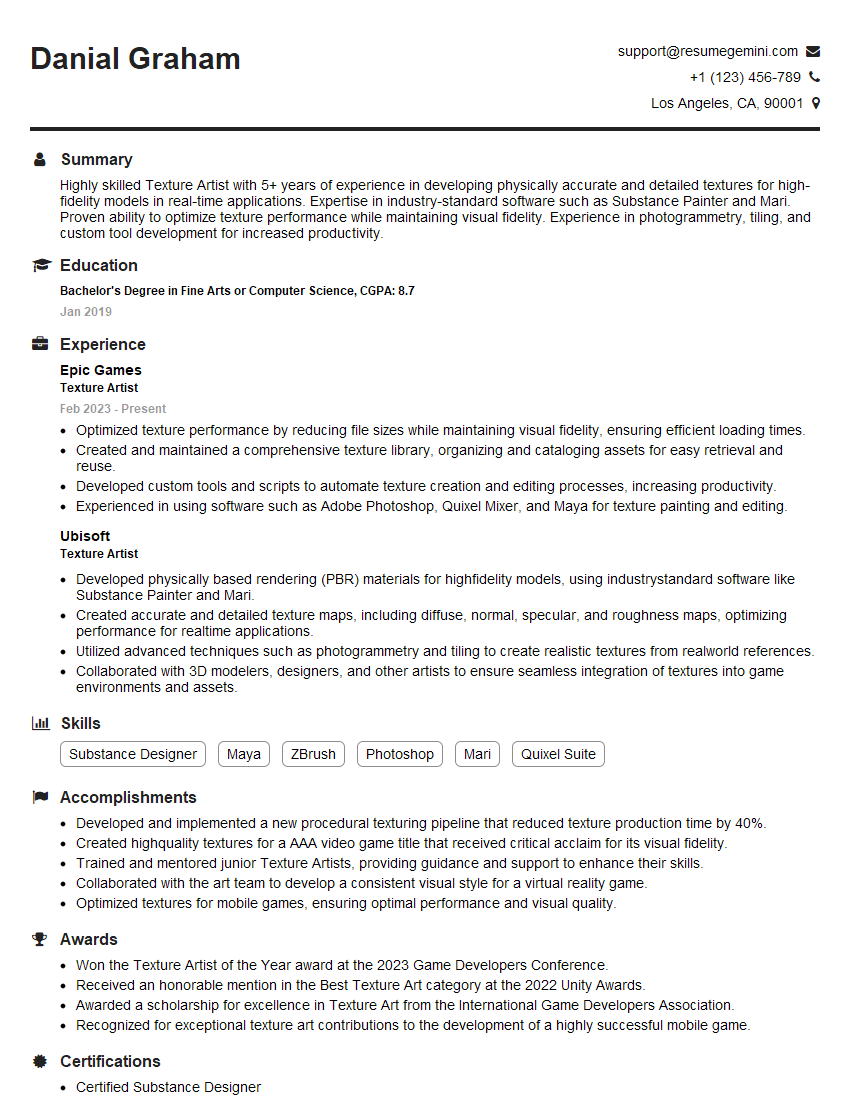
Mastering texturing in Substance Painter and Mari is crucial for career advancement in the game, film, and VFX industries. These skills are highly sought after, opening doors to exciting opportunities and higher earning potential. To maximize your job prospects, focus on building an ATS-friendly resume that effectively highlights your technical skills and accomplishments. ResumeGemini is a trusted resource to help you craft a professional and impactful resume that stands out from the competition. Examples of resumes tailored to Texturing (Substance Painter, Mari) professionals are available to further assist you in this process.
Explore more articles
Users Rating of Our Blogs
Share Your Experience
We value your feedback! Please rate our content and share your thoughts (optional).
What Readers Say About Our Blog
Very informative content, great job.
good